Rapid Strength Concrete Market Size and Share
Market Overview
| Study Period | 2020 - 2031 |
|---|---|
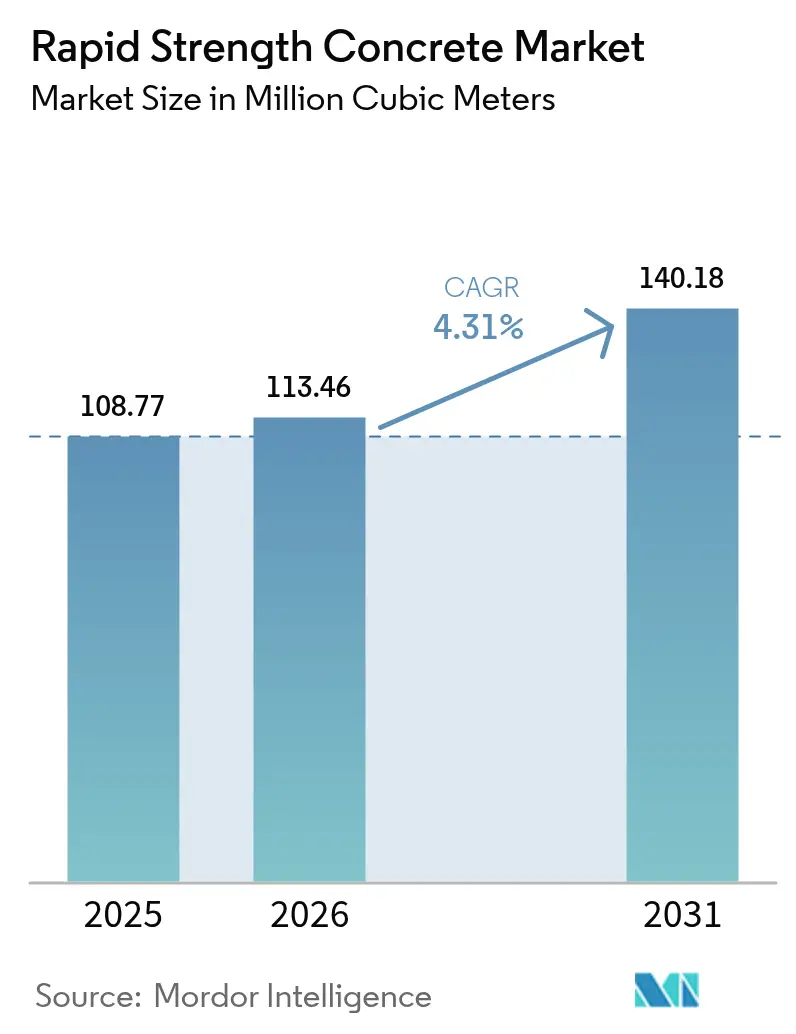
| Market Volume (2026) | 113.46 Million cubic meters |
| Market Volume (2031) | 140.18 Million cubic meters |
| Growth Rate (2026 - 2031) | 4.31 % |
| Fastest Growing Market | Asia Pacific |
| Largest Market | Asia Pacific |
| Market Concentration | Medium |
Major Players *Disclaimer: Major Players sorted in no particular order Image © Mordor Intelligence. Reuse requires attribution under CC BY 4.0. | |
Rapid Strength Concrete Market Analysis by Mordor Intelligence
The Rapid Strength Concrete Market size is expected to grow from 108.77 million cubic meters in 2025 to 113.46 million cubic meters in 2026 and is forecast to reach 140.18 million cubic meters by 2031 at 4.31% CAGR over 2026-2031. Robust public-sector stimulus, surging urban redevelopment, and the need to slash project timelines are propelling adoption, while artificial-intelligence-enabled batching systems cut waste and improve curing efficiency. Government programs in the United States, China, and the Middle East are channeling capital toward time-critical infrastructure, and 3D printing solutions that require rapid early-age strength are opening fresh revenue streams. Asia-Pacific leads global demand thanks to mega-projects and urbanization, whereas North America and Europe emphasize life-cycle cost savings and sustainability. Competitive dynamics remain moderate, yet digital quality control, low-carbon binders, and ultra-high-performance mixes are creating clear differentiation levers for both incumbents and new entrants.
Key Report Takeaways
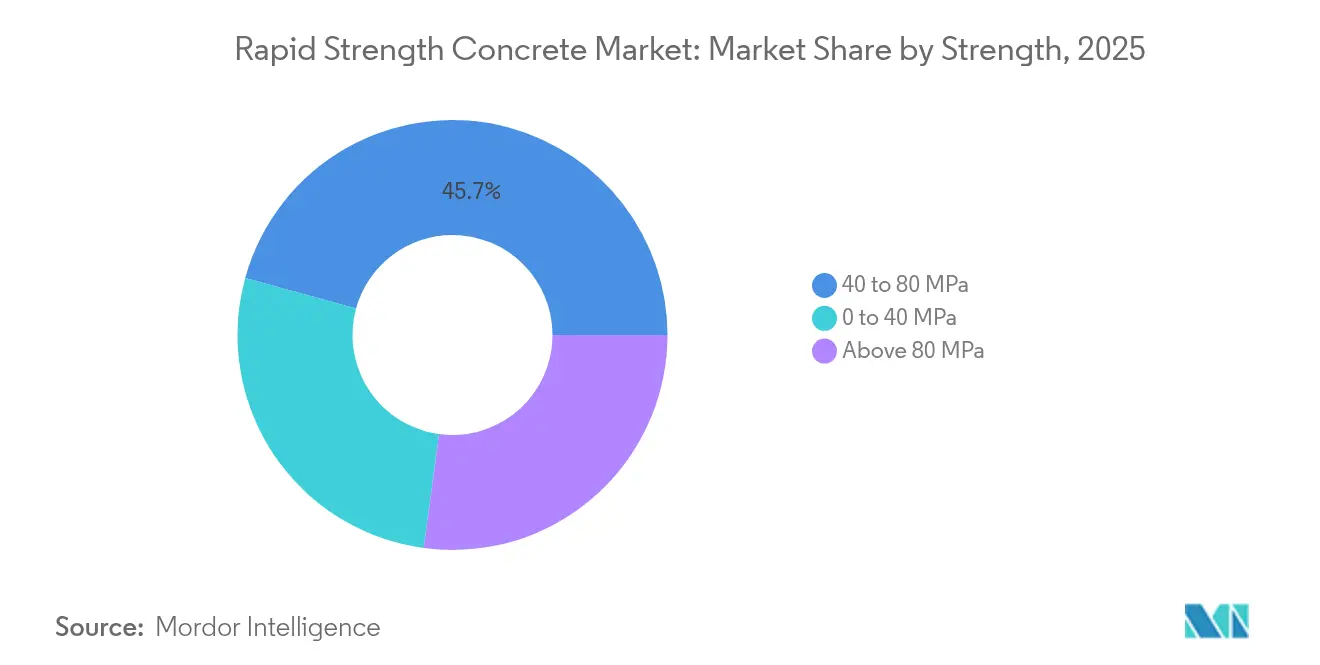
- By strength, the 40-80 MPa segment held 45.72% of the rapid strength concrete market share in 2025. The above-80 MPa bracket is projected to advance at a 5.29% CAGR between 2026 and 2031.
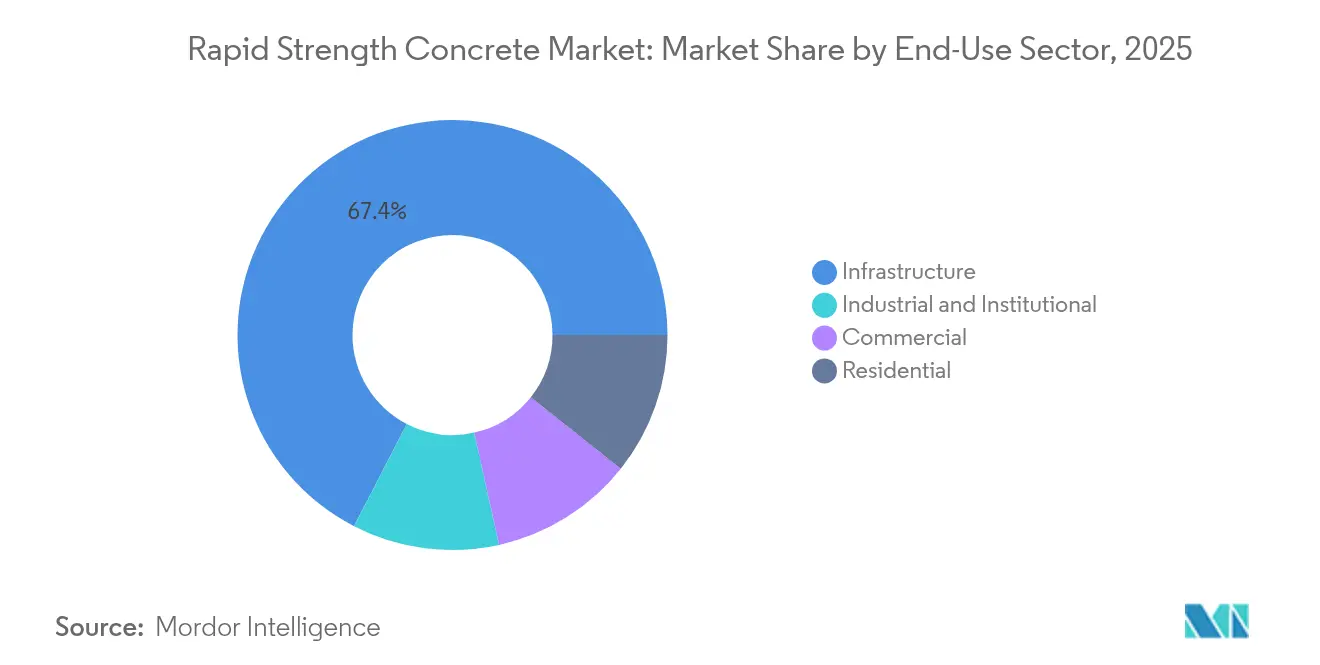
- By end-use sector, infrastructure captured 67.43% of the rapid-strength concrete market size in 2025. Industrial and institutional projects are expected to log the fastest 5.83% CAGR through 2031.
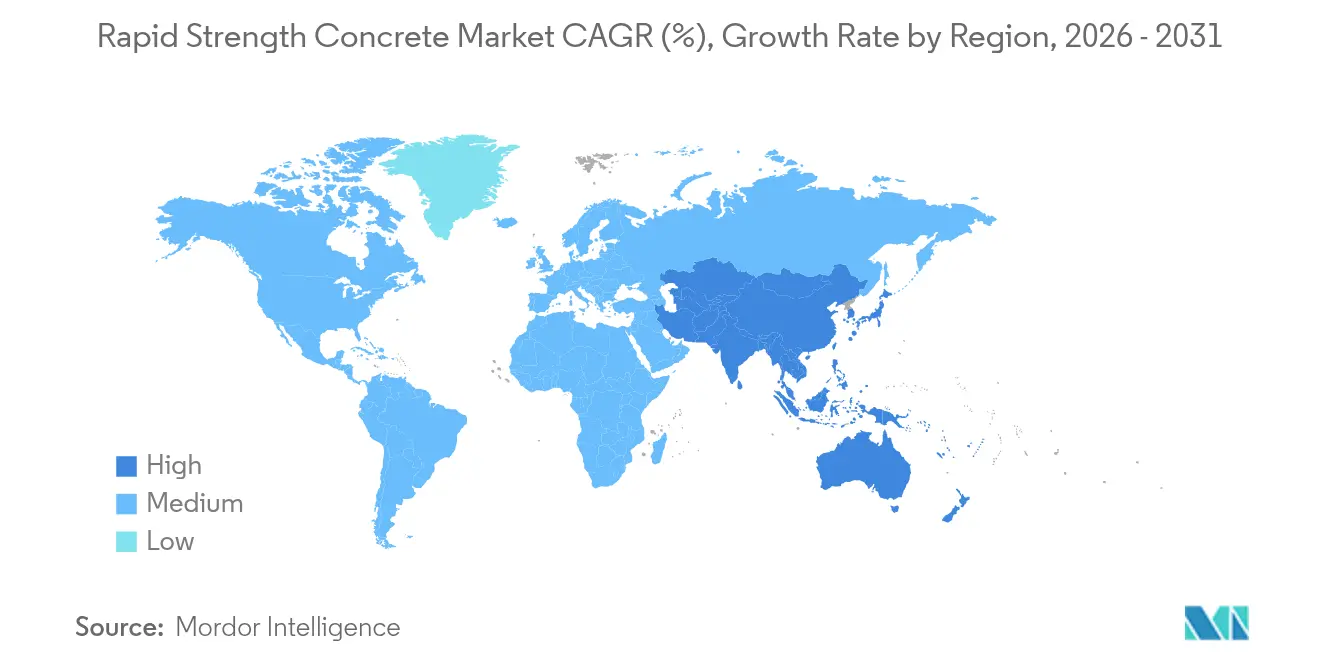
- By geography, Asia-Pacific commanded 44.12% of global volume in 2025, while the region is forecast to post a 4.39% CAGR to 2031.
Note: Market size and forecast figures in this report are generated using Mordor Intelligence’s proprietary estimation framework, updated with the latest available data and insights as of 2026.
Market Trends and Insights
Drivers Impact Analysis of Rapid Strength Concrete Market*
| Drivers | (~) % Impact on CAGR Forecast | Geographic Relevance | Impact Timeline |
|---|---|---|---|
| Government-funded infrastructure stimulus packages | +1.2% | Global, strongest in North America and APAC | Medium term (2-4 years) |
| Adoption of rapid-setting mixes in precast and 3-D printed components | +0.8% | Global, concentrated in developed markets | Short term (≤ 2 years) |
| High-rise and mixed-use urban redevelopment | +0.7% | APAC core, spill-over to MEA | Long term (≥ 4 years) |
| Life-cycle cost savings over conventional concrete | +0.5% | North America and EU primarily | Medium term (2-4 years) |
| AI-optimised batching systems cutting waste and curing time | +0.3% | Developed markets, gradual APAC adoption | Long term (≥ 4 years) |
| Military demand for expeditionary repair materials | +0.2% | North America, select EU markets | Short term (≤ 2 years) |
| Source: Mordor Intelligence | |||
Government-funded infrastructure stimulus packages drive market expansion
More than USD 2 trillion in global public-sector outlays earmark accelerated project delivery, and rapid strength concrete trims construction cycles by 30-50%, lowering user disruption and contractor overhead. The U.S. Infrastructure Investment and Jobs Act alone directed USD 6 billion to schemes requiring materials that meet strict speed-to-service criteria. China’s record 2024 infrastructure spending mirrored this momentum, spearheading adoption across highways, bridges, and grid upgrades. Procurement frameworks now mandate life-cycle cost analysis, a methodology that consistently favors rapid-strength mixes even with premium unit prices. As a result, suppliers that align portfolios with stimulus-funded specifications stand to secure multi-year volume visibility.
Adoption of rapid-setting mixes in precast and 3D-printed components
Digital construction is reshaping demand patterns by pairing automated production with concrete that gains structural capacity within hours. Research teams at PolyU demonstrated printed elements hitting 79 MPa compressive strength the same day, enabling on-site installation the next morning[1]. Precast plants switching to calcium sulfoaluminate binders shorten demolding windows from 24 hours to 6 hours, boosting throughput by up to 60%. Patent filings covering rapid carbonation and micro-fiber dosing rose sharply in 2024, underscoring a wave of research and development aimed at balancing flowability with swift set times. For contractors, such mixes synchronize batch production with just-in-time logistics while slashing storage costs.
High-rise and mixed-use urban redevelopment
Vertical construction in dense metro corridors increasingly specifies rapid strength concrete to minimize neighborhood disturbance and shrink schedule-driven cost overruns. NEOM’s THE LINE project requires over 20,000 m³ daily of specialized material produced at an on-site factory. Across Asia-Pacific, towers exceeding 300 meters rely on sequential floor pours every 24 hours, a cadence achievable only with early-strength mixes that meet stringent structural safety within a day. Mixed-use sites further leverage the technology to open retail podiums months ahead of final completion, generating early rental income for developers.
Life-cycle cost savings over conventional concrete
Federal Highway Administration studies revealed a 4:1 economic advantage when user delay costs are folded into total project economics, with rapid strength concrete overlays outlasting standard repairs while restoring traffic sooner. Ultra-high-performance variants push service life toward 80 years, extending maintenance cycles and trimming public-sector budget pressure. Productivity gains of up to 95% in comparative trials translate into reduced equipment rental and labor expenditure, strengthening the investment case for owners that manage critical infrastructure assets.
Restraints Impact Analysis of Rapid Strength Concrete Market*
| Restraints | (~) % Impact on CAGR Forecast | Geographic Relevance | Impact Timeline |
|---|---|---|---|
| Premium pricing versus OPC deters budget-constrained contractors | -0.9% | Global, strongest impact in emerging markets | Medium term (2-4 years) |
| Variable on-site workmanship causing performance scatter | -0.6% | Global, concentrated in markets with limited QC infrastructure | Long term (≥ 4 years) |
| Scarcity of CSA clinker in some regions | -0.4% | Regional, primarily affecting specialized applications | Short term (≤ 2 years) |
| Source: Mordor Intelligence | |||
Premium pricing versus OPC deters budget-constrained contractors
Rapid strength concrete costs 40-80% more per cubic meter than ordinary Portland cement mixes, an obstacle in low-margin residential or small commercial work. Contractors focused on bid competitiveness often overlook life-cycle economics, particularly where labor is inexpensive and schedule compression yields limited savings. Regional price disparities compound the issue, with emerging markets exhibiting elevated sensitivity. Even so, procurement mandates that incorporate user delay costs are shifting the conversation toward value-based decisions.
Variable on-site workmanship causing performance scatter
Unlike conventional concrete with generous placement windows, rapid strength mixes demand tight control over batching, delivery, and finishing. Inexperienced crews risk premature set or inadequate compaction, leading to early-age strength shortfalls that erode specifier confidence. Standardized training and maturity testing protocols remain sparse outside major urban hubs, causing project-to-project variability in delivered performance. Industry associations are responding with certification programs designed to lift quality benchmarks and reduce variability across job sites.
*Our forecasts treat driver/restraint impacts as directional, not additive. The impact forecasts reflect baseline growth, mix effects, and variable interactions.
Rapid Strength Concrete Market Segment Analysis
By Strength:
Ultra-high performance segment accelerates growthThe 40-80 MPa band accounted for 45.72% of the rapid strength concrete market share in 2025, serving mainstream high-rise and industrial foundations that require thinner elements and faster cycle times. Performance-price parity keeps this range attractive for developers balancing cost control with structural demands. Ultra-high-performance mixes above 80 MPa, though smaller in absolute volume, lead growth at a 5.29% CAGR as defense, data center, and super-tall projects specify compressive strengths beyond 150 MPa for security and durability. Admixture innovations such as nano-silica and hybrid fiber blends enable these metrics without sacrificing workable pot life, a critical property for large-volume continuous pours.
Designers are also tapping the 0-40 MPa class for rapid pavement rehabilitation, utility trench backfills, and secondary structural elements where immediate reopening outweighs high ultimate strength. The rapid strength concrete market size for this lower band remains steady by supporting municipal works that demand overnight service restoration. Across all strength groups, digital sensors embedded in fresh concrete transmit in-situ data to predict readiness for subsequent construction steps, closing the feedback loop between mix design and field execution.

By End-Use Sector:
Infrastructure retains dominance amid industrial accelerationInfrastructure projects generated 67.43% of volume in 2025, underlining how roadways, bridges, and runways benefit most from materials that cure quickly and tolerate early traffic loads. For airports, mixes reaching operational capacity within six hours avoid extended flight diversions, preserving revenues for operators. Rapid-strength overlays on highways can be placed during night curfews, restoring lanes before morning rush, which slashes user time loss and fuel consumption.
Industrial and institutional demand expands at a 5.83% CAGR through 2031, propelled by factories, data centers, and hospitals that cannot afford long shutdowns. Data centers in particular require equipment plinths to accept heavy server racks within days, accelerating commissioning and revenue recognition. Military engineering programs add steady volume by deploying expeditionary formulations capable of achieving 20 MPa in 24 hours for airfield repairs, thereby restoring operational readiness rapidly. While commercial high-street developments adopt the technology for earlier tenant fit-outs, residential uptake lags due to tighter budget constraints and less pronounced schedule benefits.
Geography Analysis
APAC Rapid Strength Concrete Market
The Asia-Pacific region accounted for 44.12% of the global volume in 2025 and is projected to grow at a 4.39% CAGR through 2031, reflecting significant investments in transport corridors, smart cities, and industrial parks. China anchors the region’s demand curve, with provincial governments driving the rollout of highways and metros that favor rapid turnarounds. India’s cement majors have pledged new capacity over the next four years, adding significant clinker and grinding assets that can be pivoted toward rapid-strength blends. Research hubs in Hong Kong and Singapore fast-track 3D printing mix designs, helping regional contractors leapfrog traditional methods.
North America and Europe Rapid Strength Concrete Market
North America and Europe's growth is sustained by infrastructure modernization and stringent life-cycle performance criteria. The United States reserved USD 6 billion for grid hardening projects that specify materials with quick-curing profiles to limit service disruptions. European Union initiatives on decarbonization are steering clients toward performance-based standards that reward higher durability and lower embodied carbon, a proposition well aligned with rapid-strength formulations. NATO defense budgets also spur specialized demand for expeditionary applications that must reach design strength under austere conditions.
MEA and South America Rapid Strength Concrete Market
The Middle East and Africa are emerging as hot spots, led by mega-projects such as NEOM, where an on-site factory produces 20,000 m³ daily of rapid-setting product with integrated carbon capture. In South America, Brazilian producer Votorantim Cimentos has earmarked BRL 5 billion for a 10% capacity increase, a move expected to unlock additional supply to meet regional rapid-strength demand. Technology transfer, combined with the rise of urban populations, sets the stage for accelerated adoption across these developing markets.
Competitive Landscape
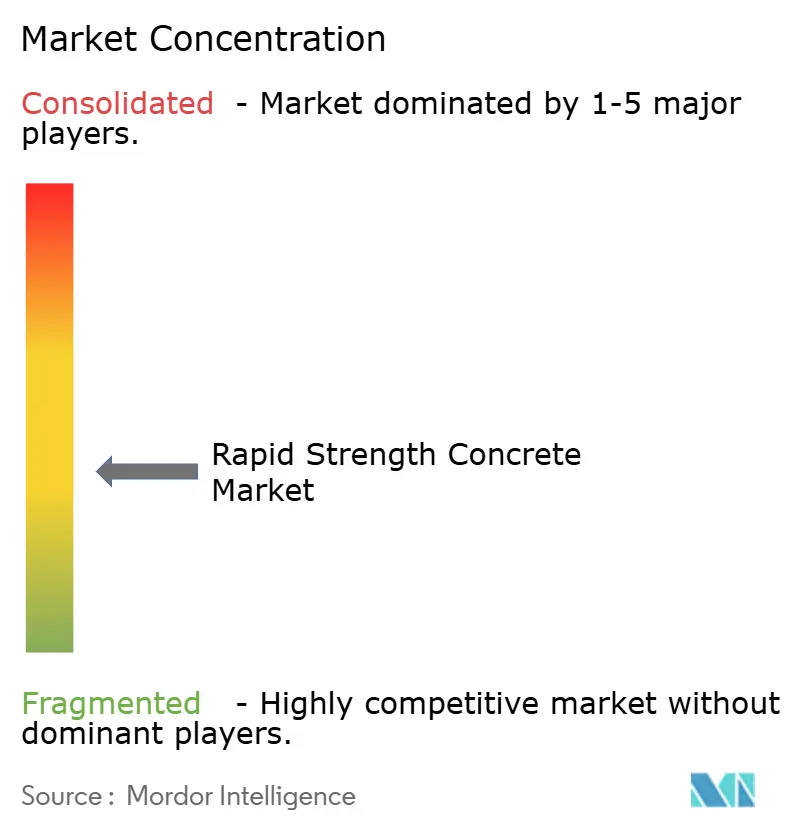
The rapid strength concrete industry is moderately concentrated, anchored by vertically integrated majors that leverage broad terminal networks and proprietary admixtures. Strategic differentiation now centers on specialty binders and low-carbon credentials. HOLCIM introduced a biochar-infused rapid-strength series that sequesters carbon without sacrificing early strength, carving a green niche in premium segments[2]. Start-ups focused on geopolymer systems and printable mortars are challenging incumbents by offering zero-clinker alternatives. Meanwhile, joint ventures between admixture specialists and 3D printer manufacturers are racing to certify plug-and-play materials that integrate machine parameters with concrete rheology, minimizing trial cycles for contractors. Regional challengers are investing in process automation and smart batching to match the consistency of global leaders.
Rapid Strength Concrete Industry Leaders
-
HOLCIM
-
Heidelberg Materials
-
CRH plc
-
CEMEX S.A.B. de C.V.
-
UltraTech Cement Ltd.
- *Disclaimer: Major Players sorted in no particular order
Rapid Strength Concrete Market Companies Covered in this Report
- Breedon Group plc
- Buzzi Unicem SpA
- CEMEX S.A.B. de C.V.
- CRH plc
- Heidelberg Materials
- HOLCIM
- SAMPYO GROUP
- Thomas Concrete Group
- UltraTech Cement Ltd.
- Vicat SA
- Vulcan Materials Company
- Westbuild
Recent Industry Developments in Rapid Strength Concrete Market
- May 2025: HOLCIM, in collaboration with ELEMENTAL, introduced a novel biochar-based technology that enables concrete to function as a carbon sink. This innovation integrates biochar, significantly reducing CO₂ emissions without compromising performance.
- December 2023: CEMEX S.A.B. de C.V. announced supplying 350,000 cubic meters of concrete, including 280,000 cubic meters of high-strength, accelerated-setting concrete, for Bogotá’s First Metro Line. The company’s proprietary mix achieves double the strength of conventional concrete within just 11 hours, significantly expediting construction timelines.
Global Rapid Strength Concrete Market Report Scope
Commercial, Industrial and Institutional, Infrastructure, Residential are covered as segments by End Use Sector. Asia-Pacific, Europe, Middle East and Africa, North America, South America are covered as segments by Region.| 0–40 MPa |
| 40–80 MPa |
| Above 80 MPa |
| Commercial |
| Industrial and Institutional |
| Infrastructure |
| Residential |
| Asia-Pacific | China |
| India | |
| Japan | |
| South Korea | |
| Australia | |
| Indonesia | |
| Vietnam | |
| Rest of Asia-Pacific | |
| North America | United States |
| Canada | |
| Mexico | |
| Europe | Germany |
| France | |
| United Kingdom | |
| Italy | |
| Spain | |
| Russia | |
| Rest of Europe | |
| South America | Brazil |
| Argentina | |
| Rest of South America | |
| Middle-East and Africa | Saudi Arabia |
| United Arab Emirates | |
| Rest of Middle-East and Africa |
| By Strength | 0–40 MPa | |
| 40–80 MPa | ||
| Above 80 MPa | ||
| By End-Use Sector | Commercial | |
| Industrial and Institutional | ||
| Infrastructure | ||
| Residential | ||
| By Region | Asia-Pacific | China |
| India | ||
| Japan | ||
| South Korea | ||
| Australia | ||
| Indonesia | ||
| Vietnam | ||
| Rest of Asia-Pacific | ||
| North America | United States | |
| Canada | ||
| Mexico | ||
| Europe | Germany | |
| France | ||
| United Kingdom | ||
| Italy | ||
| Spain | ||
| Russia | ||
| Rest of Europe | ||
| South America | Brazil | |
| Argentina | ||
| Rest of South America | ||
| Middle-East and Africa | Saudi Arabia | |
| United Arab Emirates | ||
| Rest of Middle-East and Africa | ||
Market Definition
- END-USE SECTOR - Rapid strength concrete consumed in the construction sectors such as commercial, residential, industrial, institutional, and infrastructure are considered under the scope of the study.
- PRODUCT/APPLICATION - Under the scope of the study, the consumption of rapid-strength concrete for road repairs, internal/external paving, cold store floors, fast track projects, structural repairs, and tidal construction among others are considered.
| Keyword | Definition |
|---|---|
| Accelerator | Accelerators are admixtures used to fasten the setting time of concrete by increasing the initial rate and speeding up the chemical reaction between cement and the mixing water. These are used to harden and increase the strength of concrete quickly. |
| Acrylic | This synthetic resin is a derivative of acrylic acid. It forms a smooth surface and is mainly used for various indoor applications. The material can also be used for outdoor applications with a special formulation. |
| Adhesives | Adhesives are bonding agents used to join materials by gluing. Adhesives can be used in construction for many applications, such as carpet laying, ceramic tiles, countertop lamination, etc. |
| Air Entraining Admixture | Air-entraining admixtures are used to improve the performance and durability of concrete. Once added, they create uniformly distributed small air bubbles to impart enhanced properties to the fresh and hardened concrete. |
| Alkyd | Alkyds are used in solvent-based paints such as construction and automotive paints, traffic paints, flooring resins, protective coatings for concrete, etc. Alkyd resins are formed by the reaction of an oil (fatty acid), a polyunsaturated alcohol (Polyol), and a polyunsaturated acid or anhydride. |
| Anchors and Grouts | Anchors and grouts are construction chemicals that stabilize and improve the strength and durability of foundations and structures like buildings, bridges, dams, etc. |
| Cementitious Fixing | Cementitious fixing is a process in which a cement-based grout is pumped under pressure to fill forms, voids, and cracks. It can be used in several settings, including bridges, marine applications, dams, and rock anchors. |
| Commercial Construction | Commercial construction comprises new construction of warehouses, malls, shops, offices, hotels, restaurants, cinemas, theatres, etc. |
| Concrete Admixtures | Concrete admixtures comprise water reducers, air entrainers, retarders, accelerators, superplasticizers, etc., added to concrete before or during mixing to modify its properties. |
| Concrete Protective Coatings | To provide specific protection, such as anti-carbonation or chemical resistance, a film-forming protective coat can be applied on the surface. Depending on the applications, different resins like epoxy, polyurethane, and acrylic can be used for concrete protective coatings. |
| Curing Compounds | Curing compounds are used to cure the surface of concrete structures, including columns, beams, slabs, and others. These curing compounds keep the moisture inside the concrete to give maximum strength and durability. |
| Epoxy | Epoxy is known for its strong adhesive qualities, making it a versatile product in many industries. It resists heat and chemical applications, making it an ideal product for anyone needing a stronghold under pressure. It is widely used in adhesives, electrical and electronics, paints, etc. |
| Fiber Wrapping Systems | Fiber Wrapping Systems are a part of construction repair and rehabilitation chemicals. It involves the strengthening of existing structures by wrapping structural members like beams and columns with glass or carbon fiber sheets. |
| Flooring Resins | Flooring resins are synthetic materials applied to floors to enhance their appearance, increase their resistance to wear and tear or provide protection from chemicals, moisture, and stains. Depending on the desired properties and the specific application, flooring resins are available in distinct types, such as epoxy, polyurethane, and acrylic. |
| High-Range Water Reducer (Super Plasticizer) | High-range water reducers are a type of concrete admixture that provides enhanced and improved properties when added to concrete. These are also called superplasticizers and are used to decrease the water-to-cement ratio in concrete. |
| Hot Melt Adhesives | Hot-melt adhesives are thermoplastic bonding materials applied as melts that achieve a solid state and resultant strength on cooling. They are commonly used for packaging, coatings, sanitary products, and tapes. |
| Industrial and Institutional Construction | Industrial and institutional construction includes new construction of hospitals, schools, manufacturing units, energy and power plants, etc. |
| Infrastructure Construction | Infrastructure construction includes new construction of railways, roads, seaways, airports, bridges, highways, etc. |
| Injection Grouting | The process of injecting grout into open joints, cracks, voids, or honeycombs in concrete or masonry structural members is known as injection grouting. It offers several benefits, such as strengthening a structure and preventing water infiltration. |
| Liquid-Applied Waterproofing Membranes | Liquid-Applied membrane is a monolithic, fully bonded, liquid-based coating suitable for many waterproofing applications. The coating cures to form a rubber-like elastomeric waterproof membrane and may be applied over many substrates, including asphalt, bitumen, and concrete. |
| Micro-concrete Mortars | Micro-concrete mortar is made up of cement, water-based resin, additives, mineral pigments, and polymers and can be applied on both horizontal and vertical surfaces. It can be used to refurbish residential complexes, commercial spaces, etc. |
| Modified Mortars | Modified Mortars include Portland cement and sand along with latex/polymer additives. The additives increase adhesion, strength, and shock resistance while also reducing water absorption. |
| Mold Release Agents | Mold release agents are sprayed or coated on the surface of molds to prevent a substrate from bonding to a molding surface. Several types of mold release agents, including silicone, lubricant, wax, fluorocarbons, and others, are used based on the type of substrates, including metals, steel, wood, rubber, plastic, and others. |
| Polyaspartic | Polyaspartic is a subset of polyurea. Polyaspartic floor coatings are typically two-part systems that consist of a resin and a catalyst to ease the curing process. It offers high durability and can withstand harsh environments. |
| Polyurethane | Polyurethane is a plastic material that exists in various forms. It can be tailored to be either rigid or flexible and is the material of choice for a broad range of end-user applications, such as adhesives, coatings, building insulation, etc. |
| Reactive Adhesives | A reactive adhesive is made of monomers that react in the adhesive curing process and do not evaporate from the film during use. Instead, these volatile components become chemically incorporated into the adhesive. |
| Rebar Protectors | In concrete structures, rebar is one of the important components, and its deterioration due to corrosion is a major issue that affects the safety, durability, and life span of buildings and structures. For this reason, rebar protectors are used to protect against degrading effects, especially in infrastructure and industrial construction. |
| Repair and Rehabilitation Chemicals | Repair and Rehabilitation Chemicals include repair mortars, injection grouting materials, fiber wrapping systems, micro-concrete mortars, etc., used to repair and restore existing buildings and structures. |
| Residential Construction | Residential construction involves constructing new houses or spaces like condominiums, villas, and landed homes. |
| Resin Fixing | The process of using resins like epoxy and polyurethane for grouting applications is called resin fixing. Resin fixing offers several advantages, such as high compressive and tensile strength, negligible shrinkage, and greater chemical resistance compared to cementitious fixing. |
| Retarder | Retarders are admixtures used to slow down the setting time of concrete. These are usually added with a dosage rate of around 0.2% -0.6% by weight of cement. These admixtures slow down hydration or lower the rate at which water penetrates the cement particles by making concrete workable for a long time. |
| Sealants | A sealant is a viscous material that has little or no flow qualities, which causes it to remain on surfaces where they are applied. Sealants can also be thinner, enabling penetration to a certain substance through capillary action. |
| Sheet Waterproofing Membranes | Sheet membrane systems are reliable and durable thermoplastic waterproofing solutions that are used for waterproofing applications even in the most demanding below-ground structures, including those exposed to highly aggressive ground conditions and stress. |
| Shrinkage Reducing Admixture | Shrinkage-reducing admixtures are used to reduce concrete shrinkage, whether from drying or self-desiccation. |
| Silicone | Silicone is a polymer that contains silicon combined with carbon, hydrogen, oxygen, and, in some cases, other elements. It is an inert synthetic compound that comes in various forms, such as oil, rubber, and resin. Due to its heat-resistant properties, it finds applications in sealants, adhesives, lubricants, etc. |
| Solvent-borne Adhesives | Solvent-borne adhesives are mixtures of solvents and thermoplastic or slightly cross-linked polymers such as polychloroprene, polyurethane, acrylic, silicone, and natural and synthetic rubbers. |
| Surface Treatment Chemicals | Surface treatment chemicals are chemicals used to treat concrete surfaces, including roofs, vertical surfaces, and others. They act as curing compounds, demolding agents, rust removers, and others. They are cost-effective and can be used on roadways, pavements, parking lots, and others. |
| Viscosity Modifier | Viscosity Modifiers are concrete admixtures used to change various properties of admixtures, including viscosity, workability, cohesiveness, and others. These are usually added with a dosage of around 0.01% to 0.1% by weight of cement. |
| Water Reducer | Water reducers, also called plasticizers, are a type of admixture used to decrease the water-to-cement ratio in the concrete, thereby increasing the durability and strength of concrete. Various water reducers include refined lignosulfonates, gluconates, hydroxycarboxylic acids, sugar acids, and others. |
| Water-borne Adhesives | Water-borne adhesives use water as a carrier or diluting medium to disperse resin. They are set by allowing the water to evaporate or be absorbed by the substrate. These adhesives are compounded with water as a dilutant rather than a volatile organic solvent. |
| Waterproofing Chemicals | Waterproofing chemicals are designed to protect a surface from the perils of leakage. A waterproofing chemical is a protective coating or primer applied to a structure's roof, retaining walls, or basement. |
| Waterproofing Membranes | Waterproofing membranes are liquid-applied or self-adhering layers of water-tight materials that prevent water from penetrating or damaging a structure when applied to roofs, walls, foundations, basements, bathrooms, and other areas exposed to moisture or water. |
Research Methodology
Mordor Intelligence follows a four-step methodology in all our reports.
- Step-1: Identify Key Variables: The quantifiable key variables (industry and extraneous) pertaining to the specific product segment and country are selected from a group of relevant variables & factors based on desk research & literature review; along with primary expert inputs. These variables are further confirmed through regression modeling (wherever required).
- Step-2: Build a Market Model: In order to build a robust forecasting methodology, the variables and factors identified in Step-1 are tested against available historical market numbers. Through an iterative process, the variables required for market forecast are set and the model is built on the basis of these variables.
- Step-3: Validate and Finalize: In this important step, all market numbers, variables and analyst calls are validated through an extensive network of primary research experts from the market studied. The respondents are selected across levels and functions to generate a holistic picture of the market studied.
- Step-4: Research Outputs: Syndicated Reports, Custom Consulting Assignments, Databases & Subscription Platforms