
UK Facade Market Size and Share
Market Overview
| Study Period | 2020 - 2031 |
|---|---|
| Forecast Data Period | 2026 - 2031 |
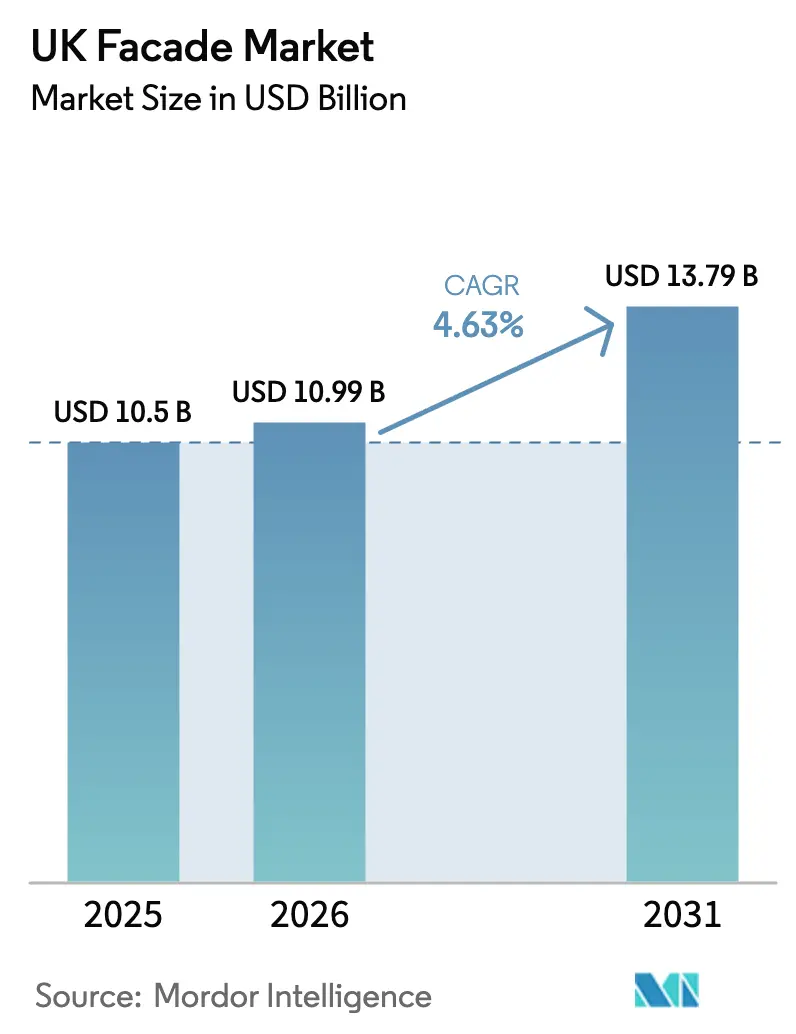
| Base Year Market Size (2025) | USD 10.5 Billion |
| Market Size (2026) | USD 10.99 Billion |
| Market Size (2031) | USD 13.79 Billion |
| Growth Rate (2026 - 2031) | 4.63 % |
| Market Concentration | Medium |
Major Players *Disclaimer: Major Players sorted in no particular order Image © Mordor Intelligence. Reuse requires attribution under CC BY 4.0. | |
UK Facade Market Analysis by Mordor Intelligence
UK façade market size in 2026 is estimated at USD 10.99 billion, growing from 2025 value of USD 10.5 billion with 2031 projections showing USD 13.79 billion, growing at 4.63% CAGR over 2026-2031. Rapid post-Grenfell safety reforms, net-zero envelope mandates, and mounting demand from the data-center construction pipeline underpin growth. Developers now prioritize non-combustible, thermally efficient façades over upfront cost savings, while extended VAT relief on energy-saving materials is accelerating the adoption of building-integrated photovoltaics (BIPV). England leads spending but Wales is the fastest-growing geography on the back of large mixed-use schemes in Cardiff. Competitive dynamics have shifted toward compliance credentials, with Saint-Gobain’s USD 815 million takeover of OVNIVER and Kingspan’s insulation push illustrating vertical-integration plays. At the same time, a shortage of 251,500 construction workers by 2028 is catalyzing modular off-site façades that lower on-site labor intensity[1]
Key Report Takeaways
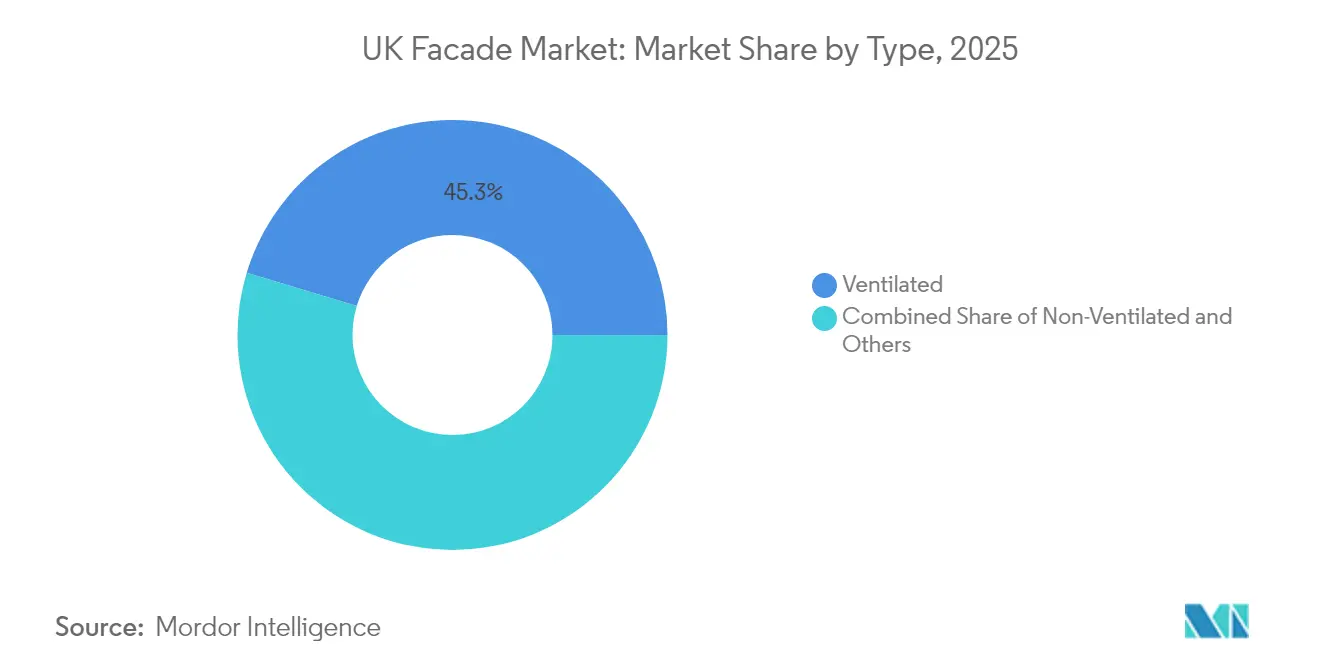
- By façade type, ventilated systems captured 45.32% of the UK façade market share in 2025 and are expanding at a 7.65% CAGR between 2026-2031.
- By system configuration, rainscreen cladding led with 32.74% revenue in 2025, while unitised curtain walls are the fastest-growing at 8.47% CAGR between 2026-2031.
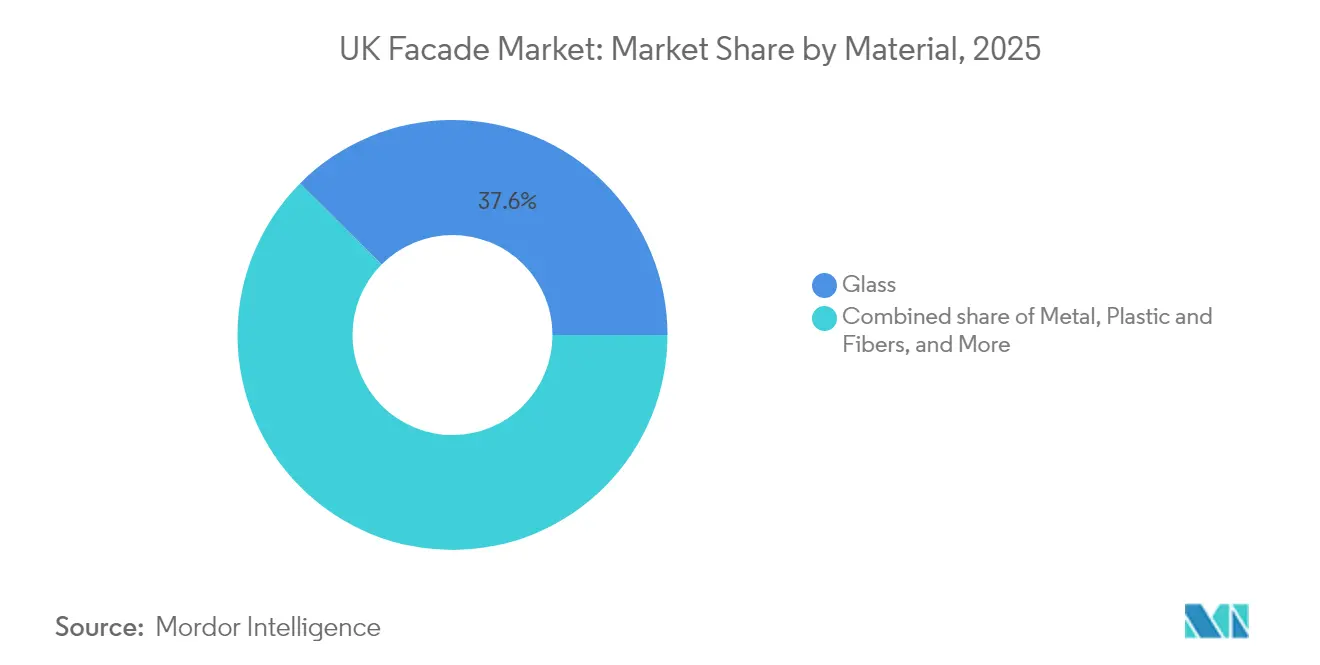
- By material, glass held a 37.55% share of the UK façade market size in 2025; Other Segment is advancing at 12.1% annually, buoyed by VAT exemptions effective until March 2027.
- By installation, renovation, and retrofit applications are growing at 8.66% CAGR versus 60.35% share for new-build projects in 2025, propelled by London’s “Retrofit First” policy.
- By end-user, commercial buildings commanded 53.22% of the UK façade market in 2025, with data-center demand pushing the segment at a 6.98% CAGR between 2026-2031.
Note: Market size and forecast figures in this report are generated using Mordor Intelligence’s proprietary estimation framework, updated with the latest available data and insights as of 2026.
Market Trends and Insights
Drivers Impact Analysis of UK Facade Market*
| Driver | % Impact on CAGR Forecast | Geographic Relevance | Impact Timeline |
|---|---|---|---|
| Post-Grenfell recladding surge | +1.2% | England core, spill-over to Wales, Scotland | Medium term (2-4 years) |
| Net-zero 2050 envelope mandates | +0.8% | Global | Long term (≥ 4 years) |
| Modular off-site build adoption | +0.6% | England, Scotland | Medium term (2-4 years) |
| Data-centre build boom | +0.5% | England core, selective Scotland sites | Short term (≤ 2 years) |
| VAT relief energising BIPV façades | +0.4% | England, Wales, Scotland | Short term (≤ 2 years) |
| London "Retrofit First" policy | +0.2% | London, selective England metros | Medium term (2-4 years) |
| Source: Mordor Intelligence | |||
Post-Grenfell Recladding Surge
The Building Safety Act 2022 identified 5,052 residential blocks over 11 meters with unsafe cladding as of April 2025, with 2,477 already undergoing remediation [2]. First-tier Tribunal rulings now deem even “medium” fire-risk ratings unacceptable, broadening liability exposure. Insurers are excluding combustible façades, effectively mandating A1-rated systems. VAT deductions on remediation work further lower upgrade costs. Established suppliers with certified, non-combustible portfolios are therefore capturing outsized demand.
Net-Zero 2050 Envelope Mandates
The Future Homes Standard, due in 2025, requires steep cuts in operational carbon, while London obliges whole-life carbon assessments for schemes above 1,000 m². Research shows glass accounts for up to 60% of façade embodied carbon, prompting manufacturers to develop high-recycled-content glazing.[3] Government recognition of data centers as nationally significant infrastructure is shortening planning timelines but tightening energy-performance criteria. Public-sector BREEAM “Excellent” thresholds now hinge on façade decarbonization, illustrated by Cardiff’s Velindre Cancer Centre.
Modular Off-Site Build Adoption
Government studies highlight that volumetric modular delivery, when coupled with early Design-for-Manufacture decisions, mitigates quality risks and speeds completion. Labor shortages—251,500 extra workers needed by 2028—make factory-built façades attractive. High-rise automation research confirms improved geometric tolerances and connection robustness for façade modules. Data-center developers are leading adoption because the approach compresses delivery schedules without compromising performance.[4]
Data-Center Build Boom
England’s technology corridors host a GBP 10 billion (USD 13 billion) AI campus at Blyth and a GBP 3.75 billion (USD 5.06 billion) hyperscale site in Hertfordshire, both requiring high-performance façades capable of managing elevated heat loads. European data-center demand is set to expand grid power needs by 160% by 2030, intensifying the call for energy-efficient envelopes. Façade systems now integrate smart shading and passive cooling features to control internal temperatures while meeting stringent PUE targets. Edge-computing roll-outs are also spurring retrofit solutions that slot into existing urban shells.
Restraints Impact Analysis of UK Facade Market*
| Restraint | % Impact on CAGR Forecast | Geographic Relevance | Impact Timeline |
|---|---|---|---|
| Aluminium & glass price volatility | -0.7% | Global | Short term (≤ 2 years) |
| Shortage of certified façade labour | -0.5% | England core, Scotland, Wales | Medium term (2-4 years) |
| Insurance exclusions for combustible systems | -0.3% | England, Wales, Scotland | Short term (≤ 2 years) |
| Embodied-carbon caps (London Plan) | -0.2% | London, selective England metros | Long term (≥ 4 years) |
| Source: Mordor Intelligence | |||
Aluminium & Glass Price Volatility
Energy-intensive aluminium smelting faces shifting supply dynamics and geopolitical trade risks that filter through to façade budgets. UK construction material indices recorded a 2.0% year-on-year decline as of June 2024, yet spot prices remain unstable, complicating cost planning for long-lead façade contracts. Flat-glass producers are investing in automation to curb unplanned downtime that can top GBP 1 million (USD 1.3501 million) per minute.
Shortage of Certified Façade Labor
Only 60,000 of the 251,500 additional construction workers required by 2029 will be government-funded trainees, prolonging skill shortages. Façade installers must now evidence competency under Building Safety Act regulations, narrowing the available talent pool. Heat-pump engineering shortfalls underscore the wider scarcity of building-envelope skills. Prefabricated, unitised systems that reduce on-site labor are therefore winning specification priority.
*Our forecasts treat driver/restraint impacts as directional, not additive. The impact forecasts reflect baseline growth, mix effects, and variable interactions.
UK Facade Market Segment Analysis
By Type:
Ventilated Systems Drive Performance InnovationVentilated systems accounted for 45.32% of UK façade market share in 2025, and the segment is set to grow at a 7.65% CAGR through 2031. Their cavity design limits fire propagation and enhances thermal regulation, aligning with Building Safety Act compliance and net-zero targets two priorities that now shape nearly every tender in the UK façade market. The technology is evolving toward smart modules such as seele’s ISOshade®, which uses embedded sensors and AI-driven louvers to modulate solar gain without active energy consumption. Demand is also rising for ventilated retrofits on occupied residential towers, leveraging VAT relief and insurance incentives to replace combustible cladding. As insurers tighten underwriting, developers increasingly view ventilated systems as the baseline solution rather than an upgrade.

By Façade System Type:
Unitised Innovation Challenges Rainscreen DominanceRainscreen cladding captured 32.74% of UK façade market revenue in 2025, reflecting its versatility and proven A1-rated assemblies. However, unitised curtain walls are advancing at an 8.47% CAGR to 2031, driven by factory-controlled quality and faster installation that counters labor shortages in the UK façade market. Manufacturers are blurring lines between systems; hybrid unitised-rainscreen solutions promise the aesthetic freedom of rainscreens with the speed advantages of unitised panels. CWCT-certified mock-ups are now mandatory on most high-rise projects, favoring suppliers that can test entire unitised assemblies under worst-case load scenarios. As modular builders standardize bay sizes, unitised panels are becoming the default interface.
By Material:
BIPV Glass Disrupts Traditional SpecificationsGlass held 37.55% of UK façade market size in 2025, but Other segment is expanding at 12.1% annually thanks to VAT exemptions and net-zero commitments. Vitro’s Solarvolt™ panels and Guardian-ML System solar windows capture daylight while generating up to 33 Wp/m². University of York research reports vertical bifacial arrays delivering winter power gains of 24.5%, a notable advantage for northerly latitudes. Metals maintain relevance for fire performance, while plastics face rising insurance exclusions. Developers increasingly specify low-carbon aluminium with high recycled content, pushing producers toward closed-loop supply models.
By Installation:
Retrofit Acceleration Transforms Market DynamicsNew-builds represented 60.35% of 2025 installations, yet retrofit demand is forecast to grow at 8.66% CAGR through 2031 as London’s Retrofit First mandate and whole-life-carbon caps favor building reuse. Retrofit projects are leveraging VAT deductions for remediation to finance façade upgrades. The retrofit wave requires flexible panelized systems that can interface with unknown substrate conditions and variable floor heights. Suppliers offering detailed digital surveys and parametric panelization are gaining share as clients demand minimal tenant disruption-another competitive differentiator in the UK façade market.
By End-User:
Commercial Sector Leads Innovation AdoptionCommercial buildings controlled 53.22% of UK façade market revenue in 2025 and are projected to expand at 6.98% CAGR to 2031, buoyed by hyperscale data-center projects and ESG-driven office refurbishments. Developers accept premium pricing for BIPV and intelligent façades that lower operational carbon or improve occupant well-being.
Residential demand remains volume-rich but price-sensitive; social landlords often adopt standardized ventilated panels to meet both safety and budget constraints. Industrial and institutional segments adopt niche innovations-think blast-resistant or radiation-shielding façades-but represent smaller slices of overall spend.

Geography Analysis
England generated 69.45% of UK façade market revenue in 2025, driven by London’s stringent whole-life carbon rules and high concentration of high-rise projects. Planning reforms that fast-track data centers and life-science campuses further consolidate spending in the South-East, although regional authorities adopt similar safety standards, extending compliance-driven demand across the country.
Wales delivers the fastest growth at 6.28% CAGR through 2031. Cardiff’s 50-story tower and the Velindre Cancer Centre exemplify large schemes requiring advanced façades that align with BREEAM “Excellent” ambitions. The Ffrâm24 framework, with 80% of approved suppliers local, improves supply-chain resilience for Welsh projects. Scotland maintains steady façade demand from public-realm investments such as the Dunard Centre concert hall and university expansions, albeit under tighter public-spending oversight. The Single Building Assessment pilot covering 107 blocks is expected to unlock remediation pipelines once funding is clarified. Northern Ireland records consistent but smaller volumes, with quarterly construction output stabilizing since mid-2024.
Regulatory Landscape
The UK facade market operates under tightened building-safety and energy-performance requirements shaped by post-Grenfell reforms and the Building Safety Regulator (BSR) framework. Fire safety expectations for external walls are anchored in Approved Document B (Fire Safety), updated through 2025 and 2026 amendments across both Volume 1 (dwellings) and Volume 2 (buildings other than dwellings), reinforcing scrutiny of fire spread and the quality of façade system compliance documentation.
On energy and carbon, the Future Homes and Buildings Standards (FHBS) are being implemented via The Building Regulations etc. (Amendment) (England) Regulations 2026 (S.I. 2026/335). The 2026 edition of Approved Document L reframes Part L as Energy and Greenhouse Gas Emissions and introduces new functional requirements (including L3). This lifts the importance of high-performance, low-leakage envelopes and integration with on-site renewable electricity generation in dwellings and buildings containing dwellings, increasing specification pressure on glazing, insulation, and system assemblies.
Value Chain Analysis
The UK facade value chain runs from upstream material inputs (flat glass, aluminium, insulation, sealants, and fixings) to system design and fabrication (curtain walling, rainscreens, ventilated facades, windows and doors), followed by logistics, on-site installation, testing/commissioning, and lifecycle services. System houses and large suppliers play a central role in translating regulatory and performance requirements into tested, warrantable assemblies. Market participants such as Schuco UK (facade and fenestration systems), Kingspan Insulated Panels UK (insulated panel and thermal technology), and Saint-Gobain Glass UK (flat and coated/laminated glazing solutions) span design support through product supply.
Midstream and downstream activity is coordinated by professional and trade bodies that influence competence, guidance, and technical adoption. The Society of Facade Engineering (SFE) under CIBSE supports training and knowledge-sharing for facade engineers, while the Flat Glass Manufacturers Association (FGMA) and INCA (external wall insulation) provide industry coordination around product categories central to compliance-led refurbishment and new-build envelopes. The Construction Industry Council (CIC) functions as a cross-profession forum that links standards, competency, and policy discussions, helping align designers, contractors, and manufacturers around building-safety and climate-change expectations that increasingly shape procurement.
Competitive Landscape
The UK façade market is moderately concentrated: the top five suppliers control roughly 48% of combined revenue, and recent M&A activity points toward further consolidation. Saint-Gobain’s USD 815 million OVNIVER deal expands its non-combustible product range, while Kingspan’s Steico acquisition boosts bio-based insulation capabilities. Forterro’s back-to-back software buys reveal a push toward integrated digital design-to-manufacture workflows for windows and façades.
Value propositions now hinge on third-party certification, supply-chain transparency, and service bundling (design-assist, digital twinning, and on-site quality control). Kingspan reports a 65% drop in scope 1 and 2 emissions since 2020, signaling that decarbonization credentials drive tender success. Meanwhile, mid-tier players are partnering with international system houses—Schüco’s tie-up with Skyline Windows is a case in point—to gain access to tested, code-ready assemblies. Technological differentiation centers on BIPV integration, AI-enabled shading, and prefabricated volumetric façade “cassettes” that can be installed with a fraction of traditional labor. Suppliers investing early in digital fabrication and low-carbon materials are likely to expand their share as insurers and asset owners demand quantifiable performance data.
UK Facade Industry Leaders
-
Permasteelisa
-
Schüco UK
-
Kingspan Insulated Panels UK
-
Saint-Gobain Glass UK
-
AluK (GB) Ltd
- *Disclaimer: Major Players sorted in no particular order

UK Facade Market Companies Covered in this Report
- Schüco UK
- Permasteelisa UK
- Kingspan Insulated Panels UK
- Saint-Gobain Glass UK
- Reynaers Aluminium UK
- Kawneer UK
- AluK (GB) Ltd
- Senior Architectural Systems
- Yuanda Europe (UK)
- McMullen Facades
- Etex EOS Facades
- Sotech UK
- Prism Architectural
- Technal UK
- Alucraft Systems
- Vision Built UK
- Sto Ltd
- Glassolutions (Saint-Gobain)
- Fineline Aluminium
- OAG (Optima Architectural Glazing)
Market Opportunities and Future Outlook
Compliance-led retrofit and remediation remains a core opportunity for suppliers that can package certified, non-combustible systems with robust design-assist and installation support. The Building Safety Act regime and the continuing external-wall focus in Approved Document B elevate demand for traceable test evidence, competent installation, and quality assurance, creating openings for manufacturers and specialist contractors that can deliver complete system responsibility rather than component-only supply.
Decarbonization requirements are also driving demand for low-embodied-carbon materials and higher-performing envelopes that help projects meet tightening Part L expectations. The 2026 edition of Approved Document L, implemented alongside FHBS through S.I. 2026/335, increases attention on whole-envelope performance and on-site renewable integration in the residential segment, supporting adoption of solutions such as low-carbon aluminium profiles and BIPV-enabled glazing. At the sector level, governance changes toward a more consolidated construction-regulation approach, building from the BSR and government direction of travel toward a single construction regulator, increase the premium on documented compliance workflows, digital product information, and audit-ready supply chains across the facade ecosystem.
Recent Industry Developments in UK Facade Market
- June 2026: Reds10 acquired 50/50 stake in façade and cladding specialist Mad About Facades to integrate design, manufacture, and installation capability into its offsite construction model. This strengthens offsite workflow and control across design-to-install for UK facades.
- June 2026: Reds10 - Acquired 50/50 stake in façade and cladding specialist Mad About Facades to integrate design, manufacture, and installation capability into its offsite construction model. The announcement reinforces Reds10's strategic push into integrated supply chains for UK facades.
- May 2026: Staticus appointed to deliver the façade package for the 60,000 sqm Vista South Bank redevelopment in London, featuring Closed Cavity Façade technology. The appointment points to ongoing demand for premium façade systems and CCF adoption in major UK schemes.
UK Facade Market Report Scope and Research Methodology
Market Definition and Coverage
For this report, the UK facade market covers the supply and installation value of exterior building envelope systems used to protect, insulate, and finish buildings, including cladding and glazed facade solutions across new build and renovation activity.
Scope exclusions: Interior wall finishes, standalone roofing-only packages, and general structural framing are not counted unless they are sold as part of a facade system package.
Segments Covered in This Report
- By Type
- Ventilated
- Non-Ventilated
- Others
- By Facade System Type
- Rainscreen Cladding
- Curtain-Wall Systems
- Others
- By Material
- Glass
- Metal
- Plastic & Fibres
- Stone
- Others
- By Installation
- New Construction
- Renovation & Retrofit
- By End-User
- Commercial
- Residential
- Others
- By Region
- England
- Scotland
- Wales
- Northern Ireland
Data Sources, Market Sizing, and Validation
Desk Research
Desk research was used to build the base demand picture for facade activity across the United Kingdom, and to identify the main drivers that move volumes and pricing. We typically start from public construction output and building pipeline signals, then map them to facade-intensive building types.
Key public sources reviewed include official datasets and publications such as the UK Office for National Statistics (construction output and new orders), UK government planning and building safety guidance pages, the Building Cost Information Service style cost references where publicly summarized, and UK trade bodies covering glass, metal, and cladding products. We also used company annual reports, investor presentations, press releases, and curated paid subscriptions for company financials and intelligence, patents, and shipment-level import and export checks for relevant facade materials. The desk sources listed here are illustrative only, and many additional sources were consulted for data collection, validation, and clarification.
Primary Interviews and Surveys
Primary work focused on validating what gets specified and purchased in the UK, and how pricing shifts when compliance requirements, labor availability, and material mix change. We spoke with stakeholders across the value chain, including contractors, fabricators, installers, distributors, architects, and project-side procurement teams. These inputs helped tighten assumptions that are hard to infer directly from public datasets.
Because the market is country-specific, interviews were weighted toward the main UK construction hubs, while still checking differences across the devolved nations where renovation programs and commercial build cycles can vary.
Distribution of primary research fieldwork respondents
| Company type | Respondent position |
|---|---|
| Top tier: 32% | CXOs: 14% |
| Mid tier: 53% | Functional/Unit leaders: 38% |
| Smaller Players: 15% | Managers: 48% |
Market-Sizing & Forecasting
The core model is built using a top-down approach where UK construction activity and building pipeline indicators are converted into an addressable facade demand pool by building type and installation split (new construction versus renovation). Once the demand pool is formed, it is translated into value using observed system mix and pricing bands gathered from tender discussions and contractor checks.
To keep the figures realistic, totals were then corroborated with selective bottom-up approximations, such as sample project bill-of-quantities checks, supplier and installer revenue logic, and sampled average selling price times volume for common facade systems. Where company disclosures or project data was thin, gaps were handled by using peer-group ratios, installation intensity benchmarks, and conservative share-of-facade-package assumptions, which were re-tested in calls.
Forecasts were developed using scenario analysis tied to variables that materially move facade spend in the UK, including new orders and starts trends, renovation cadence linked to building safety remediation, the shift between curtain wall and rainscreen solutions by building type, material price movements for glass and metals, and labor constraints that affect installed costs. Assumptions for these drivers were stress-tested with interview feedback so the forward view remains explainable and repeatable.
Data Validation & Update Cycle
Outputs are checked through multiple steps so the final series does not rely on a single dataset or one interview stream. We compare model results against independent signals such as construction output direction, import and export patterns for key facade materials, and disclosed order books or project wins where available.
When variances look unusual, they are reviewed again at the assumption level, and follow-up calls are triggered to confirm whether the change is real or a timing issue in the data. Before sign-off, another analyst reviews the model structure, year-over-year movements, and any step changes in mix or pricing. Reports are refreshed annually, and material events can drive interim updates, followed by a final pre-delivery pass to ensure the latest public information is reflected.
Mordor Intelligence's UK Facade Market Estimate Compared With Other Published Estimates
Published market sizes for UK facades can differ even when the topic sounds the same, because the measurement boundary is not always consistent. Differences usually come from what is counted as a facade system, whether installation is included, how renovation work is treated, and the year chosen for currency conversion.
By tracking project pipeline signals, refreshing price bands during expert callbacks, and keeping the scope to facade systems only, Mordor Intelligence arrives at a value series that is not inflated by adjacent building envelope items that are often bundled in broader building materials totals.
Benchmark comparison
| Source | Market Size | Gaps in Research Methodology |
|---|---|---|
| Mordor Intelligence | USD 10.50 B (2025) | |
| Industry Press Release A | USD 11.90 B (2023) | Uses an earlier base year and does not clearly separate facade systems from broader cladding and envelope packages, which can pull in non-system components and shift the implied price level. |
| Construction Commentary B | USD 10.99 B (2026) | Anchors the estimate on a single forward year without showing the bridge from construction activity to facade addressable demand, so the mix between new build and retrofit and the installed-value treatment can differ. |
The spread across sources is mainly explained by scope boundaries, base year selection, and how installed value and retrofit remediation are counted. A model that ties UK facade demand to observable construction activity, then checks it with project and channel signals, produces a cleaner number that can be re-run when assumptions change.
Key Questions Answered in the Report
How large is the UK façade market in 2026?
The UK façade market is projected to reach USD 10.99 billion in 2026, on track for a 4.63% CAGR through 2031.
Which façade type is growing the fastest?
Ventilated façade systems are expanding at a 7.65% CAGR, driven by safety compliance and superior thermal performance.
What role does BIPV play in future UK façades?
Building-integrated photovoltaic glass is growing 12.1% each year, aided by VAT relief and net-zero targets that reward on-site power generation.
Why are unitised curtain walls gaining share?
Factory-built unitised panels cut installation time and reduce reliance on scarce certified labor, leading to an 8.47% CAGR forecast.
How is regulation shaping façade procurement?
The Building Safety Act 2022 and London’s whole-life carbon rules compel developers to specify non-combustible, low-carbon façades with robust documentation.