
Market Overview
| Study Period | 2021 - 2031 |
|---|---|
| Forecast Data Period | 2026 - 2031 |
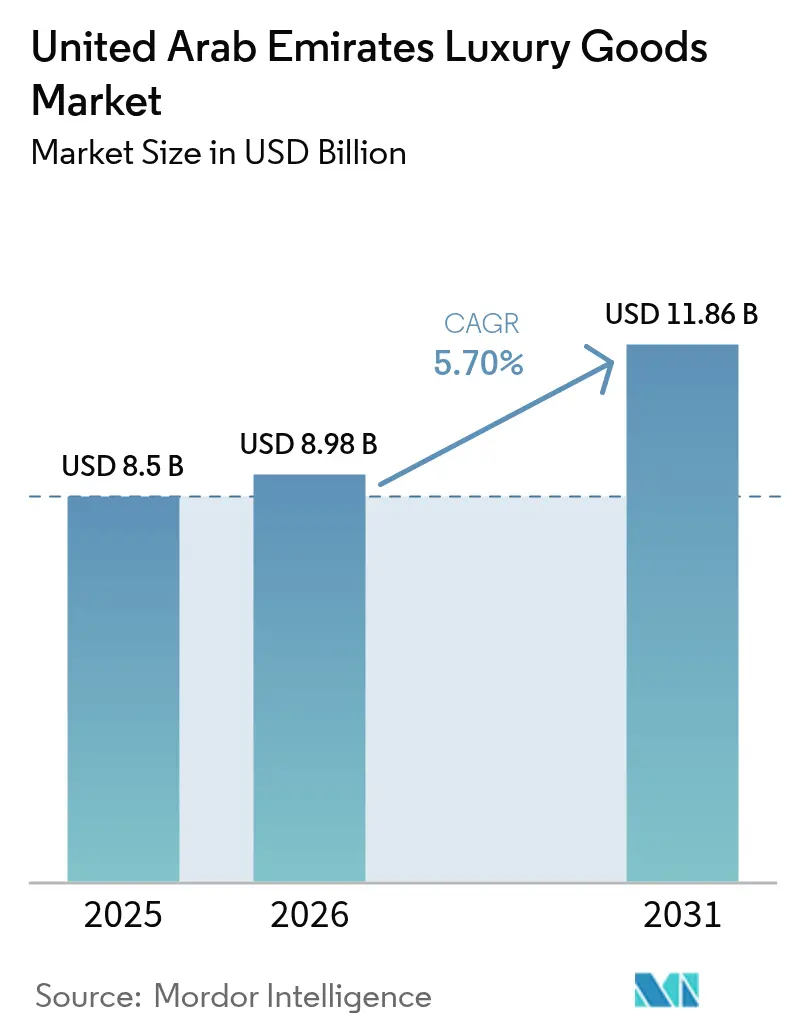
| Base Year Market Size (2025) | USD 8.50 Billion |
| Market Size (2026) | USD 8.98 Billion |
| Market Size (2031) | USD 11.86 Billion |
| Growth Rate (2026 - 2031) | 5.70 % |
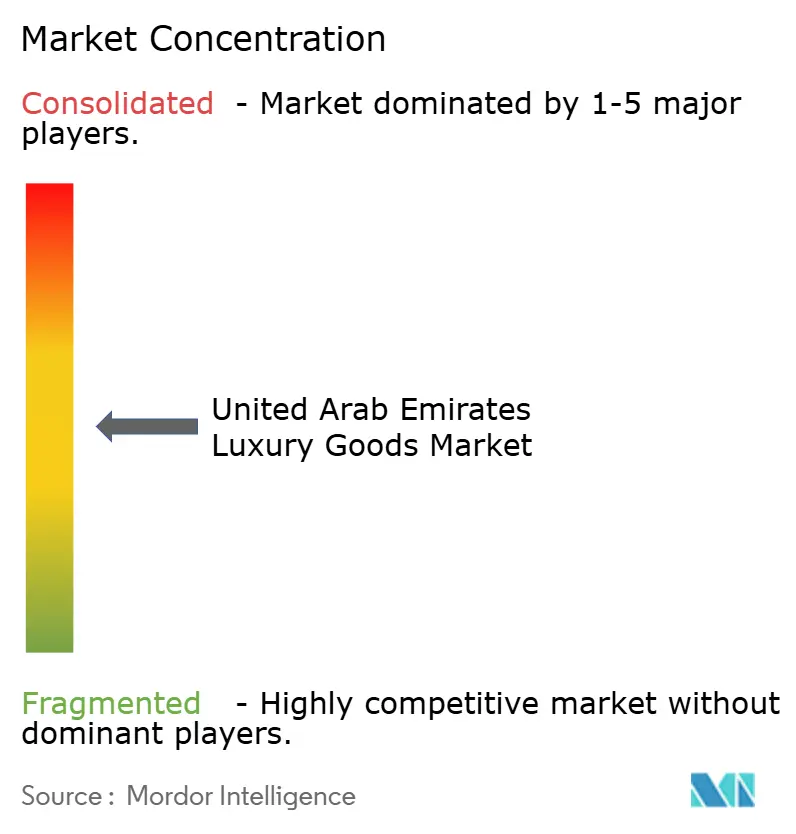
| Market Concentration | Medium |
Major Players
*Disclaimer: Major Players sorted in no particular order Image © Mordor Intelligence. Reuse requires attribution under CC BY 4.0. |
|
United Arab Emirates Luxury Goods Market Analysis by Mordor Intelligence
United Arab Emirates luxury goods market size in 2026 is estimated at USD 8.98 billion, growing from 2025 value of USD 8.50 billion with 2031 projections showing USD 11.86 billion, growing at 5.7% CAGR over 2026-2031. This growth highlights the United Arab Emirates' status as a global shopping hub, supported by its advanced tourism infrastructure and business-friendly regulations. Factors such as the expansion of large shopping malls and record-high duty-free sales have significantly boosted the demand for luxury products. Government initiatives, including the "We the United Arab Emirates 2031" vision and stricter enforcement of intellectual property rights, are also creating a favorable environment for the long-term development of the luxury goods market in the United Arab Emirates. By product type, apparel continues to dominate the market, while the demand for luxury watches is growing rapidly. In terms of end users, women remain the largest consumer group, although the market share of men is steadily increasing. Regarding distribution channels, online platforms are gaining traction, complementing the strong presence of physical retail stores. The United Arab Emirates luxury goods market is moderately consolidated, with major international brands operating alongside regional companies and emerging digital players.
Key Report Takeaways
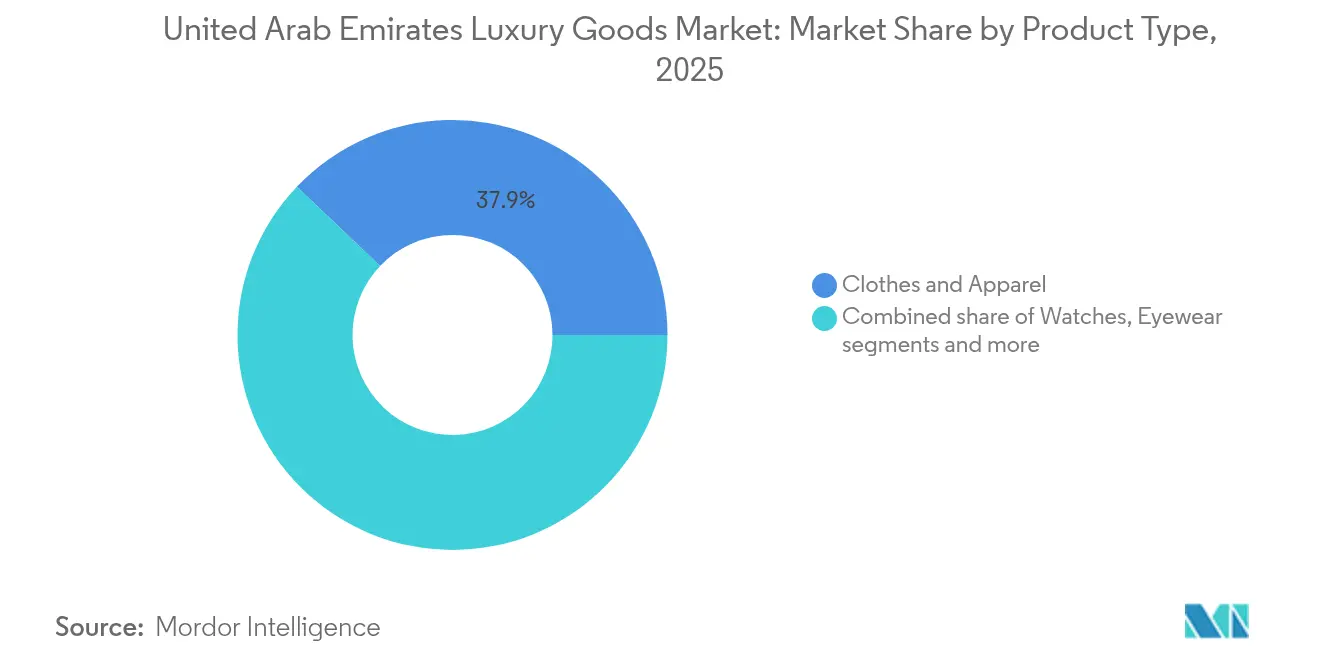
- By product type, clothing and apparel held a 37.88% share of the United Arab Emirates luxury goods market in 2025, while watches are projected to expand at a 7.22% CAGR through 2031.
- By end user, women accounted for 60.98% of the United Arab Emirates luxury goods market share in 2025, while men are forecast to record a 6.12% CAGR to 2031.
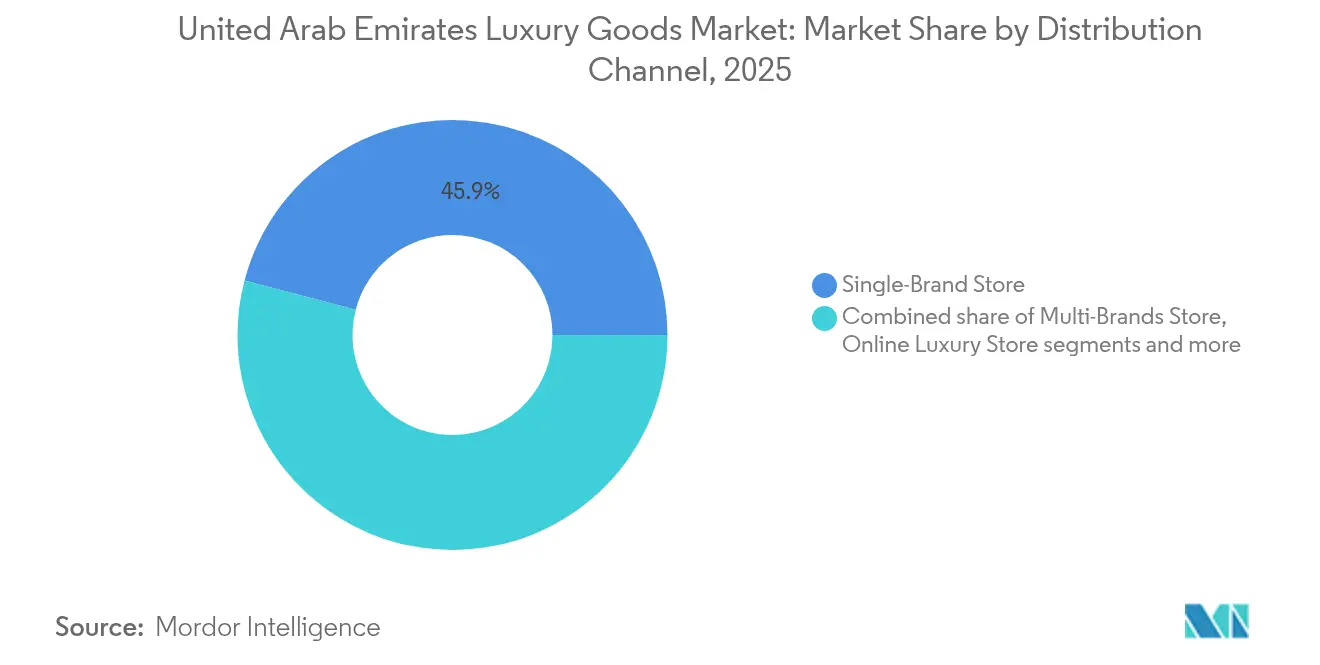
- By distribution channel, single-brand store led with 45.92% of the United Arab Emirates luxury goods market share in 2025; online luxury store are advancing at a 7.1% CAGR to 2031.
Note: Market size and forecast figures in this report are generated using Mordor Intelligence’s proprietary estimation framework, updated with the latest available data and insights as of 2026.
United Arab Emirates Luxury Goods Market Trends and Insights
Drivers Impact Analysis*
| DRIVER | (~) % IMPACT ON CAGR FORECAST | GEOGRAPHIC RELEVANCE | IMPACT TIMELINE |
|---|---|---|---|
| Consumer preference for limited edition products | +1.2% | United Arab Emirates core, spillover to Gulf Cooperation Council | Medium term (2-4 years) |
| Impact of social media and celebrity endorsements | +0.8% | Concentrated in United Arab Emirates urban centers | Short term (≤ 2 years) |
| Booming inbound tourism and duty-free ecosystem | +1.5% | United Arab Emirates national, early gains in Dubai, Abu Dhabi | Long term (≥ 4 years) |
| Innovation in raw materials and design | +0.7% | United Arab Emirates as testing ground | Long term (≥ 4 years) |
| Growing consumer preference for sustainable and eco-certified luxury products | +0.9% | United Arab Emirates and Gulf Cooperation Council, aligned with Vision 2030 | Medium term (2-4 years) |
| Expansion of luxury shopping malls and retail real-estate | +1.1% | United Arab Emirates national, concentrated in Dubai, Abu Dhabi | Medium term (2-4 years) |
| Source: Mordor Intelligence | |||


Consumer preference for limited edition products
Limited-edition collections are playing an increasingly important role in shaping consumer choices in the United Arab Emirates luxury goods market. These collections create a sense of exclusivity, making the products more desirable and valuable in the eyes of consumers. This trend is particularly evident in the luxury watch segment, where brands use limited releases to build stronger emotional and cultural connections with buyers. In November 2023, Hysek introduced a special kilada model to celebrate the UAE National Day, producing a limited edition of only 30 pieces. The watch incorporated design elements reflecting national pride, significantly boosting the brand’s prestige and emotional appeal among collectors. Similarly, Hublot introduced Arabic calligraphy-inspired models during Dubai Watch Week 2023, showcasing how integrating regional heritage into limited-edition designs can attract affluent collectors. By combining exclusivity with cultural significance, these launches foster customer loyalty and encourage consumers to pay premium prices in a competitive luxury goods market.
Expansion of luxury shopping malls and retail real-estate
The luxury goods market in the United Arab Emirates is witnessing consistent growth, driven by significant investments in retail infrastructure that reinforce its status as a global shopping hub. In June 2024, Emaar Properties revealed plans for an AED 1.5 billion expansion of the Dubai mall, which will add 240 new premium stores. Similarly, Majid Al Futtaim is allocating USD 1.36 billion to upgrade the Mall of the Emirates, introducing a broader range of retail and experiential options. These initiatives are enhancing shopping experiences, drawing both local residents and international tourists. According to the World Travel and Tourism Council, traveler spending in the United Arab Emirates reached AED 217.3 billion in 2024, underscoring the crucial role of tourism in sustaining luxury demand[1]Source: World Travel and Tourism Council, "International Traveller Spend in the UAE to Reach a Record AED 228BN This Year", wttc.org. While online shopping continues to grow, robust tourist spending and ongoing infrastructure developments underscore the significance of physical retail spaces in the market.
Booming inbound tourism and duty-free ecosystem
The United Arab Emirates' luxury goods market is strongly supported by the growth of inbound tourism and its well-established duty-free system. Dubai, for instance, welcomed 9.88 million overnight visitors between January and June 2025, marking a 6% increase compared to the same period in 2024, as reported by the Dubai Department of Economy and Tourism[2]Source: Dubai Department of Economy and Tourism, "Visitor Performance By Source Market", dubaidet.gov.ae. This highlights the United Arab Emirates' popularity as a global travel destination. Dubai Duty Free achieved record-breaking annual sales of AED 7.9 billion in 2024, according to Gulf Business, highlighting the significant role of travel-related luxury shopping. The digital value added tax (VAT) refund system encourages tourists to shop more by offering tax-free benefits, making travel-related purchases a key factor in the growth of the United Arab Emirates' luxury goods market.
Impact of social media and celebrity endorsements
Social media has a significant influence on the United Arab Emirates' luxury goods market, particularly among younger, tech-savvy consumers. Platforms like Instagram, TikTok, and Snapchat have become essential tools for brand discovery, with influencers and celebrities driving trends and shaping purchasing decisions. In 2024, the United Arab Emirates had 10.7 million active social media users, according to the World Population Review.[3]Source: World Population Review, "Social Media Users by Country 2025", worldpopulationreview.com This highlights the widespread digital engagement in a country with a high population. This high level of digital activity is further evident in the growing adoption of AI shopping assistants, which reached a 70% usage rate by May 2025. These tools are helping consumers make more informed and personalized luxury purchases. Brands like Kayali have used social media to popularize regional customs through engaging tutorials. This strategy has increased customer engagement and boosted sales conversions.
Restraints Impact Analysis*
| RESTRAINT | (~) % IMPACT ON CAGR FORECAST | GEOGRAPHIC RELEVANCE | IMPACT TIMELINE |
|---|---|---|---|
| Increase in counterfeit product availability | -0.6% | United Arab Emirates national, cross-border implications | Short term (≤ 2 years) |
| Corporate-tax introduction reducing luxury consumption appetite | -0.8% | United Arab Emirates national, affecting business spending | Medium term (2-4 years) |
| Strict regulatory frameworks and associated compliance expenses | -0.4% | United Arab Emirates national, with Gulf Cooperation Council harmonization | Long term (≥ 4 years) |
| Reduced demand from cost-conscious consumers | -0.7% | Concentrated in price-sensitive segments | Short term (≤ 2 years) |
| Source: Mordor Intelligence | |||
Increase in counterfeit product availability
The increasing presence of counterfeit luxury goods is becoming a significant challenge for the United Arab Emirates' luxury goods market, as it damages brand reputation and redirects consumer spending away from genuine products. In April 2024, several women in the United Arab Emirates fell victim to a social media scam involving fake designer handbags such as Chanel, collectively losing thousands of dirhams. These incidents highlight how counterfeit sellers are increasingly using digital platforms to deceive buyers. To combat this issue, luxury brands are taking proactive measures to protect their products and customers. They are introducing advanced technologies like QR-coded certificates, blockchain-based tracking systems, and near-field communication (NFC) chips embedded in items to verify authenticity. Many brands are collaborating with the United Arab Emirates authorities to enhance the monitoring of online marketplaces and are running educational campaigns to inform consumers about the dangers and risks of purchasing counterfeit goods.
Corporate-tax introduction reducing luxury consumption appetite
The implementation of corporate taxation in 2025 is reshaping spending patterns in the United Arab Emirates’ luxury goods market. Companies earning over AED 375,000 are now subject to a 9% tax, while large multinational corporations face an additional 15% levy, as noted by Tulpar Global Taxation. In a nation with a population of under 12.50 million, according to Emiratisation Gate, this policy change is significantly affecting consumer behavior due to the limited but high-spending population[4]Source: Emiratisation Gate, "UAE Population Statistics 2024", emiratisationgate.org. The new tax framework has reduced disposable income for both businesses and individuals, leading consumers to adopt a more cautious and selective approach to luxury purchases. Shoppers are increasingly prioritizing high-quality, durable products that provide lasting value over frequent or impulsive buying.
*Our forecasts treat driver/restraint impacts as directional, not additive. The impact forecasts reflect baseline growth, mix effects, and variable interactions.
Segment Analysis
By Product Type: Apparel Retains Lead While Watches Accelerate
Clothing and apparel accounted for the largest share of the United Arab Emirates' luxury goods market, holding 37.88% in 2025. Dubai has solidified its reputation as a global fashion hub, attracting renowned luxury brands to open flagship stores and launch exclusive collections in the region. This segment thrives due to the United Arab Emirates' appeal as a shopping and tourism destination, where high-end fashion is seen as a reflection of personal style and cultural sophistication. Both affluent residents and international tourists contribute significantly to the demand for luxury apparel, making it a cornerstone of the market.
On the other hand, the watches segment is expected to grow the fastest, with a projected CAGR of 7.22% through 2031. This growth is driven by luxury watchmakers introducing limited-edition designs that cater to local preferences, often unveiled at prestigious events like Dubai watch week. These strategies create a sense of exclusivity and cultural connection, appealing to consumers who value unique, investment-worthy timepieces. The rising interest in collectible watches as both status symbols and long-term assets further supports the segment’s expansion in the United Arab Emirates' luxury goods market.


By End User: Women Lead While Men Gain Ground
Women accounted for 60.98% of luxury spending in 2025, highlighting their strong influence on the United Arab Emirates' luxury market. This trend is supported by more women entering the workforce and incorporating luxury products into their daily lives as a symbol of style and self-expression. Luxury brands are responding by offering tailored shopping experiences that combine high-end fashion, beauty products, and wellness services. These efforts emphasize the importance of women as a key consumer group driving growth in the luxury sector.
Men’s spending on luxury goods, while smaller than women’s, is expected to grow steadily at a 6.12% CAGR through 2031. This growth is driven by increasing interest in premium grooming products, luxury casual wear, and collectible watches, especially among younger male professionals. Brands are focusing on this segment with targeted marketing campaigns and exclusive product offerings that align with their preferences and rising disposable incomes. As a result, men are becoming a growing force in the United Arab Emirates' luxury goods market, contributing to its overall expansion and diversification.
By Distribution Channel: Digital Gains Complement Brick-and-Mortar Strength
Single-brand store continued to lead the United Arab Emirates' luxury goods market in 2025, accounting for 45.92% of the total market share. Wealthy consumers highly favor these stores due to their exclusive services, personalized consultations, and unique shopping experiences. Located in prominent malls and luxury districts, these boutiques not only offer premium products but also create an environment that reflects the brand's identity and prestige. Their presence enhances the appeal of cities like Dubai and Abu Dhabi as global hubs for luxury shopping, where the shopping experience itself is as important as the products being sold.
On the other hand, online luxury retail is rapidly gaining traction and is expected to grow at a 7.1% CAGR through 2031. Advancements in technology, such as AI-based personalization and efficient cross-border delivery systems, drive this growth. Initiatives like the United Arab Emirates' tourist e-commerce VAT-refund scheme are making online luxury shopping more accessible and appealing. These developments allow digital platforms to offer convenience without compromising on exclusivity, making online shopping a strong complement to the in-store luxury experience rather than a replacement.
Geography Analysis
Dubai plays a leading role in the United Arab Emirates' luxury goods market, supported by its renowned retail destinations like the Dubai Mall. In July 2025, Dubai Duty Free recorded impressive sales of AED 638.8 million, even with only a slight increase in passenger traffic. The city continues to attract wealthy individuals, and the ongoing USD 35 billion airport expansion ensures a consistent flow of visitors. These factors contribute to maintaining high shopper density and increasing average transaction values. Dubai’s strong infrastructure and global appeal make it a cornerstone of the United Arab Emirates' luxury goods market.
Abu Dhabi is making significant strides in the luxury goods market by investing in cultural and hospitality projects. Developments such as retail spaces near the Louvre Abu Dhabi and the newly opened Baccarat Hotel are enhancing the city’s luxury offerings. Waterfront projects and a surge in real estate investments, with AED 25 billion in transactions recorded in Q1 2025, are driving growth. These initiatives are creating a unique mix of cultural attractions and high-end retail experiences, positioning Abu Dhabi as a growing hub for luxury goods and services.
The Northern Emirates are enhancing the United Arab Emirates’ luxury market by emphasizing niche segments such as eco-tourism and heritage-focused retail. For instance, Sharjah’s Mleiha National Park integrates conservation with premium desert experiences, including luxury glamping and curated cultural tours. These offerings attract affluent travelers and indirectly drive demand for high-end goods, fashion, and locally crafted souvenirs. Such initiatives diversify the market while aligning with the United Arab Emirates’ federal economic objectives, such as achieving an AED 3 trillion GDP by 2031. This strategic approach ensures luxury goods market growth extends beyond major cities to emerging regions, fostering opportunities nationwide.
Regulatory Landscape
Luxury goods retail and cross-border selling in the UAE operate under a mix of market-entry liberalization and stronger consumer, data, and anti-counterfeit enforcement. Federal Decree-Law No. 32 of 2021 enables 100% foreign ownership for retail entities, which supports wholly owned brand subsidiaries and tighter control over merchandising and after-sales operations. On the enforcement side, Federal Decree-Law No. 42 of 2023 on Combating Commercial Fraud bans the trade, promotion, and possession of counterfeit goods, and it established the Supreme Committee for Combating Commercial Fraud, reinforcing brand-protection actions relevant to watches, jewelry, leather goods, and apparel.
For day-to-day compliance, luxury retailers rely on Federal Law No. 15 of 2020 on Consumer Protection (pricing transparency, warranties, and returns) and Federal Decree-Law No. 45 of 2021 (Personal Data Protection Law), which shapes CRM, loyalty programs, and omnichannel personalization through consent and cross-border data-transfer requirements. On imports, the UAE applies a standard 5% customs duty on most goods (CIF basis), with duty estimation and classification supported through the Federal Authority for Identity, Citizenship, Customs & Port Security (ICP) tariff system. Product conformity and quality oversight ties to the Ministry of Industry and Advanced Technology (MoIAT) under the standards and metrology framework (Federal Decree-Law No. 20 of 2020), which is relevant for categories such as cosmetics/beauty and other consumer-facing accessories sold through malls and duty-free channels.
Competitive Landscape
The United Arab Emirates' luxury goods market is moderately consolidated, with luxury brands operating alongside regional players and innovative digital disruptors. International brands focus on controlling their inventory and protecting their brand image through vertical integration. Meanwhile, local start-ups are finding opportunities in areas like sustainable fashion and pre-owned luxury goods, which are gaining popularity among environmentally conscious consumers. This mix of established players and emerging businesses is shaping a dynamic and competitive market environment.
Collaborations and partnerships are playing a significant role in the growth of the United Arab Emirates' luxury goods market. For instance, OTB Group and Chalhoub Group have announced plans to open 15 stores for brands such as Jil Sander, Maison Margiela, and Marni over the next five years. These partnerships highlight how companies are working together to expand their presence and reach new customers. Retailers are increasingly adopting advanced technologies like artificial intelligence, augmented reality, and blockchain to create unique and engaging shopping experiences, setting themselves apart from competitors.
Sustainability is becoming a major focus in the United Arab Emirates luxury goods market, but there are still not enough eco-friendly options available. Consumers are increasingly looking for sustainable products, creating a clear gap in the market. Companies like Reklaim are addressing this by offering certified pre-owned luxury collections. These collections provide environmentally conscious buyers with high-quality, sustainable choices.
United Arab Emirates Luxury Goods Industry Leaders
-
LVMH Moët Hennessy Louis Vuitton
-
Kering SA
-
Hermès International SA
-
Rolex SA
-
Chanel SA
- *Disclaimer: Major Players sorted in no particular order

Market Opportunities and Future Outlook
Retail infrastructure investment and asset consolidation are creating room for more curated luxury merchandising, tenancy, and experiential formats across the UAE. In February 2026, Aldar Properties and Mubadala completed an AED 10 billion retail joint venture platform that includes Yas Mall and The Galleria Luxury Collection. The structure signals a more centralized approach to premium retail asset management in Abu Dhabi and gives luxury brands clearer pathways for flagship placement, pop-ups, and cross-mall activations. Large mall upgrades already outlined in the country, including Emaar Properties plan for an AED 1.5 billion Dubai Mall expansion and Majid Al Futtaim program to upgrade Mall of the Emirates, also increase the addressable footprint for single-brand boutiques and high-service categories such as watches and jewelry.
Logistics, compliance-led trust, and digital operating models are emerging as near-term build areas for luxury players in addition to storefront expansion. The Dubai Customs Virtual Warehouses Initiative, effective 1 April 2026, offers a three-year duty suspension for private artworks and high-value luxury assets, which can support longer-hold inventory strategies, private client selling, and authenticated secondary transactions handled through controlled storage and documentation. At the same time, brand groups and retailers are investing in AI-enabled customer engagement and supply chain modernization, including Chalhoub Group adoption of SAP S/4HANA and integrated AI capabilities, which aligns with the market shift toward data-driven personalization under the UAE personal data protection regime. Anti-counterfeit enforcement and consumer-protection requirements also support opportunities for authenticated commerce models, including certified pre-owned and digitally verified products, as counterfeit risks remain a concern in online and social channels.
Recent Industry Developments
- June 2026: RAK Ceramics signed an exclusive multiyear licensing agreement with Roberto Cavalli to manufacture and distribute ceramic tiles, sanitaryware, and faucets across the UAE and 11 other markets. The partnership extends a luxury fashion house into premium home and lifestyle categories that overlap with luxury retail ecosystems anchored by malls and design-led spending.
- May 2026: DAMAC Group announced the sale of a majority interest in Roberto Cavalli to Marquee Brands, while retaining a significant minority stake and entering a strategic partnership for future development. The ownership change supports renewed brand monetization via licensing and category expansion, which can influence luxury distribution and brand presence in the UAE.
- February 2026: Aldar Properties and Mubadala Investment Company completed an AED 10 billion joint venture to create a consolidated retail platform that includes Yas Mall and The Galleria Luxury Collection. The combined platform strengthens Abu Dhabi capability to curate premium tenant mixes and deliver larger, more coordinated luxury retail destinations for international brands.


Research Methodology Framework and Report Scope
Market Definition and Coverage
This market covers the value of luxury goods sold to consumers in the UAE through offline and online retail, where products are positioned and priced as premium or luxury within their category.
Scope exclusions: We exclude non-goods luxury services (such as travel, hotels, fine dining), resale-only activity, and counterfeit trade that is not captured in official channels.
Segmentation Overview
-
By Product Type
- Clothing and Apparel
- Footwear
- Leather Goods
- Watches
- Jewellery
- Eyewear
- Other Product Types
-
By End User
- Men
- Women
- Unisex
-
By Distribution Channel
- Single-Brand Store
- Multi-Brand Store
- Online Luxury Store
- Other Distribution Channels
Data Sources, Market Sizing, and Validation
Desk Research
Desk research was used to set the factual base for the UAE demand pool and to keep the model anchored to observable signals. We referred to public sources such as the UAE Federal Competitiveness and Statistics Centre datasets, Dubai Statistics Center releases, Central Bank of the UAE indicators, and UAE Federal Customs Authority trade data where relevant for imported luxury categories. For travel-linked demand, reference points were taken from Dubai Department of Economy and Tourism publications and Dubai Duty Free annual updates, used as indicative checks rather than a single driver.
To translate these indicators into a usable market model, we also reviewed brand owner and retailer annual reports, investor presentations, and audited financial statements that comment on UAE or GCC exposure, along with reputable press coverage on store openings, mall expansions, and online retail adoption. Patent and trademark databases were scanned selectively to understand the pace of new premium product launches and brand protection activity, and paid subscriptions focused on company financials and news were used to validate large-company revenue direction. These desk sources are illustrative only, and many other references were consulted for data collection, validation, and clarification during the study.
Primary Interviews and Surveys
Primary work centered on structured interviews and short surveys with executives, category leads, retail managers, distributors, and e-commerce operators who are active in luxury goods selling and merchandising in the UAE. These discussions helped confirm what is treated as luxury in day-to-day merchandising, to sense-check price ladders across tiers, and to validate channel mix shifts across major emirates and travel retail before finalizing assumptions.
Distribution of primary research fieldwork respondents
| Company type | Respondent position |
|---|---|
| Top tier: 38% | CXOs: 13% |
| Mid tier: 46% | Functional/Unit leaders: 43% |
| Smaller Players: 16% | Managers: 44% |
Market-Sizing & Forecasting
Sizing is built using top-down logic, where UAE consumer spending signals and retail activity are translated into a luxury-only value pool, and then that total is distributed across key product groups and channels based on observed splits. To keep the totals realistic, we also did selective bottom-up approximations using supplier and retailer revenue references, sampled price points across luxury tiers, and checked store footprint and sales productivity, then used those results to adjust the final totals when gaps appeared.
Inputs used in the model include UAE population and inbound visitor trends, duty-free and airport retail momentum as a directional indicator, premium price inflation and exchange-rate effects on imported goods, online luxury adoption, and changes in store count and mall-led retail capacity. With these drivers combined, the main market movement becomes clearer, particularly in years when tourism and discretionary spending shift together.
For forecasting, scenario analysis was applied so the base case can reflect different paths for tourism growth, consumer confidence, and online penetration. Where bottom-up points were missing for smaller categories, we filled gaps using conservative price-band and volume proxies validated during expert calls, then rechecked that the implied per-capita spend stayed within plausible limits for the UAE.
Data Validation & Update Cycle
Validation was done through multiple cross-checks so the model does not rely on one data stream. We compared outputs against independent indicators such as tourism arrivals, the direction of retail sales, and trade-linked signals for imported premium categories, then investigated variances that did not match the expected pattern.
Before sign-off, assumptions and calculations are reviewed in steps by another analyst, and follow-up calls are triggered when a key split or growth driver shows an unusual jump. Reports are refreshed annually, with interim updates when material events occur, such as major policy changes, sharp currency moves, or demand shocks. Right before delivery, a final review pass is completed so clients receive the latest updated view.
Mordor Intelligence's UAE Luxury Goods Market Sizing Compared With Other Published Estimates
Published market sizes for UAE luxury goods often vary because the scope lines are drawn differently, and because price and channel assumptions are refreshed at different times. The benchmark table helps make this visible, since even when the country and theme are the same, what is counted as luxury and which selling routes are included can change the outcome.
Key gap drivers usually come from whether duty-free and travel retail are included, whether premium (but not truly luxury) price bands are blended into the total, and how online sales are treated when goods are shipped cross-border. Currency conversion timing also matters in an import-heavy market like the UAE, and some estimates apply a single inflation factor rather than updating category-level price ladders and channel mix changes year by year.
Benchmark comparison
| Source | Market Size | Gaps in Research Methodology |
|---|---|---|
| Mordor Intelligence | USD 8.50 B (2025) | |
| Global Consultancy A | USD 4.41 B (2025) | Often reflects a narrower basket that leans toward select personal luxury categories and may not fully capture travel retail dynamics, which can understate the UAE spend pool in high-tourism years. |
| Industry Association B | USD 9.30 B (2025) | May use broader premium-plus definitions and apply blended growth and pricing assumptions, which can lift totals when mid-premium goods and higher assumed online acceleration are included. |
The table shows a wide spread for the same year, and in Mordor Intelligence's model the UAE total is counted only for luxury-positioned goods sold through both store-based retail and digital channels, with travel-linked demand treated as a check rather than a blanket add-on. Once those scope choices are fixed, the rest of the work becomes a repeatable set of steps, where price ladders, channel mix, and tourism sensitivity are updated and revalidated so the final number stays traceable to clear variables.


Key Questions Answered in the Report
What is the current value of the UAE luxury goods market?
The UAE luxury goods market size is USD 8.98 billion in 2026.
How fast is the market expected to grow?
It is projected to register a 5.7% CAGR and reach USD 11.86 billion by 2031.
Which product category generates the most revenue?
Clothing and apparel lead with 37.88% share of 2025 sales.
How important is e-commerce in luxury sales?
Online luxury stores are advancing at a 7.1% CAGR, supported by AI personalization and tourist VAT refunds.
Page last updated on:




