
Market Overview
| Study Period | 2020 - 2031 |
|---|---|
| Forecast Data Period | 2026 - 2031 |
| Base Year Market Size (2025) | USD 2.40 Billion |
| Market Size (2026) | USD 2.53 Billion |
| Market Size (2031) | USD 3.31 Billion |
| Growth Rate (2026 - 2031) | 5.52 % |
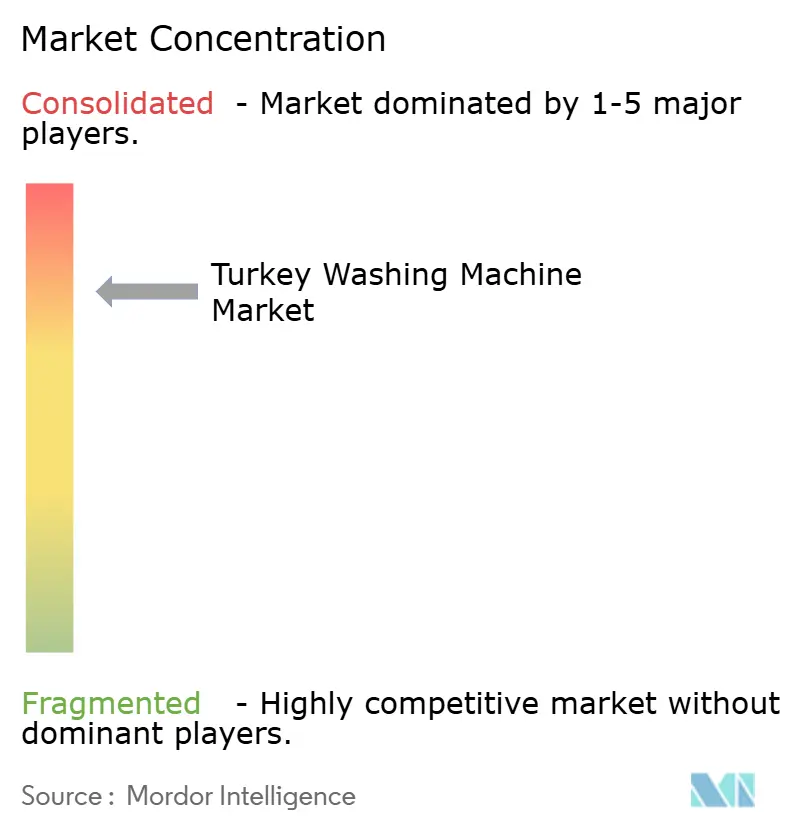
| Market Concentration | Medium |
Major Players *Disclaimer: Major Players sorted in no particular order Image © Mordor Intelligence. Reuse requires attribution under CC BY 4.0. | |
Turkey Washing Machine Market Analysis by Mordor Intelligence
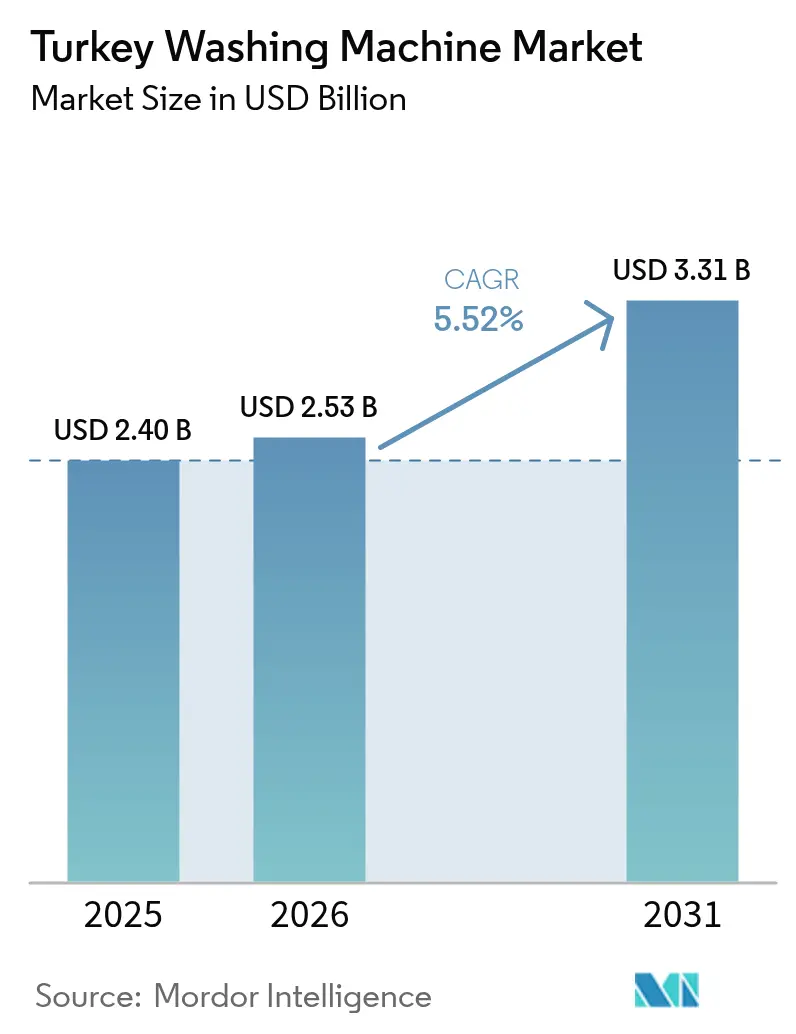
The Turkey washing machine market size is expected to grow from USD 2.40 billion in 2025 to USD 2.53 billion in 2026 and is forecast to reach USD 3.31 billion by 2031 at 5.52% CAGR over 2026-2031. Rising urbanization, digital transformation spending, and stricter energy‐efficiency regulations underpin the outlook despite policy-induced demand headwinds. The Central Bank’s 50% policy rate, set to curb inflation that peaked at 75% in May 2024, lengthens replacement cycles yet accelerates a consumer shift toward energy-sipping and smart-connected models. Established manufacturers leverage vertical integration to hedge currency volatility, while import-dependent rivals battle margin pressure from a weak lira. Regional imbalances shape growth: Marmara provides scale and premium uptake, whereas the Mediterranean registers the quickest volume expansion on the back of build-to-rent housing and tourism recovery. Capacity utilization stuck near 74.9% in September 2024 limits supply flexibility, tilting the field toward players with local component ecosystems [1]Ministry of Trade, “Economic Outlook 2024,” ticaret.gov.tr.
Key Report Takeaways
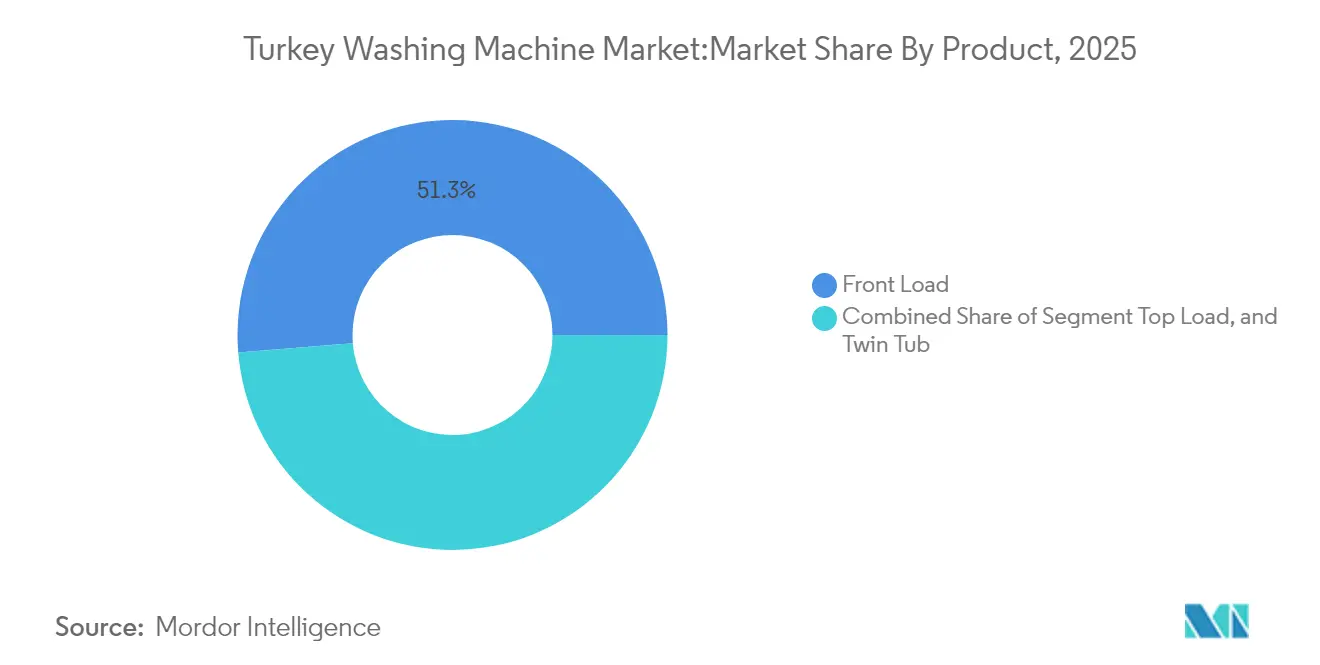
- By product type, front-load machines led with 51.30% share of the Turkey washing machine market in 2025 and will advance at 6.58% CAGR to 2031.
- By technology, fully automatic units held 59.20% of Turkey washing machine market share in 2025 and are set for a 7.18% CAGR through 2031.
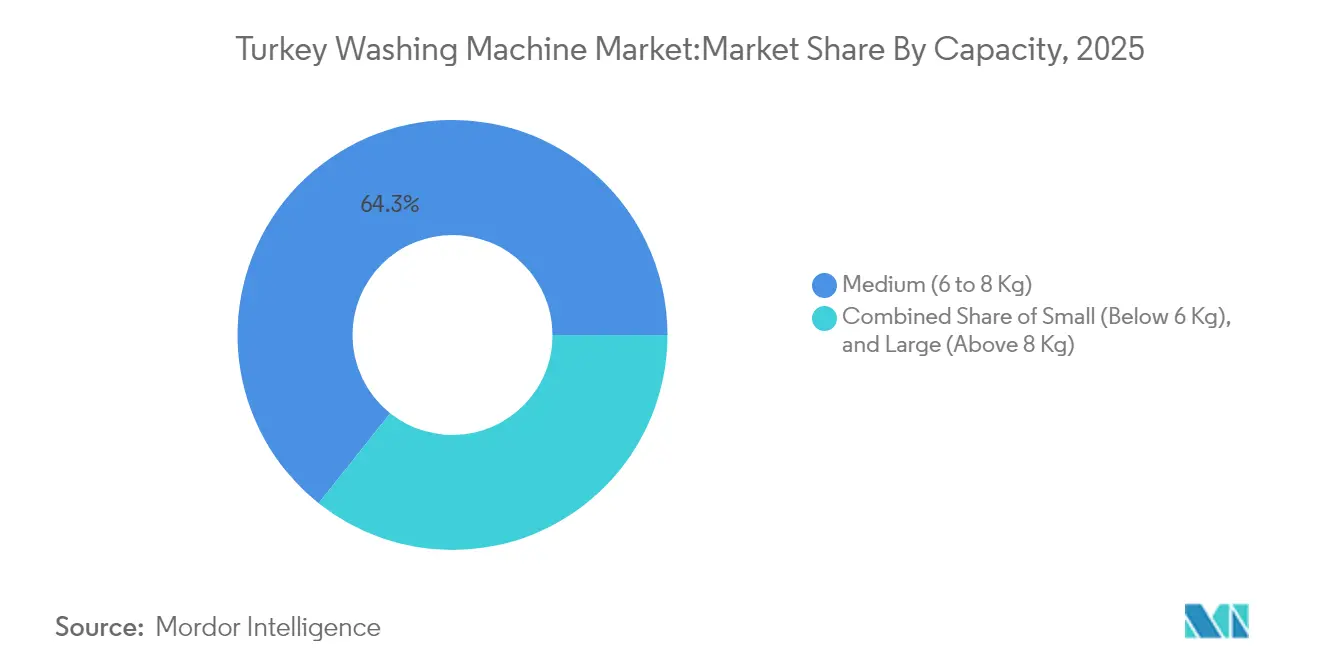
- By capacity, the 6-8 kg band accounted for 64.30% of the Turkey washing machine market size in 2025, while models above 8 kg are forecast to grow at 7.75% CAGR during 2026-2031.
- By connectivity, conventional designs dominated with an 87.40% share of Turkey washing machine market in 2025, yet smart-connected variants are rising at an 11.12% CAGR.
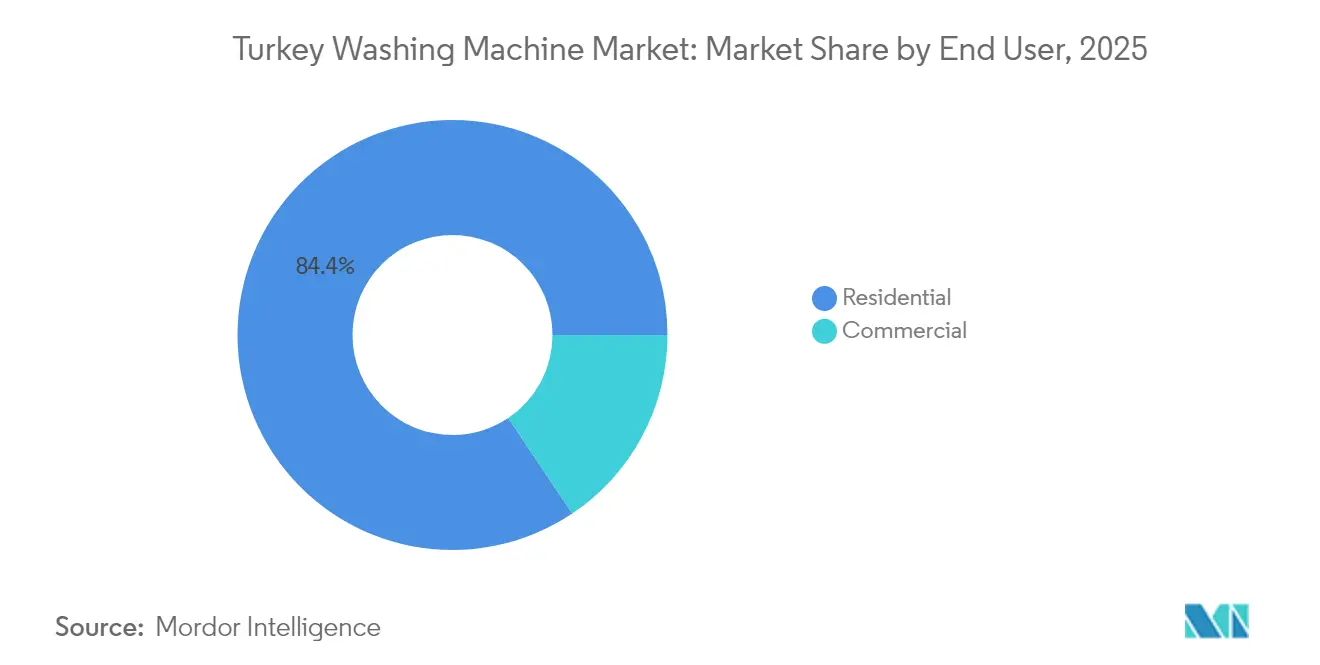
- By end user, residential customers captured 84.40% revenue share of the Turkey washing machine market in 2025; commercial demand is poised for a 7.55% CAGR to 2031.
- By region, Marmara commanded 34.60% of Turkey's washing machine market in 2025, whereas the Mediterranean is expanding fastest at 7.85% CAGR to 2031.
Note: Market size and forecast figures in this report are generated using Mordor Intelligence’s proprietary estimation framework, updated with the latest available data and insights as of 2026.
Turkey Washing Machine Market Trends and Insights
Drivers Impact Analysis*
| Driver | ~ % Impact on CAGR Forecast | Geographic Relevance | Impact Timeline |
|---|---|---|---|
| Rising urbanization and household formation | +1.2% | National, concentrated in Marmara and Mediterranean | Medium term (2-4 years) |
| Growing consumer disposable incomes | +0.8% | Marmara, Central Anatolia, Aegean | Short term (≤ 2 years) |
| Technological advancements and smart IoT-enabled appliances | +1.5% | Urban centers, early adoption in Istanbul and Ankara | Long term (≥ 4 years) |
| Government energy-efficiency subsidies | +0.9% | National with higher uptake in developed regions | Medium term (2-4 years) |
| Expansion of build-to-rent housing projects | +0.7% | Metropolitan areas, Mediterranean coastal cities | Medium term (2-4 years) |
| Increased credit-card installment limits for appliances | +0.6% | Urban centers with established banking infrastructure | Short term (≤ 2 years) |
| Source: Mordor Intelligence | |||
Rising Urbanization And Household Formation
Urban migration lifts the Turkey washing machine market as secondary cities such as Bursa, Antalya, and Gaziantep register apartment completions that spur first-time appliance purchases [2]Strategy and Budget Office, “Twelfth Development Plan 2024-2028,” sbb.gov.tr. Younger cohorts form households earlier, driving medium-capacity demand. Build-to-rent developments in Mediterranean hubs bundle appliances into lease packages, enabling bulk procurement. Improved utility grids in emerging towns remove legacy barriers to automatic machines. Government incentives that add manufacturing jobs amplify disposable incomes in peri-urban belts, reinforcing upgrade intent.
Growing Consumer Disposable Incomes
Real wages in export-oriented Marmara industries rose in 2024, supporting premium front-load upgrades despite tighter monetary policy. Kocaeli’s TRY 516,460 per-capita GDP sustains demand for energy-class A machines. Wider credit access through installment campaigns mitigates upfront sticker shock, though high rates still prune discretionary spending in Central Anatolia. Dual-income households value time-saving wash programs, nudging demand toward fully automatic SKUs. Income divergence keeps value models relevant in eastern provinces.
Technological Advancements And Smart IoT-Enabled Appliances
Annual Industry 4.0 spending of USD 1.0 - 1.5 billion accelerates smart-device literacy, converting into double-digit growth for Wi-Fi-enabled washers. Energy-optimization algorithms deliver 10-20% utility savings, a compelling proposition amid elevated power tariffs [3]DergiPark, “Water Scarcity and Appliance Adoption,” dergipark.org.tr. Local brands bundle Turkish-language apps that schedule cycles for low-tariff nights. Network effects emerge as consumers syncing thermostats and lighting now seek washer compatibility. Penetration expands from Istanbul piloting toward secondary cities once broadband reliability improves.
Government Energy-Efficiency Subsidies
The forthcoming green taxonomy compels corporates to favour eco-labelled appliances from 2027, triggering procurement of high-efficiency washers in office and hospitality estates. Subsidies offset 5-8% of retail prices for class A units, tipping payback calculus for cost-sensitive buyers. Domestic factories able to document low-carbon supply chains access preferential grants, fortifying local incumbents. Tighter EU-aligned standards will phase out legacy top-loaders that exceed water-use maxima, compressing compliance timelines.
Restraints Impact Analysis*
| Restraint | ~ % Impact on CAGR Forecast | Geographic Relevance | Impact Timeline |
|---|---|---|---|
| High inflation and currency depreciation raising prices | -1.8% | National with acute impact in lower-income regions | Short term (≤ 2 years) |
| Supply-chain volatility and component shortages | -0.7% | Manufacturing centers, import-dependent regions | Medium term (2-4 years) |
| Regional water-scarcity regulations increasing operating costs | -0.4% | Central Anatolia, Southeast Anatolia, Mediterranean | Long term (≥ 4 years) |
| Source: Mordor Intelligence | |||
High Inflation and Currency Depreciation Raising Prices
High inflation and a weaker lira are pushing washing-machine prices up. The Central Bank’s 50% policy rate makes loans expensive, so many households skip installment plans. As prices climb, buyers keep existing units longer, a shift that hurts the mid-market most because these shoppers are more price-sensitive than budget or premium customers. The burden is heavier in lower-income provinces, where a new washer now eats up a larger share of household budgets than it does in wealthier cities. Producers try to soften the blow by redesigning models, using more local parts, and trimming costly features, yet this approach often strips away functions that justify higher price tags. Tighter credit access adds another layer of pressure, prompting many families to postpone purchases until financing terms improve.
Supply-Chain Volatility And Component Shortages
Global chip tightness extended smart-washer lead times to eight weeks in early-2025, forcing dealers to push non-connected stock. Factory utilization at 74.9% signals idle lines awaiting microcontroller deliveries. Logistic bottlenecks through the Red Sea route added freight surcharges, eroding margins on value SKUs. Brands explore Eurasian rail but capacity is limited, preserving supply-risk premiums on inventories.
*Our forecasts treat driver/restraint impacts as directional, not additive. The impact forecasts reflect baseline growth, mix effects, and variable interactions.
Segment Analysis
By Product: Front-Load Dominance Drives Premium Shift
Front-loaders accounted for 51.30% of Turkey washing machine market size in 2025 and are tracking a 6.58% CAGR through 2031. Apartment dwellers in Istanbul and Izmir appreciate stacking flexibility that maximises compact kitchens. Energy labels place most front-load designs one band above comparable top-loaders, bolstering purchase justification. Manufacturers introduce quiet-spin technologies to suit thin-walled urban housing.
The fully automatic top-load cohort still resonates in rural Anatolia where users prize familiar ergonomics, yet its share is set to erode as urban migration persists. Persistence of twin-tub units in water-scarce Southeast Anatolia preserves a low-priced niche. Regulatory harmonisation with EU efficiency tiers will gradually tilt shelf space toward front-load SKUs in all large retail chains.



By Technology: Automation Drives Market Evolution
Fully automatic machines held 59.20% Turkey washing machine market share in 2025, growing at 7.18% CAGR, propelled by dual-income households seeking hands-free convenience. Wash programmes optimised for Turkish cottons and synthetics now anchor brand differentiation. Expansion of producer finance cuts the acquisition premium over semi-automatics to 15%.
Semi-automatic designs remain relevant in power-outage-prone provinces where manual control avoids cycle aborts. Government efficiency messaging underscores automatic models’ 20% water savings, nudging utility-paying households to upgrade. Smart connectivity layers primarily onto fully automatic chassis, foreshadowing greater dominance ahead.
By Capacity: Medium Segments Anchor Market Growth
Medium-capacity washers in the 6-8 kg range sit at the sweet spot for most Turkish households. They held 64.30% of sales in 2025 because they fit neatly into urban apartments and match the laundry loads of typical nuclear families. Bigger machines—those over 8 kg—are growing fastest, with a 7.75% CAGR, as wealthier buyers pay more for features that let them tackle bulky items in fewer cycles. At the other end of the scale, sub-6 kg units keep a small but steady following among people who need a second washer for delicates or who live in very tight spaces.Rising incomes in the country’s more developed provinces also push shoppers toward larger drums. Fewer washes per week, plus room for comforters and curtains, help justify the higher upfront cost. Efficiency plays a part as well: a full 9 kg load can use less water and power per kilogram than smaller models, trimming utility bills over time. Regional differences remain clear. Big-city residents lean toward high-capacity machines, while smaller towns and rural areas stick with mid-size options that strike the best balance between price and performance.
By Connectivity: Smart Revolution Gains Momentum
Conventional models still dominate at 87.40% share in 2025, yet connected variants are sprinting at 11.12% CAGR. Remote diagnostics cut service visits by 30%, a key value for landlords managing portfolios.Smart models also integrate tariff-aware scheduling that defers operation to cheaper night bands, saving TRY 180 annually on electricity bills. Component costs fall as Wi-Fi modules commoditise, narrowing retail price gaps to under 12% by 2027. Early adopter testimonials on social media accelerate mainstream acceptance.
By End User: Residential Dominance with Commercial Acceleration
Residential buyers drove 84.40% of the 2025 volume thanks to a deep home-ownership culture. The residential market reflects Turkey's homeownership culture and apartment living trends that create consistent replacement demand cycles.
Commercial applications span hotels, laundromats, and multi-family housing developments where centralized laundry facilities serve multiple units, creating distinct purchasing patterns focused on durability and operating cost efficiency. Commercial demand is scaling at 7.55% CAGR as hotel occupancy rebounds and build-to-rent investors spec batch orders of durable stainless-steel drum units. Laundry-as-a-service start-ups in Ankara contract three-year supply deals, creating annuity-like shipment visibility for OEMs.
By Distribution Channel: Online Gains Reshape Retail Landscape
Traditional B2C retail still supplied 87.60% of units in 2025, but e-commerce slices are rising with a 9.05% CAGR. Same-day delivery within Istanbul’s ring road and integrated installation slots improve customer acceptance.Exclusive brand stores in high-footfall malls showcase premium smart lines and upsell dryers, defending margins. B2B direct shipping to property developers bypasses retail mark-ups, a model likely to enlarge as multi-family projects proliferate.
Geography Analysis
Marmara contributed 34.60% of 2025 shipments, buoyed by Istanbul’s 30.4% share of national GDP and Kocaeli’s high per-capita incomes that favour premium models. Replacement intervals in the region shorten to under seven years, giving manufacturers a dependable refresh pipeline. Retailers operate experiential showrooms where connected appliances are trialled, accelerating smart adoption.
Central Anatolia and the Aegean deliver steady mid-single-digit growth as Ankara’s civil-service employment and Izmir’s diversified industry provide income stability. Textile clusters in the Aegean generate specialist commercial washer demand for in-house laundries. Credit institutions in both regions extend appliance instalment plans, smoothing monthly outlays.
The Mediterranean region expands the quickest at 7.85% CAGR on account of build-to-rent housing for tourism workers in Antalya and Mersin. Southeast and Eastern Anatolia remain under-penetrated yet benefit from infrastructure projects improving electricity access, setting the stage for gradual uptake. EU-Turkey trade, valued at EUR 206 billion in 2024, indirectly stimulates hinterland employment, lifting washer affordability over the forecast horizon.
Regulatory Landscape
Washing machines sold in Turkey are governed by the Ministry of Trade technical regulation framework and EU-harmonized requirements, notably the Communique on Ecodesign Requirements (SGM:2021/3) and the Communique on Energy Labelling (SGM:2021/4), aligned with EU rules for household washing machines and washer-dryers. Compliance typically combines energy label and eco-design performance thresholds with mandatory CE marking and the relevant safety and EMC obligations (for example Low Voltage and Electromagnetic Compatibility directives), with test and certification work commonly routed through notified-body and standards infrastructure such as the Turkish Standards Institution (TSE) and international standards like IEC 60335-2-7.
Market access and ongoing compliance are reinforced through risk-based import and product safety controls administered by the Ministry of Trade via TAREKS, which is the core platform used for conformity assessment and inspection workflows. A concrete anchor is February 2026, when the Ministry of Trade issued the Import Inspection Communique on Machinery (2026/32), updating machinery inspection procedures and integrating additional HS-code coverage into TAREKS, raising the importance of documentation readiness and correct technical-file management for importers and distributors of washing machines and related components.
Value Chain Analysis
The Turkey washing machine value chain starts with raw materials (flat steel, plastics, copper, and aluminum) and moves through component manufacturing (drums, cabinets, pumps, wiring harnesses, electronics), final assembly, testing, packaging, and downstream logistics. Production is clustered in and around major industrial zones such as Istanbul, Bursa, Tekirdag, Manisa, Ankara, Eskisehir, and Kayseri, supporting dense supplier ecosystems and enabling leading OEMs to localize high-bulk parts while maintaining export capability. A key dependency persists in advanced inputs such as inverter motors and semiconductor-based control modules, which are more import-exposed and have contributed to lead-time and cost volatility.
Downstream, manufacturers balance vertically integrated brand channels (exclusive stores and service networks in large metros) with multi-brand retailers, e-commerce, and B2B/direct supply to property developers, hospitality, and laundromat operators. Sector operating economics are also shaped by system-wide cost items such as the GEKAP recovery contribution fee and by export logistics given Turkey’s role as a European white-goods production hub with about 29 million units of annual capacity (2025). In 2025, TURKBESD reported washing machine production of 5.76 million units (down from 7.07 million in 2024) and exports of 3.57 million units (down from 4.80 million in 2024), underlining the current focus on cost control, supply assurance for electronics, and channel mix optimization.
Competitive Landscape
Turkey’s washing-machine arena is moderately concentrated. Home-grown leader Arçelik holds the top spot thanks to its own parts network and a stable of brands that cover every price point. Close behind, BSH, Samsung, and LG run local assembly lines and court wealthier city dwellers with premium, feature-rich models. Turkey’s role as both a large consumer market and an export base keeps the pressure high: multinationals build plants to serve Europe and the Middle East, while Turkish makers push abroad through acquisitions and new branches.
At the lower end of the market, smaller local labels and import-focused distributors battle mainly on price, creating a crowded field. In contrast, the premium and smart-appliance segments are tightening around firms that can afford big R&D budgets and nationwide service fleets. Technology and energy efficiency now define the rivalry. Brands pour money into Wi-Fi connectivity, AI cycle controls, and greener production lines to match Turkey’s digital-transformation goals and new environmental rules. BSH’s success with Turkish-specific product tweaks shows how regional customization can outshine a one-size-fits-all global platform.
Fresh openings are emerging as build-to-rent housing and a recovering tourism sector order machines in bulk. Developers and hotel chains favor suppliers that offer a full product range and quick service turnaround. Overall, the winners blend low-cost manufacturing with digital know-how, aligning perfectly with consumers who now expect every new appliance to be smart-ready.
Turkey Washing Machine Industry Leaders
Arçelik A.Ş. (Beko, Grundig)
Vestel Ticaret A.Ş.
BSH Home Appliances Group
Samsung Electronics Co., Ltd.
LG Electronics Inc.
- *Disclaimer: Major Players sorted in no particular order

Market Opportunities and Future Outlook
Opportunity is concentrated in higher-efficiency and connected product tiers that directly map to Turkey’s EU-aligned eco-design and energy labelling regime under the Ministry of Trade, pushing manufacturers and retailers to refresh assortments toward better-rated models and clearer label-based differentiation. In parallel, smart-connected washers benefit from the country’s ongoing digitalization spend and the practical value proposition of tariff-aware scheduling and remote diagnostics highlighted in the market context, giving brands whitespace to package energy-and-service savings into mid-premium propositions rather than competing only on upfront price.
On the supply side, Turkey’s position as a large white-goods manufacturing base creates room for product and process upgrades that reduce import sensitivity for electronics and improve compliance documentation through platforms such as TAREKS. Industry data from TURKBESD showing a 9% decline in total production and a 10% decline in exports in 2025, alongside sharp GEKAP cost pressure discussed publicly by the association in 2026, is prompting manufacturers to pursue cost-down engineering, localization, and portfolio rationalization while protecting differentiated laundry platforms. A concrete investment signal is Arcelik’s commissioning-linked washing machine factory expansion activity in Manisa tied to a 2025 expansion project, which supports competitiveness initiatives around automation, throughput, and product refresh cycles.
Recent Industry Developments
- May 2026: Samsung announced the 2026 Bespoke AI Laundry Combo as an all-in-one laundry platform with AI-driven wash and dry capabilities and upgraded performance for the combined format. The move raises feature and software expectations in the premium segment and intensifies competition around connected ecosystems and energy-management functionality.
- April 2026: Arcelik signed a definitive agreement with Hitachi Global Life Solutions to sell its stake in Arcelik Hitachi Home Appliances (AHHA). The transaction supports portfolio streamlining and capital reallocation priorities that can influence product, R&D, and manufacturing focus across core home-appliance categories.
- October 2024: The Central Bank of Turkey raised the policy rate to 50%, tightening consumer credit conditions for big-ticket appliances. Higher financing costs fed into longer replacement cycles and shifted demand emphasis toward energy-efficient models with clearer total-cost-of-ownership benefits.


Research Methodology Framework and Report Scope
Market Definition and Coverage
For this study, the market covers revenues generated from washing machines sold and used in Turkey, counted at the point where the unit is purchased through offline or online channels, and measured in value terms.
Scope exclusions: We exclude spare parts, standalone repair services, and extended warranties that are billed separately from the washing machine unit.
Segmentation Overview
- By Product
- Front Load
- With Dryers
- Without Dryers
- Top Load
- With Dryers
- Without Dryers
- Twin Tub
- Front Load
- By Technology
- Fully Automatic
- Semi-Automatic
- By Capacity
- Small (Below 6 Kg)
- Medium (6 to 8 Kg)
- Large (Above 8 Kg)
- By Connectivity
- Smart Connected
- Conventional
- By End User
- Residential
- Commercial
- By Distribution Channel
- B2C/Retail
- Multi-brand Stores
- Exclusive Brand Outlets
- Online
- Other Distribution Channels
- B2B/Directly from the Manufacturers
- B2C/Retail
- By Region
- Marmara
- Central Anatolia
- Aegean
- Mediterranean
- Black Sea
- Southeast Anatolia
- Eastern Anatolia
Data Sources, Market Sizing, and Validation
Desk Research
Desk work starts by mapping the Turkey appliance demand environment and converting it into measurable inputs for the model. We typically use public sources such as TurkStat household and population indicators, Turkish Customs trade statistics for appliance-related flows, Central Bank of the Republic of Turkey macro series, and energy efficiency rules and labels published through official government portals. In addition, industry association releases and reputable press coverage are used to capture direction changes like channel shifts and pricing pressure.
After the baseline context is built, company filings and investor presentations are used to understand product focus, recent capacity commentary, and mix changes that affect average selling prices. Where public disclosures do not provide enough granularity, we lean on paid subscriptions that aggregate company financials and news, and selectively on shipment-level import and export datasets to sanity check movements. The sources named here are illustrative only, and we also reviewed other public documents and data points to collect, validate, and clarify the final assumptions.
Primary Interviews and Surveys
Primary interviews are used to confirm what is actually selling in Turkey, and how pricing and channel mix move across the forecast period. We speak with brand and distributor teams, large-format retailers, e-commerce channel contacts, and service ecosystem participants, then use their feedback to tighten adoption and replacement assumptions before finalizing totals.
Distribution of primary research fieldwork respondents
| Company type | Respondent position |
|---|---|
| Top tier: 25% | CXOs: 12% |
| Mid tier: 60% | Functional/Unit leaders: 39% |
| Smaller Players: 15% | Managers: 49% |
Market-Sizing & Forecasting
Sizing is built using a top-down and bottom-up combination, where the demand pool is first reconstructed from Turkey household formation and appliance replacement cycles, then checked against supplier and channel signals. To keep the model grounded, we track a small set of repeatable inputs such as household count and urbanization direction, replacement rate expectations, unit shipment direction from trade and channel checks, average selling price movement under inflation and currency effects, and share shifts between offline retail and e-commerce.
Forecasts are produced using scenario analysis, because demand and pricing can shift differently under changes in consumer confidence and financing conditions. In practice, we project volumes and prices separately, and then recombine them so market value reflects mix upgrades, for example higher-capacity and fully automatic units, without assuming a straight-line price lift. Where direct volume signals are missing for a segment, we handle gaps using proportional splits anchored to interview inputs, then cross-check them against the total market direction so the sums remain realistic.
Data Validation & Update Cycle
Validation is done through multiple checks so that one data series does not overly drive the outcome. We compare the implied unit and value trend against independent signals such as trade movement, macro indicators linked to consumer durables, and channel commentary on sell-out, then review and correct any large variance with a clear reason logged.
Before sign-off, the model and assumptions go through step-by-step internal reviews, and respondents are re-contacted when a key input changes or an outlier appears. Reports are refreshed annually, with interim updates added when major events materially affect demand, pricing, or availability. Right before delivery, a fresh pass is completed so the numbers reflect the latest available public indicators.
Mordor Intelligence's Turkey Washing Machine Market Size Compared With Other Published Estimates
Published market values for washing machines in Turkey do not always align because scope can change in small ways, and those choices can move the total by a lot. The most common differences come from what is counted as part of the product set, whether values reflect retail spend or factory-level revenue, and how quickly pricing assumptions are refreshed when currency and inflation move.
In the table, the spread is mainly explained by whether washer-dryers and wider home laundry appliances are blended into the same total, and whether the estimate uses an aggressive price uplift without checking it against unit movement. When only standalone washing machines are counted and pricing is updated with channel-validated mix changes instead of a single inflation factor, the 2025 base-year size of USD 2.40 B is reached, which is the choice used in Mordor Intelligence.
Benchmark comparison
| Source | Market Size | Gaps in Research Methodology |
|---|---|---|
| Mordor Intelligence | USD 2.40 B (2025) | |
| Industry News Desk A | USD 1.16 B (2024) | Uses a narrower counting approach that appears to track selected retail channels and a limited product set, which can understate totals when broader offline sales and full pricing mix are not captured. |
| Sector Publisher B | USD 2.47 B (2024) | Likely rolls up a wider home laundry basket and then applies rapid value growth assumptions, which can inflate the washing machine-only total when washer-dryer value and stronger price lifts are blended in. |
Overall, the table indicates that the biggest drivers are scope (washing machines only versus a broader laundry basket) and how price is carried forward year to year in a high-volatility environment. Our approach keeps the value traceable to a clear demand pool and a small set of checkable variables, which helps reconcile the result when new trade, macro, or channel signals become available.


Key Questions Answered in the Report
What is the current value of the Turkey washing machine market?
The Turkey washing machine market is valued at USD 2.53 billion in 2026.
How fast will the Turkey washing machine market grow by 2031?
The market is forecast to expand at a 5.52% CAGR, reaching USD 3.31 billion by 2031.
Which product segment leads the Turkey washing machine market?
Front-load machines lead with a 51.30% share and are projected to grow at a 6.58% CAGR through 2031.
Why are smart-connected washers gaining traction in Turkey?
Industry 4.0 spending, high electricity costs, and consumer familiarity with connected devices are driving an 11.12% CAGR in smart washer demand.
Which region shows the fastest growth?
The Mediterranean region posts the highest regional CAGR at 7.85% through 2031, propelled by build-to-rent housing and tourism recovery.
How do high interest rates affect appliance purchases?
A 50% policy rate raises financing costs, lengthening replacement cycles and increasing consumer focus on value engineering and instalment plans.
Page last updated on:





