
Transcritical Co2 Market Size and Share
Market Overview
| Study Period | 2020 - 2031 |
|---|---|
| Market Volume (2026) | 0.64 Million tons |
| Market Volume (2031) | 1.46 Million tons |
| Growth Rate (2026 - 2031) | 18.05 % |
| Fastest Growing Market | Europe |
| Largest Market | Europe |
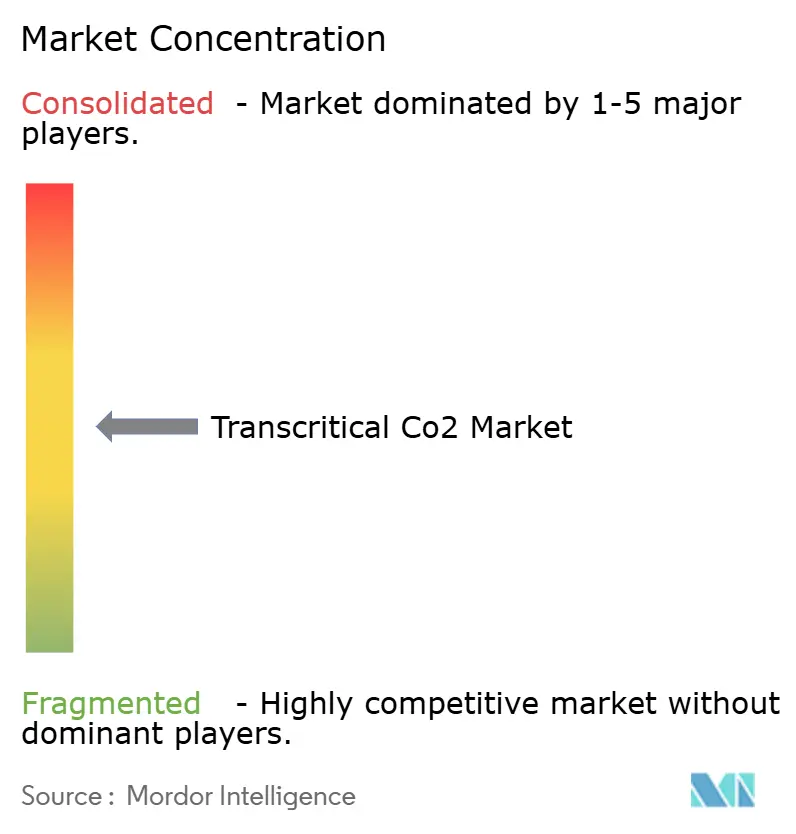
| Market Concentration | Medium |
Major Players *Disclaimer: Major Players sorted in no particular order Image © Mordor Intelligence. Reuse requires attribution under CC BY 4.0. | |
Transcritical Co2 Market Analysis by Mordor Intelligence
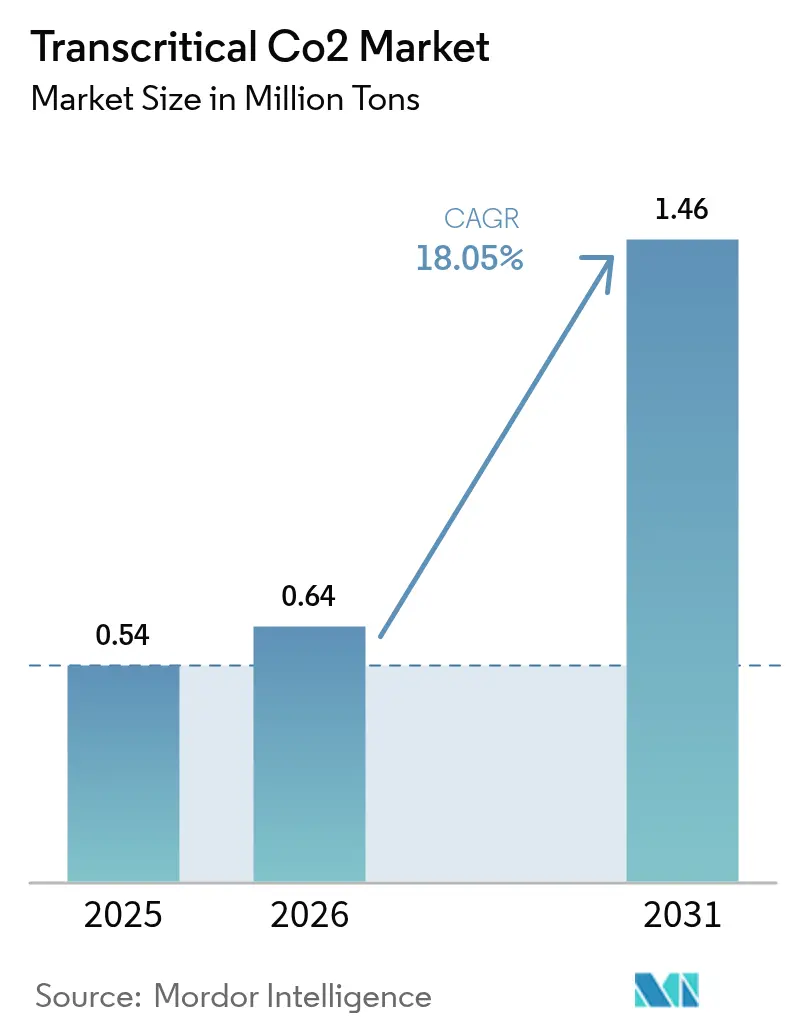
The Transcritical Co2 Market size was valued at 0.54 Million tons in 2025 and estimated to grow from 0.64 Million tons in 2026 to reach 1.46 Million tons by 2031, at a CAGR of 18.05% during the forecast period (2026-2031). This rapid expansion reflects how environmental rules, especially the EU F-Gas Regulation, are driving a wholesale shift toward natural refrigerants with near-zero climate impact. Efficiency gains from ejectors, parallel compression, and liquid-piston compressors are shrinking operating costs, giving end users a clear financial incentive to abandon high-GWP refrigerants. Growth is also fueled by emerging high-temperature heat pumps that push outlet temperatures to 124 °C, opening new industrial process-heat revenue streams and broadening the appeal of the transcritical CO2 market.
Key Report Takeaways
- By component, compressors held a 34.60% revenue share in 2025, while gas coolers exhibited the fastest growth at a 18.6% CAGR.
- By function, refrigeration captured 67.40% of the transcritical CO2 market share in 2025; heating applications are projected to expand at a 18.95% CAGR to 2031.
- By installation type, new-build projects commanded 74.20% of the transcritical CO2 market size in 2025 and continue to lead with a 19.25% CAGR.
- By application, supermarkets accounted for 74.30% share of the transcritical CO2 market size in 2025 and are advancing at a 19.05% CAGR through 2031
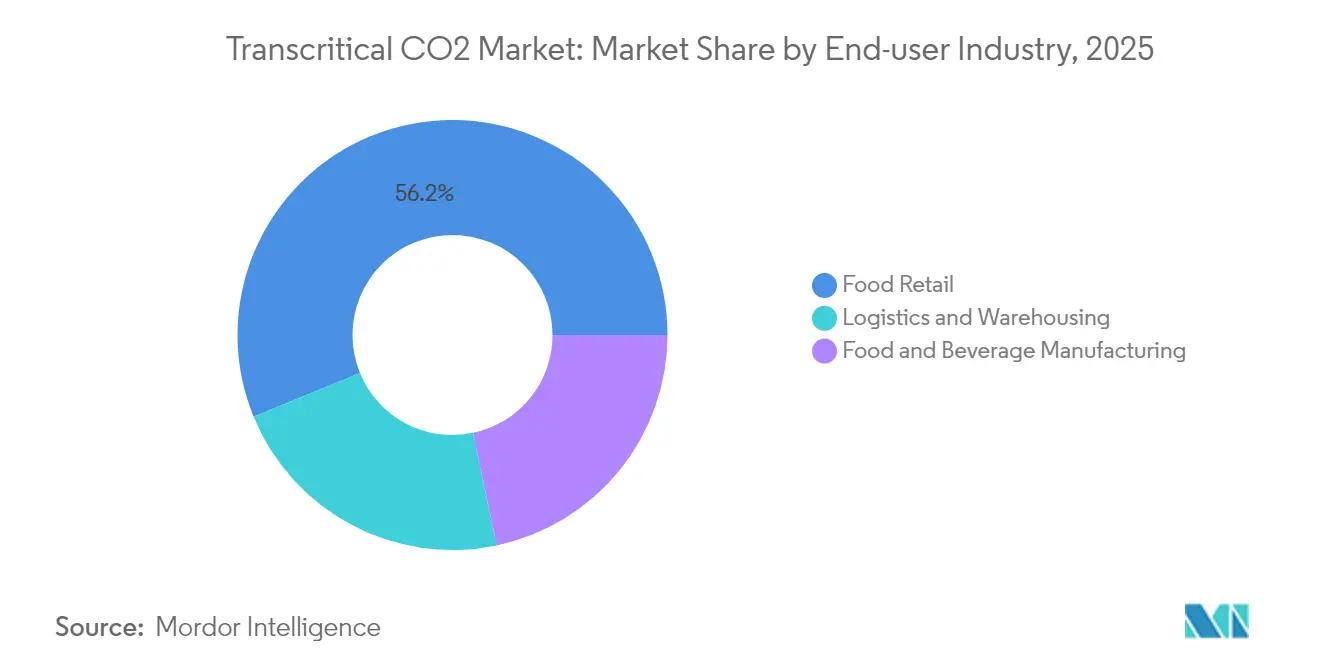
- By end-user industry, food retail dominated with 56.20% share in 2025; logistics and warehousing is the fastest-growing segment at a 18.75% CAGR to 2031.
- By geography, Europe dominated with 77.30% shares in 2025 and is also the fastest growing with an 18.4% CAGR.
Note: Market size and forecast figures in this report are generated using Mordor Intelligence’s proprietary estimation framework, updated with the latest available data and insights as of 2026.
Market Trends and Insights
Drivers Impact Analysis of Transcritical Co2 Market*
| Drivers | (~) % Impact on CAGR Forecast | Geographic Relevance | Impact Timeline |
|---|---|---|---|
| Stringent F-Gas Phase-Down in Europe and Canada | +6.2% | Europe, North America | Short term (≤ 2 years) |
| Increasing Demand from Super Markets and Convenience Stores Segment | +4.8% | Global, with concentration in Europe and North America | Medium term (2-4 years) |
| Rising Demand from Food Processing and Storage Facilities Segment | +3.1% | Global, with emphasis on developed markets | Medium term (2-4 years) |
| Rising demand for natural refrigerants with low environmental impact | +2.9% | Global, with early adoption in Europe | Long term (≥ 4 years) |
| Decreasing costs of CO₂ systems due to scale and innovation | +1.8% | Global | Long term (≥ 4 years) |
| Source: Mordor Intelligence | |||
Stringent F-Gas Phase-Down Accelerates Adoption Timelines
Quota cuts under the EU’s 2024 F-Gas revision have raised HFC prices by up to 400% and forced retailers to accelerate equipment replacement schedules. Similar legislation in Canada and forthcoming AIM Act rules in the United States align global compliance horizons, allowing manufacturers to scale component production and reduce per-unit cost. As supply chains standardize around CO₂ specifications, cross-border equipment certification has become simpler, lowering engineering hours per installation. These synchronized policies have therefore moved transcritical systems from a long-term sustainability option to an immediate business requirement[1]UK Department for Environment Food & Rural Affairs, “F-Gas Regulation in Great Britain,” assets.publishing.service.gov.uk.
Supermarkets Drive Innovation Through Scale and Integration
Chain grocers now specify CO₂ racks with integrated heat reclaim that cool cabinets, warm store aisles, and feed domestic hot-water loops in one circuit. Store retrofits between 2023 and 2025 show energy demand dropping 55-60% when advanced cabinet doors and ejector-assisted parallel compression are combined. Payback periods have narrowed to 3-5 years, creating a replicable template for smaller convenience formats. Modularity requirements from this sector have steered OEM product roadmaps, pushing for plug-and-play gas coolers and condensing units that shorten onsite build times.
Food Storage Facilities Prioritize Temperature Precision and Reliability
Cold rooms using transcritical CO₂ maintain temperature swings within 1 degree Celsius, safeguarding protein, producing quality, and extending shelf life. Operators also appreciate the technology’s ability to multitask from blast freezing at −40 degrees Celsius to chilled storage near 2 degrees Celsius on one central plant, trimming capital outlay and floor space. AI-enabled controls now predict compressor wear, cutting downtime by 35% and keeping throughput constant during peak harvest seasons.
Natural Refrigerants Gain Momentum Beyond Environmental Benefits
With a GWP of 1 and no future phase-out risk, CO₂ offers hedge value against evolving climate policy. Thermodynamic advantages, such as high volumetric capacity, allow smaller compressor frames, while free heat recovery can cover 100% of space-heating loads in temperate regions. Field data from Nordic installations confirm energy savings of up to 30% over optimized HFC systems, even before carbon-price credits are counted.
Restraints Impact Analysis of Transcritical Co2 Market*
| Restraints | % Impact on CAGR Forecast | Geographic Relevance | Impact Timeline |
|---|---|---|---|
| Lack of Awareness About Transcritical CO2 Systems | -1.2% | Global, with emphasis on developing markets | Medium term (2-4 years) |
| High initial installation and equipment costs | -2.4% | Global, more pronounced in price-sensitive markets | Short term (≤ 2 years) |
| Slower adoption outside of Europe due to regulatory gaps | -1.8% | North America, Asia Pacific, Latin America, MEA | Medium term (2-4 years) |
| Source: Mordor Intelligence | |||
Technical Complexity Creates Implementation Barriers
Operating pressures that approach 120 bar demand special piping, valves, and rigorous commissioning processes. A 2024 contractor survey showed 68% citing limited training as their top barrier to bidding on CO₂ jobs. Industry associations have expanded certification programs, yet field capacity still lags demand, extending project timelines in North America and Asia. Digital twin tools are emerging to streamline design, but widespread proficiency is unlikely before 2027.
Initial Cost Premium Challenges ROI Calculations
For small stores or light-industrial sites, a 15-30% capital premium over HFC systems can stall board approval despite favorable lifetime economics. Although component prices have fallen roughly 8-10% per year since 2023, interest-rate volatility keeps payback scrutiny high. Scale economies from Europe’s mature supply chain are gradually spilling into other regions, narrowing cost gaps for 20–200 kW plants. Financial incentives tied to decarbonization targets are further softening the upfront hurdle.
*Our forecasts treat driver/restraint impacts as directional, not additive. The impact forecasts reflect baseline growth, mix effects, and variable interactions.
Transcritical Co2 Market Segment Analysis
By Component:
Gas Coolers Drive Efficiency ImprovementsCompressors commanded 34.60% of 2025 revenue and remain the heartbeat of any rack design. Efficiency leaps, such as Danfoss’s BOCK HGX56 CO₂ T six-cylinder unit, deliver up to 135 kW of cooling while slashing discharge temperatures, lowering service intervals. Yet gas coolers are the fastest mover, growing 18.6% annually as OEMs refine microchannel fin packs and adopt adiabatic sprays that pull peak-summer EER up 25%.
High-pressure electronic expansion valves and adaptive controls now modulate flow at 120 bar with sub-second precision, driving 15-20% annual efficiency gains. Component improvements cascade into system-level performance, broadening the credible climate range of transcritical CO2 market installations and unlocking projects on every continent.




By Function:
Heating Applications Gain Strategic ImportanceRefrigeration remained the anchor of the transcritical CO2 market in 2025, generating 67.40% revenue through thousands of supermarket, warehouse, and process-cooling deployments. Energy-saving upgrades, adiabatic gas coolers, ejectors, and parallel compression have improved warm-climate performance, keeping the segment on a double-digit growth path.
Heating, though smaller, is racing ahead at a 18.95% CAGR as factories and district-energy networks adopt high-temperature heat pumps that hit 124 °C outlet and COP levels above 3. When waste-heat integration is added, effective COP values climb past 5, turning what was a compliance-driven technology into a profitable decarbonization tool.
By Installation Type:
New-Build Dominates Through Design IntegrationDesigning CO₂ infrastructure from day one avoids costly plant-room retrofits and allows architects to reclaim waste heat into HVAC layouts, giving new builds a 74.20% share in 2025. The total installed cost is 15-20% below comparable retrofits because there is no need for temporary cooling plants or phased switchover labor. The segment is expanding at a 19.25% CAGR as greenfield grocery, cold-storage, and industrial projects proliferate worldwide.
By Application:
Supermarkets Lead Adoption and InnovationSupermarkets controlled 74.30% of the 2025 demand, equaling the scale needed to pressure OEMs into serial production and component upgrades. A single 6,780 m² store near Stockholm logged a 55% drop in refrigeration power and a 64% cut in heating energy by switching to an integrated CO₂ rack with heat recover.
Rapid payback, reinforced by carbon-tax relief, means retail chains plan whole-portfolio roll-outs through 2031. The transcritical CO2 market continues to benefit from this predictable multiyear investment cycle, anchoring supply-chain capacity.
By End-User Industry:
Logistics Sector Embraces Precision ControlFood retail delivered 56.20% of total volume in 2025, reinforcing the link between grocery decarbonization targets and transcritical technology. Chains value simultaneously meeting refrigeration, HVAC, and hot-water loads without fossil boilers.
Logistics and warehousing, however, are clocking the quickest growth at 18.75% CAGR. Cold-storage developers specify CO₂ racks to meet stricter ESG investor mandates and hedge against carbon levies. A newly opened 292,000 ft² Minnesota facility combines advanced racks with thermal-storage tanks, flattening demand peaks and securing LEED certification.
Geography Analysis
Europe Transcritical Co2 Market
Europe commanded 77.30% of the 2025 volume, underpinned by the EU’s aggressive HFC phase-down and a mature ecosystem of specialized component makers. The region also posts the highest 18.4% CAGR as district-energy pilots adopt 3–10 MW CO₂ heat pumps connected to municipal networks, demonstrating megawatt-scale viability.
North America and APAC Transcritical Co2 Market
North America is rapidly catching up as AIM Act rules converge with Canadian thresholds, triggering a wave of supermarket rack orders and purpose-built cold stores. Asia Pacific shows mixed progress. Japan’s subsidy programs have driven thousands of convenience-store installations, while China’s first industrial blast-freezers and logistics hubs now trial 1–2 MW CO₂ skids for export cold chains.
South America and MEA Transcritical Co2 Market
South America and MEA remain early-stage; yet proof-of-concept plants, such as a renewably powered fish-cold-store in Cape Verde that cuts emissions 95%, illustrate viability even in hot, grid-constrained locales. Regional training alliances with European OEMs aim to close the skills gap by 2027, setting the stage for broader penetration.
Regulatory Landscape
Regulation is a demand catalyst for transcritical CO2 systems as jurisdictions tighten limits on high-GWP refrigerants while formalizing safety and competence requirements for natural refrigerants. In the European Union, Regulation (EU) 2024/573 reinforces the HFC phase-down trajectory and expands compliance obligations, including requirements around certification and training for personnel handling alternative refrigerants such as CO2. The European Commission is tasked to set minimum requirements for training attestations by 12 March 2026.
In North America, the United States continues implementing the AIM Act through EPA rulemakings and allowance programs that shape refrigerant and equipment decisions. EPA set 2026 HFC production allowances at 229,521,263 MTEVe and consumption allowances at 181,522,990 MTEVe, and issued a final rule on 26 May 2026 that provided targeted relief for several subsectors by extending certain compliance deadlines under the Technology Transitions program. This included an interim GWP limit of 1,400 for retail food remote condensing unit systems effective 27 July 2026, with original stricter limits resuming 1 January 2032. Taken together, these measures keep pressure on lower-GWP solutions and influence the near-term pace of conversions by subsector.
Value Chain Analysis
The transcritical CO2 value chain begins with upstream inputs such as high-pressure steel, copper, and electronic components, then moves into specialized component manufacturing for CO2 duty, including compressors, gas coolers, high-pressure valves, receivers, and electronic controls. OEM and system integrators assemble these into racks, condensing units, and packaged heat-pump solutions. Integrators and OEMs increasingly differentiate through controls software, remote monitoring, and commissioning expertise, before systems pass through installers or contractors and distribution partners to end users in food retail, cold storage and logistics, food processing, and emerging high-temperature heat-pump applications. Recent product activity shows continued industrialization of the chain, including Danfoss launching the Optyma iCO2 condensing unit platform (February 2026) and Zero Zone launching a compact transcritical condensing unit for North America (March 2026).
Compliance and capability requirements create bottlenecks, especially around workforce readiness and adherence to codes and standards for high-pressure systems. EU Regulation 2024/573 raises the bar for training and certification for installers, service technicians, and maintenance providers working with alternative refrigerants such as CO2. Standards such as ANSI/IIAR CO2-2021 guide design, installation, startup, and maintenance practices. As adoption expands beyond Europe, localized technical expertise, code alignment, and commissioning capacity continue to be key constraints that can extend project timelines and increase total installed cost even when equipment availability improves.
Competitive Landscape
The transcritical CO2 market is moderately fragmented. Global leaders like Danfoss, Advansor, and Carrier leverage vertical integration, compressors, valves, and controls to guarantee turnkey compatibility and shorten commissioning. They pour research and development into warm-climate performance, a key differentiator that commands price premiums. Mid-tier specialists, often European, focus on bespoke rack engineering for industrial or marine niches, building reputations on customization rather than volume.
Transcritical Co2 Industry Leaders
Advansor A/S
BITZER Kühlmaschinenbau GmbH
CCR
Danfoss Industries Pvt Ltd
Hillphoenix
- *Disclaimer: Major Players sorted in no particular order
Transcritical Co2 Market Companies Covered in this Report
- Advansor A/S
- ATMOsphere
- BITZER Kühlmaschinenbau GmbH
- Carnot Refrigeration
- CCR
- Danfoss Industries Pvt Ltd
- Emerson Electric Co.
- EVAPCO, Inc.
- FRASCOLD SPA
- Güntner GmbH & Co. KG
- Henry Group Industries
- Hillphoenix
- M & S GmbH Refrigeration and Air Conditioning Technology
- MAYEKAWA MFG. CO., LTD.
- Panasonic Corporation
- Parker Hannifin Corp
- SCM Frigo S.p.A.

Market Opportunities and Future Outlook
Commercial refrigeration still anchors demand, but the opportunity set is widening as OEMs package transcritical CO2 into smaller-format condensing units and standardized racks for new store builds, retrofits, and distributed cold rooms where onsite complexity needs to stay low. North America shows conversion activity that supports this shift, with 6,360 food retail and industrial sites using transcritical CO2 systems across the United States and Canada as of 2025, representing a 28% year-over-year increase. Major retailers including ALDI US, Costco, and Kroger have adopted transcritical CO2 as the primary refrigerant approach for new store construction. Product roadmaps aimed at improving warm-climate performance, such as inverter-driven compressors, ejectors, and advanced controls, are directly tied to expanding beyond historically temperate deployment zones.
Industrial and district-energy heating is the second opportunity lane. CO2 platforms are moving into higher temperature and larger capacity use cases, supported by OEM announcements and deployments that position CO2 as a decarbonization tool rather than only a compliance refrigerant. Regulatory and standards activity also creates structured adoption triggers that favor capable suppliers. In the EU, Regulation (EU) 2024/573 tightens conditions for high-GWP refrigerants while raising certification and training expectations for CO2 handlers, and in the United States, the May 2026 EPA Technology Transitions update under the AIM Act created interim compliance pathways for certain refrigeration subsectors that affect timing and equipment choices. Across regions, these shifts increase demand for documentation, leakage management, commissioning quality, and lifecycle service models, creating openings for OEMs and integrators that can bundle equipment with controls, monitoring, and certified field support.
Recent Industry Developments in Transcritical Co2 Market
- June 2026: Danfoss published results highlighting 21% total energy savings in transcritical CO2 booster systems using Multi Ejector High Pressure technology combined with parallel compression versus traditional systems. The documented performance supports broader acceptance of ejector-based architectures in warm-climate applications, where efficiency has been a key adoption barrier.
- May 2026: BITZER and partners advanced localization of next-generation compressor technology through the BITZER-CIGTech Centrifugal Compressor (Nanjing) Co., Ltd. joint venture, with official registration and approval reported on May 14, 2026. The change strengthens regional development and supply capability for advanced compressors, which can influence cost, lead times, and platform expansion for natural refrigerant systems.
- March 2026: Advansor announced the SteelXL Heat Pump, a CO2 (R744) system offering up to 5 MW heating capacity per unit and scalability to 50 MW in parallel installations. The launch broadens transcritical CO2 participation in large-scale heating and process-heat use cases, extending the market beyond its supermarket-led refrigeration base.


Transcritical Co2 Market Report Scope and Research Methodology
Market Definition and Coverage
For this methodology, the market covers transcritical CO2 systems used for refrigeration, heating, and heat-pump duties where the cycle operates above CO2 critical conditions, along with core packaged system components sold with these installations.
Scope exclusions: We exclude portable CO2 cylinders and applications where CO2 is used only in subcritical cascade or booster configurations.
Segments Covered in This Report
- By Component
- Compressors
- Gas Coolers
- Valves and Controls
- By Function
- Refrigeration
- Heating
- Air-Conditioning
- By Installation Type
- New-Build
- Retrofit
- By Application
- Commercial Refrigeration
- Industrial Refrigeration
- Super Markets
- Others
- By End-User Industry
- Food Retail
- Food and Beverage Manufacturing
- Logistics and Warehousing
- By Geography
- Asia Pacific
- China
- Japan
- India
- South Korea
- Australia and New Zealand
- Rest of Asia Pacific
- North America
- United States
- Canada
- Mexico
- Europe
- Germany
- United Kingdom
- Italy
- France
- Rest of Europe
- South America
- Brazil
- Argentina
- Rest of South America
- Middle East and Africa
- Saudi Arabia
- South Africa
- Rest of Middle East and Africa
- Asia Pacific
Data Sources, Market Sizing, and Validation
Desk Research
Desk research was used to set the market boundary, build the adoption context, and anchor demand drivers for transcritical CO2 expansion or pauses. We relied on public regulatory and technical signals such as European Commission F-gas rulemaking and national environmental agency guidance, along with standards references like ISO and ASHRAE publications.
To keep the sizing grounded, we also reviewed open sources such as UN Comtrade trade statistics for relevant equipment flows, energy and emissions datasets from sources such as the IEA, and peer-reviewed refrigeration journals that track efficiency improvements like ejectors and parallel compression. Company annual reports, investor presentations, association websites, and reputable trade press were then used to cross-check recent project activity and pricing direction. Where needed, paid subscriptions were used for company financials and intelligence, patent lookups, and shipment-level import and export cross-checks. These examples are not exhaustive, and many other sources were consulted to collect data, validate assumptions, and clarify open questions.
Primary Interviews and Surveys
Primary work focused on validating what is getting installed, where it is being deployed, and how pricing moves with ambient design packages and component availability. We engaged a mix of system OEMs, component suppliers, contractors, consultants, and end users across major regions so the adoption curve in food retail and cold chain was not overgeneralized from one geography.
Inputs from interviews also helped confirm conversion rates from legacy HFC systems, typical system capacity ranges, and realistic commissioning timelines for installed projects.
Distribution of primary research fieldwork respondents
| Company type | Respondent position | Region |
|---|---|---|
| Top tier: 35% | CXOs: 12% | APAC: 44% |
| Mid tier: 46% | Functional/Unit leaders: 33% | EMEA: 30% |
| Smaller Players: 19% | Managers: 55% | Americas: 26% |
Market-Sizing & Forecasting
Sizing starts with a top-down build that reconstructs demand from the addressable equipment pool being converted to natural refrigerants, which is then filtered by transcritical suitability by application and climate. In practice, we link the demand pool to indicators such as supermarket store additions and remodel rates, cold storage and food processing capacity additions, and policy pressure from refrigerant phase-down schedules.
The totals are then checked using selective bottom-up approximations, mainly sampled system ASPs multiplied by estimated installation volumes, plus channel checks on key component runs like compressors, gas coolers, valves, and controls. When interviews indicated that some projects were being counted twice across packaged systems and component value, the model was tightened so each installation contributes only once to the final total. For forecasting, scenario analysis was used because adoption depends on step-change variables including high-ambient performance package uptake, contractor readiness, electricity price direction, and the pull from high-temperature industrial heat-pump projects. Any gaps in country-level visibility were handled by using regional proxy ratios tied to known retail and cold chain footprints, and then re-tested with expert feedback before finalizing.
Data Validation & Update Cycle
Outputs are validated through several checks so extreme values do not slip through. We compare model results with independent signals such as policy milestones, commissioning pipelines, and the implied component intensity per installed system, and then investigate any large variance before sign-off.
A second analyst reviews key assumptions like conversion rates, ASP progression, and the split between refrigeration and heat-pump demand, and re-contact is triggered when responses conflict on a major driver. Reports are refreshed annually, with interim updates when there are material regulatory changes, large project announcements, or supply disruptions. Before delivery, a final pass is performed so clients receive the most current view based on the latest available inputs.
Mordor Intelligence's Transcritical Co2 Market Size Measured Against Other Published Estimates
Published estimates for this market can look far apart because authors do not always size the same thing, even when the title sounds identical. Differences usually come from whether the measure is volume or revenue, which applications are counted, and how installation pace is converted into a yearly market total.
Key gap drivers here include whether subcritical CO2 cascade systems are bundled into the total, whether service and retrofit revenue is mixed with new installations, and how high-ambient design upgrades are priced over time. The spread can also be widened by currency timing and refresh cadence, since policy dates and supermarket rollout plans can change quickly.
Benchmark comparison
| Source | Market Size | Gaps in Research Methodology |
|---|---|---|
| Mordor Intelligence | USD 0.64 M (2026) | |
| Trade Journal A | USD 2.45 B (2025) | Reported as revenue for refrigeration systems only, which omits heating and industrial heat-pump applications and can also mix in aftermarket revenue streams that are not tied to new installations. |
| Industry Research Desk B | USD 2.30 B (2024) | Uses a revenue frame with broader system definitions and faster assumed uptake in warm-climate regions, and it is less explicit on excluding subcritical cascade configurations. |
The table shows that the widest gaps come from unit choice and scope, not from a single math step. By keeping the demand pool tied to new transcritical installations and then checking it against component intensity and conversion indicators, the final total stays traceable to clear inputs. That is why the tonnage path of 0.64 million tons in 2026 to 1.46 million tons by 2031 is kept separate from revenue-style totals in Mordor Intelligence.


Key Questions Answered in the Report
What is driving the rapid growth of the transcritical CO2 market?
Regulatory phase-downs of high-GWP refrigerants, supermarket demand for integrated heating and cooling, and efficiency gains from new component designs are propelling an 18.05% CAGR through 2031.
How large will the transcritical CO2 market be by 2031?
The transcritical CO2 market size is projected to reach 1.46 million tons by 2031, more than doubling its 2025 level.
Which application segment holds the largest share today?
Supermarkets lead with a 74.30% share in 2025 because integrated CO₂ racks meet refrigeration, space-heating, and hot-water needs in one system.
Why are gas coolers the fastest-growing component?
Heat-rejection performance limits overall efficiency; advances in microchannel fins and adiabatic pre-cooling add up to 25% energy savings, making gas coolers a 18.6%-CAGR segment.
What restrains adoption outside Europe?
High upfront cost premiums and a shortage of technicians trained to work at 120 bar pressures slow uptake, especially in developing regions.
Page last updated on:


 Your data is secure and never sold or shared.


