
Europe Titanium Dioxide Market Size and Share
Market Overview
| Study Period | 2020 - 2031 |
|---|---|
| Forecast Data Period | 2026 - 2031 |
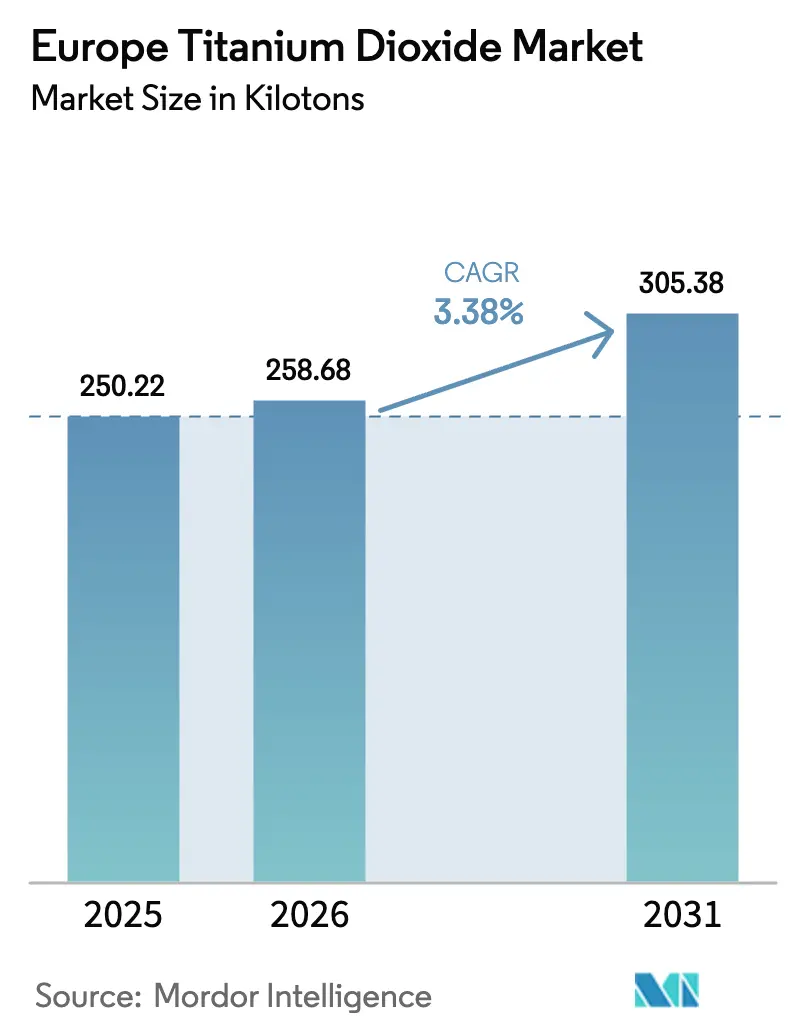
| Base Year Market Size (2025) | 250.22 kilotons |
| Market Volume (2026) | 258.68 kilotons |
| Market Volume (2031) | 305.38 kilotons |
| Growth Rate (2026 - 2031) | 3.38 % |
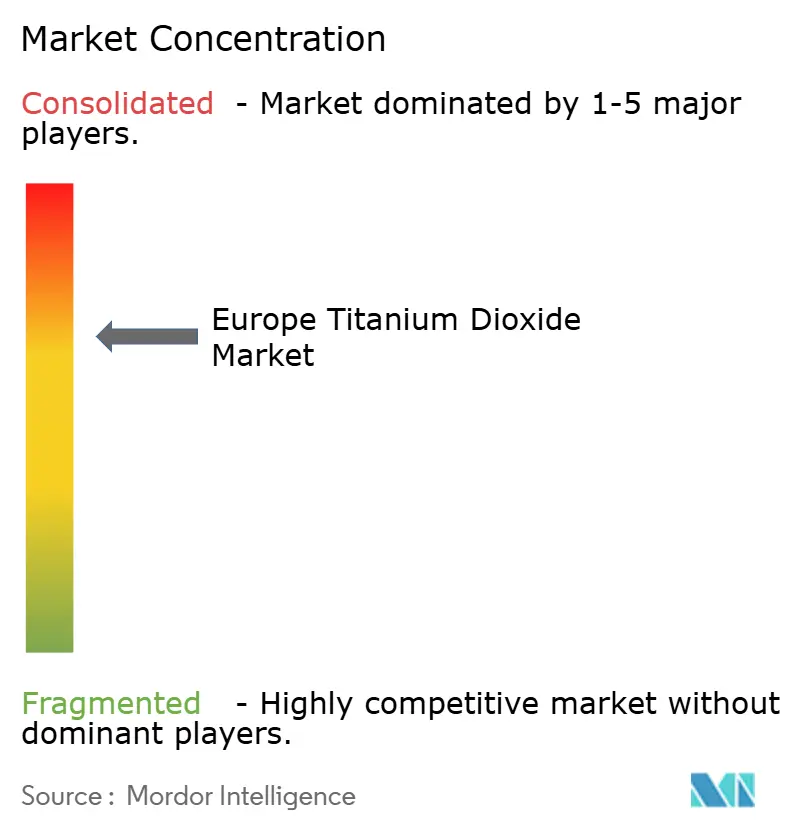
| Market Concentration | Medium |
Major Players *Disclaimer: Major Players sorted in no particular order Image © Mordor Intelligence. Reuse requires attribution under CC BY 4.0. | |
Europe Titanium Dioxide Market Analysis by Mordor Intelligence
The Europe Titanium Dioxide Market size was valued at 250.22 kilotons in 2025 and estimated to grow from 258.68 kilotons in 2026 to reach 305.38 kilotons by 2031, at a CAGR of 3.38% during the forecast period (2026-2031). Capacity rationalization now overlaps with stringent environmental mandates, shifting demand toward chloride-route, high-purity grades that satisfy Nordic Swan and ISO 50001 requirements. Venator’s closure of 130,000 tonnes of sulfate lines and Tronox’s 90,000-tonne Botlek shutdown illustrate how Western producers cede share to premium chloride units even after the January 2025 anti-dumping duties on Chinese imports. Nano and ultrafine TiO₂ grades are expanding at 5.18% annually as self-cleaning façade coatings and medical-device coatings grow under the EU Renovation Wave and EMA rulings, adding a specialty tailwind that partly offsets contraction in commodity volumes.
Key Report Takeaways
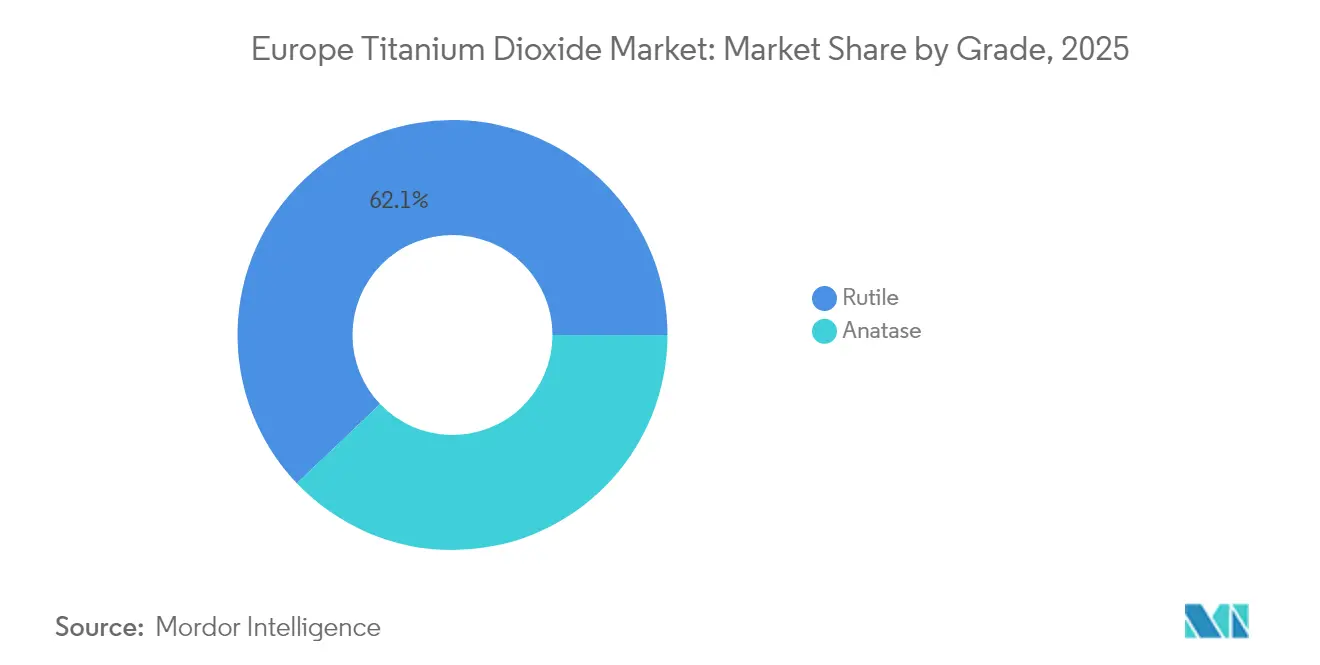
- By grade, rutile held 62.12% of the Europe titanium dioxide market share in 2025, while nano and ultrafine grades are advancing at a 4.96% CAGR through 2031.
- By production process, the chloride route commanded 57.86% of the Europe titanium dioxide market size in 2025, and its output is projected to grow at a 4.12% CAGR to 2031.
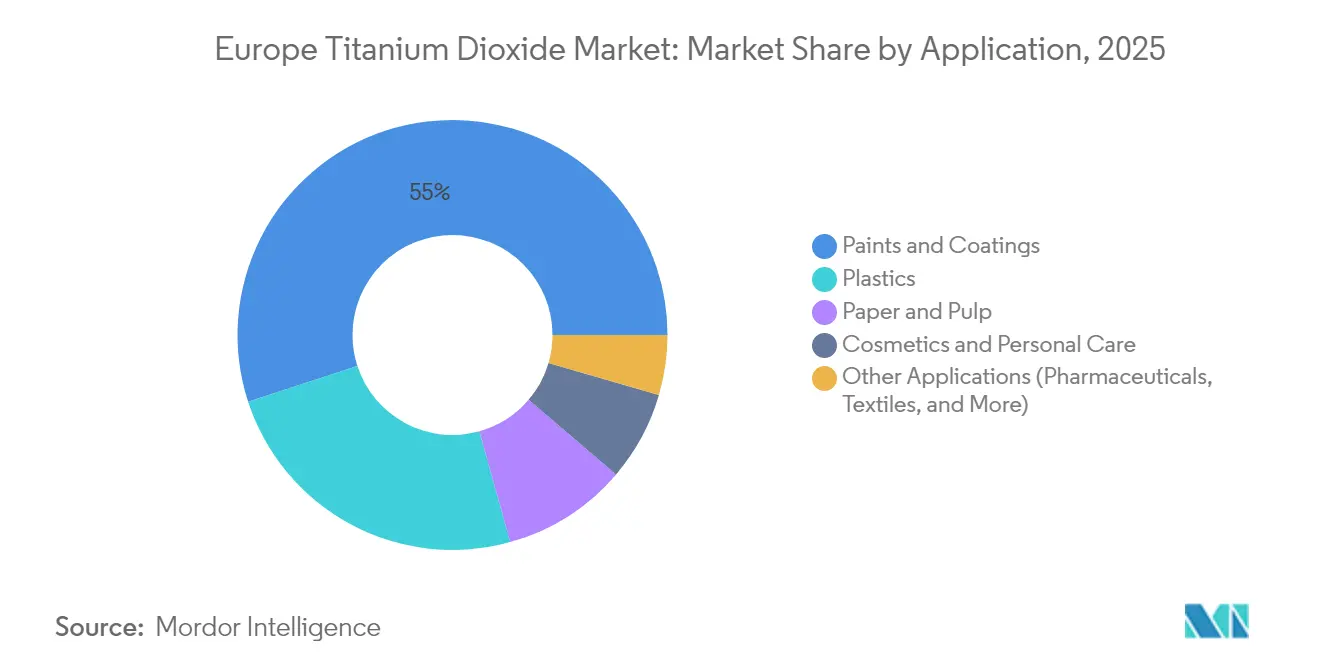
- By application, paints and coatings accounted for 55.02% of the Europe titanium dioxide market size in 2025; cosmetics and personal care are growing the fastest at a 5.12% CAGR.
- By geography, Germany led with 18.96% of the Europe titanium dioxide market share in 2025, whereas the Nordics represent the quickest riser at a 4.58% CAGR to 2031.
Note: Market size and forecast figures in this report are generated using Mordor Intelligence’s proprietary estimation framework, updated with the latest available data and insights as of 2026.
Worldwide, activity is shaped by contributions from multiple regions, with Europe representing one of the more structurally developed among them. The global report on titanium dioxide market by Mordor Intelligence reflects how these regional layers combine into a single system.
Europe Titanium Dioxide Market Trends and Insights
Drivers Impact Analysis*
| Driver | (~) % Impact on CAGR Forecast | Geographic Relevance | Impact Timeline |
|---|---|---|---|
| Construction-driven demand for high-performance paints and coatings | +0.9% | Germany, France, Nordics, Spain, Italy | Medium term (2-4 years) |
| Lightweight durable plastics boosting TiO₂ loadings | +0.6% | Germany, France, Italy | Medium term (2-4 years) |
| Shift to chloride-process premium grades for sustainability | +0.7% | Nordics, Germany | Long term (≥ 4 years) |
| EU Renovation Wave spurring photocatalytic facades | +0.5% | Germany, France, Nordics, Spain | Medium term (2-4 years) |
| Ultrafine rutile in medical-device and drug-delivery coatings | +0.3% | Germany, France, United Kingdom | Long term (≥ 4 years) |
| Source: Mordor Intelligence | |||
Construction-Driven Demand for High-Performance Paints and Coatings
Architectural coatings retain a roughly 56% share of Europe’s paints segment, making TiO₂ indispensable for opacity and weather resistance[1]Fédération Française des Industries des Peintures, “Coatings Cost Index 2025,” fipec.org. The EU Renovation Wave, aimed at a 40% cut in building emissions by 2030, channels subsidies toward high-hiding‐power façade coatings that lower life-cycle paint use. France’s electricity costs, while down 40% year-over-year to EUR 58/MWh in 2024, are still 80% above 2019 levels, nudging formulators to favor durable TiO₂-rich recipes rather than cheaper extenders. German green-building incentives prioritize photocatalytic coatings that decompose NOx, a niche requiring TiO₂ loads of more than 3% to comply with ISO 50001. Finnish producer Teknos has requested an 18-month phase-in of anti-dumping duties, warning that sudden cost spikes on Chinese TiO₂ would slow waterborne repaint projects.
Lightweight Durable Plastics Boosting TiO₂ Loadings
The automotive shift to glass-fiber-reinforced polyolefins and the proliferation of thin, high-opacity packaging films are increasing TiO₂ concentrations in masterbatches. Volkswagen and Stellantis specify 2%–4% TiO₂ in interior trims to meet color-fastness targets in electric vehicles manufactured in Germany and France. Recycled polymer lines, accounting for 89 kilo tonnes of 2024 output, also rely on TiO₂ to blend post-consumer feedstocks into a uniform white base. EU single-use plastic rules are driving the use of thinner films, which require higher pigment loadings to maintain shelf appeal. Chloride-route pigment, which generates at most 329 kg of waste per tonne, increasingly displaces sulfate grades in REACH-compliant automotive supply chains.
Shift to Chloride-Process Premium Grades for Sustainability Compliance
The Europe titanium dioxide market is tilting toward chloride units because they consume 20% less energy and skirt sulfate acid-waste disposal. Nordic Swan limits sulfate emissions to 7 kg SOx/tonne, a threshold most legacy plants breach, prompting Tronox and Venator to close 220,000 tonnes of sulfate capacity since 2024. Chemours’ decision to pair TiO₂ with an on-site 340,000-tonne chlorine plant illustrates how vertical integration is becoming mandatory for cost control. Chinese chloride output decreased to 13.91% of its 2024 total, highlighting technical hurdles that provide European producers with a premium-price window. Germany’s VdMi forum is meanwhile uniting producers around a chloride-advocacy platform to shore up competitiveness.
EU Renovation Wave Spurring Photocatalytic Self-Cleaning Facades
Anatase TiO₂ coatings cut NOx by up to 60% under UV, according to 2024 TU Wien trials, fitting the Renovation Wave’s air-quality goals. Europe’s photocatalytic coatings market now totals USD 659 million, with titanium dioxide (TiO₂) comprising 70% of the active ingredients. Municipal tenders in Germany, France, and the Nordics typically accept a 15%–25% cost premium, as maintenance savings offset the higher purchase prices. Coatings containing more than 3% TiO₂ must demonstrate ISO 50001 energy management compliance, driving demand for chloride rutile that meets stricter waste caps[2]Nordic Ecolabelling, “Criteria for Indoor Paints and Varnishes (2024),” nordic-ecolabel.org. VTT’s EUR 1.3 million CELLIGHT program, which studies cellulose-based alternatives, underscores how regulators continue to push incumbents for additional environmental proof points.
Restraints Impact Analysis*
| Restraint | (~) % Impact on CAGR Forecast | Geographic Relevance | Impact Timeline |
|---|---|---|---|
| Toxicity perception and tightening REACH/CLP rules | -0.5% | Germany, France, Nordics | Short term (≤ 2 years) |
| Volatile prices for ilmenite, rutile, and energy | -0.4% | Germany, France, Italy | Short term (≤ 2 years) |
| Chlorine availability pressure on chloride units | -0.2% | Germany, Netherlands, UK | Medium term (2-4 years) |
| Source: Mordor Intelligence | |||
Toxicity Perception and Tightening REACH/CLP Classification
ECHA’s 2021 inhalation-hazard label on TiO₂ now forces any powder product exceeding 1% content to carry a cancer warning, denting consumer confidence in wall paints and cosmetics. Germany’s 2022 ban on food-grade E171 amplified public concern, encouraging brands like AURO to unveil TiO₂-free paints despite lower opacity. Lavera and other cosmetics players followed by launching TiO₂-free foundations in 2024, even though SCCS confirmed skin safety the same year. Occupational safety mandates in France and Germany now require respirators in powder units, which increases compliance costs and nudges coatings producers toward liquid dispersions. Green-building labels further reward partial TiO₂ substitution with calcium carbonate, cutting embodied carbon 15%–20% at the expense of visual brightness.
Volatile Prices for Ilmenite, Rutile and Energy
Norway’s 360,000-tonne ilmenite output serves under 5% of European pigment needs, while Ukraine’s conflict-hit mines delivered just 120,000 tonnes of ilmenite and 10,000 tonnes of rutile in 2024, tightening feedstock supply. Natural-gas prices of EUR 36/MWh in France—triple the 2019 baseline—inflate sulfate-route costs, which are already 20% more energy-intensive than those of the chloride route. Fipec notes that 2024–2025 TiO₂ pigment invoice levels remain 30%–40% above pre-COVID averages, leaving paint makers to choose between margin erosion and end-market price hikes. Russian titanium worth USD 244 million continued to flow to the EU in 2023, exposing Germany, France, and the United Kingdom to supply-chain criticism despite sanctions rhetoric. Titanor’s Kokkola project may yield 1.6 million tonnes of ore annually but awaits EUR 85–110 million in financing and stringent tailings approval, meaning reliance on imports will persist through the forecast.
*Our forecasts treat driver/restraint impacts as directional, not additive. The impact forecasts reflect baseline growth, mix effects, and variable interactions.
Segment Analysis
By Grade: Nano Innovations Challenge Rutile Dominance
Rutile controlled 62.12% of the Europe titanium dioxide market in 2025 thanks to superior opacity and weather fastness required in exterior paints and plastics. Nano and ultrafine pigments are projected to grow at a 4.96% CAGR, driven by self-cleaning coatings and pharmaceutical demand, which supports premium prices that cushion revenue despite their smaller tonnage base. Chloride-route rutile is priced 10%–15% higher than sulfate rivals due to its tighter particle distribution and lower impurity levels, attributes that are highly valued by automotive OEMs for achieving high-gloss finishes. The Europe titanium dioxide market size for rutile applications is forecast to expand steadily even as substitution pressure nudges commodity interior grades toward calcium carbonate extenders.
Anatase retains relevance in photocatalytic façades because its surface energy accelerates NOx oxidation, a function validated by TU Wien’s 2024 tests, which showed 40%–60% pollution removal. Yet economic headwinds stifle new sulfate-anatase investment after Venator mothballed its Duisburg and Scarlino units. VTT’s cellulose-based CELLIGHT concept illustrates a long-term threat across all grades but faces functional gaps in opacity, UV shielding, and chemical inertness that TiO₂ uniquely provides. Thus, rutile should hold core share while nano segments erode margin dilution by capturing specialty demand under stricter EU ecolabels.



By Production Process: Chloride Routes Gain Amid Sulfate Retreat
Chloride operations supplied 57.86% of the Europe titanium dioxide market in 2025 and are expanding 4.12% yearly, outpacing sulfate’s sub-3% advance as waste-acid fees soar and energy costs linger above pre-2019 benchmarks. Europe titanium dioxide market size for chloride grades will widen as producers retrofit ISO 50001 and secure captive chlorine streams, illustrated by Chemours partnering PCC for an integrated chlor-alkali line.
Sulfate capacity rationalization has removed over 220,000 tonnes since 2024, leaving a smaller, higher-utilization base that still struggles under Nordic Swan’s 7 kg SOx ceiling. Chinese competition remains acute, yet anti-dumping margins of EUR 0.25–0.74/kg provide modest breathing space for Europe’s premium chloride segments. Feedstock flexibility once favored sulfate, but geopolitical disruptions to Ukrainian ilmenite and rising disposal levies erode that edge, making further shutdowns likely near term.
By Application: Cosmetics Surge as Paints Plateau
Paints and coatings consumed 55.02% of Europe titanium dioxide market size in 2025, but growth hovers in low single digits because extenders like calcium carbonate nibble at loading rates. In contrast, cosmetics and personal care are growing at a rate of 5.12% per year, buoyed by the SCCS clearance of nano-TiO₂ and a consumer shift to mineral sunscreens following the 2022 E171 food-grade ban. Europe titanium dioxide market share gains in cosmetics cushion overall revenue and improve mix toward higher-margin ultrafine grades.
Plastics account for roughly a quarter of the volume, supported by automotive lightweighting and flexible packaging. TotalEnergies’ 9,111 kilo-tonne petrochemical platform embeds TiO₂ in both virgin and recycled resins, sustaining dependable offtake. Pharmaceuticals remain a niche yet secure pillar, following the EMA's maintenance of TiO₂ authorization in October 2025. Paper coatings are declining as digital media expands, yet specialty papers in luxury packaging partially offset the contraction, leaving overall demand divergent across end-use sectors.
Geography Analysis
Germany’s 18.96% share underscores its twin status as Europe’s largest TiO₂ producer and consumer, anchored by 339,000 tonnes of chloride capacity serving automotive and construction clusters. VdMi’s 2024 summit crystallized German leadership in chloride advocacy, while AURO’s TiO₂-free paint launch demonstrates how localized consumer green sentiment is influencing pigment demand.
France hosts Europe’s second-largest coatings base, but elevated power tariffs and Fipec-reported 30%–40% pigment cost inflation squeeze margins, inducing producers to favor higher-coverage TiO₂ grades over extender dilution. Tronox’s shift in focus away from its Thann unit to battery materials further tightens French supply. The United Kingdom’s 315,000-tonne chloride capacity provides high-purity pigment to local aerospace and healthcare sectors, yet faces cost pressure after Venator’s asset disposals. The Nordics lead growth at 4.58% annually as green-building codes, photocatalytic coatings, and cellulose substitution projects gain state backing. Norway’s ilmenite mines and Finland’s prospective Kokkola project aim to cut import dependency, though environmental permitting delays linger. Italy and Spain round out Southern Europe demand via packaging and textiles, while ongoing Russian exports highlight geopolitical complexity when sanctions clash with supply security.
Mordor Intelligence provides coverage of the titanium dioxide market across other key regional markets, including North America, each with their regulatory frameworks and demand patterns.
Regulatory Landscape
Titanium dioxide placed on the EU market remains governed by REACH registration obligations and downstream communication duties, alongside CLP labeling and packaging rules that shape how powdered pigments and TiO2-containing mixtures are marketed across paints, plastics, and cosmetics supply chains. A key recent inflection point was the Court of Justice of the European Union decision in August 2025 confirming the annulment of the harmonized classification of titanium dioxide powder as suspected carcinogenic (Category 2). ECHA then removed the classification from its C&L Inventory, which reduced immediate labeling pressure for powder forms.
On the trade side, definitive anti-dumping duties were imposed on titanium dioxide imports originating in China via Commission Implementing Regulation (EU) 2025/4 dated 17 December 2024. This provides a policy backstop for European producers while also increasing compliance and documentation requirements for importers and distributors. Sustainability-linked compliance also affects procurement, since Nordic Swan criteria and ISO 50001 energy-management requirements are used by some buyers and ecolabel schemes to screen pigments and finished coatings. This reinforces the shift toward lower-waste, chloride-route grades highlighted in the report scope.
Value Chain Analysis
Europe's titanium dioxide value chain starts with mined titanium feedstocks (ilmenite and rutile) and chemical inputs, notably chlorine for chloride-route units and sulfuric acid for sulfate-route units. After pigment manufacturing, the material moves through finishing (surface treatment and milling) and into distribution for large-volume end users such as paints and coatings, plastics masterbatch and compounders, paper, and specialty applications in cosmetics and pharmaceuticals. The Titanium Dioxide Manufacturers Association (TDMA), operating as a sector group within Cefic, supports shared sustainability and safety messaging and coordinates with EU regulatory processes that affect both producers and downstream formulators.
European supply-chain structure has also been reshaped by asset realignment following Venator Materials PLC's 2025 insolvency. LB Group acquired the Greatham (UK) TiO2 site, Indorama Corporation acquired the Huelva (Spain) site, and International Chemical Investors Group (ICIG) took over the Duisburg (Germany) facility. These ownership changes influence how production is integrated with logistics, customer qualification, and capital availability for compliance upgrades, while Europe still relies on imported feedstocks due to limited ore coverage relative to pigment demand.
Competitive Landscape
The Europe Titanium Dioxide market is moderately consolidated, with Kronos, Tronox, and Venator spearheading 2023’s anti-dumping petition that yielded January 2025 tariffs on Chinese imports. Capacity rationalization is the prime lever: Tronox eliminated 90,000 tonnes at Botlek in 2025, and Venator shuttered 130,000 tonnes at Duisburg and Scarlino in 2024 before divesting its LPC unit to Kronos for USD 185 million. Smaller players such as Cinkarna Celje, Grupa Azoty, and Precheza carve regional niches through ISO 50001 compliance, particularly in the Nordics, where ecolabel criteria strictly favor low-carbon pigments. Chinese producers maintain price pressure globally, but technical limits in chloride scaling and EU duties afford European suppliers a premium corridor in high-purity grades.
Europe Titanium Dioxide Industry Leaders
The Chemours Company
Venator Materials PLC
Kronos Worldwide, Inc.
Tronox Holdings plc
LB Group
- *Disclaimer: Major Players sorted in no particular order

Market Opportunities and Future Outlook
Product and process opportunities in Europe are concentrated at the intersection of compliance and performance, where customers are increasingly specifying higher-purity pigments to pass stricter ecolabel and energy-management screening. Nordic Swan criteria and ISO 50001-linked requirements are used in certain coating tenders and green-building programs, which, within the report scope, points to whitespace for chloride-route, low-waste grades and for specialty nano and ultrafine TiO2 used in self-cleaning facade coatings and regulated healthcare applications. This demand backdrop is supported by in-market programs such as the EU Renovation Wave and continued EMA authorization referenced in the report context.
Supply-side restructuring also creates opportunities for re-qualification, distribution, and tolling tied to European assets that changed hands, including the Greatham (UK) site acquired by LB Group and the Duisburg (Germany) facility taken over by ICIG after Venator's insolvency. As downstream buyers rebalance supplier portfolios, these changes can open room for qualified second-source supply and process-tailored service. Trade measures add another lever: the EU's definitive anti-dumping duties on Chinese TiO2 under Commission Implementing Regulation (EU) 2025/4 (dated 17 December 2024) increase the value of reliable regional supply and application support, particularly for coatings and plastics customers managing both cost and compliance risk across powder handling, labeling, and sustainability disclosure.
Recent Industry Developments
- April 2026: LB Group finalizes acquisition of Venator Materials PLC's Greatham titanium dioxide site and assets, planning restart in 2026 under the new name Tioxide. The acquisition expands direct market capacity and strengthens footprint in Europe, supporting supply security. It also enhances chloride-process capability and aligns production away from older sulfate assets, contributing to capacity rationalization in the region.
- April 2026: The Chemours Company closes a substantial portion of the sale of its former Kuan Yin titanium dioxide site. The sale activity directly affects European and international TiO2 capacity alignment and market structure. It improves Chemours' balance sheet and enables focus on core assets while reducing the overhang from legacy sites in the Asian supply chain.
- February 2026: Tronox Holdings plc implements global price increases of 2% to 4% for the first quarter of 2026. The pricing action reflects ongoing supply side discipline in the TiO2 market and supports margin preservation amid softer demand. It signals continued price discipline and potential regional pricing drift as markets adjust to structural shifts.


Research Methodology Framework and Report Scope
Market Definition and Coverage
For this study, the market covers titanium dioxide (TiO2) supplied and consumed across Europe for pigment and related end uses, measured in volume terms and tracked through major consuming industries and production routes.
Scope exclusions: The sizing excludes downstream finished goods value and counts only TiO2 volumes, not the value of paints, plastics, paper, or cosmetics that use it.
Segmentation Overview
- By Grade
- Rutile
- Anatase
- By Production Process
- Sulfate
- Chloride
- By Application
- Paints and Coatings
- Plastics
- Paper and Pulp
- Cosmetics and Personal Care
- Other Applications (Pharmaceuticals, Textiles, Food Colorants, etc.)
- By Geography
- Germany
- United Kingdom
- France
- Italy
- Spain
- Nordics Countries
- Russia
- Rest of Europe
Data Sources, Market Sizing, and Validation
Desk Research
Desk research is used to set the structure of the market model and to anchor Europe level demand signals that can be checked year after year. We refer to public statistics and technical references such as Eurostat trade and industrial output series, European Commission policy and chemicals related updates, ECHA publications, and customs tariff notes that affect pigment flows and compliance requirements.
To keep assumptions realistic, we also review company annual reports and investor presentations for capacity moves, plant shutdowns, and major maintenance cycles that can tighten supply. Peer reviewed chemistry and materials journals are used to understand grade shifts between rutile and anatase and the practical differences between sulfate and chloride routes. For cross checks, we selectively use paid subscriptions focused on company financials and intelligence, patent databases, and shipment level import and export records where they are relevant. The desk sources listed above are illustrative, and many other public and paid references are used to collect, validate, and clarify data points.
Primary Interviews and Surveys
Primary work is used to validate how TiO2 volumes move through paints and coatings, plastics, paper, and specialty uses, and to pressure test any desk based assumptions that look too smooth. We speak with producers, distributors, compounders, formulators, and large end users across key European countries so the model reflects actual ordering patterns, typical contract timing, and near term substitution behavior.
Feedback is also taken on pricing direction, operating rates, and compliance driven grade migration so the final numbers follow real market behavior rather than a single dataset trend.
Distribution of primary research fieldwork respondents
| Company type | Respondent position |
|---|---|
| Top tier: 33% | CXOs: 15% |
| Mid tier: 47% | Functional/Unit leaders: 26% |
| Smaller Players: 20% | Managers: 59% |
Market-Sizing & Forecasting
Sizing starts with a top-down rebuild of the Europe demand pool using production context, trade flows, and end use output indicators that explain how much TiO2 is realistically needed. Those totals are then corroborated using selective bottom-up approximations, such as supplier volume cues from interviews, distributor channel checks, and sampled consumption logic that links application level volumes to typical dosage ranges.
Inputs used in the model include Europe paints and coatings activity signals, plastics conversion trends, paper and pulp production direction, import penetration and export outflows for TiO2, and the shift in production mix between sulfate and chloride routes. Grade movements (rutile versus anatase) are also tracked because they change where volumes land by application, especially as regulations and performance needs evolve. When a country level split is thin, we use proportional allocation based on trade shares and validated consumption indicators, then adjust it after expert feedback.
Forecasts are built using scenario analysis supported by short cycle indicators, followed by an exponential smoothing pass to avoid overreacting to one-off shocks. The final forecast is accepted only after assumptions on capacity changes, utilization, and end market direction are aligned with what industry respondents expect for the next planning cycle.
Data Validation & Update Cycle
Validation is done through multiple checks that compare the modeled volumes with independent signals like trade balances, operating rate commentary, and end use output direction. We review unusual jumps by country or application, and if a variance cannot be explained by a real event (for example, a plant outage or a sudden demand pause), assumptions are revisited and the model is rerun.
Before sign-off, the work is reviewed in steps so calculation logic, unit conversions, and country rollups are consistent and traceable. Experts are re-contacted when a key assumption changes or when a new policy or capacity event could alter flows. Reports are refreshed annually, and interim updates are made when material events occur, followed by a final pre-delivery pass to ensure clients receive the latest view.
Mordor Intelligence's Europe Titanium Dioxide Market Size Compared With Other Published Estimates
Published estimates for Europe TiO2 often spread out because not everyone measures the same thing, and because some sources mix volume and value without stating the conversion logic. Differences also come from the set of countries treated as Europe, the way imports and re-exports are handled, and whether the focus is on pigment grade only or includes adjacent titanium chemicals.
Some external figures fold in broader titanium value chain items or use a value number built from assumed average pricing that is not refreshed with recent contract resets. In contrast, the split in this study is kept to physical TiO2 volumes by grade, route, and application, and Mordor Intelligence limits the count to Europe supply and consumption flows that can be cross-checked through trade direction and end use activity, before the forecast is extended.
Benchmark comparison
| Source | Market Size | Gaps in Research Methodology |
|---|---|---|
| Mordor Intelligence | USD 250.22 M (2025) | |
| Industry Association A | USD 2.10 B (2025) | Uses value based reporting and tends to include downstream pigment and formulation value, so TiO2 only volume is not isolated and price assumptions can inflate totals. |
| Trade Journal B | USD 295.00 M (2026) | Focuses on a narrower set of Western European countries and applies a single average import price, which can miss grade mix changes and re-export adjustments. |
Overall, the spread is mainly explained by whether the estimate is pure TiO2 volume converted consistently, or a broader value number that blends in adjacent products and simplified pricing. By anchoring totals to trade direction, end use activity, and validated grade and route mix, the method stays repeatable and keeps year to year movements easy to audit.


Key Questions Answered in the Report
How large is the Europe titanium dioxide market today?
The market stood at 258.68 kilo tons in 2026 and is on track to reach 305.38 kilo tons by 2031.
What CAGR is expected for European TiO₂ demand through 2031?
Demand is projected to expand at a 3.38% CAGR between 2026 and 2031, led by chloride-route specialty grades.
Which application is growing fastest for TiO₂ in Europe?
Cosmetics and personal care are set to rise 5.12% annually, benefiting from nano-pigment uptake in sunscreens.
Why are chloride-route pigments gaining share?
Lower energy use, reduced acid waste, and compliance with Nordic Swan and ISO 50001 standards favor chloride processes.
How will anti-dumping duties affect supply?
Duties of EUR 0.25–0.74/kg on Chinese imports give European producers margin relief but could lift costs for downstream coatings if local capacity remains tight.
Page last updated on:


 Your data is secure and never sold or shared.


