
Tire Retreading Market Size and Share
Market Overview
| Study Period | 2020 - 2031 |
|---|---|
| Market Size (2026) | USD 7.87 Billion |
| Market Size (2031) | USD 10.39 Billion |
| Growth Rate (2026 - 2031) | 5.72 % |
| Fastest Growing Market | Middle East and Africa |
| Largest Market | Asia Pacific |
| Market Concentration | Medium |
Major Players *Disclaimer: Major Players sorted in no particular order Image © Mordor Intelligence. Reuse requires attribution under CC BY 4.0. | |
Tire Retreading Market Analysis by Mordor Intelligence
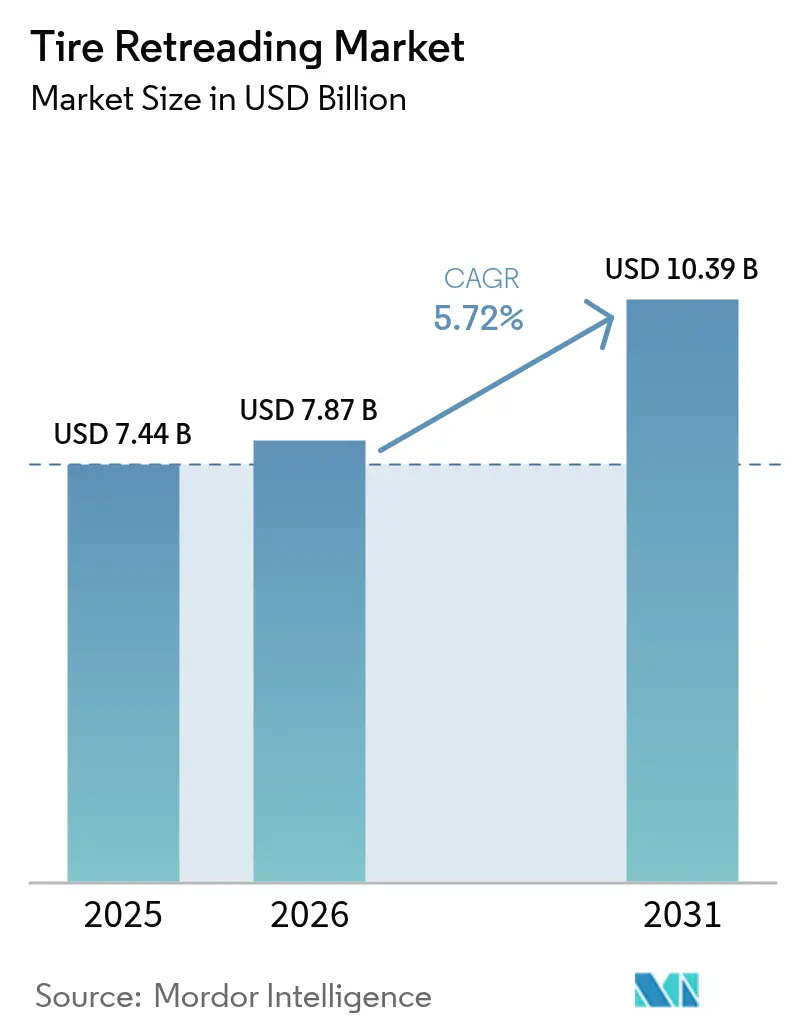
The Tire Retreading Market size was valued at USD 7.44 billion in 2025 and estimated to grow from USD 7.87 billion in 2026 to reach USD 10.39 billion by 2031, at a CAGR of 5.72% during the forecast period (2026-2031). Driven by rising raw-material prices, ongoing carbon-reduction targets, and the imperative to maximize truck uptime, the momentum in the retreading industry continues. Retreaded casings offer significant cost savings and achieve notable reductions in carbon emissions and energy consumption, underscoring their dual economic and environmental advantages. The Asia-Pacific region commands the largest share of the market, thanks to China's expansive heavy-duty fleet and India's rapidly expanding logistics networks. In contrast, the Middle East & Africa emerge as the region with the most robust growth, driven by heightened off-road tire usage spurred by booming mining and infrastructure projects. Furthermore, advancements like RFID tracking, automated inspection lines, and predictive maintenance analytics are evolving from a mere cost-saving measure to a pivotal, data-centric service integral to comprehensive fleet contracts.
Key Report Takeaways
- By vehicle type, medium and heavy-duty trucks led with 45.02% of the tire retreading market share in 2025, whereas off-the-road and mining tires are forecast to accelerate at a 5.96% CAGR through 2031.
- By production method, the pre-cure process controlled 60.95% of the tire retreading market size in 2025, while mold-cure technology is expanding at a 5.88% CAGR between 2026 and 2031.
- By tire type, radial construction dominated with 73.05% of the tire retreading market share in 2025, whereas solid and foam-filled variants are projected to expand at a 6.04% CAGR through 2031
- By sales channel, independent retreaders commanded 57.22% of the tire retreading market size in 2025, whereas OEM and captive fleet facilities are progressing at a 5.93% CAGR to 2031.
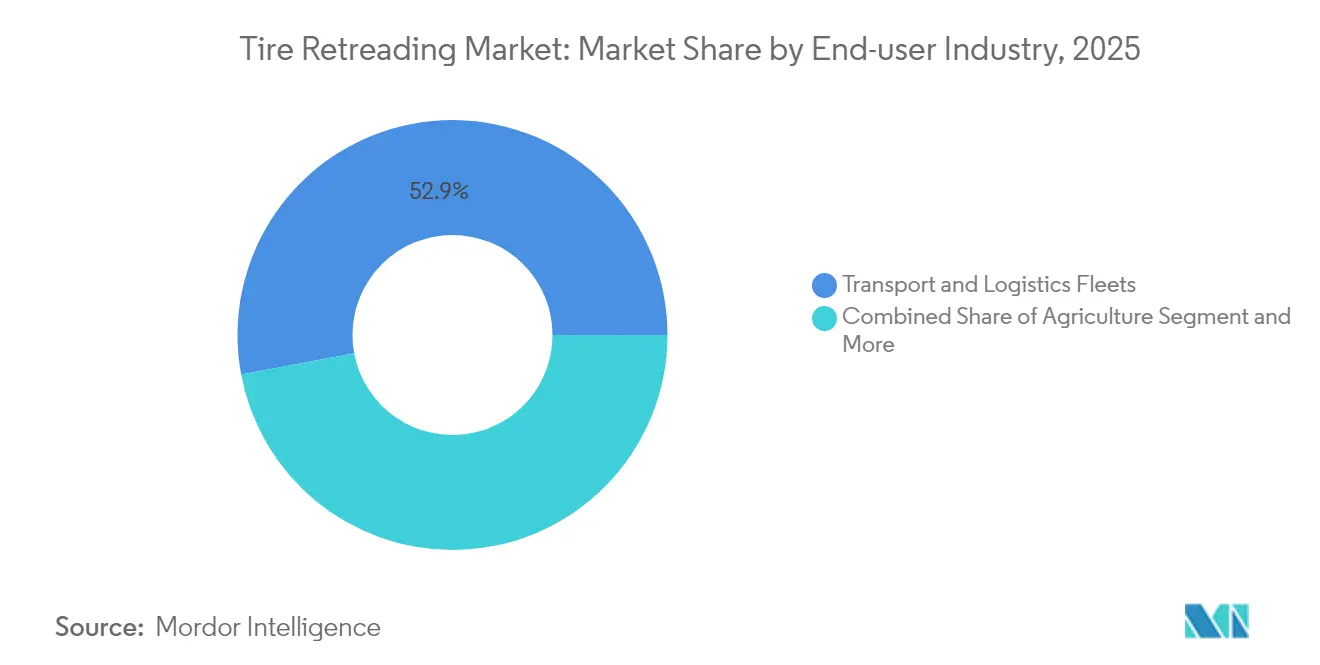
- By end-user industry, transport and logistics fleets accounted for 52.94% of 2025 revenue, while aviation is forecast to post the highest 6.01% CAGR to 2031.
- By application, on-road service held 67.41% revenue share in 2025; off-road use is expected to grow at a 6.02% CAGR between 2026 and 2031.
- By geography, Asia-Pacific captured a 38.51% revenue share in 2025, but the Middle East and Africa are set to grow the fastest, at a 6.06% CAGR during the same period.
Note: Market size and forecast figures in this report are generated using Mordor Intelligence’s proprietary estimation framework, updated with the latest available data and insights as of 2026.
Market Trends and Insights
Drivers Impact Analysis of Tire Retreading Market*
| Driver | (~) % Impact on CAGR Forecast | Geographic Relevance | Impact Timeline |
|---|---|---|---|
| Cost-Savings Over New Tires | +1.8% | Global, strongest in Asia-Pacific and Latin America | Long term (≥ 4 years) |
| Stricter Circular-Economy | +1.2% | EU core, expanding to North America and Asia Pacific | Medium term (2-4 years) |
| Fleet-Mileage Growth | +1.1% | Global, concentrated in urban centers | Medium term (2-4 years) |
| Government Tax-Credit Schemes | +0.7% | North America, select EU markets | Short term (≤ 2 years) |
| RFID-Enabled Lifecycle Tracking | +0.6% | North America and EU early adoption | Long term (≥ 4 years) |
| Green Procurement Policies | +0.5% | Global, led by multinational logistics companies | Medium term (2-4 years) |
| Source: Mordor Intelligence | |||


Cost-savings Over New Tires
Commercial operators now embed retreading in annual budget planning because a single retread delivers two-fifths purchase-price relief versus a comparable new tire. That differential widens as synthetic rubber and petroleum costs trend upward, reinforcing retreading’s payback in high-utilization fleets such as long-haul trucking and express-parcel delivery. China’s heavy-duty sector, which logged almost 300,000 truck sales in the first half of 2025, epitomizes this cost calculus, while airlines stretch aviation-tire service life across multiple cycles to preserve thin operating margins [1]“2025 Heavy-Duty Truck Sales Report,” SINOTRUK, sinotruk.com.
Stricter Circular-Economy & CO₂ Regulations
EU Circular Economy Action Plan rules oblige transport operators to prioritize reuse over disposal, turning tire retreading into a compliance tool rather than a discretionary measure. Euro 7 emission thresholds reinforce the mandate by penalizing premature tire replacement, and similar stimuli surface in North America and key Asia-Pacific economies. Environmental math is straightforward: every retread slashes carbon output by 30% and energy inputs by 70%, metrics that help carriers meet Scope 3 reporting targets [2]“Euro 7 Emission Standards,” European Commission, europa.eu .
Fleet-Mileage Growth From E-Commerce Logistics
B2C parcel volumes keep city trucks in near-constant duty cycles marked by dense stop-and-go routes that accelerate tread wear. Asia-Pacific, already the world’s largest e-commerce arena, amplifies this mileage surge and positions retreading as the default cost-containment lever for last-mile operators. Providers that can adjust curing patterns for smaller rim diameters and mixed-service tread designs are winning share within this logistics niche.
Government Tax-Credit Schemes For Domestic Retreads
Proposed U.S. federal credits and Canada’s retention of accelerated depreciation for retread equipment reduce the total cost of ownership gap between retread and new alternatives. Several EU states also reimburse up to one-fifth of qualifying retread capital spending, incentivizing fleets to channel tire budgets toward local plants and reinforcing the security of domestic supply [3]“Tire Retread Facilities Survey 2024,” Government of Canada, canada.ca .
Restraints Impact Analysis of Tire Retreading Market*
| Restraint | (~) % Impact on CAGR Forecast | Geographic Relevance | Impact Timeline |
|---|---|---|---|
| Volatile Casing and Rubber Prices | -1.4% | Global, most acute in import-dependent regions | Short term (≤ 2 years) |
| Influx Of Ultra-Low-Cost Import Tires | -0.9% | North America and EU primary impact | Medium term (2-4 years) |
| Passenger-Car Safety Perception Gaps | -0.8% | Global, strongest in developed markets | Long term (≥ 4 years) |
| Limited EV-Ready Retread Designs | -0.6% | North America and EU early adoption markets | Medium term (2-4 years) |
| Source: Mordor Intelligence | |||
Volatile Casing & Rubber Prices
Sudden swings in natural-rubber benchmarks and petroleum-linked synthetic rubber costs erode profit margins and complicate pricing grids for retread shops. Smaller independents often lack forward-buying capacity, exposing them to spot-market shocks that compress gross margin or force price hikes that narrow retread’s cost edge against new imports. When raw material prices pull back, new-tire discounts can temporarily curb retread demand until equilibrium reasserts.
Influx Of Ultra-Low-Cost Import Tires
Budget-tier imports from newer Asian producers challenge retread economics, particularly in the passenger and light-truck categories. These tires undercut domestic retread price points, prompting fleets to weigh immediate savings against shorter service life and uncertain warranty. Quality audits and anti-dumping tariffs mitigate some pressure, yet the price gap remains a recurring headwind in North America and parts of the EU.
*Our forecasts treat driver/restraint impacts as directional, not additive. The impact forecasts reflect baseline growth, mix effects, and variable interactions.
Tire Retreading Market Segment Analysis
By Vehicle Type:
Commercial Dominance Drives GrowthMedium and heavy-duty trucks generated 45.02% of 2025 revenue, confirming that high-mileage cycles make retreading indispensable for line-haul and regional-haul carriers. This segment will continue anchoring the tire retreading market through 2031 as freight demand remains resilient. Off-the-road and mining tires are charted for a 5.96% CAGR, riding on mineral extraction activity in Africa and South America, where specialized casings cost multiples of on-road equivalents. With its 4-10 approved retread cycles, the aviation niche reveals how rigorous safety oversight can coexist with aggressive cost management, forecasting a robust CAGR that outpaces most ground-based segments.
Passenger car retreading remains marginal in Europe and North America amid safety perceptions but maintains footholds in Latin America and Asia, where regulatory barriers are lower. Light commercial vans, pivotal in e-commerce logistics, now adopt shorter retread cycles adjusted to urban stop frequency. Emerging double-articulated rigs in Japan require retread designs capable of handling higher axle loads, a technical capability that only the most advanced independent retreaders currently offer.



By Production Method:
Pre-cure Maintains LeadershipThe pre-cure process held 60.95% of global revenue in 2025 and remains the go-to for high-volume truck casings. Its competitive advantage stems from lower per-unit cost and faster throughput. Mold-cure is gaining a 5.88% CAGR owing to improved precision heating and automated presses that shorten cycle times while allowing bespoke tread patterns. Automation, from AI-based surface inspection to collaborative robotic handlers, props up both methods by standardizing quality and trimming labor input. However, capitalization requirements could accelerate industry consolidation as smaller shops struggle to fund upgrades.
The tire retreading market size attributed to mold-cure lines is projected to increase as fleet demand for custom patterns grows. Yet, pre-cure’s simplicity and lower energy load keep it the preferred method for cost-sensitive fleets. OEM-integrated retread plants hedge their bets by running hybrid facilities that switch methods based on order mix and casing availability.
By Tire Type:
Radial Construction DominatesRadial casings accounted for 73.05% of 2025 revenue because their steel-belted architecture offers superior heat dispersion and fuel economy. Solid and foam-filled variants, while still niche, will post a 6.04% CAGR through 2031 as warehouses and construction sites seek puncture-proof options that curb downtime. Increased axle weights on battery-electric trucks are ushering in next-gen radial sidewalls and bead packages engineered to withstand higher torque loads without compromising retreadability. Bias-ply remains viable only in specialized off-road settings where sidewall stiffness trumps fuel efficiency.
As sustainability metrics penetrate procurement scorecards, fleet managers evaluate whether new radial designs can realize two retread lives instead of one, amplifying total-cost-of-ownership benefits. Manufacturers respond by optimizing compound formulations for repeated curing cycles without sacrificing baseline performance standards.
By Sales Channel:
Independent Retreaders LeadIndependent operators served 57.22% of global customers in 2025, leveraging proximity to fleets and flexible casing stock to deliver fast turnaround. Yet OEM-linked and captive fleet facilities, growing at 5.93% CAGR, are compressing this lead through bundled tire-service contracts that guarantee warranty coverage and data integration across the vehicle lifecycle. Large logistics providers now negotiate framework agreements stipulating minimum retread volumes that often favor OEM plants capable of digital tracking from original fitment through the final retread.
To stay competitive, independents deploy cloud-based CRM systems and subscription maintenance dashboards that mimic the digital experience offered by multinationals. Franchise alliances are also emerging, letting smaller shops share procurement clout and technology investments while preserving local brand equity.
By End-user Industry:
Transport Fleets Drive DemandTransport and logistics operators generated 52.94% of 2025 sales, reflecting route density and mileage rates that perfectly fit retreading economics. Aviation’s 6.01% CAGR shows how strict safety compliance aligns with multi-cycle tire management when full traceability is embedded. Mining and construction fleets, burdened by abrasive terrains and high casing prices, remain dependable buyers as retreading often halves per-hour tire costs.
Agricultural usage ebbs and flows with planting seasons; yet demand for flotation tires that minimize soil compaction is nudging retread shops to invest in wider curing envelopes. With predictable daily routes, waste management fleets continue to embed retreading in three-year tire contracts that fix operating costs amid volatile commodity prices.
By Application:
On-road DominatesOn-road applications delivered 67.41% of 2025 revenue, a function of highway freight prevalence and established inspection standards safeguarding safety perceptions. Off-road, slated for a 6.02% CAGR, is buoyed by mining equipment operating in remote sites where supply-chain delays make new tire lead times untenable. Urban transit buses also lean on retreading, where predictable depot schedules dovetail with retread turnaround times.
Specialty sectors such as oversized load haulage demand bespoke tread patterns and reinforced shoulders that mold-cure lines are best suited to provide. Under stringent regulation, hazardous-material carriers increasingly specify RFID-enabled casings to prove maintenance compliance, a service capability that only technologically equipped retreaters can meet.
Geography Analysis
APAC Tire Retreading Market
Asia-Pacific commanded 38.51% revenue in 2025, due to China’s gigantic truck fleet and India’s infrastructure push that multiplies highway ton-kilometers. Government policies emphasizing circular-economy compliance, such as China’s Large-scale Equipment Renewal Action Plan, channel fleets toward retreading while they phase into new-energy vehicles. Japan’s emphasis on total-life cost modeling translates into sophisticated demand for retread services that plug directly into predictive maintenance dashboards.
MEA Tire Retreading Market
Middle East & Africa, the fastest-advancing region at 6.06% CAGR, gains from energy and mineral projects that lift off-road tire usage in deserts and open-pit mines. Saudi Arabia’s ban on retread imports, combined with incentives for domestic production, shields local plants from foreign price shocks. South Africa and Botswana mining corridors underpin steady demand, although logistical constraints require mobile inspection units and on-site buffing rigs to curtail equipment downtime.
North America and Europe Tire Retreading Market
North America remains a mature yet tech-progressive territory where RFID programs and government incentives foster plant modernization. Canada hosts multiple dedicated retread facilities focused mainly on truck casings, and proposed U.S. credits would boost domestic volumes if passed into law. Europe blends regulatory tailwinds, Euro 7 and waste-framework directives, with competitive headwinds from low-priced imports, prompting retreaters to invest in automated stereography and robotics to achieve cost and quality leadership.


Regulatory Landscape
Tire retreading operates under product-safety performance standards for retreaded tires and end-of-life tire (ELT) and waste-movement rules that affect casing availability and compliance costs. In the United States, U.S. DOT rules under 49 CFR 571.117 require performance, labeling, and certification for retreaded pneumatic passenger car tires, while international access is commonly supported by UNECE frameworks such as UN Regulation No. 108, which sets technical provisions and production unit approvals for retreaded pneumatic tires.
Circular-economy policies increasingly link retreading demand to formal ELT targets and export controls. Spain enacted Real Decreto 712/2025, which introduced mandatory ELT preparation-for-reuse, recycling, and recovery targets, including a 15% preparation-for-reuse target for 2025 (and carried forward to 2030 and 2035). In the United Kingdom, the Environment Agency reported in March 2026 that enhanced compliance checks for waste pneumatic tire exports, introduced in October 2025, stopped shipments to facilities in India that did not meet equivalent environmental standards, tightening oversight on cross-border flows of used tires that can function as retread feedstock.
Value Chain Analysis
The value chain begins with casing supply from fleet operators, dealers, and collection networks, followed by sorting and inspection (often using non-destructive testing such as shearography), then retreading operations (buffing, repair, building, curing via pre-cure or mold-cure, and final inspection). Distribution returns to fleets through dealer networks, independent retreaders, and OEM or captive facilities. Upstream inputs include tread rubber, bonding materials, repair compounds, and equipment supplied by large tire groups and specialist material and machinery providers, while downstream demand is concentrated among high-mileage transport and logistics fleets, off-the-road and mining operators, and regulated niches such as aviation.
Quality and compliance requirements drive process control and traceability investments across the chain. In the United States, 49 CFR 571.117 governs retreaded passenger tire performance and labeling, with Tire Identification Number (TIN) practices used to support traceability and recalls, while UN Regulation No. 108 is a common reference point for production-unit approval in international trade. Bottlenecks center on sourcing high-quality casings, labor availability, and cost volatility in rubber and operating inputs, which contributes to a shift toward consolidation, higher automation, and tighter reverse-logistics programs to secure casing pools and improve throughput.
Competitive Landscape
The tire retreading market features a moderate concentration where top global brands hold scale advantages, but regional independents sustain strong footholds. Bridgestone’s commitment to expand its Warren County plant illustrates the tire-maker's bets on vertically integrated retread programs that lock customers into cradle-to-grave service loops. Goodyear is deploying a vast amount to automate its Oklahoma site, including AI inspection that trims cycle time while guaranteeing traceability for fleet warranties. Michelin threads RFID data from the original tire built through each retread pass, folding analytics into fleet dashboards that predict optimum pull-points and extend casing life.
Technology vendors are disrupting the space with AI vision systems that scan, causing anomalies in seconds, reducing scrap rates, and unlocking higher plant throughput. Yokohama’s acquisition of Goodyear’s off-the-road tire unit arms it with mining-grade casings that are routinely retreaded, securing a quicker entry into heavy-equipment segments. Continental’s Thailand expansion melds new-tire and retread production under one roof, shortening logistics chains for Asia-Pacific fleets.
Smaller independents retain local market share by offering fast turnaround, personalized service, and multi-brand casing pools. Still, many face capital hurdles to match their larger rivals' automation and data services. Franchise networks and regional alliances are emerging as survival strategies that preserve independent ownership while enabling shared investments in robotics, stereography, and ERP platforms.
Tire Retreading Industry Leaders
Bridgestone Corporation
Goodyear Tire and Rubber Company
Marangoni S.p.A.
Southern Tire Mart
Continental AG
- *Disclaimer: Major Players sorted in no particular order

Tire Retreading Market Companies Covered in this Report
- Bridgestone Corporation
- Michelin
- Goodyear
- Marangoni
- Continental AG
- Vipal Rubber
- Kal Tire
- Best-One Tire Group
- Southern Tire Mart
- Yokohama Rubber
- Hankook Tire
- Pirelli
- Sumitomo Rubber
- MRF
- Oliver Rubber
- TreadWright
- Qingdao Doublestar
- Rethread (Pty) Ltd
- Parrish Tire
- Redburn Tire

Market Opportunities and Future Outlook
Regulatory and finance-framework recognition is opening space for retreading programs that can document lifecycle benefits with auditable traceability. In the European Union, proposed revisions referenced by BIPAVER and the European Commission in April 2026 aimed to bring retreaded tires into the EU sustainable finance network through updates to the Climate and Environmental Delegated Acts. That approach is strengthening the business case for fleets and service providers that can deliver verifiable ESG reporting. In the United States, H.R. 3401 (Retreaded Tire Jobs, Supply Chain Security and Sustainability Act of 2025) proposes a federal tax credit for retreaded tires placed in service after December 31, 2025, highlighting a policy pathway that can support domestic retread adoption and equipment investment.
Operational opportunities are most visible where casing supply security and modernized capacity are being built. May 2026 actions by Vipal Rubber to expand tread production at its Madison, Tennessee facility, along with its April 2026 consolidation of Marangoni Tread North America and Vipal Rubber Corp. into a single entity, point to supply-chain localization efforts designed to reduce reliance on imported inputs and improve responsiveness for independent retreaders. Capacity and technology upgrades in Europe also provide evidence of investment momentum, including Tuf Treads reopening a 22,000 sq ft retreading facility in South Wales in March 2026 with shearography and integrated extrusion capabilities, and Rigdon moving forward in June 2026 with a passenger car tire retreading plant in Germany supported by a BMUV grant. These steps expand the addressable base beyond core truck applications where safety perceptions and certification pathways can be met.
Recent Industry Developments in Tire Retreading Market
- May 2026: Vipal Rubber expanded local tread production at its Madison, Tennessee facility to strengthen North American supply availability for retreaders. The move supports shorter lead times and improves resilience against imported input disruptions, particularly for independent retread plants competing on turnaround time and service consistency.
- October 2025: Marangoni S.p.A. published CO2 emissions data for its full RINGTREAD product range, enabling fleets to incorporate retread choices into ESG and Scope 3 reporting. The disclosure adds a measurable sustainability attribute that can be used in fleet procurement scorecards and multi-year service contracts.
- October 2024: Continental invested USD 315 million to expand its Thailand facility, increasing capacity for both new tires and retreading operations serving Asia-Pacific commercial vehicle markets. Co-locating production and retread activity under one footprint can shorten logistics chains and improve casing and tread supply coordination for regional fleet customers.


Tire Retreading Market Report Scope and Research Methodology
Market Definition and Coverage
The market is defined as revenue earned from retreading services and retreaded tire outputs, where a used casing is inspected, prepared, and given a new tread for further use in on-road and off-road mobility.
Scope exclusions: New tire manufacturing revenue and scrap tire recycling value are excluded from this sizing.
Segments Covered in This Report
- By Vehicle Type
- Passenger Car
- Light Commercial Vehicle
- Medium & Heavy-Duty Truck
- Bus & Coach
- Off-the-Road & Mining
- Agriculture & Specialty
- By Production Method
- Pre-cure
- Mold-cure
- By Tire Type
- Radial
- Bias
- Solid / Foam-filled
- By Sales Channel
- Independent Retreaders
- OEM / Captive Fleet Facilities
- By End-user Industry
- Transport & Logistics Fleets
- Construction & Mining
- Agriculture
- Aviation
- Military & Defense
- Waste Management & Others
- By Application
- On-road
- Off-road
- Geography
- North America
- United States
- Canada
- Mexico
- Rest of North America
- South America
- Brazil
- Argentina
- Rest of South America
- Europe
- Germany
- United Kingdom
- France
- Italy
- Russia
- Spain
- Rest of Europe
- Asia-Pacific
- China
- India
- Japan
- South Korea
- Rest of Asia-Pacific
- Middle East and Africa
- United Arab Emirates
- Saudi Arabia
- Turkey
- Egypt
- South Africa
- Rest of Middle East and Africa
- North America
Data Sources, Market Sizing, and Validation
Desk Research
Desk research was used to set guardrails on what can realistically be retreaded, where demand comes from, and how value should be expressed. We reviewed public transportation and fleet indicators, trade and production statistics, and safety or quality guidance that shapes casing acceptance and retread life.
Typical sources referenced include government road transport statistics and vehicle parc data, customs and trade databases published by national agencies, and publications from tire and rubber associations such as USTMA or ETRMA. We also used safety and test standards information (such as NHTSA and ISO), plus peer reviewed papers on casing durability and rolling resistance. On the commercial side, company annual reports, investor decks, and credible press releases helped anchor service mix and geography exposure, and a paid company financials and intelligence subscription supported revenue cross checks and ownership mapping. These examples are not exhaustive, and many other sources were used to collect, validate, and clarify data points during the study.
Primary Interviews and Surveys
Primary work focused on validating how retread volumes translate into value and where the demand pool stays most consistent across cycles. We spoke with independent retreaders, fleet maintenance and procurement teams, tire dealers, and logistics operators across APAC, EMEA, and the Americas to pressure test casing yield, pricing, and replacement patterns before finalizing assumptions.
Distribution of primary research fieldwork respondents
| Company type | Respondent position | Region |
|---|---|---|
| Top tier: 28% | CXOs: 16% | APAC: 41% |
| Mid tier: 56% | Functional/Unit leaders: 29% | EMEA: 32% |
| Smaller Players: 16% | Managers: 55% | Americas: 27% |
Market-Sizing & Forecasting
Sizing starts with a top-down demand pool build that ties retreading value to the available casing base and its practical retread rate. For each region, we first map the active fleet base for retread-heavy applications, then apply indicators such as average tire replacement cycles, casing acceptance rates after inspection, and the typical number of lives per casing to translate activity into retread counts.
Those totals are corroborated with selective bottom-up approximations. Sampled retreader throughput, channel checks on price sheets, and typical invoice values help confirm the implied average selling price and service mix. When small workshops do not publish reliable financials, we use capacity based estimates (bay counts, shift patterns, and utilization ranges), and then validate the ranges through interviews.
For forecasting, scenario analysis is used because the market can shift when a few variables move quickly. Inputs include natural rubber and synthetic rubber price direction, diesel and freight activity as a proxy for truck miles, new tire import pressure that changes the retread value equation, mining and construction activity for OTR retreads, and adoption of casing tracking or inspection automation that improves yield. These variable paths are reviewed with experts to reflect a realistic base case, followed by conservative and upside bands where appropriate.
Data Validation & Update Cycle
Model outputs are checked against independent signals such as fleet operating trends, retread penetration discussion from associations, and observed pricing ranges across regions. Outliers are flagged, reviewed in a second analyst pass, and then rechecked by reconnecting with sources when variance cannot be explained by mix or geography.
The report is refreshed annually, and interim updates are triggered when material events occur, such as major input cost shifts, trade measures affecting new tire pricing, or changes in fleet replacement behavior. Before delivery, we run a final sweep to align assumptions with the latest public data and interview feedback so clients receive an updated view.
Mordor Intelligence's Tire Retreading Market Estimate Compared With Other Published Estimates
Published market values often differ for tire retreading because firms do not always count the same revenue streams, and they may also anchor pricing and volume to different vehicle pools. Differences also show up when one study uses a single global average selling price, while another builds prices by region and by service type, which can move the total quickly.
New tire sales and recycling revenue sit outside Mordor Intelligence's scope here, and that exclusion alone can widen the spread versus figures that blend retreaded tires with broader tire aftermarket value. Beyond scope, the biggest gaps usually come from how casing acceptance is treated, whether off-road and specialty casings are fully captured, how ASP inflation is applied over the forecast, and whether currency conversion uses a fixed base-year rate or updates annually.
Benchmark comparison
| Source | Market Size | Gaps in Research Methodology |
|---|---|---|
| Mordor Intelligence | USD 7.87 B (2026) | |
| Trade Data Compiler A | USD 5.82 B (2024) | Anchors value to reported global revenue in an earlier base year and appears to undercount captive fleet retreading and off-road casings, which reduces implied volumes and pricing breadth. |
| Industry Analytics Group B | USD 7.68 B (2025) | Uses a different year and a faster process-led growth view, and the price build is less transparent on casing yield and regional mix, which can lift totals when applied across all vehicle types. |
Across the three figures, the largest driver of variance is what is counted as retreading revenue and how the casing pool is converted into paid retread jobs. When volume, yield, and pricing are tied back to fleet activity and checked with operator feedback, the market size becomes easier to trace and repeat year to year.


Key Questions Answered in the Report
How large is the tire retreading market in 2026?
The tire retreading market size is USD 7.87 billion in 2026.
What is the expected growth rate for tire retreading to 2031?
Market revenue is forecast to expand at a 5.72% CAGR through 2031.
Which region leads global sales?
Asia-Pacific captured 38.51% of 2025 revenue, the highest regional share.
Why do fleets prefer tire retreading over new tires?
Retreading cuts purchase costs by two-fifth and lowers carbon emissions by one-third, offering economic and environmental gains.
Which production method dominates global retreading?
The pre-cure method held 60.95% of 2025 sales thanks to cost efficiency and high throughput.
What technology trends are reshaping the sector?
RFID-enabled lifecycle tracking and AI-based casing inspection are moving toward predictive maintenance and full traceability.
Page last updated on:


 Your data is secure and never sold or shared.


