
Thermal Spray Coatings Market Size and Share
Market Overview
| Study Period | 2020 - 2031 |
|---|---|
| Market Size (2026) | USD 9.53 Billion |
| Market Size (2031) | USD 11.65 Billion |
| Growth Rate (2026 - 2031) | 4.11 % |
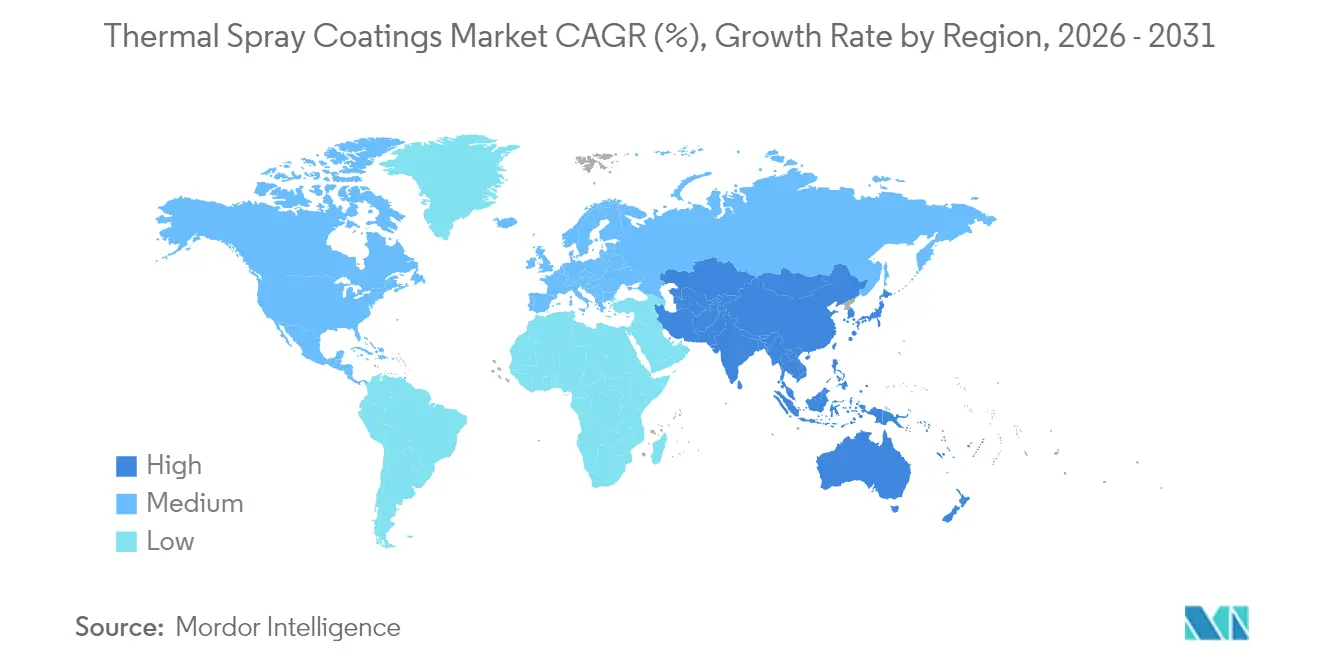
| Fastest Growing Market | Asia Pacific |
| Largest Market | North America |
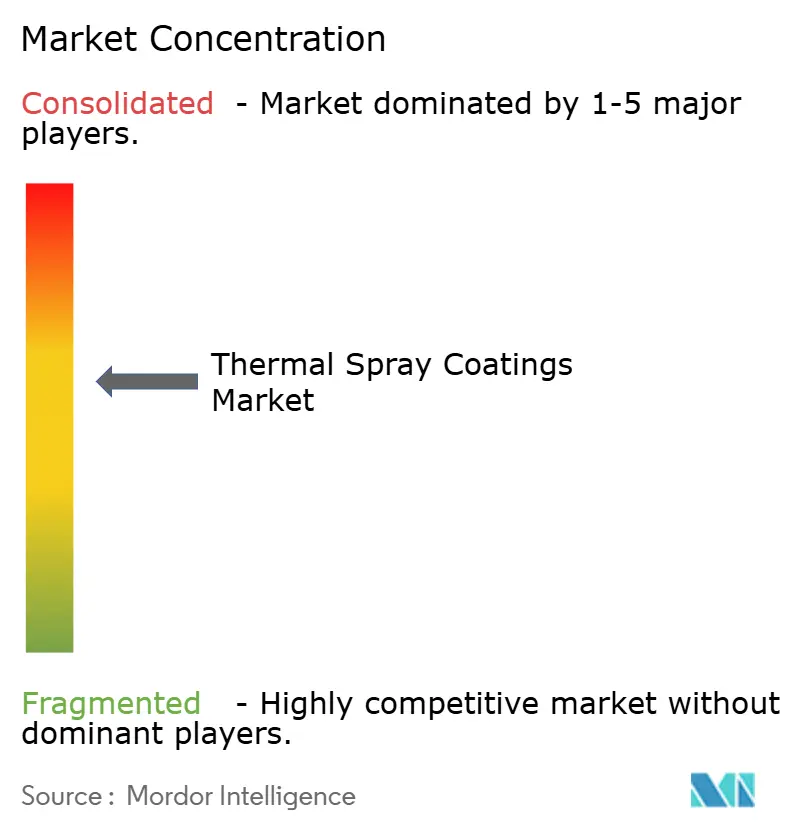
| Market Concentration | Medium |
Major Players
*Disclaimer: Major Players sorted in no particular order Image © Mordor Intelligence. Reuse requires attribution under CC BY 4.0. |
|
Thermal Spray Coatings Market Analysis by Mordor Intelligence
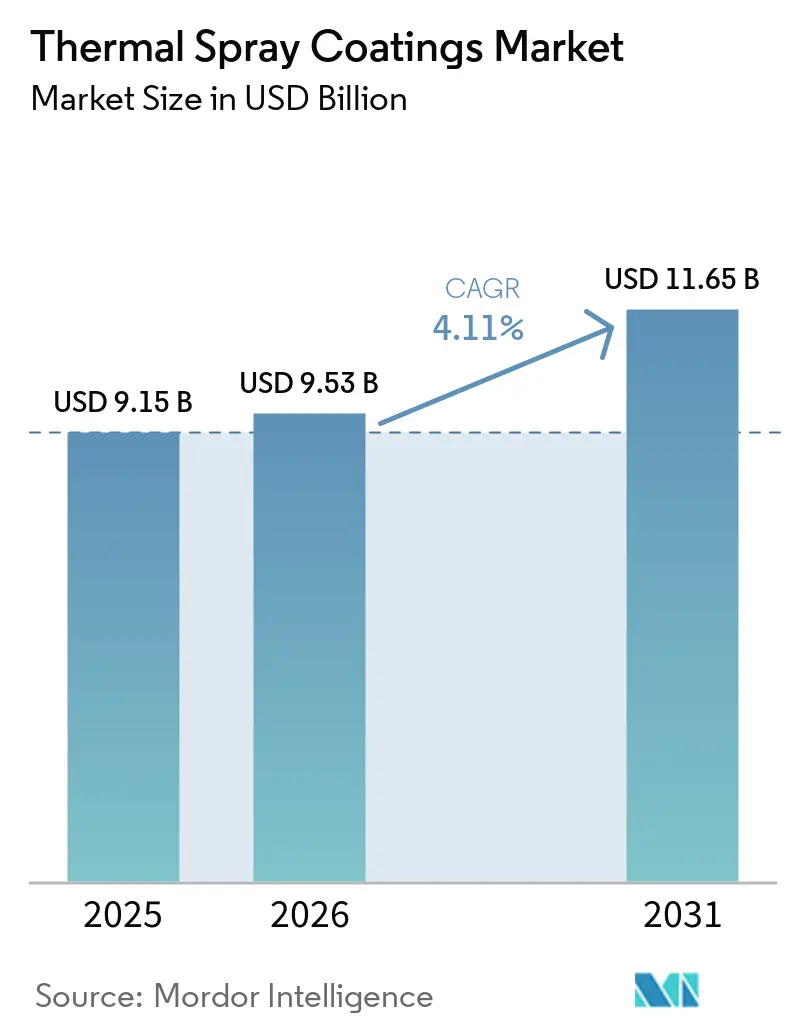
Thermal Spray Coatings Market size in 2026 is estimated at USD 9.53 billion, growing from 2025 value of USD 9.15 billion with 2031 projections showing USD 11.65 billion, growing at 4.11% CAGR over 2026-2031. Demand is fueled by hybrid additive-plus-spray repair methods that extend component life, widening medical applications that require bio-active surfaces, and aerospace programs that rely on advanced thermal-barrier stacks for higher engine temperatures. Growth also reflects rising adoption of cold-spray EMI shielding in e-mobility electronics, while digitalized “smart” spray cells are tightening process control and shortening development cycles. Regionally, Asia-Pacific’s manufacturing build-out is closing the gap with North America, even as tightening VOC rules in the United States accelerate the shift to low-emission electric-energy spray routes.
Key Report Takeaways
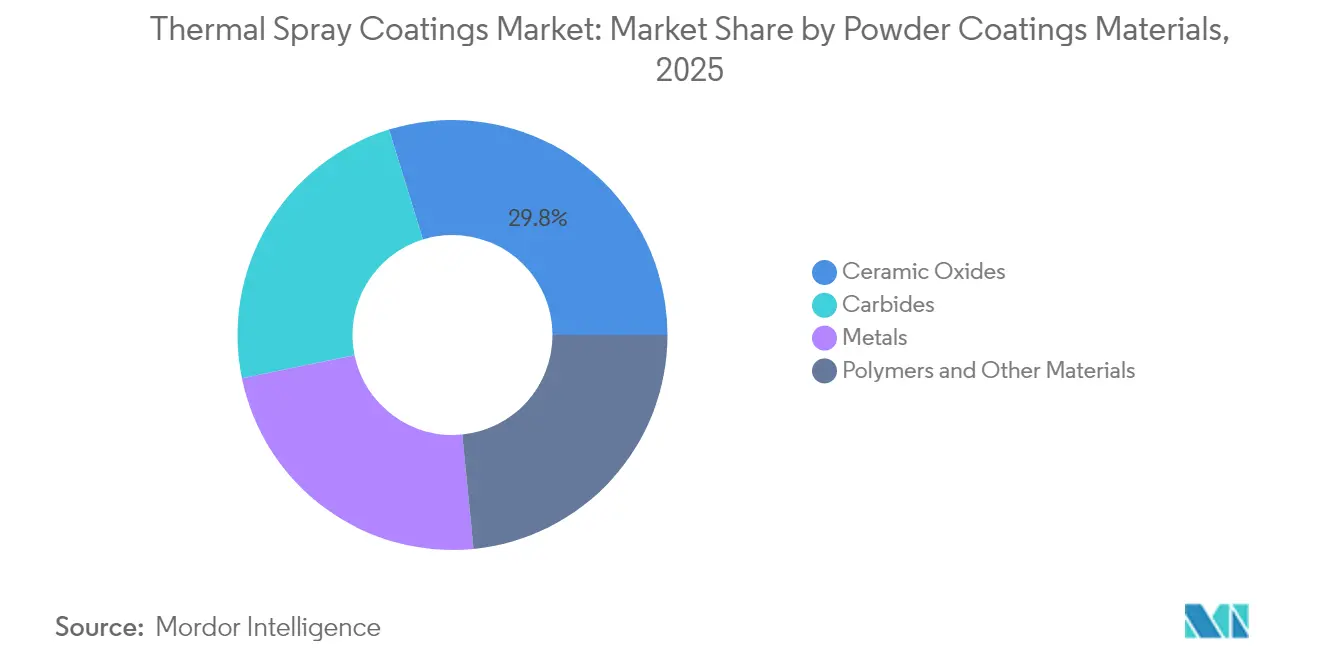
- By powder material, ceramic oxides led with 29.78% revenue share in 2025, while also posting the fastest 4.91% CAGR to 2031.
- By process, the combustion route held 61.92% of the thermal spray coating market share in 2025; electric-energy methods are projected to grow at 5.19% CAGR through 2031.
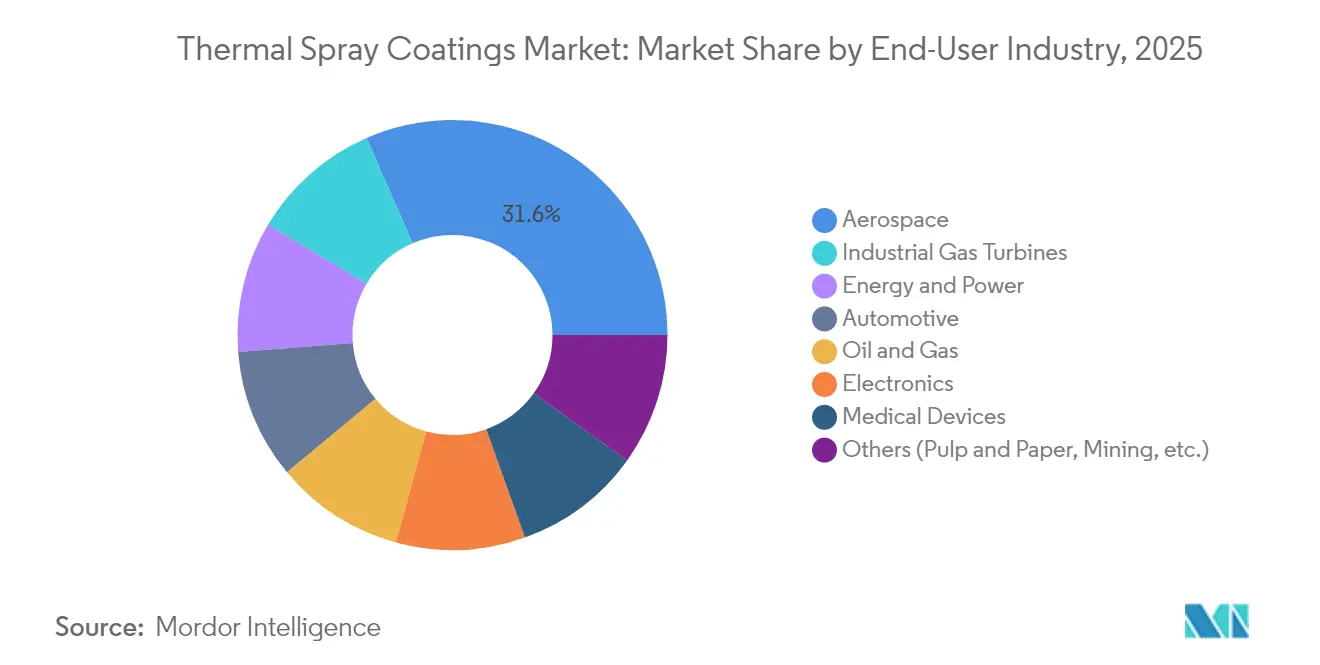
- By end-user industry, aerospace accounted for 31.55% of the thermal spray coating market size in 2025, whereas industrial gas turbines are poised for the highest 5.79% CAGR.
- By geography, North America commanded 33.86% share of the thermal spray coating market in 2025, but Asia-Pacific is forecast to register a 6.03% CAGR over 2026-2031.
Note: Market size and forecast figures in this report are generated using Mordor Intelligence’s proprietary estimation framework, updated with the latest available data and insights as of 2026.
Market Trends and Insights
Drivers Impact Analysis of Thermal Spray Coatings Market*
| Driver | (~) % Impact on CAGR Forecast | Geographic Relevance | Impact Timeline |
|---|---|---|---|
| Increased usage in medical implants & prosthetics | +0.8% | Global, with concentration in North America & Europe | Medium term (2-4 years) |
| Growing adoption in aerospace turbine & air-frame parts | +1.2% | North America, Europe, Asia-Pacific | Long term (≥ 4 years) |
| Rising preference for ceramic-oxide barrier coatings | +0.9% | Global, led by industrial regions | Medium term (2-4 years) |
| Cold-spray EMI shielding for e-mobility components | +0.7% | Asia-Pacific core, spill-over to North America & Europe | Short term (≤ 2 years) |
| Additive-manufacturing repair of super-alloy parts | +1.0% | North America & Europe, expanding to Asia-Pacific | Long term (≥ 4 years) |
| Source: Mordor Intelligence | |||
Increased Usage in Medical Implants and Prosthetics
Medical-grade plasma-sprayed hydroxyapatite continues to be the only FDA-cleared coating technology for mass-produced orthopedic implants, and recent work with β-phase Ti alloys is reducing elastic-modulus mismatch to bone. High-power impulse magnetron sputtering and HVOF overlays are now being combined in layered constructs that supply antibacterial surfaces without compromising osseointegration. As 3-D printed lattice implants scale up, spray-applied bio-ceramic finishes allow patient-specific geometries to move through qualification more quickly, though regulators are still finalizing test protocols. Coating providers able to certify repeatable roughness and phase composition are winning new multi-year supply contracts.
Growing Adoption in Aerospace Turbine & Air-Frame Parts
Engine primes are raising turbine inlet temperatures and demanding smart factories that deliver tight thickness windows on every coupon. Digitalized spray cells developed by Oerlikon and MTU Aero Engines now employ closed-loop plume diagnostics that cut rework rates by 25%[1]. Cold-spray has become a frontline depot-repair tool, allowing aluminum flight-control housings and magnesium gearbox covers to be rebuilt without heat-affected distortion. Multilayer ceramic-oxide barrier stacks with oxidation-resistant inter-layers are extending engine overhaul intervals, enabling airlines to keep narrow-body fleets in service longer.
Rising Preference for Ceramic-Oxide Barrier Coatings
Nanostructured yttria-stabilized zirconia produced by suspension plasma spray is delivering double-digit gains in thermal-cycling life versus conventional air-plasma coatings[2]. Functionally graded layers now mitigate thermal-expansion mismatch, and rare-earth dopants are pushing endurance above today’s 1 200 °C ceiling. Gas-turbine OEMs are pairing these coatings with closed-loop cooling schemes, yielding higher firing temperatures and better combined-cycle efficiency. As hydrogen-capable turbines enter demonstration, the materials window for hot-section barrier coatings will widen further.
Cold-Spray EMI Shielding for E-Mobility Components
Battery-electric vehicles require lightweight, high-performance EMI shielding across battery packs and control modules. Dense Cu-Zn cold-spray coatings achieve 80 dB attenuation at 100 µm thickness with negligible substrate heating, which allows direct metallization of polymer housings. Asian tier-1 suppliers are already shipping cold-sprayed enclosures in mass-production programs, and North American automakers have launched pilot lines to localize supply. Integration with in-line machining creates a one-step structural-plus-shielding route, trimming takt times and scrap.
Restraints Impact Analysis of Thermal Spray Coatings Market*
| Restraint | (~) % Impact on CAGR Forecast | Geographic Relevance | Impact Timeline |
|---|---|---|---|
| Reliability & coating-quality repeatability issues | -0.6% | Global, particularly in high-precision applications | Medium term (2-4 years) |
| Tightening VOC / dust-emission regulations | -0.9% | North America & Europe, expanding globally | Short term (≤ 2 years) |
| Critical-powder supply volatility (WC, rare carbides) | -0.7% | Global, with Asia-Pacific most affected | Long term (≥ 4 years) |
| Source: Mordor Intelligence | |||
Reliability & Coating-Quality Repeatability Issues
Large OEMs now specify statistical process windows that smaller job shops struggle to meet. Particle size variance, plume dynamics, and substrate pre-heat all influence oxide content and porosity, which in turn dictate in-service wear. Automated vision and inline acoustic sensors are helping detect off-nominal conditions, but integration costs remain high for low-volume applications. Without global standards on real-time monitoring, qualification cycles lengthen, especially in aerospace and medical device programs.
Tightening VOC / Dust-Emission Regulations
The California Air Resources Board is assessing total metal particulate emissions from thermal spray booths and may impose capture-efficiency thresholds above 98%. The European Union’s newly published BAT conclusions for surface treatment with organic solvents slash VOC limits and mandate advanced filtration by 2027. Compliance requires high-energy plasma systems using inert shrouds or water-borne binders, driving capital upgrades across legacy lines. Operators who adopt electric-energy routes see double benefits of lower exhaust volumes and easier permitting.
*Our forecasts treat driver/restraint impacts as directional, not additive. The impact forecasts reflect baseline growth, mix effects, and variable interactions.
Thermal Spray Coatings Market Segment Analysis
By Powder Coating Materials:
Ceramic Oxides Sustain LeadershipCeramic oxides recorded 29.78% of 2025 revenue and will grow fastest at 4.91% CAGR. This dominance arises from outstanding high-temperature stability and bio-compatibility, making oxides the default for turbine, medical, and hydrogen infrastructure projects. Carbide blends follow for extreme wear tasks on oil-and-gas valves and mining tools. Metals such as Ni-Cr-Mo alloys serve corrosion defense of marine structures, while polymer-based overlays target electronics where dielectric properties matter. Nanostructured oxides fabricated via suspension plasma spray tighten thermal-cycling life and are unlocking future propulsion architectures. Manufacturers combining rare-earth-doped zirconia with functionally graded bond coats now market 50 000-hour durability guarantees, lifting the thermal spray coating market perception from protective to performance-enabling.
New powder atomization methods are also trimming tungsten carbide supply risk. Several Asian plants have begun recycling hard-metal scrap into agglomerated WC-Co feedstock, lessening exposure to Chinese primary tungsten. At the same time, hybrid spark-plasma-sintered rod stock is widening the choice of feed materials. These shifts will strengthen the thermal spray coating market by easing raw-material cost swings and opening the door to localized powder hubs.

By Process:
Electric-Energy Routes Gain MomentumCombustion guns held 61.92% share in 2025 thanks to low equipment cost and field portability. Yet plasma, arc, and induction systems together will post a 5.19% CAGR as customers demand finer microstructure control and lower emissions. Induction plasma torches now handle feed rates above 80 kg/h, supporting large-area cladding on wind-tower flanges. High-velocity oxygen fuel (HVOF) remains the go-to for carbide overlays on pump sleeves, delivering <1% porosity without melting carbides. Cold-spray’s solid-state impact bonding is carving out new business in aerospace repair and electric-vehicle EMI shielding, though capex remains twice that of classic HVOF sets. Net-shape additive builds followed by in-situ spray finishing illustrate how hybrid cells are changing the economics of repair. These process innovations reinforce the thermal spray coating market trajectory toward smarter, greener production lines.
By End-User Industry:
Energy-transition demand reshapes segment prioritiesAerospace commanded 31.55% of the thermal spray coating market share in 2025, reflecting the sector’s reliance on multilayer ceramic-oxide barriers that enable hotter turbine inlet temperatures and lower fuel burn. Engine primes are integrating smart factory spray cells that cut rework rates and certify every coupon in real time, which is accelerating line-side adoption of advanced coatings for rotating and hot-section parts. Naval and commercial aviation depots now rebuild magnesium and aluminum housings with cold-spray, a solid-state process that has restored more than 400 flight-critical components without heat-affected failures, saving millions in part replacement costs.
Industrial gas turbines form the fastest-growing customer base at 5.79% CAGR through 2031, driven by grid operators who need flexible, hydrogen-capable peaking units and combined-cycle plants with improved thermal efficiency. Hybrid thermal-barrier stacks that pair rare-earth-doped zirconia with cooling-air optimization are raising firing temperatures, boosting output, and expanding the thermal spray coating market size for energy producers. Automotive programs use arc-sprayed Fe-Cr-Al or plasma-sprayed Al-Si cylinder liners to cut friction and reduce fuel use by 2-4% in both diesel and gasoline engines. Electronics demand is climbing as cold-sprayed Cu-Zn EMI shields replace heavier stamped boxes in battery packs, while medical-device OEMs continue to specify plasma-sprayed hydroxyapatite as the only FDA-cleared orthopedic coating. Power-generation and oil-and-gas operators rely on HVOF or arc-sprayed Ni-based overlays to resist hot corrosion and chloride attack on boiler tubes and offshore structures, extending maintenance intervals well beyond uncoated carbon steel benchmarks.
Geography Analysis
North America Thermal Spray Coatings Market
North America led with 33.86% revenue in 2025 on the back of entrenched aerospace, defense, and medical device ecosystems. FAA-class repair shops now rely on cold-spray to redeposit material on magnesium gearboxes, avoiding costly part replacement, while the Department of Energy funds oxide-coating research for hydrogen-ready turbines. California’s air-quality probes add compliance uncertainty, but the region’s first-mover advantage in smart spray cells should preserve leadership during the forecast window.
APAC Thermal Spray Coatings Market
Asia-Pacific is projected to grow fastest at 6.03% CAGR as automotive electrification, consumer-electronics capacity, and gas-turbine build-outs surge. Chinese powder recyclers already supply carbide feedstock to local coaters, hedging tungsten risks identified by USGS. Japanese semiconductor plants are scaling plasma-resistant alumina coatings for sub-5 nm etch chambers, while Indian railways specify arc-sprayed steel overlays on high-speed track components. These projects illustrate how the thermal spray coating market is embedding itself across the region’s manufacturing spectrum.
EMEA Thermal Spray Coatings Market
Europe shows steady progress as tougher VOC caps push operators toward closed-loop plasma booths and water-borne binders. Offshore wind farms in the North Sea now specify Al-Zn thermally sprayed sacrificial anodes on monopile interiors, lengthening service life beyond 25 years. The European Commission’s “Fit-for-55” package indirectly boosts demand for efficiency-raising barrier coatings on industrial gas turbines. Middle East and Africa remain niche today but will see higher uptake as refinery revamps and desalination plants pursue long-life corrosion shields.
Regulatory Landscape
Thermal spray operations face tightening air-emissions and worker-exposure compliance, particularly where metallic particulates and hexavalent chromium are regulated. In the United States, California regulates hexavalent chromium and nickel emissions from thermal spraying operations under Title 17, Section 93101.5, which is pushing coaters toward higher capture-efficiency booth designs and cleaner process choices. At the same time, workplace requirements tied to spray activities and PPE practices add compliance costs for job shops serving aerospace and medical programs, where auditability and documentation are required.
Standards activity is also shaping qualification pathways and workforce certification. ISO 21452:2025 (published March 2025) sets requirements for thermal spray coatings on power plant boiler tubes, reinforcing documentation and performance verification for energy and power end users. China issued GB/T 19824-2026 on March 31, 2026, for thermal spraying operator assessment, effective October 1, 2026, which increases formal operator qualification and can affect supplier approval for export-oriented manufacturers. In Europe, REACH-related chromium VI policy discussions continue to shift from case-by-case authorizations toward a horizontal restriction approach, increasing the urgency for substitutes such as HVOF and cold spray in hard chromium replacement applications.
Value Chain Analysis
The value chain starts with upstream feedstocks and critical minerals (tungsten carbide, cobalt, chromium, nickel), which move into powder manufacturing through atomization, agglomeration and sintering, spray drying, and plasma spheroidization. Powder producers then supply integrated coating providers or independent job shops that apply coatings using combustion (HVOF/HVAF) and electric-energy routes (plasma, arc, induction, cold spray), followed by machining, inspection, and certification to OEM specifications. Major participants such as Oerlikon Metco and Praxair Surface Technologies (Linde) use vertically integrated models across powders, equipment, and services, helping lock in OEM programs that require repeatable microstructure control and traceability.
Downstream, aerospace and power-generation customers add qualification and approval gates that affect supplier selection and switching costs. FAA-linked approval pathways and DER-driven documentation requirements can extend validation cycles for new materials and process changes, which favors incumbents with established specifications and audited process controls. The chain also reflects consolidation and capability build-out in MRO networks, including StandardAero's February 2024 acquisition of TSS Canada to scale plasma-spray throughput for hot-section components. Across regions, feedstock volatility for WC and other critical powders remains a bottleneck, driving efforts around localized powder supply and recycling to reduce exposure to concentrated upstream sources.
Competitive Landscape
The market is moderately consolidated around a core of integrated solution providers. Oerlikon Metco, Sulzer, and Praxair Surface Technologies operate global powder-to-service portfolios, while mid-sized specialists focus on regional wear or biomedical niches. Oerlikon’s 2024 launch of an AI-assisted spray cell halves parameter-setup time and has been adopted by MTU Aero Engines for scalable, serialized turbine manufacturing. Sulzer invested in on-site spray booths at gas-compressor OEM plants, cementing long-term maintenance contracts.
M&A remained active: Aalberts’ purchase of Steel Goode Products in October 2024 expanded its southern U.S. footprint by adding hard-chromium replacement capabilities. Patent filings reveal new carbide-graphene blends targeting brake-disc wear, signaling entry of automotive suppliers keen to curb particulate emissions. Cold-spray system builders are courting venture capital to scale nozzle-gas recycling technology that slashes helium cost. Environmental performance is emerging as the next competitive battleground, with companies touting closed-loop powder capture and VOC-free masking systems to win aerospace and medical device qualifications.
Investment in powder production is also rising. A U.S. startup opened a high-pressure water-atomization line in 2025 to localize Ni-base super-alloy feedstock, reducing dependence on European imports. Meanwhile, a Korean consortium commissioned a 500 t/y suspension-plasma-spray precursor plant, securing supply for nanostructured thermal barrier projects in Asia-Pacific jet-engine programs. These moves underscore how raw-material security and vertical integration are reshaping the thermal spray coating market calculus.
Thermal Spray Coatings Industry Leaders
-
OC Oerlikon Management AG
-
Chromalloy Gas Turbine LLC
-
Linde
-
Kennametal Inc.
-
Bodycote
- *Disclaimer: Major Players sorted in no particular order
Thermal Spray Coatings Market Companies Covered in this Report
- Abakan Inc.
- APS Materials Inc.
- Bodycote
- Chromalloy Gas Turbine LLC
- Curtiss-Wright Corporation (FW Gartner)
- Fisher Barton
- Flame Spray Technologies BV
- Hannecard Roller Coatings, Inc - ASB Industries
- Kennametal Inc.
- Linde
- OC Oerlikon Management AG
- Steel Goode Products, LLC
- Sulzer Ltd
- Thermion
- Tocalo Co. Ltd.
- TST LLC
Market Opportunities and Future Outlook
Regulatory and OEM qualification pressures are creating whitespace for coating solutions that replace higher-risk legacy surface treatments while improving repeatability. California's Title 17 requirements for hexavalent chromium and nickel emissions in thermal spraying operations reinforce demand for advanced capture, filtration, and process selections that reduce hazardous emissions, supporting adoption of electric-energy routes and modernized booths. In Europe, the ongoing shift under REACH toward broader chromium VI restrictions increases the incentive to qualify alternative coating stacks, sustaining opportunities for HVOF/HVAF and cold spray in hard chromium replacement, along with demand for suppliers that can provide auditable process windows for aerospace and medical device customers.
Technology development is also opening new application geometries and higher-performance thermal barrier stacks, which widens the set of components addressed beyond traditional line-of-sight parts. Peer-reviewed 2026 research highlights internal diameter (ID) thermal barrier coating approaches using ID-HVOF for bond coats with APS top coats, targeted to confined geometries common in aero-engine hardware and industrial turbine parts. April 2026 work on Cord Plasma Spray for depositing fine, non-flowable powders such as YSZ provides another route to deposit advanced ceramic-oxide systems without relying only on suspension plasma spray, which can help where powder handling and repeatability have been barriers. In addition, comparative life cycle assessment findings that show favorable economics for HVOF on WC-Co systems support opportunities to standardize wear coatings in high-volume industrial components where cost-per-part and throughput influence procurement decisions.
Recent Industry Developments in Thermal Spray Coatings Market
- April 2026: Chromalloy reported that a U.S. commercial airline selected its FAA-approved PMA blades for CFM high-pressure turbines, supported by the companys thermal barrier coating capabilities. The win reinforces PMA adoption as an alternative supply route for hot-section parts and expands demand for qualified coating processes tied to aviation safety and traceability.
- December 2025: Linde Advanced Material Technologies acquired the Equipment and Parts Division of Kermetico Inc. to broaden its High Velocity Air Fuel (HVAF) thermal spray systems portfolio. The move strengthens Lindes equipment ecosystem and installed-base support, improving access to high-throughput wear and corrosion coating capability for industrial customers.
- July 2025: Oerlikon Metco launched Surface Two, an IIoT-enabled, scalable thermal spray platform designed for large components up to 2,000 mm in diameter and 1,500 mm in height. This platform-level release supports automation and data-driven process control, aligning with aerospace and turbine customers that require tighter parameter management and faster qualification cycles.
Thermal Spray Coatings Market Report Scope and Research Methodology
Market Definition and Coverage
This market covers the revenues generated from thermal spray coating services and coating deposition used to improve wear, corrosion, and heat resistance of parts across industrial and engineered applications, measured at the point where coating value is realized in the supply chain.
Scope exclusions: Paints, electroplating, PVD/CVD thin films, and non-thermal spray surface treatments are excluded from this market sizing.
Segments Covered in This Report
-
By Powder Coating Materials
- Ceramic Oxides
- Carbides
- Metals
- Polymers & Other Materials
-
By Process
- Combustion
- Electric Energy
-
By End-user Industry
- Aerospace
- Industrial Gas Turbines
- Automotive
- Electronics
- Medical Devices
- Energy and Power
- Oil and Gas
- Others (Pulp and Paper, Mining, etc.)
-
By Geography
-
Asia-Pacific
- China
- India
- Japan
- South Korea
- Rest of Asia-Pacific
-
North America
- United States
- Canada
- Mexico
-
Europe
- Germany
- United Kingdom
- Italy
- France
- Rest of Europe
-
South America
- Brazil
- Argentina
- Rest of South America
-
Middle East and Africa
- Saudi Arabia
- South Africa
- Rest of Middle East and Africa
-
Asia-Pacific
Data Sources, Market Sizing, and Validation
Desk Research
Desk work started with building a clean fact base on the industries that consume thermal spray coatings and the pace at which parts move through overhaul and replacement cycles. We referenced public sources such as USGS materials data, US International Trade Commission import export statistics, NIST publications on coatings and materials, FAA and EASA airworthiness and maintenance information, and selected peer reviewed journals that cover coating performance and process standards.
We also reviewed company annual reports, investor presentations, and technical brochures to understand process mix, application share, and common pricing logic (for example, by coating type and typical component category). Where available, we used paid subscriptions for company financials and intelligence, patent databases, and an import export shipment level database to validate directional trends and to avoid over relying on a single public series. This desk source list is illustrative, and many other public references were also used for data collection, validation, and clarification.
Primary Interviews and Surveys
Primary work focused on interviews and short surveys with coating service providers, equipment and consumable suppliers, and end users that specify coatings in aerospace, industrial gas turbines, automotive, electronics, and medical devices. Because this is a global market, we spoke across APAC, EMEA, and the Americas so regional differences in process preference, qualification cycles, and repair versus new build demand could be checked before finalizing assumptions.
Distribution of primary research fieldwork respondents
| Company type | Respondent position | Region |
|---|---|---|
| Top tier: 37% | CXOs: 16% | APAC: 39% |
| Mid tier: 47% | Functional/Unit leaders: 34% | EMEA: 36% |
| Smaller Players: 16% | Managers: 50% | Americas: 25% |
Market-Sizing & Forecasting
Sizing was built using a top-down approach where end use demand pools were reconstructed from observable production and maintenance activity, and then converted into coating demand using penetration and refurbish rates that came out of interviews. To keep totals realistic, we corroborated the outcome with selective bottom-up checks such as sampled price per square meter or per component for common applications, followed by a sanity roll up across a limited set of service capacity and utilization indicators.
Key inputs used in the model included aircraft engine and airframe maintenance intensity, industrial gas turbine service intervals, auto and e-mobility component adoption where thermal management matters, medical implant procedure volumes where bioactive coatings apply, and the process mix split across HVOF, plasma spray, arc spray, and combustion routes. Forecasts were developed using scenario analysis supported by expert views on manufacturing output, repair volumes, qualification lead times, and expected price movement in powders and energy intensive spraying. When bottom-up information was thin for a niche application, we used conservative proxy ratios from adjacent industries and then revalidated them with follow up calls.
Data Validation & Update Cycle
Outputs were validated through multiple checks, where market totals were compared against independent signals like end use production trends, maintenance activity, and trade movement for relevant feedstock materials. If a region or end use produced an unexpected jump, the drivers were revisited, and respondents were re contacted to confirm whether a real demand shift or a modeling assumption caused the variance.
Before sign off, the model and assumptions go through a step by step analyst review so arithmetic, units, and currency timing remain consistent across segments. Reports are refreshed annually, and interim updates are made when material events occur, such as sharp changes in aerospace build rates, major regulatory changes, or large shifts in industrial energy demand. Right before delivery, a fresh final pass is completed so clients receive the most current view supported by the latest evidence.
Mordor Intelligence's Thermal Spray Coatings Market Sizing Compared With Other Published Estimates
Published values for thermal spray coatings do not always match because the included surfaces, pricing point in the value chain, and the year used as the base can vary across studies. Differences also show up when one estimate leans more on capacity statements, while another leans on demand side maintenance and production indicators.
Thin film technologies like PVD and CVD sit outside Mordor Intelligence's scope, which narrows the counted revenue to true thermal spray coatings and avoids mixing adjacent coating markets that have different pricing and adoption patterns. Gaps can also come from how ASPs are progressed, such as using a flat price versus adjusting for powder cost swings, energy intensity, and qualification driven mix shifts, and from refresh cadence when aerospace and turbine cycles change quickly.
Benchmark comparison
| Source | Market Size | Gaps in Research Methodology |
|---|---|---|
| Mordor Intelligence | USD 9.53 B (2026) | |
| Global Consultancy A | USD 11.30 B (2025) | Uses a different base year and commonly includes broader application and material revenue capture assumptions, which can lift totals when pricing is taken at a wider value chain point. |
| Industry Research Group B | USD 12.77 B (2024) | Earlier base year and a faster growth posture can raise the stated value, and limited clarity on exclusions can lead to adjacent coating categories being counted alongside thermal spray. |
The spread in the table is mainly explained by base year alignment and how strictly the counted scope is limited to thermal spray coatings rather than neighboring surface technologies. By tying demand to repeatable activity indicators and then cross checking pricing and mix changes with practitioner inputs, the final number stays traceable and practical to update as new signals emerge.
Key Questions Answered in the Report
How large is the thermal spray coating market in 2026?
The thermal spray coating market size is USD 9.53 billion in 2026 and is projected to reach USD 11.65 billion by 2031.
Which material segment leads the market?
Ceramic oxides hold the top spot with 29.78% 2025 revenue share and are forecast to grow at 4.91% CAGR through 2031.
What is driving the shift toward electric-energy spray processes?
Stricter VOC rules and the need for finer microstructure control are steering users to plasma and arc systems that emit fewer pollutants and enable advanced materials.
Why is Asia-Pacific the fastest-growing region?
Rapid expansion of e-mobility, electronics, and industrial gas-turbine installations is lifting demand, giving the region a 6.03% forecast CAGR.
How are emission regulations affecting coating providers?
New rules in California and the European Union require higher capture efficiencies and greener chemistries, prompting investment in closed-loop plasma booths and low-VOC masking.