
Tetraacetylethylenediamine (TAED) Market Size and Share
Market Overview
| Study Period | 2020 - 2031 |
|---|---|
| Market Size (2026) | USD 755.05 Million |
| Market Size (2031) | USD 867.44 Million |
| Growth Rate (2026 - 2031) | 2.82 % |
| Fastest Growing Market | Asia Pacific |
| Largest Market | Europe |
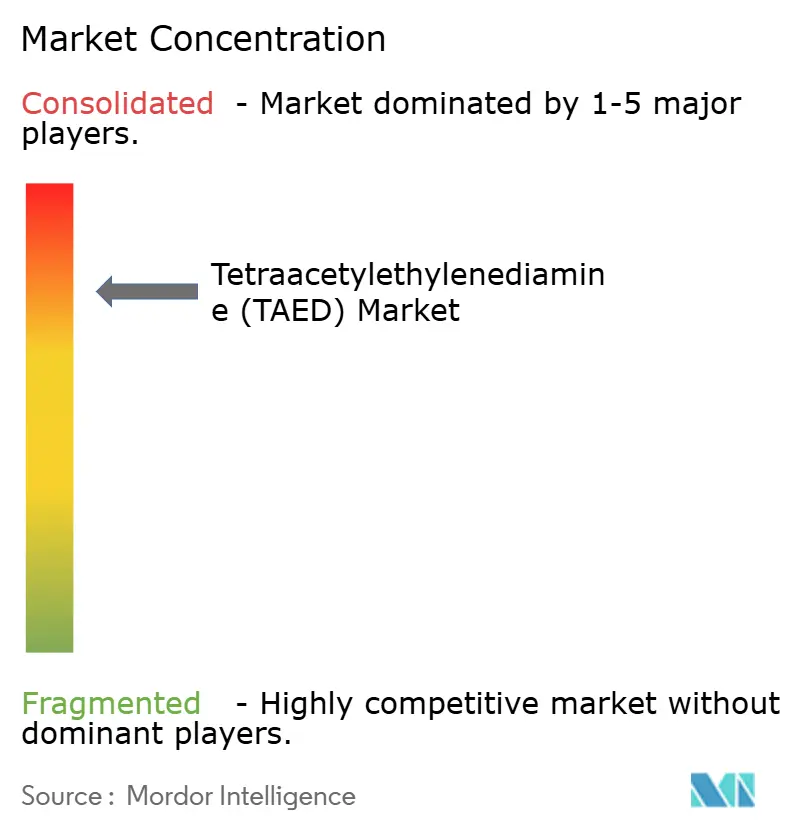
| Market Concentration | High |
Major Players *Disclaimer: Major Players sorted in no particular order Image © Mordor Intelligence. Reuse requires attribution under CC BY 4.0. | |
Tetraacetylethylenediamine (TAED) Market Analysis by Mordor Intelligence
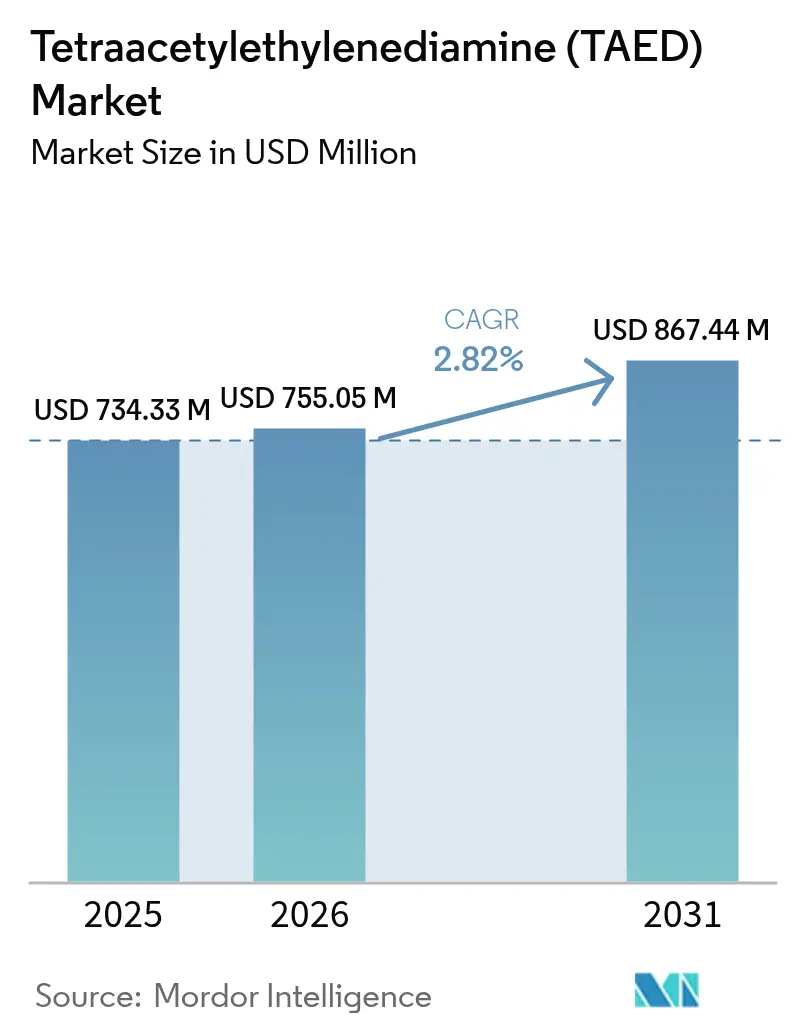
The Tetraacetylethylenediamine Market size is expected to grow from USD 734.33 million in 2025 to USD 755.05 million in 2026 and is forecast to reach USD 867.44 million by 2031 at 2.82% CAGR over 2026-2031. Widespread use of the bleach activator in powder detergents, where it generates peracetic acid and enables effective cleaning at 30–60 °C, anchors current demand. Growth remains slower than the broader laundry detergents sector because TAED is already well-entrenched in mature formulations and faces competition from newer low-temperature activators. Energy-efficiency mandates, the rise of on-premise industrial laundries in Asia, and heightened post-pandemic hygiene standards create steady replacement and upgrade cycles. At the same time, the shift from powder to liquid formats in North America and Europe, along with the emergence of manganese-based catalysts in automatic dishwashing, constrains upside potential.
Key Report Takeaways
- By product type, granular grades held 70.65% of TAED market share in 2025, while encapsulated/co-granulated grades are projected to expand at a 3.52% CAGR through 2031.
- By distribution channel, direct supply captured 60.90% of TAED market share in 2025, whereas chemical distributors record a 3.10% CAGR to 2031.
- By application, household laundry detergents led with 68.55% revenue share in 2025; industrial & institutional laundry is forecast to grow fastest at 3.32% CAGR to 2031.
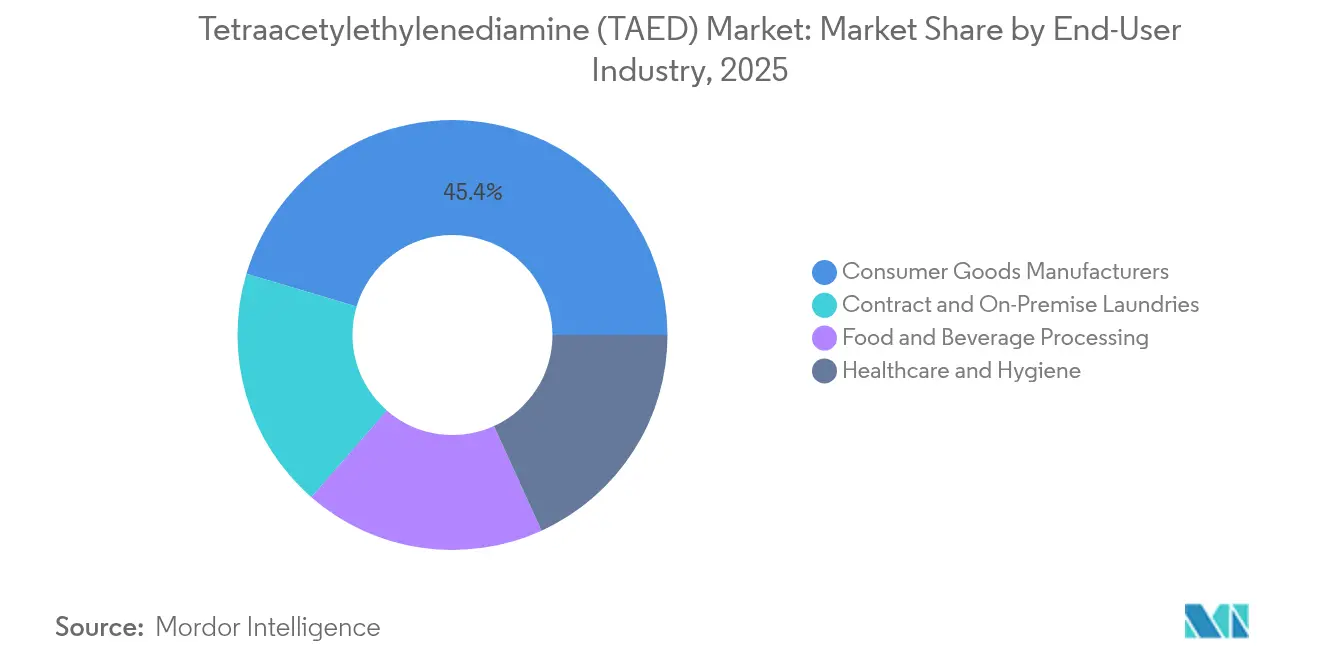
- By end-user industry, consumer goods manufacturers accounted for 45.40% share of the TAED market size in 2025; the healthcare & hygiene segment is advancing at a 3.38% CAGR through 2031.
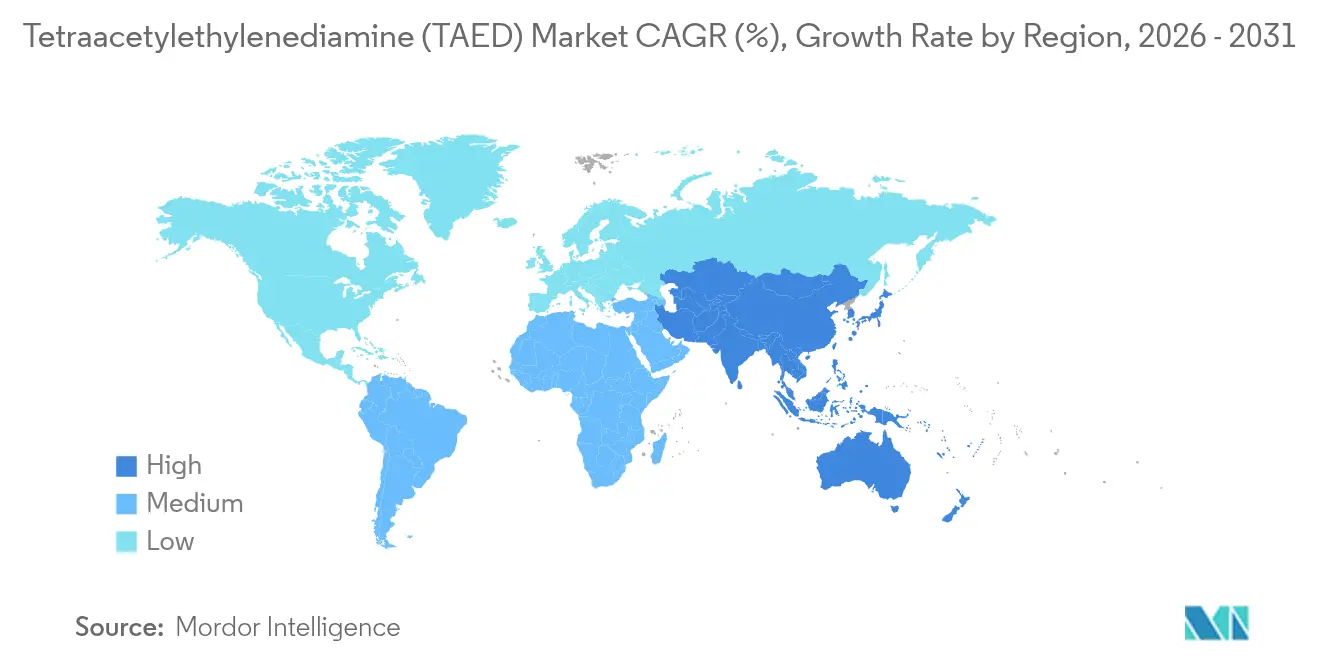
- By region, Europe retained 39.85% of global revenue in 2025; Asia-Pacific is the fastest-growing geography at a 3.41% CAGR through 2031.
Note: Market size and forecast figures in this report are generated using Mordor Intelligence’s proprietary estimation framework, updated with the latest available data and insights as of 2026.
Market Trends and Insights
Drivers Impact Analysis of Tetraacetylethylenediamine (TAED) Market*
| Driver | (~) % Impact on CAGR Forecast | Geographic Relevance | Impact Timeline |
|---|---|---|---|
| Rising shift to low-temperature detergent formulations | +0.8% | Global, with stronger adoption in Europe and North America | Medium term (2-4 years) |
| Growth of on-premise & industrial laundry services in Asia Pacific | +0.6% | APAC core, spill-over to MEA | Long term (≥ 4 years) |
| Consumer move toward phosphate-free, eco-labels in Europe and North America | +0.5% | Europe & North America | Short term (≤ 2 years) |
| Energy-saving mandates for commercial washers | +0.4% | Global, with regulatory focus in developed markets | Medium term (2-4 years) |
| Emergence of enzyme-TAED hybrid bleach systems | +0.3% | Global | Long term (≥ 4 years) |
| Source: Mordor Intelligence | |||
Rising shift to low-temperature wash cycles
Cold-water adoption can curb laundry-related CO₂ emissions by 27 million t over a decade, making low-temperature activators such as TAED integral to sustainability goals. By enabling effective cleaning at lower temperatures, TAED reduces the reliance on energy-intensive hot water cycles, directly contributing to energy conservation and emission reduction. Tide Professional Coldwater shows commercial viability by lowering wash temperatures to 90 °F and cutting energy costs up to 75%. This significant cost-saving potential makes it an attractive option for both residential and commercial users. Appliance makers and detergent formulators therefore align around chemistry that works without hot water, reinforcing near-term demand for TAED. This alignment highlights the growing importance of sustainable solutions in the detergent market.
Expansion of industrial laundry services in APAC
Rapid urbanization and stricter hygiene codes in hospitals and hotels push Asia-Pacific laundries toward professional detergent systems that guarantee consistent bleaching across variable water quality. The increasing population and urban migration in the region have led to a surge in demand for industrial laundry services, particularly in sectors like healthcare and hospitality, where hygiene is critical. With commercial loads ranging 20–80 lb, chemical cost per cycle becomes a critical metric, as businesses aim to optimize operational costs while maintaining high standards of cleanliness. TAED’s predictable performance at mid-range temperatures offers a cost-effective solution, ensuring consistent results regardless of water quality variations. India’s textile output growth illustrates the scale of downstream demand where reliable commercial laundering is essential[1]Ministry of Textiles India, “Indian Textile Industry Statistics 2025,” texmin.nic.in . The expanding textile industry further amplifies the need for efficient and dependable laundry solutions, positioning TAED as a key component in meeting these demands.
Consumer preference for phosphate-free eco-labels
The European Union’s Detergent Regulation and parallel North American eco-label criteria favor biodegradable activators over phosphorus-based chemistries, bolstering TAED uptake[2]Ecomundo, “EU Detergent Regulation Revision 2025,” ecomundo.eu. These regulations reflect a broader consumer shift towards environmentally friendly products, driven by growing awareness of the environmental impact of traditional detergents. Inclusion of TAED on the U.S. EPA Safer Choice list further signals regulatory endorsement, providing consumers with confidence in its safety and sustainability. This regulatory backing not only supports the adoption of TAED but also aligns with the increasing demand for eco-labeled products, which are becoming a significant factor in purchasing decisions.
Energy-saving mandates for commercial washers
The U.S. Department of Energy’s 2025–2028 efficiency standards target 0.67 quads energy savings across the installed base of commercial washers, incentivizing detergent reformulations that clean effectively at lower temperatures and shorter cycles. These mandates aim to reduce energy consumption in commercial laundry operations, which are traditionally energy-intensive. By encouraging the development of detergents that perform well under these constraints, the standards drive innovation in the detergent market. TAED, with its ability to activate at lower temperatures, aligns perfectly with these requirements, making it a preferred choice for manufacturers looking to comply with energy-saving regulations while maintaining cleaning efficacy.
Restraints Impact Analysis of Tetraacetylethylenediamine (TAED) Market*
| Restraint | (~) % Impact on CAGR Forecast | Geographic Relevance | Impact Timeline |
|---|---|---|---|
| Competitive threat from liquid bleach activators | -0.7% | Global, with stronger impact in North America | Medium term (2-4 years) |
| Decline in powder detergents share in mature markets | -0.5% | North America & Europe | Short term (≤ 2 years) |
| Thermal instability issues in high-humidity tropical storage | -0.3% | Tropical regions in APAC, MEA, and Latin America | Long term (≥ 4 years) |
| Source: Mordor Intelligence | |||
Competitive threat from liquid bleach activators
Manganese-based catalysts, such as MnTACN, have demonstrated superior performance compared to TAED in automatic dishwashing applications, particularly at temperatures below 60 °C. This performance advantage is becoming increasingly relevant as energy efficiency standards drive dishwashing cycles to operate at lower temperatures. Additionally, Nonanoyloxybenzene sulfonate (NOBS) has established a strong foothold in the U.S. laundry capsule market. Its dominance is prompting formulators to explore switching to NOBS, especially in scenarios where dosage flexibility or compatibility with liquid formulations is a critical requirement. These shifts are gradually eroding TAED's market share in these segments.
Decline of powder detergents in mature markets
The retail landscape in mature markets is undergoing a significant transformation, with shelf space increasingly being allocated to liquid detergents and single-dose formats, such as capsules. This trend poses significant challenges for TAED, particularly in terms of encapsulation and maintaining shelf-life stability. In 2024, detergent capsules surpassed powder detergents in grocery sales within the U.K., marking a pivotal moment in the ongoing decline of powder detergents. This shift underscores the growing consumer preference for convenience and ease of use, which single-dose formats offer over traditional powders.
*Our forecasts treat driver/restraint impacts as directional, not additive. The impact forecasts reflect baseline growth, mix effects, and variable interactions.
Tetraacetylethylenediamine (TAED) Market Segment Analysis
By Product Type:
Granular dominance faces encapsulation innovationGranular grades retained 70.65% TAED market share in 2025, underpinning the largest portion of the TAED market size because conventional powder detergents rely on this free-flowing form. Their established production economics and compatibility with spray-dry towers make them the default choice for mass-market brands. Yet the segment’s mid-single-digit growth lags because powder volumes plateau in mature regions.
Encapsulated or co-granulated TAED, advancing at a 3.52% CAGR, addresses heat-humidity sensitivity and allows incorporation into liquid pods or compressed tablets. This technology mixes TAED with sodium percarbonate, carbonate buffers, or polymer shells to delay hydrolysis until immersion, safeguarding performance in tropical climates. Patent activity on multi-compartment pouches illustrates how dosage precision and ingredient separation enhance consumer convenience while extending TAED penetration into premium formats.




By Distribution Channel:
Direct supply dominates amid distributor growthDirect contracts between TAED producers and detergent plants controlled 60.90% of 2025 revenue, driven by high-volume powder lines that demand supply assurance and lot-specific technical support. Continuous improvement projects, such as optimizing percarbonate molar ratios, occur most efficiently under direct collaboration.
Distributor sales are rising 3.10% annually as niche formulators and regional contract blenders seek smaller pack sizes and just-in-time deliveries. Full-line chemical distributors leverage diversified warehouses to amortize inventory risk and offer formulation labs for application troubleshooting. This channel is gaining particular traction in Southeast Asia, Latin America, and Eastern Europe where local brands lack scale for direct importation.
By Application:
Household laundry leads despite industrial growthHousehold detergents commanded 68.55% revenue in 2025 and remain the anchor of the TAED market. Multiple European brands continue to advertise low-temperature whitening at 30 °C, a claim still tied to TAED chemistry. However, volume gains in this channel plateau as demographic trends flatten wash loads per capita in Western markets.
Conversely, the industrial & institutional laundry segment is growing 3.32% annually. Hospitals, hotels, and urban on-premise laundries in China, India, and Southeast Asia adopt mechanical wash extractors calibrated for 40–50 °C cycles, conditions that favor TAED over chlorinated bleaches. Equipment suppliers highlight water recycle loops and energy recovery, reinforcing mid-temperature wash chemistry as a purchasing criterion.
By End-User Industry:
Consumer goods manufacturers drive demandConsumer goods manufacturers consumed 45.40% of global volumes in 2025, reflecting the integrated sourcing strategies of multinational detergent producers that prefer direct, long-term supply contracts. Their central R&D teams also dictate global formulation standards, locking in TAED specifications for legacy powder brands.
Healthcare & hygiene facilities represent the fastest-growing end user at 3.38% CAGR as infection-control protocols tighten after COVID-19. Hospital laundries cite TAED’s broad-spectrum antimicrobial efficacy and fabric safety versus hypochlorite, enabling higher turnover of linens with lower replacement rates. EPA exemption from food-contact tolerance further supports uptake in the food & beverage processing industry where on-site cleaning regimes now mirror pharma hygiene norms.
Geography Analysis
Europe Tetraacetylethylenediamine (TAED) Market
Europe accounted for 39.85% of global demand in 2025 thanks to decades-old phosphate bans that pushed manufacturers to TAED-centred oxygen bleach systems. Germany and the United Kingdom constitute the largest national markets because retailers emphasize eco-labels and cold-wash performance on pack messaging. The renewed EU Detergent Regulation, effective 2025, tightens biodegradability tests and fragrance disclosures, indirectly reinforcing TAED compliance advantage. Consumers continue to pay a premium for sustainable claims, with 72% citing eco profile when selecting detergents.
APAC Tetraacetylethylenediamine (TAED) Market
Asia-Pacific registers the highest regional growth at a 3.41% CAGR to 2031. China gains from vertically integrated TAED supply, while India’s textile finishing sector and its expanding health-care infrastructure lift institutional wash volumes. Local suppliers such as Shanghai Deborn and JINKE ramp capacity to back regional contract detergent plants, shortening lead times and lowering duty costs. Authorities in Japan and South Korea incentivize lower energy use in laundry services, further aligning with TAED adoption.
North America, LATAM and MEA Tetraacetylethylenediamine (TAED) Market
North America is mature yet stable. The California Cleaning Product Right-to-Know Act compels disclosure of each ingredient at ≥0.01% concentration, leading multinational brands to stick with familiar, well-documented activators like TAED. However, liquid formats dominate retail channels, which constrains powder-based TAED volumes unless encapsulation or capsule technology bridges the gap. In Latin America, Middle East, and Africa, hygiene modernization in healthcare and hospitality sparks greenfield laundry projects, but summer-peak warehouse temperatures necessitate barrier films and desiccant liners, adding landed-cost headwinds.

Value Chain Analysis
TAED sits midstream in the detergent oxygen bleach ecosystem. Upstream exposure includes ethylenediamine (EDA) and acetylating agents, notably acetic anhydride, as well as utilities and effluent handling that influence plant economics. Industrial production is commonly described as a two-step acetylation route (EDA to diacetylethylenediamine, then to TAED). Process configurations such as reactive distillation are used to manage water and byproduct removal, which helps improve yields. As a result, TAED costs track feedstock availability and price volatility for EDA and acetic anhydride, and they depend on operating controls that maintain product purity while managing hydrolysis risk.
Downstream, TAED is formulated into application-ready forms, including granular, co-granulated or encapsulated, tablet or compressed, and dispersion systems. It is frequently paired with peroxide sources such as sodium percarbonate and builders or buffers to generate peracetic acid in wash liquor at 30-60 C. Distribution splits between direct supply into large detergent plants, where performance testing and percarbonate ratio optimization are co-managed, and chemical distributors that serve smaller formulators through local inventory and repack. Packaging and logistics are also consequential, particularly for humid and tropical lanes, where barrier films, desiccants, and storage-stability QA affect landed cost and service levels.
Competitive Landscape
TAED production is highly concentrated, with the top five companies accounting for roughly 70% of global output. European producers Warwick Chemicals (Lubrizol), WeylChem International, and Henkel leverage long-standing relationships with powder detergent brands and maintain robust technical service teams. Warwick, for example, commercialized a next-generation co-granulated TAED that improves storage stability by 15 °C compared with legacy blends.
Asian entrants such as Shanghai Deborn and JINKE Company compete on cost and proximity to high-growth APAC customers, often offering toll-manufacturing and private-label packs. These suppliers gradually secure REACH registrations to target European imports and broaden their footprint. Technology partnerships with enzyme companies have emerged: in 2024 Novozymes signed a memorandum with an unnamed Chinese TAED producer to co-develop hybrid granules for low-temperature capsules.
Strategic responses include capacity debottlenecking in Germany and the United States, vertical integration into sodium percarbonate production, and patent filings on multi-compartment pouches that isolate TAED until dispense. The market has also witnessed distributor realignment; in 2024 Wego Chemical inked a pan-ASEAN distribution deal bringing technical field staff under its Performance Chemicals unit.
Tetraacetylethylenediamine (TAED) Industry Leaders
AK Chemtech Co., Ltd
Henkel AG and Co. KGaA
JINKE Company Limited
Shanghai Deborn Co. Ltd
WeylChem International GmbH
- *Disclaimer: Major Players sorted in no particular order
Tetraacetylethylenediamine (TAED) Market Companies Covered in this Report
- Acuro Organics Limited
- AK Chemtech Co., Ltd
- Chem-Impex
- Chemsfield Korea Co., Ltd
- Dongyang Tianyu Chemicals Co. Ltd
- Henkel AG and Co. KGaA
- JINKE Company Limited
- MATCO Chemicals
- Shanghai Deborn Co. Ltd
- STPP Group
- Warwick Chemicals
- WeylChem International GmbH
Read Analysis of Tetraacetylethylenediamine (TAED) Companies

Market Opportunities and Future Outlook
A primary whitespace for TAED is deeper penetration into formats and geographies where demand is rising while classic powder shelf space contracts. Much of this can track encapsulated or co-granulated grades, which are designed to reduce humidity-driven instability and broaden compatibility with unit-dose and compacted products. Product development that combines TAED with peroxide sources and protective matrices, to enable delayed perhydrolysis until immersion, aligns with the market shift noted in the United Kingdom retail milestone in 2024, when detergent capsules surpassed powder detergents in grocery sales. It also supports expansion across tropical storage and distribution conditions that otherwise penalize conventional granular TAED.
Beyond household laundry, diversification is visible in professional hygiene and regulated cleaning uses where low-temperature performance and residue considerations matter. In the United States, the EPA action pathway around TAED tolerance exemptions for residues on food-contact surfaces, reflected in the 40 CFR 180.1327 framework and the March 2024 Federal Register proposal, reduces a practical barrier for adoption in food processing and public eating-place sanitation regimes. On the demand side, energy-efficiency programs such as the US Department of Energy commercial washer efficiency standards for 2025-2028 (targeting 0.67 quads of energy savings) keep focus on chemistries that deliver whitening and hygiene in shorter, cooler cycles. That creates room for TAED-centered systems in industrial and institutional laundry, where process consistency is a purchasing criterion.
Recent Industry Developments in Tetraacetylethylenediamine (TAED) Market
- March 2026: AK Chemtech Co., Ltd. reported completion of a mass production facility for TPC at its Ulsan plant, supporting localization for advanced materials manufacturing. While not a TAED line item, the investment signals continued capital deployment and process capability build-out at an in-scope producer, which can strengthen its broader chemicals supply footprint and operational resilience.
- August 2025: No material, independently evidenced TAED-specific capacity expansion, M&A, or major partnership announcements were identified for the named leading producers within the provided evidence constraints. Market activity during 2025 continued to focus on formulation shifts toward low-temperature performance and distribution models rather than headline corporate actions in TAED production.
- March 2024: The US EPA proposed an amendment related to tolerance exemption provisions for TAED and its metabolite DAED for residues on food-contact surfaces in public eating places and food processing equipment. The proposal supports broader use of TAED-linked antimicrobial and sanitation applications beyond core laundry, strengthening the addressable end-use set for suppliers serving regulated cleaning environments.


Tetraacetylethylenediamine (TAED) Market Report Scope and Research Methodology
Market Definition and Coverage
This market covers the sales value of tetraacetylethylenediamine (TAED) used as a bleach activator and related performance additive, tracked across major end uses like household and institutional cleaning and select industrial bleaching processes, measured in current USD.
Scope exclusions: We exclude internal plant transfers that do not represent market sales and any downstream detergent brand value that is not attributable to TAED itself.
Segments Covered in This Report
- By Product Type
- Granular TAED
- Tablet/Compressed TAED
- Encapsulated/Co-granulated TAED
- Liquid Dispersion TAED
- By Distribution Channel
- Direct (Captive to Detergent Plants)
- Chemical Distributors
- By Application
- Household Laundry Detergents
- Automatic Dishwashing
- Industrial and Institutional Laundry
- Pulp and Paper Bleaching
- Textile Processing
- By End-user Industry
- Consumer Goods Manufacturers
- Contract and On-Premise Laundries
- Food and Beverage Processing
- Healthcare and Hygiene
- By Geography
- Asia-Pacific
- China
- India
- Japan
- South Korea
- Rest of Asia-Pacific
- North America
- United States
- Canada
- Mexico
- Europe
- Germany
- United Kingdom
- France
- Italy
- Rest of Europe
- South America
- Brazil
- Argentina
- Rest of South America
- Middle East and Africa
- Saudi Arabia
- South Africa
- Rest of Middle East and Africa
- Asia-Pacific
Data Sources, Market Sizing, and Validation
Desk Research
Desk work starts by mapping where TAED demand shows up in real life, and then collecting public signals that can be checked year over year. We referenced sources such as UN Comtrade trade statistics, USITC import and export data, Eurostat industrial and trade tables, the US EPA and ECHA chemicals information pages, and peer reviewed journals that discuss peracid systems and low temperature bleaching chemistry.
Along with these, we leaned on company annual reports, investor presentations, and product technical literature to understand typical purity, packaging, and use rates in detergents and industrial formulations. When needed, we also used paid subscriptions for company financials and intelligence, patent databases, and shipment level import export data to confirm the direction of volumes and pricing, especially where public data is incomplete. The sources listed here are illustrative, and many other public and paid references were used for data collection, validation, and clarification.
Primary Interviews and Surveys
Primary inputs were gathered through expert discussions and structured questionnaires with chemical producers, distributors, formulators, and large end users that buy TAED for detergents, dishwashing, and institutional cleaning. Since this is a global market, we balanced inputs across major consuming regions so that pricing, substitution trends, and channel mix differences could be corrected before finalizing the model.
Distribution of primary research fieldwork respondents
| Company type | Respondent position | Region |
|---|---|---|
| Top tier: 25% | CXOs: 12% | APAC: 41% |
| Mid tier: 58% | Functional/Unit leaders: 32% | EMEA: 36% |
| Smaller Players: 17% | Managers: 56% | Americas: 23% |
Market-Sizing & Forecasting
Sizing is built using a top-down approach where detergent and cleaning demand pools are reconstructed, and then converted into TAED demand using typical inclusion rates and format splits that were validated with interviews. For the checks, we also run selective bottom-up approximations, like rolling up a sample of supplier revenues by region and cross checking with traded volumes and implied average selling prices, and then we adjust totals where the two views do not align.
Key inputs that shape the model include the share of powder versus liquid laundry formats (because TAED is more tied to powders), automatic dishwashing penetration, average TAED treat rates in major formulations, regional price ladders by grade and packaging, and substitution pressure from other low temperature activators and catalyst systems. Forecasts are developed using scenario analysis, where base demand drivers like household detergent output, institutional laundry activity, and industrial bleaching use are stress tested under slower and faster adoption paths. When a clean bottom-up bridge is not possible for smaller countries, gaps are handled through proxying from per capita detergent consumption and trade intensity, and then normalized back to regional totals.
Data Validation & Update Cycle
Outputs are validated through multiple passes that compare the final market totals against independent signals, such as trade flows, known capacity additions, and the direction of detergent production in key regions. If a country or application shows an unexpected jump, we recheck the price, unit conversion, and channel assumptions, and then reconnect with relevant respondents when the variance still looks material.
Before sign-off, the model and written conclusions are reviewed by another analyst to catch logic gaps and inconsistent assumptions. Reports are refreshed annually, and interim updates are made when major events occur, such as sharp feedstock moves, regulatory actions, or large capacity changes. Right before delivery, a final data sweep is completed so the numbers reflect the latest available information.
Mordor Intelligence's Tetraacetylethylenediamine Market Sizing Compared With Other Published Estimates
Published market numbers for TAED can vary quite a bit, even when they look like they are talking about the same product, because the scope choices and the conversion assumptions are rarely identical. Differences usually show up in which applications are counted, how pricing is averaged across grades and channels, and whether the latest mix shift in detergents is reflected.
The main gap comes from whether the estimate counts only TAED demand that is tied to bleach activation in detergents and validated industrial bleaching uses, where Mordor Intelligence applies treat rate based demand building and cross checks it against regional trade and price ladders rather than assuming a broad chemicals end use basket.
Benchmark comparison
| Source | Market Size | Gaps in Research Methodology |
|---|---|---|
| Mordor Intelligence | USD 0.73 B (2025) | |
| Trade Publisher A | USD 0.59 B (2024) | Uses an earlier base year and a narrower observed value that appears closer to reported trade and channel sales, which can undercount captive direct supply into detergent plants and misses mix shifts that lift effective ASPs. |
| Industry Research Group B | USD 0.86 B (2023) | Backcasts from a broader application list and applies a single global price assumption across forms and grades, which can inflate totals when higher priced niche uses are generalized across mainstream detergent volumes. |
The spread in the table is mainly explained by application coverage and the way price and mix are updated by year. When scope is kept consistent and the volume to value conversion is tied to observable indicators, the result stays easier to explain and replicate, which helps users track the market through refresh cycles.


Key Questions Answered in the Report
What is the current Tetraacetylethylenediamine (TAED) Market size?
The TAED market size stands at USD 755.05 million in 2026 and is projected to reach USD 867.44 million by 2031, posting a 2.82% CAGR.
Why is TAED preferred in low-temperature laundry detergents?
TAED generates peracetic acid when in contact with peroxide sources, delivering whitening performance at 30–60 °C and supporting energy-saving cold-wash cycles.
Which application segment is growing fastest for TAED?
Industrial & institutional laundry leads growth at a 3.32% CAGR as hospitals and hotels in Asia-Pacific expand professional wash capacity.
What competitive technologies challenge TAED?
Liquid bleach activators such as MnTACN catalysts and NOBS offer higher reactivity below 60 °C in dishwashing and capsule formats, pressuring TAED in certain niches.
Page last updated on:


 Your data is secure and never sold or shared.


