
Ethyleneamines Market Size and Share
Market Overview
| Study Period | 2021 - 2031 |
|---|---|
| Market Size (2026) | USD 2.33 Billion |
| Market Size (2031) | USD 3.01 Billion |
| Growth Rate (2026 - 2031) | 5.28 % |
| Fastest Growing Market | Asia Pacific |
| Largest Market | Asia Pacific |
| Market Concentration | Medium |
Major Players *Disclaimer: Major Players sorted in no particular order Image © Mordor Intelligence. Reuse requires attribution under CC BY 4.0. | |
Ethyleneamines Market Analysis by Mordor Intelligence
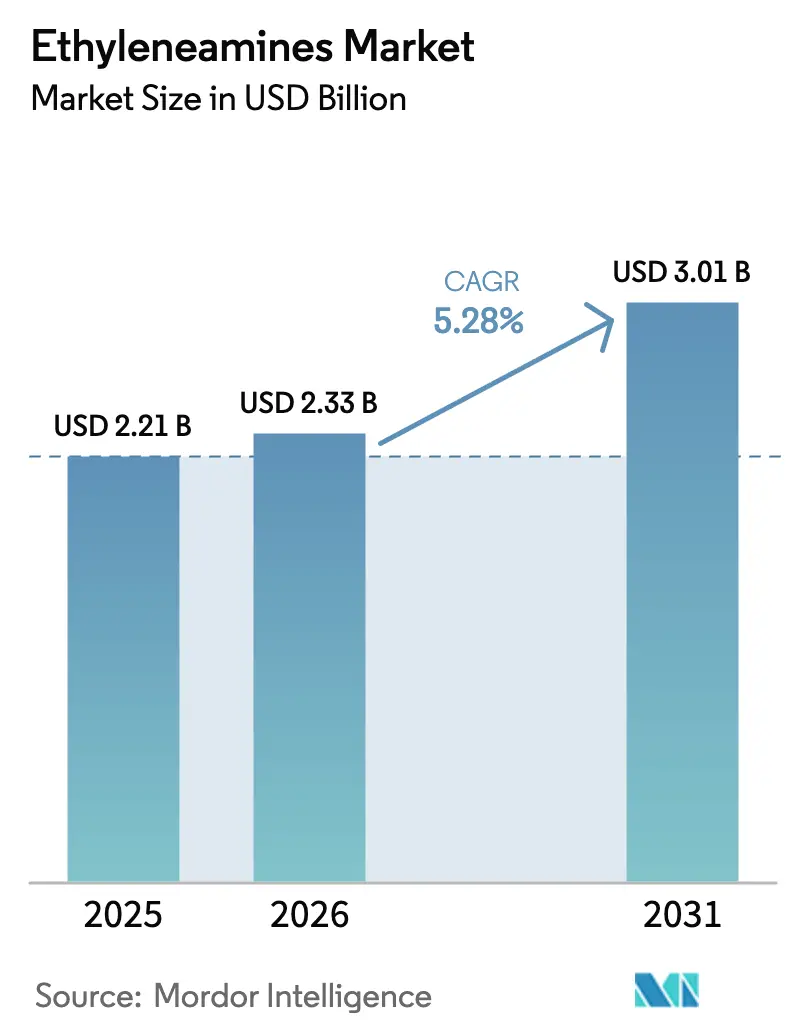
The Ethyleneamines Market size was valued at USD 2.21 billion in 2025 and is estimated to grow from USD 2.33 billion in 2026 to reach USD 3.01 billion by 2031, at a CAGR of 5.28% during the forecast period (2026-2031). Growth is anchored by epoxy-resin demand in wind-energy blades, accelerating adoption of amine-blend solvents for carbon capture, and steady pull-through from agrochemicals, surfactants, and waterborne coatings. Producers with integrated ethylene oxide and ammonia enjoy margin advantages when feedstock prices swing, while the shift toward low-carbon and biomass-balanced pathways is opening premium niches for mass-balance certified grades. Capacity rationalization in Europe contrasts with new builds in China and Saudi Arabia, reshaping regional trade flows within the ethyleneamines market. At the same time, tightening occupational-exposure limits and volatile feedstocks continue to temper short-term operating rates yet have not derailed the sector’s medium-term expansion.
Key Report Takeaways
- By type, ethylenediamine held 62.94% of the ethyleneamines market share in 2025 and is forecast to witness a 5.36% CAGR through 2031.
- By end-user industry, agrochemicals accounted for a 16.02% share of the ethyleneamines market size in 2025. Personal care is projected to post the fastest 5.48% CAGR through 2031 within the ethyleneamines market.
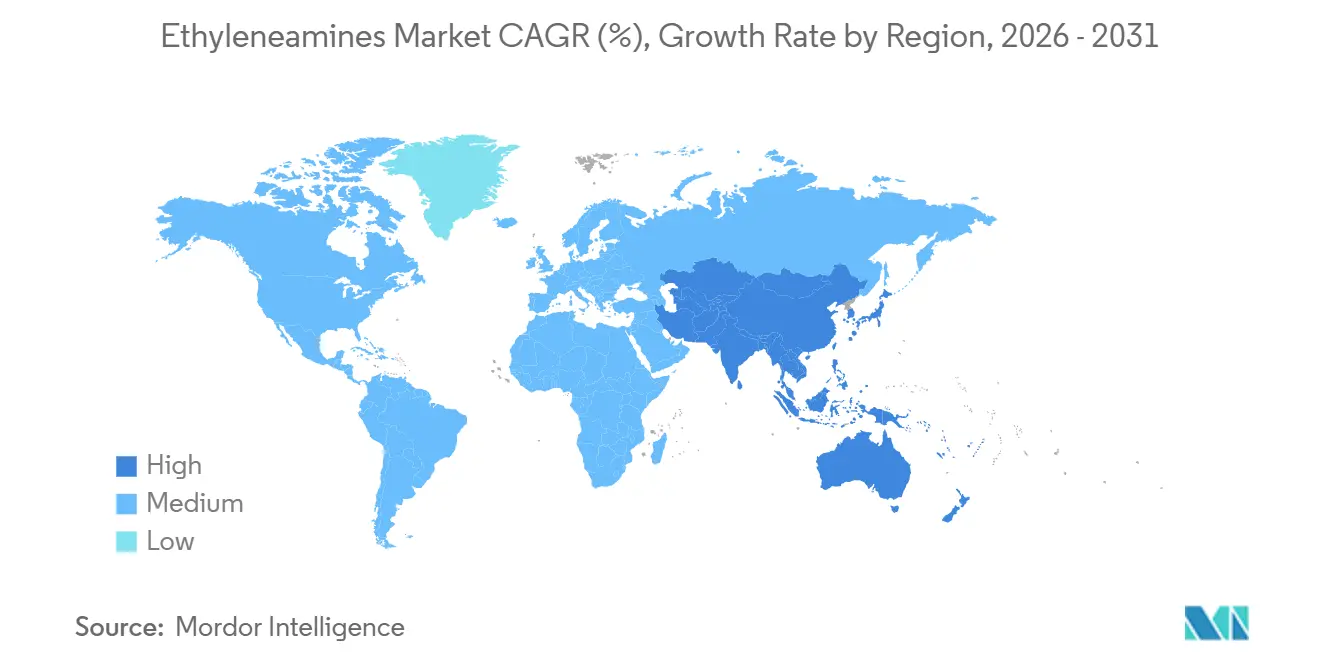
- By geography, Asia-Pacific commanded 53.32% of the 2025 volume and is set to increase at a 5.43% CAGR, the quickest among all regions, highlighting its pivotal role in the ethyleneamines market.
Note: Market size and forecast figures in this report are generated using Mordor Intelligence’s proprietary estimation framework, updated with the latest available data and insights as of January 2026.
Market Trends and Insights
Drivers Impact Analysis of Ethyleneamines Market*
| Drivers | (~) % Impact on CAGR Forecast | Geographic Relevance | Impact Timeline |
|---|---|---|---|
| Booming epoxy-resin demand from wind-energy blade production | +0.9% | Global, with concentrated capacity in China, Europe, and North America | Medium term (2–4 years) |
| Rising agrochemical consumption in Asia and South America | +1.1% | Asia-Pacific (China, India), South America (Brazil, Argentina) | Short term (≤ 2 years) |
| Surfactant and detergent capacity additions in Asia-Pacific | +0.7% | Asia-Pacific core, spill-over to Middle-East and Africa | Medium term (2–4 years) |
| Shift to low-VOC coatings using polyamine curing agents | +0.6% | North America and EU, early adoption in China | Long term (≥ 4 years) |
| CO₂-capture solvent research and development using ethyleneamines blends | +0.4% | Global, pilot, and early commercial projects in North America, the EU, Middle East | Long term (≥ 4 years) |
| Source: Mordor Intelligence | |||
Booming Epoxy-Resin Demand from Wind-Energy Blade Production
Multi-year epoxy supply agreements are being inked by wind-turbine manufacturers, leading to a surge in the consumption of polyamine curing agents and, consequently, boosting volumes in the ethyleneamines market. Huntsman provides ethyleneamine-based systems that cure at room temperature, ensuring the necessary fatigue resistance for blades longer than 80 meters in length[1]Huntsman Corporation, “Form 10-K 2024,” huntsman.com. In 2024, China bolstered its wind capacity significantly, with each gigawatt requiring substantial amounts of epoxy resin, thereby amplifying the demand for heavy ethyleneamines. European manufacturers of wind turbine blades are transitioning to vacuum-infusion resins, which necessitate customized DETA and TETA blends to manage gel time. With the expansion of rotor diameters, there's a need for thicker laminates to achieve a quicker through-cure, resulting in an amine-to-resin ratio that escalates at a pace outstripping the increase in turbine unit counts.
Rising Agrochemical Consumption in Asia and South America
As growers combat glyphosate resistance, Brazil and Argentina see a resurgence in herbicide formulations utilizing ethylenediamine salts. In 2024, India greenlit several new crop-protection formulations, many incorporating ethylenediamine-based adjuvants to boost foliar uptake. China, the globe's leading glyphosate producer, highlights high-value agrochemical intermediates as strategic in its 14th Five-Year Plan, bolstering local demand for ethyleneamines. With South American soybean acreage expanding significantly in 2024, herbicide application intensity surged, driving up the use of ethyleneamine derivatives. Swift regulatory approvals and bolstered domestic capacities fuel the short-term growth of the ethyleneamines market within the agrochemical sector.
Surfactant and Detergent Capacity Additions in Asia-Pacific
Between 2024 and 2025, China and India added new surfactant capacity, with a significant focus on betaine and amine-oxide lines. Ethylenediamine, a key ingredient for cocamidopropyl betaine, is increasingly sought after in sulfate-free shampoos and body washes throughout Asia. India's chemical roadmap highlights surfactants as a key priority. Meanwhile, China aims for growth in petrochemicals for 2025–2026, with a spotlight on specialty surfactants for electronics cleaning and oilfield services. As disposable incomes rise, consumers are gravitating towards premium formulations, propelling personal care to the forefront of demand growth in the ethyleneamines market.
Shift to Low-VOC Coatings Using Polyamine Curing Agents
North American and European VOC limits push coatings formulators toward waterborne or high-solids systems that rely on polyamine curing agents[2]U.S. Environmental Protection Agency, “NESHAP,” epa.gov. Evonik is expanding specialty-amine capacity in Nanjing to supply low-VOC epoxy curatives, with start-up slated for 2026. Polyaspartic coatings cure quickly and emit little odor, reducing downtime for commercial spaces. Europe’s Industrial Emissions Directive tightens allowable solvent emissions in metal and plastic finishing, accelerating demand for amine-cured systems. Coatings producers now request mass-balance certified ethyleneamines to meet Scope 3 targets, opening premium segments within the ethyleneamines market.
Restraints Impact Analysis of Ethyleneamines Market*
| Restraints | (~) % Impact on CAGR Forecast | Geographic Relevance | Impact Timeline |
|---|---|---|---|
| Toxicity-driven workplace exposure limits tightening | -0.8% | Global, with stricter enforcement in North America and EU | Short term (≤ 2 years) |
| Volatile ethylene oxide and ammonia feedstock pricing | -1.2% | Global, acute in regions dependent on imported feedstocks | Short term (≤ 2 years) |
| Emerging bio-based polyamines cannibalising petro routes | -0.6% | North America and EU early adoption, spreading to Asia-Pacific | Long term (≥ 4 years) |
| Source: Mordor Intelligence | |||
Toxicity-Driven Workplace Exposure Limits Tightening
Producers are investing in containment upgrades as occupational agencies lower exposure limits for several ethyleneamines to 1 ppm. Authorization fees from European Chemicals Agency reviews under REACH could raise production costs. Before idling its Moers plant, Huntsman incurred restructuring charges in 2025, which included spending on environmental and safety measures. While formulators are testing polyetheramines as partial substitutes, trade-offs in cure speed and durability hinder widespread replacement. With tightening enforcement, capacity additions are moving toward regions with clearer regulatory pathways, reshaping the global footprint of the ethyleneamines market.
Volatile Ethylene Oxide and Ammonia Feedstock Pricing
In 2024–2025, ethylene oxide spot prices fluctuated, influenced by outages along the Gulf Coast. Concurrently, ammonia prices surged to a peak, driven by curbs on fertilizer exports. While integrated producers like BASF and Dow manage to stabilize their operations through internal sourcing, merchant producers find themselves grappling with margin reductions. SABIC, in 2024, cited feedstock volatility as a contributing factor to its diminished petrochemical volumes. While buyers are leaning towards formula-based contracts, they still contend with lag risks. The ethyleneamines market sees a hesitance towards forward contracting, and capital-budget planning becomes a challenge, all due to the consistently broad price ranges.
*Our forecasts treat driver/restraint impacts as directional, not additive. The impact forecasts reflect baseline growth, mix effects, and variable interactions.
Ethyleneamines Market Segment Analysis
By Type:
EDA Dominates While Heavy Amines Target Specialty NichesEthylenediamine captured 62.94% of the ethyleneamines market share in 2025 and is projected to grow at a 5.36% CAGR through 2031, underpinned by its dual role in polyetheramine production and water-treatment chelation. Heavy ethyleneamines such as DETA, TETA, TEPA, and AEP supply epoxy curing, asphalt modification, and oilfield chemicals where higher amine functionality drives adhesion and film build. Bio-attributed feedstocks are gaining momentum; BASF and Evonik signed a biomass-balanced ammonia agreement in 2024, allowing ISCC PLUS certification that carries a price premium.
Piperazine, though smaller in volume, enjoys steady pharmaceutical demand as an intermediate for antihistamines and anthelmintics. Aminoethylpiperazine bridges cyclic and linear chemistries, offering fast cure in polyurea coatings and robust corrosion inhibition in pipelines. As rotor blades lengthen and low-VOC regulations tighten, formulations often specify narrow amine functionality windows, favoring suppliers with broad heavy-amine slats. These needs reinforce the dominance of integrated producers within the ethyleneamines market. Over the forecast, the ethyleneamines market size for heavy amines is expected to expand steadily, supported by composite, oilfield, and specialty-adhesive applications.



By End-User Industry:
Agrochemicals Lead Share While Personal Care AcceleratesAgrochemicals held 16.02% of the ethyleneamines market size in 2025, driven by glyphosate, triazine herbicides, and micronutrient fertilizers across Brazil, India, and China. Personal care, however, is set to grow the fastest at 5.48% CAGR as sulfate-free shampoos and body washes boost demand for betaine and amine oxides derived from ethylenediamine. India’s expanding middle class and Southeast Asia’s contract manufacturing hub status spur surfactant build-outs that vertically integrate into ethyleneamines. Adhesives, paints, and resins remain significant, employing DETA, TETA, and TEPA in epoxy curatives and polyamide backbones, especially for wind-blade and flooring markets.
Automotive uses ethyleneamines in fuel additives and cooling-system inhibitors, yet electric-vehicle uptake is capping long-term growth. Oil and gas services deploy heavy amines in corrosion inhibitors and demulsifiers, with Middle Eastern producers supplying much of this demand. Pharmaceuticals and textiles consume piperazine and ethylenediamine in API synthesis and softeners, respectively, with moderate expansion tied to generics and synthetic-fiber blends. Across segments, premium pricing for biomass-balanced or low-carbon variants supports margin resilience, reinforcing the positive trajectory of the ethyleneamines market.


Geography Analysis
APAC Ethyleneamines Market
Asia-Pacific accounted for 53.32% of global volume in 2025 and is forecast to post a 5.43% CAGR to 2031. China is ramping up its integrated complexes, with Hengli Petrochemical spearheading a specialty-materials unit. This unit, which includes ethyleneamines, strategically pairs captive ethylene oxide with downstream derivatives, ensuring a cost edge. Meanwhile, India is making waves with a substantial capital investment in downstream chemicals, particularly emphasizing backward integration in agrochemicals and surfactants. While Japan and South Korea play pivotal roles in electronics and auto manufacturing, their growth lags behind the regional average. In Southeast Asia, rising disposable incomes are luring multinational personal-care firms, leading to localized surfactant production and a surge in ethyleneamine imports.
North America and Saudi Arabia Ethyleneamines Market
North America, despite its robust production capabilities, grapples with competitive pressures. Dow’s Sadara joint venture in Saudi Arabia is making global waves by shipping cost-advantaged amines, thereby nibbling away at the Gulf Coast's export share. Following the closure of its Moers facility, Huntsman has pivoted its Chocolate Bayou plant's focus towards epoxy and oilfield clientele. In a move towards sustainability, Canada’s Path2Zero ethylene complex is rolling out low-carbon ethylene oxide, positioning Alberta as a prime supply hub for environmentally-conscious buyers. Capitalizing on its proximity to Gulf-Coast feedstocks, Mexico is ramping up its surfactant lines to cater to U.S. personal-care brands.
EMEA and South America Ethyleneamines Market
Europe grapples with soaring energy costs and stringent REACH regulations. This has led to selective investments, such as BASF’s expansion of alkyl-ethanolamines in Antwerp and Evonik’s specialty-amine facility in Nanjing, strategically catering to European demand. In South America, the focus remains on agrochemical consumption, albeit with a heavy reliance on imports. The Middle East, bolstered by SABIC’s ethyleneamine unit and Huntsman’s Arabian Amines venture, is exporting to both Asia and Europe. They're also exploring carbon-capture projects to bolster their sustainability image. Africa, still in its infancy in this market, sees demand primarily driven by imported agrochemicals and coatings.

Value Chain Analysis
The ethyleneamines value chain starts with petrochemical and nitrogen inputs (ethylene/ethylene oxide, ethylene dichloride, monoethanolamine, and ammonia), which feed two main production routes, EDC ammonolysis and MEA reductive amination. Integrated producers with captive ethylene oxide and reliable ammonia sourcing typically sustain cost and availability advantages during feedstock swings. This integration is a differentiator for major suppliers such as BASF, Dow, Huntsman, SABIC (via Sadara), Nouryon, Tosoh, Delamine, and regional players including Arabian Amines Company.
Manufacturing involves reaction and separation steps to produce EDA and heavier ethyleneamines (DETA, TETA, TEPA, AEP, etc.), followed by storage, packaging (including higher-purity offerings for sensitive applications), and distribution through bulk logistics and chemical distributors. Downstream demand spans epoxy curing agents (wind blades and coatings), agrochemicals, surfactants and detergents, water treatment and chelation, lubricant and fuel additives, and oilfield chemicals. Bottlenecks tend to sit in capital intensity, permitting and compliance overhead, and safe handling requirements across the chain. Regulatory and occupational controls, for example REACH in the EU and TSCA in the United States, raise barriers for new entrants and favor established, compliant assets.
Competitive Landscape
The ethyleneamines market is moderately consolidated. Strategic themes center on low-carbon credentials and regional diversification. BASF and Evonik now market ISCC PLUS-certified ethyleneamines using biomass-balanced ammonia, aligning with downstream Scope 3 targets. Hengli Petrochemical’s planned complex in China could shift global supply if its integrated economics prove competitive. Technology innovation also matters; continuous reactive distillation trims production costs, giving operators of modern plants a pricing edge. In application development, Pacific Northwest National Laboratory’s work on energy-lean CO₂ solvents highlights new pull-through opportunities for tailored ethyleneamine blends.
Ethyleneamines Industry Leaders
Huntsman International LLC
Dow
BASF SE
Nouryon
Tosoh Corporation
- *Disclaimer: Major Players sorted in no particular order

Ethyleneamines Market Companies Covered in this Report
- Alkyl Amines Chemicals Ltd.
- Arabian Amines Company
- Arkema
- BALAJI SPECIALITY CHEMICALS LIMITED
- BASF SE
- Delamine BV
- Diamines and Chemicals Ltd.
- Dow
- Eastman Chemical Company
- Evonik Industries
- Huntsman International LLC
- INEOS
- Nouryon
- Oriental Union Chemical Corporation
- SABIC
- Sadara Chemical Company
- Tosoh Corporation

Market Opportunities and Future Outlook
Premium, differentiated ethyleneamine grades remain a visible whitespace as downstream buyers tighten product-carbon-footprint and Scope 3 requirements, while also managing VOC and performance constraints in coatings and composites. Evonik's expansion provides a concrete signal of where supply is moving, with the company starting operation of an expanded specialty amine production line in Nanjing (Jiangbei New Material Technology Park) in April 2026. The incremental local capability supports polyurethane and epoxy-related applications and reduces reliance on long-distance imports for specialty amine needs.
Process and pathway innovation is a second opportunity theme, particularly where energy intensity and emissions from conventional production routes translate into cost and compliance burdens. In February 2026, Tohoku University reported an industrial-scale electrosynthesis approach for ethylamine with high Faradaic efficiency and long stability, which reinforces how electrified synthesis concepts are progressing toward scalable operation. While this is not a direct commercial change for ethyleneamines, it supports supplier initiatives around mass-balance certified, lower-carbon, and higher-purity portfolios for applications such as low-VOC epoxy curatives, carbon capture solvent blends, and electronics-adjacent surfactant and additive chains where qualification and supply assurance can command premiums.
Recent Industry Developments in Ethyleneamines Market
- April 2026: Evonik started operation of an expanded specialty amine production facility in the Nanjing Jiangbei New Material Technology Park in China. The additional local capability strengthens supply for polyurethane and epoxy-related applications and supports shorter lead times for regional customers. It also reflects continued investment in Asia-Pacific production footprints as downstream coatings, composites, and formulated-product manufacturing scale.
- September 2025: BASF announced it will convert its Geismar amines portfolio, including ethyleneamines, to 100% renewable electricity from Q4 2025. The company targets a reduction of 25,000 t CO2e and a 4.5% reduction in product carbon footprint, supporting customers seeking lower-carbon inputs. It also positions the site for differentiated supply as buyers increasingly request lower-emissions chemical intermediates.
- November 2024: BASF and SINOPEC’s BASF-YPC site in Nanjing inaugurated expanded downstream plants, adding capacity for purified ethylene oxide and ethyleneamines. The integrated expansion increases regional availability of key intermediates used in epoxy curing agents, surfactants, and other specialty chains. Greater local supply can reshape trade flows by reducing import dependence for certain grades in China and nearby markets.


Ethyleneamines Market Report Scope and Research Methodology
Market Definition and Coverage
For this study, the ethyleneamines market is defined as the value of ethyleneamine chemicals sold into end-use applications, counted at the manufacturer level in USD, and covering both ethylenediamine and heavier ethyleneamines across major regions.
Scope exclusions: It excludes downstream finished products where ethyleneamines are only an input, as well as internal transfers that do not represent an external sale.
Segments Covered in This Report
- By Type
- Ethylenediamine (EDA)
- Heavy Ethyleneamines (DETA, TETA, TEPA, AEP, etc.)
- By End-user Industry
- Personal Care Industry
- Pulp and Paper Industry
- Adhesives, Paints, and Resins
- Agro Chemicals Industry
- Automotive Industry
- Pharmaceutical Industry
- Oil and Gas Industry
- Textile Industry
- Metal Industry
- Other End-user Industries
- By Geography
- Asia-Pacific
- China
- India
- Japan
- South Korea
- Rest of Asia-Pacific
- North America
- United States
- Canada
- Mexico
- Europe
- Germany
- United Kingdom
- Italy
- France
- Rest of Europe
- South America
- Brazil
- Argentina
- Rest of South America
- Middle-East and Africa
- Saudi Arabia
- South Africa
- Rest of Middle-East and Africa
- Asia-Pacific
Data Sources, Market Sizing, and Validation
Desk Research
Desk work starts by mapping the product scope and typical end uses, then aligning that to measurable industry signals. Public sources used include USGS chemical and minerals statistics, UN Comtrade trade flows for relevant chemical codes, the U.S. International Trade Commission trade database, Eurostat industrial and trade datasets, and publications from chemistry and coatings trade associations.
To anchor assumptions, we also reviewed company annual reports, investor presentations, and plant announcements covered in business press. Patent databases were used to see where new amine chemistry is being applied, which helps track adoption in resins, additives, and treatment chemicals. We also used paid subscriptions for company financials and intelligence, plus shipment-level import and export checks where trade clarity was needed. The desk sources listed here are illustrative, and additional public references were also used for collection, validation, and clarification.
Primary Interviews and Surveys
Primary work was used to confirm how demand splits across key end uses such as epoxy curing, water treatment, paper processing, and agrochemical intermediates, and to sense-check price movement assumptions by grade. We spoke with producers, distributors, and large end users across APAC, EMEA, and the Americas, then revisited any large variance points with follow-up outreach so the final model remains realistic.
Distribution of primary research fieldwork respondents
| Company type | Respondent position | Region |
|---|---|---|
| Top tier: 33% | CXOs: 16% | APAC: 51% |
| Mid tier: 51% | Functional/Unit leaders: 29% | EMEA: 31% |
| Smaller Players: 16% | Managers: 55% | Americas: 18% |
Market-Sizing & Forecasting
The market was built using a top-down approach, where production, trade, and end-use demand indicators were combined to reconstruct consumption by region, then converted into value using typical grade-level pricing. To keep the model grounded, we ran selective bottom-up checks using supplier revenue ranges, channel discussions, and sampled volume-by-application builds, and used them to adjust totals when gaps appeared.
Key inputs in the model include epoxy resin activity (since curing agents are a major pull), water treatment chemical demand signals, pulp and paper output trends, agrochemical intermediate demand patterns, and capacity additions or shutdowns for ethylenediamine and heavy ethyleneamines. Pricing used feedstock-linked movement (ethylene and ammonia direction) alongside expert-validated spreads by grade, because simple averages can hide changes in product mix. For forecasting, we used scenario analysis supported by multivariate relationships between end-use output indicators and ethyleneamine consumption intensity, then reviewed the pathway with industry respondents to keep assumptions consistent. Where bottom-up information was thinner for smaller countries, we filled gaps using import dependence, industrial output proxies, and a conservative application mix.
Data Validation & Update Cycle
After the first model run, outputs were cross-checked against independent signals such as trade balances, operating rate commentary, and demand movement in major consuming industries. When a country or application showed an unusual jump, we revisited the drivers and corrected assumptions like utilization, net exports, or price averages before sign-off.
A multi-step internal review is completed so calculations, conversions, and time-series logic stay consistent across regions. Reports are refreshed annually, and interim updates are triggered when material events occur, including large capacity changes, trade restrictions, or sharp feedstock moves. Before final delivery, we do an additional pass on the latest public updates so clients receive an up-to-date view.
Mordor Intelligence's Ethyleneamines Market Size Measured Against Other Published Estimates
Published ethyleneamines market numbers often do not match because groups use different product lists, pricing points, and base years, and those decisions change the final total. Differences also show up in how trade is treated, how captive consumption is handled, and whether value is counted at the producer level or closer to the final formulated product.
Some external estimates are wider because they blend adjacent amine families or include a broader set of downstream formulations, while others are narrower because they anchor on fewer applications or use older price points. The spread is also influenced by currency timing, assumed price progression by grade, and whether capacity and trade checks were used to challenge demand-only builds. This is where Mordor Intelligence counts ethylenediamine and heavy ethyleneamines as sold chemical products and does not add value from downstream finished formulations that only contain these materials.
Benchmark comparison
| Source | Market Size | Gaps in Research Methodology |
|---|---|---|
| Mordor Intelligence | USD 2.33 B (2026) | |
| Global Consultancy A | USD 2.57 B (2025) | Uses an earlier base year and can capture a slightly wider chemistry basket or blended application values, which can lift the total when compared to producer-level chemical sales only. |
| Trade Publisher B | USD 2.79 B (2024) | Anchored on an older price year and may apply broader average pricing across applications, which can overstate value when product mix shifts toward lower-priced heavy ethyleneamines. |
The table shows that timing and what gets counted in the value chain are the two biggest reasons for the spread. By keeping scope tied to the core ethyleneamine products and validating volume and pricing against trade and capacity signals, our estimate remains traceable to clear steps that can be repeated and rechecked.


Key Questions Answered in the Report
What was the global size of the ethyleneamines market in 2026, and how fast is it forecast to grow?
It reached USD 2.33 billion in 2026 and is projected to advance to USD 3.01 billion by 2031, implying a 5.28% CAGR.
Which ethyleneamine grade currently dominates demand?
Ethylenediamine leads with a 62.94% share in 2025, supported by its roles in water treatment, chelation, and polyetheramine production.
Why is Asia-Pacific expected to post the fastest growth?
China’s integrated petrochemical expansions and India’s downstream-chemicals pipeline together underpin a 5.43% CAGR to 2031 for the region.
How are wind-energy installations influencing ethyleneamine consumption?
Larger turbine blades require more epoxy resin cured with heavy ethyleneamines, directly lifting volumes for DETA and TETA.
What regulatory factors could restrain near-term production?
Stricter 1 ppm workplace exposure limits and volatile ethylene oxide plus ammonia pricing are raising compliance costs and squeezing margins.
Page last updated on:





