
Purified Terephthalic Acid Market Size and Share
Market Overview
| Study Period | 2021 - 2031 |
|---|---|
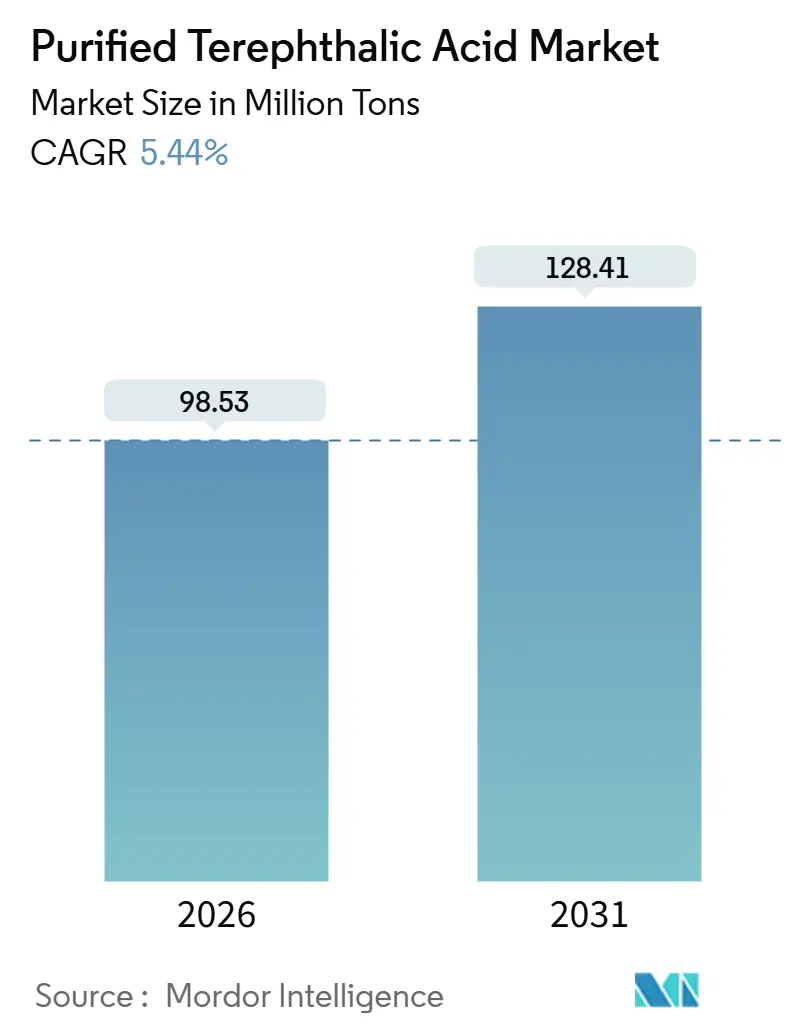
| Market Volume (2026) | 98.53 Million tons |
| Market Volume (2031) | 128.41 Million tons |
| Growth Rate (2026 - 2031) | 5.44 % |
| Fastest Growing Market | Asia-Pacific |
| Largest Market | Asia-Pacific |
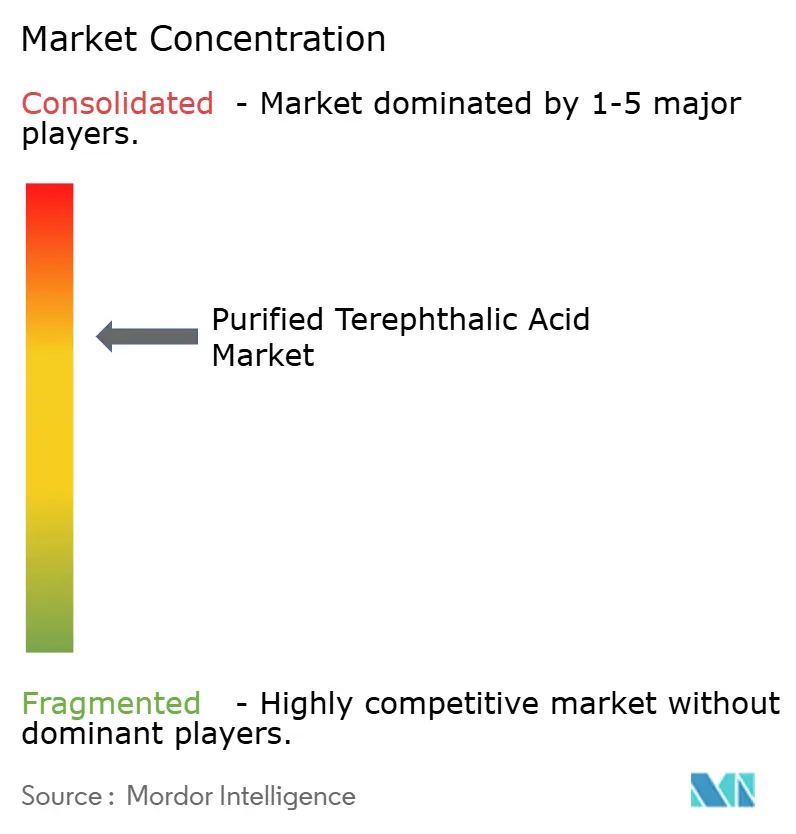
| Market Concentration | Medium |
Major Players *Disclaimer: Major Players sorted in no particular order Image © Mordor Intelligence. Reuse requires attribution under CC BY 4.0. | |
Purified Terephthalic Acid Market Analysis by Mordor Intelligence
The Purified Terephthalic Acid Market size is estimated at 98.53 Million tons in 2026, and is expected to reach 128.41 Million tons by 2031, at a CAGR of 5.44% during the forecast period (2026-2031). This expansion stems from structural shifts in downstream polymer demand rather than transient packaging cycles, as integrated Asian producers scale PTA assets to serve both polyester-fiber and PET resins for export beverage packaging. Rising e-commerce, recycled-content mandates, and lightweighting initiatives in automotive interiors elevate long-term visibility for the purified terephthalic acid market, while sustained paraxylene availability and continued technology upgrades underpin cost competitiveness. Competitive intensity is moderate: five vertically integrated suppliers control close to half of installed capacity, yet second-tier participants remain fragmented and vulnerable to margin swings tied to crude-oil volatility. Parallel momentum in chemical recycling and bio-based PTA, although nascent, introduces differentiation opportunities as brand owners internalize carbon-footprint targets.
Key Report Takeaways
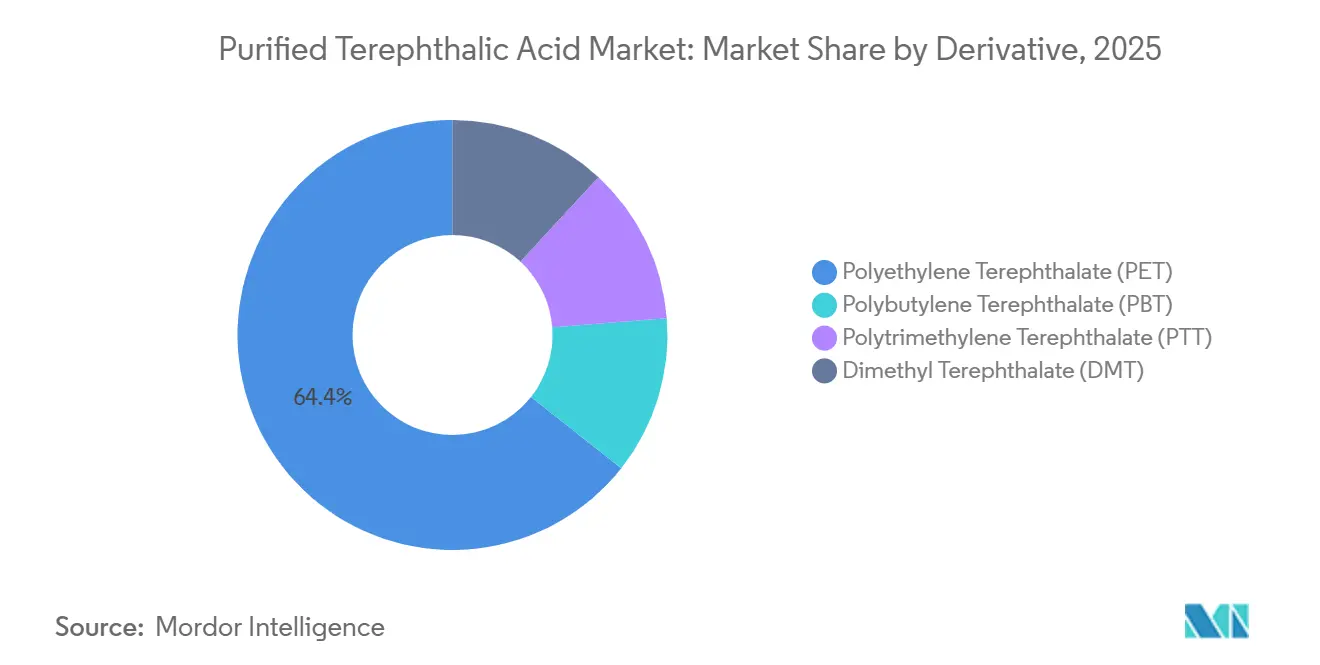
- By derivative, polyethylene terephthalate (PET) commanded 64.35% of the purified terephthalic acid market share in 2025; the segment is forecast to advance at a 6.51% CAGR to 2031.
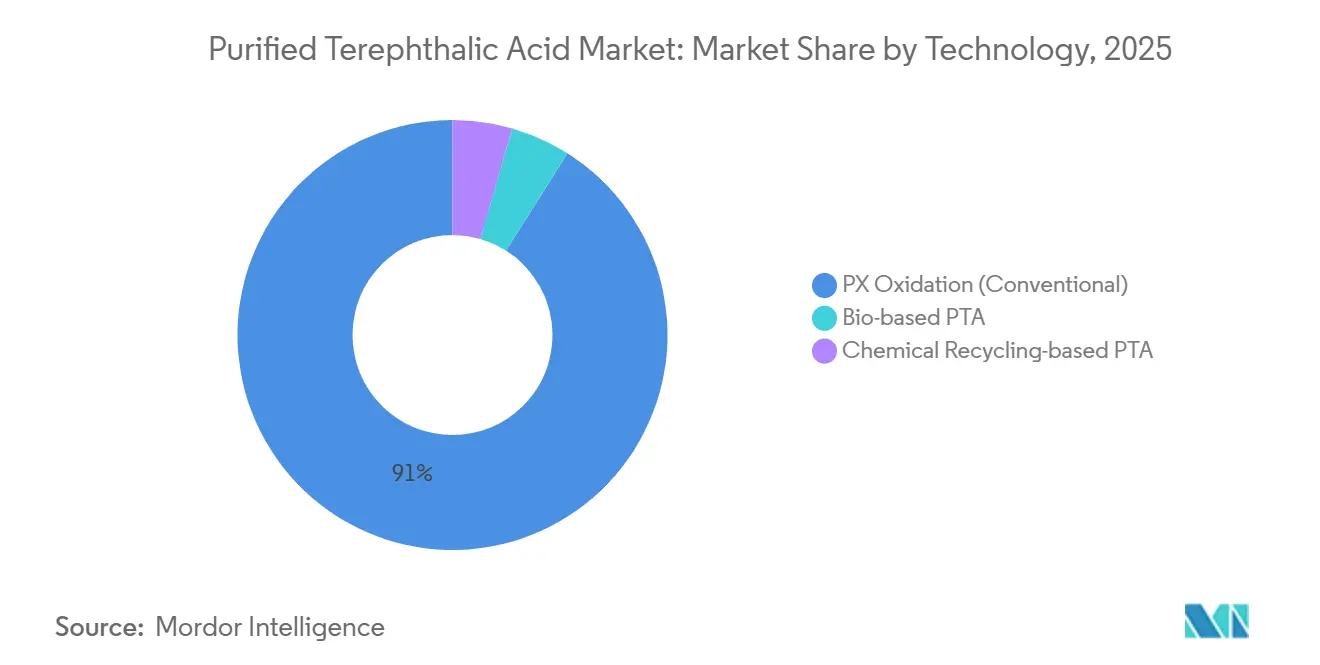
- By technology, PX oxidation (conventional) retained 91.03% revenue share in 2025; bio-based PTA is forecast to post the highest 6.87% CAGR through 2031.
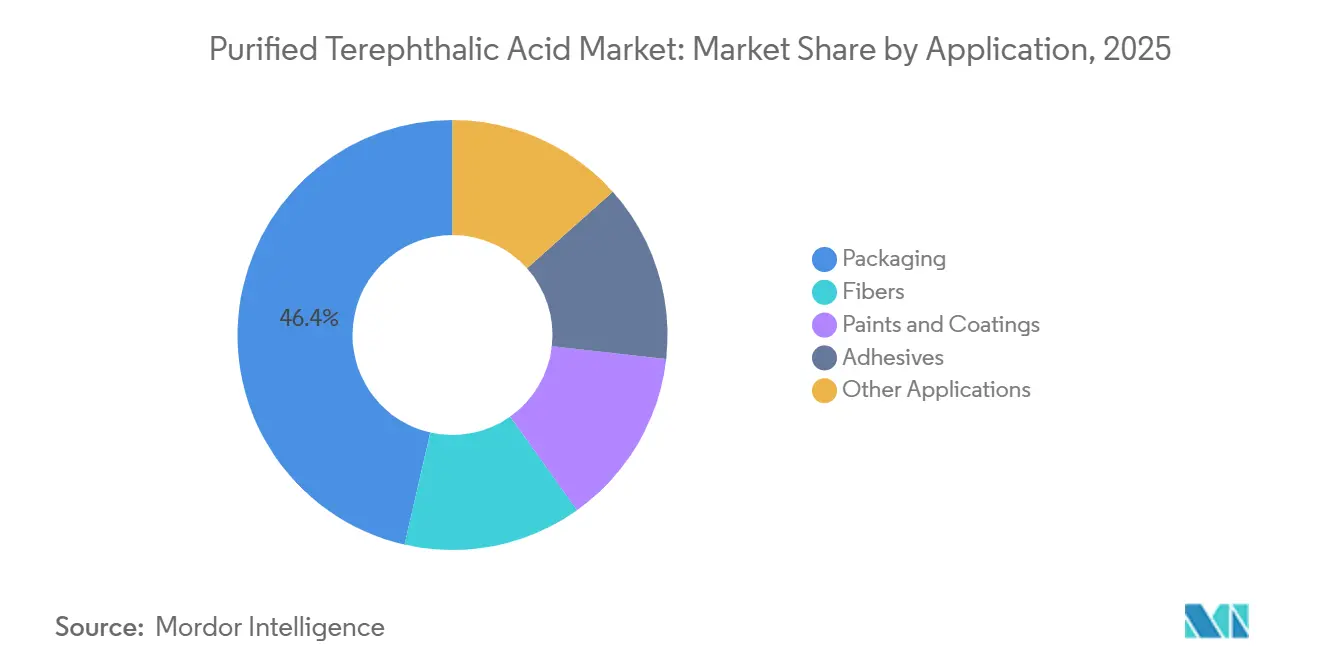
- By application, packaging captured 46.41% of purified terephthalic acid market size in 2025 and is set to grow at 6.22% CAGR through 2031.
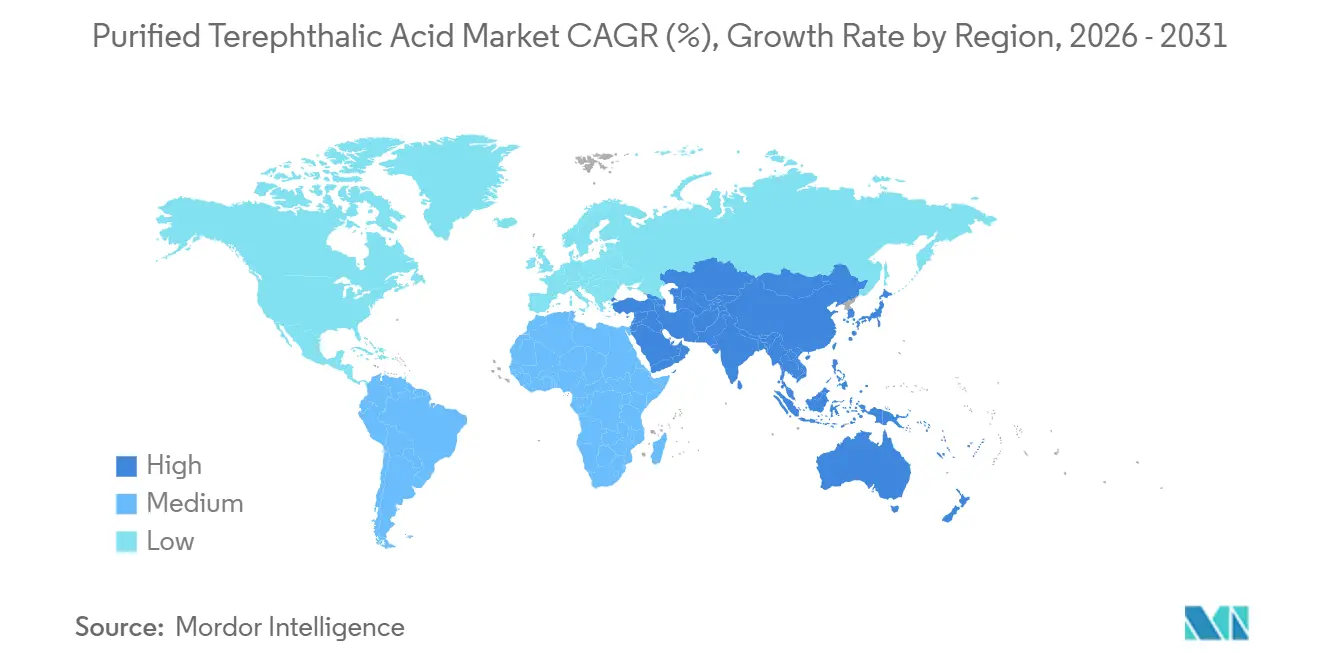
- By geography, Asia-Pacific controlled 53.75% of 2025 volume and will outpace all regions with a 7.12% CAGR by 2031.
Note: Market size and forecast figures in this report are generated using Mordor Intelligence’s proprietary estimation framework, updated with the latest available data and insights as of January 2026.
Market Trends and Insights
Drivers Impact Analysis of Purified Terephthalic Acid Market*
| Driver | (~) % Impact on CAGR Forecast | Geographic Relevance | Impact Timeline |
|---|---|---|---|
| Strong PET-Packaging Demand from E-Commerce | +1.2% | Global, with concentration in North America, Europe, and APAC urban corridors | Medium term (2-4 years) |
| Polyester-Fibre Capacity Additions in Asia | +1.5% | APAC core (China, India, Vietnam, Bangladesh), spill-over to Middle-East | Long term (≥ 4 years) |
| Automakers' Shift to Lightweight PET Composites | +0.6% | North America, Europe, Japan, South Korea | Medium term (2-4 years) |
| Recycled-PET (rPET) Closed-Loop Mandates | +1.0% | Europe (EU27), North America (California, New York), select APAC markets (Japan, South Korea) | Short term (≤ 2 years) |
| Battery-Separator-Grade PTA Uptake | +0.4% | APAC (China, South Korea, Japan), North America (EV manufacturing hubs) | Long term (≥ 4 years) |
| Source: Mordor Intelligence | |||
Strong PET-Packaging Demand from E-Commerce
The steady rise of online grocery and meal-kit delivery boosts demand for lightweight, shatter-resistant PET containers that withstand complex fulfillment chains. Brazil recycled 410,000 tons of PET in 2024 yet still operated at 23% idleness, underscoring feedstock shortages even as a new decree forces a 32% recovery rate in 2026 and 50% by 2040. Brand owners must fund roughly USD 2 billion a year for collection and recycling capacity, while virgin PTA producers weigh backward-integration strategies to secure rPET supply.
Polyester-Fiber Capacity Additions in Asia
Chinese and Indian producers brought 4.2 million tons of new polyester-fiber capacity online between 2024 and 2025. Reliance Industries alone generated 2.59 million tons of PTA during FY 2024-25 to feed its captive yarn lines. Overcapacity suppresses Zhengzhou PTA futures but favors large integrated firms that wield paraxylene advantages and withstand price troughs better than merchant players.
Automakers’ Shift to Lightweight PET Composites
Automotive OEMs employ PET-based composites in interior panels to trim vehicle weight by up to 12%. Eastman Chemical reports a 20% cost savings versus carbon fiber and a 40% weight reduction versus steel, helping global manufacturers meet U.S. CAFE and forthcoming Euro 7 emission limits. PTA suppliers must meet higher IV and purity thresholds, spurring capex upgrades worth USD 50-70 per ton.
Recycled-PET Closed-Loop Mandates
EU Regulation 2022/1616 enforces 30% recycled content in PET bottles by 2030. California’s AB 793 scales to 50% by 2030, driving offtake premiums of USD 100-150 per ton over virgin resin[1]European Commission, “Single-use plastics directive and recycled content targets,” europa.eu . Chemical depolymerization technologies deployed by Eastman and Loop Industries unlock hard-to-recycle feedstock streams that mechanical recycling cannot service, bifurcating demand between virgin and circular PTA grades.
Restraints Impact Analysis of Purified Terephthalic Acid Market*
| Restraint | (~) % Impact on CAGR Forecast | Geographic Relevance | Impact Timeline |
|---|---|---|---|
| Toxicological Concerns Around PTA Dust Exposure | -0.3% | Global, with acute pressure in North America and Europe due to stricter OSHA/ECHA enforcement | Short term (≤ 2 years) |
| Paraxylene and Crude-Oil Price Volatility | -0.8% | Global, with highest impact in import-dependent regions (Europe, Southeast Asia) | Medium term (2-4 years) |
| Bio-Based PEF and Other Polymer Substitutions | -0.5% | Europe, North America (early-adopter markets for sustainable packaging) | Long term (≥ 4 years) |
| Source: Mordor Intelligence | |||
Toxicological Concerns Around PTA Dust Exposure
OSHA maintains a 5 mg/m³ TWA for terephthalic acid dust, compelling retrofit investments of USD 10-15 million for older 500,000-ton units[2]OSHA, “Terephthalic acid dust permissible exposure limits,” osha.gov. INEOS shuttered a Belgian plant in 2023 over compliance costs, and Mitsubishi Chemical divested Indonesian assets, illustrating tightening regulatory economics for sub-scale producers.
Paraxylene and Crude-Oil Price Volatility
Paraxylene represents 60-65% of PTA cash cost. A USD 20 per-barrel fluctuation in Brent translates into 8-12% PTA netback swings, squeezing non-integrated suppliers that sell under fixed contracts. Integrated projects such as Lotte Chemical’s USD 3.9 billion Indonesia complex illustrate the stabilizing effect of scale and vertical integration on netbacks.
*Our forecasts treat driver/restraint impacts as directional, not additive. The impact forecasts reflect baseline growth, mix effects, and variable interactions.
Purified Terephthalic Acid Market Segment Analysis
By Derivative:
PET Dominance Anchors Volume GrowthPolyethylene Terephthalate (PET) absorbed 64.35% of purified terephthalic acid market share in 2025 and is forecast to grow at 6.51% CAGR through 2031, reinforcing its central role in packaging and textiles. PBT retains a lower market share, serving high-temperature automotive connectors, while PTT remains niche in carpets and specialty textiles. DMT’s role has dwindled as direct esterification prevails, yet Koch Technology Solutions’ PolyVolve process renews interest by integrating recycled streams and cutting energy consumption 9%.
The derivative mix tilts further toward PET over the outlook as e-commerce orders and rPET mandates accumulate. However, achieving recycled-content goals hinges on sufficient post-consumer supply, a variable that could temper PET’s growth advantage. Producers increasingly deploy continuous-polymerization lines compatible with depolymerized monomers, enhancing circularity credentials for the purified terephthalic acid market.



By Technology:
Conventional PX Oxidation Retains Scale AdvantagePX oxidation (conventional) captured 91.03% of 2025 output due to established catalyst systems and cost structures near USD 600-700 per ton in integrated settings. INVISTA’s P8 design, licensed widely across Asia, trims capital intensity by 15% through thermosyphon reactors and nitrogen spargers. Bio-based PTA enjoys a 6.87% CAGR but lacks feedstock economics; facilities below 10,000 tons remain demonstrative, awaiting cheaper bio-paraxylene pathways. Methanolysis and glycolysis plants led by Eastman and Loop reach commercialization by 2027, yet capital costs of USD 1,500-2,000 per installed ton limit diffusion outside regions with robust recycled-content laws.
Integrated majors such as Hengli Petrochemical already run single-site complexes exceeding 16 million tons, leveraging scale and captive paraxylene to fend off entrants. The technology mix shift thus favors incremental retrofits rather than wholesale replacement, sustaining conventional oxidation’s volume lead within the purified terephthalic acid market.
By Application:
Packaging Leads, Fibers FollowPackaging accounted for 46.41% of 2025 demand and will grow at 6.22% CAGR through 2031, supported by single-serve beverages in Asia and Latin America plus rising rPET content targets. Fiber use grows at a slower pace amid Chinese overcapacity, but consolidated integrated players still backfill volumes for fast-fashion and home-textile exports.
Coatings and adhesives progress at mid-single-digit rates, with PTA enabling higher crosslink density in alkyd resins for marine and industrial applications. Advanced niches such as battery separator films require ultrapure PTA grades, commanding 30-40% margin premiums. Although these volumes are modest, they deepen PTA’s role in emerging energy value chains, broadening the purified terephthalic acid market beyond traditional segments.
Geography Analysis
APAC Purified Terephthalic Acid Market
Asia-Pacific held 53.75% of 2025 consumption and is tracking a 7.12% CAGR, the purified terephthalic acid market’s fastest regional pace. New PTA lines in China’s Jiujiang and India’s Maharashtra add more than 8 million tons by 2027, underpinning vertically integrated polyester chains. India’s Reliance plans an additional 3 million-ton module at Dahej by 2027, while Adani-Indorama’s USD 3 billion JV fast-tracks a 3.2 million-ton plant using port proximity to slash freight costs.
North America and Europe Purified Terephthalic Acid Market
In North America, Alpek’s 1.2 million-ton Mexican unit supplies U.S. converters, yet Chinese imports cap pricing. Eastman’s depolymerization plant in France will export recycled PTA to North American brand owners, offering premium feedstock for closed-loop bottles.
EMEA and South America Purified Terephthalic Acid Market
Europe lags growth as high energy prices restrain new builds. INEOS’s 2023 closure highlights compliance burden under REACH, driving investment into chemical recycling rather than virgin capacity. South America contributes 6% led by Brazil, which must quadruple selective collection by 2040 to meet new decrees, generating opportunities for recycling ventures. Middle-East and Africa collectively command lower share; SABIC channels capital into Chinese downstream assets rather than local PTA, focusing on capturing value in end-use growth hubs.

Value Chain Analysis
The purified terephthalic acid (PTA) value chain starts with upstream aromatics, where paraxylene (PX) is the key feedstock and typically accounts for 60-65% of PTA cash cost, linking producer economics to refining and aromatics cycles. Commercial PTA is mainly produced through catalytic air oxidation of PX in an acetic acid solvent system (AMOCO/Mid-Century type routes), followed by purification to reach polymer-grade requirements. Firms with captive PX, or integrated refining-aromatics positions, can manage feedstock volatility and keep throughput steady, while non-integrated producers tend to be more exposed to contract pricing and crude-linked PX swings.
PTA plants increasingly co-locate with downstream polyester and PET polymerization to cut logistics and working-capital intensity, including direct melt transfer concepts that reduce solid handling, bagging, and related dust-control costs. End demand is concentrated in PET and polyester fiber/resin producers, with additional pull from engineering plastics and higher-purity niches that require tighter IV and impurity control. Distribution is led by bulk shipments into integrated polymer sites and regional hubs, and differentiation comes from scale (often million-ton-class units), proximity to ports and polymer clusters, and technology and retrofit capability that supports both conventional and circular (recycled-monomer-compatible) feedstocks.
Competitive Landscape
The five largest players (Reliance Industries, Indorama Ventures, Yisheng Pet Resin, Hengli Petrochemical, and FCFC) command about 47% of installed capacity, imparting moderate concentration. Strategy revolves around end-to-end integration, from paraxylene through PTA into polyester resins or fibers, insulating margins from crude swings. Reliance’s INR 75,000 crore expansion will raise Indian PTA capacity to nearly 10 million tons within five years and deepen its export reach across Southeast Asia.
Indorama pursues regional diversification with joint ventures and depolymerization projects in Europe and North America, positioning itself for recycled-content premiums. Sinopec and Hengli leverage coastal mega-complexes exceeding 16 million tons that exploit scale economies and favorable logistics for both domestic and bonded exports. BP retains sizable European capacity but weighs technology licensing and partnerships to hedge against high continental energy costs.
Technology licensors such as INVISTA and Koch Technology Solutions emerge as competitive enablers, reducing capital intensity and energy demand. Meanwhile, Middle Eastern producers mull downstream equity stakes; Saudi Aramco’s interest in Hengli typifies efforts to lock in paraxylene outlets. Closures of marginal players in Belgium and Indonesia affirm a trend toward scale and compliance capability, reinforcing the competitive moat of integrated majors within the purified terephthalic acid market.
Purified Terephthalic Acid Industry Leaders
HENGLI PETROCHEMICAL ( DALIAN ) CHEMICAL CO., LTD.
Reliance Industries Limited
Indorama Ventures Public Company Limited
Yisheng Pet Resin
FCFC
- *Disclaimer: Major Players sorted in no particular order
Purified Terephthalic Acid Market Companies Covered in this Report
- Alpek S.A.B. de C.V.
- BP p.l.c.
- China Petroleum & Chemical Corporation
- Eastman Chemical Company
- FCFC
- HENGLI PETROCHEMICAL ( DALIAN ) CHEMICAL CO., LTD.
- Indian Oil Corporation Ltd
- Indorama Ventures Public Company Limited
- INEOS
- JBF Industries Limited
- LOTTE Chemical Corporation
- Mitsubishi Chemical Corporation
- Oriental Petrochemical (Taiwan) Co., Ltd.
- PetroChina Company Limited
- Reliance Industries Limited
- SABIC
- Samnam Petrochemical Co.,Ltd.
- Yisheng Pet Resin

Market Opportunities and Future Outlook
A key opportunity is at the overlap between virgin PTA economics and circularity requirements. Recycled-content rules in major packaging markets are pushing investments in food-grade rPET supply, which in turn increases the need for PTA/PET assets that can incorporate chemically recycled monomers while still meeting bottle-grade specifications. Recent milestones, including India’s FSSAI approval of food-grade rPET for food and beverage contact applications in March 2025 and new recycling capacity additions such as CPC’s Vietnam facility in June 2025, reinforce the commercial path for closed-loop PET and create a clearer role for PTA producers and licensors around purification, contamination control, and integration solutions, beyond commodity volume.
Geographic and cost-curve shifts are also opening space for new integrated complexes in logistics-led locations, as well as upgrades at established Asian mega-sites. In January 2026, MAK Germany Group signed an agreement with Sohar Port and Freezone to develop a 1.5 million tpa integrated PTA and PET facility in Oman, and in June 2026 construction commenced, reflecting continued equipment relocation toward logistics hubs. At the same time, operational events in 2026 such as large-scale maintenance shutdowns at major Chinese producers (including Hengli and Yisheng) highlight the value of reliability, turn-around execution, and feedstock flexibility when supply tightens periodically. Decarbonization-linked process changes, including reported reductions in hydrogen-related global warming potential when substituting conventional hydrogen with green hydrogen in the PTA chain, also point to an additional opportunity track for producers meeting brand-owner carbon-footprint screening and procurement requirements.
Recent Industry Developments in Purified Terephthalic Acid Market
- June 2026: MAK Germany Group commenced construction of its integrated PTA and PET complex in the Sohar Port and Freezone, following an agreement signed earlier in 2026 to relocate equipment from its closed Rotterdam site. The project anchors a new PTA supply point in an advantaged logistics hub, supporting export-oriented PET chains and diversifying supply away from higher-cost European operations.
- April 2025: Indorama Ventures completed the divestment of its entire equity stake in Indorama Ventures Portugal PTA - Unipessoal, LDA, which operated a PTA facility in Sines, Portugal. The exit sharpened the company’s portfolio toward more competitive and strategically aligned assets, reflecting ongoing rationalization pressure on European PTA economics.
- June 2024: Circular Plastics Company (CPC) commenced operations at its PET bottle recycling facility in Vietnam, with initial annual capacity of 30,000 tonnes of flakes and 14,000 tonnes of food-grade rPET flakes. The start-up expanded regional availability of bottle-to-bottle material, strengthening the circular feedstock base that interacts directly with PTA and PET value chains under recycled-content programs.


Purified Terephthalic Acid Market Report Scope and Research Methodology
Market Definition and Coverage
For this methodology, the market covers purified terephthalic acid supply and demand, measured as the volume of material consumed by downstream users over the study period.
Scope exclusions: We exclude downstream polymer and fiber revenues, along with paraxylene and other upstream feedstocks, even when they are produced in integrated complexes.
Segments Covered in This Report
- By Derivative
- Polyethylene Terephthalate (PET)
- Polybutylene Terephthalate (PBT)
- Polytrimethylene Terephthalate (PTT)
- Dimethyl Terephthalate (DMT)
- By Technology
- PX Oxidation (Conventional)
- Bio-based PTA
- Chemical Recycling-based PTA
- By Application
- Packaging
- Fibers
- Paints and Coatings
- Adhesives
- Other Applications (Engineering Plastics, Pharmaceuticals and Intermediates, etc.)
- By Geography
- Asia-Pacific
- China
- India
- Japan
- South Korea
- ASEAN Countries
- Rest of Asia-Pacific
- North America
- United States
- Canada
- Mexico
- Europe
- Germany
- United Kingdom
- Italy
- France
- NORDIC Countries
- Rest of Europe
- South America
- Brazil
- Argentina
- Rest of South America
- Middle-East and Africa
- Saudi Arabia
- South Africa
- Rest of Middle-East and Africa
- Asia-Pacific
Data Sources, Market Sizing, and Validation
Desk Research
Desk work was used to set the fact base around PTA capacities, operating rates, and trade flows that determine where volumes can realistically land each year. We reviewed public sources such as national customs and statistics portals, UN Comtrade trade tables, USGS chemicals and minerals summaries, IEA energy and feedstock context notes, and peer reviewed journal articles on oxidation and purification routes.
We also leaned on company annual reports and investor presentations to track plant start ups, debottlenecking, and planned turnarounds, then cross checked timelines using reputed press and association websites covering polyester and packaging chains. A paid subscription for company financials and intelligence was used selectively to standardize plant ownership mapping, and a shipment level import export database was used in a few places to sanity check net trade direction. The desk sources listed here are illustrative, and many other public documents were referred to for data collection, validation, and clarification.
Primary Interviews and Surveys
Primary calls and surveys were completed with a mix of PTA producers, distributors, and procurement and technical teams at key downstream users such as polyester and packaging chains, with coverage spread across the main consuming regions. The discussions were used to confirm operating rate ranges, typical turnaround patterns, and how contract versus spot buying shifts volumes when margins tighten, and then to stress test the assumptions taken from desk research.
Distribution of primary research fieldwork respondents
| Company type | Respondent position | Region |
|---|---|---|
| Top tier: 36% | CXOs: 12% | APAC: 40% |
| Mid tier: 44% | Functional/Unit leaders: 32% | EMEA: 37% |
| Smaller Players: 20% | Managers: 56% | Americas: 23% |
Market-Sizing & Forecasting
The core model is built from a top-down reconstruction of the volume pool, where regional PTA demand is derived from polyester and PET chain indicators and then reconciled with supply side signals such as effective capacity and utilization. After forming regional totals, we corroborated them with selective bottom-up approximations, mainly plant and corridor level sense checks, sampled output run rates, and channel checks on typical monthly shipments, which were then used to adjust outliers.
Inputs used in the model include PTA installed capacity and announced additions, utilization ranges and turnaround calendars, net imports and exports by major corridors, and shifts in polyester and PET operating rates that pull PTA offtake. For newer routes, the pace of bio-based and chemical recycling based PTA adoption was treated as a separate ramp factor so it does not get blended into conventional volumes too early. For forecasting, we used scenario analysis anchored on expected capacity additions, utilization normalization, and trade behavior, and then refined the path using primary feedback on pricing cycles and run rate discipline. Where gaps existed at a country level, we bridged them using regional peers with similar asset structures and trade exposure, followed by a review pass to avoid overstating small markets.
Data Validation & Update Cycle
Model outputs are triangulated against independent signals like capacity minus net exports, regional operating rate benchmarks, and year over year changes that should track downstream polyester and PET production behavior. Any sharp step changes trigger an anomaly review, and then follow up questions are sent back to a subset of respondents to confirm whether the move was caused by outages, commissioning delays, or trade re-routing.
Before sign off, the full set of assumptions is reviewed in more than one analyst pass so calculation logic, unit consistency, and regional roll ups match. Reports are refreshed annually, and interim updates are made when material events occur, such as a major plant start up delay or a long shutdown that changes regional balance. Right before delivery, a final refresh is done so clients receive the latest updated view.
Mordor Intelligence's Terephthalic Acid Market Size Compared Against Other Published Estimates
Published market sizes for terephthalic acid related topics often do not match because the product definition, units, and the point in the value chain are not kept consistent. Some sources report value in USD, others report volume in tons, and the year labeling can also shift based on whether a study uses an estimated year or an actual year.
A common gap driver is scope, since certain estimates combine PTA with adjacent products like DMT or even fold in downstream polyester and PET revenue, which inflates the apparent size. In Mordor Intelligence, the market is kept as purified terephthalic acid volume only, and the totals are tied back to capacity, utilization, and net trade checks so downstream polymer value is not counted twice.
Benchmark comparison
| Source | Market Size | Gaps in Research Methodology |
|---|---|---|
| Mordor Intelligence | USD 98.53 M (2026) | |
| Global Consultancy A | USD 68.25 B (2024) | Uses USD value sizing for a broader terephthalic acid scope that includes PTA and DMT types, and the value basis can reflect price swings and currency timing rather than pure volume movement. |
| Industry Portal B | USD 14.20 B (2024) | Uses revenue based sizing with a narrower demand pool and different grade grouping, and the forecast path appears to lean on headline CAGR without clear capacity and trade reconciliation. |
The spread in the table mainly comes from mixing value based reporting with volume based reporting, plus differences in whether adjacent terephthalate products are bundled into one number. By keeping the steps transparent and linking yearly totals to plant capacity, utilization behavior, and trade signals, the final estimate stays repeatable and easier to audit when new supply or demand events occur.


Key Questions Answered in the Report
How large is the global purified terephthalic acid market?
The purified terephthalic acid market size reached 98.53 million tons in 2026 and is forecast at 128.41 million tons by 2031.
Which derivative segment grows fastest through 2031?
Polyethylene terephthalate records a 6.51% CAGR, the highest among derivatives.
Why is Asia-Pacific expanding PTA capacity rapidly?
China, India, and ASEAN producers build multi-million-ton plants to feed polyester fibers and export PET bottles, lifting regional CAGR to 7.12%.
What risk does paraxylene volatility pose?
A USD 20 per-barrel crude swing alters PTA production costs by 8-12%, squeezing non-integrated suppliers.
Page last updated on:


 Your data is secure and never sold or shared.


