
Swab And Viral Transport Medium Market Size and Share
Market Overview
| Study Period | 2020 - 2031 |
|---|---|
| Market Size (2026) | USD 817.74 Million |
| Market Size (2031) | USD 981.74 Million |
| Growth Rate (2026 - 2031) | 3.72 % |
| Fastest Growing Market | Asia-Pacific |
| Largest Market | North America |
| Market Concentration | Medium |
Major Players *Disclaimer: Major Players sorted in no particular order Image © Mordor Intelligence. Reuse requires attribution under CC BY 4.0. | |
Swab And Viral Transport Medium Market Analysis by Mordor Intelligence
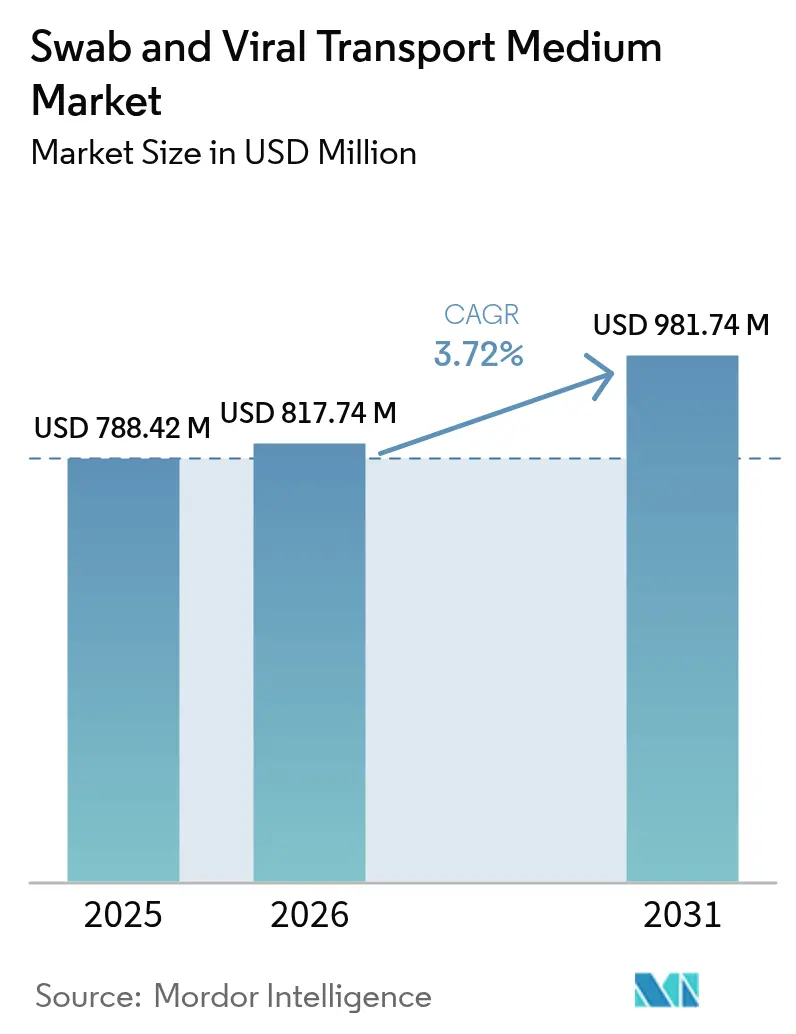
The swab and viral transport medium market size is expected to grow from USD 788.42 million in 2025 to USD 817.74 million in 2026 and is forecast to reach USD 981.74 million by 2031 at 3.72% CAGR over 2026-2031. Sustained demand stems from institutionalized respiratory virus surveillance, broader preparedness funding, and the normalization of post-pandemic testing volumes. Growth is also influenced by the July 2024 FDA rule that brings laboratory-developed tests under medical device regulations, raising quality thresholds for collection systems. Supply-chain realignment toward domestic manufacturing, the rise of home sampling, and the rapid uptake of molecular diagnostics further support the swab and viral transport medium market trajectory. Competitive intensity remains moderate as scale advantages, regulatory expertise, and innovation in pathogen-inactivating media shape strategy.
Key Report Takeaways
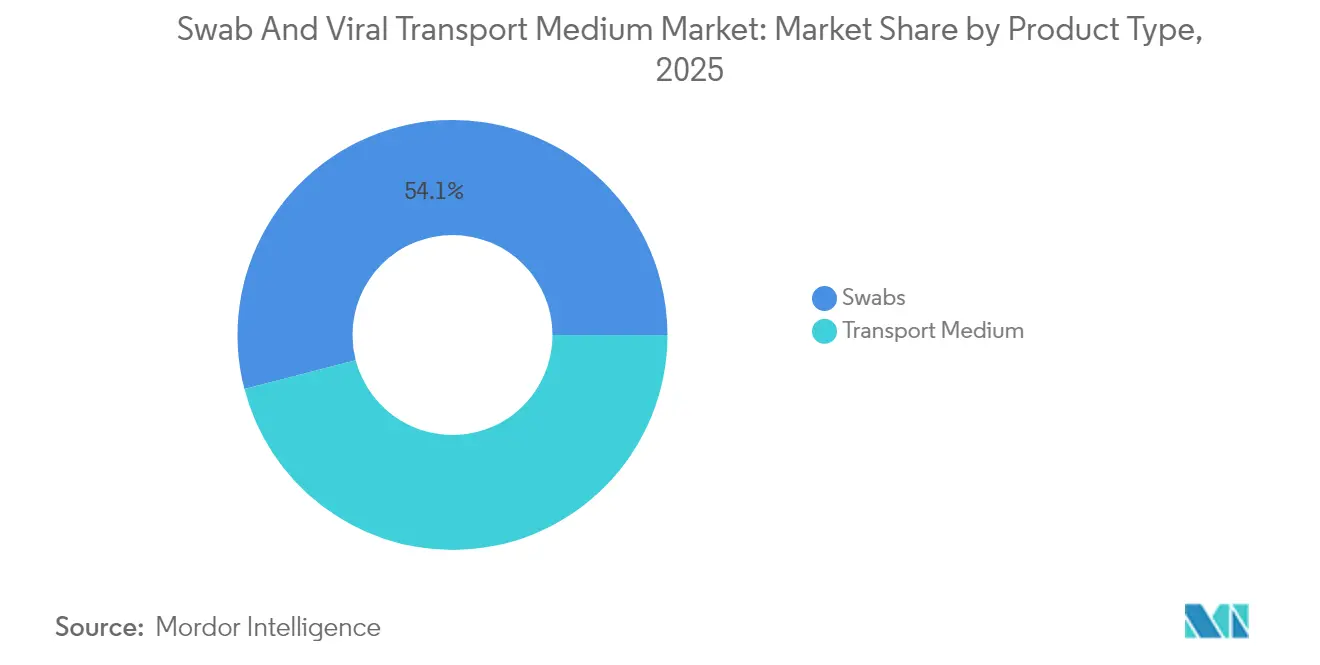
- By product type, swabs led with 54.05% revenue share in 2025, while transport medium is projected to post the fastest 5.52% CAGR through 2031.
- By swab material, flocked nylon held 45.98% of the swab and viral transport medium market share in 2025; polyester/rayon is expected to advance at a 5.63% CAGR to 2031.
- By application, COVID-19 dominated with 70.65% share of the swab and viral transport medium market size in 2025; respiratory syncytial virus testing is set to expand at a 6.62% CAGR through 2031.
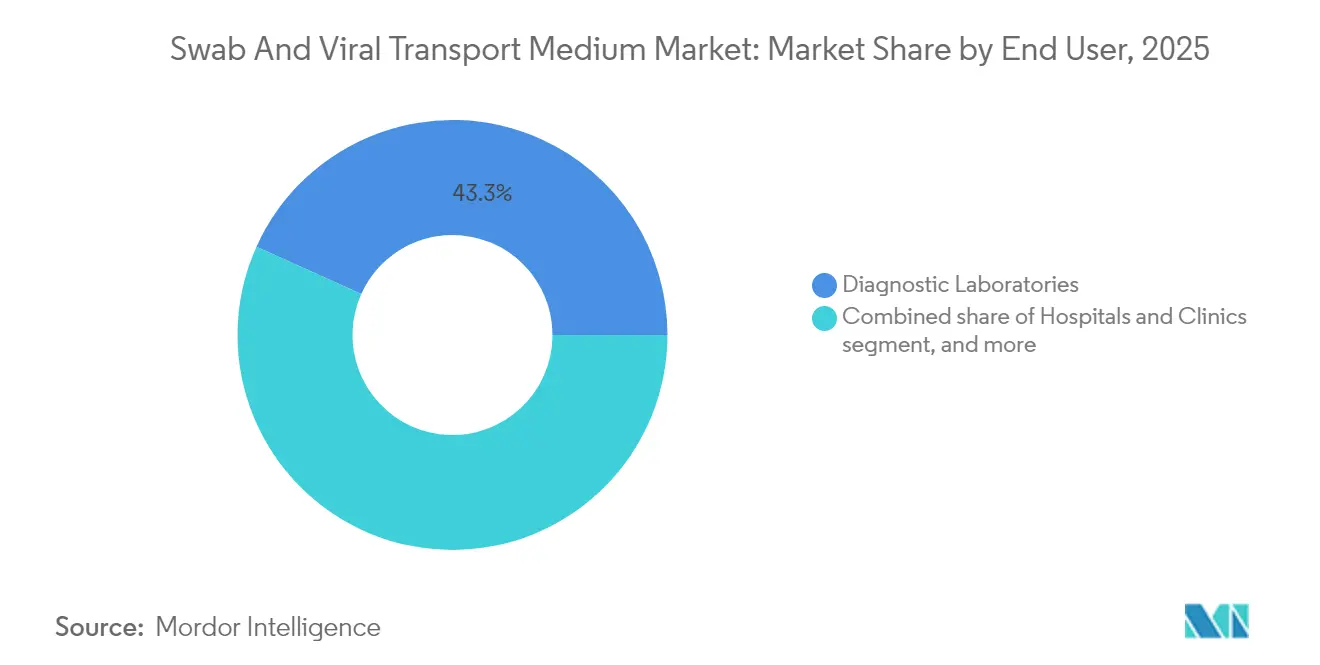
- By end user, diagnostic laboratories accounted for 43.26% share in 2025, whereas point-of-care testing centers register the highest projected 6.33% CAGR between 2026-2031.
- By distribution channel, direct tenders captured 60.98% share in 2025; online channels represent the fastest 6.12% CAGR amid procurement digitization.
- By geography, North America commanded 39.95% revenue share in 2025; Asia-Pacific is anticipated to grow at a 4.55% CAGR during the forecast period.
Note: Market size and forecast figures in this report are generated using Mordor Intelligence’s proprietary estimation framework, updated with the latest available data and insights as of 2026.
Market Trends and Insights
Drivers Impact Analysis of Swab And Viral Transport Medium Market*
| Driver | % Impact on CAGR Forecast | Geographic Relevance | Impact Timeline |
|---|---|---|---|
| Rising incidence of respiratory viral infections | +1.2% | Global, highest in North America & Europe | Medium term (2-4 years) |
| Increasing adoption of molecular diagnostic testing | +0.9% | Global, led by developed markets | Long term (≥4 years) |
| Government investments in public health preparedness | +0.7% | North America, Europe, core APAC | Long term (≥4 years) |
| Expansion of home sampling and mail-back testing kits | +0.6% | North America & EU | Medium term (2-4 years) |
| Commercialization of room-temperature stable transport media | +0.5% | Global | Medium term (2-4 years) |
| Digitally tracked supply chains for sample integrity | +0.4% | Global, early uptake in developed markets | Short term (≤2 years) |
| Source: Mordor Intelligence | |||
Rising Incidence of Respiratory Viral Infections
Non-COVID respiratory pathogens are resurfacing, and adult RSV detection in Western Australia climbed from 16.3 per 100,000 in 2017 to 50.7 per 100,000 in 2023[1]. Hospitals now run year-round surveillance, maintaining higher inventories of collection kits to meet baseline demand. Multiplex PCR panels detect viral pathogens in more than half of pediatric outpatient specimens, increasing the need for validated swab-VTM pairings. Unpredictable viral seasonality following pandemic interventions forces laboratories to secure steady supplies. The resulting demand stability underpins long-term growth for the swab and viral transport medium market.
Increasing Adoption of Molecular Diagnostic Testing
Nucleic-acid amplification tests have supplanted culture methods and require media that inactivate pathogens yet preserve RNA integrity. FDA draft guidance obliges manufacturers to validate each swab-medium combination with spiking studies. Room-temperature stable products such as PrimeStore MTM reduce cold-chain expenses; over 60 million vials have been distributed globally. Point-of-care molecular devices need media that ensure biosafety without compromising sensitivity, pushing demand for premium formulations. Technology shifts therefore elevate both pricing and adoption rates for advanced transport media.
Government Investments in Public Health Preparedness
The US Critical Medical Device List classifies diagnostic collection systems as essential infrastructure, prompting federal stockpiling and domestic production grants[2]. Thermo Fisher earmarked USD 2 billion for US manufacturing, offsetting tariff pressures and enhancing supply security. Emergency Use Authorization pathways remain in place for emerging pathogens, preserving rapid market-entry routes. Public funding increasingly links purchasing decisions to local manufacturing commitments, supporting baseline swab and viral transport medium market demand.
Expansion Of Home Sampling and Mail-Back Testing Kits
Consumer acceptance doubled the at-home testing market to USD 500 million in 2024. Dry swab protocols proved diagnostically equivalent to VTM in SARS-CoV-2 assays, simplifying mail-back workflows. SwabExpress achieved 100% sensitivity and 99.4% specificity in extraction-free testing, cutting processing costs while increasing throughput. Growth in self-collection drives product design toward leak-proof packaging and ambient-stable media, widening the addressable swab and viral transport medium market.
Restraints Impact Analysis of Swab And Viral Transport Medium Market*
| Restraints Impact Analysis | (~) % Impact on CAGR Forecast | Geographic Relevance | Impact Timeline |
|---|---|---|---|
| Supply chain disruptions of medical-grade plastics | -0.8% | Global, acute in APAC hubs | Short term (≤2 years) |
| High incidence of false-negative results due to improper sampling | -0.6% | Global | Short term (≤2 years) |
| Stringent regulations on single-use plastic waste | -0.5% | Europe first, then global | Medium term (2-4 years) |
| Shift toward saliva and non-swab collection methods | -0.5% | North America & Europe | Medium term (2-4 years) |
| Source: Mordor Intelligence | |||
Supply Chain Disruptions of Medical-Grade Plastics
Medical device makers now spend up to 20% of revenue on supply chain costs amid raw material inflation. Canada’s Federal Plastics Registry introduces detailed reporting for cotton swabs, adding compliance overhead[3]. Companies respond by consolidating distribution centers and dual-sourcing polymers, but higher inventory requirements raise working-capital needs. Short-term turbulence could temper the swab and viral transport medium market growth until alternative supply routes stabilize.
Shift Toward Saliva and Non-Swab Collection Methods
Saliva-based assays reduce reliance on specialized swabs and VTM while maintaining accuracy for several respiratory viruses. Injection-molded polyester swabs such as ClearTip™ offer supply flexibility and improved comfort. Immediate processing in point-of-care devices eliminates transport media in some settings, shrinking demand in high-volume screening programs. Although these methods will not fully displace swab-based protocols, they present a medium-term headwind for traditional swab and viral transport medium industry incumbents.
*Our forecasts treat driver/restraint impacts as directional, not additive. The impact forecasts reflect baseline growth, mix effects, and variable interactions.
Swab And Viral Transport Medium Market Segment Analysis
By Product Type:
Transport Medium Drives InnovationSwabs captured 54.05% of the swab and viral transport medium market in 2025, but transport medium is forecast to post the fastest 5.52% CAGR through 2031. The transport-medium sub-segment benefits from room-temperature stable and pathogen-inactivating formulations that extend testing beyond conventional laboratories. COPAN’s eNAT, which preserves viral RNA for 14 days without cold chain, showcases this evolution.
Universal and molecular transport media gain traction as laboratories consolidate workflows, while DNA/RNA Shield variants support multi-pathogen tests. Regulatory requirements linking specific swab-medium pairings favor established suppliers that can execute full validation. As a result, the swab and viral transport medium market size for transport media is projected to widen its contribution, despite swabs’ headline revenue leadership.

By Swab Material:
Polyester Innovation Challenges Nylon DominanceFlocked nylon retained 45.98% share in 2025, yet polyester/rayon swabs are expected to expand at a 5.63% CAGR. Nylon’s superior specimen elution underpins clinical preference, but polyester offers scalable injection-molding and broader supplier availability. Manufacturers prioritize supply resilience after pandemic shortages; hence, polyester/rayon adoption rises even where sensitivity gains are marginal. The swab and viral transport medium market size for polyester-based devices is set to accelerate alongside cost-optimization mandates in procurement.
Continued R&D pursues hybrid materials that blend comfort and recovery efficiency. Patent filings around micro-injection molded tips and hydrophilic coatings illustrate differentiation attempts. Over time, diversified materials mitigate single-source risks and support the swab and viral transport medium market’s transition to balanced supply chains.
By Application:
RSV Surveillance Drives Beyond-COVID GrowthCOVID-19 testing still dominated with 70.65% share in 2025, yet RSV testing is predicted to advance at 6.62% CAGR to 2031. The introduction of nirsevimab prophylaxis heightens RSV monitoring needs, strengthening demand for accurate collection kits. Multiplex PCR panels that screen 15-20 pathogens concurrently require media able to preserve multiple targets, broadening transport-medium use-cases.
Influenza programs stabilize as seasonal patterns normalize, while emerging pathogen assays attract new investment following mpox and avian influenza alerts. The swab and viral transport medium market benefits as laboratories move from episodic to continuous respiratory surveillance, maintaining baseline purchase orders throughout the year.
By End User:
Point-of-Care Testing Centers Accelerate DecentralizationDiagnostic laboratories generated 43.26% revenue in 2025 thanks to high-throughput infrastructure and regulatory credentials. However, point-of-care testing centers are forecast to experience the sharpest 6.33% CAGR, reflecting healthcare’s shift to decentralized decision-making. Clinics and urgent-care sites value collection media that inactivate pathogens for safe handling, including PrimeStore MTM.
Occupational health units, retail clinics, and home-health providers add incremental demand as payer models reward rapid diagnosis. Consequently, the swab and viral transport medium market share for decentralized settings increases, even if central labs remain the volume core for complex panels.
By Distribution Channel:
Online Sales Transform ProcurementDirect tenders delivered 60.98% revenue share in 2025, underscoring institutional buying dynamics. Digital marketplaces nevertheless post the fastest 6.12% CAGR as hospitals adopt e-procurement for real-time inventory visibility. Online platforms shorten replenishment cycles and diversify vendor bases, reducing sole-source risk amid supply disruptions.
Distributors that integrate predictive analytics and automated restocking gain competitive advantage. These shifts redistribute margins but ultimately enlarge the swab and viral transport medium market by removing friction from purchasing.
Geography Analysis
North America Swab and Viral Transport Medium Market
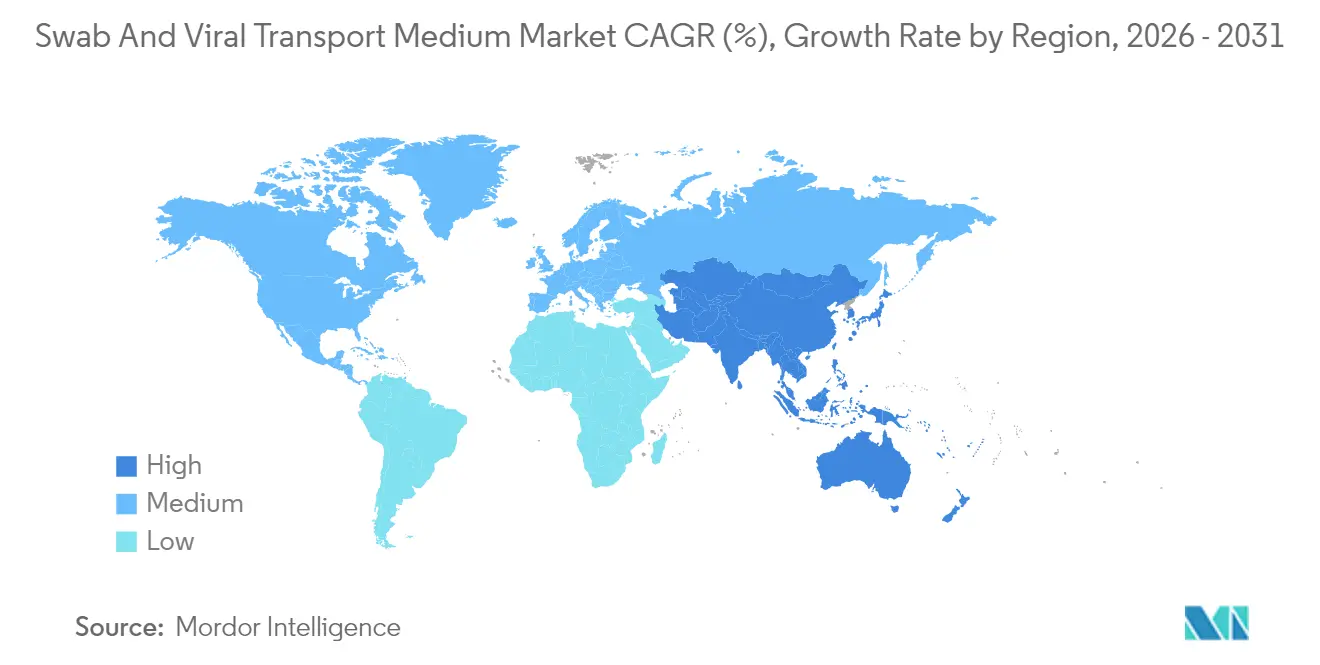
North America held 39.95% of the swab and viral transport medium market in 2025, buoyed by robust regulatory oversight, extensive public-health funding, and domestic capacity expansions such as BD’s USD 30 million North Carolina plant. The FDA’s four-year LDT compliance timeline amplifies demand for validated collection systems, while US federal stockpiling secures baseline volumes. Strategic investments totaling USD 2 billion by Thermo Fisher further anchor manufacturing in the region.
APAC Swab and Viral Transport Medium Market
Asia-Pacific represents the fastest-growing region at a 4.55% CAGR, propelled by diagnostic capacity build-outs and rising respiratory surveillance programs. China’s healthcare reform and demographic shifts expand testing volumes, whereas Japan and South Korea lead adoption of point-of-care molecular assays. ASEAN regulatory harmonization supports cross-border product standardization but still requires navigation of diverse approval timelines.
EMEA and South America Swab and Viral Transport Medium Market
Europe maintains significant market influence through stringent MDR requirements and sustainability-focused regulations such as the Packaging and Packaging Waste directive effective August 2026. Roche’s EUR 600 million German diagnostics hub underscores regional commitment to supply security and automation. Middle East & Africa and South America continue to open opportunities tied to infrastructure upgrades, though economic volatility moderates near-term adoption rates.
Regulatory Landscape
In the United States, viral transport media are regulated by the FDA as medical devices, commonly under 21 CFR 866.2390 with product codes such as JSM and QMC. Commercial distribution typically follows standard premarket pathways (for example, 510(k)), alongside quality system requirements. As pandemic-era enforcement policies have shifted, FDA oversight has placed more weight on validated swab-medium combinations and documented performance for downstream molecular testing, reflected in FDA activity including multiple 510(k) clearances for transport systems and media during 2024-2025.
In Europe, swabs that contact the body are generally regulated as medical devices under Regulation (EU) 2017/745 (MDR). Transport media and specimen transport systems can fall under the IVD framework (IVDR, Regulation (EU) 2017/746), depending on intended use and risk classification. For integrated collection kits, manufacturers need to manage the MDR-IVDR boundary and associated conformity assessment documentation. EU guidance from the Medical Device Coordination Group (MDCG) continues to shape borderline and classification interpretations for specimen collection and transport workflows.
Value Chain Analysis
The value chain starts with raw materials and consumables used to formulate and package transport media and collection devices. Inputs include buffered solutions, antimicrobial agents (for example, gentamicin sulfate and amphotericin B), stabilizers, pH indicators, and sterile plastics (tubes, caps, and packaging), along with flocked nylon or polyester/rayon swabs. Manufacturing typically covers media formulation, sterile filtration, aseptic filling, kit assembly, labeling, and lot release testing, with performance expectations often tied to quality-control approaches referenced in standards such as CLSI M40-A2 for microbiological transport systems.
Products then move through direct tenders and regional distributors/wholesalers into diagnostic laboratories, hospitals, and point-of-care testing settings, with online procurement playing a larger role in replenishment and inventory visibility. Bottlenecks often stem from reliance on specialized inputs (such as biological ingredients and sterile filtration components), concentrated supply for flocked swab technologies, and periodic constraints in medical-grade plastics. These factors increase the value of dual-sourcing, inventory buffering, and localized manufacturing footprints to maintain supply continuity.
Competitive Landscape
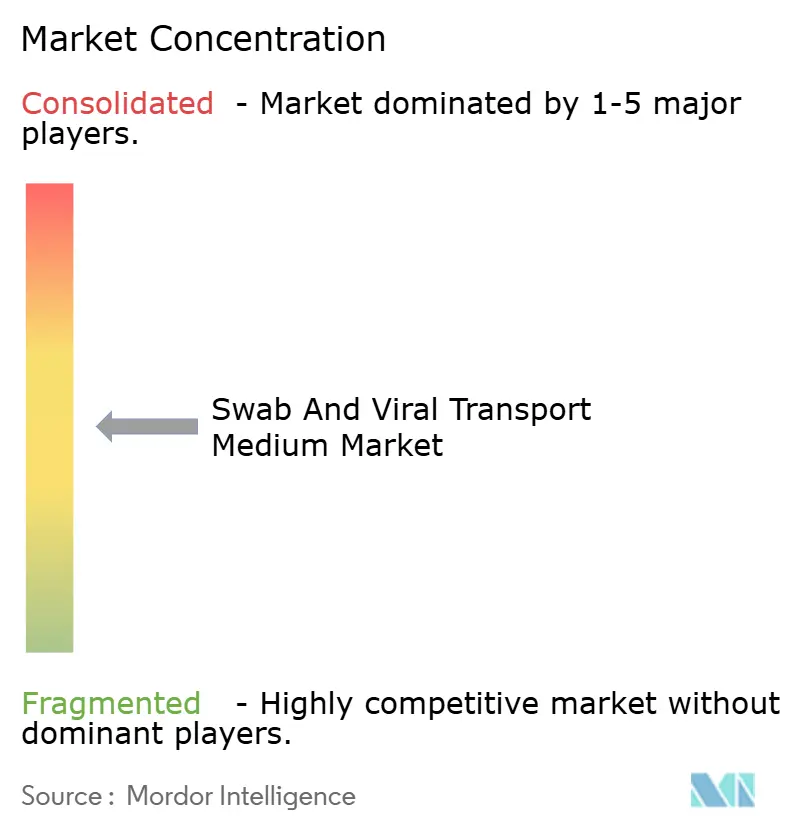
The swab and viral transport medium market is moderately fragmented. Thermo Fisher Scientific and Becton Dickinson leverage global production footprints and regulatory depth to defend share, while COPAN Diagnostics differentiates via eNAT’s pathogen-inactivation and stability profile. Technology adoption—including room-temperature media, digital supply-chain tracking, and automated swab molding—drives competitive advantage.
Patent filings for injection-molded tips and chemical stabilization cocktails create short-lived moats, yet basic device simplicity limits long-term exclusivity. Supply-chain resilience is now pivotal; firms investing in on-shore capacity and dual sourcing mitigate disruption risk and appeal to procurement teams prioritizing continuity. White-space opportunities exist in sustainable packaging and integrated sample-to-digital-report solutions, areas where smaller innovators may secure niche positions before incumbents scale offerings.
Investor activism, as seen in BD’s contemplated life-sciences divestiture, may catalyze portfolio reshaping and fresh alliances. Regulatory tightening favors larger players with established quality systems, potentially driving consolidation and a gradual rise in the swab and viral transport medium market concentration.
Swab And Viral Transport Medium Industry Leaders
-
COPAN Diagnostics
-
Puritan Medical Products
-
Thermo Fisher Scientific
-
Becton, Dickinson and Company
-
Longhorn Vaccines & Diagnostics
- *Disclaimer: Major Players sorted in no particular order
Swab And Viral Transport Medium Market Companies Covered in this Report
- Thermo Fisher Scientific
- Beckton Dickinson
- COPAN Diagnostics
- Puritan Medical Products
- Longhorn Vaccines & Diagnostics
- Titan Biotech
- Medical Wire & Equipment Co.
- Trinity Biotech
- Yocon Biology
- DiaSorin
- EKF Diagnostics
- McKesson Medical-Surgical
- Cardinal Health
- QuidelOrtho
- Hardy Diagnostics
- Meridian Bioscience
- Avantor
- Sarstedt
- Roche
- Labware Inc.
Market Opportunities and Future Outlook
Regulatory normalization has created room for suppliers that can consistently support clearance and quality-system readiness for transport media and integrated collection kits. This is especially relevant as laboratories standardize specimen collection to protect molecular test performance. FDA 510(k) clearances for transport media and related collection/transport devices during 2025, including Hangzhou AllTest Biotech (April 2025), Medical Wire & Equipment Company (November 2025), and Jinan Babio Biotechnology (September 2025), point to active product turnover and highlight demand for differentiated media that align with automated PCR workflows and broader intended-use claims.
Innovation opportunities concentrate on room-temperature stability, pathogen inactivation, and packaging designed for home sampling and mail-back logistics. These developments reduce cold-chain dependence while improving biosafety and specimen integrity. On the buying side, procurement pressure and supply resilience initiatives support continued investment in localized capacity and validated swab-medium pairings, creating openings for suppliers that can bundle compliant kits, maintain lot-to-lot consistency, and provide digital traceability for tender-based buyers and large lab networks.
Recent Industry Developments in Swab And Viral Transport Medium Market
- February 2026: Copan Group announced FDA 510(k) clearance for PhenoMATRIX, an automated image assessment software used with WASPLab laboratory automation. The clearance expands Copan's U.S. positioning around automated microbiology workflows that connect specimen handling to downstream processing, reinforcing the value of integrated pre-analytical and laboratory automation ecosystems.
- September 2025: COPAN Diagnostics announced over USD 7 million in new U.S. manufacturing investments in California and Puerto Rico to expand production capacity for UTM Universal Transport Medium and other devices, with operations planned to start in Q1 2026. The move supports supply assurance for transport media and collection kits and strengthens localized production as buyers emphasize continuity and shorter lead times.
- July 2024: The FDA finalized its rule to phase out enforcement discretion for laboratory-developed tests over a multi-year timeline, bringing more testing under medical-device-style oversight. As laboratories and IVD suppliers align to higher documentation and validation expectations, demand favors standardized collection systems with well-characterized swab-medium performance.
Swab And Viral Transport Medium Market Report Scope and Research Methodology
Market Definition and Coverage
For this report, the market covers the revenue generated from swabs and viral transport medium (VTM) products that are used to collect, stabilize, and transport patient specimens for viral testing and related lab workflows across the full distribution chain.
Scope exclusions: The sizing does not count laboratory diagnostic instruments, test kits and reagents, or lab service revenues that sit outside swab and transport-medium product sales.
Segments Covered in This Report
- By Product Type
- Swabs
- Nasopharyngeal Swabs
- Oropharyngeal (Throat) Swabs
- Anterior-nasal Swabs
- Mid-turbinate Swabs
- Transport Medium
- Viral Transport Medium (VTM)
- Universal Transport Medium (UTM)
- Molecular Transport Medium (MTM)
- DNA/RNA Shield & Others
- Swabs
- By Swab Material
- Flocked Nylon
- Foam
- Polyester / Rayon
- Other Swab Materials
- By Application
- COVID-19
- Influenza
- Respiratory Syncytial Virus (RSV)
- Herpes Simplex Virus
- Other Applications
- By End User
- Hospitals & Clinics
- Diagnostic Laboratories
- Point-of-Care Testing Centers
- Other End Users
- By Distribution Channel
- Direct Tenders
- Distributors / Wholesalers
- Online Sales
- Geography
- North America
- United States
- Canada
- Mexico
- Europe
- Germany
- United Kingdom
- France
- Italy
- Spain
- Rest of Europe
- Asia-Pacific
- China
- Japan
- India
- Australia
- South Korea
- Rest of Asia-Pacific
- Middle East & Africa
- GCC
- South Africa
- Rest of Middle East & Africa
- South America
- Brazil
- Argentina
- Rest of South America
- North America
Data Sources, Market Sizing, and Validation
Desk Research
Desk work started with mapping how specimen collection and transport products are used in routine respiratory and infectious disease testing, and then aligning definitions with how public agencies describe sampling and biospecimen transport. We referenced non-paywalled sources such as CDC guidance, FDA updates and safety communications, WHO laboratory guidance, and OECD health statistics, which help us understand testing pathways and the conditions where VTM is required.
To anchor the model with measurable signals, we also reviewed sources such as USITC trade data, UN Comtrade flows, and relevant peer reviewed microbiology and clinical lab publications that discuss transport media performance and sample stability needs. Company annual reports, investor decks, and credible press coverage were used to validate product mix narratives and channel structure, and we also used a paid subscription for company financials and a patent database to sanity check innovation themes. The desk sources listed here are illustrative only, and many other public documents and data points were used for collection, validation, and clarification.
Primary Interviews and Surveys
Primary discussions were used to confirm how demand splits between routine surveillance, seasonal respiratory panels, and outbreak-driven testing, and to validate what labs and distributors treat as acceptable transport conditions. We spoke with a mix of manufacturers, distributors, hospital and reference lab stakeholders, and procurement focused roles across major regions, and then used their input to adjust assumptions for product substitution, pricing bands, and channel margins.
Distribution of primary research fieldwork respondents
| Company type | Respondent position | Region |
|---|---|---|
| Top tier: 34% | CXOs: 13% | APAC: 41% |
| Mid tier: 49% | Functional/Unit leaders: 34% | EMEA: 35% |
| Smaller Players: 17% | Managers: 53% | Americas: 24% |
Market-Sizing & Forecasting
The market was sized using a top-down approach where testing demand pools and specimen collection requirements were reconstructed by country group, and then translated into swab and VTM consumption using realistic usage factors. In practice, we connected total viral test volumes and seasonality patterns to expected swab counts per test, followed by the share of tests requiring transport media based on transport time, setting of care, and lab protocols. Because pricing varies sharply by swab material and kit configuration, ASP ranges were built using distributor feedback and public tender references, and then normalized to a consistent currency timing.
To keep totals grounded, selective bottom-up checks were added, including supplier revenue roll ups where disclosures exist, sampled price times volume checks across key channels, and import-export shipment trends that act as a directional control. When some geographies had limited visibility, gaps were handled by using proxy indicators like population served by diagnostic labs, respiratory disease burden trends, and the local mix of centralized versus near patient testing, which were then rechecked in interviews.
For forecasting, scenario analysis was used because demand is influenced by periodic outbreaks and policy shifts that are not captured well by a single straight line trend. Inputs that mattered most included routine respiratory surveillance intensity, molecular testing adoption in labs, procurement standardization for specimen collection kits, freight and lead time normalization, and expected price compression as emergency purchasing fades. Assumptions were tightened through expert consensus, and small deviations were kept visible so users can trace changes year to year.
Data Validation & Update Cycle
Each major assumption was tested using at least two independent signals, and then the model outputs were reviewed for outliers at country and regional level before consolidation. We also ran variance checks on implied pricing, per-test consumption, and growth rates to ensure they remain consistent with procurement behavior and reported testing practices.
Before sign-off, the numbers go through an internal multi-step review where logic, units, and currency handling are rechecked, and follow-up calls are triggered when a large mismatch appears versus trade flows, tender pricing, or interview feedback. Reports are refreshed annually, and interim updates are made when material events occur, such as changes affecting sample collection protocols or supply constraints that shift pricing. Right before delivery, the latest public updates are scanned again so clients receive a current view.
Mordor Intelligence's Swab and Viral Transport Medium Market Size Compared Against Other Published Estimates
Published market sizes for swabs and viral transport medium often differ because firms draw the boundary around different products, count different buyer channels, and make different assumptions about testing volumes after the pandemic demand spike. Currency timing and the choice of base year also matter, since pricing and procurement patterns have been shifting back toward routine purchasing.
Testing volume trends and import-export shipment signals are used as cross-checks to keep Mordor Intelligence's estimate tied to realistic consumption and replenishment needs, rather than assuming extended emergency stockpiling in the base case.
Benchmark comparison
| Source | Market Size | Gaps in Research Methodology |
|---|---|---|
| Mordor Intelligence | USD 788.42 M (2025) | |
| Trade Publisher A | USD 1210.00 M (2025) | This figure appears to bundle broader specimen collection products and kit components beyond swabs and VTM, and it also uses a higher post-pandemic testing baseline that lifts volumes and value. |
| Industry Research Portal B | USD 1330.00 M (2025) | The estimate likely applies aggressive ASP progression and includes adjacent transport and collection consumables in the same bucket, which can inflate the revenue total for the defined market. |
The spread across sources mainly comes from what is counted as part of the product set and how quickly volumes and pricing are assumed to normalize after emergency purchasing periods. By keeping the demand build tied to test volumes, swab-per-test usage, and a clear VTM inclusion rule, the final number stays easier to reproduce and audit.
Key Questions Answered in the Report
How large is the swab and viral transport medium market in 2026?
The market stands at USD 817.74 million in 2026 and is projected to reach USD 981.74 million by 2031.
What CAGR is forecast for global demand through 2031?
Demand is expected to rise at a 3.72% CAGR during 2026-2031.
Which product type is expanding the fastest?
Transport medium is forecast to grow at 5.52% CAGR, benefiting from room-temperature and pathogen-inactivating innovations.
Which region shows the highest growth potential?
Asia-Pacific is anticipated to grow at a 4.55% CAGR as diagnostic capacity and public-health investment expand.
How are supply-chain concerns shaping procurement?
Hospitals increasingly use online platforms for real-time purchasing, while manufacturers invest in domestic capacity to mitigate disruption risks.
What impact do new FDA regulations have on suppliers?
The July 2024 LDT rule imposes medical-device-level compliance, favoring manufacturers with robust quality systems and validated swab-medium combinations.