
Surface Mount Technology Market Size and Share
Market Overview
| Study Period | 2020 - 2031 |
|---|---|
| Market Size (2026) | USD 7.11 Billion |
| Market Size (2031) | USD 10.19 Billion |
| Growth Rate (2026 - 2031) | 7.49 % |
| Fastest Growing Market | Asia Pacific |
| Largest Market | Asia Pacific |
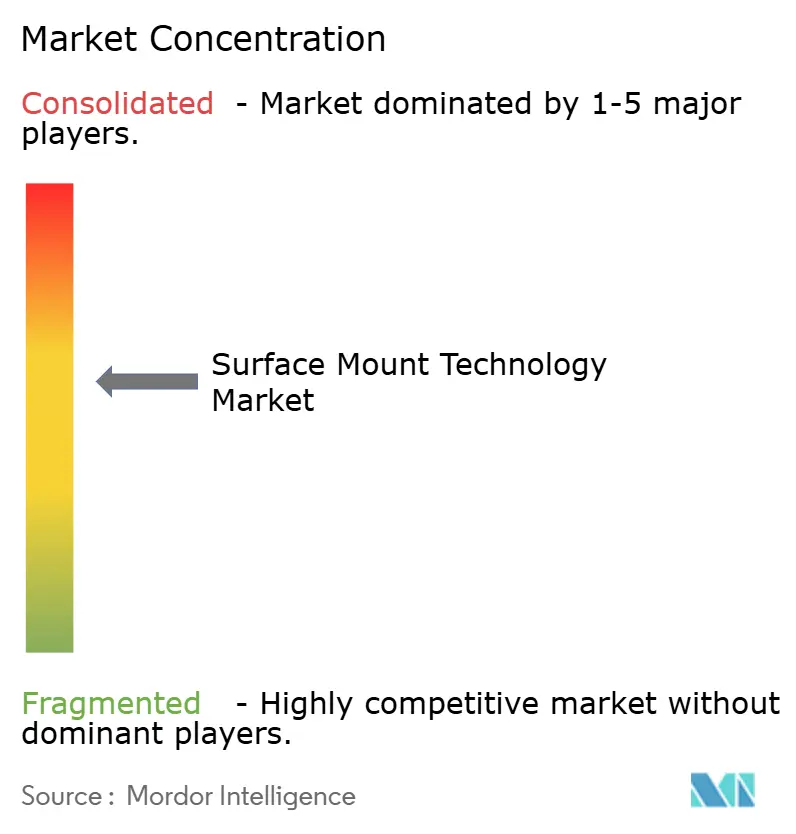
| Market Concentration | Medium |
Major Players *Disclaimer: Major Players sorted in no particular order Image © Mordor Intelligence. Reuse requires attribution under CC BY 4.0. | |
Surface Mount Technology Market Analysis by Mordor Intelligence
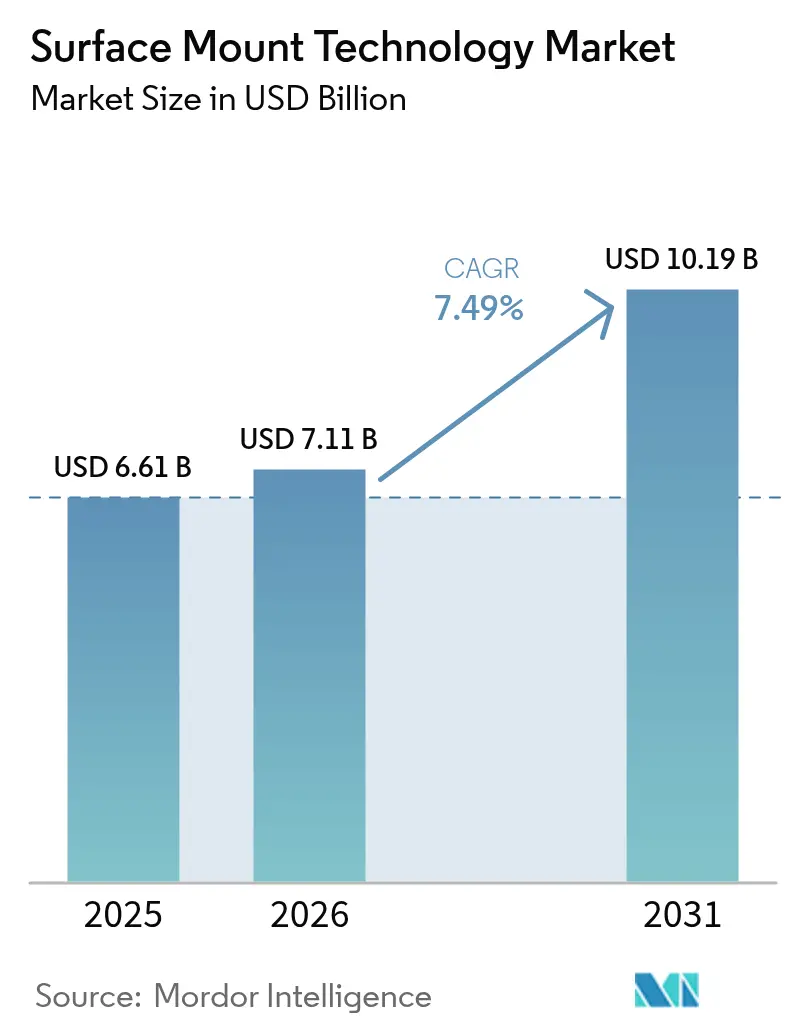
The Surface Mount Technology market size was valued at USD 6.61 billion in 2025 and estimated to grow from USD 7.11 billion in 2026 to reach USD 10.19 billion by 2031, at a CAGR of 7.49% during the forecast period (2026-2031). Demand for miniaturized, high-density electronics in consumer devices, electric vehicles, and industrial automation is underpinning this trajectory. Accelerated deployment of 5 G infrastructure, growth in artificial-intelligence servers, and the spread of edge and IoT products are keeping production lines close to full capacity across Asia, North America, and Europe. Automotive original-equipment manufacturers now specify automotive-grade SMT solutions able to tolerate –40 °C to 150 °C thermal swings, further tightening equipment requirements. Meanwhile, micro-LED and System-in-Package (SiP) innovations are shifting placement accuracy expectations from ±25 µm toward the sub-10 µm realm. Supply-chain volatility, especially for semiconductors and high-precision ceramics, remains the primary brake on near-term throughput despite healthy end-market fundamentals.
Key Report Takeaways
- By component, Active Components led with 65.74% Surface Mount Technology market share in 2025, while the segment is advancing at an 8.62% CAGR through 2031.
- By equipment type, Placement Equipment accounted for a 42.62% share of the Surface Mount Technology market size in 2025; Inspection Equipment is expanding at a 8.83% CAGR through 2031.
- By assembly line type, High-Volume/High-Mix held a 52.88% share in 2025, whereas High-Mix/Low-Volume is projected to grow at an 8.31% CAGR to 2031.
- By end-user industry, Consumer Electronics commanded a 38.64% share in 2025; Automotive applications are rising at a 9.02% CAGR through 2031.
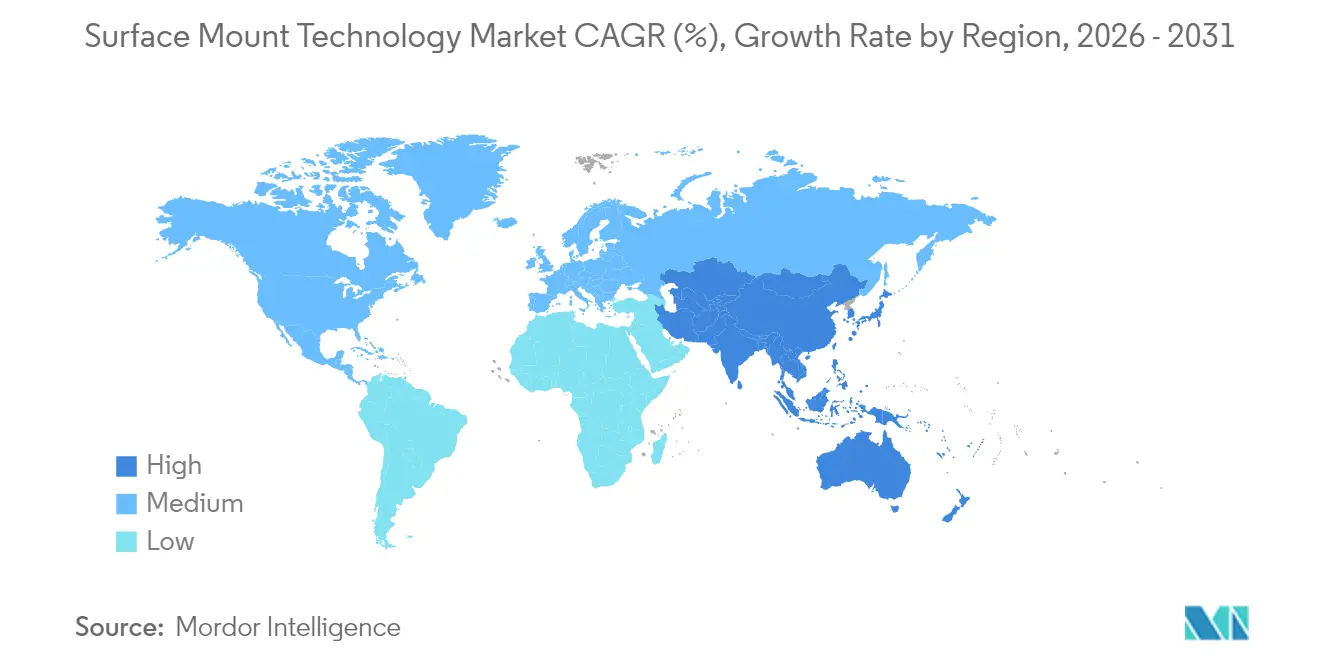
- By geography, Asia-Pacific captured 48.05% Surface Mount Technology market share in 2025 and is forecast to post an 8.12% CAGR between 2026 and 2031.
Note: Market size and forecast figures in this report are generated using Mordor Intelligence’s proprietary estimation framework, updated with the latest available data and insights as of 2026.
Market Trends and Insights
Drivers Impact Analysis of Surface Mount Technology Market*
| Driver | (~) % Impact on CAGR Forecast | Geographic Relevance | Impact Timeline |
|---|---|---|---|
| IoT and wearable demand for high-density PCBs | +1.8% | APAC, North America | Medium term (2-4 years) |
| Automotive ADAS electronics adoption | +2.1% | Europe, North America, APAC | Long term (≥ 4 years) |
| 5 G infrastructure and high-frequency boards | +1.5% | APAC core, global spill-over | Medium term (2-4 years) |
| System-in-Package integration in smartphones | +1.2% | APAC manufacturing hubs | Short term (≤ 2 years) |
| Micro-LED manufacturing requirements | +0.7% | APAC, North America | Long term (≥ 4 years) |
| OEM outsourcing to EMS firms | +1.1% | APAC, Latin America, Eastern Europe | Medium term (2-4 years) |
| Source: Mordor Intelligence | |||
IoT and Wearables Fuel Ultra-Dense PCB Adoption
Device makers now pack more than 10,000 multilayer ceramic capacitors into a single smartwatch, tripling the count seen five years ago. To print conductive traces below 50 µm and microvias under 75 µm, assemblies rely on placement tools that consistently handle 01005 packages at ±25 µm accuracy. Compliance with FCC emissions limits and IEC safety requirements is pushing additional electromagnetic-interference shielding steps, elevating demand for precision solder-paste inspection and automated optical inspection systems.
Automotive ADAS Electronics Adoption Reshapes Reliability Needs
Electric-vehicle reference designs use upward of 10,000 MLCCs and more than 200 electronic control units each, lifting SMT volumes even as lifecycle qualification stretches beyond three years. ISO 26262 functional-safety mandates and –40 °C to 150 °C operating windows compel suppliers to certify processes under automotive PPAP and AEC-Q200 stress tests. Equipment makers that can validate long-term solder-joint reliability are winning multiyear supply agreements across Europe and Japan.
5G Infrastructure and High-Frequency Boards
Millimeter-wave base stations need substrates as thin as 0.1 mm and component placement accuracies below 10 µm to mitigate signal loss. Reflow profiles must align with the low-Z-axis expansion of Rogers laminates to avoid warpage. Regional spectrum allocations cause line configurations to diverge: Asia-Pacific plants tune for 26–28 GHz arrays, while European factories stay largely below 6 GHz, affecting stencil design and solder-paste metallurgy.
System-in-Package Integration in Smartphones
SiP modules often combine logic, RF, and sensor dice in packages under 10 × 10 mm, forcing pick-and-place heads to align markers below 5 µm. Heat densities topping 100 W/cm² require underfill chemistries that survive multiple cycles without delamination, pressuring reflow and x-ray inspection stations. Wafer-level chip-scale packaging lowers pitch below 0.4 mm, prompting investments in the next generation of placement hardware capable of sub-micrometer repeatability.
Restraints Impact Analysis of Surface Mount Technology Market*
| Restraint | (~) % Impact on CAGR Forecast | Geographic Relevance | Impact Timeline |
|---|---|---|---|
| High upfront capex for high-speed lines | –1.3% | Global, SME manufacturers | Short term (≤ 2 years) |
| Lead-free solder thermal constraints | –0.8% | Price-sensitive markets | Medium term (2-4 years) |
| Semiconductor supply-chain volatility | –1.1% | Import-dependent regions | Short term (≤ 2 years) |
| Skilled labor shortage for AI inspection | –0.9% | North America, Europe | Long term (≥ 4 years) |
| Source: Mordor Intelligence | |||
High Upfront Capex Constrains Smaller Firms
Next-generation placement platforms cost upward of USD 3 million per line when bundled with in-line SPI, AOI, and x-ray testers. Although predictive-maintenance analytics lower total cost of ownership, many small and medium EMS providers struggle to justify payback within three years. Equipment rental and outcome-based service contracts are emerging but remain uncommon outside Tier-1 OEMs.
Lead-Free Solder Thermal Constraints Lower Yield
RoHS-compliant tin–silver–copper alloys reflow 30 °C higher than legacy tin–lead solders, shrinking process windows and amplifying tombstoning and head-in-pillow defects. Manufacturers combating yield loss deploy nitrogen reflow and laser-assisted soldering, yet face higher utility costs and stricter chamber maintenance schedules, lengthening the learning curve in cost-sensitive markets.
*Our forecasts treat driver/restraint impacts as directional, not additive. The impact forecasts reflect baseline growth, mix effects, and variable interactions.
Surface Mount Technology Market Segment Analysis
By Component:
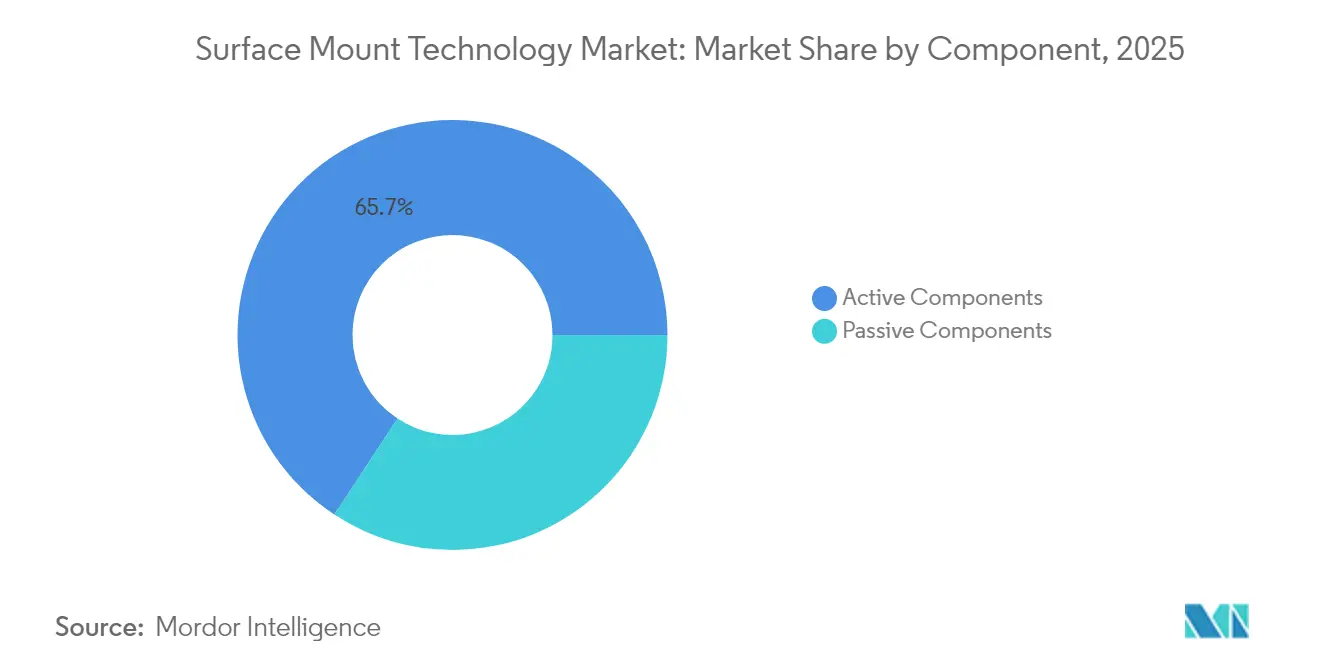
Active Components Drive Miniaturization SuccessActive Components accounted for 65.74% of the Surface Mount Technology market share in 2025 as MCU, ASIC, and power-management demand accelerated in AI servers and electric vehicles. The segment is forecast to grow at an 8.62% CAGR to 2031 on the back of increased adoption of heterogenous SoC designs and high-voltage transistors. Passive Components still benefit from rising unit counts in 5G handsets and automotive traction inverters, but ceramic and tantalum material shortages continue to test supply-chain resiliency.
Customer expectations are evolving from component cost control to board-level integration density and long-tail reliability. OEMs request sub-10 ppm failure rates and 15-year field lifetimes, driving closer collaboration between substrate vendors, component makers, and placement-equipment suppliers. Suppliers that deliver active-passive co-design libraries and full Design-for-Assembly review accelerate new-product ramps, securing supplier-of-choice status for advanced wearables and industrial IoT gateways.

By Equipment Type:
Inspection Equipment Becomes the Growth EnginePlacement Equipment still commands 42.62% of the Surface Mount Technology market size in 2025, but Inspection Equipment is rising fastest with a 8.83% CAGR. High-speed pick-and-place machines now hit 100 k cph with ±10 µm accuracy, aided by machine-learning vision systems that auto-tune head pressure. Soldering Equipment faces process-window squeezes as lead-free alloys demand tighter thermal gradients, while Screen-Printing platforms adopt closed-loop SPI feedback to boost first-pass yield.
Investment momentum favors AOI and x-ray systems that harness deep learning to cut false-call rates by 90 % and raise inspection speed four-fold. ViTrox and Koh Young incorporate IPC-CFX connectivity for real-time analytics that flag yield-eroding trends within minutes. Equipment finance packages bundling analytics subscriptions help offset sticker shock, enticing Tier-2 EMS firms in Eastern Europe and Southeast Asia to upgrade lines.
By Assembly Line Type:
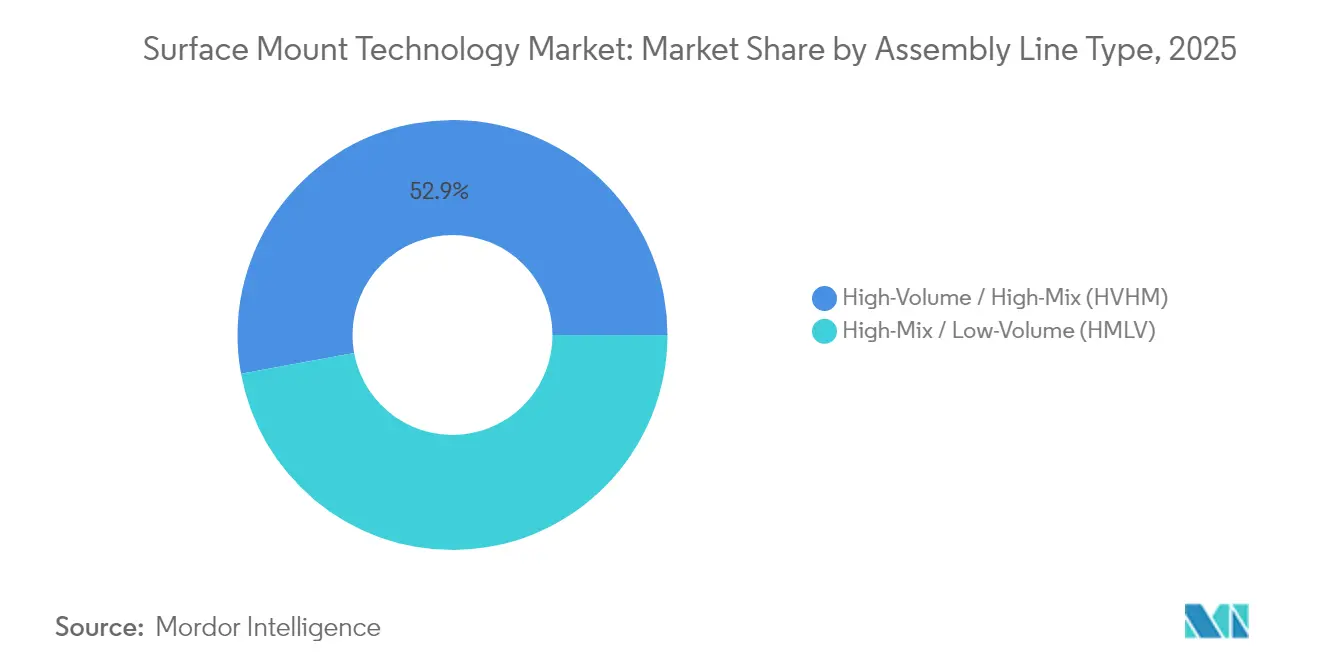
Flexibility Accelerates HMLV AdoptionHigh-Volume/High-Mix lines dominated with 52.88% share in 2025, leveraging automated changeovers and predictive scheduling to sustain utilization above 85 % in smartphone production. Yet High-Mix/Low-Volume configurations are gaining at an 8.31% CAGR to 2031 as automotive and industrial OEMs demand shorter design-iteration loops.
Flexible feeders, quick-release stencil frames, and AI-driven line-balancing algorithms enable sub-20-minute product changeovers, expanding the addressable market among specialty medical and aerospace firms. Compliance demands under FDA 21 CFR Part 820 and IPC-610 Class 3 drive in-line traceability, prompting barcode-centric material-tracking systems and automated optical zoom for conformal-coated assemblies.
By End-User Industry:
Automotive Electrification Reshapes Demand CurvesConsumer Electronics retained 38.64% share in 2025, but Automotive electronics now exhibit a 9.02% CAGR on rising electric-vehicle penetration and ADAS rollouts. Each EV now integrates USD 7,000 worth of semiconductors, up from USD 600 in legacy vehicles, multiplying SMT board counts and tightening quality-certification needs.
Industrial Electronics and Aerospace and Defense present steady, specification-heavy demand driven by factory automation and defense modernization. Healthcare contributes niche yet high-margin volumes requiring ISO 13485 and IPC-Class 3 builds. Telecom and IT Infrastructure capitalizes on 5G densification and edge-compute nodes, pushing demand for low-loss, high-frequency assemblies.
Geography Analysis
APAC Surface Mount Technology Market
Asia-Pacific dominated with 48.05% Surface Mount Technology market share in 2025 and is forecast to post an 8.12% CAGR through 2031. China, Taiwan, and South Korea together are slated to invest more than USD 84 billion in new 300 mm fabs by 2027, securing upstream substrate and component capacity. Japan’s Kumamoto cluster, anchored by TSMC JASM’s USD 20 billion expansion, adds over 100,000 12-inch wafers per month while creating 3,400 high-tech roles.
North America Surface Mount Technology Market
North America trails but is accelerating under the CHIPS Act, with announced projects doubling regional capacity investment from USD 12 billion in 2024 to USD 24.7 billion by 2027. Advanced packaging pilots in Arizona and New York target sub-10 µm placement for AI accelerators, reducing dependence on trans-Pacific shipping lanes. Regulatory emphasis on cyber-secure production flows nudges factories toward CMMC and IPC-1791 trusted builder accreditation.
Europe Surface Mount Technology Market
Europe focuses on automotive power semiconductors and wide-band-gap devices, with Infineon and STMicroelectronics driving capital expenditure to support 800 V EV inverters. The region’s RoHS expansion and incoming Ecodesign rules favor repairable PCBs, stimulating demand for selective soldering and rework platforms. Workforce upskilling programs under Europe’s Pact for Skills align with IPC’s certified interconnect designer curriculum, aiming to close a 146,000-worker gap by 2029.
MEA Surface Mount Technology Market
Middle East and Africa makes incremental gains as Saudi Arabia and the UAE funnel sovereign-fund capital into tech parks that bundle EMS incentives with reduced utility tariffs. South Africa’s Gauteng hub attracts telecom-equipment refurbishers that rely on modular SMT lines to process short-run, high-mix repair orders. Still, infrastructure gaps and limited specialist labor temper adoption of cutting-edge equipment in most sub-Saharan markets.
Regulatory Landscape
Environmental and product-compliance rules continue to shape SMT materials, process windows, and documentation requirements across major manufacturing hubs. In Europe, RoHS remains a primary anchor for assembly materials and equipment, with Regulation (EU) 2026/1289 revising RoHS Annex II and setting a 0.1% phthalate limit for relevant use cases, effective January 1, 2027. For factories supporting high-reliability and automotive electronics, compliance cascades into supplier declarations and tighter incoming-material controls for solders, adhesives, and polymeric components used in feeders, metering, and handling systems.
In China, MIIT published the 2026 Edition of the RoHS Compliance Management Catalogue, expanding the scope to 33 product categories and applying mandatory enforcement for new entrants starting August 1, 2027. This adds another compliance track for globally distributed EMS and OEM programs. In the United States, trade and environmental compliance are also operational considerations, including a January 2026 US proclamation implementing a 25% ad valorem tariff on specific semiconductor imports and derivative products, along with US CBP entry guidance (CSMS #67400472) for affected HTSUS classifications. On the emissions side, semiconductor-manufacturing NESHAP requirements under 40 CFR Part 63 Subpart BBBBB remain a key reference point for upstream suppliers feeding SMT-intensive electronics production.
Value Chain Analysis
The SMT value chain connects component and material inputs (ICs, passives, solder paste alloys, fluxes, stencil foils, PCB laminates, and copper foils) to equipment OEMs (printing, placement, reflow, and inspection), and then to OEM and EMS assembly lines, followed by test, box-build integration, and regional distribution. Equipment vendors increasingly bundle software, IPC-CFX connectivity, and service contracts around placement and inspection platforms, while upstream PCB and substrate capacity and materials (glass styles, resins, and copper foil) remain key determinants of how quickly SMT lines can ramp for AI servers, telecom, and automotive electronics.
Recent supply-chain evidence points to upstream constraints as a recurring limiter rather than downstream assembly space. Reported PCB price increases (up to 40% in April 2026) and epoxy-resin lead-time extensions (from roughly three weeks to fifteen) illustrate how laminate and materials availability can throttle board output, even when placement equipment is available. At the capacity and tooling layer supporting advanced interconnects, SCHMID Group disclosed a repeat order exceeding EUR 37 million (July 2026) for HDI-ML and mSAP production equipment tied to AI server boards and optical modules. AT&S also announced an expansion of its Kulim site in Malaysia alongside a 2026/27 CAPEX plan of EUR 1.0 to 1.2 billion, underscoring how substrate and HDI capability investment sits upstream of, and directly influences, SMT throughput and product mix.
Competitive Landscape
The SMT equipment space remains moderately concentrated. ASMPT, Fuji, and Yamaha collectively capture a significant share of 2024 revenue, leveraging deep process know-how and regional support networks. Competitive pressure intensifies as AI-driven inspection entrants such as ViTrox and Koh Young demonstrate software-centric advantages with 90% fewer false calls and faster programming cycles.
Incumbents respond by extending outcome-based service contracts. ASM International posted record 53.4% gross margins in Q1 2025 on process-specific metrology packages tied to advanced-node AI chips. Yamaha touts turnkey lines that integrate feeder intelligence and cloud-based analytics to boost first-pass yield by 11% among French EMS customers.[4]
White-space innovation centers on micro-LED and heterogenous integration. Coherent’s Laser-Induced Forward Transfer achieves 99.7% placement accuracy for sub-5 µm dies, reshaping display assembly economics. Mycronic’s deep-learning AOI engine, launched in 2024, slashes programming labor by 60% and aligns with IPC-CFX for shop-floor interoperability. Regional workforce-development hubs in Mexico and Malaysia underpin after-sales service strength, sharpening time-to-benefit for mid-tier EMS customers.
Surface Mount Technology Industry Leaders
-
ASMPT Limited
-
Fuji Corporation
-
Panasonic Holdings Corporation
-
Yamaha Motor Co., Ltd.
-
Hanwha Precision Machinery Co., Ltd.
- *Disclaimer: Major Players sorted in no particular order
Surface Mount Technology Market Companies Covered in this Report
- ASMPT Limited
- Fuji Corporation
- Yamaha Motor Co., Ltd. (SMT Division)
- Panasonic Holdings Corporation (Panasonic Smart Factory Solutions)
- Hanwha Precision Machinery Co., Ltd.
- Mycronic AB
- Juki Corporation
- Nordson Corporation
- Koh Young Technology Inc.
- Saki Corporation
- Test Research, Inc. (TRI)
- Viscom SE
- Europlacer Holdings Ltd.
- Shenzhen JT Automation Equipment Co., Ltd.
- Rehm Thermal Systems GmbH
- Heller Industries, Inc.
- MIRTEC Co., Ltd.
- Shenzhen NEODEN Technology Co., Ltd.
- Shenzhen JAGUAR Automation Equipment Co., Ltd.
- Hanwa Precision Machinery Co., Ltd.
Market Opportunities and Future Outlook
A major opportunity area is the convergence of SMT with advanced packaging and high-density interconnect manufacturing, where tighter placement tolerances, richer inspection, and closed-loop process control become mandatory for AI servers, optical modules, and high-frequency infrastructure hardware. Corporate actions in 2026 highlight this shift: SCHMID Group announced a repeat order exceeding EUR 37 million for HDI-ML and mSAP production equipment for next-generation AI server boards and optical modules, and it also signed an investment framework agreement for a new manufacturing campus in Zhongshan, China, intended to double effective manufacturing capacity in the region by mid-2027. These moves translate into continued demand for higher-precision placement, print control, and inspection toolchains needed for finer pitches, denser routing, and yield management at scale.
Regional localization programs and new manufacturing ecosystems also create whitespace for turnkey lines, automation of line preparation, and workforce-light operating models, particularly where skilled labor is a constraint. In India, VVDN Technologies inaugurated a new SMT line and a Mechanical Innovation Park in Manesar (June 2026), reflecting active investment to localize components and electronics manufacturing and increasing demand for scalable SMT line architectures, traceability, and rapid changeover capability. At the same time, Japan-linked investment in silicon photonics and advanced packaging capacity, such as Tower Semiconductor announcing a USD 3 billion dual-track expansion supported by METI grants (July 2026), reinforces a hardware mix that tends to pull higher-end assembly and inspection requirements into the SMT ecosystem, including tighter process control for high-reliability interconnects.
Recent Industry Developments in Surface Mount Technology Market
- June 2026: ASMPT announced a repeat order for eight thermo-compression bonding (TCB) tools for chip-to-wafer applications from a leading integrated device manufacturer. The order supports advanced client and datacenter CPU production, further aligning ASMPTs portfolio with heterogeneous integration workflows that increasingly influence high-end assembly requirements across electronics manufacturing.
- February 2025: TSMC, Sony, DENSO, and Toyota confirmed a USD 20 billion second-fab outlay for JASM Kumamoto, with ramp plans targeting 100,000 12-inch wafers per month by 2027. The expansion strengthens upstream wafer supply and packaging ecosystems in Japan, feeding demand for high-density assemblies and associated SMT-capable production infrastructure across electronics value chains.
- November 2024: ViTrox opened a demo center in Mexico showcasing its V510i 3D AOI and V310i SPI platforms. The expansion improves local access to inspection technology and applications support, lowering adoption friction for EMS and OEM sites seeking to scale inline quality control and analytics-driven yield management.
Surface Mount Technology Market Report Scope and Research Methodology
Market Definition and Coverage
We define the surface mount technology market as the value of equipment, materials, and related solutions used to mount electronic components directly onto printed circuit boards, from printing and placement through soldering and inspection, across major electronics end uses and regions.
Scope exclusions: We exclude through-hole only assembly flows and services that are not directly tied to SMT line build, operation, or process control.
Segments Covered in This Report
- By Component
- Passive Components
- Resistors
- Capacitors
- Active Components
- Transistors
- Integrated Circuits
- Passive Components
- By Equipment Type
- Placement Equipment
- High-speed Pick-and-Place Machines
- Soldering Equipment
- Reflow Ovens
- Wave Solder Systems
- Inspection Equipment
- Automated Optical Inspection (AOI)
- Solder Paste Inspection (SPI)
- X-ray Inspection
- Screen Printing Equipment
- Placement Equipment
- By Assembly Line Type
- High-Mix / Low-Volume (HMLV)
- High-Volume / High-Mix (HVHM)
- By End-user Industry
- Consumer Electronics
- Automotive
- Industrial Electronics
- Aerospace and Defense
- Healthcare
- Telecom and IT Infrastructure
- Other End-users
- By Geography
- North America
- United States
- Canada
- Mexico
- Europe
- Germany
- United Kingdom
- France
- Italy
- Spain
- Rest of Europe
- Asia-Pacific
- China
- Japan
- South Korea
- India
- Rest of Asia-Pacific
- Middle East
- Saudi Arabia
- United Arab Emirates
- Rest of Middle East
- Africa
- South Africa
- Rest of Africa
- North America
Data Sources, Market Sizing, and Validation
Desk Research
Desk work starts with building a clear picture of electronics output and assembly intensity, then mapping where SMT is most used in production lines. Public sources such as the United States International Trade Commission trade statistics, UN Comtrade, the World Semiconductor Trade Statistics association, and IPC publications (as available in open releases) help us align demand cycles with electronics manufacturing activity.
We also use company annual reports, earnings decks, and reputable press coverage to track capacity expansions, utilization changes, and shifts in component mix that feed into placement and soldering requirements. Patent databases are referenced to identify where process upgrades are happening, including inspection capability and fine pitch handling. For equipment movement where data visibility is limited, we use an import and export shipment level database selectively as a sanity check. These desk research sources are illustrative only, and we rely on additional public and paid references to collect, validate, and clarify assumptions.
Primary Interviews and Surveys
Primary interviews and surveys were used to pressure test the market boundaries and confirm how SMT line spending is split across printing, placement, soldering, and inspection in different end uses. We spoke with a mix of equipment-focused participants, process and manufacturing leaders at electronics plants, and downstream buyers who influence line upgrades, keeping coverage balanced across APAC led build regions and demand centers in the Americas and EMEA.
Distribution of primary research fieldwork respondents
| Company type | Respondent position | Region |
|---|---|---|
| Top tier: 26% | CXOs: 14% | APAC: 40% |
| Mid tier: 57% | Functional/Unit leaders: 38% | EMEA: 37% |
| Smaller Players: 17% | Managers: 48% | Americas: 23% |
Market-Sizing & Forecasting
Sizing starts with a top-down reconstruction of SMT demand by linking electronics manufacturing activity to SMT line adoption and refresh needs, then translating that into value using typical system pricing and spend mix by process step. To keep totals realistic, the model uses a small set of observable inputs such as electronics production growth, PCB assembly intensity by end use, equipment replacement cycles, placement speed and accuracy requirements (which influence tool class), and the share of high-mix versus high-volume lines by region.
Those totals are then cross-checked using selective bottom-up approximations, where sampled supplier revenues, channel checks on equipment shipments, and ASP by tool type are rolled up for reasonableness. Where a sub-area lacks consistent disclosure, gaps are handled through conservative interpolation. Forecasts are built using scenario analysis supported by expert views, so variables like EV electronics content, 5G infrastructure rollouts, and industrial automation capex can be flexed without breaking the logic of the demand pool.
Data Validation & Update Cycle
Validation is done in multiple passes, where we compare model outputs against independent signals such as electronics production direction, trade flow movement for relevant equipment categories, and the timing of factory expansion announcements. When a variance looks too large, assumptions are re-checked and follow-up calls are triggered, with totals adjusted only after the change can be explained through a clear variable shift.
Before sign-off, a second analyst review is completed to catch math errors, inconsistent year-to-year transitions, and any scope leakage into adjacent assembly methods. Reports are refreshed annually, with interim updates for material events that can change demand or pricing, and a final pre-delivery review is performed so clients receive the latest updated view.
Mordor Intelligence's Surface Mount Technology Market Sizing Compared With Other Published Estimates
Published market sizes for surface mount technology can look far apart, even when everyone is discussing the same factory floors, because the inclusion rules and pricing logic are rarely aligned. Differences usually come from what is counted inside the SMT spend pool, how equipment versus consumables are treated, and whether the number reflects bookings, shipments, or installed base related demand.
The gap drivers tend to be practical and repeatable, such as whether inspection and screen printing are included as full value, how high-mix lines are priced versus high-volume lines, and which year currency conversion is locked for multi-region totals. Another common reason is refresh timing, where some estimates keep older ASPs in place longer, even though automation upgrades and fine pitch requirements can move average system values.
Benchmark comparison
| Source | Market Size | Gaps in Research Methodology |
|---|---|---|
| Mordor Intelligence | USD 6.61 B (2025) | |
| Global Consultancy A | USD 5.90 B (2025) | Uses a narrower equipment-only view that commonly drops consumables and limits the line to placement and reflow, which reduces the captured value in high-mix builds. |
| Industry Association B | USD 7.80 B (2025) | Often aggregates SMT with broader PCB assembly spending, where adjacent assembly and factory services can get included, and where optimistic upgrade rates are applied uniformly across end uses. |
The table shows a spread that mainly comes from what gets counted as SMT line value, and in Mordor Intelligence's model the scope is kept to SMT relevant equipment and process needs across printing, placement, soldering, and inspection without pulling in broader PCB assembly services. With the same year anchor (2025) and clear checks on line type mix and replacement cycles, the result is easier to reconcile to observable demand signals and to update when conditions change.
Key Questions Answered in the Report
What is the projected value of the Surface Mount Technology market by 2031?
The market is expected to reach USD 10.19 billion by 2031, growing at a 7.49% CAGR.
Which component segment leads current demand?
Active Components hold 65.74% share, buoyed by AI processors and automotive power electronics.
Why are inspection systems growing faster than placement machines?
Manufacturers are adopting AI-driven AOI and x-ray tools to hit zero-defect targets, pushing the segment at a 8.83% CAGR.
How important is Asia-Pacific to SMT growth?
Asia-Pacific accounts for 48.05% of 2025 revenue and is projected to expand at an 8.12% CAGR through 2031.
What restraint most affects smaller EMS providers?
High upfront capital expenditure for new high-speed placement lines reduces investment flexibility and can trim overall CAGR by 1.3%.
How is automotive electrification shaping SMT demand?
Each electric vehicle deploys up to USD 7,000 in semiconductors, lifting board counts and driving a 9.02% CAGR for automotive SMT assemblies.