
Superhydrophobic Coatings Market Size and Share
Market Overview
| Study Period | 2020 - 2031 |
|---|---|
| Market Size (2026) | USD 62.89 Million |
| Market Size (2031) | USD 190.72 Million |
| Growth Rate (2026 - 2031) | 24.85 % |
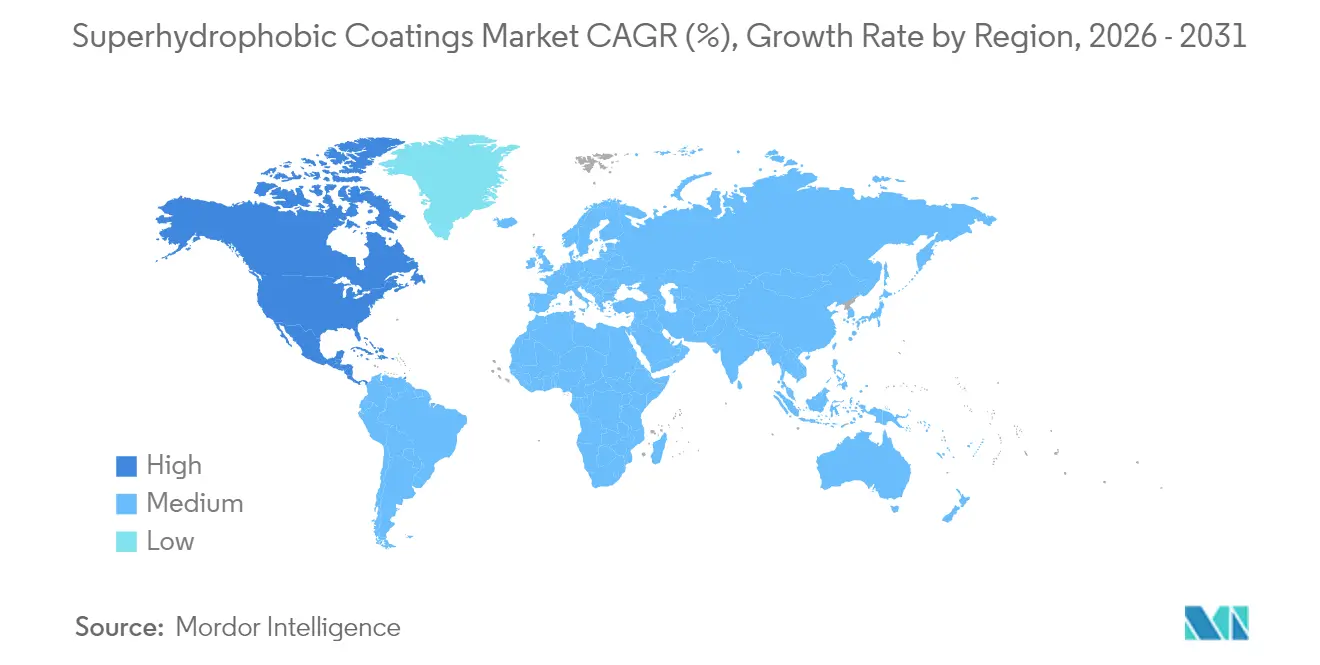
| Fastest Growing Market | North America |
| Largest Market | North America |
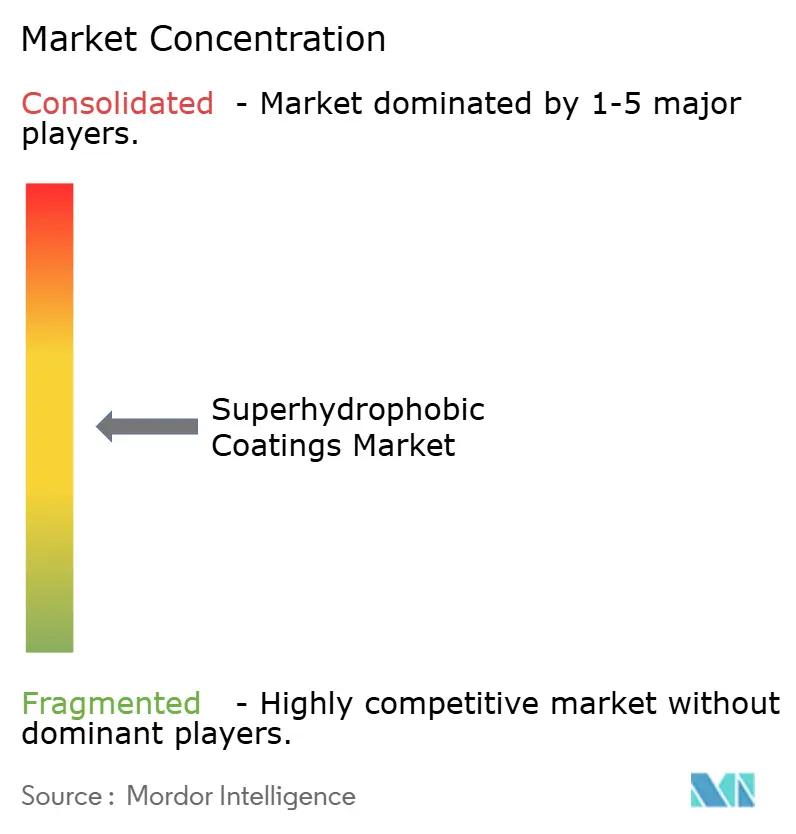
| Market Concentration | Medium |
Major Players *Disclaimer: Major Players sorted in no particular order Image © Mordor Intelligence. Reuse requires attribution under CC BY 4.0. | |
Superhydrophobic Coatings Market Analysis by Mordor Intelligence
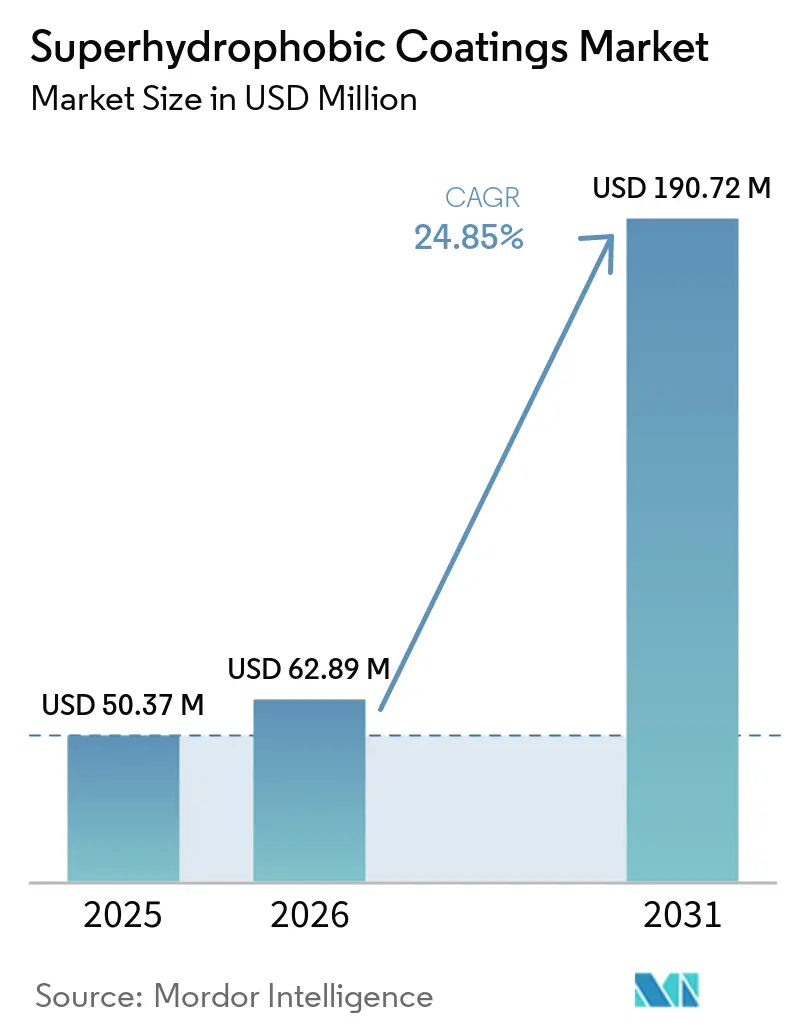
The Superhydrophobic Coatings Market size is expected to grow from USD 50.37 million in 2025 to USD 62.89 million in 2026 and is forecast to reach USD 190.72 million by 2031 at 24.85% CAGR over 2026-2031. Automotive-led modernization of electric vehicle (EV) battery packs, tightening global restrictions on fluorinated chemistries, and premium applications in augmented-reality head-up displays continue to keep demand momentum high. Manufacturers pursue functional integration, blending anti-wetting, corrosion resistance, and self-cleaning attributes to simplify coating stacks and lower the total cost of ownership. Precision spray-plasma deposition lines, though capital-intensive, deliver the coating uniformity and nanostructured control needed for large-scale deployments. Investment flows favor North America, where automakers combine lifetime paint warranties with aggressive EV rollouts, while European players race to commercialize PFAS-free silica platforms before looming REACH deadlines. Competitive intensity centers on patent portfolios covering PFAS-free nanoparticles and low-temperature plasma processing, elevating intellectual property (IP) as a strategic barrier to entry.
Key Report Takeaways
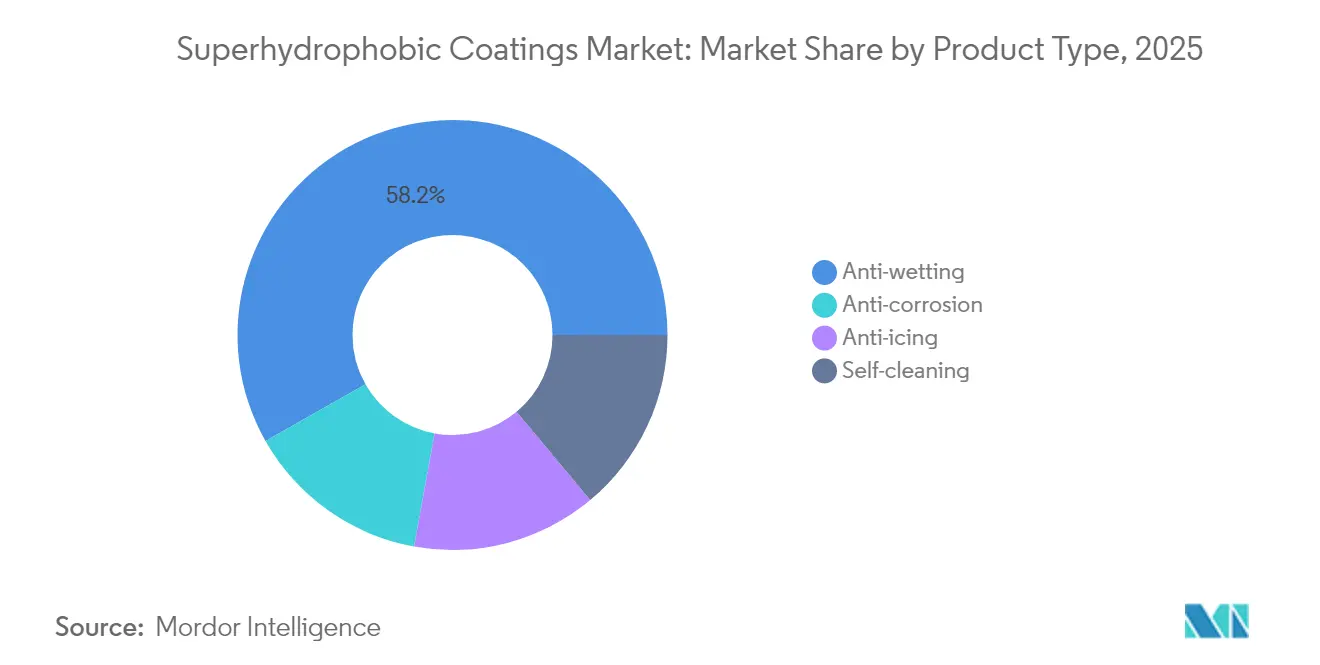
- By product type, anti-wetting captured 58.21% of the superhydrophobic coating market share in 2025 and is projected to expand at a 25.95% CAGR through 2031.
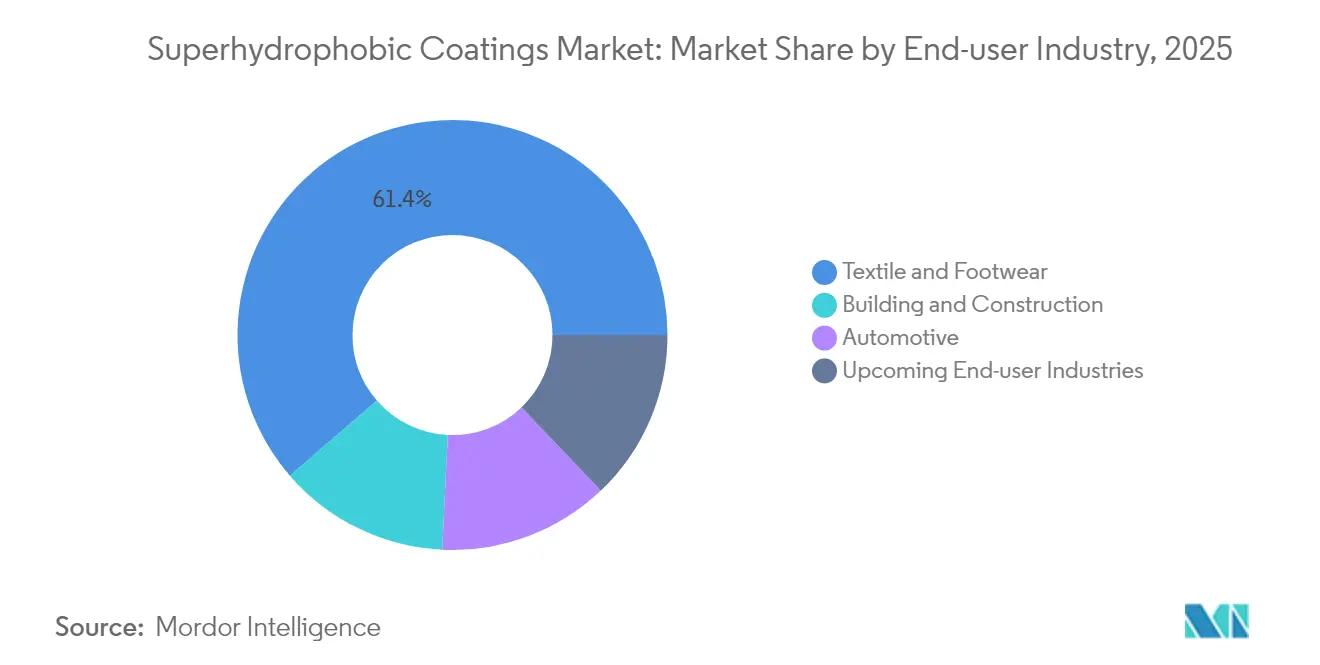
- By end-user industry, textile and footwear accounted for a 61.35% share of the superhydrophobic coating market size in 2025. Upcoming end-user industries are projected to advance at a 25.1% CAGR through 2031.
- By geography, North America accounted for 62.60% of the revenue share in 2025 and is projected to grow at a 37.85% CAGR from 2026 to 2031.
Note: Market size and forecast figures in this report are generated using Mordor Intelligence’s proprietary estimation framework, updated with the latest available data and insights as of 2026.
Market Trends and Insights
Drivers Impact Analysis of Superhydrophobic Coatings Market*
| Drivers | (~) % Impact on CAGR Forecast | Geographic Relevance | Impact Timeline |
|---|---|---|---|
| Surging demand for corrosion-resistant coatings in EV battery packs | +3.8% | Global, strongest in APAC and North America | Medium term (2-4 years) |
| Rapid replacement of fluorinated chemistries by PFAS-free nano-silica systems | +3.1% | Europe and North America expanding to APAC | Short term (≤ 2 years) |
| Growth of transparent, self-cleaning glass coatings for AR-HUDs | +2.0% | North America and EU | Long term (≥ 4 years) |
| Automotive OEM push for lifetime paint-protection warranties | +2.5% | Global, highest in North America and Europe | Medium term (2-4 years) |
| Standardization of ISO 21207 multi-cycle corrosion test in marine sector | +1.8% | Global, primary in Europe and Asia-Pacific | Medium term (2-4 years) |
| Source: Mordor Intelligence | |||
Surging Demand for Corrosion-Resistant Coatings in EV Battery Packs
EV battery manufacturers integrate nano-structured barriers that lower moisture-related failures, leveraging spray-plasma lines at Tesla and BYD facilities. Suppliers tailor hydrophobic coatings to withstand aggressive thermal cycling and electrochemical stress typical of pouch and cylindrical cell designs. The super hydrophobic coating market benefits from this shift as battery makers lock in long-term supply contracts, prompting coating firms to build dedicated automotive-grade capacity. Growth accelerates as global EV assembly volumes grow annually, reinforcing the scaling advantages of PFAS-free chemistries.
Rapid Replacement of Fluorinated Chemistries by PFAS-Free Nano-Silica Systems
EU REACH proposals targeting C6 fluoropolymers accelerate industry migration to silica-based platforms capable of achieving water contact angles of 150 ° or greater without fluorine, supporting applications alongside oil and gas water treatment chemicals. Equipment recalibration for silica particle dispersion incurs near-term expenses, but volume scaling is expected to narrow cost premiums by 2026.Patents related to particle functionalization and low-temperature curing underscore IP’s strategic importance across the superhydrophobic coating market.
Growth of Transparent, Self-Cleaning Glass Coatings for Augmented-Reality HUDs
Premium automakers, including Mercedes-Benz and BMW, utilize transparent nanocoatings that prevent windshields from forming water spots without compromising optical clarity[2]. Surface roughness tuning maintains transmission above 95% while sustaining contact angles of 140° or greater, thereby resolving a long-standing performance trade-off. Tight tolerances demand clean-room deposition and in-line spectrophotometry, driving high margins for qualified suppliers. Although unit volumes remain modest, revenue per square meter is three to four times that of conventional anti-wetting coatings, adding leverage to the superhydrophobic coating market size.
Automotive OEM Push for Lifetime Paint-Protection Warranties
Ford extended paint guarantees, mandating coatings that survive accelerated weathering cycles. Superhydrophobic layers serve as sacrificial shields against UV radiation, road salt, and micro-abrasion, thereby reducing warranty claims. OEM bid specifications increasingly call for self-healing matrices that restore hydrophobicity after scratches, prompting resin suppliers to integrate dynamic polymer networks. The shift to high-volume demand reinforces North America’s leadership in the superhydrophobic coating market.
Restraints Impact Analysis of Superhydrophobic Coatings Market*
| Restraints | (~) % Impact on CAGR Forecast | Geographic Relevance | Impact Timeline |
|---|---|---|---|
| High capex of precision spray-plasma lines for mass production | -1.5% | Global, strongest in emerging markets | Short term (≤ 2 years) |
| Pending EU REACH restriction on C6 fluoropolymers increases reformulation risk | -1.0% | Europe, secondary global impact | Medium term (2-4 years) |
| Abrasion-induced performance decay on textile fibers over 50 wash cycles | -1.3% | Global, highest in Asia-Pacific textile hubs | Long term (≥ 4 years) |
| Source: Mordor Intelligence | |||
High Capex of Precision Spray-Plasma Lines for Mass Production
The high cost of plasma units limits capacity expansion for small firms. Uniform coating of large substrates hinges on precise control of gas flow, power density, and substrate temperature, demanding specialized engineers. Alternate sol-gel routes reduce capital needs but sacrifice abrasion resistance, constraining penetration in heavy-duty segments. Consolidation favors incumbents who can amortize equipment across high-volume contracts, thereby sustaining moderate fragmentation in the superhydrophobic coating market.
Pending EU REACH Restriction on C6 Fluoropolymers Increases Reformulation Risk
Draft restrictions inject regulatory uncertainty, slowing capital deployment and delaying customer qualification. Fluoropolymer suppliers curtail output, inducing price volatility that hits formulators reliant on legacy chemistries. Diversified players hedge with silica and bio-based platforms, but single-chemistry firms face margin compression as they rush to replicate performance benchmarks under compressed timelines. The transition reshapes competitive dynamics, advantaging technology owners with wide chemistry toolkits.
*Our forecasts treat driver/restraint impacts as directional, not additive. The impact forecasts reflect baseline growth, mix effects, and variable interactions.
Superhydrophobic Coatings Market Segment Analysis
By Product Type:
Anti-Wetting Dominance Across Diverse ApplicationsThe anti-wetting segment held a 58.21% market share in the superhydrophobic coating market in 2025 and is forecasted to deliver the fastest 25.95% CAGR from 2026 to 2031. The lead traces to versatile, silica- and fluorine-free chemistries that span automotive, textile, and architectural domains. Self-cleaning variants capture architectural glass jobs in high-rise façades where maintenance‐free optics lower total building costs. Anti-corrosion subtypes serve oil platforms and chemical tanks, trading higher solids content for extreme chemical resistance. Anti-icing blends stand out in the aerospace industry, where certification costs justify premium pricing.
Convergence blurs historic boundaries as formulators embed multi-functionality within single coats that resist water, salt, and fouling. Plasma-assisted grafting permits nano-scaled roughness without bulk fluorine, easing future compliance. As test protocols evolve, anti-wetting suppliers integrate abrasion modifiers that preserve contact angles of 130° or greater under rotary taber tests, thereby extending service life. Advanced polymer cross-linking and nano-particle dispersion unlock performance synergies that expand the superhydrophobic coating market size across all product categories.

By End-User Industry:
Textile Leadership Faces Emerging CompetitionTextile and footwear applications represented 61.35% of the superhydrophobic coating market size in 2025. Water-repellent outerwear and stain-proof fashion goods dominate volume. Upcoming End-user Industries collectively clock a 25.1% CAGR, outpacing traditional segments. EV battery enclosures and premium automotive exteriors enhance the automotive industry’s contribution, while wind turbines utilize ice-shedding surfaces to increase winter capacity factors. Electronics OEMs request splash-proof smartphone casings that rely on nano-thin coatings invisible to the end user.
Textile durability remains the primary hurdle, as hydrophobic treatment often decays after frequent laundering. Research focuses on covalent grafting and polymer encapsulation to achieve more than 100 wash cycles without requiring surface retreatment. Upcoming medical and electronics niches, although lower in tonnage, achieve up to six times higher price points, thereby cushioning margins. Regulatory certifications, including ISO 10993 for biocompatibility and IPC surface cleanliness standards, lengthen product introduction cycles but secure longer-term volume stability for qualified vendors in the superhydrophobic coating market.
Geography Analysis
North America Superhydrophobic Coatings Market
North America accounted for 62.60% of the superhydrophobic coating market share in 2025 and is projected to advance at a 37.85% CAGR from 2026 to 2031. The United States drives uptake through Tesla’s battery pack coating deployments and Ford’s paint protection guarantees. Canada enhances growth with anti-icing solutions for regional jets and wind turbines that operate in severe icing conditions, while Mexico’s vehicle assembly lines specify cost-efficient, PFAS-free nano-silica blends compatible with U.S. OEM standards.
APAC Superhydrophobic Coatings Market
Asia-Pacific registers robust gains in textile production in Vietnam and Bangladesh, plus accelerating EV assembly in India and Thailand. China’s battery gigafactories utilize line-integrated spray-plasma systems, generating high-volume orders that expand the market size for superhydrophobic coatings. Japan and South Korea supply precision plasma equipment and specialty chemicals, reinforcing intra-regional value chains. Electronics brands in Seoul and Tokyo are integrating splash-proof coatings into consumer devices, which boosts average selling prices.
Europe Superhydrophobic Coatings Market
Europe maintains steady growth despite REACH headwinds, with German premium automakers leading the way in PFAS-free technology pilots. The United Kingdom’s aerospace cluster specifies anti-icing coatings for next-generation narrow-body aircraft, while France’s couture houses deploy hydrophobic treatments on luxury textiles to elevate garment longevity. Italy’s architecture firms are adopting self-cleaning glass façades, and Spain is channeling renewable energy subsidies toward blade protection. ISO 21207 marine standards drive early adoption across North Sea shipyards, ensuring durable corrosion protection in harsh saltwater environments.
MEA and South America Superhydrophobic Coatings Market
South America, the Middle-East, and Africa represent emerging demand nodes. Brazil’s offshore drillships require anti-corrosion barriers, and Saudi Arabia’s giga-projects order hydrophobic glass panels that slash cleaning costs across desert climates. Currency swings and tariff policies shape procurement, underscoring the need for localized production partnerships. The competitive field remains dynamic as suppliers balance cost lines against fluctuating exchange rates while scaling PFAS-free chemistries.
Value Chain Analysis
Upstream inputs include nanoparticles and precursors, notably silica and other metal oxides, along with advanced carbon fillers such as graphene and carbon nanotubes. Surface-functionalizing agents, including silane and fluorosilane coupling agents, support low-surface-energy chemistry and particle anchoring. Midstream activity covers dispersion, resin selection (including waterborne polyurethane and sol-gel binders), and formulation into anti-wetting, anti-corrosion, anti-icing, and self-cleaning systems. Application can follow spray, dip, roll, or higher-precision routes such as plasma-based deposition, where tighter nanostructure control is needed for large or complex parts.
Downstream demand concentrates in textile and footwear finishing, automotive exteriors and EV battery packs, building glass and facades, and marine corrosion protection, with emerging uses in electronics protection. Across the chain, durability and qualification remain persistent bottlenecks: mechanical abrasion and UV exposure can degrade micro- and nanostructures, while consistent large-area coating at scale depends on tight process control and high capex for precision spray-plasma lines. Industry efforts to reduce supply and compliance risk are reflected in fluorine-free R&D pipelines, including Gebert Ruf Stiftung funding for the BFH VAAKA project (GRS-063/25) running through October 2026 and Yoshikawa Kogyo Co. reporting a water-based, lower-cost superhydrophobic coating developed at its Techno Center in Kitakyushu (September 2025), both pointing to shifts in upstream chemistries and downstream commercialization pathways.
Competitive Landscape
The superhydrophobic coating market remains moderately fragmented. Specialty firms such as exploit intellectual property around nanometer-scale surface modification, focusing on electronics and medical device niches where conformal coverage is critical. Vertical integration trends surfaced, with coating vendors acquiring plasma equipment manufacturers to secure process know-how and after-sales revenue. Strategic alliances between chemical formulators and EV battery OEMs lock in volume commitments and accelerate formulation cycles. Startups targeting bio-based chitosan and rosin platforms attract sustainability-focused investors and license their technologies to large chemical houses for global rollout. Equipment suppliers bundle analytics software that tunes plasma parameters in real time, providing process guarantees that reduce scrap rates. As PFAS restrictions tighten, incumbents expedite the retirement of legacy fluorinated lines, freeing capital for PFAS-free scaling and positioning the industry for a decisive shift toward silica and bio-derived solutions within the forecast horizon.
Superhydrophobic Coatings Industry Leaders
-
UltraTech International Inc.
-
NEI Corporation
-
P2i Ltd
-
Aculon
-
Nasiol Nano Coating
- *Disclaimer: Major Players sorted in no particular order
Superhydrophobic Coatings Market Companies Covered in this Report
- Aculon
- Advanced Nanotech Lab
- Beijing Neatrition Tech Co Ltd
- Cytonix
- DryWired
- HZO Inc
- Lotus Leaf Coatings Inc.
- Nanex Co.
- Nasiol Nano Coating
- NEI Corporation
- NTT Advanced Technology Corporation
- P2i Ltd
- Pearl Nano LLC
- PPG Industries, Inc.
- Rust-Oleum
- Surfactis Technologies
- The Sherwin-Williams Company
- UltraTech International Inc.
Market Opportunities and Future Outlook
White space is most visible where end users require superhydrophobic performance alongside validated robustness under abrasion, weathering, and cycling, since durability remains a primary constraint for textiles, infrastructure, and outdoor industrial assets. In 2026-published R&D, one practical pathway for suppliers is competing on robustness and application practicality through a fully waterborne, two-step spray approach (waterborne polyurethane with silica nanoparticles) that reported resistance to 600 Taber abrasion cycles. That focus better matches OEM qualification expectations and helps bridge the gap between lab results and field service requirements.
A second opportunity area centers on regulatory-driven reformulation and process redesign toward fluorine-free and waterborne systems, which aligns with the report scope's emphasis on EU REACH pressure on fluorinated chemistries and rapid replacement by PFAS-free nano-silica systems. This creates demand for integrated packages that pair coating chemistry with deposition equipment and in-line process control, with the aim of reducing scrap rates and shortening customer qualification timelines, particularly for automotive battery-pack moisture barriers and premium optical surfaces such as AR-HUD glass. In parallel, funding-backed academic-to-industry transfer and infrastructure-oriented coatings research, including 2026 advances reported for nanocomposite-derived coatings for concrete, expands partnering and licensing routes for players looking for differentiated, fluorine-free platforms.
Recent Industry Developments in Superhydrophobic Coatings Market
- June 2026: NEI Corporation expanded its advanced materials portfolio with a new line of standard electrode sheets for aqueous sodium-ion batteries. This broadens NEI's battery-focused offering and supports cross-sell pathways tied to moisture management and protective surface engineering for energy-storage components and enclosures.
- October 2025: Jolt Capital finalized an GBP 8 million investment in P2i Ltd to strengthen finances and support expansion tied to its plasma enhanced vapor deposition capability. The funding supports scaling industrialized nano-coating processes used for water and corrosion protection across electronics and other high-value applications.
- February 2025: P2i Ltd extended its manufacturing outsourcing partnership with PP Control and Automation (PP C&A) to produce the new 18L coating system. This manufacturing step-up improves equipment availability for industrial customers that need repeatable deposition hardware for superhydrophobic and protective nano-coating processes at scale.
Superhydrophobic Coatings Market Report Scope and Research Methodology
Market Definition and Coverage
This market covers revenues earned from superhydrophobic coating materials that are applied on surfaces to create very high water repellency, which is then used for functions such as self-cleaning, anti-icing, anti-wetting, and corrosion protection across end-use industries.
Scope exclusions: Revenues from general hydrophobic coatings that do not meet superhydrophobic performance, plus unrelated surface prep equipment and application machinery, are excluded.
Segments Covered in This Report
- By Product Type
- Anti-corrosion
- Anti-icing
- Self-cleaning
- Anti-wetting
- By End-user Industry
- Textile and Footwear
- Automotive
- Building and Construction
- Upcoming End-user Industries
- By Geography
- Asia Pacific
- China
- India
- Japan
- South Korea
- ASEAN Countries
- Rest of Asia-Pacific
- North America
- United States
- Canada
- Mexico
- Europe
- Germany
- United Kingdom
- France
- Italy
- Spain
- Russia
- Rest of Europe
- South America
- Brazil
- Argentina
- Rest of South America
- Middle-East and Africa
- Saudi Arabia
- South Africa
- Turkey
- Rest of Middle-East and Africa
- Asia Pacific
Data Sources, Market Sizing, and Validation
Desk Research
Desk work was used to set the market boundaries, identify the demand pool, and ground assumptions behind coating consumption and pricing. We relied on public and official sources such as US EPA and ECHA updates (including PFAS-related restrictions), USITC and UN Comtrade trade statistics for relevant chemicals, and ISO/ASTM standards and testing references to understand performance thresholds that influence adoption.
We also reviewed company filings, investor decks, product datasheets, patent publications, and reputable press to map where superhydrophobic functions are actually sold and how product claims are positioned for specific applications. Where needed, paid subscriptions supporting company financials, news screening, patent lookups, and shipment-level trade visibility were used to cross-check revenue and supply chain signals without overfitting the model to any single data stream. The desk sources listed here are illustrative only, and many other public references were used for data collection, validation, and clarification during the study.
Primary Interviews and Surveys
Primary interviews and surveys were used to confirm where demand is real versus experimental, and to verify practical pricing and usage rates by end use. We spoke with coating formulators, raw material participants, applicators, and downstream users across the main regions so assumptions on adoption, durability expectations, and replacement cycles could be stress-tested and adjusted before final sizing.
Distribution of primary research fieldwork respondents
| Company type | Respondent position | Region |
|---|---|---|
| Top tier: 31% | CXOs: 13% | APAC: 43% |
| Mid tier: 52% | Functional/Unit leaders: 40% | EMEA: 36% |
| Smaller Players: 17% | Managers: 47% | Americas: 21% |
Market-Sizing & Forecasting
Sizing was built using top-down logic where end-use activity levels and coating adoption are reconstructed into a revenue pool, and then reconciled with selective bottom-up checks to keep totals realistic. For example, automotive and construction demand signals were translated into the likely coated-surface opportunity, followed by penetration and average coating spend per unit, and the output was compared with supplier-side revenue patterns and channel checks.
Key inputs (illustrative) included application mix across self-cleaning, anti-icing, anti-wetting, and anti-corrosion uses, typical coating loading and reapplication cycles by substrate, pricing spread by chemistry and performance claims, PFAS-free reformulation impacts on price and adoption timing, and regional end-use growth in textiles and footwear, automotive, and building activity. When bottom-up approximations were used, gaps were handled with conservative assumptions that were reviewed in interviews, such as using mid-range price bands and adoption ranges when product-level splits were not consistently disclosed.
Forecasting used scenario analysis supported by a simple multivariate view of end-use growth, adoption rate progression, and price movement. Iterations were done based on expert feedback from the primary work. Where short-term disruption or regulation-driven substitution risk was flagged, the scenarios were tightened and carried into the final forecast path instead of applying a single straight-line CAGR.
Data Validation & Update Cycle
Outputs were validated through multiple checks so the final number stays tied to real demand indicators and reasonable price-volume math. We compared modeled totals against independent signals like trade and patent direction, regional end-use momentum, and the implied revenue pool that suppliers would need to capture, then reworked outliers until the drivers and totals aligned.
Before sign-off, variance checks are run across regions and applications, followed by a second-pass analyst review that challenges the largest assumptions and the fastest growth pockets. Reports are refreshed annually, and interim updates are triggered when material events occur, such as regulation changes affecting fluorinated chemistries, major capacity additions, or sharp feedstock price swings. Right before delivery, a fresh review pass is completed so clients receive the latest updated view.
Mordor Intelligence's Superhydrophobic Coatings Market Size Compared With Other Published Estimates
Published market sizes for superhydrophobic coatings often differ because each study draws the line differently on what counts as a qualifying product and when early-stage uses get counted as commercial demand. Differences also show up when one estimate emphasizes lab and pilot activity, while another focuses mainly on repeat purchases in stable end uses.
The main gap comes from mixing general hydrophobic products into the total. Mordor Intelligence counts revenues only for coatings positioned and sold as superhydrophobic across defined functional uses like self-cleaning and anti-icing, then checks the result against adoption and pricing inputs validated in interviews.
Benchmark comparison
| Source | Market Size | Gaps in Research Methodology |
|---|---|---|
| Mordor Intelligence | USD 62.89 M (2026) | |
| Industry Data Publisher A | USD 24.50 M (2024) | Uses an earlier base year and a narrower growth path, and it also appears to apply a tighter commercialization filter that can undercount faster-moving end uses where adoption is accelerating after 2024. |
| Global Analyst Desk B | USD 32.80 M (2025) | Represents a different timing and likely a different inclusion set for superhydrophobic claims, and market conversion to USD can shift totals when regional pricing and currency points are not aligned to the same year. |
Across the three figures, the spread is mainly explained by what is included as superhydrophobic, the year selected for the baseline, and how quickly adoption is allowed to step up in automotive, construction, and textiles. By keeping inputs tied to clear application-level demand drivers and interview-checked price and usage assumptions, the final estimate stays repeatable and easier to reconcile when readers test it against observable market signals.
Key Questions Answered in the Report
How fast is the superhydrophobic coating market expected to grow from 2026 to 2031?
Revenue is projected to rise from USD 62.89 million in 2026 to USD 190.72 million in 2031, reflecting a 24.85% CAGR.
Which region holds the largest share of demand for superhydrophobic coatings?
North America led with a 62.60% share in 2025, supported by strong EV battery, aerospace, and premium automotive activities.
What drives the transition away from fluorinated chemistries?
Pending REACH restrictions on C6 fluoropolymers and corporate sustainability goals are pushing rapid adoption of PFAS-free nano-silica systems.
Which product type dominates current sales?
Anti-wetting formulations account for 58.21% revenue and show the fastest growth at a 25.95% CAGR through 2031.
How do superhydrophobic coatings benefit EV battery packs?
They cut moisture-related failures, enhancing thermal runaway prevention and extending battery life in demanding duty cycles.