
Sugar Packaging Market Size and Share
Market Overview
| Study Period | 2020 - 2031 |
|---|---|
| Market Size (2026) | USD 7.09 Billion |
| Market Size (2031) | USD 8.56 Billion |
| Growth Rate (2026 - 2031) | 3.84 % |
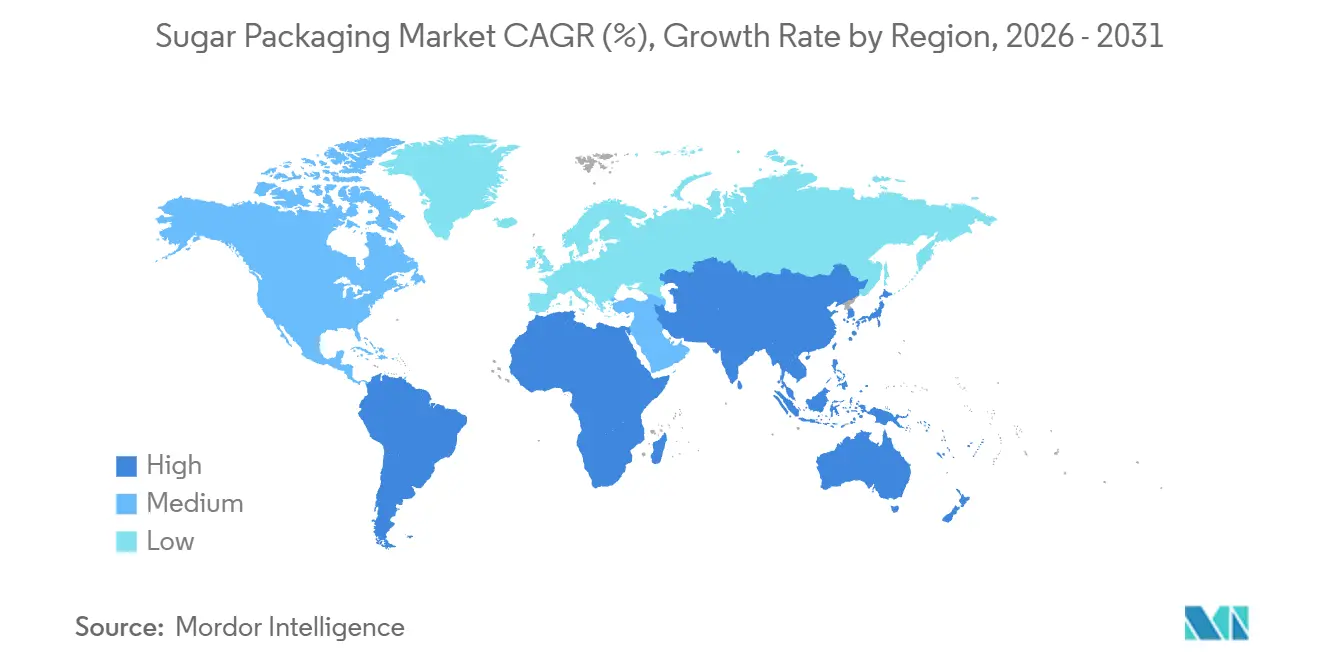
| Fastest Growing Market | Middle East and Africa |
| Largest Market | Asia Pacific |
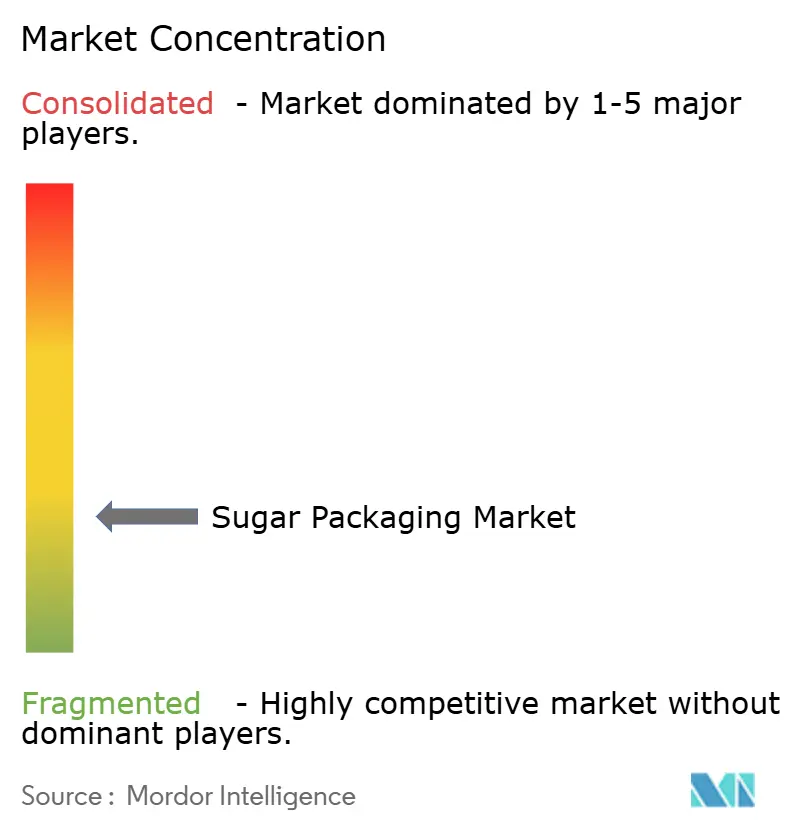
| Market Concentration | Low |
Major Players *Disclaimer: Major Players sorted in no particular order Image © Mordor Intelligence. Reuse requires attribution under CC BY 4.0. | |
Sugar Packaging Market Analysis by Mordor Intelligence
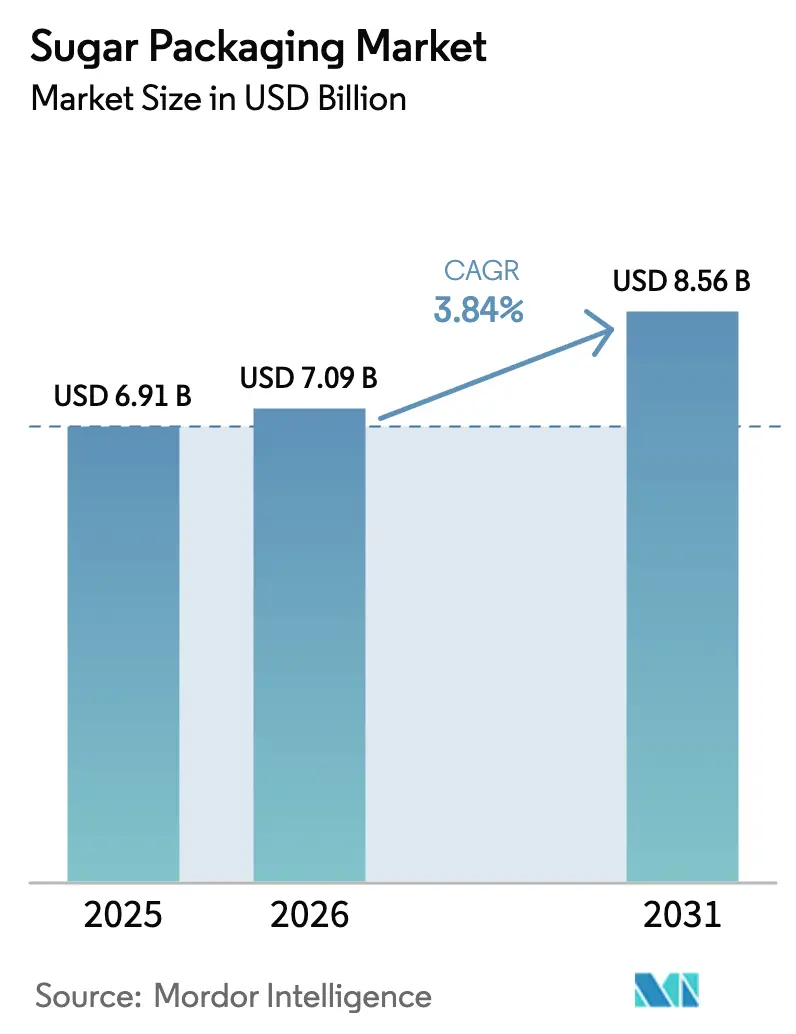
The sugar packaging market size was valued at USD 6.91 billion in 2025 and is estimated to grow from USD 7.09 billion in 2026 to reach USD 8.56 billion by 2031, at a CAGR of 3.84% during the forecast period (2026-2031). Converters are pivoting away from commodity polypropylene sacks toward bio-based, high-barrier formats that protect free-flowing crystals in humid climates and simplify compliance with Extended Producer Responsibility rules, especially in Europe and much of the Asia-Pacific. Flexible formats dominate because stand-up pouches and single-serve sachets support e-commerce dimensional-weight economics and enhance shelf presentation in brick-and-mortar outlets. At the same time, blockchain-linked QR codes and nutrient-stable multi-layer films are transforming packaging from a passive cost center into a visible quality and safety differentiator for premium sugars.
Key Report Takeaways
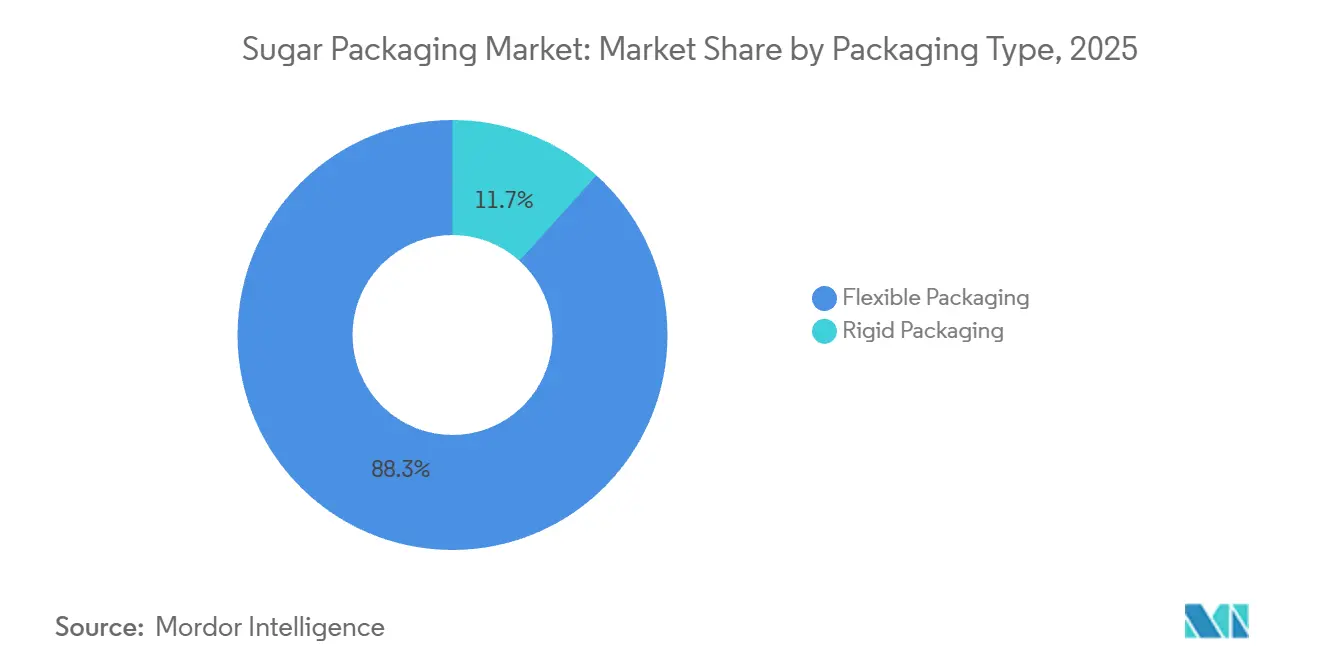
- By packaging type, flexible formats led with 88.32% sugar packaging market share in 2025, and are forecast to grow at a slower 4.62% CAGR through 2031.
- By material type, plastic retained 68.97% of the sugar packaging market size in 2025, while bio-based and compostable substrates are projected to expand at a 5.22% CAGR to 2031.
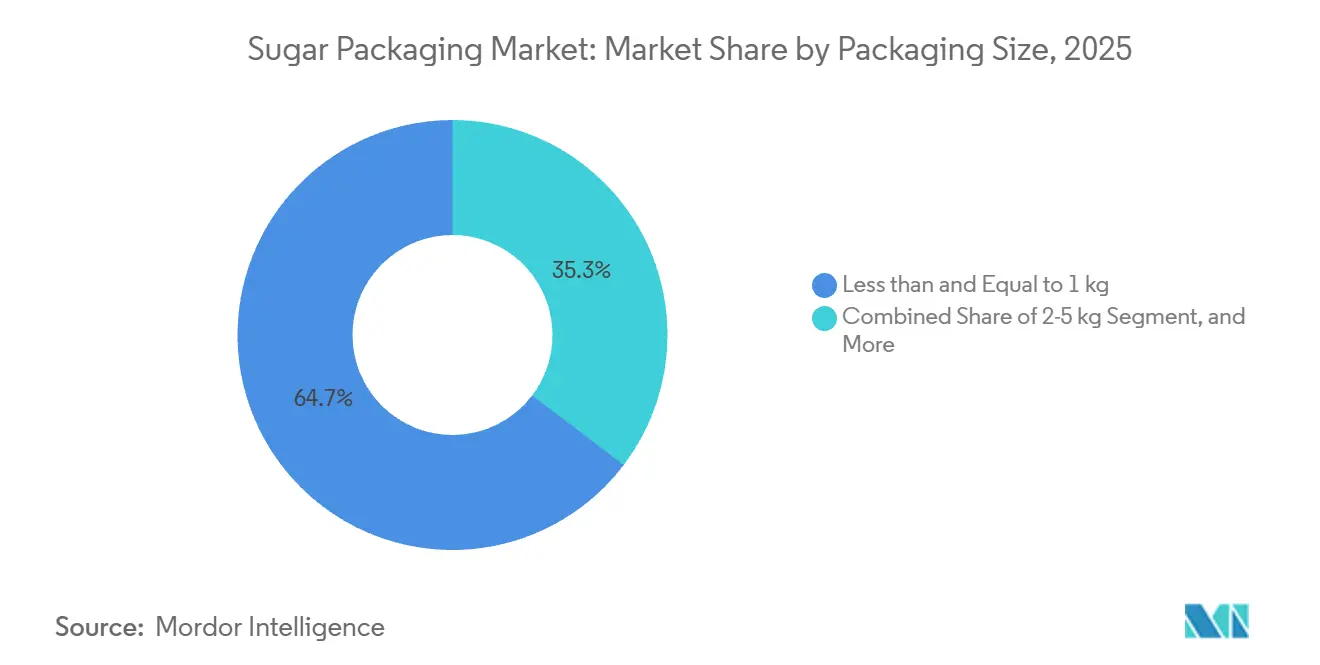
- By packaging size, ≤1 kilogram packs commanded 64.67% of the sugar packaging market in 2025, whereas 2-5 kilogram formats had the fastest growth outlook at a 4.76% CAGR.
- By end user, large scale Manufacturers accounted for 58.65% of the market share in 2025, and small scale manufacturers advanced at a 4.98% CAGR through 2031.
- By geography, Asia-Pacific accounted for 40.21% of market share in 2025; the Middle East and Africa region presents the strongest upside, advancing at a 5.32% CAGR through 2031.
Note: Market size and forecast figures in this report are generated using Mordor Intelligence’s proprietary estimation framework, updated with the latest available data and insights as of January 2026.
Market Trends and Insights
Drivers Impact Analysis of Sugar Packaging Market*
| Driver | (~) % Impact on CAGR Forecast | Geographic Relevance | Impact Timeline |
|---|---|---|---|
| Steady Increase in Sugar Consumption in Emerging Economies | +1.2% | Asia-Pacific core, spill-over to Middle East and Africa | Medium term (2-4 years) |
| Rising Demand for Customized and Sustainable Packaging Formats | +1.0% | Global, with early gains in Europe and North America | Long term (≥ 4 years) |
| Growth of E-commerce Fueling Unit-Sized Sugar Packs | +0.8% | North America, Europe, urban Asia-Pacific | Short term (≤ 2 years) |
| Blockchain-Enabled Supply Chain Traceability for Premium Sugars | +0.4% | North America, Europe, premium segments in Asia-Pacific | Medium term (2-4 years) |
| Mandatory Sugar-Fortification Programs Requiring Specialized Packs | +0.6% | India, sub-Saharan Africa, select Middle East markets | Long term (≥ 4 years) |
| Adoption of Biodegradable High-Barrier Films in Humid Regions | +0.7% | Southeast Asia, Brazil, coastal Africa | Medium term (2-4 years) |
| Source: Mordor Intelligence | |||
Steady Increase in Sugar Consumption in Emerging Economies
Per-capita intake in India climbed to 20.1 kilograms in 2025, and similar gains appeared in Indonesia and Vietnam, lifting baseline demand for both bulk sacks and retail pouches.[1] The 2–5 kilogram bracket benefits most because household shopping trips in these markets balance price sensitivity with storage constraints. In China, organic and specialty sugars represented 8% of consumption in 2025, requiring tamper-evident, resealable packs that justify price premiums. Southeast Asia’s net imports rose 4.2% year-on-year, further expanding volumes through flexible formats that withstand tropical humidity. Altogether, heightened regional consumption is a direct growth engine for the sugar packaging market.
Rising Demand for Customized and Sustainable Packaging Formats
The European Union’s Packaging and Packaging Waste Regulation, fully enforced in 2025, compels 65% recyclability or compostability by 2030, steering converters toward mono-material polyethylene and polylactic acid substrates. Mondi reported that bio-attributed resins reached 42% of its food-flexible mix in 2025, up sharply from 28% two years earlier.[2] Brands are also embracing single-serve sachets with tear notches, resealable zippers, and laser scoring for portion control, all of which heighten shelf appeal. Amcor’s AmLite family, introduced mid-2025, cut film gauge by 15% yet preserved barrier performance via nano-clay coatings, lowering carbon intensity and shipping weight. [3] These design shifts keep the sugar packaging market on a path of premiumization, even as raw material prices fluctuate.
Growth of E-commerce Fueling Unit-Sized Sugar Packs
United States online grocery penetration reached 14.3% of food and beverage sales in 2025, with sugar and sweeteners among the top twenty categories by purchase frequency. E-commerce platforms favor ≤ 1-kilogram pouches because they fit dimensional-weight algorithms and withstand automated sortation. Amazon’s private-label sugar range shifted entirely to stand-up pouches with reinforced corners, decreasing damage claims and optimizing shelf presentation. In Europe, Ocado’s 2025 guidelines mandated a 1.2-meter drop-test threshold, pushing suppliers toward thicker laminates that resist puncture. The e-commerce driver, therefore, dictates both format choice and substrate engineering in the sugar packaging market.
Blockchain-Enabled Supply Chain Traceability for Premium Sugars
Tate and Lyle embedded QR-linked blockchain records on 1-kilogram pouches in late 2025, enabling consumers to verify farm origin, milling time stamps, and organic certification in seconds. IBM Food Trust data show recall response times drop by 60% once lot-level traceability is digitized, saving cost and limiting brand damage. Gulf Cooperation Council import authorities are piloting mandatory blockchain documentation to curb counterfeit shipments, elevating traceability from an optional added value to a regulatory prerequisite. Technology, therefore, is reshaping the sugar packaging market by linking physical packs to immutable data ecosystems valued by regulators and consumers alike.
Restraints Impact Analysis of Sugar Packaging Market*
| Restraint | (~) % Impact on CAGR Forecast | Geographic Relevance | Impact Timeline |
|---|---|---|---|
| Operational and Regulatory Compliance Costs for Converters | -0.9% | Europe, North America, select Asia-Pacific markets | Short term (≤ 2 years) |
| Volatility in Global Sugar Prices Impacting Packaging Demand | -0.6% | Global, with acute effects in import-dependent regions | Short term (≤ 2 years) |
| Shift Toward Alternative Sweeteners Reducing Per-Capita Sugar Use | -0.7% | North America, Western Europe, urban Asia-Pacific | Long term (≥ 4 years) |
| Extended Producer Responsibility (EPR) Increasing Packaging Costs | -0.5% | European Union, United Kingdom, Canada | Medium term (2-4 years) |
| Source: Mordor Intelligence | |||
Operational and Regulatory Compliance Costs for Converters
Extended Producer Responsibility fees averaged EUR 0.12 per kilogram (USD 0.13) of plastic packaging in France, Germany, and the Netherlands during 2025, squeezing converter margins and raising shelf prices by 3–5%. Smaller converters unable to absorb these charges exited commodity contracts, prompting some supply chain consolidation. New recyclability testing rules add EUR 8,000–EUR 15,000 (USD 8,500–USD 16,000) per SKU, an upfront burden that lengthens payback periods for new film constructions. Varying standards in Canada and Asian markets complicate inventory management and duplicate testing. The result is a drag on expansion plans, especially for mid-size firms, within the sugar packaging market.
Shift Toward Alternative Sweeteners Reducing Per-Capita Sugar Use
United States refined-sugar intake fell to 22.1 kilograms per capita in 2025 as stevia and monk-fruit blends captured 11% of household sweetener volume. Germany charted a 6.8% drop in retail sugar purchases between 2023 and 2025 as zero-calorie options gained shelf space. Less throughput in mature markets reduces absolute demand for standard 1-kilogram packs and industrial sacks. Surviving volume is skewing toward high-margin, specialty sugars that require sophisticated barrier films, partially offsetting the decline but adding complexity and cost for converters. This substitution trend softens top-line growth for the sugar packaging market in advanced economies.
*Our forecasts treat driver/restraint impacts as directional, not additive. The impact forecasts reflect baseline growth, mix effects, and variable interactions.
Sugar Packaging Market Segment Analysis
By Packaging Type:
Flexible Formats Sustain Dominance Through ResealabilityFlexible solutions accounted for 88.32% of the sugar packaging market in 2025 and are expanding at a 4.62% CAGR through 2031. Bags and pouches drive volume, yet sachets are steadily gaining share in quick-service restaurants and hospitality channels. Rigid containers remain niche, catering to premium organic sugars and foodservice dispensers where clarity and reuse offset higher shipment costs. Sealed Air’s recyclable polyethylene pouch with an integrated degassing valve prevents ballooning in humid climates, reducing retailer returns and validating the format’s premium positioning. In contrast, sacks are ceding space to intermediate bulk containers where automated handling favors rigid formats, underscoring how material handling innovation influences the trajectory of the sugar packaging market.
Rigid packaging’s lower 3.1% CAGR stems from concentration in mature markets and consumer price sensitivity, yet glass jars are enjoying a limited revival in European organic channels associating transparency with purity. Flexible formats, however, are likely to retain leadership because lightweighting, resealable features, and omnichannel durability remain highly valued by retailers and consumers alike. Consequently, the sugar packaging market is expected to see continued investment in film science and closure innovation.
By Material Type:
Bio-Based Substrates Gain Despite Cost GapPlastic retained 68.97% sugar packaging market share in 2025, split between woven polypropylene for bulk and multilayer laminates for retail. Yet bio-based and compostable substrates are growing fastest at 5.22% CAGR, driven by retailer scorecards and consumer sustainability preferences. Paper packaging also edges higher as kraft pouches with biodegradable liners satisfy both visual and environmental expectations, especially in European premium segments. Billerud’s grease-resistant laminate passed EU Regulation 10/2011, demonstrating that paper can meet safety standards without plastics, though price premiums keep adoption selective.
Smurfit WestRock’s joint venture with GranBio aims to commercialize bagasse-derived polyethylene at scale, targeting cost parity with fossil-based resin by 2029. Until then, polyethylene and polypropylene films will dominate because they deliver proven moisture barriers at lower weights, minimizing logistics costs. Nonetheless, retailer mandates suggest that bio-based films will capture incremental share, sustaining innovation demand within the sugar packaging industry.
By Packaging Size:
Unit Packs Lead, Mid-Range AcceleratesPacks of 1 kilogram or less accounted for 64.67% of market share in 2025, reflecting urban storage constraints and rising e-commerce demand. The 2–5 kilogram tier grows fastest at 4.76% CAGR through 2031 as warehouse clubs proliferate in North America and household sizes remain large in India, Indonesia, and Nigeria. E-commerce continues to reinforce unit packs; Glenroy recorded a 40% drop in transit damage when a leading U.S. brand switched from pillow bags to quad-seal pouches with reinforced corners.
Meanwhile, the 5–25 kilogram bracket retains relevance in bakeries and small food plants, and formats above 25 kilograms stay entrenched in industrial channels. Retailers in emerging economies allocate more shelf space to 2–5 kilogram pouches, encouraging graphic differentiation and functional add-ons like carry handles. This balanced-size portfolio supports broad-based growth across the sugar packaging market.

By End User:
Small-Scale Manufacturers Outpace IncumbentsLarge-scale manufacturers accounted for 58.65% of market share in 2025, yet grew more slowly than agile small-scale competitors, which grew at a 4.98% CAGR. Direct-to-consumer channels, localized sourcing, and storytelling via QR codes are propelling small brands. TedPack’s digital printing cuts minimum orders to 5,000 units, lowering barriers for artisanal producers. Large players counter with AI-enabled quality control and material lightweighting, reducing defects by 18% and protecting margins at high volumes.
The bifurcation reflects how the sugar packaging market combines a commodity tier driven by scale and a premium tier driven by customization and traceability. Packaging innovation provides the bridge that allows newcomers to command shelf presence even against entrenched incumbents. This dynamic has led to increased competition and a focus on differentiation within the market.
Geography Analysis
APAC Sugar Packaging Market
Asia-Pacific held 40.21% of the market share in 2025 and is expected to grow at an estimated 4.1% CAGR through 2031. India’s mandated iron-fortified sugar program drives demand for high-barrier films, while China’s blockchain adoption in premium segments differentiates products on safety credentials. Southeast Asia is transitioning rapidly from loose bulk to retail packs as urbanization accelerates. Japan’s aging demographics are pushing brands to engineer easy-open closures and smaller formats, underscoring diverse regional needs that are expanding the sugar packaging market.
MEA Sugar Packaging Market
The Middle East and Africa region posts the highest forecast at 5.32% CAGR. Saudi Arabia enforces tamper-evident packaging on imports, spurring holographic labels and breakable seals that local converters often cannot supply, thereby opening export opportunities for European and Asian suppliers. Nigeria’s sugar consumption reached 1.8 million metric tons in 2025, but domestic packaging capacity trails demand, promoting foreign investment. Currency volatility, such as Egypt’s 2025 devaluation, alters substrate choices, favoring lower-cost paper sacks in industrial channels and reshaping the sugar packaging market across the region.
Europe Sugar Packaging Market
In Europe, growth is muted by declining sugar use but buoyed by sustainability mandates. Germany raised EPR fees on non-recyclable packs, accelerating the switch to mono-material polyethylene. France’s ban on single-use plastic sachets creates uncertainty, prompting brands to hedge with paper alternatives. Closed-loop recycling pilots in Spain and Italy demonstrate the potential of the circular economy but depend on multi-stakeholder coordination. Regulatory complexity, therefore, defines the European outlook for the sugar packaging industry.
North America Sugar Packaging Market
In North America, the United States relies on e-commerce to stimulate unit-pack demand, whereas Canada’s draft EPR proposal diverges from U.S. rules, complicating cross-border compliance. Mexico’s exporters use higher-barrier laminates to meet U.S. retailer shelf-life requirements. Overall, innovation skewed to resealability and graphics delivers incremental value in this mature part of the sugar packaging market.
South America Sugar Packaging Market
South America is expected to be one of the growing regions, powered by Brazil’s sugarcane-derived polyethylene supply and Argentina’s stabilization of input costs. Mercosur tariff cuts on packaging materials cut production costs and encourage cross-border integration. Urban consumers in São Paulo and Buenos Aires increasingly prefer resealable pouches, while rural retail still leans on low-cost sacks. As bio-polymer capacity climbs, South America could become an exporting hub for sustainable inputs used worldwide in the sugar packaging market.
Regulatory Landscape
Regulation for sugar packaging is tightening around recyclability, food-contact safety, and traceability, with the European Union serving as the most prescriptive reference market for global converters. The EU Packaging and Packaging Waste Regulation (PPWR) (EU) 2025/40 entered into force on 11 February 2025 and applies from 12 August 2026, bringing design-for-recycling and labeling obligations to packaging placed on the EU market and increasing compliance pressure on multi-material laminates used in retail sugar pouches and sachets.
Food-contact requirements add further material constraints for EU-bound packs. PPWR-linked restrictions include limits that accelerate PFAS-free documentation and testing for food-contact packaging by 12 August 2026, while Commission Regulation (EU) 2026/250 (February 2026) adjusts transition timelines within the EU BPA restriction framework for certain final food-contact articles, including a 20 July 2026 transition deadline for specific single-use applications and longer derogations for certain coatings to 20 January 2028. In the United States, FDA oversight of food-contact substances (via Food Contact Notifications) governs permitted chemistries for plastic films and coatings, and FDA set 1 January 2028 as the uniform compliance date for food labeling regulations published between 1 January 2025 and 31 December 2026, affecting how sugar brands synchronize label refresh cycles across SKUs.
Value Chain Analysis
The sugar packaging value chain starts upstream with feedstocks and additives, including polyethylene and polypropylene resins, paper and specialty barrier coatings, inks, adhesives, and emerging bio-based inputs. Conversion then moves into films, laminates, sacks, and pouches through extrusion, coating, printing, and bag-making, before packaging is integrated into sugar producers and refiners operations where drying, filling, sealing, coding, and palletization are carried out to meet retail and industrial specifications. Moisture protection for free-flowing crystals in humid climates and tamper-evidence for regulated import markets remain recurring functional requirements.
Downstream, the chain depends on bulk logistics and port infrastructure, where multimodal networks connect mills and refineries to domestic distribution and exports. In Brazil, partnerships around VLI's logistics corridors and the Santos port (Tiplam terminal) illustrate how reliability in bulk movements influences packaging schedules, inventory, and format choices across sacks, intermediate bulk containers, and high-barrier retail packs. Circularity initiatives are also becoming embedded in the chain: Mitr Phol and SCGC signed an MoU in October 2025 for a packaging circularity collaboration that uses SCGC GREEN POLYMER resins to convert recycled plastics from sugar operations into film applications, aligning material sourcing with recyclability requirements and brand sustainability scorecards.
Competitive Landscape
The sugar packaging market is fragmented, with global players including Mondi, Amcor, Smurfit Westrock, Sealed Air, International Paper, and others. These leaders expand vertically into bio-polymer production, pursue regional acquisitions, and invest in barrier-coating patents that enable fully recyclable structures. Mondi’s water-based oxygen barrier, patented in 2025, shows oxygen-transmission rates below 1 cc/m²/day without aluminum or EVOH layers, promising greater recyclability once scaled. Amcor’s USD 180 million purchase of a Brazilian converter secures sugarcane-based polyethylene feedstock, illustrating how mergers combine capacity and sustainable inputs.
Technology collaborations also drive differentiation. Sealed Air tailored its coffee-grade degassing valve to humid-market sugar packs, cutting packaging failures by one-third. International Paper’s AI vision systems cut defects across containerboard destined for industrial sugar applications. Smaller digital printing specialists cater to artisanal brands by slashing minimum order sizes, earning quick traction among e-commerce-focused producers. Certification breadth, spanning EU, FDA, and BIS standards, increasingly separates preferred suppliers from competitors in the sugar packaging industry.
Mid-size converters in India, Thailand, and Brazil fill critical regional gaps by offering multilingual artwork services, faster regulatory approvals, and order-to-ship cycles under ten days, a speed unattainable for the global majors that rely on centralized plants. Several of these firms are licensing digital-holography modules to embed low-cost tamper evidence directly into pouch side gussets, thereby competing on functionality rather than scale. Private-equity funds have begun rolling up such regional assets five deals closed in 2025 alone to create sub-continental champions able to negotiate resin contracts collectively and qualify for multinational tenders that require ISO 22000 and BRC certification. Meanwhile, specialty coating start-ups in the United States are partnering with large resin suppliers to commercialize solvent-free nano-barrier layers that can be extruded in a single pass, reducing energy consumption by 22% compared with legacy aluminum-oxide vapor-deposition systems. This convergence of speed, niche technology, and financial backing suggests that the next competitive wave will be defined less by absolute capacity and more by the ability to integrate advanced materials, digital security, and agile production into one cohesive service offering, further diversifying the global sugar packaging landscape.
Sugar Packaging Industry Leaders
-
Mondi Group
-
Smurfit WestRock
-
Amcor plc
-
Sealed Air Corporation
-
International Paper Company
- *Disclaimer: Major Players sorted in no particular order
Sugar Packaging Market Companies Covered in this Report
- Mondi plc
- Klabin S.A.
- Coveris Holdings S.A.
- United Bags Inc.
- Smurfit WestRock
- Amcor plc
- Sealed Air Corporation
- International Paper Company
- TedPack Company Limited
- Packman Industries
- Swiss Pack Private Limited
- Grupo Bio Pappel S.A.B. de C.V.
- Stora Enso Oyj
- Crown Holdings Inc.
- Huhtamaki Oyj
- Billerud AB
- Glenroy Inc.
Market Opportunities and Future Outlook
A near-term opportunity lies in redesigning sugar pouches and sachets for EU compliance where PPWR (EU) 2025/40 applies from 12 August 2026. The scope includes shifting structures toward recyclable mono-material solutions and upgrading labeling and batch identification to meet stricter EU requirements, which pulls demand toward high-barrier, recycle-ready polyethylene films and compatible coatings that help keep sugar free-flowing in humid climates. It also supports paper-based barrier concepts where performance and sealing can be validated on existing equipment.
Material and format whitespace is also emerging through fiber-based and bio-derived inputs that link packaging sustainability to sugar-industry by-products and retailer scorecards. Examples include sugar-beet pulp-derived paper used for granulated sugar bags (Cosun Beet Company) and fiber-based rigid dispensing formats such as the recycled-fiber sprinkler container adopted by Cristalco for a sugar brand, reducing virgin plastic while preserving consumer usability. On the technology side, collaboration-led development is accelerating, with May 2026 activity involving UPM Specialty Materials, Michelman, and BOBST introducing validated bio-based paper packaging concepts with heat-sealable barrier coatings aligned with EU packaging rules, which indicates a practical pathway for paper barrier systems to compete with conventional laminates in retail sugar applications.
Recent Industry Developments in Sugar Packaging Market
- May 2026: Smurfit WestRock unveiled ActiBlu, a prototype packaging solution that uses water-activated seals to remove traditional hot-melt gluelines in packaging production. Reducing adhesive use can simplify certain recycling pathways and lower process complexity for high-volume converting lines used across food and dry-goods applications, including sugar packs. The prototype also reflects a push to eliminate manufacturing bottlenecks associated with glue application and cure windows.
- April 2026: Mondi announced a joint venture with PT Indocement Tunggal Prakarsa Tbk to establish a paper bag production platform in Indonesia, adding more than 200 million bags of annual capacity. Expanding regional paper-bag output supports local supply resilience and shorter lead times for industrial and food-grade bag users in Southeast Asia. The effort aligns with broader shifts away from commodity plastic sacks in parts of the sugar supply chain where paper-based formats can meet handling and compliance needs.
- December 2025: Mondi confirmed a EUR 120 million expansion of bio-based barrier-film capacity in Germany, targeting an additional 25,000 metric tons of annual output. Incremental high-barrier capacity supports converters and brands migrating to improved moisture protection and sustainability-led film structures for sugar in humid and e-commerce-heavy channels. The investment also strengthens European sourcing options as EPR-related costs and recyclability requirements reshape material selection.
Sugar Packaging Market Report Scope and Research Methodology
Market Definition and Coverage
For this methodology, the market covers packaging products used to pack sugar for retail and bulk handling, where value is counted as packaging revenue generated for sugar applications across major regions.
Scope exclusions: We exclude raw sugar production, sugar trading, and downstream food products where sugar is only an ingredient rather than the primary packed product.
Segments Covered in This Report
- By Packaging Type
- Flexible Packaging
- Bags and Pouches
- Sachets
- Sacks
- Rigid Packaging
- Jars and Containers
- Flexible Packaging
- By Material Type
- Plastic
- Woven Polypropylene
- Plastic Films
- Paper
- Bio-based and Compostable Materials
- Plastic
- By Packaging Size
- Less than equal to 1 kg
- 2 - 5 kg
- 5 - 25 kg
- More than 25 kg
- By End User
- Large Scale Manufacturers
- Medium Scale Manufacturers
- Small Scale Manufacturers
- By Geography
- North America
- United States
- Canada
- Mexico
- South America
- Brazil
- Argentina
- Rest of South America
- Europe
- Germany
- United Kingdom
- France
- Italy
- Spain
- Rest of Europe
- Asia -Pacific
- China
- India
- Japan
- South Korea
- Australia
- Rest of Asia-Pacific
- Middle East and Africa
- Middle East
- Saudi Arabia
- United Arab Emirates
- Turkey
- Rest of Middle East
- Africa
- South Africa
- Egypt
- Nigeria
- Rest of Africa
- Middle East
- North America
Data Sources, Market Sizing, and Validation
Desk Research
Desk work starts by mapping the packaging demand pool to real sugar movement, then linking it to the packaging formats used in retail packs and bulk sacks. Public statistics and standards sources such as FAOSTAT for sugar output and trade, UN Comtrade for import-export flows, and national customs or statistical offices are used to sanity check large country trends.
To keep packaging assumptions realistic, we also review ISO packaging and food contact related standards, plus government environmental policy pages covering EPR and packaging waste rules. For material performance assumptions, we look at peer-reviewed papers on barrier films, paper performance, and compostable materials. Company annual reports, investor decks, and reputable trade press are used to confirm capacity moves, material substitution, and pricing direction. In a few cases where public reporting is thin, we rely on paid subscriptions for company financials and shipment-level trade views to reduce gaps. The desk sources listed here are illustrative, and many other public documents were checked for validation and clarification.
Primary Interviews and Surveys
Primary work is used to translate sugar demand into packaging volume and value, since pack mix and pricing can change by channel and region even when sugar consumption is stable. We speak with packaging converters, material suppliers, sugar packers, and large buyers to confirm pack size splits, typical material choices (paper vs plastic vs compostable), and how pricing changes with resin, paper, and freight conditions across APAC, EMEA, and the Americas.
Distribution of primary research fieldwork respondents
| Company type | Respondent position | Region |
|---|---|---|
| Top tier: 39% | CXOs: 13% | APAC: 41% |
| Mid tier: 45% | Functional/Unit leaders: 30% | EMEA: 36% |
| Smaller Players: 16% | Managers: 57% | Americas: 23% |
Market-Sizing & Forecasting
Sizing begins with a top-down build where sugar production and trade flows are converted into packaging needs by applying realistic pack size and format shares. Volumes are then translated into value using region-specific average selling prices. We also cross-check totals with selective bottom-up approximations, such as supplier revenue roll-ups, channel checks with packers, and sampled ASP times volume calculations for the most common pack types, to correct any over or under statements.
Key inputs used in the model include sugar production and import-export direction, the split between retail packs and industrial sacks, the share of flexible versus rigid formats, typical material mix (paper, plastic, and compostable options), and packaging price movement linked to paper, resin, and freight costs. Where bottom-up views are incomplete for smaller converters, gaps are handled through coverage ratios by region and format, followed by a reasonableness check against known capacity and utilization signals discussed in interviews.
For forecasting, scenario analysis is used so the model can reflect different paths for sustainability regulation, material substitution, and retail pack demand changes, while still being anchored to sugar consumption trends. Assumptions are refined with interview consensus on how quickly compostable and high-barrier formats are being adopted and where price premiums are likely to hold.
Data Validation & Update Cycle
Validation is done through multiple passes so the numbers do not rely on one data stream. We compare outcomes against independent signals such as sugar output direction, packaging material price trends, and reported packaging demand commentary, then investigate any large variance before sign-off.
If an anomaly appears, we re-check assumptions such as pack size mix, flexible-rigid shares, and the timing of price changes. We then re-contact selected experts to confirm whether it is a real market shift or a modeling artifact. Reports are refreshed annually, with interim updates when material events occur, including major regulation changes, large capacity additions, or sudden raw material price swings. Before delivery, an analyst completes a fresh review pass so clients receive the latest updated view.
Mordor Intelligence's Sugar Packaging Market Size Compared With Other Published Estimates
Published market sizes for sugar packaging can vary even when firms look at the same end use, because packaging scope, pack types, and the year used for pricing assumptions are not always aligned. Differences also come from how bulk sacks are treated versus retail packs, and whether compostable formats are counted as a separate adjacent category.
A common gap driver is the definition of what counts as sugar packaging revenue, since some estimates blend in wider food dry goods packaging or include secondary transport packaging, which inflates totals. Another driver is pricing logic, where some sources apply a single global ASP curve and others use region- and material-specific pricing. The gap becomes larger in years with resin and paper volatility. When bulk and retail are kept distinct and pack size shares are checked with industry feedback, the resulting spread becomes easier to explain, which is how the model is kept consistent in Mordor Intelligence.
Benchmark comparison
| Source | Market Size | Gaps in Research Methodology |
|---|---|---|
| Mordor Intelligence | USD 7.09 B (2026) | |
| Trade Publisher A | USD 6.00 B (2026) | Uses a narrower view centered on sugar bag and sack formats, and tends to undercount small retail pack formats such as pouches and sachets, which reduces the total value. |
| Industry Blog B | USD 12.70 B (2030) | Reports a later year point without clarifying the underlying pack mix and pricing path, and the number is likely influenced by broader packaging scope beyond primary sugar packs, which pushes the figure upward. |
The table shows that the main spread is explained by scope discipline and by how pricing and year alignment are handled, not by one single growth assumption. By keeping pack types tied to sugar specific demand signals and then pressure testing the ASP path with interview checks, the estimate stays traceable to clear variables and repeatable steps.
Key Questions Answered in the Report
What is the projected value of the sugar packaging market by 2031?
It is expected to reach USD 8.56 billion as converters shift toward bio-based, high-barrier formats.
Which region is forecast to grow fastest?
The Middle East and Africa region shows the highest outlook at a 5.32% CAGR through 2031 due to tamper-evident mandates and rising consumption.
Why are flexible pouches preferred in e-commerce channels?
Stand-up pouches minimize dimensional weight, resist automated sortation damage, and fit consumer expectations for resealability.
How are sustainability regulations influencing packaging materials?
EU and Canadian EPR frameworks require higher recyclability, pushing converters toward mono-material polyethylene, bio-based films, and recyclable paper laminates.
What role does blockchain play in sugar packaging?
QR-linked blockchain records enhance traceability, reduce recall times by 60%, and strengthen consumer trust for premium organic sugars.
Which packaging size segment is expanding fastest?
The 2–5 kilogram bracket is growing at 4.76% CAGR because it balances bulk economics with household convenience in emerging markets.