
Steam Turbine MRO Market Size and Share
Market Overview
| Study Period | 2021 - 2031 |
|---|---|
| Market Size (2026) | USD 23.65 Billion |
| Market Size (2031) | USD 29.21 Billion |
| Growth Rate (2026 - 2031) | 4.31 % |
| Fastest Growing Market | Asia Pacific |
| Largest Market | Asia-Pacific |
| Market Concentration | Medium |
Major Players
*Disclaimer: Major Players sorted in no particular order Image © Mordor Intelligence. Reuse requires attribution under CC BY 4.0. |
|
Steam Turbine MRO Market Analysis by Mordor Intelligence
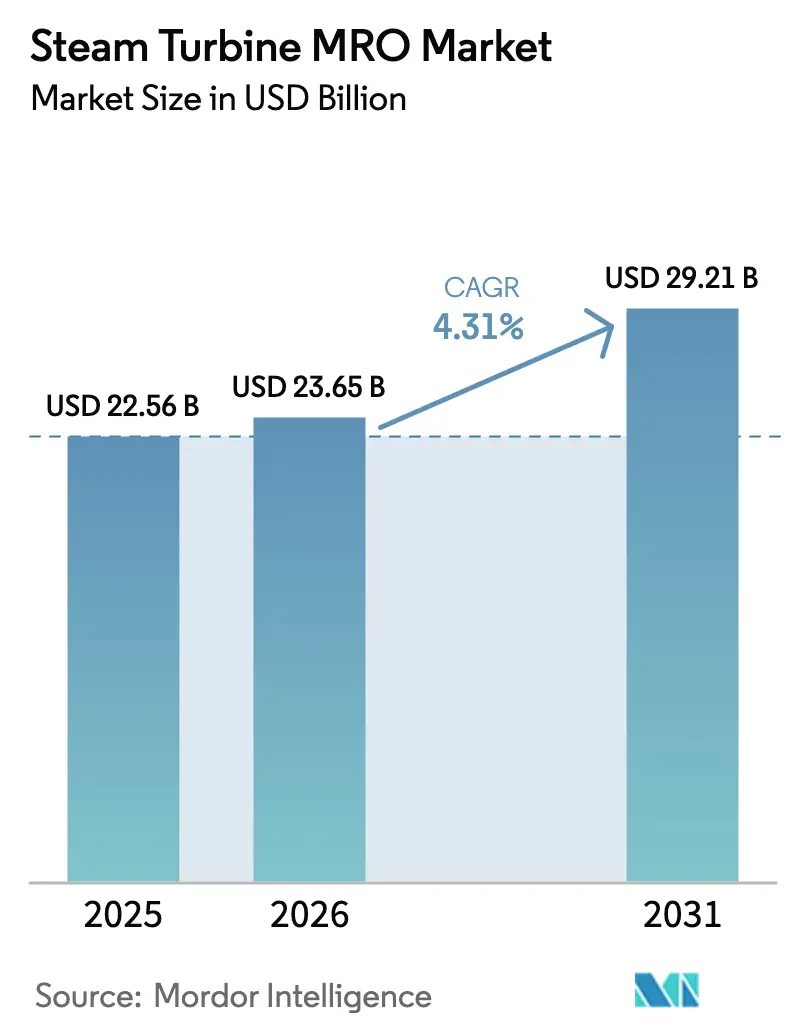
The Steam Turbine MRO Market size is expected to grow from USD 22.56 billion in 2025 to USD 23.65 billion in 2026 and is forecast to reach USD 29.21 billion by 2031 at 4.31% CAGR over 2026-2031.
Regional demand is pivoting toward Asia-Pacific, nuclear life-extension programs in the United States and France, and advanced combined-cycle builds in the Middle East, all of which reshape the service mix and lift long-term contract values. Coal retirements across OECD nations are reducing the transactional repair pool, yet life-cycle extensions for subcritical and nuclear units continue to generate high-value overhauls. OEMs now bundle predictive analytics and spare-parts guarantees inside long-term service agreements (LTSAs), converting episodic spending into annuity streams and fortifying switching barriers. Independent service providers, however, are winning legacy fleets by promising 20–30% lower cost and faster turnaround while exploiting parts scarcity through additive manufacturing.
Key Report Takeaways
- By capacity, the 300–600 MW bracket held 50.5% of the steam turbine MRO market share in 2025. Turbines above 600 MW are forecast to expand at a 5.1% CAGR through 2031.
- By plant fuel, coal captured 60.1% of expenditure in 2025. Nuclear services are advancing at a 5.5% CAGR to 2031.
- By service, maintenance dominated with 53.9% revenue share in 2025. Repair work is rising at a 5.0% CAGR through 2031.
- By end user, power generation commanded 67.3% spending in 2025 and will grow at a 4.7% CAGR through 2031.
- By geography, Asia-Pacific led with 49.6% regional share in 2025, and is also the fastest-growing geography at 5.8% CAGR.
- GE Vernova, Siemens Energy, and Mitsubishi Power collectively held 45% of the aftermarket in 2025.
Note: Market size and forecast figures in this report are generated using Mordor Intelligence’s proprietary estimation framework, updated with the latest available data and insights as of January 2026.
Market Trends and Insights
Drivers Impact Analysis of Steam Turbine MRO Market*
| Driver | (~) % Impact on CAGR Forecast | Geographic Relevance | Impact Timeline |
|---|---|---|---|
| Aging global thermal-power fleet lifecycle extension | +1.2% | Global, concentrated in North America, Europe, China, India | Long term (≥ 4 years) |
| Expansion of combined-cycle & advanced ultra-supercritical plants | +0.9% | Asia-Pacific core (China, India, Japan), Middle East, spill-over to Southeast Asia | Medium term (2-4 years) |
| OEM long-term service agreement boom | +0.8% | Global, early adoption in Middle East (Saudi Arabia, UAE), North America | Medium term (2-4 years) |
| Predictive-maintenance digital twins adoption | +0.6% | North America & Europe lead, Asia-Pacific following | Short term (≤ 2 years) |
| Decarbonization retrofits including H₂/NH₃ co-firing | +0.5% | Europe, Japan, pilot projects in Middle East and Australia | Long term (≥ 4 years) |
| Rise of industrial micro-CHP in emerging markets | +0.3% | Southeast Asia, Latin America, Sub-Saharan Africa | Medium term (2-4 years) |
| Source: Mordor Intelligence | |||
Aging Global Thermal-Power Fleet Lifecycle Extension
The median U.S. coal unit age reached 44 years in 2024, and owners are choosing 50–60 year life extensions that call for rotor re-boring, creep assessments, and 3D aerodynamic blade retrofits, typically restoring 80–90% original efficiency at one-third of new-build capital.[1] NTPC extended fifteen Indian units totaling 3.8 GW in 2025 under a Bharat Heavy Electricals contract covering metallurgy upgrades and advanced seals. China mirrors the pattern, retrofitting pre-2010 subcritical plants with upgraded seals and low-pressure stage replacements to meet 2030 carbon-intensity targets while deferring decommissioning.
Expansion of Combined-Cycle & Advanced Ultra-Supercritical Plants
Steam temperatures above 600 °C in these units accelerate creep, doubling inspection frequency versus legacy subcritical fleets. Japan’s J-POWER introduced nickel-based 650 °C blades in 2024, requiring specialist weld repair unserved by most independents. China added 28 GW of ultra-supercritical capacity in 2025, and mandated 12,000-hour inspections, raising overhaul incidence. Siemens Energy’s 15-year Qurayyah LTSA in Saudi Arabia demonstrates how high-efficiency assets lock in long-duration MRO cash flows immediately after commissioning.[2]
OEM Long-Term Service Agreement Boom
LTSAs now guarantee availability, efficiency, and emissions compliance. GE Vernova’s 20-year Kuwait LTSA covers 4.8 GW and taps its Asset Performance Management platform for failure prediction 6–12 months out. Mitsubishi Power secured a 25-year New Capital deal in Egypt with a 95% availability guarantee that pushes proactive blade replacement and rotor balancing. Siemens Energy disclosed that LTSAs generated 38% of Gas Services revenue in fiscal 2025 at margins 15–20% above transactional work.
Predictive-Maintenance Digital Twins Adoption
Siemens Energy’s Omnivise cut forced outages 22% across 12 GW of European capacity in 2025 by flagging rotor eccentricity and blade erosion ahead of control-room alarms. GE Vernova’s Turbine Life Assessment software lets operators defer major inspections by up to 12 months when calculated creep life remains adequate. Hybrid models that blend finite-element stress analysis with machine-learning anomaly detection achieve 94% crack-identification accuracy, curbing false positives.
Restraints Impact Analysis of Steam Turbine MRO Market*
| Restraint | (~) % Impact on CAGR Forecast | Geographic Relevance | Impact Timeline |
|---|---|---|---|
| Accelerated retirement of coal assets in OECD | -0.7% | North America, Europe (Germany, UK, Netherlands), Japan | Short term (≤ 2 years) |
| High outage CAPEX & downtime for major overhauls | -0.4% | Global, acute in liberalized power markets (US, EU, Australia) | Medium term (2-4 years) |
| OEM software lock-in limiting independents | -0.3% | Global, most pronounced in North America and Europe | Medium term (2-4 years) |
| Scarcity of legacy spare parts for <300 MW units | -0.2% | North America, Europe, parts of Asia with aging subcritical fleets | Long term (≥ 4 years) |
| Source: Mordor Intelligence | |||
Accelerated Retirement of Coal Assets in OECD
EIA data show 23 GW of U.S. coal shut in 2024, with another 14 GW slated by 2029, eliminating large swaths of addressable MRO volume.[3] The U.K. closed its last coal station in 2024, and Germany debates pulling its 2038 exit forward to 2030, squeezing European service demand. IEA forecasts a 40% decline in OECD coal capacity by 2035, a contraction that disproportionately hurts independents unable to pivot to gas or nuclear.
High Outage CAPEX & Downtime for Major Overhauls
An overhaul on a ≥300 MW unit costs USD 5–15 million and idles the plant 30–90 days, creating up to USD 2 million daily opportunity cost when spot power prices soar, pushing some merchant operators into run-to-failure mode.[4] OEM modular rotor-exchange programs trim downtime to 15–25 days but demand 20–30% price premiums that only high-capacity-factor plants can justify.
*Our forecasts treat driver/restraint impacts as directional, not additive. The impact forecasts reflect baseline growth, mix effects, and variable interactions.
Steam Turbine MRO Market Segment Analysis
By Capacity:
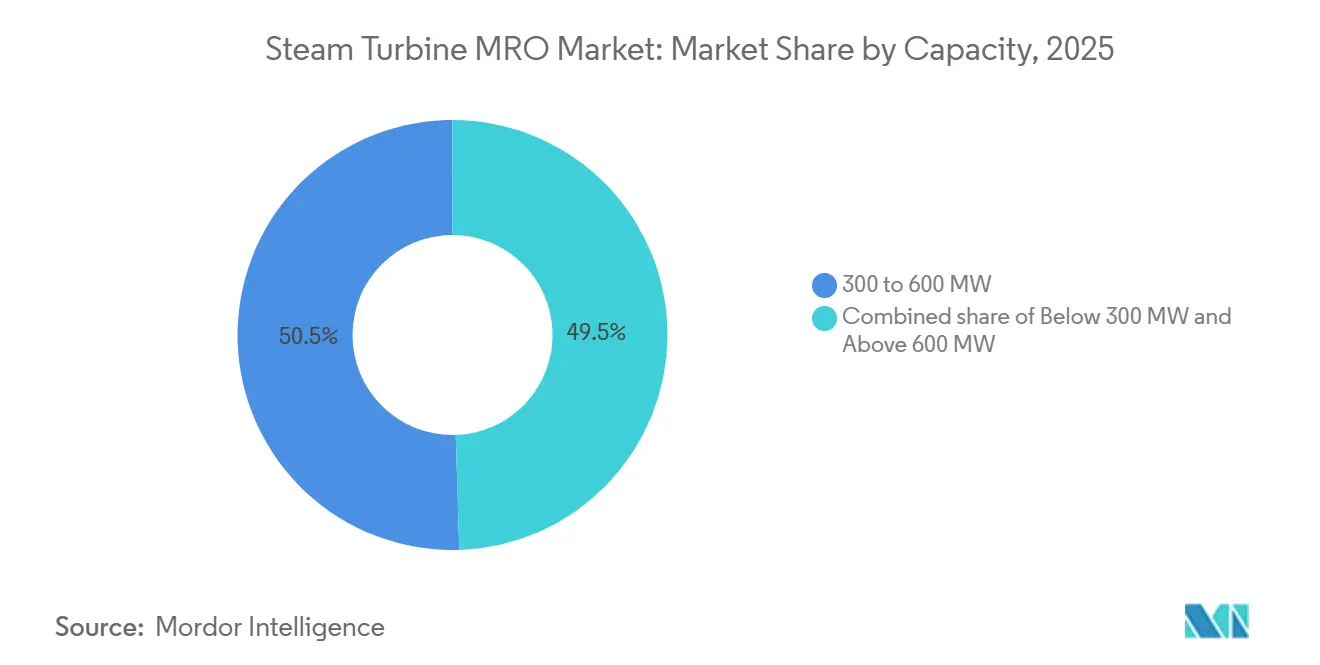
Mid-Range Dominance, Large-Unit Growth AcceleratesIn 2025, 300–600 MW units accounted for 50.5% of the steam turbine MRO market share thanks to the vast 1990s subcritical coal fleet. Above-600 MW turbines will post a 5.1% CAGR to 2031, lifting the steam turbine MRO market size for this bracket as China, India, and Japan deploy ultra-supercritical designs that demand nickel-alloy repairs and phased-array ultrasonic inspections.
Mid-range units are far from obsolete; J-POWER lifted four 600 MW subcritical units’ efficiency 2.3 points by swapping low-pressure stages for 3D blades in 2025, underscoring retrofit economics over retirement. Below-300 MW machines face parts shortages and early retirement, producing only 14% of MRO revenue on 22% of capacity in the United States.

By Plant Fuel:
Coal Dominates, Nuclear Surges on Life ExtensionsCoal plants generated 60.1% of global spend in 2025 and underpin the steam turbine MRO market despite OECD retirements, because Asia runs 1,900 GW of coal capacity. Nuclear work will outpace all fuels at 5.5% CAGR after NRC and ASN approvals push U.S. and French reactors to 80-year lives, swelling steam-generator swaps and rotor re-boring scopes that expand the steam turbine MRO market size for nuclear sites.
Natural-gas combined-cycle fleets carry 25% of spending and will grow 4.8% CAGR, buoyed by Middle-East megaproject LTSAs. Biomass and WtE plants remain niche yet require corrosion-resistant coatings, a specialized repair opportunity.
By Service Type – Maintenance Leads, Repair Gains on Aging Fleets
Maintenance activities, which include routine inspections, vibration monitoring, lube-oil sampling, and minor component swaps, accounted for 53.9% of 2025 revenue and represented the largest steam turbine MRO market share. The dominance stems from a broad installed base still within its first three decades of operation, when preventive work keeps forced-outage risk low and satisfies ISO 55000 asset-management requirements. OEMs monetize this layer through digital-twin subscriptions that trigger just-in-time part shipments and shorten outage windows, converting what was episodic spending into predictable annuity streams. Independents respond with mobile condition-monitoring trailers that can be deployed within twenty-four hours, a model favored by industrial plants lacking dense instrumentation. As combined-cycle and ultra-supercritical fleets mature, owners are bundling hot-gas-path inspections with standard maintenance visits to limit downtime overlap, raising average contract value and expanding the steam turbine MRO market size for service packages that promise 96% or better fleet availability.
Repair work, blade refurbishment, rotor re-machining, seal replacement, and bearing overhaul will rise at a 5.0% CAGR through 2031 as thermal fleets age and fatigue-induced failures accelerate. GE Vernova’s laser powder-bed fusion process rebuilds eroded nickel-based blades within six weeks, cutting lead times by 70% and protecting operators against legacy-spare scarcity. Mitsubishi Power’s 2025 introduction of laser-clad blade leading-edge restoration extends component life 50,000-80,000 operating hours, deferring USD 2–4 million full-stage replacements. Cold-spray additive services from Sulzer reduce repair costs by 35% versus weld-and-machine methods, broadening access for sub-300 MW units pressed to operate beyond design life. High-energy cogeneration turbines in refineries and petrochemical complexes now specify service agreements that blend predictive analytics with rotor-exchange modules, halving downtime to fifteen days and reinforcing long-term demand for advanced repair capabilities.
By End-User Industry – Power Generation Anchors, Industrial CHP Diversifies
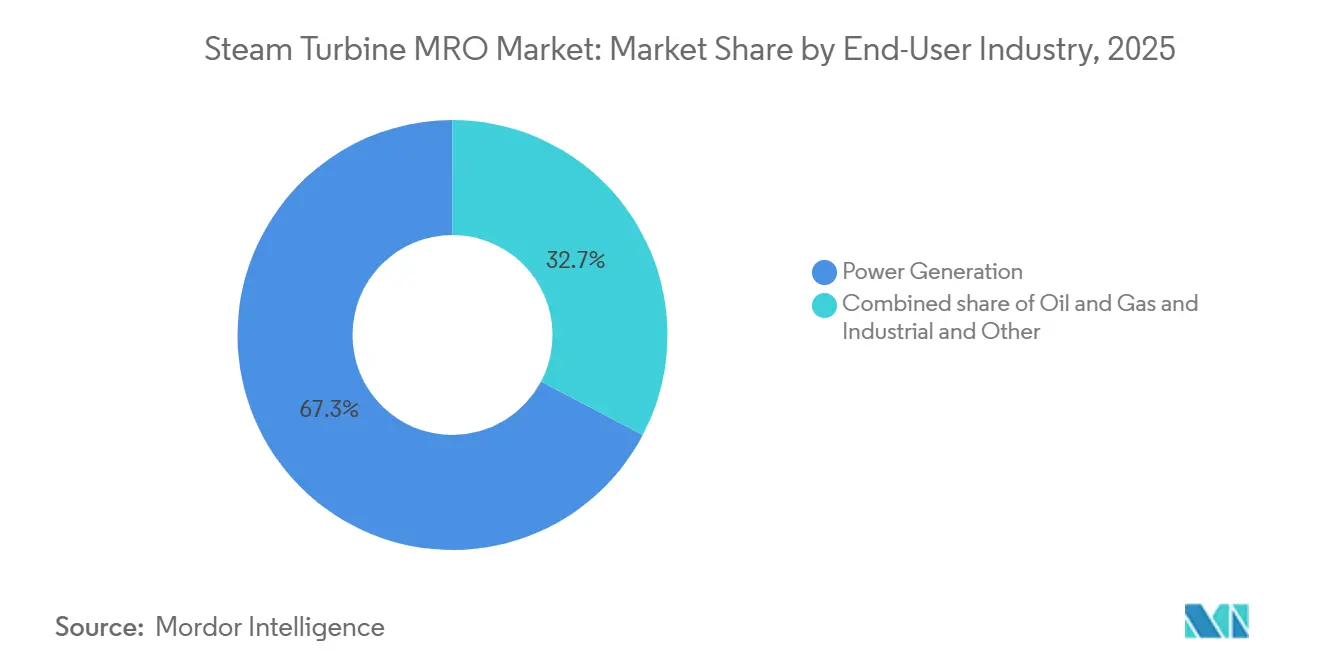
Utility-scale power producers commanded 67.3% of 2025 spending, benefiting from an installed base that spans coal, gas, and nuclear assets and delivers multi-decade steam turbine MRO market size stability. Nuclear life-extension programs in the United States and France alone will lock in USD 400–600 million turbine and balance-of-plant overhauls per reactor. Gas-fired combined-cycle plants in Saudi Arabia and the United Arab Emirates rely on LTSAs that guarantee 95% availability, embedding OEMs for twenty years and ensuring recurring overhaul revenue streams. Coal plants in Asia remain the largest single source of transactional repair, but creeping retirements in OECD countries are shrinking this pool and pushing service firms toward diversified customer mixes.
The industrial and oil-and-gas segment is driven by 5–50 MW micro-CHP turbines that run at 85–95% load factors and require more frequent hot-section inspections than grid-connected peers. India commissioned 4.2 GW of industrial cogeneration capacity in 2024–2025, with Triveni Turbine capturing 38% of sub-30 MW installs and supplying regional hubs that guarantee a forty-eight-hour response, a service advantage over global OEMs. Vietnam’s twenty-year PPA regime for factory CHP projects created a 1.8 GW pipeline that demands localized MRO networks and mobile diagnostic rigs for plants where online sensors are sparse. Saudi Aramco’s ten-year, USD 680 million agreement with Baker Hughes covering 12 GW of refinery cogeneration shows the scale of future refinery-sector opportunity and highlights the premium placed on remote condition monitoring in hazardous locations. As industrial users adopt ISO 45001 safety frameworks, they increasingly favor service partners that can integrate emissions testing and regulatory documentation into overhaul scopes, shortening permitting cycles and elevating value-added engineering content.
Geography Analysis
APAC Steam Turbine MRO Market
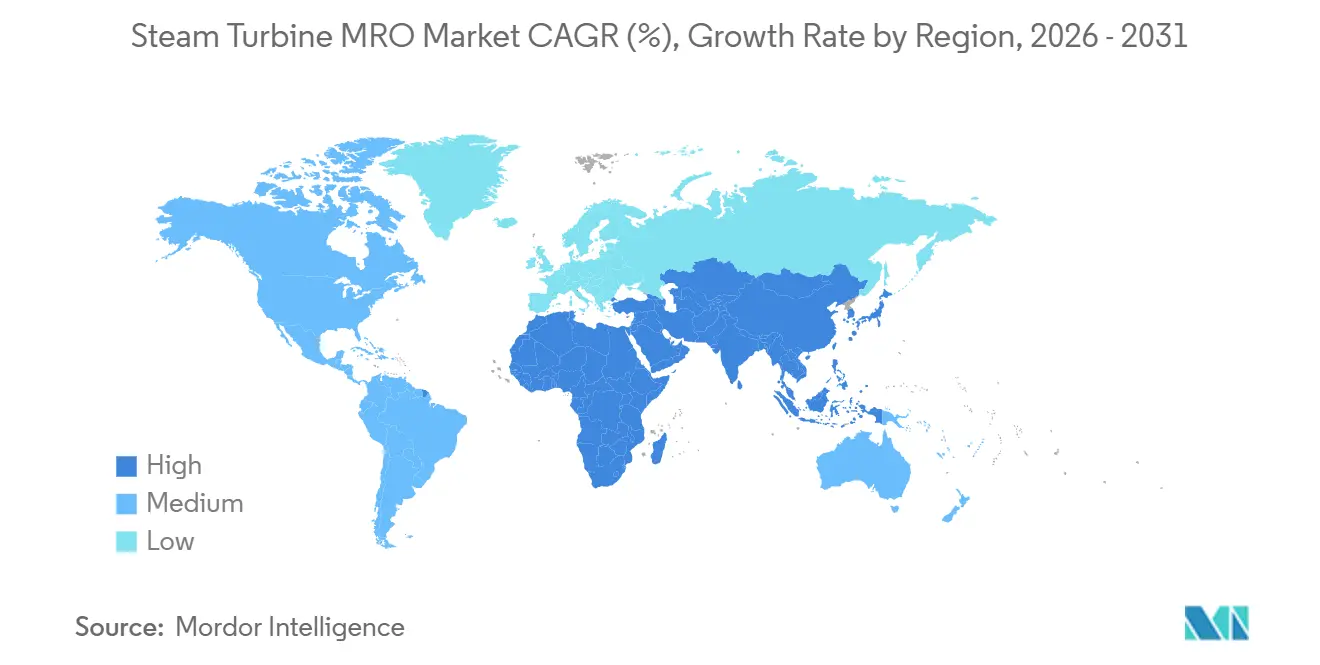
Asia-Pacific controlled 49.6% of 2025 revenue and is projected to deliver a 5.8% CAGR to 2031 as China, India, and Southeast Asia expand ultra-supercritical and combined-cycle fleets. State Grid contracts for 78 GW of Chinese ultra-supercritical capacity already rely on domestic repair houses that possess nickel-alloy weld and phased-array UT capabilities, compressing foreign OEM share. India’s 3.8 GW NTPC refurbishment award to Bharat Heavy Electricals showcases the large-scale lifecycle-extension pipeline through the next decade.
The Americas and EMEA Steam Turbine MRO Market
North America’s growth is slowing down as coal closures offset nuclear life-extension gains; however, 250 GW of combined-cycle capacity anchors a robust LTSA base. Europe’s market is propelled by French nuclear upgrades and German CCGT build-outs to firm renewables. The Middle East and Africa market growth is fueled by Qurayyah, Al Dhafra, and New Capital mega-contracts linking LTSAs with digital-twin analytics. South America’s 6% slice benefits from Brazilian hydro-thermal hybrid upgrades and Argentine cogeneration tied to Vaca Muerta shale gas.
Regulatory Landscape
The steam turbine MRO market sits within a layered compliance environment covering safety and asset-integrity requirements, and for nuclear sites, stricter controls on quality and traceability. In fossil-fueled power generation, ASME TDP-1-2023 is a commonly referenced practice to reduce water induction damage risk, which affects inspection regimes, drain and warm-up procedures, and the scope of corrective maintenance during outages. Insurers and risk engineers also shape maintenance governance, including through FM Global guidance on asset integrity and QA/QC programs that drive documentation discipline, inspection rigor, and contractor qualification requirements.
In nuclear applications, turbine-island repair and replacement activities need to follow regulator-driven quality systems and records-retention expectations. In the US, the Nuclear Regulatory Commission (NRC) emphasizes traceability, repair documentation, and controlled processes for safety-related and quality-class components. This raises the bar for independent providers working on nuclear-adjacent scopes and increases demand for certified procedures, calibrated NDE, and auditable material pedigrees across the overhaul supply chain.
Competitive Landscape
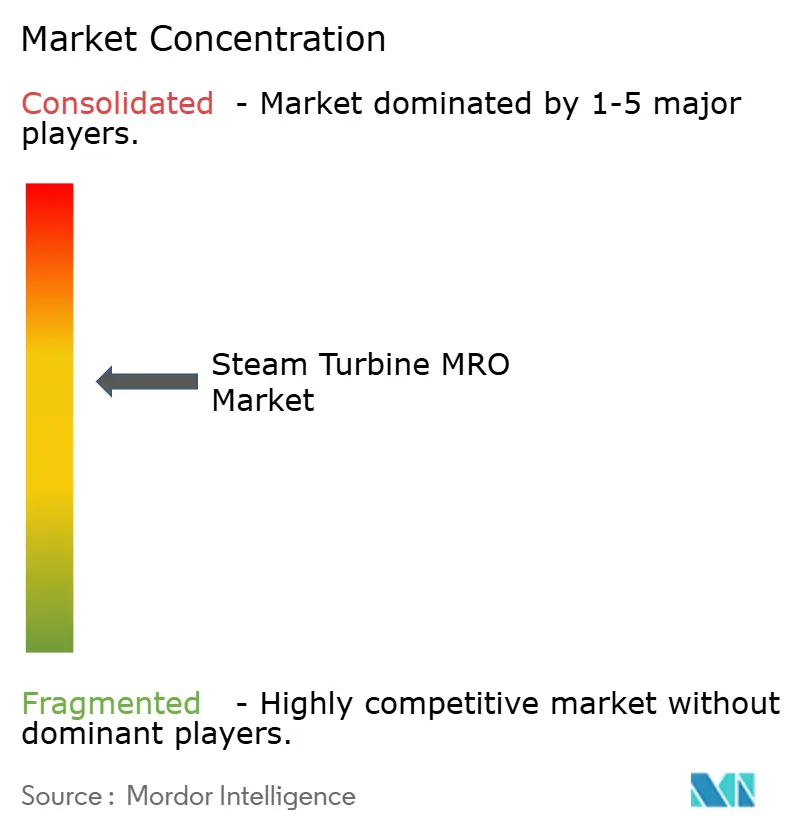
The market is moderately concentrated. GE Vernova, Siemens Energy, and Mitsubishi Power jointly hold a 45% share, reinforced by installed-base data, proprietary controls, and LTSAs that limit third-party entry. GE Vernova operates 180 service centers and prints nickel-based blades in-house via additive manufacturing, cutting lead time to six weeks. Siemens Energy leverages Omnivise predictive analytics across 12 GW to foresee blade-crack propagation. Mitsubishi Power leads alternative-fuel retrofits after its 50% hydrogen and 20% ammonia references.
Regional OEMs dominate home markets: Shanghai Electric, Harbin Electric, and Dongfang Turbine command 65% of China’s aftermarket, while Bharat Heavy Electricals controls 55% in India, leveraging preferential procurement and cost advantages. Independents such as EthosEnergy and Sulzer push into non-OEM fleets by promising 30% savings and cold-spray blade repairs that shorten outages, though software lock-in still blocks their advanced analytics offerings. Additive manufacturing disrupts component supply chains and may erode OEM spare-parts mark-ups over the forecast horizon.
Steam Turbine MRO Industry Leaders
-
GE Vernova
-
Siemens Energy
-
Mitsubishi Power
-
Shanghai Electric
-
EthosEnergy (incl. Wood Group JV)
- *Disclaimer: Major Players sorted in no particular order
Steam Turbine MRO Market Companies Covered in this Report
- GE Vernova
- Siemens Energy
- Mitsubishi Power
- Shanghai Electric
- Harbin Electric
- Dongfang Turbine
- Bharat Heavy Electricals
- Baker Hughes
- Sulzer
- EthosEnergy
- Elliott Group
- Triveni Turbine
- Doosan Enerbility
- MAN Energy Solutions
- Toshiba Energy Systems
- Ansaldo Energia
- Fuji Electric
- Voith Turbo
- Kessels Steam Turbines
- TMS Turbomaschinenservice
Market Opportunities and Future Outlook
Opportunities are concentrating around capacity-constrained outage execution, outage planning, and specialized repair capability for advanced materials. Siemens Energy has highlighted the need to prioritize resources and plan major work well in advance, with customers initiating discussions multiple years ahead of target outage dates. That scheduling pattern supports demand for additional field-service labor, outage logistics, and faster-turn blade and rotor repair capacity, particularly for above-600 MW and high-temperature fleets where inspection frequency and creep management requirements are more intensive.
Contracting behavior also continues to move toward long-duration service models that bundle parts, digital monitoring, and performance guarantees. This creates room for providers that can package multi-year maintenance with rapid parts availability. The direction is supported by GE Vernova securing a 12-year nuclear turbine island overhaul contract in February 2025 covering 2,400 MW, and Mitsubishi Power expanding a long-term service agreement in March 2025 for a 900 MW Gulf Coast combined cycle portfolio. On the supply side, additional repair-capacity investment points to where demand is concentrating, including Siemens Energy investments referenced for expanding precision blade repair and service-center footprint in the United States. Independents can still compete where software lock-in is less binding, by prioritizing turnaround time, additive repair pathways, and lifecycle documentation that aligns with insurer and owner QA/QC expectations.
Recent Industry Developments in Steam Turbine MRO Market
- June 2026: Siemens Energy delivered steam turbine technology for the 2.6 GW Taweelah C Independent Power Producer project in Abu Dhabi, UAE. The launch expands Siemens Energy's footprint in the Middle East large-scale projects and reinforces an LTSA-led revenue model through high-value service commitments. The deal strengthens project execution capabilities in CCS/CCGT retrofits and supports long-term service relationships in a strategic regional market.
- May 2026: Siemens Energy entered an agreement with Mai-Liao Power to provide equipment and long-term services for a 2,400MW gas-fired combined cycle facility in Taiwan. The partnership expands regional presence in Asia-Pacific and aligns with LTSA-driven revenue streams. The collaboration also increases Siemens Energy exposure in urban utilities, reflecting how long-term service commitments translate into recurring service demand.
- April 2026: GE Vernova awarded an order to modernize key power plants in Egypt Banha and Nubaria, with multiyear service agreements. The modernization increases MRO contract value and extends aftermarket exposure. The agreement reinforces an OEM-led service bundling trend in a strategic market.
Steam Turbine MRO Market Report Scope and Research Methodology
Market Definition and Coverage
For this methodology, the market covers the revenue earned from maintaining, repairing, and overhauling steam turbines after they are installed, including planned outages and corrective work across power and industrial settings.
Scope exclusions: We exclude new steam turbine sales, balance of plant work not tied to the turbine train, and routine plant O&M labor that is not billed as turbine MRO.
Segments Covered in This Report
-
By Capacity
- Below 300 MW
- 300 to 600 MW
- Above 600 MW
-
By Plant Fuel
- Coal
- Natural Gas
- Nuclear
- Biomass/Waste-to-Energy
-
By Service Type
- Maintenance
- Repair
- Overhaul
-
By End-user Industry
- Power Generation
- Oil and Gas (Up-/Mid-/Down-stream)
- Industrial and Other
-
By Geography
-
North America
- United States
- Canada
- Mexico
-
Europe
- Germany
- United Kingdom
- France
- Italy
- NORDIC Countries
- Russia
- Rest of Europe
-
Asia-Pacific
- China
- India
- Japan
- South Korea
- ASEAN Countries
- Rest of Asia-Pacific
-
South America
- Brazil
- Argentina
- Rest of South America
-
Middle East and Africa
- Saudi Arabia
- United Arab Emirates
- South Africa
- Egypt
- Rest of Middle East and Africa
-
North America
Data Sources, Market Sizing, and Validation
Desk Research
Desk research was used to set the operating context and anchor the model to observable activity in the installed base. We relied on public sources such as the International Energy Agency, the U.S. Energy Information Administration, Eurostat, and national energy or grid agencies, which helped validate generation mix shifts and plant utilization trends that drive outage cycles.
We also reviewed sources such as UN Comtrade for cross-border flows of parts categories, and patent databases to understand where upgrade kits and repair methods are changing. Company annual reports, investor presentations, and trade press were used to map service mix changes, for example longer interval overhauls and life extension programs. In parallel, we used paid subscriptions for company financials and news screening, and an import-export shipment level database for selective part movement checks. The desk research sources listed here are illustrative only, and many other public references were also used to collect, cross check, and clarify data.
Primary Interviews and Surveys
Primary work was done through expert interviews and structured surveys with utility maintenance teams, plant operators, independent service providers, and parts and field service specialists. We used the respondent input to confirm typical outage scopes, timing, and cost ranges by unit size and fuel type, and then to test whether the modeled utilization and retirement assumptions matched what is being seen in the field across major regions.
Distribution of primary research fieldwork respondents
| Company type | Respondent position | Region |
|---|---|---|
| Top tier: 38% | CXOs: 20% | APAC: 41% |
| Mid tier: 41% | Functional/Unit leaders: 39% | EMEA: 37% |
| Smaller Players: 21% | Managers: 41% | Americas: 22% |
Market-Sizing & Forecasting
Sizing starts with a top-down reconstruction of the serviceable demand pool using the steam turbine installed base and its operating profile, which is then converted into expected MRO spend using observed outage patterns. Only after the demand pool was built up, selective bottom-up checks were applied using sampled service contract values, typical labor hour ranges for outage types, and parts plus repair pricing points to adjust totals where needed.
Key inputs used in the model include the active steam turbine fleet by capacity class, thermal generation share and utilization, planned outage intervals (minor inspection versus major overhaul), retirement and life extension activity, and the split between in-house work and outsourced services. In markets with higher coal and nuclear exposure, we stress tested assumptions around longer outages and stricter inspection routines, since these shift the mix toward larger overhaul tickets. For forecasting, we used scenario analysis supported by a light multivariate regression that links MRO spending to utilization, fleet age, and net capacity additions or retirements, and then we aligned the final path to what interviewees expected on outage planning and pricing. Where country data was incomplete, gaps were handled through regional proxy ratios based on similar fleet mix and operating hours, followed by a reasonableness check against reported service revenues.
Data Validation & Update Cycle
Model outputs are cross checked against independent signals such as thermal generation trends, capacity change announcements, and service revenue direction from major reporting entities, and then inconsistencies are reviewed before sign-off. Outliers are challenged using follow-up calls when the implied spend per turbine, per outage, or per MW looks too high or too low versus the expected maintenance cycle.
A second analyst review is carried out to verify formulas, currency conversions, and year alignment, and any large variances are traced back to a specific input assumption. Reports are refreshed annually, and interim updates are triggered when material events occur, such as major plant retirement waves or a step change in outage deferrals. Before delivery, a final pass is completed so clients receive the most current view available at that time.
Mordor Intelligence's Steam Turbine MRO Market Size Compared With Other Published Estimates
Published market values for steam turbine MRO can look far apart because each publisher chooses different service inclusions and different timing for the base year, and then those choices flow through the forecast. We also see differences when some models assume aggressive life extension spending, or when pricing is updated using broad inflation factors instead of service specific contract patterns.
Some estimates fold a wider plant services bucket into the same number, including auxiliary equipment work and broader outage management fees. In the Mordor Intelligence build, only steam turbine focused maintenance, repair, and overhaul revenue is counted, and non-turbine plant O&M is kept out, which tightens the linkage to the turbine installed base and outage cycle.
Benchmark comparison
| Source | Market Size | Gaps in Research Methodology |
|---|---|---|
| Mordor Intelligence | USD 22.56 B (2025) | |
| Global Consultancy A | USD 22.60 B (2023) | Uses an earlier base year and may include a broader outage services scope across the steam island, which can lift the reported total even before forecasting assumptions are applied. |
| Industry Analyst B | USD 20.51 B (2025) | Applies a narrower spend capture for overhauls and upgrades in certain end users, and the implied average spend per outage is lower than what was confirmed through service contract and outage cycle checks. |
The comparison shows that scope and base year alignment explain most of the spread, followed by how outage intensity and service pricing are refreshed. By tying the total to the operating fleet, outage intervals, and service mix checks, the resulting number stays traceable to inputs that can be revisited and updated in a repeatable way.
Key Questions Answered in the Report
What is the current size of steam turbine MRO market?
The market size stood at USD 22.56 billion in 2026.
What percentage of service revenue came from routine maintenance in 2025?
Maintenance activities accounted for 53.9% of global spending, reflecting the largest steam turbine MRO market share among all service categories.
Which end-user group drives the majority of aftermarket demand?
Utility-scale power generators represented 67.3% of 2025 spending and remain the anchor segment thanks to large coal, gas, and nuclear fleets.
How are industrial cogeneration projects influencing the aftermarket?
Rapid build-out of 5-50 MW micro-CHP turbines in emerging markets is raising demand for localized MRO hubs that can respond within forty-eight hours.
What role do long-term service agreements play in end-user decisions?
LTSAs bundle predictive analytics, spare parts, and availability guarantees, turning unpredictable repair costs into planned expenditures and lowering refinancing risk for asset owners.
Why is repair work expected to outpace maintenance growth?
Aging coal and gas fleets are encountering more fatigue-related blade and rotor issues, pushing repair expenditures to a projected 5.0% CAGR through 2031.