
Steam Autoclaves Market Size and Share
Market Overview
| Study Period | 2020 - 2031 |
|---|---|
| Market Size (2026) | USD 2.86 Billion |
| Market Size (2031) | USD 4.21 Billion |
| Growth Rate (2026 - 2031) | 8.03 % |
| Fastest Growing Market | Asia-Pacific |
| Largest Market | North America |
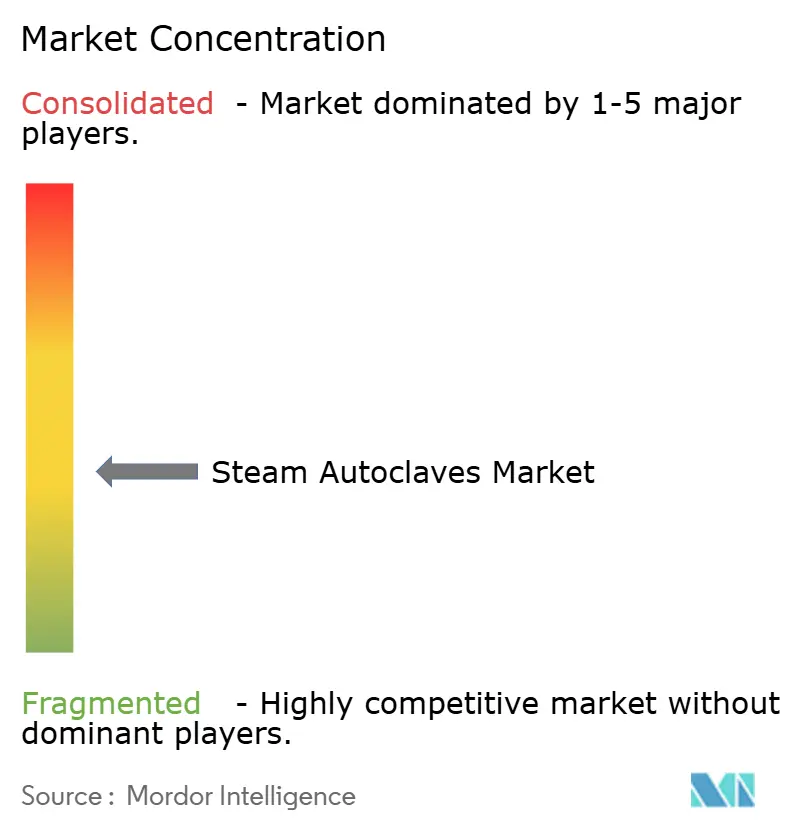
| Market Concentration | Medium |
Major Players *Disclaimer: Major Players sorted in no particular order Image © Mordor Intelligence. Reuse requires attribution under CC BY 4.0. | |
Steam Autoclaves Market Analysis by Mordor Intelligence
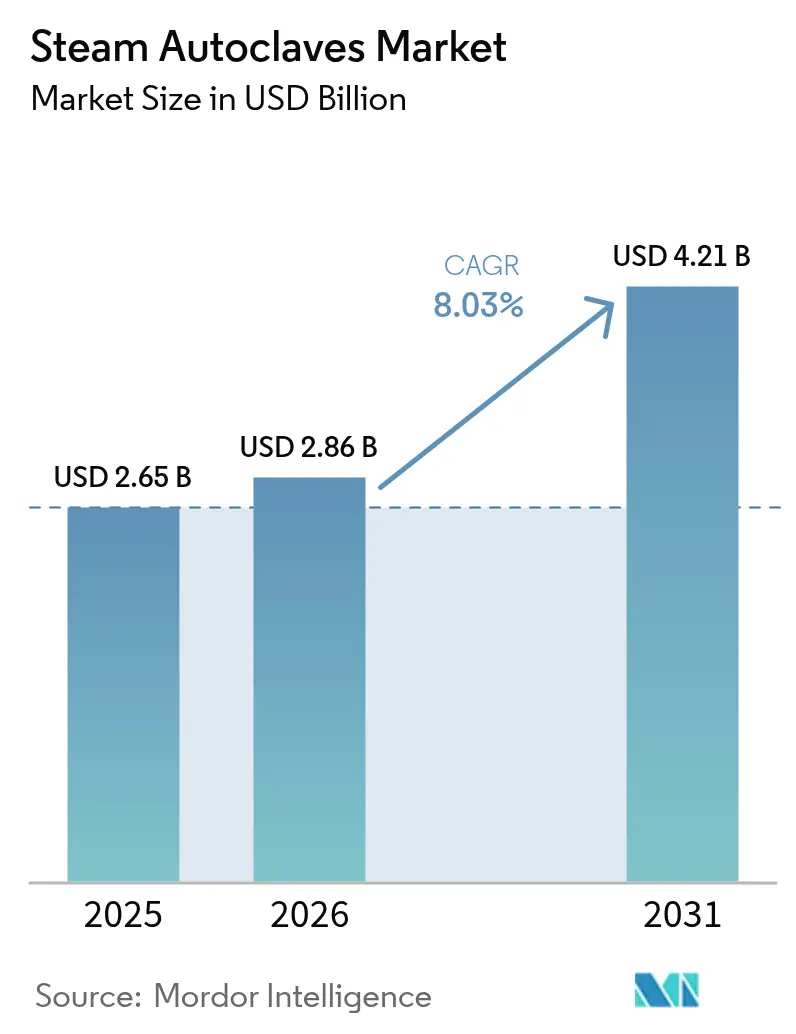
The steam autoclaves market size is expected to grow from USD 2.65 billion in 2025 to USD 2.86 billion in 2026 and is forecast to reach USD 4.21 billion by 2031 at 8.03% CAGR over 2026-2031. Rising infection‐control requirements, tightening emissions rules for ethylene oxide, and the growing urgency to contain healthcare-associated infections are keeping capital expenditure on steam sterilization resilient, even as health systems weigh cost and sustainability trade-offs. North American hospitals continue to refresh their fleets in line with accreditation cycles, while Asia-Pacific providers accelerate first-time installations in response to infrastructure expansion and medical device manufacturing growth. Regulatory shifts—such as the U.S. FDA’s alignment of quality system rules with ISO 13485 and the EU’s GMP Annex 1 update—favour digitally connected units that automate validation and record‐keeping, spurring premium segment demand. Concurrently, vendors are redesigning chambers and cycles to curb water and power usage, appealing to buyers intent on meeting decarbonisation targets without compromising sterilisation efficacy.
Key Report Takeaways
- By product type, vertical units led with 41.95% of steam autoclaves market share in 2025; table-top/benchtop models are projected to expand at a 9.94% CAGR through 2031.
- By mobility, floor-standing systems accounted for 70.02% of steam autoclaves market size in 2025, whereas portable units show the fastest 12.31% CAGR outlook.
- By sterilisation technology, gravity displacement held 46.05% of steam autoclaves market size in 2025, while pre-vacuum technology is set to grow at a 10.66% CAGR.
- By end user, hospitals and clinics represented 54.30% of steam autoclaves market share in 2025, yet dental facilities are advancing at a 10.43% CAGR.
- By geography, North America commanded 34.55% of revenue in 2025; Asia-Pacific is forecast to climb at an 11.42% CAGR.
Note: Market size and forecast figures in this report are generated using Mordor Intelligence’s proprietary estimation framework, updated with the latest available data and insights as of 2026.
Market Trends and Insights
Drivers Impact Analysis of Steam Autoclaves Market*
| Driver | (~) % Impact on CAGR Forecast | Geographic Relevance | Impact Timeline |
|---|---|---|---|
| Rising Prevalence Of Hospital-Acquired Infections | +1.8% | Global, with highest impact in North America & Europe | Short term (≤ 2 years) |
| Stringent Infection-Control & Accreditation Norms | +1.5% | Global, led by North America, Europe, followed by APAC | Medium term (2-4 years) |
| Growing Need To Manage Bio-Hazardous / Medical Waste | +1.2% | Global, with emphasis on developed markets | Medium term (2-4 years) |
| Shift Toward Point-Of-Use Sterilization In Ambulatory Settings | +0.9% | North America & Europe, expanding to APAC | Long term (≥ 4 years) |
| Emergence Of Energy-Efficient 'Green' Autoclaves | +0.7% | Europe leading, North America & APAC following | Long term (≥ 4 years) |
| Integration Of IoT Sensors For Remote Cycle Validation & Compliance | +0.6% | North America & Europe early adoption, APAC emerging | Long term (≥ 4 years) |
| Source: Mordor Intelligence | |||
Rising Prevalence of Hospital-Acquired Infections
Hospitals worldwide still record roughly 1 in 31 inpatients with at least one healthcare-associated infection, sustaining investment in reliable steam cycles that eradicate resistant organisms. Although the CDC noted double-digit declines in MRSA and CLABSI rates between 2022 and 2023, administrators recognise that prevention remains cheaper than treatment, keeping new-build and replacement demand intact across surgical, critical-care and transplant units[1]. Steam autoclaves deliver rapid, reproducible lethality without chemical residuals, aligning with operating-room turnaround imperatives and environmental, health and safety policies. Suppliers are therefore embedding IoT sensors for automatic cycle tracking, enabling infection-control teams to audit loads in real time and trigger corrective action before breaches escalate. This capability resonates most in tertiary centres where diverse instrument sets require differentiated parameters yet strict chain-of-custody documentation.
Stringent Infection-Control & Accreditation Norms
The FDA’s 2025 update to 21 CFR 880.6880 formalised the need for integrated monitoring and electronic records in steam sterilizers, pushing facilities to phase out legacy equipment lacking automated data export. In Europe, Annex 1 places explicit emphasis on contamination-control strategies and quality-risk management that many providers meet by deploying autoclaves with closed-loop sensors and validated leak-rate testing. Dental practices face comparable scrutiny; CDC guidance issued in late 2024 mandates weekly biological monitoring, a requirement easier to satisfy with benchtop units offering built-in printouts or cloud reporting. Comparable regimes in Canada, Japan and Australia mirror these expectations, creating a coordinated global pull for digitally native platforms capable of harmonised audit trails. Resulting procurement cycles favour manufacturers with cross-regional regulatory teams and post-installation service networks that sustain compliance across a device’s 15-year life.
Growing Need to Manage Bio-Hazardous Medical Waste
The U.S. EPA now obliges commercial sterilizers using ≥ 100 lbs of ethylene oxide annually to achieve 99.99% emission reduction, accelerating migration toward on-site thermal treatment in hospitals and reference labs[2]. California’s Medical Waste Management Act similarly stresses pre-disposal treatment, with steam autoclaving listed as a primary method to render waste non-infectious. On-premise autoclaves cut transportation risks, lower disposal costs by shrinking waste volume through steam-mediated cell lysis, and help organisations meet decarbonisation goals by avoiding incinerators’ higher greenhouse footprint. Manufacturers are capitalising by offering waste-dedicated chambers equipped with shredders and condensate filtration, appealing to life-science campuses and teaching hospitals seeking turnkey “treat-and-toss” solutions. Demand is particularly acute in North America and Western Europe, where environmental services departments shoulder compliance penalties for untreated waste interceptions.
Shift Toward Point-of-Use Sterilisation in Ambulatory Settings
Ambulatory surgery centres and dental clinics value fast cycle times that enable same-day instrument reuse without couriering to central sterile departments. Advances in microprocessor control, compact vacuum pumps and water-recirculation loops permit benchtop autoclaves to complete wrapped loads in under 15 minutes, facilitating chairside workflows. Portable units weighing < 25 kg are also gaining adoption in home-health programmes and military field hospitals that need rugged, low-maintenance sterilisers operable on limited power. Traceability software embedded in these devices supports barcode scanning, bridging documentation gaps between decentralised care sites and central quality teams. Consequently, table-top models represent the fastest expanding slice of the steam autoclaves market, with manufacturers bundling leasing plans that ease capital hurdles for small practices.
Restraints Impact Analysis of Steam Autoclaves Market*
| Restraint | (~) % Impact on CAGR Forecast | Geographic Relevance | Impact Timeline |
|---|---|---|---|
| High Capital & Maintenance Costs Of Large Units | -1.3% | Global, particularly impacting emerging markets | Short term (≤ 2 years) |
| Growing Adoption Of Disposable Single-Use Instruments | -0.8% | North America & Europe leading, APAC following | Medium term (2-4 years) |
| Space & Utility Constraints In Resource-Limited Clinics | -0.6% | Emerging markets in APAC, MEA, Latin America | Short term (≤ 2 years) |
| Complex Qualification / Re-Validation Documentation Burden | -0.4% | Global, with highest impact in regulated markets | Medium term (2-4 years) |
| Source: Mordor Intelligence | |||
High Capital & Maintenance Costs of Large Units
Floor-standing, double-door autoclaves can command list prices above USD 250,000, excluding site upgrades for electrical, steam and water utilities, a hurdle for resource-strained public hospitals. Annual upkeep—ranging from gasket replacement to chamber re-qualification—adds recurring cost, prompting many facilities in Latin America, the Middle East and parts of Southeast Asia to defer purchases or opt for outsourced reprocessing. Energy and water data further complicate budgeting: a single 400-litre jacketed unit may consume 60 gallons per cycle, challenging sustainability pledges as providers track Scope 1 and Scope 2 emissions. Vendors respond with modular chamber designs and heat-recovery systems, yet payback periods remain lengthy, restraining uptake in price-sensitive territories.
Growing Adoption of Disposable Single-Use Instruments
Minimally invasive surgery and interventional cardiology increasingly rely on pre-sterilised, single-patient disposables that bypass reprocessing altogether[3]. EU rules now hold reprocessors to the same requirements as original manufacturers, discouraging hospitals from in-house reuse and nudging surgeons toward throw-away kits. While disposables raise waste-management challenges, they eliminate sterility failures linked to complex lumens and hinged joints. Consequently, demand growth for small-batch hospital autoclaves moderates in orthopaedics and ophthalmology, even as total procedure volumes rise. Manufacturers target mitigation by emphasising hybrid models—sterilising reusable core instruments while single-use consumables handle the most intricate geometries.
*Our forecasts treat driver/restraint impacts as directional, not additive. The impact forecasts reflect baseline growth, mix effects, and variable interactions.
Steam Autoclaves Market Segment Analysis
By Product Type:
Vertical Units Lead Market ShareVertical units accounted for 41.95% of steam autoclaves market share in 2025, confirming their popularity in theatres and labs that value narrow footprints and ergonomic top loading. Rising refurbishment of secondary hospitals in Europe and India maintains baseline demand, as these vertical chambers sterilise gowns, handpieces and culture media without extensive plumbing. Table-top models, in contrast, are set to post a 9.94% CAGR through 2031, fuelled by ambulatory centres installing point-of-care sterilisation to shorten instrument turnaround. The CDC’s 2024 dental guidance reinforced weekly biological monitoring, encouraging clinics to replace ageing heat-only sterilisers with automated benchtop steam units that document each cycle.
Manufacturers differentiate through cycle versatility and intuitiveness. Touch-screen HMIs, pre-programmed lumened-device cycles and cloud integration have become standard, while optional water-savings kits and HEPA exhaust filters add sustainability. Horizontal floor-standing units still underpin high-throughput central sterile departments, yet their uptake is tempered by space constraints and the -1.31% CAGR drag associated with acquisition and maintenance costs. Nonetheless, orthopaedic centres performing back-to-back joint replacements will continue ordering 600-litre chambers capable of handling large trays, shielding this niche from displacement.


By Sterilisation Technology:
Gravity Displacement Maintains LeadershipGravity displacement processes held 46.05% of steam autoclaves market size in 2025 thanks to simplicity, low capital cost and minimal maintenance. In small clinics, gravity cycles remain adequate for solid instruments and liquid media, especially where budgets rule out vacuum pumps. Yet complexity in surgical devices is driving a shift toward pre-vacuum systems that demonstrate a leading 10.66% CAGR. These high-vac units draw air through a series of negative pulses, ensuring steam penetrates lumens and porous wraps, which is essential for robotic instruments and micro-laparoscopes in tertiary hospitals.
Steam-flush pressure pulse (SFPP) chambers serve labs needing rapid turnarounds, cycling loads in under 25 minutes without high-energy vacuum pumps. Meanwhile, pass-through double-door designs address unidirectional workflows between dirty and clean zones, a regulatory requirement in many GMP manufacturing suites. Vendors layer in passive heat recovery and jacket insulation to shrink utility draws by up to 25%, targeting green procurement metrics and life-cycle cost justifications for pre-vacuum installations.
By Mobility:
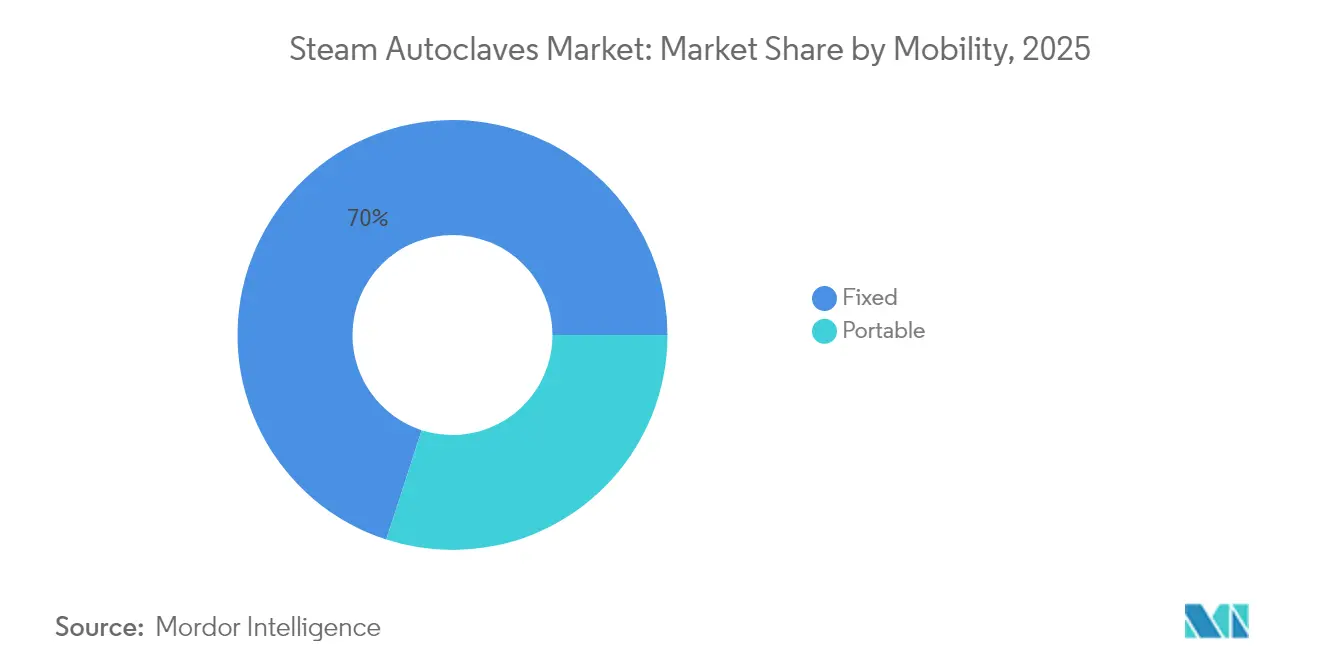
Fixed Units Dominate Despite Portable GrowthFloor-standing models contributed 70.02% of steam autoclaves market size in 2025, supported by integrated central sterile departments where high-capacity, PLC-driven systems align with ISO 11134 validation and HVAC integration. Their robust construction and chamber volumes above 300 litres enable batch processing that keeps operating-room schedules on track. Portable autoclaves, though a modest revenue base, are accelerating at a 12.31% CAGR. Rural outreach programmes, battlefield medicine and veterinary clinics appreciate their plug-and-play utility, 115-volt compatibility and compact design that fits mobile vans.
Field units increasingly adopt lithium-ion battery packs and solar chargers for off-grid sterilisation, while ruggedised casings resist vibration during transport. Manufacturers provide smartphone apps for cycle monitoring, an attractive feature for NGOs auditing infection-control practices in dispersed locations. This convergence of durability and digital oversight strengthens value propositions and ensures that portable categories continue widening their addressable market within the broader steam autoclaves market.
By End User:
Hospitals Lead While Dental Grows FastestHospitals and clinics captured 54.30% of steam autoclaves market share in 2025, underpinned by multi-disciplinary instrument needs, large sterile processing departments and mandated accreditation checks. Operating rooms account for the bulk of loads, sterilising basins, forceps and implants several times daily. Dental facilities, however, present the fastest trajectory at a 10.43% CAGR, reflecting increased oral-health coverage and the CDC’s insistence on strict sterilisation documentation in chairside settings. Compact Class B autoclaves with fractionated pre-vacuum cycles suit dental handpieces, driving replacement cycles every 7-10 years.
Pharmaceutical and biotech environments apply steam for terminal sterilisation of vials, stoppers and media. EU Annex 1 pushes for real-time particulate monitoring, spurring investment in validated pass-through autoclaves integrated with cleanrooms. Research institutes demand cycle flexibility to accommodate agar, pipettes and biohazard waste, often specifying cross-linked data logs to prove chain-of-custody. Veterinary hospitals and contract sterilisers emerge as niche adopters, moving up from desktop pressure cookers to programmable units to meet evolving animal-care standards.
Geography Analysis
North America Steam Autoclaves Market
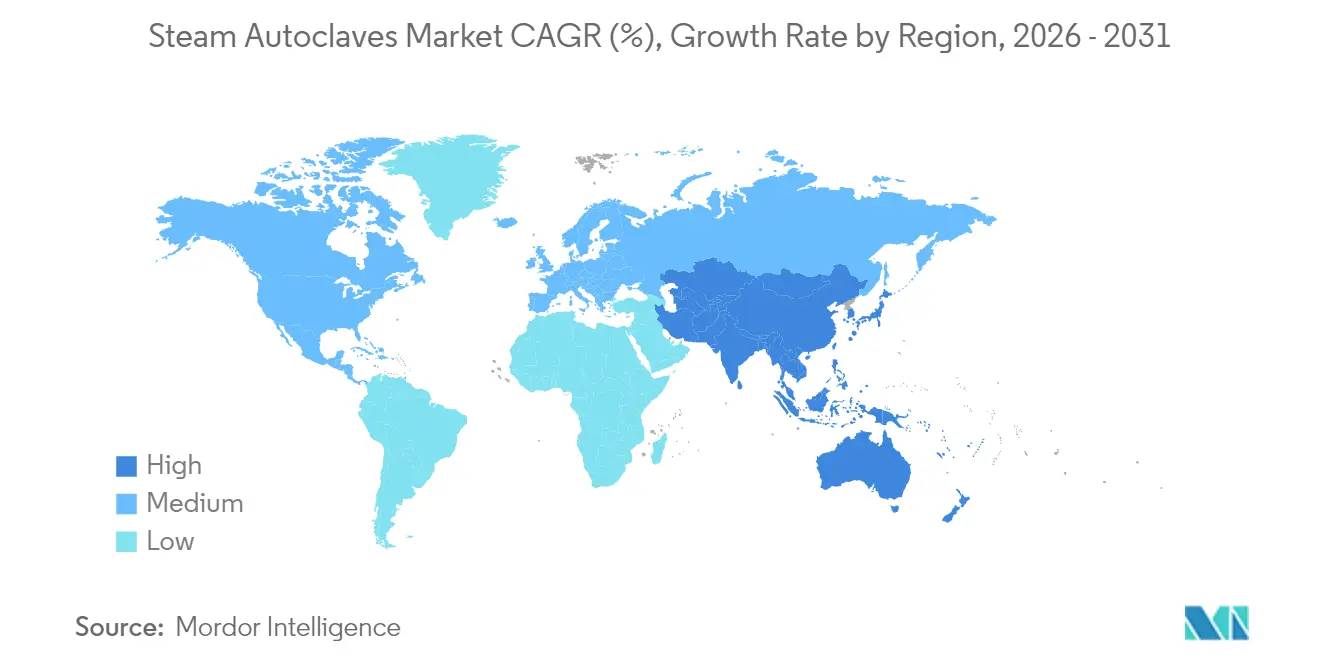
North America retained the largest revenue share at 34.55% in 2025 thanks to mature replacement cycles, advanced accreditation requirements and rapid adoption of IoT-enabled sterilisation suites. Hospitals continue swapping legacy gravity units for energy-efficient high-vac autoclaves that integrate with central sterile tracking platforms. Federal incentives for sustainable infrastructure also push providers toward water-saving models, cushioning total-cost-of-ownership concerns.
Europe Steam Autoclaves Market
Europe follows closely, yet faces the dual burden of Medical Device Regulation compliance and Brexit-related supply disruptions. Annex 1 and harmonised standards clamp down on manual documentation, driving upgrades to machines with automated load release and Wi-Fi audit trails. Germany, France and the Nordics lead substitution, whereas Eastern European markets still rely on refurbished imports.
APAC, MEA and South America Steam Autoclaves Market
Asia-Pacific is the fastest expanding geography, with an 11.42% CAGR projected through 2031. Extensive hospital construction in China and India, coupled with rising domestic device manufacturing, fuels demand for both large central units and portable field models. Government-subsidised health-insurance schemes in Southeast Asia further incentivise clinics to meet infection-control benchmarks. Meanwhile, Middle East and Africa, along with South America, witness steady adoption as private operators open tertiary centres and specialty clinics, although foreign-exchange volatility and import tariffs temper the pace in select economies.
Regulatory Landscape
Steam autoclaves are regulated as medical devices in major markets, with tighter expectations around validation, traceability, and performance documentation. In the United States, the FDA classifies steam sterilizers under 21 CFR 880.6880 as Class II devices (product code FLE), which frames both premarket submissions and postmarket controls and supports demand for integrated monitoring and electronic records in regulated healthcare settings.
In Europe, conformity is increasingly anchored to updated consensus standards cited under the EU Medical Device Regulation (EU) 2017/745. In April 2026, the European Commission adopted Implementing Decision (EU) 2026/760, harmonizing EN 13060:2025 for small steam sterilizers and providing a clearer presumption-of-conformity route for CE marking. ISO 17665:2024 also consolidated prior moist heat sterilization standards into a single framework, prompting manufacturers and regulated end users to refresh validation and routine control practices while updating technical documentation across regions.
Competitive Landscape
The steam autoclaves market exhibits moderate concentration. Major players collectively command a significant revenue share, benefitting from multi-regional service reach and decades of regulatory expertise. STERIS’s launch of Verafit sterilisation bags in 2024 demonstrates agility in aligning product pipelines with EU Annex 1, differentiating its consumables portfolio. Getinge reported resilient order intake in Q3 2024 despite logistics delays, underscoring robust underlying demand and the strategic importance of diversified manufacturing footprints.
Companies increasingly compete on embedded connectivity, predictive maintenance and cloud dashboards that cut unplanned downtime and facilitate paperless audits. SteelcoBelimed—a joint venture between Miele and Metall Zug—illustrates consolidation aimed at scaling R&D and leveraging complementary channel strengths across Europe, the Americas and Asia. New entrants focus on green‐tech value propositions, such as heat-pump-assisted steam generators promising 30% lower energy draw. Yet capital intensity and certification hurdles restrict rapid share shifts.
Strategic moves include Getinge’s acquisition of Healthmark Industries to broaden consumable lines, and Tuttnauer’s investment in IoT-driven “smart laboratory” platforms that allow real-time load traceability. Vendors also diversify through as-a-service models, wrapping hardware, consumables and data analytics into subscription bundles that smooth cash outflows for hospitals while cementing long-term relationships.
Steam Autoclaves Industry Leaders
-
TESALYS Group
-
Astell Scientific
-
BMM Weston Ltd.
-
Celitron Medical Technologies
-
Belimed AG
- *Disclaimer: Major Players sorted in no particular order
Steam Autoclaves Market Companies Covered in this Report
- Getinge
- STERIS
- Tuttnauer Ltd.
- Steelco S.p.A (Miele Group)
- Shinva Medical Instrument
- Astell Scientific Ltd.
- Belimed
- MELAG Medizintechnik
- Celitron Medical Technologies
- Consolidated Sterilizer Systems
- Midmark
- SciCan Ltd. (Coltene)
- Matachana Group
- BMM Weston
- Rodwell Engineering Group Ltd.
- Priorclave Ltd.
- TESALYS Group
- Hirayama Manufacturing
- Dental X
- Steriflow SAS
- LTE Scientific Ltd.
Market Opportunities and Future Outlook
The most immediate opportunity shows up in compliance-driven replacement and upgrade cycles, where facilities seek digitally native sterilizers that reduce documentation burden and support audit readiness. The FDA clearance of STERIS's AMSCO 700 Steam Sterilizer in June 2026 (K261055) points to continued platform renewal under the US Class II pathway, while the July 2026 publication of ANSI/AAMI ST8 (7th edition) raises safety and performance requirements for hospitals and manufacturers. Together, these steps create room for systems that automate cycle records, embed verification tests, and fit into sterile processing tracking workflows.
In the EU, the citation of harmonized standards such as EN 13060:2025 (small steam sterilizers) and EN 14222:2021+A1:2025 (steam boilers) in 2026 clarifies the technical route for demonstrating MDR conformity, supporting investment in both benchtop units and integrated steam-generation architectures. With ISO 17665:2024 also harmonized under the EU MDR in 2026, suppliers that can translate the consolidated moist-heat requirements into turnkey qualification (IQ/OQ/PQ) packages, service documentation, and lifecycle revalidation support have a clearer basis to win multi-site tenders from hospitals, dental chains, and regulated life-science users standardizing sterilization practices across geographies.
Recent Industry Developments in Steam Autoclaves Market
- June 2026: STERIS received FDA 510(k) clearance for the AMSCO 700 Steam Sterilizer (K261055) under the general hospital device framework. The clearance supports product refresh cycles among facilities prioritizing documented performance and modern controls, and it strengthens STERISs positioning in regulated hospital sterilization suites.
- April 2026: The European Commission adopted Implementing Decision (EU) 2026/760, harmonizing EN 13060:2025 for small steam sterilizers under the EU Medical Device Regulation. The update clarifies the presumption-of-conformity pathway for manufacturers targeting CE marking, pushing product documentation and validation practices toward the latest cited standard.
- October 2024: The Medical Device Coordination Group (MDCG) published updated guidance on legacy device compliance with EU MDR requirements. The guidance influenced how manufacturers and healthcare providers manage continued use and compliance documentation for older sterilization equipment, adding urgency to upgrade plans where technical files and postmarket obligations are difficult to sustain.
Steam Autoclaves Market Report Scope and Research Methodology
Market Definition and Coverage
This market covers revenue from steam autoclave equipment used to sterilize instruments and materials using saturated steam in controlled pressure and temperature cycles, typically in healthcare, laboratory, and life science settings. We treat the market as equipment sales value captured across major regions.
Scope exclusions: Excludes non-steam sterilization equipment (such as ethylene oxide and dry heat systems) and consumer or home-use benchtop devices marketed for tattoo or beauty use.
Segments Covered in This Report
- By Product Type
- Vertical Steam Autoclaves
- Horizontal Steam Autoclaves
- Table-top / Benchtop Autoclaves
- Large-capacity Floor-standing Autoclaves
- By Sterilization Technology
- Gravity Displacement
- Pre-vacuum (High-vac)
- Steam-Flush Pressure Pulse (SFPP)
- Double-door Pass-through
- By Mobility
- Fixed / Floor-standing
- Portable
- By End User
- Hospitals & Clinics
- Pharmaceutical & Biotech Companies
- Research & Academic Institutes
- Dental Facilities
- Veterinary Clinics
- Contract Sterilization Service Providers
- Geography
- North America
- United States
- Canada
- Mexico
- Europe
- Germany
- United Kingdom
- France
- Italy
- Spain
- Rest of Europe
- Asia-Pacific
- China
- Japan
- India
- South Korea
- Australia
- Rest of Asia-Pacific
- Middle East and Africa
- GCC
- South Africa
- Rest of Middle East and Africa
- South America
- Brazil
- Argentina
- Rest of South America
- North America
Data Sources, Market Sizing, and Validation
Desk Research
Desk work started with public baselines that can be checked and repeated, and then moved into industry specifics like sterilization standards and procurement signals. Common inputs included sources such as the US FDA databases and guidance pages for sterilization and device safety, the US CDC infection prevention guidance, the World Health Organization health system and safety publications, and standards and technical literature accessible through peer reviewed journals.
We also reviewed annual reports, investor decks, and product catalogs to understand typical price bands, replacement cycles, and where demand is concentrated across hospitals, labs, and pharma production. For cross checks, we used paid subscriptions focused on company financials and intelligence, patent databases, and relevant news and financials to confirm timelines and the pace of product updates. The sources listed here are illustrative only, and additional public references were used to collect data, validate assumptions, and resolve gaps during analysis.
Primary Interviews and Surveys
Primary checks were run with stakeholders across the value chain, including equipment manufacturers, distributors, hospital sterile processing users, lab managers, and quality or validation teams in regulated production sites. We covered major regions to confirm demand drivers, typical procurement behavior, service and maintenance attachment, and how technology choices like gravity displacement versus pre-vacuum change buying decisions.
Distribution of primary research fieldwork respondents
| Company type | Respondent position | Region |
|---|---|---|
| Top tier: 37% | CXOs: 15% | APAC: 47% |
| Mid tier: 42% | Functional/Unit leaders: 39% | EMEA: 35% |
| Smaller Players: 21% | Managers: 46% | Americas: 18% |
Market-Sizing & Forecasting
Sizing started with a top-down build where sterilization equipment demand pools were reconstructed using healthcare capacity indicators and sterilization throughput needs, and then filtered to steam-based systems by adoption patterns seen in end users. To keep the numbers practical, the model used a small set of measurable inputs such as hospital and clinic infrastructure growth, procedure and instrument reprocessing intensity, regulated pharma and biotech capacity additions, typical replacement and upgrade cycles for sterilizers, and observed shifts toward pre-vacuum systems for higher throughput loads.
After that, totals were stress tested with selective bottom-up approximations using sampled price points by capacity class and modeled unit volumes inferred from procurement patterns and channel feedback. This helped adjust for markets where published unit data is limited. Gaps were handled using proxy indicators like facility counts and utilization ranges, followed by conservative normalization so one outlier segment did not pull the full market. For forecasting, scenario analysis was used alongside trend smoothing, and assumptions for key drivers were aligned to what interviewees expected for regulation, infection control focus, and capital spending over the next few years.
Data Validation & Update Cycle
Outputs were checked against independent signals like healthcare capital spending direction, facility expansion plans, and visible procurement activity, and then compared across regions to spot inconsistencies. When a variance looked too large, the drivers were re-tested and the underlying assumptions were revisited with follow-up expert calls, especially around replacement timing and price movement.
A multi-step internal review is followed before sign-off, where calculations, unit logic, and currency handling are rechecked to reduce avoidable errors. The report is refreshed each year, and interim updates are made when major events materially change demand or pricing. Before delivery, a final review pass is completed so clients receive the most current view available.
Mordor Intelligence's Steam Autoclaves Market Size Compared Against Other Published Estimates
Published market numbers for steam autoclaves can look inconsistent even when they sound like they cover the same product, because firms often draw the line differently around end users, adjacent sterilization methods, and what is counted as a true autoclave sale versus related services. We also see gaps coming from different base years, varying currency conversion timing, and how price changes are projected in the out years.
Home-use benchtop devices sold for tattoo or beauty settings sit outside Mordor Intelligence's scope, which can lower the reported total versus studies that sweep in all small sterilizers without checking the intended use setting. Other gaps are commonly driven by whether refurbished units are counted, whether service and consumables are mixed into equipment revenue, and whether the forecast assumes aggressive pre-vacuum upgrades across hospitals and dental facilities without validating budgets and replacement cycles.
Benchmark comparison
| Source | Market Size | Gaps in Research Methodology |
|---|---|---|
| Mordor Intelligence | USD 2.65 B (2025) | |
| Global Report Publisher A | USD 2.45 B (2024) | Uses an earlier base year and a narrower end-user list, and it does not clearly separate equipment-only revenue from related sterilization spending, which can shift the starting point. |
| Industry Research Firm B | USD 3.20 B (2024) | Appears to apply a broader inclusion set that can pull in small sterilizers and adjacent categories, and it may also assume higher average selling prices without showing the price ladder by capacity or technology. |
Across the three figures, most of the spread is explained by what gets included with the autoclave itself, how small units are treated, and how base-year pricing is carried forward. By tying the size to clear demand drivers like facility needs, replacement timing, and technology mix, the estimate stays traceable and easier to reconcile when buyers compare sources.
Key Questions Answered in the Report
What is the projected value of the steam autoclaves market by 2031?
The market is forecast to reach USD 4.21 billion by 2031, growing at an 8.03% CAGR.
Which product category holds the largest revenue share today?
Vertical units lead with 41.95% of steam autoclaves market share as of 2025.
Why are dental facilities seen as a high-growth end-user segment?
Stricter CDC sterilisation guidelines and rising dental care utilisation drive a 10.43% CAGR for dental settings.
Which region shows the fastest market expansion?
Asia-Pacific is expected to post an 11.42% CAGR through 2031 due to large-scale healthcare infrastructure investments.
How do environmental regulations influence purchasing decisions?
EPA limits on ethylene oxide emissions and hospital decarbonisation goals push facilities toward energy-efficient steam autoclaves.
What technological features are hospitals prioritising in new autoclave purchases?
IoT integration for cycle tracking, automated documentation, and energy-saving designs are key purchasing criteria.