
Custom Procedure Packs Market Size and Share
Market Overview
| Study Period | 2020 - 2031 |
|---|---|
| Market Size (2026) | USD 9.43 Billion |
| Market Size (2031) | USD 12.12 Billion |
| Growth Rate (2026 - 2031) | 5.14 % |
| Fastest Growing Market | Asia Pacific |
| Largest Market | North America |
| Market Concentration | Medium |
Major Players *Disclaimer: Major Players sorted in no particular order Image © Mordor Intelligence. Reuse requires attribution under CC BY 4.0. | |
Custom Procedure Packs Market Analysis by Mordor Intelligence
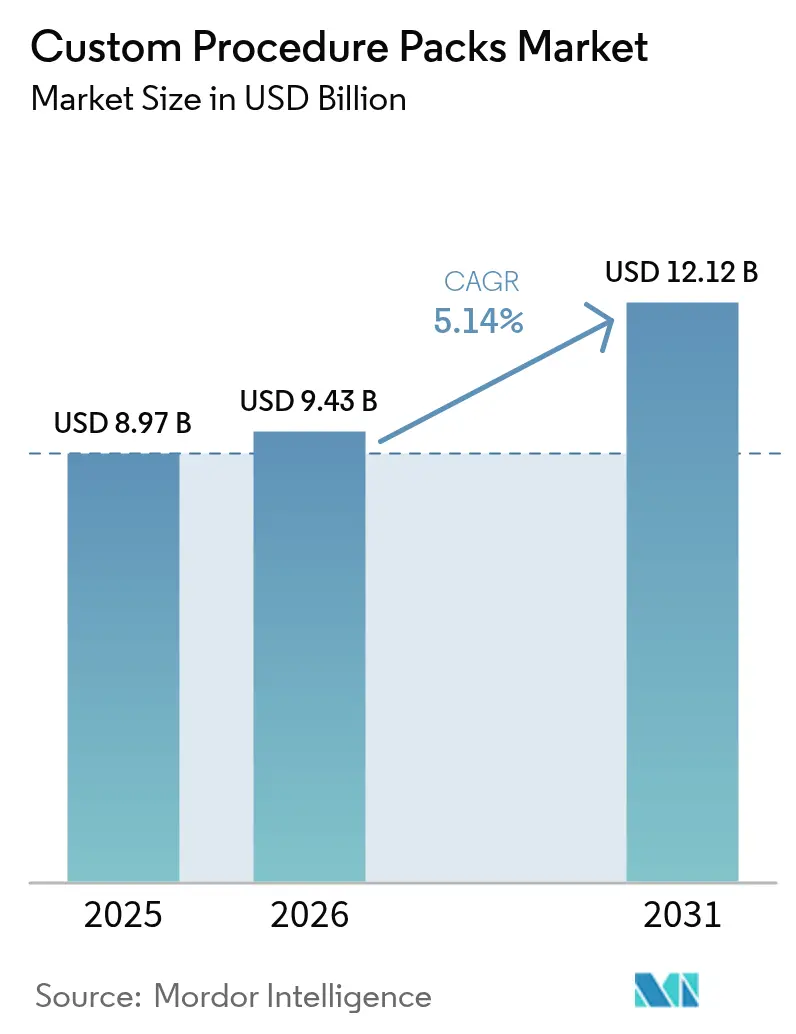
The Custom procedure packs market size is expected to grow from USD 8.97 billion in 2025 to USD 9.43 billion in 2026 and is forecast to reach USD 12.12 billion by 2031 at 5.14% CAGR over 2026-2031. Accelerating surgical volumes, wider ambulatory adoption, and hospital-level pressure to standardize supplies propel demand, while smart‐pack innovations and extended reality training amplify product differentiation. Growth is further underwritten by favorable reimbursement shifts in the United States and rising private-equity investment in Asia-Pacific healthcare delivery models. At the same time, sustainability mandates and supply-chain fragility for medical-grade polymers introduce cost and compliance complexities that producers must navigate deftly. Competitive intensity remains moderate, with a handful of scale players dominating core geographies even as niche innovators target high-growth neurosurgery and cardiology sub-segments.
Key Report Takeaways
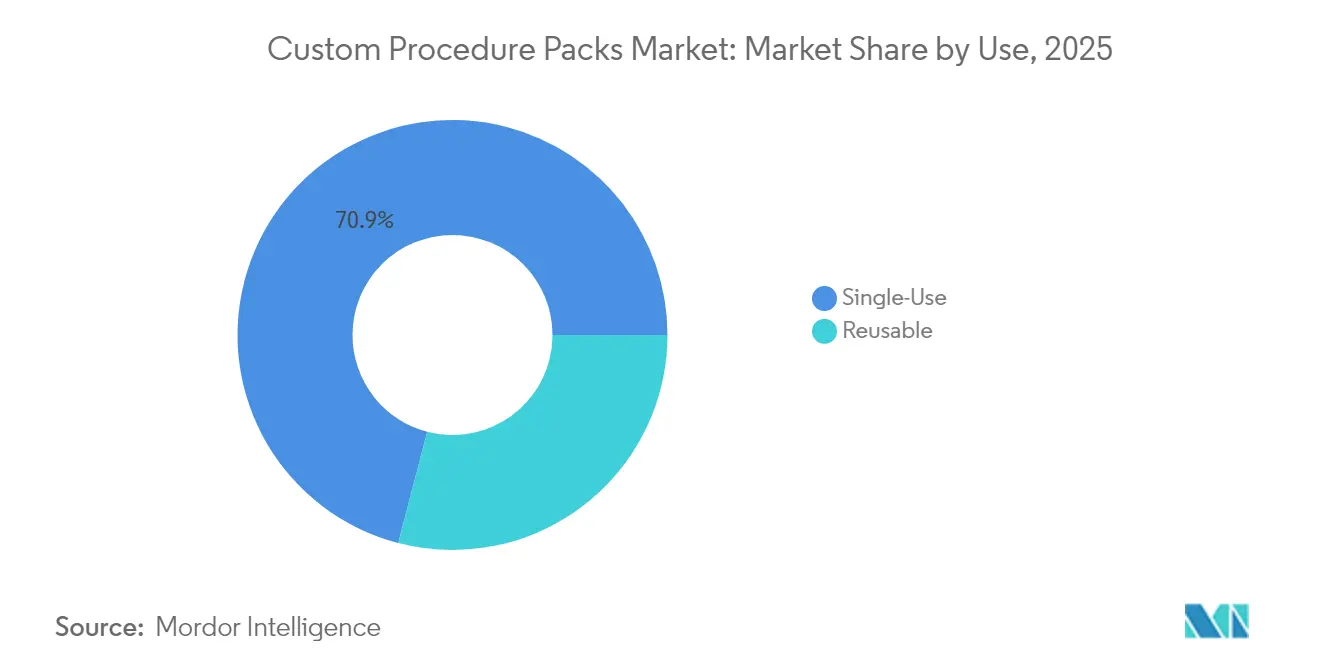
- By use, single-use packs led with a 70.94% share of the Custom procedure packs market in 2025; reusable packs are advancing at an 7.68% CAGR through 2031.
- By product, general surgery packs accounted for 36.95% of 2025 revenue, whereas neurosurgery packs are projected to expand at a 10.56% CAGR to 2031.
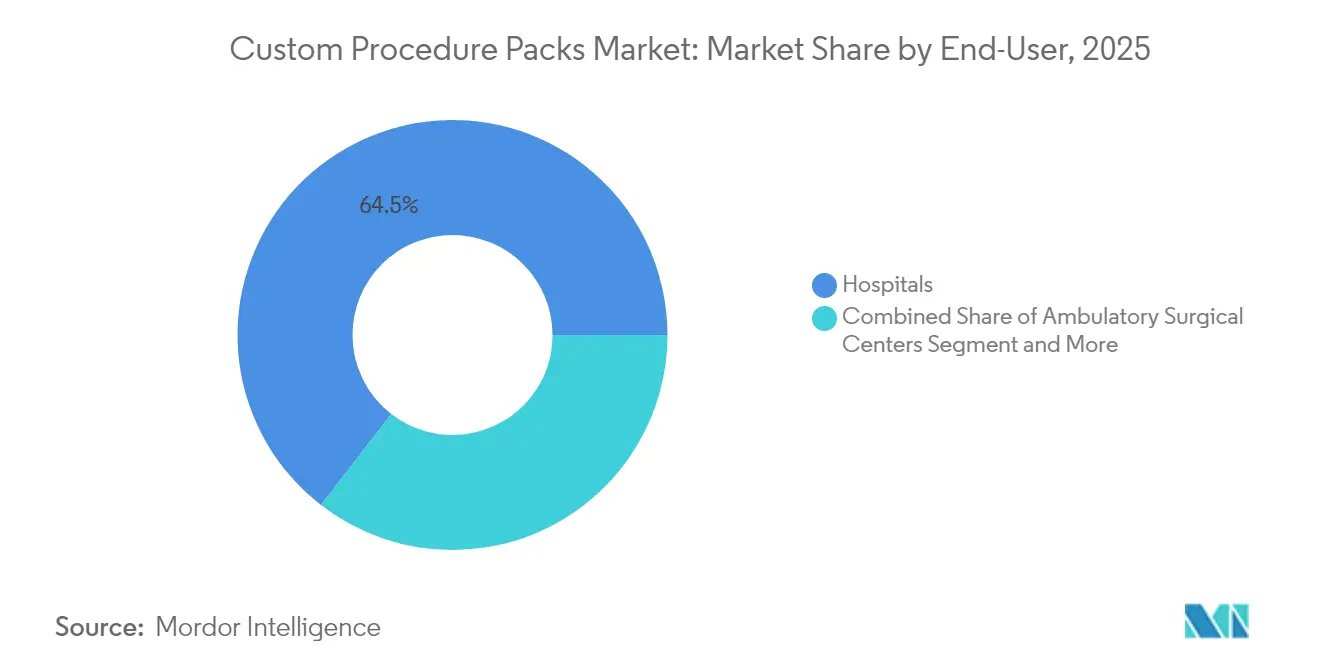
- By end-user, hospitals commanded 64.52% of 2025 demand, while ambulatory surgical centers are forecast to post a 8.74% CAGR through 2031.
- By geography, North America captured 39.85% Custom procedure packs market share in 2025, whereas Asia-Pacific is set to climb at a 9.12% CAGR to 2031.
Note: Market size and forecast figures in this report are generated using Mordor Intelligence’s proprietary estimation framework, updated with the latest available data and insights as of 2026.
Market Trends and Insights
Drivers Impact Analysis of Custom Procedure Packs Market*
| Driver | (~) % Impact on CAGR Forecast | Geographic Relevance | Impact Timeline |
|---|---|---|---|
| Increasing Volume Of Surgical Procedures | +1.2% | Global, with concentration in North America and Asia-Pacific | Medium term (2-4 years) |
| Rising Development & Launch Of Innovative Tools | +0.8% | North America & EU, spill-over to APAC | Long term (≥ 4 years) |
| Shift Toward Single-Use Sterile Supplies To Curb HAIs | +0.9% | Global, with emphasis in developed markets | Short term (≤ 2 years) |
| Hospital Push For Procedure-Standardization Cost Savings | +1.1% | North America & EU core markets | Medium term (2-4 years) |
| RFID- & IoT-Enabled Smart Packs For Real-Time Traceability | +0.6% | North America, early adoption in EU and APAC | Long term (≥ 4 years) |
| Ambulatory Surgical-Center CAPEX Surge For Specialty Packs | +0.7% | North America, expanding to developed APAC markets | Medium term (2-4 years) |
| Source: Mordor Intelligence | |||
Increasing Volume Of Surgical Procedures
Sustained growth in global surgical interventions underpins the Custom procedure packs market, with ambulatory surgical centers (ASCs) forecast to handle 44 million procedures by 2034, up 21% from 2024 levels. Ageing populations intensify demand for orthopedic, cardiology, and neurosurgery interventions, all of which rely on ready-made sterile kits to compress turnover times. Policy momentum is equally supportive: the Centers for Medicare & Medicaid Services (CMS) has added 276 new procedures to the ASC Covered Procedures List for 2026, directly enlarging the addressable base for specialty packs. Providers increasingly prefer standardized kits because outpatient total shoulder arthroplasty on an ASC pathway saves USD 3,614–5,594 per case versus inpatient settings, reinforcing economic incentives. In parallel, rising surgeon comfort with day-surgery protocols is likely to push more complex cases into the ASC space, sustaining mid-term volume growth.
Rising Development & Launch Of Innovative Tools
A wave of innovation is recalibrating kit composition. Johnson & Johnson has earmarked USD 31.35 billion of its USD 148.07 billion medtech war-chest for cardiology devices that require specialized disposables, amplifying pull-through for custom packs. Neurosurgery is a notable frontier; robotic platforms reduce operative time and open a market for instrument-compatible sterile packs that bundle accessory disposables. Extended reality training and tele-proctoring are reshaping operating theatre workflows, creating demand for packs that include cables, sensor mounts, and protective drapes suited to immersive equipment. Continuous innovation obliges pack manufacturers to refresh stock-keeping units rapidly, thereby raising the strategic value of configurable assembly lines and agile supply networks.
Shift Toward Single-Use Sterile Supplies To Curb HAIs
Infection prevention targets remain uncompromising. A 2025 Centers for Disease Control and Prevention (CDC) alert on contaminated ultrasound gel underscores the residual risks that reusable items pose in invasive settings[1]CDC, “Alert: Use Only Sterile Ultrasound Gel for Percutaneous Procedures,” cdc.gov. The Food and Drug Administration (FDA) has validated vaporized hydrogen peroxide as a sterilant alternative, yet capital constraints limit widespread conversion, driving hospitals toward ready-sterile single-use packs. Cost modeling shows that a hospital can slash post-operative infection treatment spend when procedure packs eliminate reprocessing errors, reinforcing the appeal of disposables. Tension with environmental goals persists, but institution-level lifecycle analyses increasingly favor single-use kits when full sterilization overheads and readmission penalties are included.
Hospital Push For Procedure-Standardization Cost Savings
Hospitals worldwide are re-tooling purchasing to alleviate margin compression under value-based reimbursement. Studies reveal that educating surgeons on instrument cost achieved a 17% per-case reduction, with energy device substitutions driving the bulk of savings. Cardinal Health’s WaveMark analytics show that surgical supply waste can exceed 50% of procedure cost when card optimization is poor, equating to 2 million lb of discarded consumables annually across the United States[2]Cardinal Health, “Best practices for procedure card optimization,” cardinalhealth.com. Enhanced recovery pathways in colorectal surgery have trimmed direct costs by USD 7,129 per patient and cut length of stay, outcomes made possible by tighter kit standardization. These data points confirm that harmonized packs represent a turnkey lever for hospitals to meet clinical and financial benchmarks.
Restraints Impact Analysis of Custom Procedure Packs Market*
| Restraint | (~) % Impact on CAGR Forecast | Geographic Relevance | Impact Timeline |
|---|---|---|---|
| Presence Of Faulty Or Redundant Devices In Packs | -0.4% | Global, with higher impact in cost-sensitive markets | Short term (≤ 2 years) |
| Heightened Regulatory Compliance & Recall Risk | -0.6% | North America & EU, expanding to APAC | Medium term (2-4 years) |
| Sustainability Pressure On Single-Use Plastics | -0.3% | EU core, spreading to North America and developed APAC | Long term (≥ 4 years) |
| Supply-Chain Fragility Of Medical-Grade Polymers | -0.5% | Global, with acute impact in import-dependent regions | Short term (≤ 2 years) |
| Source: Mordor Intelligence | |||
Presence Of Faulty Or Redundant Devices In Packs
Quality lapses erode confidence. The FDA’s Class II recall of 57,352 Alcon Custom Pak units for cannula defects highlights the operational chaos caused when kits fail intraoperatively[3]FDA, “Class 2 Device Recall Alcon Custom Pak,” accessdata.fda.gov. Redundancy is another drag: hospitals discard an estimated 2 million lb of unused items annually, largely the result of generic pack builds misaligned with surgeon preference. Cost analyses show supply expense accounts for over half of total case spend, so device duplication materially dents margins. Variation studies attribute up to 38.2% of cost dispersion across surgeons to differing consumable use, strengthening the argument for tighter customization. Until automated configuration engines mature, skeptical purchasers may curtail adoption, tempering near-term Custom procedure packs market expansion.
Heightened Regulatory Compliance & Recall Risk
The regulatory bar is rising. Starting February 2026, manufacturers must align with the FDA Quality Management System Regulation harmonized to ISO 13485:2016, introducing cradle-to-grave risk management and documentation burdens. Recall frequency is already trending upward; May 2025 alone saw FDA action against staple lines, infusion pumps, and sterile kits. A Class I recall covering 345 surgical packs during 2023-24 illustrates how a single component supplier misstep reverberates through multi-vendor assemblies. Compliance investments elevate fixed costs, potentially crowding out smaller entrants and slowing time-to-market for new references.
*Our forecasts treat driver/restraint impacts as directional, not additive. The impact forecasts reflect baseline growth, mix effects, and variable interactions.
Custom Procedure Packs Market Segment Analysis
By Use:
Single-Use Dominance Drives Market EvolutionSingle-use kits held 70.94% of the Custom procedure packs market in 2025, reflecting widespread infection-control protocols and OR efficiency imperatives. Providers value sterile, ready-to-discard sets that minimize reprocessing labor and eliminate residual bio-burden risk. The Custom procedure packs market size for reusable alternatives is nonetheless growing quickly, underpinned by 7.68% CAGR projections as large systems pilot sterilization hubs paired with digital tracking to verify cycle counts. Recent FDA guidance on validated reprocessing pathways has lowered compliance hurdles, catalyzing interest among budget-constrained facilities. Environmental stewardship programs further tilt some European buyers toward reusable textiles and durable trays, though the cost of central sterile upgrades remains a gating variable. Over the forecast, hospitals are expected to operate dual pathways, reserving disposables for high-acuity or time-constrained specialties and deploying reusable packs where case volume concentration justifies capital layout.
Reusable adoption is matched by innovation in cycle-proof materials and embedded RFID chips that log autoclave exposure, ensuring sterility assurance levels are met while feeding analytics dashboards. Vendors competing on this axis often offer hybrid pack portfolios, giving procurement teams levers to balance clinical, economic, and sustainability outcomes. Emerging cloud platforms integrate washer-disinfector performance data with OR scheduling, enabling just-in-time dispatch of instrument sets and reducing inventory float. Such developments solidify reusable packs as a credible complement rather than a wholesale replacement of single-use dominance within the Custom procedure packs market.



By Product:
Neurosurgery Packs Lead Innovation FrontierGeneral-surgery configurations retained the lion’s share at 36.95% in 2025, buoyed by high-volume laparoscopic and open procedures performed across care settings. Yet neurosurgery packs are the clear growth pacesetters, racing ahead at a 10.56% CAGR as robotic platforms gain surgeon acceptance and extended-reality overlays enhance visualization in minimally invasive cranial work. The Custom procedure packs market size for neurosurgery disposables is projected to more than double by 2031, propelled by demand for specialized drapes, micro-instrumentation, and integrated irrigation lines. Cardiovascular and orthopedic packs also ride outpatient migration trends, with total shoulder arthroplasty in particular pushing cardiothoracic tray makers to customize lineation for rapid turnover in ASC theaters.
Pack vendors are segmenting portfolios around subspecialty needs—hemostatic agents for endovascular work, navigation sensor pouches for spine, and viscoelastic injectors for ophthalmic cases. FDA recalls in ophthalmology have heightened scrutiny of tip integrity, nudging suppliers to invest in stricter in-line inspection. Competitive differentiation increasingly hinges on surgeon-directed customization portals that allow drag-and-drop component selection, shortening design-to-dock lead times and cementing customer loyalty in higher-margin specialty niches of the Custom procedure packs market.
By End-User:
Ambulatory Centers Drive Market TransformationHospitals, with 64.52% share, remain the backbone of demand owing to expansive case mixes and entrenched group purchasing contracts. However, the Custom procedure packs market share mix is shifting as ASCs expand; they are pegged for a 8.74% CAGR through 2031 based on payer incentives and patient preference for same-day discharge. Specialty orthopedics centers illustrate the trend, bundling joint replacement packs that streamline instrument hand-offs and compress OR turnover. CMS policy changes adding 276 covered ASC procedures in 2026 remove reimbursement barriers, unlocking a broader slate of complex surgeries that formerly required inpatient settings.
Clinics occupy a smaller slice, concentrating on dermatologic and gastroenterologic interventions that rely on compact packs with limited disposables. Yet even here, tele-endoscopy and outpatient transcatheter procedures are expanding kit complexity. Overall, vendors that tailor tiered pack catalogues to hospital, ASC, and clinic workflows capture cross-channel loyalty and buffer against volatility in any single care setting. This multi-site strategy is emerging as a cornerstone of sustainable growth in the Custom procedure packs market.
Geography Analysis
North America Custom Procedure Packs Market
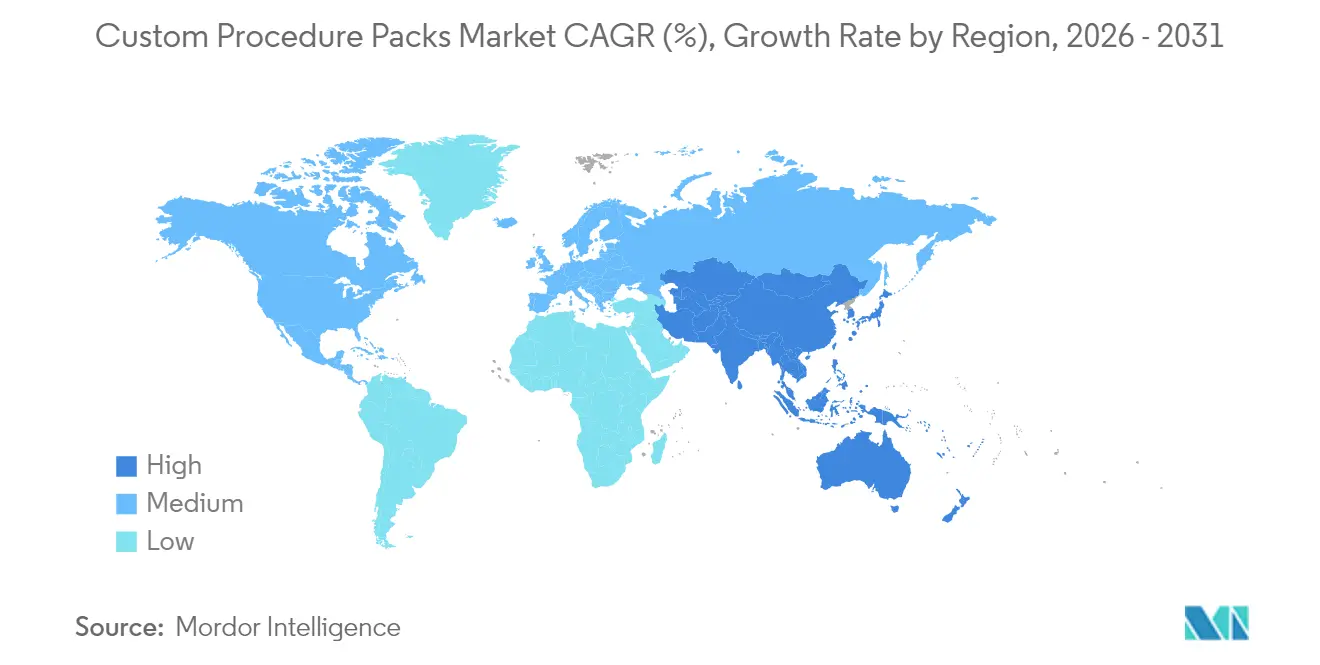
North America leads with a 39.85% Custom procedure packs market share in 2025, anchored by advanced reimbursement structures and a dense ambulatory network. The CMS 2.9% outpatient payment uplift for 2025, coupled with an expanded ASC procedure roster, directly enlarges unit demand. Still, supply-chain kinks endure; 93% of provider executives cite recurring shortages that spur parallel sourcing and larger safety stock positions. The imminent 2026 FDA Quality Management System Regulation raises compliance costs yet should strengthen export prospects by aligning with global ISO-13485 norms. Over the medium term, digital traceability pilots in major IDNs are expected to transition into standard practice, cementing first-mover advantages for tech-enabled pack suppliers.
APAC Custom Procedure Packs Market
Asia-Pacific is the fastest-growing region, charting a 9.12% CAGR through 2031 on the back of hospital construction booms and rising surgical penetration rates in populous nations. Government programs to expand health-insurance coverage and aggressive private-equity activity are funneling capital into high-acuity surgical centers equipped for complex procedures. The region is also an early adopter of Industry 4.0 in hospital supply chains, posting 61.3% gains in collaboration metrics after integrating IoT and analytics tools, a development that favors agile pack vendors capable of electronic data interchange. CDMOs in China, India, and Southeast Asia offer cost-efficient assembly capacity, allowing Western OEMs to dual-source and mitigate polymer scarcity risks.
Europe Custom Procedure Packs Market
Europe sustains steady demand as regulatory harmonization progresses. The Packaging and Packaging Waste Regulation 2025/40 drives material innovation and recycling loops, challenging producers to deliver contact-sensitive yet recyclable solutions by 2030. Amendments to the EU Medical Device Regulation now obligate early disruption alerts, improving procurement visibility for hospitals and reducing last-minute pack substitutions. Industry clusters in Germany and the Netherlands are piloting closed-loop recovery systems, feeding reclaimed polypropylene back into non-sterile components, and illustrating a pathway to reconcile single-use safety with circular-economy mandates. Collectively, these dynamics reinforce Europe as a laboratory for sustainable product design that could later migrate to other mature markets.

Regulatory Landscape
Custom procedure packs operate under core medical device quality and traceability regimes, where tighter quality-system alignment and postmarket scrutiny raise expectations for documentation and supplier controls. In the United States, the FDA finalized amendments in February 2024 to align the Quality System Regulation with ISO 13485:2016 through the Quality Management System Regulation (QMSR), and the report context points to an operational changeover timeline starting in February 2026. That will increase the emphasis on risk management, complaint handling, and CAPA across multi-component kits, and it can heighten the impact of component-level failures on pack assemblers as recall exposure extends across the supply chain.
In Europe, systems and procedure packs fall under Regulation (EU) 2017/745 (MDR), including Article 22 obligations to verify mutual compatibility of components and provide required information to users. The EU framework also supports stronger UDI and database requirements, with MDCG guidance covering UDI application for systems and procedure packs and EUDAMED-related registrations (actor and device/UDI modules) shaping how pack producers and pack integrators manage identification and market access. On the materials side, the Packaging and Packaging Waste Regulation 2025/40 referenced in the report adds another compliance layer for packaging selection and labeling, particularly for single-use configurations.
Competitive Landscape
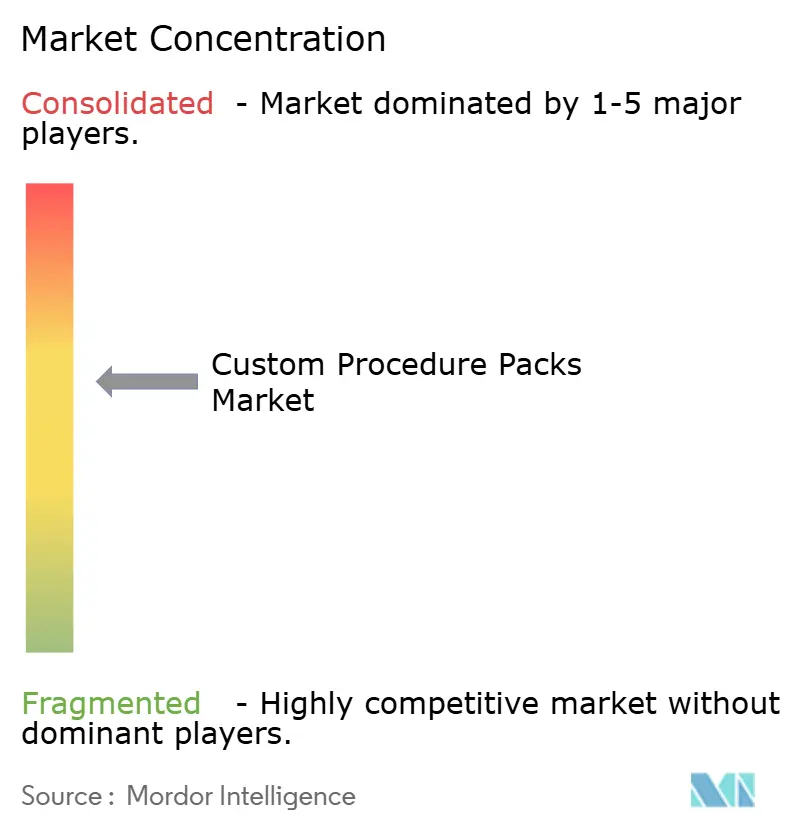
The Custom procedure packs market is moderately consolidated. Medline Industries, Cardinal Health, and Owens & Minor leverage global logistics footprints and contract manufacturing to lock in multiyear deals with group purchasing organizations. Cardinal Health grew fiscal 2024 revenue 11% to USD 226.8 billion, bolstered by its USD 1.2 billion acquisition of Specialty Networks, which deepens penetration in physician-office dispensing and aligns with broader pack customization strategy. Scale affords these leaders price leverage over resin suppliers and access to costly sterilization modalities such as vaporized hydrogen peroxide chambers that smaller rivals often outsource.
Technology investments are a key differentiator. Top players embed RFID tags at component level, enabling real-time consumption dashboards for hospital supply-chain teams and creating sticky software-as-a-service revenue. Mid-tier specialists focus on high-growth niches like neurosurgery, where 10.85% CAGR allows premium pricing. Several European firms bet on biodegradable trays made from polylactic acid blends, hoping to pre-empt EU recyclability mandates. Competitive pressure will intensify as the 2026 FDA quality rule imposes documentation rigors that may squeeze undercapitalized contenders while rewarding those with mature quality systems. In parallel, OEMs are piloting e-commerce portals that give surgeons configurator tools, broadening addressable clientele without heavy field-sales overhead. Collectively, these moves signal an industry in transition from pure-play disposables manufacturing to digitally enabled, sustainability-aware solution provisioning within the Custom procedure packs market.
Custom Procedure Packs Industry Leaders
PrionTex
Medline Industries Inc
Molnlycke Health Care AB
Cardinal Health Inc
Owens & Minor Inc
- *Disclaimer: Major Players sorted in no particular order
Custom Procedure Packs Market Companies Covered in this Report
- Medline Industries
- Owens & Minor Inc.
- Cardinal Health
- Molnlycke Health Care
- Solventum Corporation
- B. Braun
- PrionTex
- Unisurge International Ltd.
- Pennine Healthcare
- Kimal Group
- Med-Italia Biomedica Srl
- Hogy Medical Co., Ltd.
- Smiths Group
- Lohmann & Rauscher
- Hartmann Group
- DeRoyal Industries
- Steris plc
- Defries Industries
- Merit Medical Systems
- Teleflex Medical

Market Opportunities and Future Outlook
A near-term opportunity is compliance-driven differentiation, where pack assemblers that standardize design history, supplier controls, and UDI-ready traceability can reduce disruption from tightening quality expectations across the United States and Europe. The FDA transition to QMSR aligned with ISO 13485:2016, together with the EU MDR Article 22 compatibility verification obligations, increases the value of pack architectures that document component interchangeability, sterilization validation, and labeling accuracy. The report context also points to RFID- and IoT-enabled smart packs for real-time traceability, alongside hospital procedure-card optimization programs and analytics platforms such as Cardinal Health WaveMark, as practical pull-through levers that connect pack configuration to usage analytics and waste reduction.
Sterilization and packaging constraints create additional room for manufacturers that can expand capacity, strengthen nearshore assembly, or redesign packaging to improve throughput while meeting residual and emissions requirements. In May 2026, Owens & Minor announced a flagship kitting facility in Villanueva, Honduras with automated packaging systems designed to double procedure-kit production capacity, signaling active investment in scalable assembly closer to North American demand lanes. In May 2026, the third edition of ISO 10993-7 introduced updated, risk-based expectations for ethylene oxide residual assessments, which pushes kit producers to tighten toxicological risk assessments and align material and packaging choices with product design and change control. These moves reinforce opportunities for vertically coordinated players that combine kitting, packaging engineering, and validated sterilization pathways, particularly as neurosurgery and ASC-driven procedure migration remain prominent in the report.
Recent Industry Developments in Custom Procedure Packs Market
- May 2026: Owens & Minor announced a flagship kitting facility in Villanueva, Honduras, incorporating automated packaging systems designed to double production capacity for medical procedure kits. The added nearshore throughput supports service levels and lead-time performance for North American customers while reducing dependence on longer, more fragile global lanes. It also raises competitive pressure on other pack assemblers to match automation and regional redundancy in their kitting footprints.
- October 2025: Sterisets International Group acquired Medirm and Estereobato in Portugal, adding 1,000 square meters of production capacity for custom-made medical sets and packs. The deal expands Sterisets manufacturing scale in Europe and supports broader customer coverage for customized pack programs. It also reflects continued consolidation as suppliers seek capacity and localized production to manage compliance and logistics complexity.
- April 2025: Lohmann & Rauscher Group acquired Unisurge International Ltd, a UK-based manufacturer of custom procedure packs, to deepen access to hospital customers in the United Kingdom. Integrating Unisurge expands L&R's procedure-pack capabilities and strengthens its positioning with health systems seeking standardized, ready-to-use sterile kits. The acquisition also underscores the role of regional pack specialists as strategic assets for larger medtech supply providers.


Custom Procedure Packs Market Report Scope and Research Methodology
Market Definition and Coverage
This market covers ready-to-use, pre-assembled sterile packs that bundle the disposable consumables needed for a defined clinical procedure, so staff can open one pack and prepare the sterile field with less picking and counting.
Scope exclusions: Capital equipment, reusable instruments, and standalone consumables sold outside a bundled custom pack setup are not counted.
Segments Covered in This Report
- By Use
- Single-Use
- Reusable
- By Product
- Cardiovascular Surgery Packs
- Cosmetic Surgery Packs
- General Surgery Packs
- Orthopedic Surgery Packs
- Neurosurgery Packs
- Ophthalmic Surgery Packs
- Other Specialized Packs
- By End-User
- Hospitals
- Clinics
- Ambulatory Surgical Centers
- Geography
- North America
- United States
- Canada
- Mexico
- Europe
- Germany
- United Kingdom
- France
- Italy
- Spain
- Rest of Europe
- Asia-Pacific
- China
- Japan
- India
- South Korea
- Australia
- Rest of Asia-Pacific
- Middle East and Africa
- GCC
- South Africa
- Rest of Middle East and Africa
- South America
- Brazil
- Argentina
- Rest of South America
- North America
Data Sources, Market Sizing, and Validation
Desk Research
Desk research starts with mapping where procedure packs sit in hospital purchasing and sterile supply workflows, and then linking that to surgery volumes and outpatient shifts. For baseline context, we relied on public reference types such as CDC healthcare statistics, OECD health expenditure and hospital indicators, US FDA medical device guidance updates, WHO health system data, and trade data portals for basic import-export context on medical disposables.
We then reviewed annual reports, investor decks, and press releases to understand portfolio mix, manufacturing footprint changes, and distribution channel moves that can affect pricing and availability. A paid subscription for company financials and news was used to cross-check reported revenue direction and key event timing, and a patent database was referenced to identify packaging and sterile barrier innovation themes. These examples are not exhaustive, and many other public sources were also reviewed for data collection, validation, and clarification.
Primary Interviews and Surveys
Primary work focused on confirming how hospitals and ambulatory surgical centers define a custom pack, what items are typically bundled by procedure type, and how pricing changes with material costs and standardization efforts. We spoke with a mix of manufacturers, distributors, and clinical supply stakeholders across major regions, so the assumptions from desk inputs could be corrected and re-checked before finalizing the model.
Distribution of primary research fieldwork respondents
| Company type | Respondent position | Region |
|---|---|---|
| Top tier: 37% | CXOs: 18% | APAC: 43% |
| Mid tier: 45% | Functional/Unit leaders: 40% | EMEA: 35% |
| Smaller Players: 18% | Managers: 42% | Americas: 22% |
Market-Sizing & Forecasting
Sizing is built from a top-down demand pool, where procedure volumes and site-of-care mix are used to reconstruct the addressable spend on bundled packs across regions, and then it is split by pack use patterns seen in interviews. To keep the totals realistic, we corroborate them with selective bottom-up checks using sampled average selling prices and expected pack throughput at a typical hospital and ambulatory center, followed by channel checks on utilization and procurement behavior.
Inputs used in the model include overall surgical procedure volumes by region, the share of procedures shifting to ambulatory settings, average pack consumption per procedure type (single pack versus multiple packs), sterile disposables price progression, and the pace of standardization programs that convert pick-lists into custom packs. For forecasting, we run scenario analysis around procedure growth, site-of-care changes, and price inflation, then smooth results with simple trend logic when a one-off event creates an unusual spike. When local data is thin, we handle gaps using proxy indicators such as hospital admission trends and staffing constraints, and then refine implied pack penetration using follow-up validation.
Data Validation & Update Cycle
Validation is done by checking whether modeled spend moves in line with independent signals such as procedure volume trends, hospital budget direction, and reported shortages or normalization in key disposable categories. Any large variance is investigated, and assumptions are adjusted only after a second pass review so one data point does not steer the whole model. Reports are refreshed annually, and interim updates are made when material events happen, such as regulatory changes affecting sterile packaging or a notable supply disruption. Before delivery, we run a final review pass so the latest public indicators and interview feedback are reflected in the numbers.
Mordor Intelligence's Custom Procedure Packs Market Size Measured Against Other Published Estimates
Published estimates for custom procedure packs can vary even when they describe the same end use, because each publisher sets different boundaries around what qualifies as a pack and how much adjacent surgical kit revenue is counted. Differences also show up when current-year pricing is assumed from list prices instead of contracted pricing patterns, or when procedure growth is projected with a single rate rather than being tied to site-of-care shifts.
Surgery volume indicators, ambulatory center expansion signals, and pack adoption feedback from supply stakeholders are the checks that keep Mordor Intelligence's 2025 market size tied to a defined demand pool. As a result, some other published numbers land higher or lower. In practice, the main gap drivers are usually scope mixing (procedure packs vs. broader surgical kits), currency timing, and whether a model assumes faster penetration into outpatient settings than interviews support.
Benchmark comparison
| Source | Market Size | Gaps in Research Methodology |
|---|---|---|
| Mordor Intelligence | USD 8.97 B (2025) | |
| Global Consultancy A | USD 8.22 B (2025) | Uses a narrower view of pack usage and applies more conservative penetration rates in ambulatory settings, which lowers implied volume per procedure in the near term. |
| Industry Publisher B | USD 8.81 B (2025) | Keeps the core pack scope similar but relies on broader country coverage and different price escalation assumptions for sterile disposables, which changes the 2025 revenue total. |
Seen together, the spread is mostly explained by how procedure-to-pack conversion is set, and how pricing is carried from contracts into the current year. Our approach stays traceable because the total can be walked back to procedure volumes, site-of-care mix, and a clear pack definition, and those same steps can be repeated when new data is released.


Key Questions Answered in the Report
What is the projected growth rate for the Custom procedure packs market between 2026 and 2031?
The market is expected to post a 5.14% CAGR, rising from USD 9.43 billion in 2026 to USD 12.12 billion by 2031.
Which end-user segment is expanding fastest?
Ambulatory surgical centers lead with a forecast 8.74% CAGR as reimbursement parity and patient convenience accelerate outpatient migration.
How significant are single-use packs in current demand?
Single-use configurations command 70.94% of 2025 volume due to infection-control priorities and reduced reprocessing needs.
Which region is expected to grow most rapidly?
Asia-Pacific is on track for a 9.12% CAGR through 2031, driven by healthcare infrastructure investment and wider surgical access.
What is the top driver influencing market expansion?
The rising global volume of surgical procedures, particularly in outpatient settings, is the most powerful accelerator, adding an estimated 1.2 percentage points to the forecast CAGR.
Page last updated on:


 Your data is secure and never sold or shared.


