
Sputtering Equipment Cathode Market Size and Share
Market Overview
| Study Period | 2020 - 2031 |
|---|---|
| Market Size (2026) | USD 1.36 Billion |
| Market Size (2031) | USD 1.79 Billion |
| Growth Rate (2026 - 2031) | 5.62 % |
| Fastest Growing Market | Asia Pacific |
| Largest Market | Asia Pacific |
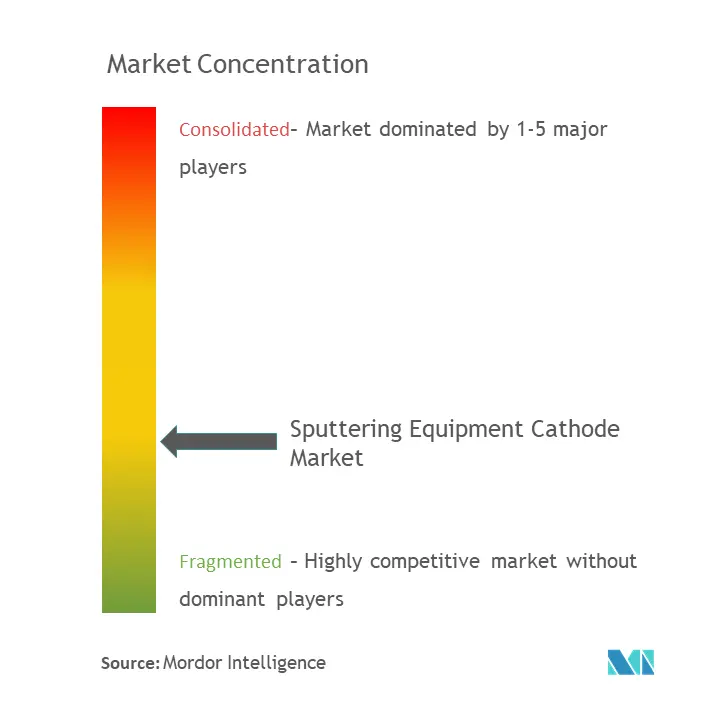
| Market Concentration | Low |
Major Players *Disclaimer: Major Players sorted in no particular order Image © Mordor Intelligence. Reuse requires attribution under CC BY 4.0. | |
Sputtering Equipment Cathode Market Analysis by Mordor Intelligence
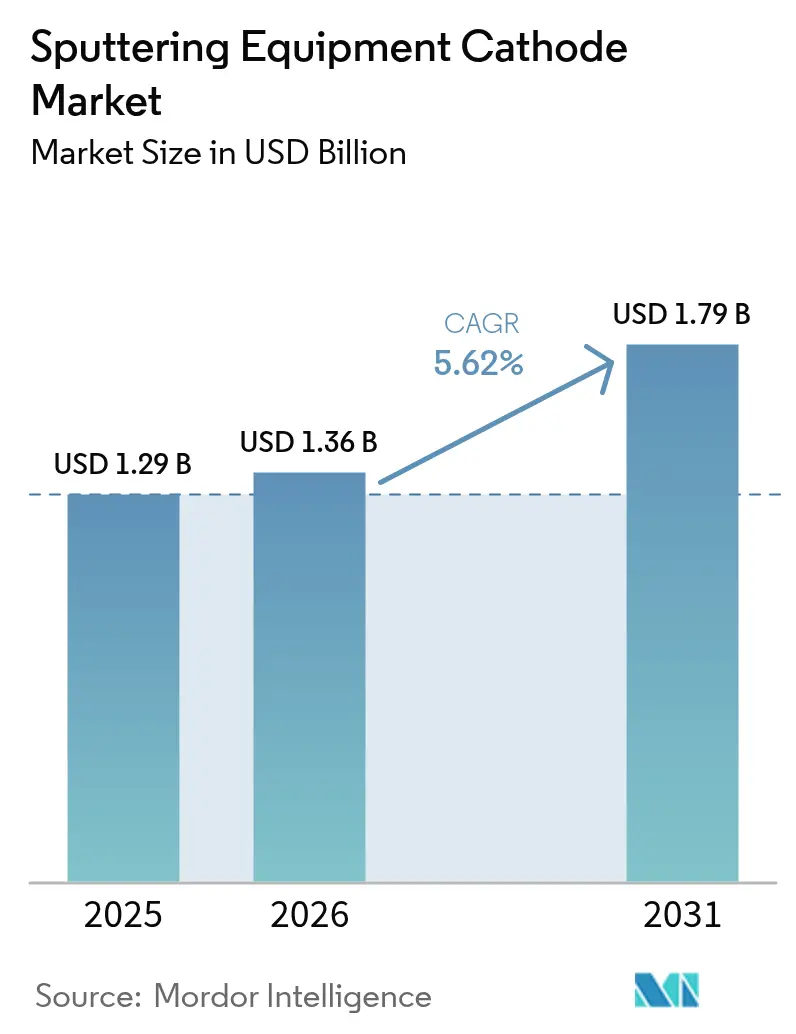
The Sputtering Equipment Cathode Market size market is expected to grow from USD 1.29 billion in 2025 to USD 1.36 billion in 2026 and is forecast to reach USD 1.79 billion by 2031 at 5.62% CAGR over 2026-2031.
The sputtering equipment cathode market is experiencing significant transformation driven by the rapid evolution of semiconductor processing equipment technologies and increasing industrial automation. The semiconductor industry continues to expand its capabilities to meet growing demand across various sectors, with the Semiconductor Industry Association projecting global semiconductor sales to reach USD 555.9 billion. This growth is further supported by the increasing integration of advanced technologies in manufacturing processes, particularly in high-precision applications such as integrated circuits, memory devices, and microprocessors. The industry's focus on miniaturization and enhanced performance capabilities has led to substantial investments in research and development of advanced physical vapor deposition equipment technologies.
The market is witnessing a notable shift towards more sophisticated and efficient coating equipment technologies, particularly in response to the growing demands of emerging technologies such as 5G networks and Internet of Things (IoT) devices. According to industry projections, silicon wafer shipments for semiconductor applications are expected to exceed 17,600 million square inches (MSI) by 2025, highlighting the expanding scale of semiconductor manufacturing operations. This growth is accompanied by increasing adoption of advanced packaging technologies and the development of more complex semiconductor devices that require precise thin film deposition equipment solutions.
The integration of Industry 4.0 principles and smart manufacturing practices is revolutionizing the sputtering equipment cathode industry. Manufacturers are increasingly implementing automated solutions and real-time monitoring systems to optimize production processes and enhance coating quality. The advancement in confocal sputtering arrangements and magnetron sputtering technology has significantly improved equipment efficiency and production output. These technological improvements are enabling manufacturers to achieve higher precision in thin-film deposition while maintaining cost-effectiveness and operational efficiency.
The market is experiencing substantial growth in diverse end-user applications, particularly in the automotive and consumer electronics sectors. The rising adoption of electric vehicles and advanced driver-assistance systems (ADAS) is creating new opportunities for semiconductor processing equipment applications in automotive component manufacturing. In the consumer electronics sector, the demand for high-performance devices continues to drive innovation in semiconductor manufacturing processes. This trend is exemplified by Deutsche Telekom's expansion of 5G network coverage, which has reached approximately 40 million users, demonstrating the growing infrastructure requirements for advanced telecommunications equipment that relies on sophisticated semiconductor components.
Note: Market size and forecast figures in this report are generated using Mordor Intelligence’s proprietary estimation framework, updated with the latest available data and insights as of 2026.
Market Trends and Insights
RISE IN THE APPLICATIONS OF SEMICONDUCTORS
The semiconductor industry is experiencing unprecedented demand growth driven by the proliferation of advanced technologies across multiple sectors. The increasing integration of semiconductors in consumer electronics, industrial equipment, automotive systems, and communication devices has created a substantial need for sophisticated manufacturing processes. According to the Semiconductor Equipment and Materials International (SEMI) forecasts, silicon wafer shipments for semiconductor applications are projected to reach 17,600 million square inches (MSI) by 2025, representing a significant increase from 11,810 MSI in 2019. This surge in demand is further amplified by the rapid adoption of wireless technologies like 5G, artificial intelligence systems, and automation solutions across various industries.
The automotive sector has emerged as a crucial driver for semiconductor applications, with modern vehicles requiring an increasing number of semiconductor components for advanced driver assistance systems (ADAS), infotainment systems, and powertrain control. The transition towards electric and autonomous vehicles has particularly accelerated this trend, as these vehicles typically require two to three times more semiconductor content compared to traditional vehicles. Additionally, the exponential growth in Internet of Things (IoT) devices has created new demands for semiconductor manufacturing, as these connected devices require various types of semiconductors for processing, sensing, and communication functions. The expansion of 5G networks is further catalyzing this growth, as it necessitates the upgrade of existing infrastructure and consumer devices, thereby driving the demand for new semiconductor components.
ADVANCEMENT IN TECHNOLOGY SUCH AS MAGNETRON SPUTTERING TECHNOLOGY
Magnetron sputtering technology has evolved significantly, offering enhanced capabilities for high-rate vacuum coating applications in semiconductor manufacturing. This advanced technology enables the deposition of metals, alloys, and compounds onto various materials with thicknesses up to the millimeter range, providing superior control over the deposition process. The technology's ability to deliver high deposition rates, produce high-purity films, and ensure excellent coverage of steps and small features has made it increasingly valuable for modern semiconductor manufacturing processes. Furthermore, the technology's compatibility with heat-sensitive substrates and its ease of automation have made it particularly attractive for large-scale industrial applications.
Recent technological advancements in magnetron sputtering equipment have introduced innovations such as confocal sputtering arrangements, which significantly improve equipment efficiency and enable the use of multiple sputtering target materials simultaneously. These developments have led to enhanced production output and improved film uniformity, particularly beneficial for applications requiring precise control over thin-film properties. The technology also offers significant advantages in terms of environmental sustainability, as it enables environmentally friendly metallization with no VOC emissions, making it particularly valuable for industries transitioning towards greener manufacturing processes. The ability to replace expensive metal parts with lightweight and low-cost alternatives coated with thin desirable metals has made this technology increasingly essential for cost-effective semiconductor production. Additionally, the integration of PVD equipment and vacuum coating equipment in the sputtering system enhances the overall efficiency and effectiveness of the manufacturing process.
Sputtering Equipment Cathode Market Segment Analysis
Circular Segment in Sputtering Equipment Cathode Market
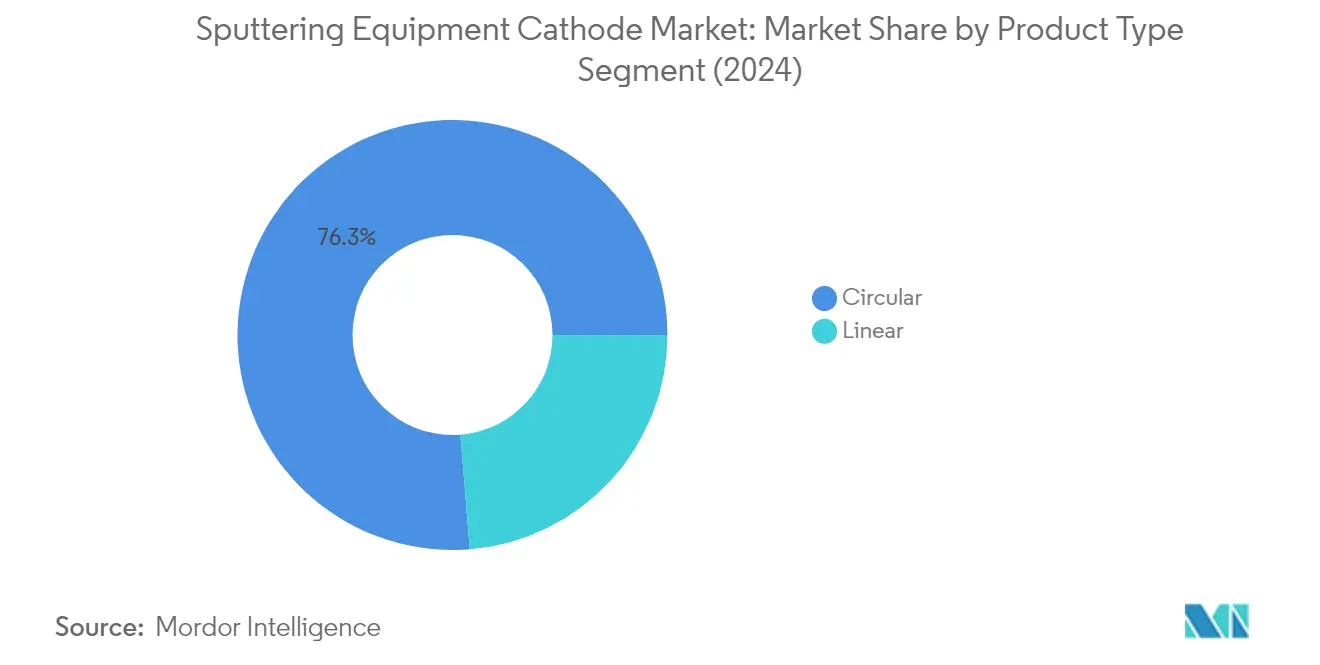
The circular segment continues to dominate the global sputtering equipment cathode market, commanding approximately 75.25% market share in 2025. This significant market position is attributed to circular cathodes' superior efficiency in high-power wide-substrate applications and their versatility across various coating processes. The segment's dominance is further strengthened by its widespread adoption in semiconductor manufacturing, particularly in advanced packaging applications and integrated circuit production. Circular cathodes are preferred in many applications due to their ability to provide uniform coating deposition, better target utilization, and enhanced process control, especially in sophisticated multi-cathode cluster assemblies. The segment's strong performance is also driven by increasing demand from emerging applications in automotive electronics, medical devices, and advanced display technologies. The integration of vacuum coating systems enhances the efficiency of circular cathodes, making them indispensable in modern thin film coating equipment.
Linear Segment in Sputtering Equipment Cathode Market
The linear segment is emerging as the fastest-growing segment in the sputtering equipment cathode market, with a projected growth rate of approximately 6.65% during 2026-2031. This accelerated growth is primarily driven by the increasing adoption of linear sputtering systems in large-area coating applications, particularly in the solar panel manufacturing industry. The segment is witnessing strong momentum due to its advantages in providing uniform coating over large substrate areas and its capability to handle high-volume production requirements. Technological advancements in linear magnetron designs, including improved magnetic field configurations and enhanced target utilization, are contributing to the segment's rapid growth. The expansion of flat panel display manufacturing and the growing demand for architectural glass coatings are further propelling the adoption of linear sputtering cathodes. The use of vacuum metallization equipment is pivotal in enhancing the capabilities of linear sputtering systems, ensuring superior performance in large-scale applications.
Sputtering Equipment Cathode Market Geography Segment Analysis
North America Sputtering Equipment Cathode Market
The North American sputtering equipment market demonstrates robust growth driven by significant technological advancements in semiconductor manufacturing and increasing investments in research and development. The United States and Canada form the key markets in this region, with both countries showing a strong commitment to developing domestic semiconductor capabilities through various initiatives and investments. The region benefits from the presence of major semiconductor manufacturers and research institutions that continue to drive innovation in sputtering technologies and applications.
The United States dominates the North American market with approximately 89.35% market share in 2025. The country's leadership position is strengthened by its robust semiconductor industry infrastructure and significant investments in research and development facilities. The presence of major semiconductor manufacturers and increasing government support for domestic chip production capabilities has created a favorable environment for market growth. The country's focus on advancing technologies in artificial intelligence, 5G networks, and autonomous vehicles continues to drive demand for sophisticated sputtering equipment market cathodes.
The United States is also experiencing the fastest growth in the region, with a projected CAGR of approximately 4.82% from 2026 to 2031. This growth is fueled by increasing investments in semiconductor manufacturing facilities and the government's push for domestic chip production. The country's strong focus on developing advanced packaging technologies and expanding production capabilities in various semiconductor applications continues to drive market expansion. The presence of leading research institutions and their collaboration with industry players further supports this growth trajectory.
Europe Sputtering Equipment Cathode Market
The European sputtering equipment market is characterized by strong technological capabilities and increasing investments in semiconductor manufacturing infrastructure. Key markets, including Germany, the United Kingdom, and France, are driving regional growth through various initiatives aimed at strengthening domestic semiconductor capabilities. The region's focus on sustainable technologies and advanced manufacturing processes has created significant opportunities for market expansion.
Germany leads the European market with approximately 36.62% market share in 2025. The country's dominant position is supported by its strong automotive and electronics manufacturing sectors, which drive demand for semiconductor components. Germany's leadership in Industry 4.0 initiatives and advanced manufacturing technologies has created a robust ecosystem for sputtering equipment applications. The country's strong focus on research and development, particularly in areas such as electric vehicles and renewable energy technologies, continues to drive market growth.
Germany demonstrates the highest growth potential in the European region, with a projected CAGR of approximately 5.74% from 2026 to 2031. This growth is driven by increasing investments in semiconductor manufacturing capabilities and the country's push towards advanced technology adoption. The expansion of electric vehicle production facilities and a growing focus on renewable energy technologies continue to create new opportunities for coating equipment market applications. Germany's strong industrial base and technological expertise further support this growth momentum.
APAC Sputtering Equipment Cathode Market
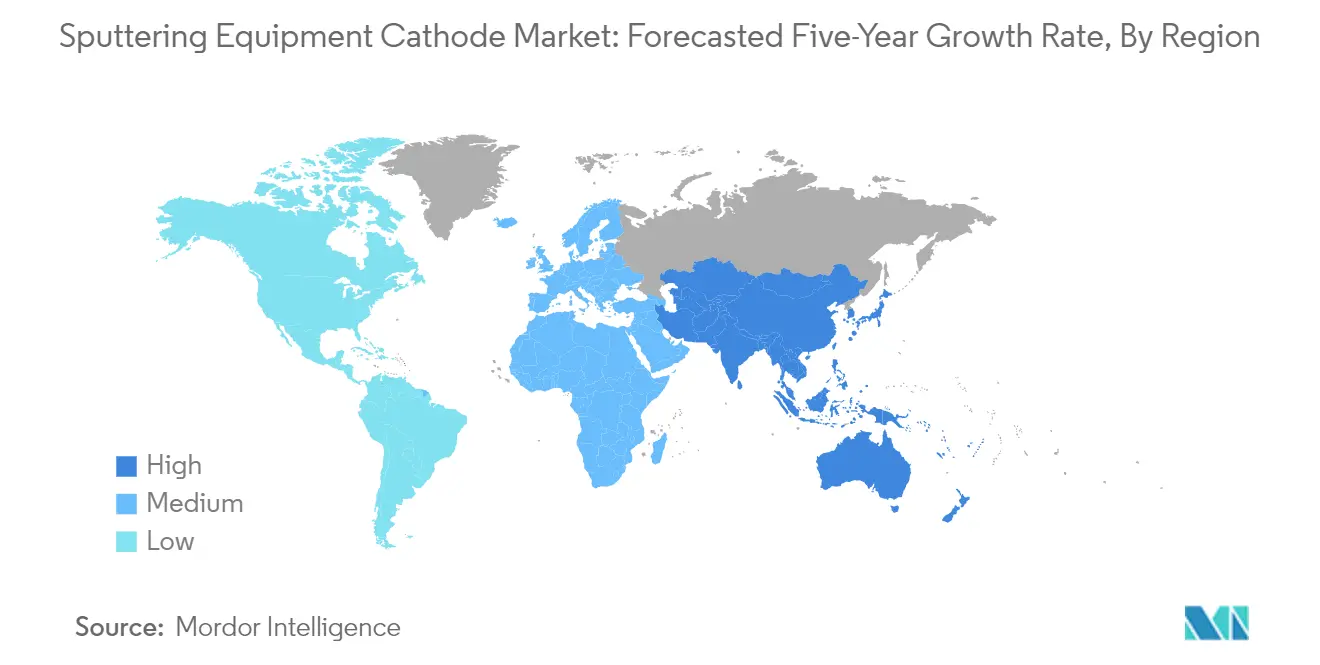
The Asia Pacific region represents the largest market for sputtering equipment cathodes, driven by the presence of major semiconductor manufacturing facilities and strong government support for technology development. Countries including China, Japan, and India are making significant investments in expanding their semiconductor manufacturing capabilities. The region's dominance in electronics manufacturing and growing adoption of advanced technologies continue to drive market growth.
China maintains its position as the largest market in the Asia Pacific region, supported by extensive semiconductor manufacturing infrastructure and strong government backing for domestic chip production. The country's robust electronics manufacturing sector and increasing investments in advanced technology development continue to drive demand for physical vapor deposition equipment market cathodes. China's focus on developing self-sufficient semiconductor capabilities and expanding production facilities creates sustained market growth opportunities.
China leads the region's growth trajectory, supported by extensive investments in semiconductor manufacturing capabilities and strong government initiatives to develop domestic chip production. The country's commitment to technological advancement and self-sufficiency in semiconductor production continues to drive market expansion. The growing adoption of advanced technologies such as 5G, artificial intelligence, and electric vehicles further supports the demand for sputtering target market cathodes.
LATAM and MEA Sputtering Equipment Cathode Market
The Rest of World market, comprising Latin America and the Middle East & Africa, shows steady growth in the coating equipment industry sector. Latin America emerges as both the largest and fastest-growing market in this region, driven by increasing investments in semiconductor manufacturing and growing adoption of advanced technologies. The region's market growth is supported by expanding electronics manufacturing capabilities and an increasing focus on technological advancement. Both regions are witnessing growing investments in research and development facilities, though at different paces, with Latin America showing more robust growth compared to the Middle East & Africa region.
Value Chain Analysis
The sputtering equipment cathode value chain starts with upstream raw materials and specialty processing for ultra-high-purity metals (such as aluminum, titanium, tantalum, and copper), which are refined and converted into target forms and cathode assemblies. Supply risk is centered more on refining bottlenecks and target-forming capacity concentration than on primary metal availability, which increases the importance of qualified suppliers and repeatable manufacturing of high-density, high-purity targets for advanced nodes and complex film stacks.
Midstream, cathode and magnetron subsystem suppliers integrate targets into circular and linear cathode assemblies, then into sputtering/PVD tools through OEMs and system integrators. Rebuild and refurbishment services help extend cathode life and stabilize uptime. Downstream, distribution and service networks deliver spares, rebuilds, and technical support close to fabs, and logistics and qualification practices become more formalized as fabs expand globally (for example, Samsung Electronics designating Lake Materials as an exclusive logistics and distribution hub for ALD and CVD precursor shipments to its Taylor, Texas facility in December 2025, illustrating tighter supply-chain visibility and control for manufacturing inputs adjacent to deposition processes).
Competitive Landscape
Top Companies in Sputtering Equipment Cathode Market
The market features established players like Kurt J. Lesker Company, Veeco Instruments, Semicore Equipment, Impact Coatings AB, and AJA International, leading innovation and development. Companies are focusing on advancing their magnetron sputtering equipment technologies and developing confocal sputtering arrangements to enhance production efficiency and coating quality. Strategic partnerships with semiconductor manufacturers and research institutions are becoming increasingly common to drive technological advancement. Operational agility is demonstrated through the establishment of global manufacturing facilities and service centers to better serve regional markets. Companies are expanding their product portfolios to include both linear and circular cathode solutions while investing in research and development to improve coating uniformity and target material utilization. The industry is witnessing an increased focus on developing solutions for emerging applications in fuel cells, solar energy, and advanced electronics, leveraging their sputtering system capabilities.
Fragmented Market with Strong Regional Players
The sputtering equipment cathode market exhibits a fragmented structure with a mix of global conglomerates and specialized regional manufacturers. Large multinational companies like Veeco Instruments maintain a significant market presence through their extensive distribution networks and comprehensive product portfolios, while specialized players like Semicore Equipment and Impact Coatings AB have carved out strong positions in specific application niches. The market is characterized by the presence of numerous local manufacturers with strong production capabilities across regions, particularly in Asia Pacific, where semiconductor manufacturing is concentrated. The high entry barriers, including substantial capital requirements and technical expertise, have limited new entrant penetration but encouraged strategic partnerships among existing players.
The industry has witnessed selective consolidation activities, primarily driven by the need to acquire technological capabilities and expand geographical presence. Companies are increasingly focusing on vertical integration strategies to maintain control over the supply chain and enhance operational efficiency. The market structure is influenced by the growing demand from emerging economies and the need for specialized solutions in advanced applications. Regional players are strengthening their positions through strategic collaborations with technology providers and end-users, while global players are expanding their presence through targeted acquisitions and joint ventures.
Innovation and Customer Relations Drive Success
For incumbent players to maintain and expand their market share, continuous investment in research and development remains crucial, particularly in developing advanced magnetron sputtering equipment technologies and improving target material efficiency. Companies need to focus on building strong relationships with semiconductor manufacturers and other end-users through comprehensive service offerings and customized solutions. The ability to provide integrated solutions that address specific customer requirements while maintaining cost competitiveness will be essential. Establishing strong intellectual property portfolios and developing proprietary technologies will help companies differentiate themselves in an increasingly competitive market. Success will also depend on the ability to adapt to rapidly evolving end-user requirements and technological advances in the semiconductor industry.
Market contenders can gain ground by focusing on specialized applications and developing innovative solutions for emerging markets such as renewable energy and advanced electronics. The relatively low threat of substitutes provides opportunities for companies to establish themselves in specific market segments through technological differentiation and superior customer service. Regulatory compliance, particularly in environmental and safety standards, will become increasingly important as governments worldwide implement stricter regulations on manufacturing processes. Companies that can effectively address these regulatory requirements while maintaining operational efficiency will have a competitive advantage. The concentration of end-users in specific regions, particularly in Asia Pacific, necessitates a strong regional presence and understanding of local market dynamics. Companies are also focusing on enhancing their coating equipment offerings to meet diverse customer needs.
Sputtering Equipment Cathode Industry Leaders
Semicore Equipment, Inc.
Sputtering Components, Inc.
Angstrom Sciences, Inc.
Veeco Instruments, Inc.
Kurt J. Lesker Company
- *Disclaimer: Major Players sorted in no particular order
Sputtering Equipment Cathode Market Companies Covered in this Report
- Kurt J. Lesker Company
- Veeco Instruments, Inc.
- Semicore Equipment Inc.
- Impact Coatings AB
- AJA International Inc.
- Soleras Advanced Coatings
- Sputtering Components, Inc.
- KDF Technologies
- Angstrom Sciences, Inc.
- Angstrom Engineering Inc.


Market Opportunities and Future Outlook
Opportunities concentrate where device architectures and large-scale fab investments increase the number and criticality of thin-film steps that depend on stable cathode performance, uniformity, and target utilization. SEMI reported global semiconductor manufacturing equipment spending reached USD 135.1 billion in 2025, with continued emphasis on advanced logic and memory capacity, which supports demand for high-throughput sputtering hardware and cathode subsystems that can help maintain tighter process windows and high-volume production on 300 mm lines.
Product-level whitespace is visible in cathode designs optimized for challenging profiles and feature coverage, including high-aspect-ratio structures in advanced interconnect and packaging flows. Suppliers with specialized cathode configurations and rebuild or service capabilities, such as KDF Electronic & Vacuum Services offering cathode configurations targeted at wafer processing use cases, can compete on process outcomes and lifecycle cost rather than initial hardware supply. As manufacturers pursue higher tool utilization and smarter maintenance, cathode makers that deliver faster refurbishment turnaround, local support, and tighter material traceability also gain leverage with fabs expanding capacity across multiple regions and tightening supplier qualification requirements.
Recent Industry Developments in Sputtering Equipment Cathode Market
- April 2026: Sputtering Components, Inc. exhibited at SVC TechCon 2026 in Long Beach, California, highlighting rotary cathodes, magnetrons, and vacuum coating solutions. The event pointed to ongoing demand for rotary and magnetron hardware used in large-area and high-throughput coating applications, supporting further development of cathode design and rebuild services across semiconductor-adjacent PVD workflows.
- May 2025: Sputtering Components, Inc. began an expansion of its Owatonna, Minnesota facility to increase space for manufacturing and operations. The expansion added higher output capacity and faster turnaround for cathode components and services, improving lead times as customers scaled coating capacity.
- March 2024: The Dresden expansion by Kurt J. Lesker Company continued to build local support capacity for EU customers, with faster deliveries from a regional distribution center. Strengthening European service and distribution improves responsiveness for cathode and vacuum hardware users that require rapid spares availability and minimized tool downtime.


Sputtering Equipment Cathode Market Report Scope and Research Methodology
Market Definition and Coverage
This market covers sputtering equipment cathodes that are sold for thin-film deposition systems, where the cathode is the consumable hardware that supports sputter deposition across major end-use industries worldwide.
Scope exclusions: It does not count full PVD tool systems, vacuum pumps, chambers, power supplies, targets as a standalone commodity, or coating service revenues unless the cathode sale is clearly bundled as part of the cathode supply.
Segments Covered in This Report
- By Product
- Linear
- Circular
- By Geography
- North America
- United States
- Canada
- Europe
- Germany
- United Kingdom
- France
- Rest of Europe
- Asia-Pacific
- China
- Japan
- India
- Rest of Asia-Pacific
- Rest of the World
- Latin America
- Middle-East and Africa
- North America
Data Sources, Market Sizing, and Validation
Desk Research
Desk research starts with building a clean view of where cathode demand comes from, then mapping it to observable production and investment signals. Public sources such as U.S. International Trade Commission trade statistics, UN Comtrade, World Semiconductor Trade Statistics, SEMI publications, and OECD industrial indicators help us understand manufacturing cycles and cross-border equipment flows.
We also review company filings, investor presentations, technical papers and journals on thin-film deposition, plus trade press coverage on fab expansions and display capacity moves. For hard-to-find company financials, patents, and shipment proxies, approved paid subscriptions are used only to structure inputs and sanity-check ranges, not to replace the core model logic. These desk sources are illustrative, and additional public references are used to support data collection and clarification during the work.
Primary Interviews and Surveys
Primary work is used to confirm which cathodes buyers are purchasing, how replacement cycles behave, and how pricing moves with materials and design (linear versus circular). We speak with a mix of cathode suppliers, coating system integrators, and high-usage end users across APAC, EMEA, and the Americas so gaps from desk research can be closed and assumptions can be checked against real buying behavior.
Distribution of primary research fieldwork respondents
| Company type | Respondent position | Region |
|---|---|---|
| Top tier: 34% | CXOs: 16% | APAC: 43% |
| Mid tier: 45% | Functional/Unit leaders: 35% | EMEA: 31% |
| Smaller Players: 21% | Managers: 49% | Americas: 26% |
Market-Sizing & Forecasting
Sizing is built using a top-down approach where electronics and industrial output signals, trade flows for relevant equipment and parts, and announced capacity additions are used to reconstruct the demand pool for cathodes by region. Once the demand pool is shaped, it is converted into value using practical price and replacement assumptions informed by interviews and public technical references.
To keep the numbers grounded, the totals are corroborated with selective bottom-up approximations such as sampled supplier revenue ranges, channel checks on cathode replacement frequency, and sampled ASP times estimated unit demand in high-consumption hubs. The key model inputs include wafer fab and display capacity expansion timelines, sputter tool utilization trends, cathode replacement intervals, mix shifts between linear and circular designs, and materials-driven ASP movement that can change with input cost swings.
For forecasting, scenario analysis is used because the market is sensitive to capex cycles and utilization changes that do not move in a straight line. Assumptions for each scenario are aligned to what primary respondents expect for semiconductor and display investment pacing, and then reconciled with the historical pattern of demand recovery after downturns. Where bottom-up gaps exist, we apply conservative fill factors based on the closest comparable region and then revisit the gap during validation calls.
Data Validation & Update Cycle
Outputs are checked in several steps so that obvious distortions are removed before sign-off. Analysts compare the market totals against independent signals like regional fab investment announcements, import and export direction, and observed pricing ranges, and then review any large variances by region and product type.
When a number looks inconsistent, we re-check assumptions, revisit source data, and re-contact selected participants to confirm whether the change is real or caused by a definition mismatch. Reviews are done across analysts to keep calculations repeatable and the logic consistent across updates. Reports are refreshed annually, with interim updates triggered by material events, and a final pre-delivery pass is completed so clients receive the latest updated view.
Mordor Intelligence's Sputtering Equipment Cathode Market Size Measured Against Other Published Estimates
Published market numbers for sputtering equipment cathodes often differ because the scope lines are not drawn the same way, and the input variables are not always tied back to observable manufacturing activity. Differences also show up when firms choose different base years, use aggressive versus conservative capex scenarios, or apply inconsistent currency timing.
The main gap comes from whether the estimate counts only cathode hardware sales versus bundling adjacent items like full sputtering tools or targets as a broader spend pool, which can inflate the total quickly. Some estimates also lean heavily on application splits without validating replacement intervals and ASP drift, and that can swing the number when utilization changes or when material costs move sharply.
Benchmark comparison
| Source | Market Size | Gaps in Research Methodology |
|---|---|---|
| Mordor Intelligence | USD 1.29 B (2025) | |
| Industry Publisher A | USD 1.92 B (2024) | Uses a broader application-led framing that can mix cathode sales with adjacent sputtering system spend, and it relies on a 2024 base year that may capture a higher capex point in the cycle. |
| Global Publisher B | USD 1.26 B (2025) | Reports a similar year but often anchors forecasts to longer-period growth assumptions, with less visible checking of replacement cadence and regional utilization swings that drive near-term cathode demand. |
The table shows that most of the spread is explained by scope bundling and cycle timing, not a single math error. The main gap comes from counting only cathode hardware tied to replacement cadence and installed base signals, a modeling choice used in Mordor Intelligence that keeps the value linked to measurable demand drivers that can be rechecked each update cycle.


Key Questions Answered in the Report
How big is the Sputtering Equipment Cathode Market?
The Sputtering Equipment Cathode Market size is expected to reach USD 1.36 billion in 2026 and grow at a CAGR of 5.62% to reach USD 1.79 billion by 2031.
What is the current Sputtering Equipment Cathode Market size?
In 2026, the Sputtering Equipment Cathode Market size is expected to reach USD 1.36 billion.
Who are the key players in Sputtering Equipment Cathode Market?
Semicore Equipment, Inc., Sputtering Components, Inc., Angstrom Sciences, Inc., Veeco Instruments, Inc. and Kurt J. Lesker Company are the major companies operating in the Sputtering Equipment Cathode Market.
Which is the fastest growing region in Sputtering Equipment Cathode Market?
Asia Pacific is estimated to grow at the highest CAGR over the forecast period (2026-2031).
Which region has the biggest share in Sputtering Equipment Cathode Market?
In 2025, the Asia Pacific accounts for the largest market share in Sputtering Equipment Cathode Market.
What years does this Sputtering Equipment Cathode Market cover, and what was the market size in 2024?
In 2024, the Sputtering Equipment Cathode Market size was estimated at USD 1.21 billion. The report covers the Sputtering Equipment Cathode Market historical market size for years: 2019, 2020, 2021, 2022, 2023 and 2024. The report also forecasts the Sputtering Equipment Cathode Market size for years: 2026, 2027, 2028, 2029, 2030 and 2031.
Page last updated on:


 Your data is secure and never sold or shared.


