
Spray Adhesive Market Size and Share
Market Overview
| Study Period | 2020 - 2031 |
|---|---|
| Market Size (2026) | USD 3.46 Billion |
| Market Size (2031) | USD 4.37 Billion |
| Growth Rate (2026 - 2031) | 4.81 % |
| Fastest Growing Market | Asia Pacific |
| Largest Market | Asia Pacific |
| Market Concentration | Medium |
Major Players *Disclaimer: Major Players sorted in no particular order Image © Mordor Intelligence. Reuse requires attribution under CC BY 4.0. | |
Spray Adhesive Market Analysis by Mordor Intelligence
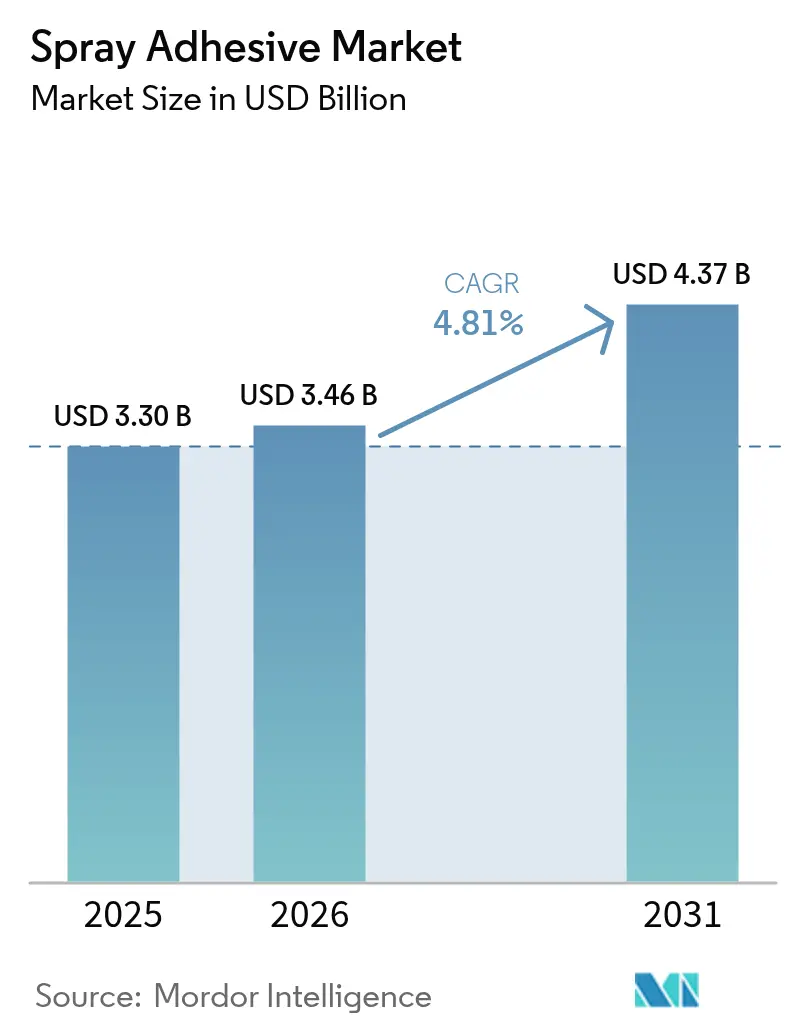
The spray adhesive market size was valued at USD 3.30 billion in 2025 and estimated to grow from USD 3.46 billion in 2026 to reach USD 4.37 billion by 2031, at a CAGR of 4.81% during the forecast period (2026-2031). Demand holds firm despite tightening VOC rules because producers continue to refine water-based and hot-melt chemistries that match the bonding strength of legacy solvent products. Growth concentrates in Asia-Pacific, where large-scale infrastructure programs, expanding furniture export hubs, and a deep automotive supply chain all require fast-tack, high-volume bonding solutions. Momentum also comes from global e-commerce logistics, which pushes fulfillment centers to specify aerosol and hot-melt variants that shorten pack-out time. Competitive pressure stays moderate, yet price-sensitive buyers have new choices from regional suppliers that replicate premium chemistries at lower cost while multinational leaders differentiate through sustainable performance upgrades. Structural drivers such as vehicle lightweighting, prefab construction, and hygienic food packaging keep end-use diversity wide, shielding the spray adhesive market from volatility in any single sector.
Key Report Takeaways
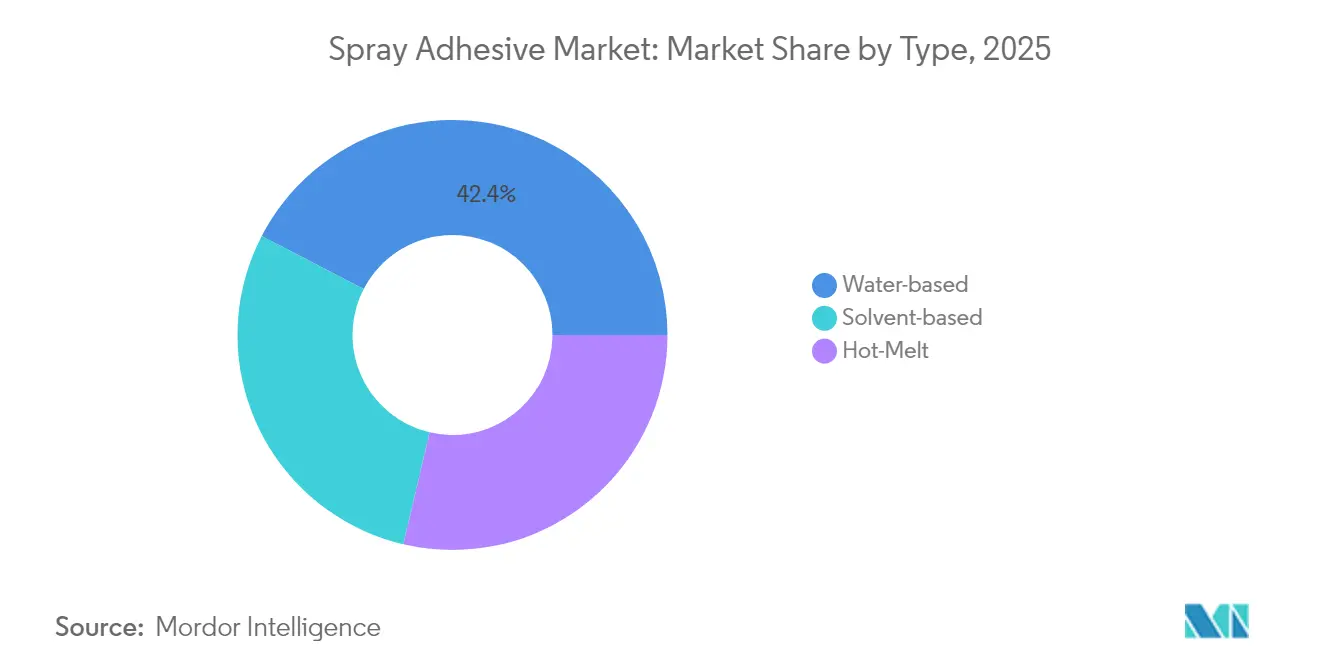
- By type, water-based products led with 42.38% of 2025 spray adhesive market share, while hot-melt grades are projected to expand at a 4.95% CAGR through 2031.
- By resin type, synthetic rubber held 36.35% revenue share in 2025; polyurethane is set to grow fastest at 5.61% CAGR.
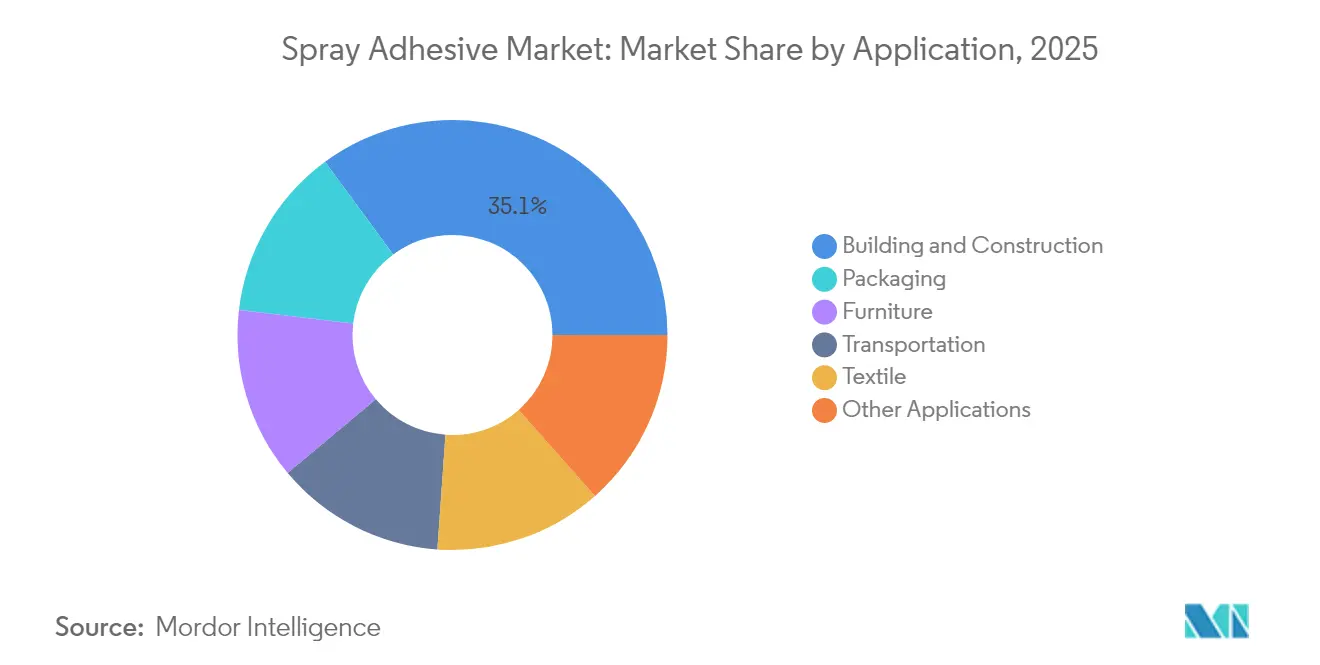
- By application, building and construction captured 35.10% of spray adhesive market size in 2025; furniture is forecast to advance at a 5.06% CAGR to 2031.
- By region, Asia-Pacific commanded 46.30% of 2025 revenue and is expected to post a 5.64% CAGR to 2031.
Note: Market size and forecast figures in this report are generated using Mordor Intelligence’s proprietary estimation framework, updated with the latest available data and insights as of 2026.
Global Spray Adhesive Market Trends and Insights
Drivers Impact Analysis*
| Drivers | ( ~ ) % Impact on CAGR Forecast | Geographic Relevance | Impact Timeline |
|---|---|---|---|
| Rapid growth of construction in emerging economies | +1.20% | Asia-Pacific, Middle East and Africa | Medium term (2–4 years) |
| Transition to water-based, low-VOC formulations | +0.90% | North America, Europe, spillover to Asia-Pacific | Long term (≥ 4 years) |
| Increasing utilization in automotive | +0.70% | Europe, North America, China | Medium term (2–4 years) |
| Demand for hygienic food packaging | +0.60% | North America, Europe | Medium term (2–4 years) |
| Expansion of e-commerce fulfillment centers | +0.50% | North America, Europe, Asia-Pacific | Short term (≤ 2 years) |
| Source: Mordor Intelligence | |||
Rapid Growth of Construction in Emerging Economies
Surging public and private infrastructure investment across China, India, Indonesia, and the Gulf states is driving relentless volume growth for construction chemicals, including spray adhesives. Prefabricated wall panels, acoustic boards, and insulation sheathing all rely on high-performance bonding to withstand temperature swings and seismic loading. Several municipal housing programs specify low-VOC adhesives to meet green-building codes, nudging contractors toward water-based spray systems. Modular builders favor portable canister rigs that reduce overspray and labor time, increasing throughput on large projects. As urbanization accelerates, local firms adopt hot-melt spray lines that cure instantly, allowing rapid assembly of kitchen cabinets and interior fixtures inside high-rise developments. These combined forces keep the spray adhesive market deeply tied to building activity, particularly in Asia-Pacific’s fast-growing megacities.
Transition to Water-Based, Low-VOC Formulations Adhesives
Regulators on three continents have enacted lower emission ceilings, prompting adhesive formulators to launch waterborne systems with comparable tack and heat resistance to solvent grades. The Texas Commission on Environmental Quality amended rules that will eliminate 3.12 tons per day of VOCs around Houston, while California’s Department of Toxic Substances Control placed spray adhesives on its 2024-2026 priority product work plan[1]Texas Commission on Environmental Quality, “Rule Project No. 2024-024-115-AI,” tceq.texas.gov. Dow’s PRIMAL CA 750 and 3M’s Fastbond 1049 demonstrate that water-based polymers can meet industrial throughput targets without costly ventilation upgrades. Large buyers, especially furniture exporters shipping into the EU, now embed low-VOC requirements in purchase contracts, accelerating penetration of waterborne chemistries. As curing ovens consume less energy with these formulations, users realize direct savings on utility expenses and scope-2 emissions.
Increasing Utilization from the Automotive Industry
Automakers depend on spray adhesives to replace rivets and welds when joining lightweight composites, aluminum, and bio-based interior trims. H.B. Fuller documents that structural bonding can remove up to 10 kg of metal fasteners per vehicle, contributing to fuel-economy and range gains[2]H.B. Fuller, “Choosing the Right Adhesives and Sealants for Automotive Applications,” hbfuller.com. Electric-vehicle battery packs employ flame-retardant spray adhesives that form thermal barriers while adding minimal mass. Henkel’s CoolX line bonds roof-liners at lower oven temperatures, reducing assembly-line energy by as much as 20%. Automotive seating suppliers also specify fast-tack water-based sprays to cut cycle time in foaming operations. With global EV output expected to keep climbing, recurring demand from battery housings, wire harness tapes, and acoustic insulation bolsters long-term volumes in the spray adhesive market.
Increasing Demand for Hygienic Food Packaging
Food brands shift to mono-material and recyclable films that still need robust seal integrity for shelf-life protection. Water-based spray adhesives with FDA and EU food-contact clearances now bond paper-based trays, pouch laminates, and fiber lids, eliminating solvent residuals that can migrate. Dow, Saint-Gobain, and specialty converters collaborate on adhesives that permit in-plant recycling of edge-trim waste. Bio-based polymer dispersions appeal to premium organic brands seeking carbon-neutral certifications. Equipment retrofits remain limited because many spray lines only require nozzle changes when upgrading to water-borne chemistry, speeding adoption. Rising regulatory scrutiny over per- and polyfluoroalkyl substances (PFAS) in food wraps heightens the value proposition of new spray adhesive formulations that exclude fluorinated additives.
Restraints Impact Analysis*
| Restraints | ( ~ ) % Impact on CAGR Forecast | Geographic Relevance | Impact Timeline |
|---|---|---|---|
| Concerns over VOC emissions | –0.8% | North America, Europe | Short term (≤ 2 years) |
| High production costs of advanced formulations | –0.6% | Global, emphasis on emerging markets | Medium term (2–4 years) |
| Competition from alternative bonding methods | –0.4% | Global | Long term (≥ 4 years) |
| Source: Mordor Intelligence | |||
Concerns Due to VOC Emissions
Air-quality agencies have tightened product-category caps, placing immediate compliance burdens on brands that still rely on strong-solvent carriers. The California Air Resources Board lowered limits on web-spray and special-purpose formulations. New Jersey’s draft rule aims to cut allowable VOCs in construction adhesives by more than half. Every new limit triggers relabeling, re-qualification, and sometimes forklift upgrades for explosive-atmosphere zones. Global producers must juggle multiple jurisdictional thresholds, fragmenting volume runs and trimming economies of scale. Firms unable to finance rapid reformulation risk losing shelf space, temporarily suppressing growth in the spray adhesive market.
Competition from Alternative Products
Mechanically applied pressure-sensitive films and advanced ultrasonic welding systems now vie for the same roles as spray adhesives in furniture edge-banding and automotive upholstery. These substitutes offer solvent-free credentials but often require costly capital equipment. As more manufacturers weigh total cost of ownership versus operational flexibility, competition intensifies. Nevertheless, spray application retains an edge in versatility and retro-fit simplicity, preserving its relevance but capping runaway market expansion.
*Our forecasts treat driver/restraint impacts as directional, not additive. The impact forecasts reflect baseline growth, mix effects, and variable interactions.
Segment Analysis
By Type: Water-Based Leads the Environmental Transition
Water-based grades held the largest 42.38% portion of 2025 revenue, confirming industry commitment to low-emission chemistries. The segment benefits from regulatory support and from upgrades in polymer design that give water dispersions heat resistance above 120 °C, widening their application window. Asia-Pacific converters adopted canister spray systems that minimize cleaning downtime, advancing penetration across plywood lamination lines. In parallel, the hot-melt category is charting the quickest 4.95% CAGR, driven by automated furniture lines that value instant handling strength and zero drying ovens. Solvent products still occupy niche spaces such as aerospace composite repair, but their spray adhesive market size is set to shrink as environmental levies rise.
A second boost to water-based adoption comes from portable equipment developments that extend pot life and reduce overspray. Worthington Enterprises collaborated with 3M to deliver lightweight pressurized canisters that maintain uniform spray patterns for the full charge, lifting in-plant transfer efficiency to 80%. These improvements help the category defend its spray adhesive market share against entrenched solvent users, positioning water-based lines for sustained leadership through 2030.



By Resin Type: Synthetic Rubber Maintains Dominance
Synthetic rubber chemistries secured 36.35% of 2025 revenue and remain popular for their balanced tack, flexibility, and cost control. Their resilience across –20 °C to 80 °C operating shelves is critical for HVAC insulation wraps and commercial roofing. Developers continue to blend styrene-block copolymers with bio-based plasticizers, trimming carbon content without sacrificing peel strength. During 2026-2031, polyurethane grades will grow the fastest at 5.61% CAGR, favored in demanding automation, aerospace interiors, and panel laminations that need high green strength. Huntsman posted USD 3.9 billion polyurethane sales in 2024, reflecting continued appetite for these chemistries.
Epoxy variants occupy a smaller yet vital niche bonding metals in rail rolling stock and wind-turbine root joints, where chemical resistance overrides cure speed. Vinyl acetate-ethylene is rallying in baby-furniture and toy assembly because VAE emulsions generate negligible odor. Hybrid systems that marry silicone or acrylic blocks into polyurethane backbones are emerging, allowing formulators to tailor heat resistance while keeping atomization behavior suitable for spray guns. This diversified resin toolkit fuels innovation, sustaining healthy competition within the spray adhesive market.
By Application: Building and Construction Drives Volume Growth
Building and construction absorbed 35.10% of global shipments in 2025, validating spray technology’s role in modern site logistics. Prefab insulation boards, drywall, and composite siding arrive on-site bonded with factory-sprayed adhesives that cut install time. New green-building codes encourage low-VOC formulas, expanding water-based uptake in facade elements. Spray adhesive market size for furniture is advancing at a 5.06% CAGR as mass-customization software prompts short production runs that rely on quick-change adhesive spray stations. Packaging lines demand clean nozzles and fast set-time, attributes available from recent hot-melt aerosol products.
Transportation keeps absorbing advanced chemistries that bond acoustic mats, headliners, and battery cell spacers. Aerospace seat makers specify fire-retardant water-based sprays that meet FAR 25.853 vertical burn tests, highlighting the sector’s trust in modern formulations. Textile mills employ repositionable sprays to stabilize fabrics during cutting, trimming waste by 15%. Electronics and medical-device makers trial low-fogging, antimony-free systems for sensitive assemblies, representing future niches that could yield premium margins inside the spray adhesive market.
Geography Analysis
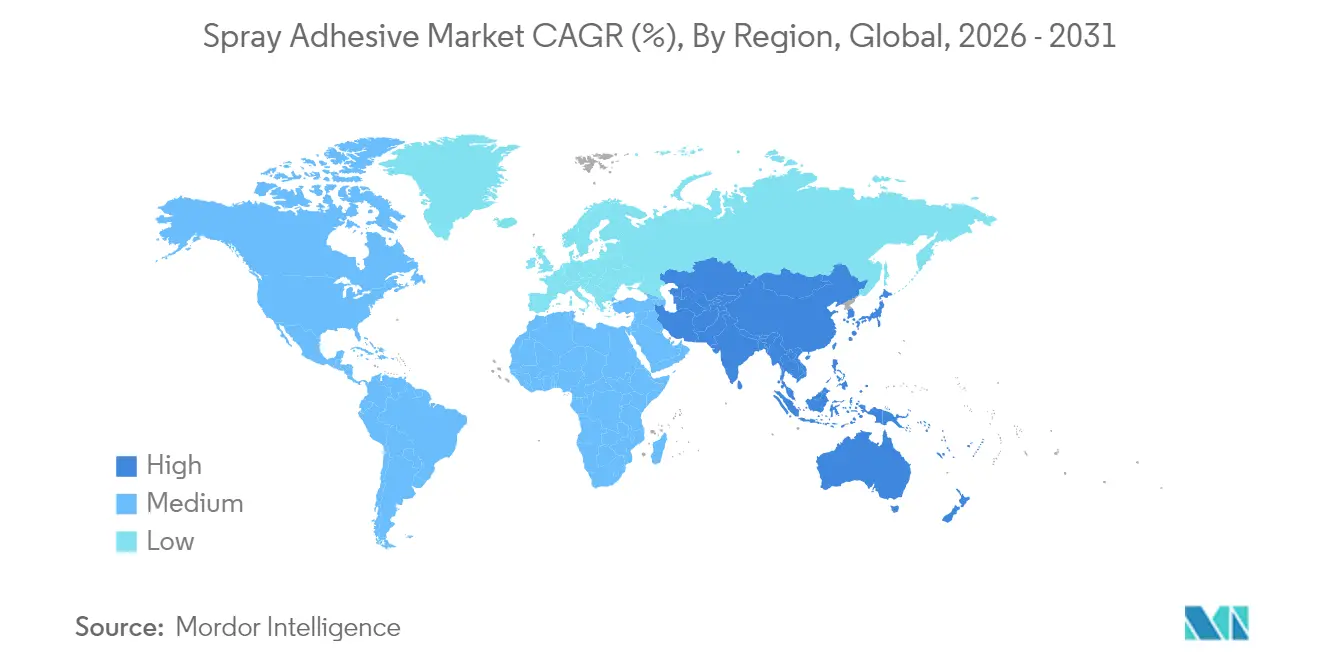
Asia-Pacific dominates with 46.30% revenue in 2025 and exhibits the fastest 5.64% CAGR outlook. China’s stimulus for affordable housing and India’s highway corridor projects ensure consistent demand for panel lamination sprays and tile adhesives. Local converters boost capacity to satisfy furniture export orders to the United States and the European Union, embedding low-VOC metrics that align with destination regulations. Japan’s electronics assemblers champion high-solids water-based sprays that reduce condensation risk on printed-circuit boards, spurring local compounders to scale formulations for subcontract partners. South Korea’s battery vertical integrates polyurethane spray lines to secure vibration isolation in high-density EV packs.
North America relies on strong residential remodeling, commercial reroofing, and resurgent domestic auto production. The Utah Department of Environmental Quality estimates a potential 4,000-ton annual VOC cuts once its consumer-product rule takes effect. This sets a compliance clock that already shifts purchase preference toward water-based canisters. Mexico’s export-oriented upholstery factories invest in automated hot-melt spray booths that boost throughput for theater seating and hospitality furniture destined for the United States. Canadian prefab home plants specify flame-retardant sprays that meet stringent provincial codes, underpinning regional diversification within the spray adhesive market.
Europe shows a mature yet innovation-driven profile. Germany’s premium auto OEMs require odor-free cockpit adhesives, steering suppliers to tailor monomer-free polyurethane dispersions. The United Kingdom’s retrofit insulation drive deploys low-emission spray foam panels secured with construction-grade water-based sprays. Sika’s CHF 11.8 billion global sales, with 7.3% growth in EMEA construction chemicals, evidence adhesive demand resilience. Italian and Polish furniture clusters automate spray lines to meet shorter lead-time expectations from online retailers. EU Green Deal policies accelerate solvent replacement, ensuring that Europe remains a reference market for sustainability in the spray adhesive market.

Value Chain Analysis
The spray adhesive value chain begins with upstream feedstocks sourced from petrochemical and bio-based streams that are converted into resins and polymers (for example polyurethane, epoxy, and VAE), plus solvents or water carriers and performance additives such as tackifiers and rheology modifiers. Across adhesives, raw materials are a major cost driver, and price volatility in building blocks like ethylene and propylene quickly translates into formulated spray adhesive pricing and margin management.
In the midstream, formulators blend and qualify sprayable systems (water-based, hot-melt, and solvent-based) and package them into aerosols, pressurized canisters, or bulk formats for automated spray equipment. Downstream channels include direct-to-OEM supply, distributors, and building-material retailers, with technical service and compatibility with nozzles and spray guns acting as differentiators. Sustainability-focused procurement and scope 3 reporting are also shaping specifications, shifting value toward suppliers that can substantiate performance while meeting low-VOC requirements.
Competitive Landscape
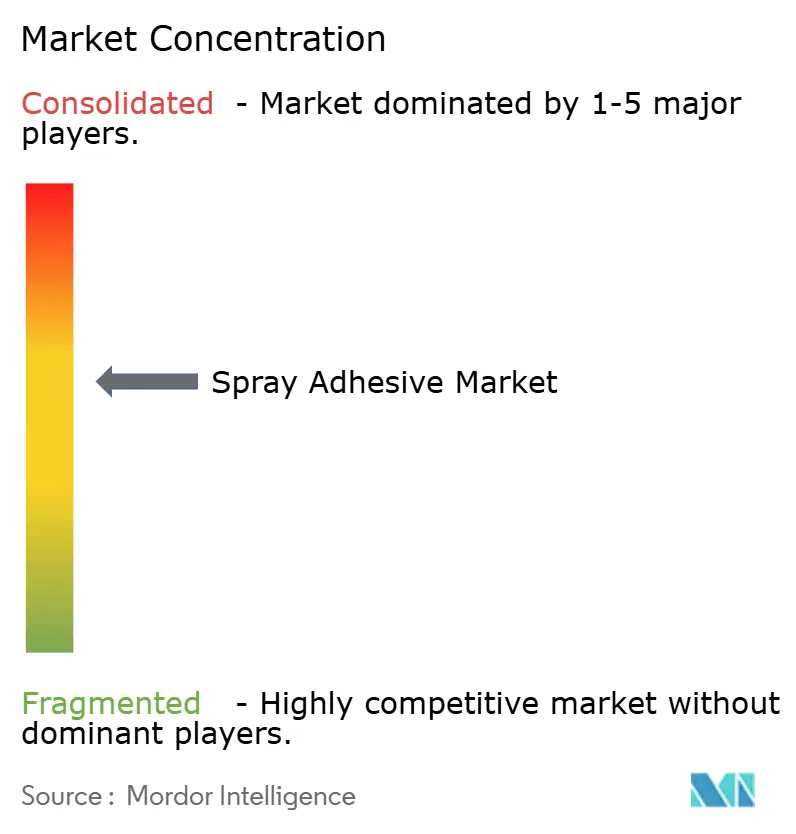
The market is moderately fragmented. Top players invest heavily in polymer research and development, scaling pilot plants for bio-based feedstocks and employing digital process controls that curb energy use. Henkel reports water-based lines capable of cutting production CO₂ by 30% compared with legacy systems. Dow’s Edison-award-winning PRIMAL CA 750 exemplifies how performance parity and allergen-free claims win orders in upholstery and foam bonding. These firms also license spray-canister technology to applicator OEMs, safeguarding downstream compatibility.
Spray Adhesive Industry Leaders
3M
Henkel AG & Co. KGaA
H.B. Fuller Company
Arkema Group (Bostik)
Sika AG
- *Disclaimer: Major Players sorted in no particular order

Market Opportunities and Future Outlook
There is a specific opportunity where low-emission performance overlaps with circularity, as brand owners and converters look for sprayable adhesives that support recyclable packaging structures and reduce solvent handling without slowing line speeds. Henkel's Loctite Liofol CS 7106 RE is an example of packaging-oriented solutions, consistent with the market shift toward water-based and hot-melt spray systems that shorten pack-out and assembly cycles in packaging and furniture.
On the supply side, capacity and portfolio moves in adjacent adhesive and feedstock ecosystems create room to localize sourcing and broaden end-use applications. Sika's acquisition of Akkim extends adhesives and sealants manufacturing reach, with production sites in Turkey and Romania, and Sonoco's USD 30 million investment expands adhesives and sealants production capacity across three facilities. BindEthics' move of a 100% bio-based, formaldehyde-free adhesive into industrial scale-up also points to demand for premium sprayable options in panels, insulation, and interior fixtures where fast tack, low odor, and compliance documentation are bundled into buying decisions.
Recent Industry Developments
- June 2026: 3M launched Ask 3M, an AI-powered tool designed to speed customer access to technical expertise, initially covering industrial adhesives and tapes. By reducing friction in product selection and troubleshooting, it strengthens service-led differentiation in applications where correct spray pattern, open time, and substrate prep materially affect bond quality.
- March 2025: A roofing adhesive using atmospheric gas technology eliminates high global-warming-potential propellants in canister systems, a development associated with H.B. Fuller. The move supports contractor adoption of lower-emissions application formats while maintaining jobsite productivity, reinforcing the shift away from legacy propellant approaches in sprayed and dispensed adhesives.
- December 2024: Arkema finalized the acquisition of Dow's flexible packaging laminating adhesives business, expanding its adhesives portfolio and positioning in packaging-converter supply chains. The added capabilities strengthen Arkema's scale in packaging adhesives where low-VOC and recyclability-aligned solutions are increasingly specified, creating competitive pressure on incumbent spray and laminate adhesive suppliers serving brand owners and converters.


Research Methodology Framework and Report Scope
Market Definition and Coverage
For this study, the spray adhesive market covers adhesives formulated to be applied as an atomized spray and sold in aerosol cans, pressurized cylinders, or bulk packs used with spray guns. Revenue is counted at the point of product sale for bonding common substrates across end uses.
Scope exclusions: We exclude non-spray contact cements and roll-on or brush-applied glues that cannot be delivered through a spray system.
Segmentation Overview
- By Type
- Solvent-based
- Water-based
- Hot-Melt
- By Resin Type
- Epoxy
- Polyurethane
- Synthetic Rubber
- Vinyl Acetate-Ethylene
- By Application
- Building and Construction
- Packaging
- Furniture
- Transportation
- Textile
- Other Applications
- By Geography
- Asia-Pacific
- China
- India
- Japan
- South Korea
- ASEAN Countries
- Rest of Asia-Pacific
- North America
- United States
- Canada
- Mexico
- Europe
- Germany
- United Kingdom
- Italy
- France
- Rest of Europe
- South America
- Brazil
- Argentina
- Rest of South America
- Middle East and Africa
- Saudi Arabia
- South Africa
- Rest of Middle-East and Africa
- Asia-Pacific
Data Sources, Market Sizing, and Validation
Desk Research
Desk research was used to set the market boundaries and to build the first set of demand and pricing assumptions. We reviewed public sources such as USITC trade statistics, UN Comtrade, US Census manufacturing data, Eurostat, and government chemical safety and regulatory publications that help track production, trade flows, and industry activity. We also used company annual reports, investor presentations, association websites, and reputed press coverage to understand end-use momentum and product positioning.
A few paid subscriptions were used only where they added structure, such as standardized company financials and news, import-export shipment-level tracking, and patent databases for sprayable adhesive technologies. These inputs were organized into a consistent time series so year-on-year movements could be explained, rather than only recorded. The desk sources noted above are illustrative, and we checked additional public documents for data collection, validation, and clarification.
Primary Interviews and Surveys
Primary work focused on validating what is actually counted as a spray adhesive sale and on tightening the price and volume drivers by product format and end use. We spoke with manufacturers, distributors, and large buyers across APAC, EMEA, and the Americas, so we could compare regional differences in adoption, packaging mix, and pricing, then reconcile them back into one model.
Distribution of primary research fieldwork respondents
| Company type | Respondent position | Region |
|---|---|---|
| Top tier: 27% | CXOs: 17% | APAC: 45% |
| Mid tier: 55% | Functional/Unit leaders: 24% | EMEA: 33% |
| Smaller Players: 18% | Managers: 59% | Americas: 22% |
Market-Sizing & Forecasting
Market size was built using a top-down approach where manufacturing output and trade movement signals are reconstructed into an addressable spray-applied adhesive demand pool, then allocated across regions using end-use activity. To keep totals realistic, we ran selective bottom-up checks using sampled supplier revenue ranges, distributor channel feedback, and simple volume times average selling price (ASP) math for common pack types.
The model uses inputs that are observable and discussable on calls, such as furniture and woodworking activity, automotive and transportation build trends, construction and renovation indicators, packaging and converting runs, and the mix shift between aerosol and bulk spray systems. Pricing was handled through an ASP ladder by pack format and resin system, with adjustments for raw material movements and confirmation via primary feedback on discounting and contract timing. For forecasting, we relied on scenario analysis supported by a short multivariate regression layer, where key demand indicators and the expected rate of substitution from alternative bonding methods are used to shape the trajectory. When bottom-up signals were missing for smaller regions or fragmented channels, we used proxy indicators and then normalized so regional totals still match global control totals.
Data Validation & Update Cycle
Outputs are checked against independent signals such as trade direction changes, packaging format mix, and visible shifts in end-use production, before the numbers are finalized. If a region shows an unusual jump, we reopen assumptions and re-contact relevant experts to confirm whether it reflects a real demand change or a timing and pricing effect.
We run a multi-step review so the model logic, inputs, and calculations stay consistent across years and regions. Reports are refreshed annually, with interim updates when major raw material shocks, regulation changes, or end-use slowdowns materially affect pricing or demand. Before delivery, a final analyst pass is completed so clients receive the most current view based on the latest available public data and field feedback.
Mordor Intelligence's Spray Adhesive Market Sizing Compared With Other Published Estimates
It is normal to see different market sizes for spray adhesives because counting rules are not always the same, even when the market name looks identical. Differences often come from what product forms are included, how pricing is converted into USD, and whether the time period is anchored on a current base year or on older historical averages.
When the model is refreshed, exchange rates and price series are re-timed to the correct year, and ASPs are rebuilt by aerosol versus bulk formats so discounting and mix shift do not get averaged away. This refresh-led discipline is also why Mordor Intelligence reports USD 3.46 B (2026). Another gap driver is scope, since some published estimates may fold in adjacent adhesive categories that are not consistently spray-applied, or they may count broader consumables alongside adhesive product revenue. Validation depth matters as well, because channel checks on aerosol versus bulk share can change the total when one format dominates specific end uses or regions.
Benchmark comparison
| Source | Market Size | Gaps in Research Methodology |
|---|---|---|
| Mordor Intelligence | USD 3.46 B (2026) | |
| Global Consultancy A | USD 6.88 B (2023) | Anchors the value on a 2023 base year and may apply broader inclusions, which can lift totals when adjacent sprayable adhesive revenues are grouped and when currency conversion is not aligned to the same timing window. |
| Industry Publisher B | USD 3.50 B (2024) | Starts from a 2024 figure and may use a simpler pricing curve across formats, which can shift the total when aerosol versus bulk mix changes and ASP progression is not rebuilt separately by pack type. |
The spread in the table is mainly explained by base-year anchoring, currency conversion timing, and how tightly the spray-applied product scope is enforced. By keeping inputs tied to visible end-use indicators and by re-checking format mix and price movements during updates, we arrive at a figure that is easier to trace back to repeatable steps and practical market signals.


Key Questions Answered in the Report
What is the current size of the spray adhesive market?
The spray adhesive market stands at USD 3.46 billion in 2026 and is projected to reach USD 4.37 billion by 2031 on a 4.81% CAGR.
Which region leads global demand for spray adhesives?
Asia-Pacific holds 46.30% of 2025 revenue and is expected to grow at 5.64% CAGR through 2031, driven by construction, furniture, and automotive output.
Why are water-based spray adhesives gaining share?
Stricter VOC limits and advancements in polymer chemistry allow water-based grades to match solvent performance while helping manufacturers comply with air-quality regulations.
Which resin is growing fastest in spray applications?
Polyurethane formulations are forecast to expand at a 5.61% CAGR from 2026-2031 due to superior bonding strength in automotive and high-temperature settings.
How do e-commerce trends influence adhesive demand?
Fulfillment centers seek fast-tack aerosol and hot-melt sprays that cut carton-sealing time, lifting operational throughput and stimulating steady adhesive consumption.
Page last updated on:


 Your data is secure and never sold or shared.


