
Market Overview
| Study Period | 2020 - 2031 |
|---|---|
| Market Size (2026) | USD 89.07 Billion |
| Market Size (2031) | USD 168.66 Billion |
| Growth Rate (2026 - 2031) | 13.62 % |
| Fastest Growing Market | Asia Pacific |
| Largest Market | Asia Pacific |
| Market Concentration | Medium |
Major Players *Disclaimer: Major Players sorted in no particular order Image © Mordor Intelligence. Reuse requires attribution under CC BY 4.0. | |
E-commerce Packaging Market Analysis by Mordor Intelligence
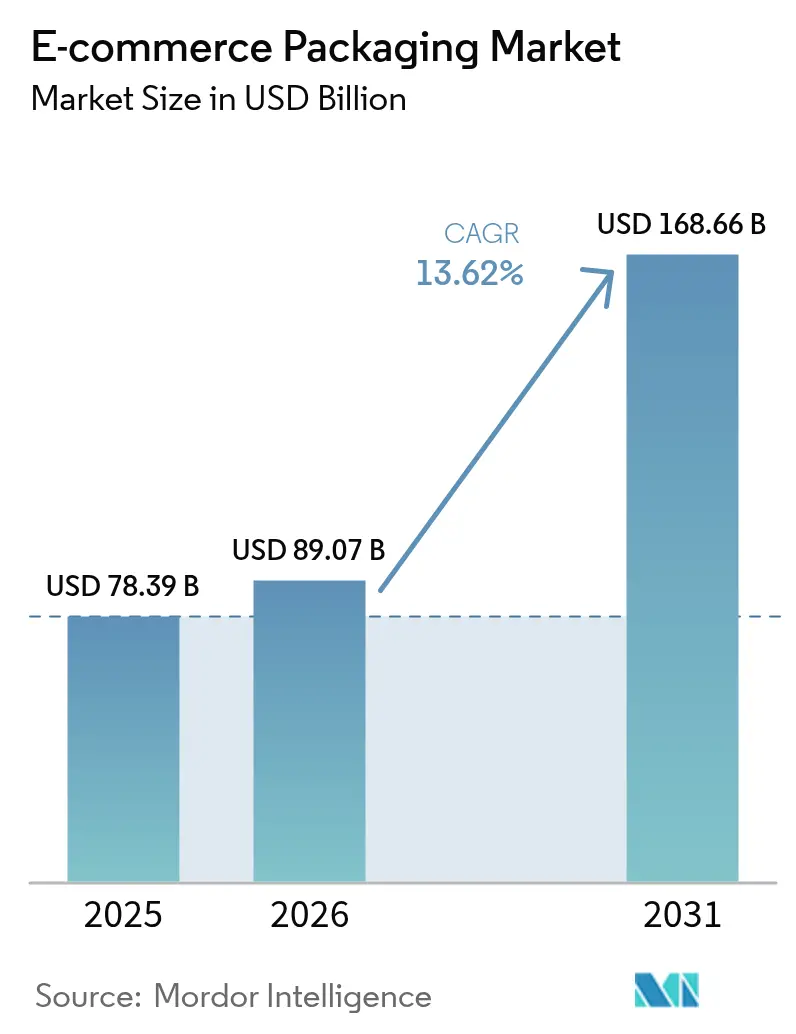
The E-commerce Packaging Market size is expected to grow from USD 78.39 billion in 2025 to USD 89.07 billion in 2026 and is forecast to reach USD 168.66 billion by 2031 at 13.62% CAGR over 2026-2031.
Volume growth stems from the surge in online retail transactions, where every single-parcel shipment replaces what was once a consolidated store delivery. Regulatory mandates that penalize difficult-to-recycle materials, coupled with rapid advances in automation and fit-to-product design software, continue to propel demand for smarter, lighter, and more sustainable packs. Material substitution toward paper, bioplastic, and mono-material flexible films is accelerating as brands align with new recycled-content quotas while still protecting goods in omnichannel logistics networks. Meanwhile, consumer expectations for premium unboxing experiences force sellers to balance aesthetics with end-of-life circularity, elevating packaging from a cost center to a revenue-generating brand asset[1]Sustainable Packaging Coalition, “Protective Packaging Design Guide,” sustainablepackaging.org.
Key Report Takeaways
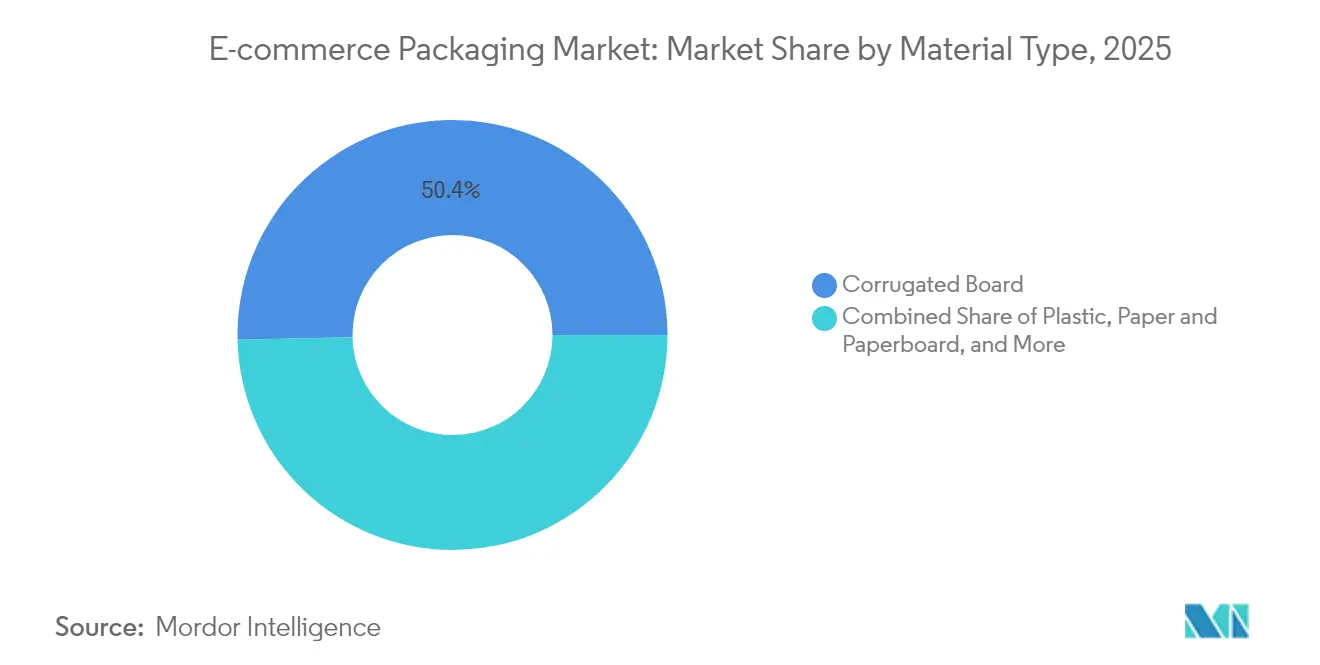
- By material type, corrugated board held 50.35% of the e-commerce packaging market share in 2025, while bioplastics are forecast to expand at a 14.72% CAGR through 2031.
- By packaging format, boxes and cartons delivered 61.20% of the e-commerce packaging market size in 2025; protective void-fill and cushioning systems are advancing at a 15.95% CAGR to 2031.
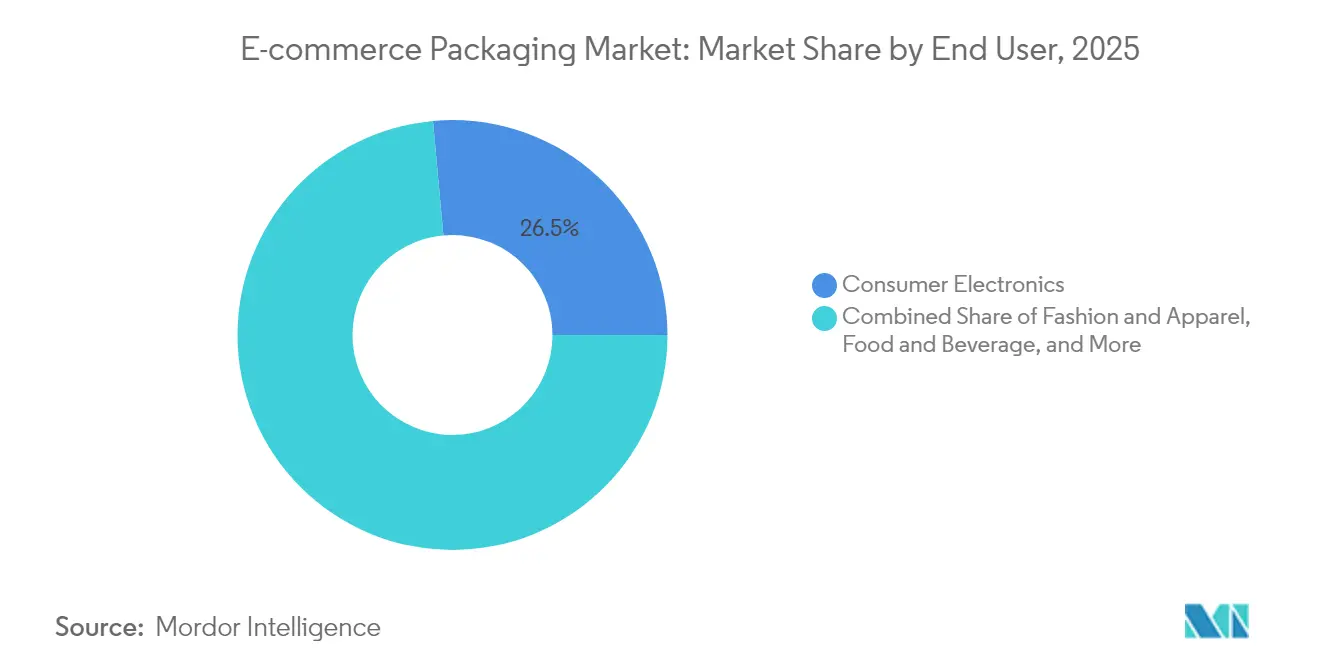
- By end user, consumer electronics accounted for 26.45% of the e-commerce packaging market size in 2025; grocery and quick-commerce are set to grow the fastest at a 14.55% CAGR between 2026 and 2031.
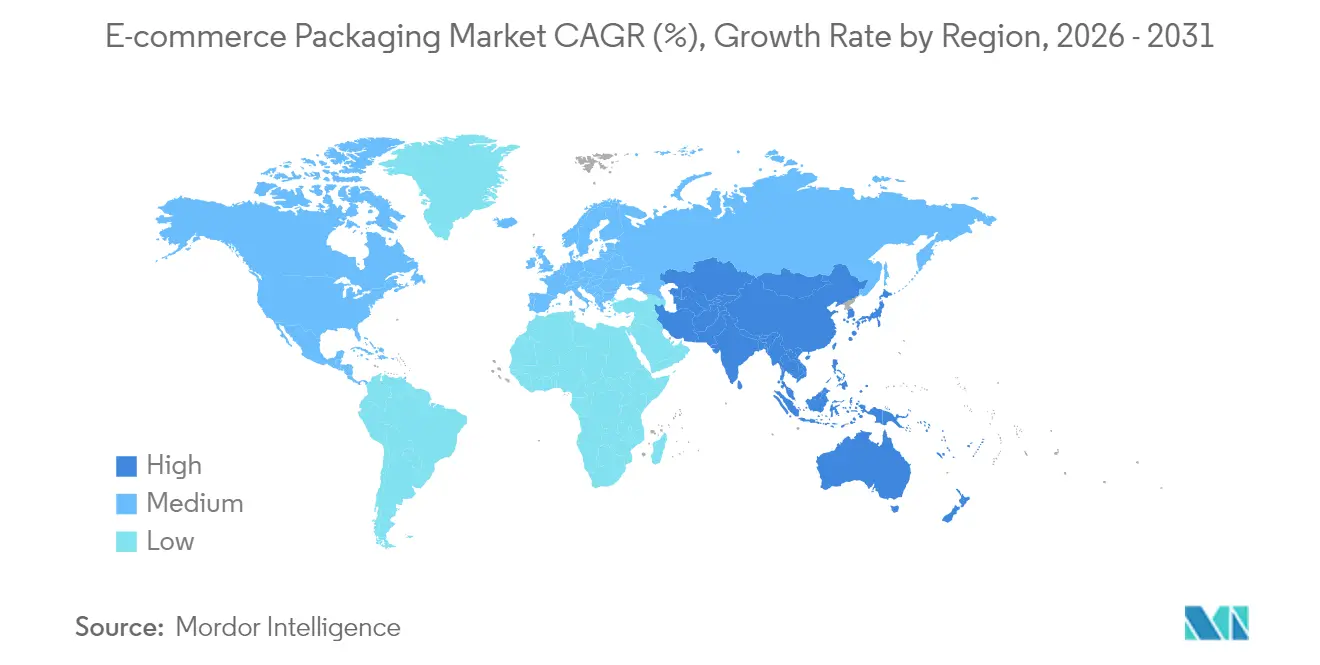
- By geography, Asia Pacific commanded 51.30% revenue share of the e-commerce packaging market in 2025 and is expanding at a 15.39% CAGR to 2031.
Note: Market size and forecast figures in this report are generated using Mordor Intelligence’s proprietary estimation framework, updated with the latest available data and insights as of 2026.
Market Trends and Insights
Drivers Impact Analysis of E-commerce Packaging Market*
| Driver | (~) % Impact on CAGR Forecast | Geographic Relevance | Impact Timeline |
|---|---|---|---|
| Explosive growth of online retail GMV | +3.20% | Global, APAC leading | Short term (≤ 2 years) |
| Shift toward lightweight and flexible formats to cut DIM-weight charges | +2.10% | North America and the EU first movers, spreading to APAC | Medium term (2–4 years) |
| Sustainability regulations are accelerating paper and bio-based adoption | +2.80% | EU core, North America following, APAC selective | Medium term (2–4 years) |
| “Unboxing experience” as a brand-engagement channel | +1.40% | Global, premium segments concentrated in developed markets | Long term (≥ 4 years) |
| AI-enabled fit-to-product automation that reduces material waste | +1.90% | North America and EU early adoption, APAC scaling | Medium term (2–4 years) |
| Rapid rise of quick-commerce and subscription retail | +2.40% | Urban centers worldwide, India and China strongest | Short term (≤ 2 years) |
| Source: Mordor Intelligence | |||
Explosive Online Retail GMV Growth
E-commerce gross merchandise value continues to climb in double digits worldwide, and every incremental order ships in its protective pack, multiplying packaging demand faster than headline retail sales. China’s 165 cross-border pilot zones alone processed nearly 20 million packages daily in 2024, underscoring how country-level GMV expansion directly fuels corrugated and mailer consumption. Urban India’s quick-commerce operators now target 10-to-15-minute grocery delivery windows, raising packaging-to-product ratios because fragile fresh items ship individually rather than in bulk crates. Subscription commerce further amplifies volumes as recurring shipments deliver monthly replenishments in branded cartons. Longer trade lanes in cross-border commerce, from Shenzhen fulfilment hubs to Western consumers, elevate the need for thicker flute grades and engineered cushioning that can withstand multi-modal handling. These volume and performance shifts anchor the growth trajectory of the global e-commerce packaging market.
Shift Toward Lightweight and Flexible Formats
Courier dimensional-weight pricing penalizes half-empty cartons, pushing sellers to adopt right-sized mailers, collapsible pouches, and gusseted bags that shave airspace and freight spend. Amazon’s on-demand packaging initiative trimmed shipping damage 24% and cut outbound freight costs 5% by pairing machine-learning software with auto-baggers that seal film around each order. Lower-margin categories such as fast-fashion rely on flexible poly-mailers to keep packaging costs below 5% of product value, while mono-material films answer recyclability rules without sacrificing density gains. Early adoption is strongest in the United States and Europe, but the trend accelerates in Asia Pacific, where last-mile costs can exceed 30% of total logistics spend. As couriers tighten volumetric pricing, lightweight formats are likely to capture an increasing share of the e-commerce packaging market.
Sustainability Regulations Accelerating Paper and Bio-Based Adoption
The European Union’s Packaging and Packaging Waste Regulation, enacted in January 2025, mandates 30% recycled content in all plastic packs by 2030, with eco-modulated EPR fees penalizing non-recyclable formats. Complying firms turn toward paper-based wraps and bio-based polymers to sidestep fee multipliers, catalysing the “paperization” of e-retail packaging. Patagonia replaced virgin fiber shipping boxes with agricultural-waste molded fiber, slashing forest resource use while satisfying curbside-recycling requirements. Similar frameworks in California, Oregon, and Colorado extend fee structures to North America. Early movers gain supply-chain credibility and avert future market-access hurdles, giving sustainability regulations one of the highest positive impacts on e-commerce packaging market growth.
Unboxing Experience as a Brand Channel
Packaging now doubles as both shipper and storyteller. H&M’s redesigned paper mailers eliminated 2,000 tons of annual plastic while adding printed interior graphics that elevate customer experience. Luxury D2C labels embed NFC chips inside rigid boxes to authenticate goods and spark post-purchase digital engagement. Social platforms amplify these efforts, with “unboxing” videos repeatedly ranking among top e-commerce content views. As user-generated content becomes a low-cost marketing multiplier, even value retailers introduce branded tissue and variable-print box liners. The dual need for aesthetic appeal and recyclability, however, forces brands to invest in water-based inks, debossing, and mono-material adhesives to maintain end-of-life compatibility. This push–pull dynamic around beauty and responsibility underpins premium-segment growth within the broader e-commerce packaging market.
Restraints Impact Analysis of E-commerce Packaging Market*
| Restraint | (~) % Impact on CAGR Forecast | Geographic Relevance | Impact Timeline |
|---|---|---|---|
| Plastic bans and EPR fees are increasing compliance costs | -1.80% | EU primary, ripple to global supply chains | Short term (≤ 2 years) |
| Kraft paper and resin price volatility | -2.30% | Global, North America, and Europe are the most exposed | Short term (≤ 2 years) |
| Cross-border damage and return rates | -1.10% | Global trade routes | Medium term (2–4 years) |
| Carbon-footprint audits amid data gaps | -0.90% | Developed markets | Long term (≥ 4 years) |
| Source: Mordor Intelligence | |||
Stringent Plastics Bans and EPR Fees Inflate Costs
Extended Producer Responsibility schemes levy fees that vary with each material’s real-world recyclability, doubling the cost of difficult-to-recycle multilayer pouches in some EU markets. California’s Plastic Pollution Prevention Act tags flat fees on every kilogram of packaging sold, compelling brands to overhaul portfolios or absorb penalties. Smaller online sellers lacking regulatory staff struggle to complete fee filings, tilting competitive advantage toward integrated players that can spread compliance fixed costs across higher volumes. These financial headwinds pare back the potential CAGR of the e-commerce packaging market over the next two years.
Kraft Paper and Resin Price Volatility Squeezes Margins
Energy spikes and mill downtimes lifted North American linerboard prices by USD 70 per ton in early 2025, forcing box plant margins below historical 10% thresholds. Flexible-film converters faced 12% resin price swings during the same quarter as Gulf Coast cracker outages tightened supply. With packaging often capped at 3–8% of a product’s landed cost, brand owners face trade-offs between absorbing price hikes or passing them to consumers, which could soften demand. Such volatility constrains investment in capacity expansions and slows material conversion in the e-commerce packaging industry.
*Our forecasts treat driver/restraint impacts as directional, not additive. The impact forecasts reflect baseline growth, mix effects, and variable interactions.
E-commerce Packaging Market Segment Analysis
By Material Type:
Bioplastics Drive Innovation Despite Corrugated DominanceCorrugated board captured 50.35% of the e-commerce packaging market in 2025 thanks to cost efficiency, high stacking strength, and near-universal curbside recyclability. The segment continues to benefit from China’s national express-packaging quality standard, which formalizes corrugate flute grades for domestic and export shipments. Meanwhile, bioplastics form the fastest-growing material group at a 14.72% CAGR through 2031, reflecting both regulatory tailwinds and shifting consumer sentiment. Converters blend PLA with post-consumer recyclate to create mailers that meet EU 30% recycled-content thresholds without compromising tensile performance. Investments in scalable fermentation facilities across Southeast Asia will gradually lower bio-resin premiums, enabling wider uptake beyond premium cosmetics and organic food sellers.
Brand owners balance corrugated’s reliable protection with renewable alternatives to reduce Scope 3 emissions. Although corrugate commands volume, bioplastics bring differentiation; D2C electronics sellers tout compostable film shrink sleeves as a visible sustainability upgrade. Traditional PE and PP operators respond by designing mono-material variants compatible with mechanical recycling, seeking to defend their share. The coexistence of renewable and fossil-based polymers signals a transition, not an overnight swap, ensuring both material clusters remain essential to the e-commerce packaging market.



By Packaging Format:
Protective Solutions Outpace Traditional BoxesBoxes and cartons generated 61.20% of the e-commerce packaging market size in 2025, reflecting their versatility across SKUs from apparel to small appliances. Yet protective systems, void-fill cushions, molded pulp, and air pillows are expanding at a 15.95% CAGR as retailers tackle returns tied to in-transit damage. U.S. consumer goods firms spent nearly USD 1 billion on damage-related write-offs in 2024, incentivizing thicker padding and engineered inserts that drop breakage rates below 1%. Parallel growth in flexible mailers for fashion items displaces rigid cartons, reducing cube waste and last-mile CO₂ emissions.
Cold-chain e-grocery further intensifies demand for specialized insulation. Temperature-controlled parcels for frozen meals and biologic drugs require phase-change liners that keep contents between 2 °C and 8 °C for 48 hours, pushing protective packaging revenues upward. Automated kitting lines now combine right-sized corrugated shells with on-demand air cushions, balancing performance and throughput. Integrated format portfolios give converters an edge, enabling them to service multiple needs under a single contract and strengthen their position within the e-commerce packaging industry.
By End User:
Quick-Commerce Transforms Grocery PackagingConsumer electronics remained the largest buyer group with 26.45% e-commerce packaging market share in 2025, driven by high average order values and the need for multi-layer protection. Phones, laptops, and gaming consoles travel through lengthy parcel networks, making anti-static bags and custom EPS corner blocks indispensable. Apparel follows closely, but it is the grocery and quick-commerce channel that accelerates fastest at a 14.55% CAGR to 2031. Rapid ultrafast deliveries in dense metros favor leak-proof paper bags coated with bio-waxes that resist condensation from refrigerated goods. Urban dark-store operators ship hundreds of micro-orders per hour, necessitating ergonomic tote-to-bag transfer stations and slim nested crates. Meal-kit companies, another growth node, integrate QR codes on ice-packs for end-user disposal instructions, marrying food safety with sustainability education. Cosmetics and personal-care brands invest in premium unboxing; rigid board boxes wrapped in printed kraft provide tactile cues that reinforce luxury positioning. Each vertical thus imposes distinct functional and branding requirements, sustaining product-development pipelines throughout the e-commerce packaging market.
Geography Analysis
APAC E-commerce Packaging Market
Asia Pacific led the e-commerce packaging market with a 51.30% revenue share in 2025 and is scaling at a 15.39% CAGR through 2031. China’s national standard GB 43352-2023 defines mandatory performance metrics for express packs, driving uniform quality expectations across 6 million active online sellers. Concurrently, India’s quick-commerce sales triple between 2025 and 2030, elevating demand for lightweight yet durable bags that perform in monsoon humidity. Southeast Asian marketplaces adopt similar rules, leveraging paper cushioning to cut plastic waste, reinforcing regional momentum.
North America E-commerce Packaging Market
North America ranks second. California’s plastic-source-reduction targets and Canada’s ban on difficult-to-recycle foam prompt accelerated substrate shifts. Fulfilment centers invest in AI-driven box-selection tools that trim corrugated usage by 12%, supporting both cost and sustainability goals. The United States also incubates cold-chain innovations as online grocery penetration touches 16% in 2025, spurring demand for temperature-stable liners across food and pharma.
EMEA E-commerce Packaging Market
Europe remains the global test bed for circularity, with the PPWR’s recycled-content and reuse mandates shaping formats that eventually scale worldwide. Retailers in Germany pilot returnable e-grocery crates that cut single-use packs by 80% in dense urban districts. Elsewhere, the Middle East and Africa trail in adoption but record double-digit gains as cross-border platforms extend logistics footprints. Infrastructure gaps and customs complexities temper volume, yet rising smartphone penetration unlocks long-run upside, embedding emerging regions in future expansion of the e-commerce packaging market.

Regulatory Landscape
The regulatory environment for e-commerce packaging is tightening around recyclability, space efficiency, and substantiation of environmental claims. In the European Union, Regulation (EU) 2025/40, the Packaging and Packaging Waste Regulation (PPWR), entered into force on February 11, 2025 and applies from August 12, 2026, replacing directive-style flexibility with directly applicable requirements that affect material choices and pack design for cross-border e-commerce flows.
Beyond recycled-content and EPR-linked requirements, PPWR also adds design-facing constraints relevant to parcel shipping, including a maximum 50% empty-space ratio for economic operators filling e-commerce, grouped, or transport packaging tied to implementing acts and a 2030 compliance horizon. The European Commission issued PPWR guidance in 2026 to support consistent application across Member States, and in the United States the Federal Trade Commission Green Guides review process (initiated via Federal Register notice in 2022) continues to shape how brands substantiate recyclability and other sustainability claims on e-commerce packs and marketing materials.
Value Chain Analysis
The e-commerce packaging value chain runs from upstream feedstocks, including kraft linerboard, recycled fiber, and polymer resins (including bio-based inputs), through conversion activities such as corrugated box manufacturing, flexible-film extrusion and converting, molded-fiber production, and protective packaging manufacture. Downstream, fulfillment centers, 3PLs, and brand owners specify pack formats and printing, and those requirements increasingly reflect what can be executed efficiently at scale in distribution and returns processes.
Compliance and automation are becoming value-chain enablers rather than optional features. In 2026, CJ Logistics deployed AI-based overpackaging detection across 26 fulfillment centers to reduce empty space. Software tools such as Fraunhofer IML and Igepa Group's CASTN SaaS optimize carton box sets to support space-efficiency rules. Material innovation is also moving upstream through partnerships and alternative inputs, including Amazon's initiative with IIT Roorkee to convert agricultural waste into biodegradable packaging materials, along with molded-pulp platforms like Specialized Packaging Group's EcoFlex, which targets foam replacement with recycled fibers and faster tooling cycles.
Competitive Landscape
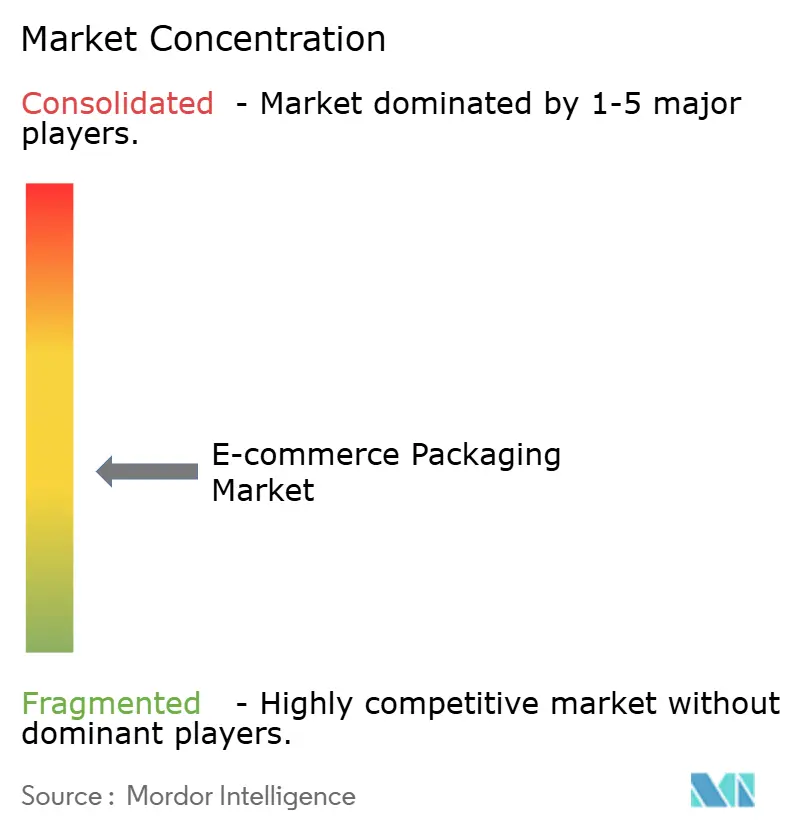
The e-commerce packaging market features moderate fragmentation, yet consolidation is quickening as compliance costs rise. Amcor closed a USD 8.4 billion all-stock deal for Berry Global in April 2025, creating a USD 24 billion revenue champion with deep flexible-film and specialty carton portfolios. Three months earlier, International Paper acquired DS Smith, targeting USD 514 million in synergies and expanding its European corrugated reach. Smurfit Kappa merged with WestRock in 2024, forming Smurfit WestRock and instantly commanding more than 500 converting plants across 40 nations.
Scale matters because upcoming EPR fees demand life-cycle data and closed-loop infrastructure investments often out of reach for smaller independents. Leading groups deploy digital twins and SaaS configurators that model cube, weight, and emissions trade-offs in real time, helping clients hit both budget and ESG targets. Meanwhile, midsize specialists carve footholds in cold-chain and reusable packaging niches; Spanish startup Cool Chain’s nine-day gel-pack solution extends delivery radii for meal-kit firms, underscoring how performance-driven sub-segments can defend pricing power even as commodity corrugate margins compress.
Sustainability credentials shape buyer shortlists. Recycled-content display boxes, water-based inks, and certified-compostable mailers differentiate offerings. However, input-cost volatility threatens profitability. Vertically integrated majors hedge Kraft-Liner risk via captive paper mills, whereas converters reliant on external supply juggle spot purchases and pass-through clauses. As regulators and marketplaces raise the bar on recyclability disclosures, technology partnerships, not just raw capacity, will likely dictate future share shifts inside the e-commerce packaging industry.
E-commerce Packaging Industry Leaders
Amcor PLC
Mondi PLC
International Paper Company
Smurfit Kappa Group PLC
DS Smith PLC
- *Disclaimer: Major Players sorted in no particular order
E-commerce Packaging Market Companies Covered in this Report
- Amcor plc
- Mondi plc
- International Paper
- Smurfit Kappa Group
- DS Smith plc
- WestRock Company
- Georgia-Pacific LLC
- Sealed Air Corporation
- Ranpak Holdings Corp.
- Pregis LLC
- Klabin SA
- Rengo Co. Ltd
- Stora Enso Oyj
- Nippon Paper Industries
- Oji Holdings
- Ranpak Holdings Corp
- Packhelp SA
- Shorr Packaging Corp.
- Packsize Intl.
- Packsize International

Market Opportunities and Future Outlook
Design constraints and documentation requirements are creating demand for right-sizing automation, empty-space detection, and compliance-ready packaging specification workflows, particularly as the EU PPWR begins applying from August 12, 2026. PPWR includes an empty-space cap that reaches 50% for filled e-commerce packaging in the run-up to 2030, which is shifting more decision-making into fulfillment operations. In that setting, AI-driven pack selection, carton-set optimization tools, and standardized packaging libraries help reduce dimensional-weight penalties while aligning with labeling and reporting expectations.
Circular and reusable models are also moving beyond limited pilots in specific lanes through named programs and partnerships. In March 2026, FedEx and Returnity launched a reusable B2B box solution designed for up to 50 shipment cycles, pointing to a commercial pathway for closed-loop packaging across repeat shipping networks. On materials and capacity, Amazon's February 2026 partnership with IIT Roorkee targets biodegradable materials from agricultural waste for India fulfillment. Film and flexible-packaging capacity plans are also moving ahead, including Oben Group's June 2026 agreement for a 12-meter BOPP line (94,000 metric tons annual capacity) and Amcor's July 2026 Dongguan facility expansion project, both aimed at supporting lighter-weight, higher-throughput e-commerce formats.
Recent Industry Developments in E-commerce Packaging Market
- June 2026: Amcor partnered with UK-based startup Kelpi to evaluate seaweed-based materials for coating technologies in fiber packaging. The collaboration targets next-generation barrier performance on fiber substrates, supporting the shift toward paper-based e-commerce formats under recyclability and circularity requirements.
- April 2025: Mondi completed the acquisition of Schumacher Packaging's Western Europe operations, adding over 1 billion square meters of packaging capacity. The deal broadened Mondi's regional converting footprint and increased scale for serving high-volume corrugated demand from e-commerce and omnichannel supply chains.
- November 2024: Smurfit Kappa merged with WestRock to form Smurfit WestRock, creating a larger integrated packaging supplier with an expanded converting network. The combination strengthens end-to-end capabilities in corrugated and fiber-based packaging used across parcel shipping and retail-ready e-commerce applications.


E-commerce Packaging Market Report Scope and Research Methodology
Market Definition and Coverage
The e-commerce packaging market, for this methodology, covers packaging products used to pack, protect, and ship items bought through online channels, including outer packs and protective formats used across parcel networks.
Scope exclusions: We exclude non-shipping retail shelf packaging that does not enter the e-commerce fulfillment and parcel delivery flow.
Segments Covered in This Report
- By Material Type
- Plastic
- Paper and Paperboard
- Corrugated Board
- Flexible Films and Mailers
- Bioplastics
- Others
- By Packaging Format
- Boxes and Cartons
- Mailers and Envelopes
- Protective Packaging (void-fill, cushioning, liners)
- Labels, Tapes and Closures
- Specialty/Returnable Systems
- By End User
- Fashion and Apparel
- Consumer Electronics
- Food and Beverage
- Personal Care and Cosmetics
- Grocery and Quick-Commerce
- Home and Living/Furniture
- Other Online Retailers
- By Geography
- North America
- United States
- Canada
- Mexico
- South America
- Brazil
- Argentina
- Rest of South America
- Europe
- United Kingdom
- Germany
- France
- Italy
- Rest of Europe
- Asia-Pacific
- China
- India
- Japan
- South Korea
- Rest of Asia-Pacific
- Middle East and Africa
- United Arab Emirates
- Saudi Arabia
- South Africa
- Rest of Middle East and Africa
- North America
Data Sources, Market Sizing, and Validation
Desk Research
Desk research was used to define the demand pool and shipment packaging context before any number-building was finalized. We pulled public data on e-commerce activity, parcel flows, and packaging materials so the model inputs were tied to what can be observed and reproduced.
The reference set included non-paywalled sources such as national statistics offices and customs portals for trade and price direction, postal and parcel regulator publications where available, and trade association pages for paper, corrugated, and plastics (including sustainability and recycling data). We also used peer-reviewed packaging and materials literature to sanity-check typical pack weights and performance requirements. Company filings, earnings decks, and reputable press were then used to understand capacity additions, pricing commentary, and mix shifts. A paid subscription for company financials and intelligence, and where helpful a patent database, were used selectively to validate revenue exposure and innovation direction. These desk sources are illustrative, and additional public references were also used to collect, cross-check, and clarify data points.
Primary Interviews and Surveys
Primary work centered on packaging converters, material suppliers, logistics and fulfillment stakeholders, and large buyer-side users that shape pack design and order profiles. We ran expert interviews and structured surveys across APAC, EMEA, and the Americas to confirm volume drivers, price movement, and substitution patterns. Where assumptions showed higher variance, we rechecked them iteratively until the totals aligned with operating signals from shipping and fulfillment.
Distribution of primary research fieldwork respondents
| Company type | Respondent position | Region |
|---|---|---|
| Top tier: 29% | CXOs: 15% | APAC: 44% |
| Mid tier: 56% | Functional/Unit leaders: 39% | EMEA: 35% |
| Smaller Players: 15% | Managers: 46% | Americas: 21% |
Market-Sizing & Forecasting
Sizing starts with a top-down build, where e-commerce order activity and parcel shipment intensity are translated into packaging demand using pack format usage and average pack weight assumptions. Value is then calculated using blended pricing by material and format. Because the same order can trigger different packaging needs, we handled mix carefully, especially corrugated box share versus mailers, and protective packaging intensity by category.
For a practical model, we focused on a limited set of inputs that could be defended in a client discussion, including e-commerce penetration by region, parcel volume growth, average items per shipment, right-sizing adoption, and material price direction for paper, corrugated, and plastics. Forecasts were developed using scenario analysis supported by the direction and magnitude shared in interviews, and smoothed where needed to avoid short-term volatility creating unrealistic jumps. Bottom-up approximations were used selectively, including supplier revenue exposure checks and ASP times volume spot-checks. When a country-level indicator was missing, we handled the gap with conservative proxy ratios from similar markets.
Data Validation & Update Cycle
Outputs were checked against independent signals, including packaging material demand direction, capacity and utilization commentary, and trade or pricing movement that should broadly track the modeled trend. If a region or material line showed an outlier change, we reopened the assumptions and reran revalidation using follow-up checks, then completed a second analyst review before sign-off.
The report is refreshed annually, with interim updates added when material events occur, including sharp input cost shifts, major regulation changes on packaging, or large capacity moves. Before delivery, we perform a final pass to make sure the numbers align with the latest available public indicators and the validated takeaways from interviews.
Mordor Intelligence's E Commerce Packaging Market Sizing Compared With Other Published Estimates
Published market sizes for e-commerce packaging often differ, even when they appear to describe the same space, because each publisher makes different choices on what products count and how the base year is defined. Differences also come from how pricing is applied, how quickly mix is assumed to shift, and whether regional totals are reconciled back to observable shipping activity.
The main gap is whether items like tapes and some retail-use packaging are included in the total. Mordor Intelligence treats e-commerce packaging as shipping and protective formats tied to online order fulfillment, then prices it using a blended material and format mix that is rechecked against current-year interview inputs.
Benchmark comparison
| Source | Market Size | Gaps in Research Methodology |
|---|---|---|
| Mordor Intelligence | USD 89.07 B (2026) | |
| Trade Publisher A | USD 76.90 B (2024) | Uses an earlier base year and a broader product list that can include tapes and some adjacent shipping supplies, which changes the included value pool and dampens comparability to a 2026-priced mix. |
| Industry Research Group B | USD 76.00 B (2024) | Lists wide segment buckets (material, end-user, packaging, channel) but provides limited clarity on fulfillment-only versus general retail packaging overlap, and base-year currency and pricing assumptions can materially alter totals. |
Looking across the table, much of the spread comes from year alignment and how each publisher scopes packaging around an online order. When scope is kept tied to fulfillment shipping packs and the price-mix is refreshed with real market checks, the resulting total is easier to trace and repeat across regions and time.


Key Questions Answered in the Report
What is the current value of the e-commerce packaging market?
The e-commerce packaging market is valued at USD 89.07 billion in 2026.
How fast is the e-commerce packaging market expected to grow?
It is forecast to grow at a 13.62% CAGR, reaching USD 168.66 billion by 2031.
Which region leads the e-commerce packaging market?
Asia Pacific holds the leading position with 51.30% revenue share in 2025 and the highest growth outlook through 2031.
Which material accounts for the largest volume in e-commerce packaging?
Corrugated board remains the dominant material, capturing 50.35% of global volume in 2025.
Why are protective packaging formats gaining momentum?
Retailers focus on damage reduction, with void-fill and cushioning solutions growing at a 15.95% CAGR as they cut returns and enhance customer experience.
How are regulations influencing material choices?
EU and North American recycled-content mandates push brands toward paper and bio-based alternatives that avoid escalating EPR fees while supporting circular-economy goals.
Page last updated on:


 Your data is secure and never sold or shared.


