
Market Overview
| Study Period | 2021 - 2031 |
|---|---|
| Forecast Data Period | 2026 - 2031 |
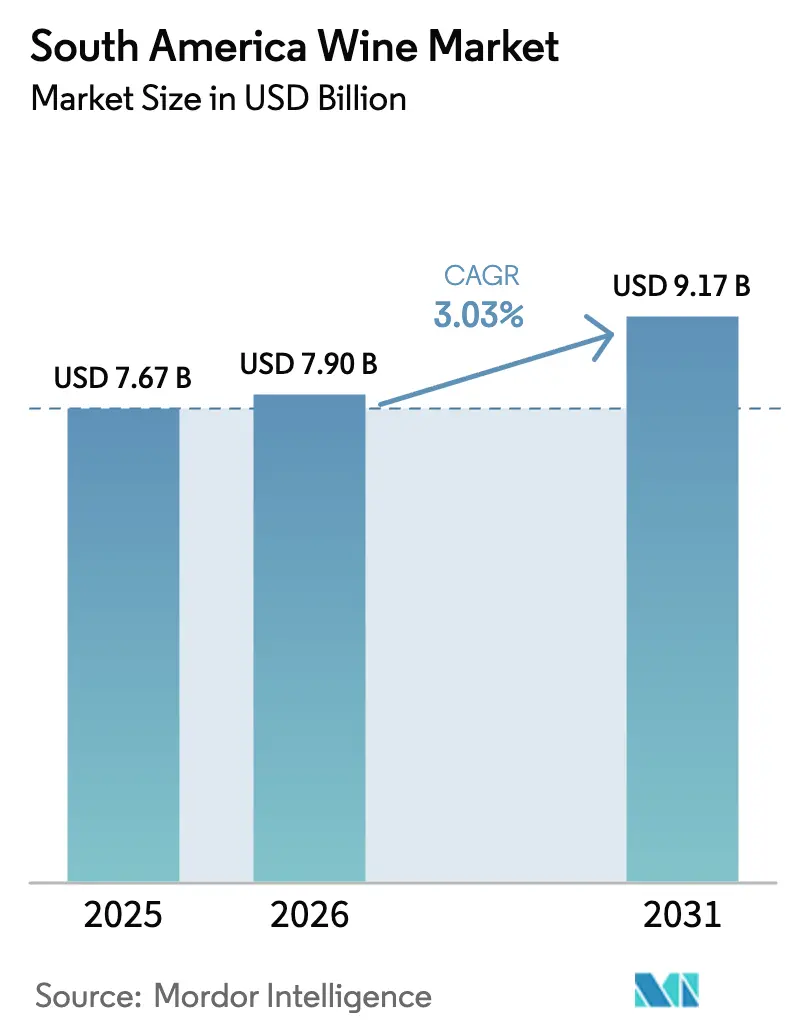
| Base Year Market Size (2025) | USD 7.67 Billion |
| Market Size (2026) | USD 7.90 Billion |
| Market Size (2031) | USD 9.17 Billion |
| Growth Rate (2026 - 2031) | 3.03 % |
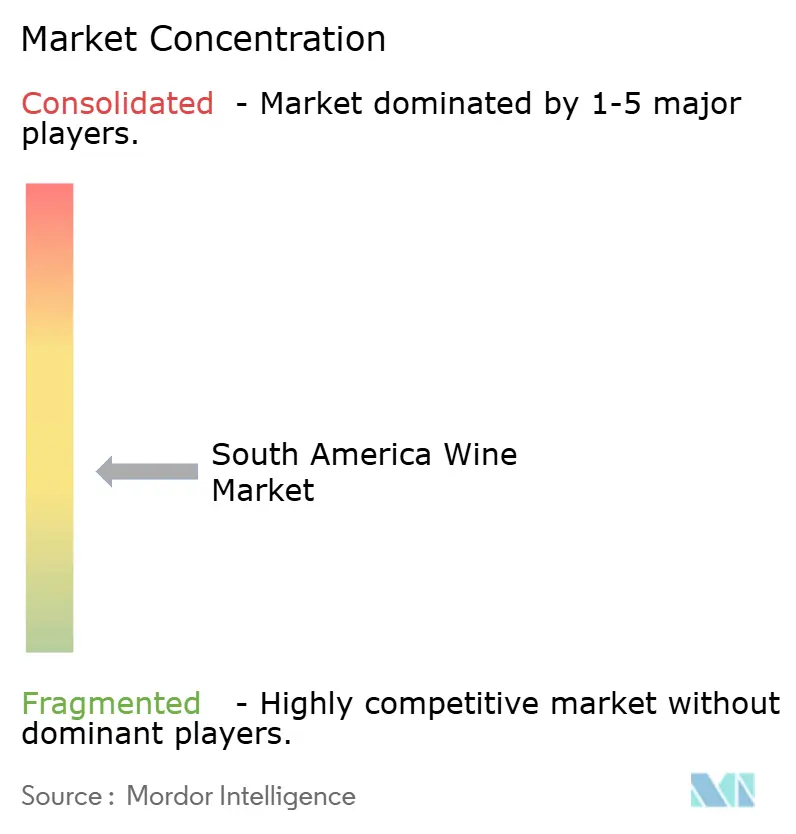
| Market Concentration | Medium |
Major Players
*Disclaimer: Major Players sorted in no particular order Image © Mordor Intelligence. Reuse requires attribution under CC BY 4.0. |
|
South America Wine Market Analysis by Mordor Intelligence
The South America wine market was valued at USD 7.67 billion in 2025 and is expected to reach USD 7.90 billion in 2026, with projections indicating it will grow to USD 9.17 billion by 2031, registering a CAGR of 3.03% during the forecast period. Key factors driving this growth include increasing premiumization, an expanding export footprint supported by tariff-reducing trade agreements, and rising female participation in wine consumption. Currency depreciation in Argentina and Chile has enhanced export competitiveness, although adverse weather conditions and water scarcity pose operational risks for growers. To address these challenges, producers are investing in water-efficient drip irrigation systems, direct-to-consumer sales channels, and wine-route tourism to mitigate the impact of rising input costs. Additionally, sparkling wine and rosé styles are emerging as faster-growing segments, reflecting global premium-occasion trends that have reached South America later than Europe or North America.
Key Report Takeaways
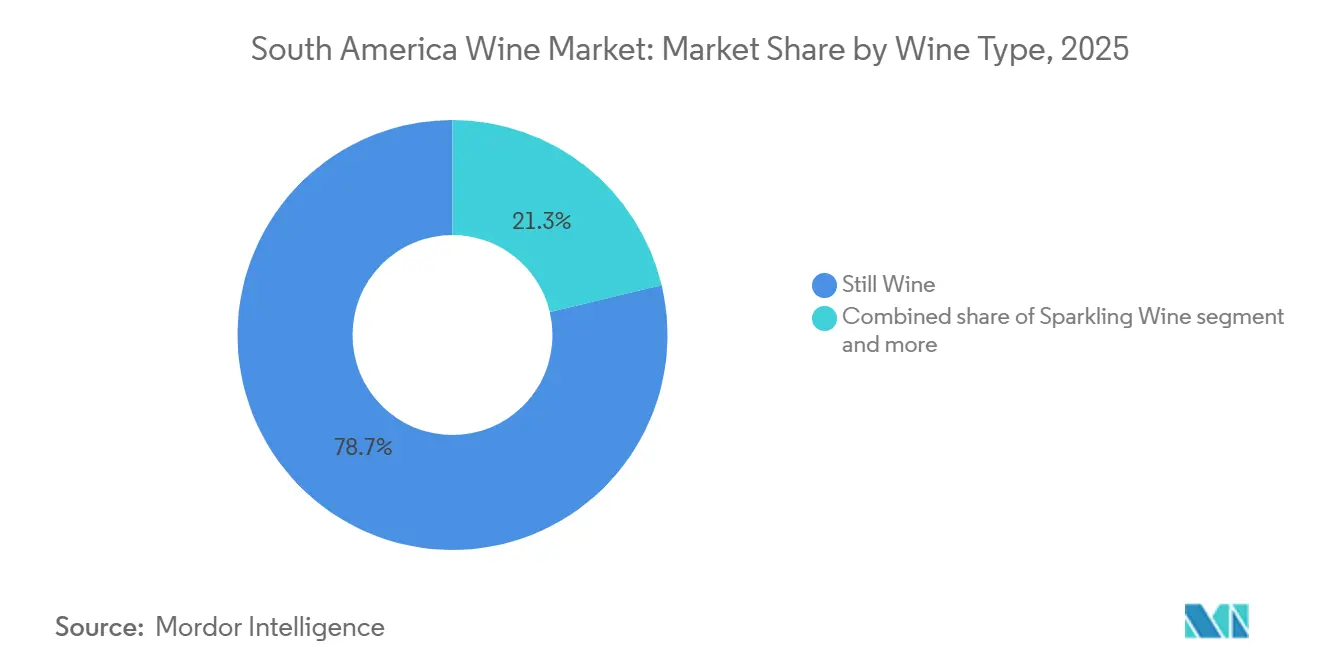
- By wine type, still wine led with 78.71% of the South America wine market share in 2025, while sparkling wine is forecast to post the fastest 3.95% CAGR through 2031.
- By color, red wine accounted for 56.10% share of the South America wine market size in 2025; rosé is on track for a 5.09% CAGR between 2026 and 2031.
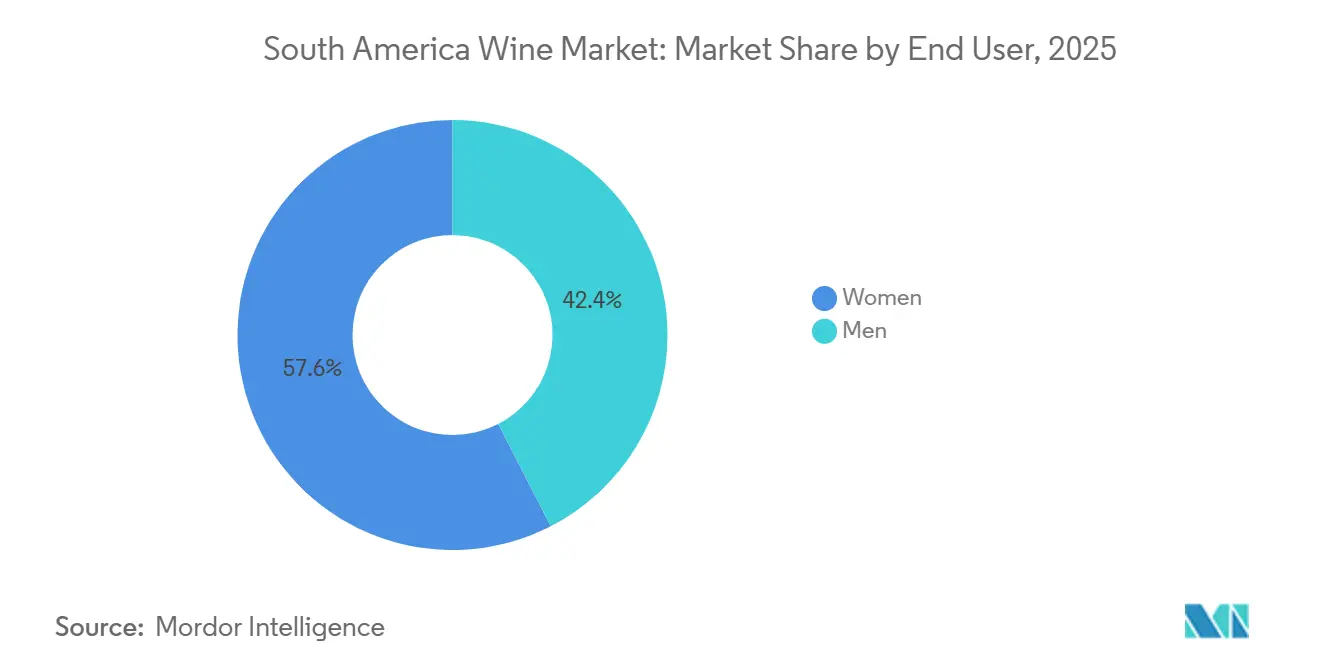
- By end user, women represented 57.56% of volume in 2025, and the men segment is projected to expand at a 3.89% CAGR to 2031.
- By distribution channel, off-trade captured a 70.38% share in 2025, yet on-trade is set to rebound at a 4.45% CAGR through 2031.
- By geography, Argentina held 39.95% of regional revenue in 2025, whereas Colombia is anticipated to deliver the quickest 4.14% CAGR through 2031.
Note: Market size and forecast figures in this report are generated using Mordor Intelligence’s proprietary estimation framework, updated with the latest available data and insights as of January 2026.
Market Trends and Insights
Drivers Impact Analysis of South America Wine Market*
| Driver | (~) % Impact on CAGR Forecast | Geographic Relevance | Impact Timeline |
|---|---|---|---|
| Growing domestic tourism and wine-route programs | +0.6% | Argentina, Chile, Brazil | Medium term (2-4 years) |
| Growing interest in premium and boutique wines | +0.8% | Argentina, Chile, Brazil, Colombia | Long term (≥ 4 years) |
| Adoption of sustainable and organic wines | +0.5% | Chile, Argentina, Brazil | Long term (≥ 4 years) |
| Ethical packaging and convenience formats | +0.3% | Brazil, Chile | Short term (≤ 2 years) |
| Rise of export-oriented free-trade deals | +0.7% | Argentina, Brazil, Uruguay, Paraguay, Chile | Medium term (2-4 years) |
| Influence of social media and wine influencers | +0.4% | Urban centers across South America | Short term (≤ 2 years) |
| Source: Mordor Intelligence | |||
Growing domestic tourism and wine-route programmes
Wine tourism is increasingly being utilized as a strategy by producers to mitigate the impact of rising climate-related costs and currency fluctuations. In 2024, Mendoza welcomed over 1.5 million visitors, generating approximately USD 300 million in additional revenue through activities such as tastings, lodging, and direct sales [1]Source: Wines of Argentina Organization, "Argentina", winesofargentina.org. This growth highlights the region's ability to attract both domestic and international tourists, driven by its reputation for high-quality wines and scenic landscapes. In Chile, the Colchagua and Casablanca valleys have established formal wine-route consortia, combining vineyard tours with culinary experiences. These initiatives capitalize on Chile's reputation for sustainability, offering a competitive edge over traditional Old World wine regions. By integrating eco-friendly practices and promoting local gastronomy, these regions are enhancing their appeal to environmentally conscious consumers. The strategic benefit is evident: direct-to-consumer channels reduce reliance on distributor margins and foster brand loyalty, providing producers with protection against retail price competition, particularly in markets where off-trade discounting is diminishing per-bottle profitability.
Growing interest in premium and boutique wines
Premiumization is gaining momentum, even as mass-market segments experience volume declines. Brazil's craft wine movement, primarily based in Rio Grande do Sul's Serra Gaúcha region, is drawing investment from urban entrepreneurs who view boutique wineries as lifestyle ventures with export opportunities to niche markets in the United States and Europe. This movement is characterized by small-scale production, a focus on high-quality grapes, and an emphasis on unique, handcrafted wines that appeal to discerning consumers. Chile's export strategy has shifted toward bottles priced above USD 10, with Carmenere and Syrah emerging as key varieties, as producers move away from bulk shipments that rely solely on cost competitiveness. This strategic pivot includes targeted marketing campaigns, partnerships with international distributors, and efforts to highlight the premium quality of Chilean wines. This trend highlights a broader development: as middle-income groups grow across South America, wine is evolving from a commodity to a status symbol, benefiting brands that focus on storytelling, terroir differentiation, and engagement with sommeliers.
Adoption of sustainable and organic wines
The growing adoption of sustainable and organic wines is a significant driver in the South American wine market. This trend is fueled by increasing consumer awareness regarding health, environmental impact, and ethical production practices. Wineries in Argentina, Chile, and Uruguay are responding by investing in organic vineyards, biodynamic methods, and eco-friendly production processes to cater to the rising demand for clean-label and sustainably produced wines. In 2025, 42% of consumers in Latin America preferred organic options, while 34% prioritized products made with locally sourced ingredients [2]Source: Kerry, "How LATAM Consumers Are Redefining Food and Beverage Functionality", kerry.com. This indicates a strong market preference for environmentally conscious and provenance-focused products. As a result, producers are innovating in vineyard management, reducing chemical inputs, and emphasizing transparency and traceability. These efforts position sustainable and organic wines as both a premium offering and a socially responsible choice for modern consumers in the region.
Ethical packaging and convenience Formats
Packaging innovation is transforming distribution economics and enhancing consumer accessibility. Aluminum cans and bag-in-box formats, previously considered less premium, are gaining popularity in Brazil and Chile as producers focus on younger consumers who value portability and portion control over traditional bottle designs. The Moreira Salles family's planned takeover of Verallia, a French glass bottler, in March 2025 highlights the strategic importance of supply chain integration. Controlling packaging inputs helps producers mitigate commodity price fluctuations and facilitates the quicker adoption of sustainable formats. This trend is advancing as convenience packaging reduces barriers for wine-curious consumers who may find 750ml bottles either intimidating or inefficient, thereby broadening the market beyond traditional fine-dining and home-entertaining scenarios.
Restraints Impact Analysis of South America Wine Market*
| Restraint | (~) % Impact on CAGR Forecast | Geographic Relevance | Impact Timeline |
|---|---|---|---|
| Currency volatility impacting imported inputs | -0.4% | Argentina, Brazil, Chile | Short term (≤ 2 years) |
| High competition from beer and spirits | -0.5% | Brazil, Colombia, Peru | Medium term (2-4 years) |
| High production costs for organic certification | -0.3% | Argentina, Chile, Brazil | Long term (≥ 4 years) |
| Climate-change-driven water scarcity | -0.6% | Chile, Argentina, Brazil | Long term (≥ 4 years) |
| Source: Mordor Intelligence | |||
Currency volatility impacting imported inputs
Currency volatility poses a significant challenge for the South American wine market, particularly for producers dependent on imported inputs such as barrels, machinery, yeast cultures, and specialized packaging materials. Fluctuating exchange rates lead to unpredictable increases in production costs, reducing profit margins and complicating budgeting and long-term planning for wineries. Smaller and mid-sized producers are particularly affected, as they often lack access to hedging mechanisms or viable local alternatives for essential imported inputs. This financial instability can hinder investment in innovation, expansion, or premium wine production, thereby slowing growth in both domestic and export markets and impacting the global competitiveness of South American wines.
High competition from beer and spirits
High competition from beer and spirits serves as a significant restraint on the South American wine market, restricting growth in both consumption and market share. In Chile, for example, beer is the most consumed alcoholic beverage, representing 77% of total alcoholic beverage sales by volume as of 2025, according to USDA reports [3]Source: USDA, "Beer and Ingredients Opportunities in Chile", usda.gov. This strong preference for beer, coupled with the prominent presence of spirits, limits shelf space, marketing focus, and consumer interest in wines, particularly during casual or on-premise drinking occasions. Consequently, wine producers encounter difficulties in expanding their market penetration, especially among younger or price-sensitive consumers, and must focus on innovation or differentiation to compete effectively with the established consumption patterns of beer and spirits.
*Our forecasts treat driver/restraint impacts as directional, not additive. The impact forecasts reflect baseline growth, mix effects, and variable interactions.
South America Wine Market Segment Analysis
By Wine Type:
Sparkling Variants Gain Celebratory ShareStill wine maintained a dominant market share of 78.71% in 2025, driven by its widespread use in everyday consumption, restaurant offerings, and export activities. However, sparkling wine is expected to grow at a compound annual growth rate (CAGR) of 3.95% through 2031, indicating a shift toward celebratory and premium consumption occasions. Fortified and dessert wines remain niche products, primarily concentrated in regions influenced by Portuguese traditions, such as Brazil and Argentina's Salta province. These wines, including late-harvest Torrontés and fortified Malbecs, cater to collectors and sommeliers rather than the broader mass market.
Additionally, other wine types, such as pét-nat and orange wines, are gaining traction in boutique portfolios as producers explore natural fermentation and extended skin contact to stand out in competitive retail markets. Historical context highlights that South America's sparkling wine tradition developed later than Europe's. However, rising disposable incomes and the increasing acceptance of wine as a lifestyle product are narrowing this gap. The strategic implication is that the growth of sparkling wine is driven more by the expansion of consumption occasions than by replacing still wine. Producers who position sparkling wine as an everyday indulgence rather than a product reserved for special events can tap into incremental consumption opportunities without significantly impacting still wine sales.



By Color:
Rosé's Premiumization Defies Red DominanceRed wine held 56.10% of the market share in 2025, driven by Argentina's Malbec exports and Chile's shipments of Carmenere and Cabernet Sauvignon. However, rosé wine, with a compound annual growth rate (CAGR) of 5.09% through 2031, highlights a trend of premiumization that is influencing producer portfolios and retail assortments. While white wine lags behind red and rosé in growth, it remains a critical component for producers aiming to maintain portfolio balance and achieve geographic diversification. Argentina's Torrontés and Chile's Sauvignon Blanc dominate white wine exports, particularly to tropical markets in Central America and the Caribbean, where the climate favors chilled, aromatic styles over tannic red wines.
In Brazil, white wine production is concentrated in Rio Grande do Sul, where Italian immigrant communities have historically cultivated Trebbiano and Moscato. Recent plantings of Chardonnay and Riesling indicate a shift toward international varieties that can command higher export premiums. The segmentation by wine color reflects a broader strategic dynamic: red wine continues to deliver volume and margins in established markets, while rosé and white wines present growth opportunities in emerging demographics and occasions where traditional red wines face cultural or climatic challenges.
By End User:
Women Drive Premiumization and Format InnovationIn 2025, women accounted for 57.56% of the wine market in South America, indicating a demographic shift that is shaping marketing strategies and product development priorities. Female consumers tend to purchase wine primarily for home consumption, place greater emphasis on health and sustainability claims, and are willing to explore new varietals and formats. This makes them a key target for premiumization strategies. In contrast, the male segment, which is projected to grow at a CAGR of 3.89% through 2031, constitutes a smaller but strategically important group. Men are characterized by higher spending per occasion in on-trade channels and exhibit stronger brand loyalty to established labels. This gender disparity is particularly pronounced in Brazil and Colombia, where wine culture is relatively new. Women in these countries are adopting wine more rapidly than men, who continue to prefer beer and spirits.
The impact of these trends extends to product design and distribution strategies. Women's preferences for lighter alcohol content, smaller serving sizes, and eco-friendly packaging are driving the adoption of formats such as 375ml bottles, aluminum cans, and bag-in-box packaging, which were previously considered less premium. On the other hand, men's dominance in on-trade channels underscores the importance of restaurant and bar placements for building brand awareness and encouraging trial, even as off-trade channels account for the majority of volume. Producers that tailor messaging and packaging by gender, while avoiding outdated stereotypes, can achieve incremental margins by aligning product attributes with consumer preferences rather than adopting a one-size-fits-all approach.
By Distribution Channel:
On-Trade Rebounds as Experience Trumps ConvenienceOff-trade accounted for 70.38% of the market share in 2025, highlighting the structural advantages of supermarkets, specialty liquor stores, and e-commerce platforms. These channels provide a wide selection, price transparency, and convenience. However, on-trade is expected to grow at a CAGR of 4.45% through 2031, reflecting a post-pandemic recovery driven by experiential consumption and premiumization. Restaurants, wine bars, and hotels generate higher per-bottle margins and serve as key venues for brand-building. Sommeliers and servers play a significant role in influencing consumer trials, making on-trade placements critical for producers aiming to establish premium positioning.
Within the off-trade channel, specialty liquor stores hold a dominant position by offering curated selections and staff expertise, bridging the gap between mass-market supermarkets and the expertise of on-premise sommeliers. Other off-trade channels, such as e-commerce and direct-to-consumer shipments, are experiencing the fastest growth in absolute terms. This growth is driven by digital-native consumers who prioritize convenience and personalized recommendations over in-store browsing. In Argentina, the devaluation of the peso has made restaurant wine prohibitively expensive for domestic consumers, accelerating a shift toward off-trade channels. This trend may persist even if the currency stabilizes, creating a structural challenge for the recovery of on-premise sales in the region's largest market.
Geography Analysis
Argentina and Colombia Wine Market
In 2025, Argentina accounted for 39.95% of South America's wine revenue. The country's RVA sustainability protocol now encompasses over 100 wineries, positioning Argentina as a climate-resilient alternative to drought-affected regions like California and Australia. This strategic positioning is gaining traction among European buyers who prioritize ESG compliance. Colombia, with a 4.14% CAGR projected through 2031, is the region's fastest-growing wine market. This growth is driven by increasing affluence, urbanization, and the emergence of a wine culture that is attracting import-focused distributors. Although wine represents a small share of Colombia's alcohol market, which is dominated by beer and aguardiente, the USD 15-plus wine segment is expanding at double-digit rates as Bogotá and Medellín's middle class shifts from mass-market beverages.
Brazil and Chile Wine Market
Brazil's wine market is experiencing a divide between craft producers in Rio Grande do Sul and mass-market cooperatives facing challenges such as cost inflation and consumer trading-down. Chile, the region's second-largest wine producer, is contending with water scarcity and stagnant domestic demand. However, Wines of Chile's sustainability certification now covers over 80% of vineyard areas, providing a compliance advantage that appeals to European retailers demanding verified ESG credentials.
Andean and Southern Cone Wine Market
Peru and other South American countries remain minor contributors to the region's wine revenue. In Peru, pisco production dominates the grape-based alcohol industry, leaving wine as an import-dependent niche primarily found in Lima's upscale restaurants. Paraguay and Bolivia's wine sectors are minimal, limited by climate, infrastructure, and cultural preferences for beer and spirits. The Mercosur-EU trade agreement, ratified in 2024, grants GI protections to 350 South American labels, including Uruguay's Tannat and Brazil's Vale dos Vinhedos. This agreement establishes a legal framework for terroir-based branding, which could enhance the visibility of smaller producers over time.
Regulatory Landscape
Wine production and trade in South America are governed by country-level alcohol and labeling rules, with GI and origin certifications shaping export positioning. In Argentina, the Instituto Nacional de Vitivinicultura (INV) regulates wine under Law No. 14.878 and the National Alcohol Law No. 24.566, covering product authenticity controls and labeling compliance. Argentina also maintains the Vino Bebida Nacional framework, reinforcing wine as a cultural product and supporting coordinated promotion with industry bodies.
In Chile, the Servicio Agricola y Ganadero (SAG) administers Law No. 18.455 and implementing decrees (including N 78, 464, and 521) covering production oversight, labeling, and the use of geographical indications and denominacion de origen. At the regional trade level, the Mercosur-EU agreement ratified in 2024 provides GI protection for 350 South American labels, tightening the legal basis for terroir-led branding and requiring exporters to align packaging and claims with protected-origin definitions in key European channels.
Value Chain Analysis
The value chain begins with grape growing across key viticultural areas, notably Argentina and Chile, and moves through vinification, maturation, packaging, and multi-channel distribution into domestic off-trade and on-trade, plus export markets. Upstream activities include vineyard development (land, vines, irrigation), imported and local winery equipment, and packaging materials (glass and alternative formats). Midstream operations are led by estates and groups that integrate vineyard assets with winemaking, quality control, and brand management, with premiumization increasing the importance of traceability, GI compliance, and sustainability certifications.
Downstream, exporters work through distributors, importers, and retail and on-trade accounts, while direct-to-consumer sales and wine tourism help support margins by reducing reliance on discount-led retail. Trade associations and export programs also coordinate market access for smaller producers. In Argentina, COVIAR supports SME export facilitation via the AAH (Asociacion Ad Hoc de PyMES Exportadoras) alongside the Argentine Bulk Wine Chamber for trade missions and fairs. In Brazil, the Wines of Brazil project (a Consevitis-RS and ApexBrasil partnership) connects wineries with international buyers through missions and exhibitions. At the scale end of the chain, capital-intensive agricultural and enological upgrades by large players influence supply reliability and quality consistency; for example, Viña Concha y Toro reported cumulative investment of USD 573 million over 2017-2025, with a large share directed to agricultural and enological development.
Competitive Landscape
The South America wine market exhibits a moderately fragmented structure. Opportunities for growth are emerging in three key areas: the premiumization of underutilized varietals such as Carmenere and Torrontés, the adoption of direct-to-consumer models that eliminate distributor margins, and wine tourism initiatives that transform vineyard visits into high-margin revenue streams. The premiumization trend is driven by increasing consumer interest in unique and high-quality wines, while direct-to-consumer models enable producers to establish closer relationships with customers and improve profit margins. Wine tourism, on the other hand, not only boosts revenue but also enhances brand loyalty by offering immersive experiences to consumers.
Smaller producers in regions like Uco Valley, Casablanca, and Serra Gaúcha are utilizing platforms such as Instagram and TikTok to enhance brand visibility without requiring large marketing budgets. These digital platforms allow producers to reach a broader audience, particularly younger consumers, through engaging content and storytelling. Additionally, craft wineries are differentiating themselves in competitive retail spaces by experimenting with natural fermentation techniques and extended skin contact. These methods cater to the growing demand for artisanal and sustainable products, helping smaller players carve out a niche in the market.
Technology adoption within the market is uneven. While precision viticulture and drip irrigation are widely implemented by large estates to optimize yields and resource efficiency, cooperatives and family-owned growers often face financial barriers to adopting these technologies due to high upfront costs. The Mercosur-EU agreement's Geographical Indication (GI) protections provide a regulatory advantage for established appellations, safeguarding the authenticity and reputation of regional wines. However, inconsistent enforcement of these protections allows counterfeit labels to threaten the premium positioning of exports in international markets, undermining the efforts of legitimate producers to maintain quality standards and brand integrity.
South America Wine Industry Leaders
-
Concha y Toro
-
Viña Santa Rita
-
Bodega Catena Zapata
-
VSPT Wine Group (Viña San Pedro)
-
Grupo Penaflor (Bodega Trapiche)
- *Disclaimer: Major Players sorted in no particular order
South America Wine Market Companies Covered in this Report
- Concha y Toro
- Viña Santa Rita
- Bodega Catena Zapata
- Viña Cono Sur
- VSPT Wine Group (Viña San Pedro)
- Grupo Penaflor (Bodega Trapiche)
- Bodega Norton
- Salentein
- Bodegas Garzón
- Bodega Montes
- Bodega Lapostolle
- Cooperativa Vinícola Aurora
- Miolo Wine Group
- Vinícola Salton
- Casa Valduga
- Finca Flichman
- Bodega Zuccardi
- Vinícola Santa Helena
- Bodega Luigi Bosca
- Bodega Tamaya

Market Opportunities and Future Outlook
Premium-led portfolio moves and export-enablement platforms are creating room for higher value mixes, particularly sparkling, rose, and boutique labels that perform well through curated retail and on-trade. A concrete signal is Viña Concha y Toro broadening its premium positioning through cross-border brand expansion, including its February 2026 agreement to acquire a stake in Provence rose producer Maison Mirabeau, alongside premium focus in its brand strategy. Portfolio diversification like this helps South American producers address demand pockets where provenance, varietal storytelling, and premium occasions influence purchase decisions.
Program-led export development also benefits smaller wineries that do not have standalone distribution scale. Brazil's Wines of Brazil initiative (Consevitis-RS with ApexBrasil) formalizes access to overseas buyers through trade missions and events, while Argentina is using PEVI 2030-linked promotion through bodies such as COVIAR and the Argentine Bulk Wine Chamber to expand the international presence of SMEs and bulk exporters. On the domestic side, wine-route tourism and direct sales support monetization during periods of currency and input volatility; Mendoza recorded more than 1.5 million wine visitors in 2024, generating ancillary revenue through tastings, lodging, and on-site purchases, which reinforces the margin role of experience-led selling.
Recent Industry Developments in South America Wine Market
- May 2026: Viña Santa Rita set final deadline of May 29, 2026 to complete the property sale and water rights transfer in Pumanque, O Higgins region. The asset and water rights transaction affects regional operations and signals a consolidation of assets in a key Chilean wine-producing area. The move strengthens the asset base and cashflow, enabling core wine business expansion in the region.
- February 2026: Viña Concha y Toro announced acquisition of French rosé brand Maison Mirabeau, pending regulatory approval. The cross-border premium rosé portfolio expansion broadens the company’s product footprint in high-value segments. The acquisition enhances premium brand footprint and diversification of the product mix in premium segments.
- January 2026: Bodega Catena Zapata initiated UK distribution partnership with Enotria following a late-2025 agreement. The UK market channel expansion supports premium wine distribution in a key European market. The partnership strengthens distribution efficiency and market reach for Catena Zapata in Europe.


South America Wine Market Report Scope and Research Methodology
Market Definition and Coverage
For this study, the market is defined as the value of wine sold for consumption across South America, counted across the main sales channels and priced at the point where the product is sold into the market.
Scope exclusions: We exclude beer, spirits, and ready-to-drink alcoholic beverages, and we also exclude grape growing and bulk grape juice that is not sold as wine.
Segments Covered in This Report
-
By Wine Type
- Fortified/Dessert Wine
- Still Wine
- Sparkling Wine
- Other Wine Types
-
By Color
- Red Wine
- White Wine
- Rosé Wine
-
By End User
- Men
- Women
-
By Distribution Channel
- On-Trade
-
Off-Trade
- Specialty/Liquor Stores
- Other Off-Trade Channels
-
By Geography
- Brazil
- Argentina
- Colombia
- Chile
- Peru
- Rest of South America
Data Sources, Market Sizing, and Validation
Desk Research
Desk work starts with building the factual base on production, trade, and consumption signals that can be checked country by country. Public sources such as OIV statistical releases, FAOSTAT, UN Comtrade, and national customs and statistical agencies in large markets are used to understand volumes, import mix, and the longer run direction.
We also review company filings and investor presentations, along with retail and horeca focused press and regional wine association updates, to keep assumptions realistic on price bands and channel mix. In parallel, we use select paid subscriptions for company financials and news screening, patent lookups (for packaging and closures where relevant), and shipment-level import-export checks when a country shows unusual swings. This list of sources is illustrative only, and many other public and paid references were used for data collection, cross-checks, and clarification.
Primary Interviews and Surveys
We speak with producers, importers, distributors, retailers, foodservice buyers, and industry specialists across South America. Their input checks secondary data, fills gaps in channel mix and pricing, and tests volume, premiumization, and forecast assumptions.
Distribution of primary research fieldwork respondents
| Company type | Respondent position |
|---|---|
| Top tier: 28% | CXOs: 18% |
| Mid tier: 47% | Functional/Unit leaders: 34% |
| Smaller Players: 25% | Managers: 48% |
Market-Sizing & Forecasting
Sizing is built with a top-down logic where country wine demand is reconstructed using production, net trade, and consumption indicators, then converted into value using observed price ladders by channel. Once the country totals are formed, they are rolled up to the South America total, where the final number is reached.
To keep the outcome grounded, we corroborate totals through selective bottom-up approximations such as sampled supplier revenue splits, distributor channel checks, and volume multiplied by average selling price ranges for key formats. A few inputs that matter most in this market are apparent consumption direction by country, import and export value movement, on-trade versus off-trade share shifts, premiumization signals in average prices, and weather-related supply disruptions that can tighten availability and move pricing. For the forecast, scenario analysis is used around these drivers, and the baseline scenario is aligned to what interviewees see for channel recovery, inflation pass-through, and export competitiveness.
When gaps show up in country data, conservative bridging is applied, then adjusted only after cross-checking with trade flows and expert feedback so the model stays repeatable and not overly tuned.
Data Validation & Update Cycle
Validation is done by triangulating the modeled value against independent signals such as trade value trends, production cycles, and channel level direction shared in interviews. If a country output swings beyond what those signals can explain, the assumptions are rechecked, and follow-up calls are triggered to confirm whether the change is real or timing related.
Before sign-off, the model is reviewed in steps, starting from country sheets and moving to the regional roll-up, which are then checked for currency consistency and unit logic. Reports are refreshed annually, and interim updates are made when material events occur, such as major tariff changes, sharp currency moves, or unusual harvest outcomes. Right before delivery, a final pass is completed so clients receive the most current view available.
Mordor Intelligence's South America Wine Market Sizing Compared With Other Published Estimates
Published market sizes for South America wine can differ even when the topic sounds the same, because the numbers depend on what is counted, how prices are treated, and which year is used as the base. Differences also come from whether the model leans on trade and production signals, or whether it relies more on channel surveys and partial country coverage.
The key gap drivers in this market are usually whether values reflect on-trade only or include off-trade, whether the estimate mixes in related alcoholic drinks, and how inflation and currency conversion timing are handled in high volatility countries. The table below shows how these choices can move the reported value, especially when average price progression is assumed rather than checked through trade values and channel discussions.
Benchmark comparison
| Source | Market Size | Gaps in Research Methodology |
|---|---|---|
| Mordor Intelligence | USD 7.67 B (2025) | |
| Regional Consultancy A | USD 8.30 B (2026) | Uses a later base year and tends to lift value through optimistic price growth assumptions, with limited transparency on how on-trade and off-trade are reconciled across countries. |
| Trade Journal B | USD 6.90 B (2025) | Leans heavily on declared trade and importer-led activity, which can understate domestic brands and locally distributed volumes that do not show up strongly in import lines. |
The table shows a clear spread that mainly comes from pricing treatment and which sales channels are fully captured. In Mordor Intelligence's model, wine value is counted across both on-trade and off-trade using country level demand signals and cross-checks, which reduces the risk of overstating price growth in volatile currency periods. With the same steps repeatable each year, the final size stays traceable to a small set of inputs that can be reviewed and updated.


Key Questions Answered in the Report
What is the current value of the South America wine market?
The South America wine market size stands at USD 7.90 billion in 2026.
Which country is the largest revenue contributor?
Argentina generated 39.95% of regional revenue in 2025.
Which wine type is growing fastest?
Sparkling wine is expanding at a 3.95% CAGR through 2031.
How will the Mercosur-EU trade deal affect exporters?
The agreement eliminates tariffs over seven years and grants GI protection to 350 South American labels, improving EU market access.
Page last updated on:


 Your data is secure and never sold or shared.


