
Market Overview
| Study Period | 2017 - 2029 |
|---|---|
| Forecast Data Period | 2025 - 2029 |
| Historical Data Period | 2017 - 2023 |
| Market Size (2025) | USD 3.53 Billion |
| Market Size (2029) | USD 5.77 Billion |
| Growth Rate (2025 - 2029) | 13.04 % |
| Market Concentration | High |
Major Players *Disclaimer: Major Players sorted in no particular order Image © Mordor Intelligence. Reuse requires attribution under CC BY 4.0. | |

South Africa Electric Cars Market Analysis by Mordor Intelligence
The South Africa Electric Cars Market size is estimated at 3.53 billion USD in 2025, and is expected to reach 5.77 billion USD by 2029, growing at a CAGR of 13.04% during the forecast period (2025-2029).
South Africa's electric vehicle industry is undergoing a significant transformation as the country adapts to global automotive trends and environmental imperatives. The nation's growing population, reaching 61.528 million in 2023, has created an expanding consumer base for automotive products, including electric vehicles in South Africa. The government has implemented supportive policies to accelerate EV adoption, most notably reducing import duties on electric passenger vehicles from 25% to 15%, making them more competitive against traditional internal combustion engine vehicles. This policy shift reflects South Africa's commitment to sustainable mobility while addressing affordability concerns that have historically hindered EV adoption.
The EV charging infrastructure landscape is evolving rapidly to support the growing EV ecosystem. As of 2022, South Africa maintained 300 public charging stations, comprising 140 slow charging and 160 fast charging points, primarily concentrated in urban centers and major highways. Private sector initiatives are driving infrastructure expansion, exemplified by Audi South Africa's 2023 collaboration with GridCars to deploy ultrafast charging stations nationwide, marking a significant milestone as the first electric vehicle brand to introduce this technology in the country. This development signals a broader industry trend toward addressing range anxiety concerns through strategic infrastructure investments.
Technological advancements and cost optimization are reshaping the market dynamics, particularly in battery technology. The industry has witnessed a steady decline in battery pack prices, dropping from 186 USD/kWh in 2022, with projections indicating further reductions to 156 USD/kWh by 2025. This trend is crucial for achieving price parity with conventional vehicles and accelerating mass-market adoption. Manufacturing capabilities are also expanding, as evidenced by BMW South Africa's announcement to electrify its Rosslyn plant in Pretoria by 2024, demonstrating the industry's commitment to local production and electric mobility solutions.
The competitive landscape is experiencing significant shifts as both established manufacturers and new entrants vie for market share. Traditional automakers are expanding their electric vehicle portfolios, while new players like JAC Motors are entering the market with innovative offerings such as the T9, positioned to become South Africa's first battery electric vehicle. The government's introduction of mobility programs with funding up to ZAR 1 million for collaborative projects further demonstrates the public sector's commitment to fostering innovation and competition in the electric vehicle market in South Africa. These developments are creating a more diverse and competitive market environment, ultimately benefiting consumers through increased choice and improved value propositions.
South Africa Electric Cars Market Trends and Insights
South Africa is experiencing a steady rise in vehicle electrification across all segments, with future forecasts suggesting significant growth by 2030, emphasizing the nation's dedication to sustainable mobility, carbon emission reduction, and alignment with global electrification trends
- The automotive sector in South Africa is witnessing a notable push toward electrification. In the passenger cars segment, the electrification rate stood at 2% in 2022 and 4% in 2023. Light commercial vehicles' (LCVs) electrification percentage rose from 0.20% in 2022 to 1.09% in 2023. The medium and heavy-duty truck (M&HDT) category, though slower to adopt, initiated its foray into electrification in 2023, starting at a 0.10% rate. Buses, a vital component of public transportation, are transitioning as well, with their electrification rate forecasted to climb from 0.50% in 2022 to 1.96% in 2023.
- From 2017 to 2022, South Africa showcased a growing commitment to greener transportation. The electrification rate for passenger cars surged from 2% in 2017 to 5% by 2022. LCVs witnessed a similar trend, with their electrification rate expanding from 0.20% in 2017 to nearly 2% in 2022. While the M&HDT category remained largely untouched by electrification until 2022, it did exhibit a nascent interest, starting at a 0.10% rate. In contrast, the two-wheeler segment, known for its affordability, saw a significant jump in electrification, from 1.50% in 2017 to 7.81% in 2022.
- From 2024 to 2030, South Africa is poised for a steady surge in vehicle electrification across all segments. Projections indicate that by 2030, electrified passenger cars will make up 12% of the market. LCVs are expected to hit a 6% electrification rate, while the M&HDT segment is expected to expand its electric fleet, reaching 4% by 2030. Buses, crucial for sustainable urban mobility, are anticipated to achieve a 10% electrification rate by 2030. The two-wheeler segment, prized for its efficiency and affordability, is forecasted to make a significant leap, reaching a 22% electrification rate by 2030.


OTHER KEY INDUSTRY TRENDS COVERED IN THE REPORT
- South Africa's population growth, driven by factors like improved healthcare and economic conditions, is expected to continue steadily, reaching 68.34 million by 2030
- After significant fluctuations from 2017-2022, CVP in South Africa is projected to steadily rise from 2024-2030, driven by technological advancements, financing options, and a growing middle class.
- South Africa's auto interest rates experienced fluctuations, influenced by economic policies and global conditions, with a notable increase in 2022
- The South African EV charging station market is set to expand in line with sustainability goals
- South Africa's EV market is on the cusp of expansion with key investments and new model introductions setting the stage for a greener automotive landscape.
- Average Brent crude oil price increased from USD 79.75 to USD 84.78 in September 2023 due to tightening supply resulting from production cuts by Saudi Arabia
- GDP per capita on a steady growth trajectory, reaching USD 7,235.46 by 2030, driven by economic reforms and improved business conditions.
- Harnessing stability in inflation is pivotal for South Africa's prosperous economic future
- South Africa's Mobility as a Service (MaaS) market: car rentals and ride-hailing services lead, car-sharing gains traction
- Downward trend in pack prices and promising future prospects
- The growth of sales in the South African used car market can be attributed to the increasing consumer trust in used cars and the overall economic recovery in the region
- The South African automotive sector showed VW and Toyota's consistent growth in cars and Ford and Isuzu's strength in light trucks, indicating market resilience and shifting consumer demands
Segment Analysis: Vehicle Configuration
Hatchback Segment in South African Electric Cars Market
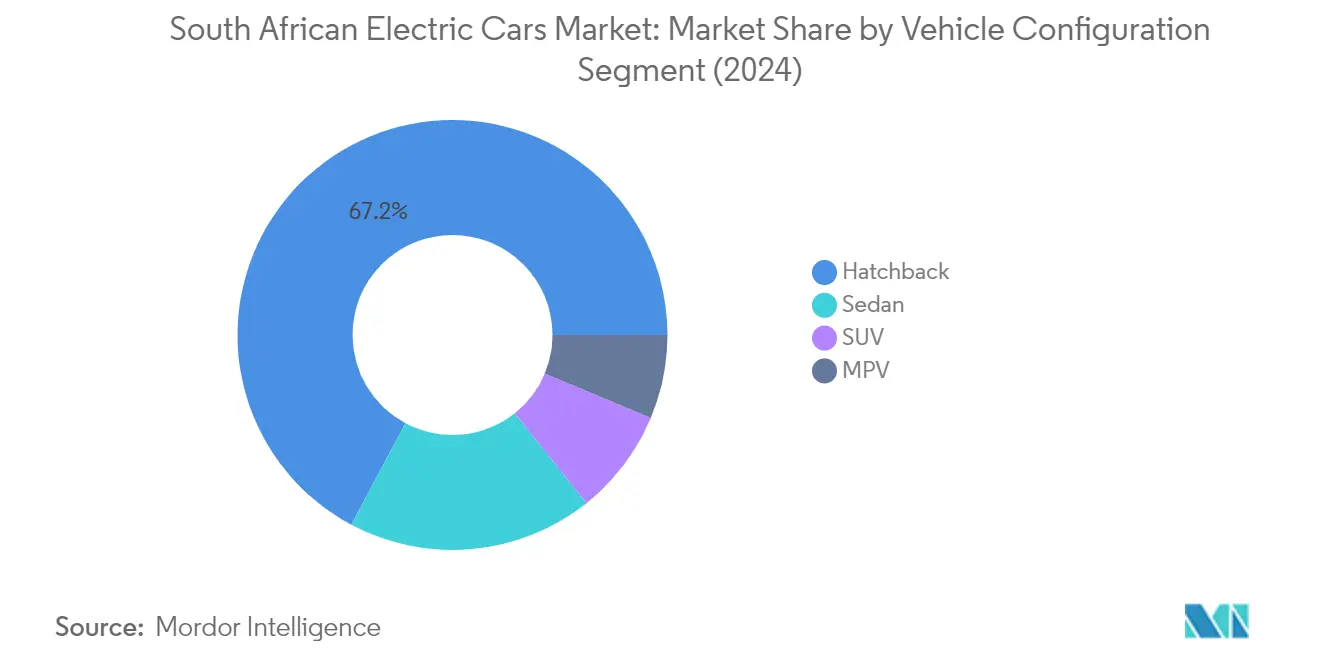
The hatchback segment dominates the South African electric cars market, commanding approximately 67% market share in 2024. This significant market position can be attributed to several factors, including the segment's appeal to urban consumers seeking compact, efficient vehicles for city driving. Hatchbacks offer an optimal balance of practicality, affordability, and maneuverability, making them particularly attractive to first-time passenger electric vehicle buyers. The segment's strong performance is further supported by increasing model availability from major manufacturers, competitive pricing strategies, and growing consumer acceptance of electric mobility solutions in the compact car segment. Additionally, government incentives and the expanding charging infrastructure network have helped boost consumer confidence in electric hatchbacks as viable daily drivers.

Multi-Purpose Vehicle (MPV) Segment in South African Electric Cars Market
The Multi-Purpose Vehicle (MPV) segment is emerging as the fastest-growing category in South Africa's electric cars market, with projections indicating substantial growth potential from 2024 to 2029. This remarkable growth trajectory is driven by increasing demand for versatile family vehicles that combine the benefits of electrification with practical space utilization. The segment's expansion is supported by new model introductions from major manufacturers, who are incorporating advanced electric powertrain technologies into their MPV offerings. Enhanced battery technologies, improved range capabilities, and the segment's ability to meet diverse consumer needs from family transportation to commercial electric vehicle applications are contributing to its accelerated growth. The MPV segment is also benefiting from evolving consumer preferences towards vehicles that offer maximum utility while maintaining environmental consciousness.
Remaining Segments in Vehicle Configuration
The electric sedan and electric SUV segments complete the South African electric vehicle market landscape, each bringing unique value propositions to consumers. The electric sedan segment maintains its appeal among business users and luxury vehicle buyers, offering sophisticated design and comfort features while embracing battery electric vehicle technology. Meanwhile, the electric SUV segment continues to attract consumers seeking higher ground clearance and robust capabilities, with manufacturers increasingly introducing electric variants of popular models. Both segments are witnessing technological advancements in terms of range, charging capabilities, and overall performance, contributing to the market's diversification and maturity. The presence of these segments ensures that the South African electric vehicle market caters to a wide range of consumer preferences and use cases.
Segment Analysis: Fuel Category
BEV Segment in South Africa Electric Cars Market
Battery Electric Vehicles (BEV) maintain their dominant position in South Africa's electric car market, commanding approximately 47% market share in 2024. This leadership position is primarily driven by increasing consumer acceptance, government support through tax incentives, and the expanding charging infrastructure network across major urban centers. Major automotive manufacturers are actively expanding their BEV portfolios in South Africa, with companies like Volkswagen, Toyota, and BMW introducing new models tailored for the local market. The segment's growth is further supported by declining battery costs, improving vehicle range capabilities, and rising environmental consciousness among South African consumers. Additionally, the government's commitment to installing over 1,500 new charging stations annually until 2030 is strengthening the BEV ecosystem, making these vehicles increasingly practical for everyday use.
FCEV Segment in South Africa Electric Cars Market
The Fuel Cell Electric Vehicle (FCEV) segment is emerging as the fastest-growing category in South Africa's electric car market, with projections indicating an impressive growth rate of approximately 32% from 2024 to 2029. This remarkable growth trajectory is supported by significant investments in hydrogen infrastructure development and increasing interest from both public and private sectors in hydrogen technology. The segment's expansion is further bolstered by partnerships between automotive manufacturers and energy companies to establish hydrogen refueling networks. Major automakers are announcing plans to introduce new FCEV models specifically designed for the South African market, while government initiatives supporting clean energy technologies are creating a favorable environment for FCEV adoption. The technology's advantages in terms of quick refueling times and longer range capabilities compared to traditional BEVs are attracting commercial fleet operators and luxury vehicle segments.
Remaining Segments in Fuel Category
The Hybrid Electric Vehicle (HEV) and Plug-in Hybrid Electric Vehicle (PHEV) segments continue to play crucial roles in South Africa's transition to electric mobility. HEVs serve as an attractive entry point for consumers hesitant to switch directly to fully electric vehicles, offering improved fuel efficiency without charging infrastructure dependency. Meanwhile, PHEVs bridge the gap between conventional hybrids and full electric vehicles, providing the flexibility of both electric and gasoline-powered driving. These segments are particularly popular among urban commuters and environmentally conscious consumers who seek to reduce their carbon footprint while maintaining the convenience of traditional fuel infrastructure. Both segments benefit from established manufacturer support, with major automotive brands continuing to expand their hybrid offerings in the South African market.
Competitive Landscape
Top Companies in South Africa Electric Cars Market
The South African electric vehicle market features a mix of established global automakers making strategic moves to capture market share. Companies are focusing on expanding their electric vehicle portfolios through continuous product innovation, particularly in the battery electric vehicle (BEV) and hybrid segments. Operational agility is demonstrated through flexible manufacturing capabilities and localized production facilities, with several manufacturers investing in upgrading their South African plants for EV production. Strategic partnerships for charging infrastructure development have become increasingly common, as exemplified by collaborations between automakers and charging network providers. Companies are also expanding their dealer networks and service centers across major South African cities to enhance customer accessibility and after-sales support. The market is characterized by significant investments in research and development, particularly in areas of battery technology and vehicle range improvement.
Consolidated Market with Strong Global Players
The South African electric cars market exhibits a high level of consolidation, with major global automotive manufacturers dominating the landscape. Toyota Motor Corporation leads the market with significant market share, followed by other established players like BMW AG, Volvo Car AB, and Audi AG. These companies leverage their global manufacturing capabilities, established brand presence, and extensive dealer networks to maintain their market positions. The market structure favors large conglomerates that can invest heavily in electric vehicle components technology and infrastructure development.
The market shows a limited presence of local manufacturers, with international players controlling most of the market share through their subsidiary operations. Merger and acquisition activities remain relatively limited, with companies focusing more on strategic partnerships and joint ventures, particularly in areas of charging infrastructure development and battery technology. The competitive dynamics are shaped by the ability of companies to offer comprehensive electric vehicle portfolios while maintaining competitive pricing despite import duties and logistics costs.
Innovation and Infrastructure Drive Future Success
For incumbent players to maintain and increase their market share, focus needs to be placed on developing affordable electric vehicle options suited to the South African market conditions. Companies must invest in localizing their production facilities to reduce costs and improve price competitiveness. Building strong relationships with government bodies and participating in policy development will be crucial for navigating regulatory frameworks. Additionally, establishing comprehensive charging networks and after-sales service infrastructure will be essential for long-term success.
Contending companies looking to gain ground must differentiate themselves through innovative technology offerings and competitive pricing strategies. The risk of substitution from traditional internal combustion engine vehicles remains significant due to price sensitivity in the market, requiring companies to clearly demonstrate the long-term value proposition of electric vehicles. Success will also depend on the ability to navigate regulatory requirements, particularly regarding local content requirements and emission standards. Companies must also consider the concentrated nature of the urban market while planning their expansion strategies, focusing on key metropolitan areas while gradually expanding to other regions. The presence of electric vehicle manufacturers in South Africa is crucial for the growth of the electric cars market in South Africa, as they contribute to the development of clean vehicle technologies and infrastructure.
South Africa Electric Cars Industry Leaders
Audi AG
Bayerische Motoren Werke AG
Daimler AG (Mercedes-Benz AG)
Toyota Motor Corporation
Volvo Car AB
- *Disclaimer: Major Players sorted in no particular order


Recent Industry Developments
- August 2023: In 2024, Toyota Argentina is set to commence production of the Hiace at its Zárate plant. Simultaneously, the company plans to expand the scope of its Conversions division. This division is responsible for crafting vehicles tailored to meet the unique requirements of diverse customers.
- August 2023: The Dubai Police Department placed an electric Mercedes EQS 580 on its fleet of luxury cars and environmentally conscious vehicles to patrol the streets.
- August 2023: Tesla introduced its car insurance services in California, the United States.


South Africa Electric Cars Market Report Scope
Passenger Cars are covered as segments by Vehicle Configuration. BEV, FCEV, HEV, PHEV are covered as segments by Fuel Category.Vehicle Configuration
| Passenger Cars | Hatchback |
| Multi-purpose Vehicle | |
| Sedan | |
| Sports Utility Vehicle |
Fuel Category
| BEV |
| FCEV |
| HEV |
| PHEV |
| Vehicle Configuration | Passenger Cars | Hatchback |
| Multi-purpose Vehicle | ||
| Sedan | ||
| Sports Utility Vehicle | ||
| Fuel Category | BEV | |
| FCEV | ||
| HEV | ||
| PHEV |


Market Definition
- Vehicle Type - The category includes passenger cars.
- Vehicle Body Type - This include various body types such as Hatchbacks, Sedans, Sports Utility Vehicles, and Multi-purpose Vehicles.
- Fuel Category - The category exclusively covers electric propulsion systems, including various types such as HEV (Hybrid Electric Vehicles), PHEV (Plug-in Hybrid Electric Vehicles), BEV (Battery Electric Vehicles), and FCEV (Fuel Cell Electric Vehicles).
| Keyword | Definition |
|---|---|
| Electric Vehicle (EV) | A vehicle which uses one or more electric motors for propulsion. Includes cars, buses, and trucks. This term includes all-electric vehicles or battery electric vehicles and plug-in hybrid electric vehicles. |
| BEV | A BEV relies completely on a battery and a motor for propulsion. The battery in the vehicle must be charged by plugging it into an outlet or public charging station. BEVs do not have an ICE and hence are pollution-free. They have a low cost of operation and reduced engine noise as compared to conventional fuel engines. However, they have a shorter range and higher prices than their equivalent gasoline models. |
| PEV | A plug-in electric vehicle is an electric vehicle that can be externally charged and generally includes all-electric vehicles as well as plug-in hybrids. |
| Plug-in Hybrid EV | A vehicle that can be powered either by an ICE or an electric motor. In contrast to normal hybrid EVs, they can be charged externally. |
| Internal combustion engine | An engine in which the burning of fuels occurs in a confined space called a combustion chamber. Usually run with gasoline/petrol or diesel. |
| Hybrid EV | A vehicle powered by an ICE in combination with one or more electric motors that use energy stored in batteries. These are continually recharged with power from the ICE and regenerative braking. |
| Commercial Vehicles | Commercial vehicles are motorized road vehicles designed for transporting people or goods. The category includes light commercial vehicles (LCVs) and medium and heavy-duty vehicles (M&HCV). |
| Passenger Vehicles | Passenger cars are electric motor– or engine-driven vehicles with at least four wheels. These vehicles are used for the transport of passengers and comprise no more than eight seats in addition to the driver’s seat. |
| Light Commercial Vehicles | Commercial vehicles that weigh less than 6,000 lb (Class 1) and in the range of 6,001–10,000 lb (Class 2) are covered under this category. |
| M&HDT | Commercial vehicles that weigh in the range of 10,001–14,000 lb (Class 3), 14,001–16,000 lb (Class 4), 16,001–19,500 lb (Class 5), 19,501–26,000 lb (Class 6), 26,001–33,000 lb (Class 7) and above 33,001 lb (Class 8) are covered under this category. |
| Bus | A mode of transportation that typically refers to a large vehicle designed to carry passengers over long distances. This includes transit bus, school bus, shuttle bus, and trolleybuses. |
| Diesel | It includes vehicles that use diesel as their primary fuel. A diesel engine vehicle have a compression-ignited injection system rather than the spark-ignited system used by most gasoline vehicles. In such vehicles, fuel is injected into the combustion chamber and ignited by the high temperature achieved when gas is greatly compressed. |
| Gasoline | It includes vehicles that use gas/petrol as their primary fuel. A gasoline car typically uses a spark-ignited internal combustion engine. In such vehicles, fuel is injected into either the intake manifold or the combustion chamber, where it is combined with air, and the air/fuel mixture is ignited by the spark from a spark plug. |
| LPG | It includes vehicles that use LPG as their primary fuel. Both dedicated and bi-fuel LPG vehicles are considered under the scope of the study. |
| CNG | It includes vehicles that use CNG as their primary fuel. These are vehicles that operate like gasoline-powered vehicles with spark-ignited internal combustion engines. |
| HEV | All the electric vehicles that use batteries and an internal combustion engine (ICE) as their primary source for propulsion are considered under this category. HEVs generally use a diesel-electric powertrain and are also known as hybrid diesel-electric vehicles. An HEV converts the vehicle momentum (kinetic energy) into electricity that recharges the battery when the vehicle slows down or stops. The battery of HEV cannot be charged using plug-in devices. |
| PHEV | PHEVs are powered by a battery as well as an ICE. The battery can be charged through either regenerative breaking using the ICE or by plugging into some external charging source. PHEVs have a better range than BEVs but are comparatively less eco-friendly. |
| Hatchback | These are compact-sized cars with a hatch-type door provided at the rear end. |
| Sedan | These are usually two- or four-door passenger cars, with a separate area provided at the rear end for luggage. |
| SUV | Popularly known as SUVs, these cars come with four-wheel drive, and usually have high ground clearance. These cars can also be used as off-road vehicles. |
| MPV | These are multi-purpose vehicles (also called minivans) designed to carry a larger number of passengers. They carry between five and seven people and have room for luggage too. They are usually taller than the average family saloon car, to provide greater headroom and ease of access, and they are usually front-wheel drive. |


Research Methodology
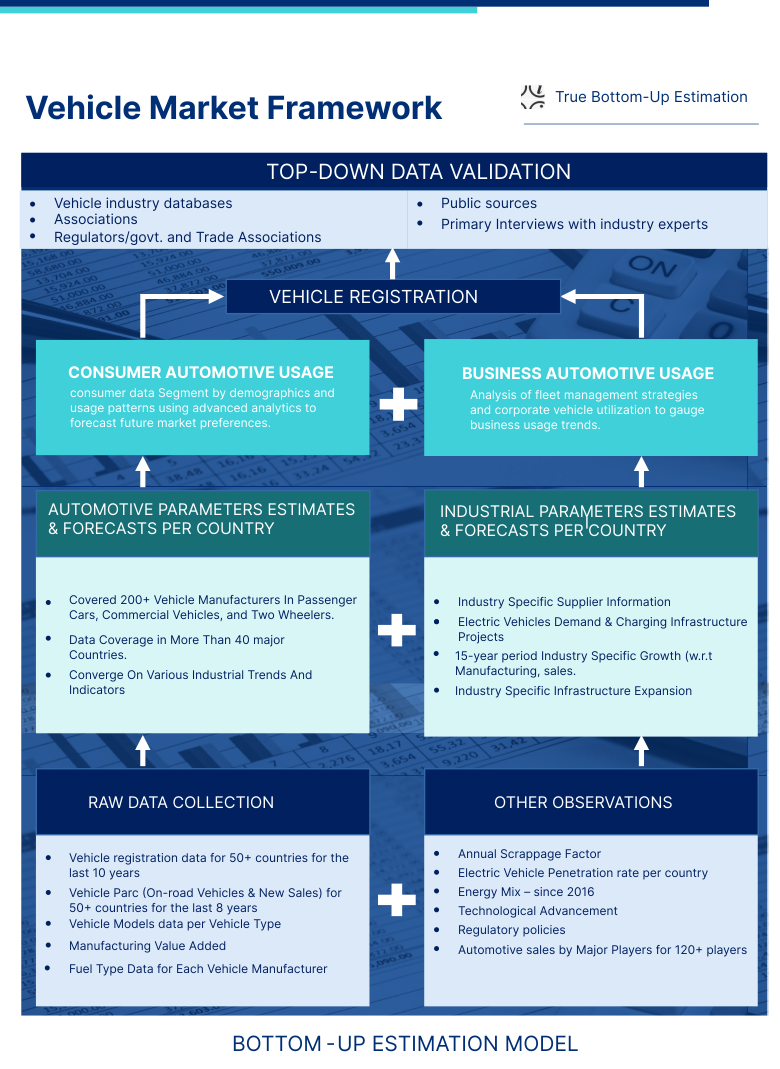
Mordor Intelligence follows a four-step methodology in all its reports.
- Step-1: Identify Key Variables: To build a robust forecasting methodology, the variables and factors identified in Step-1 are tested against available historical market numbers. Through an iterative process, the variables required for market forecast are set and the model is built based on these variables.
- Step-2: Build a Market Model: Market-size estimations for the historical and forecast years have been provided in revenue and volume terms. Market revenue is calculated by multiplying the sales volume with their respective average selling price (ASP). While estimating ASP factors like average inflation, market demand shift, manufacturing cost, technological advancement, and varying consumer preference, among others have been taken into account.
- Step-3: Validate and Finalize: In this important step, all market numbers, variables, and analyst calls are validated through an extensive network of primary research experts from the market studied. The respondents are selected across levels and functions to generate a holistic picture of the market studied.
- Step-4: Research Outputs: Syndicated Reports, Custom Consulting Assignments, Databases & Subscription Platforms.





 Your data is secure and never sold or shared.


