
Solid State Relay Market Size and Share
Market Overview
| Study Period | 2020 - 2031 |
|---|---|
| Market Size (2026) | USD 659.79 Million |
| Market Size (2031) | USD 869.03 Million |
| Growth Rate (2026 - 2031) | 5.66 % |
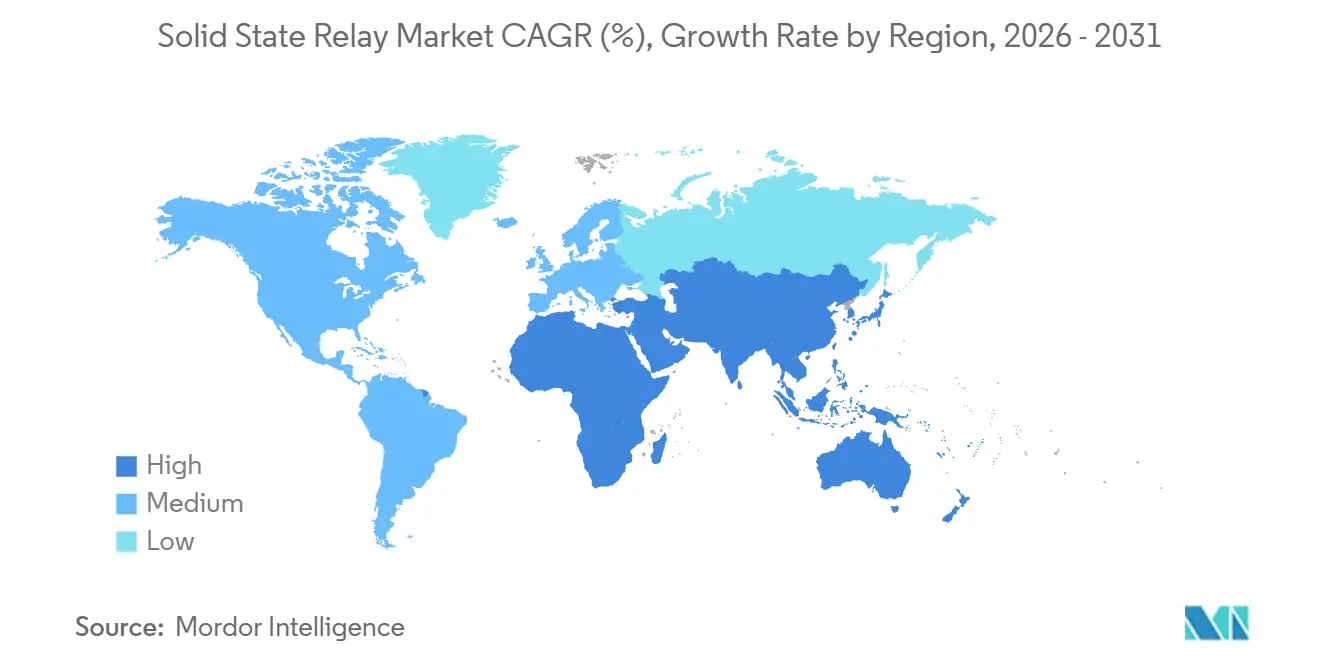
| Fastest Growing Market | Middle East and Africa |
| Largest Market | Asia Pacific |
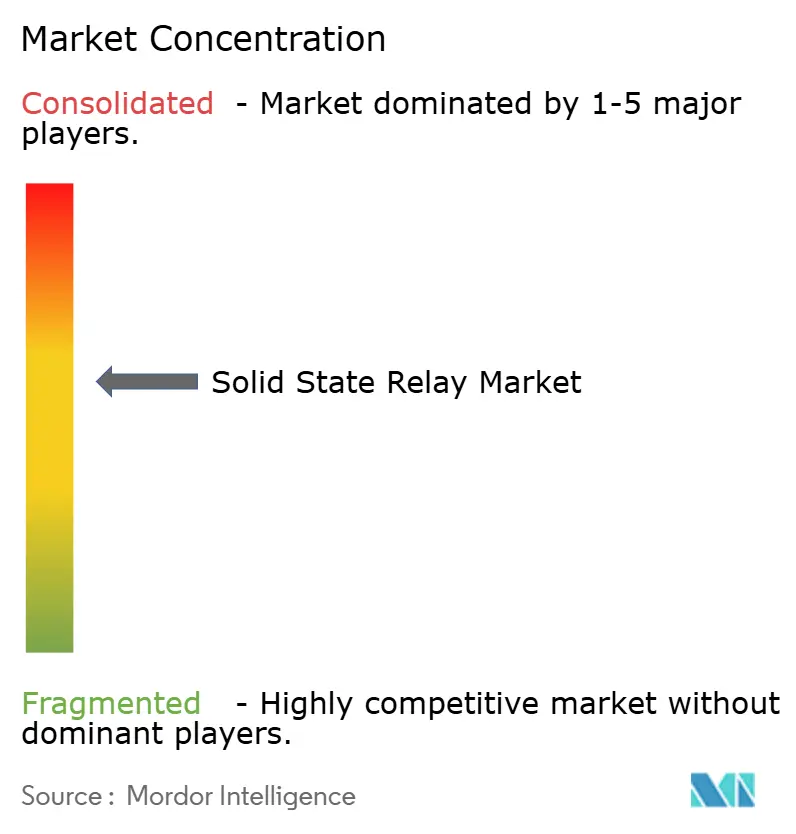
| Market Concentration | Medium |
Major Players *Disclaimer: Major Players sorted in no particular order Image © Mordor Intelligence. Reuse requires attribution under CC BY 4.0. | |
Solid State Relay Market Analysis by Mordor Intelligence
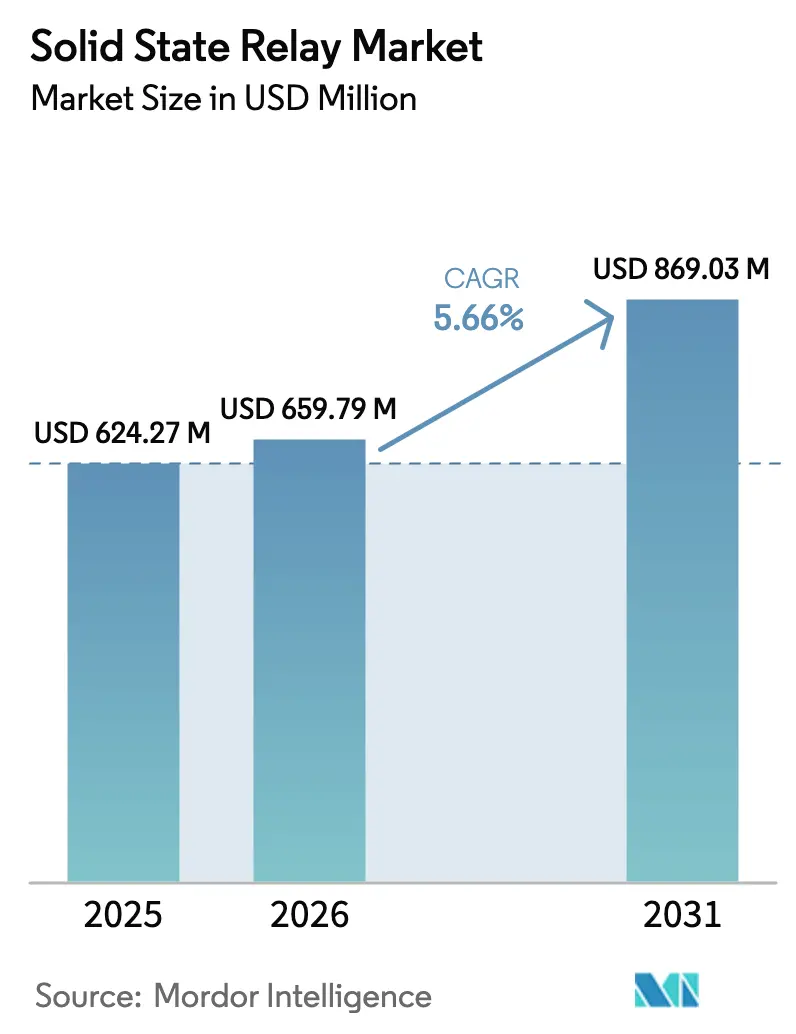
The Solid State Relay Market size is projected to expand from USD 624.27 million in 2025 and USD 659.79 million in 2026 to USD 869.03 million by 2031, registering a CAGR of 5.66% between 2026 to 2031. Growth is shaped by utilities swapping electromechanical contactors for arc-free switching, factory owners upgrading to Industry 4.0 cabinets, and device makers shrinking power-control footprints with wide-bandgap semiconductors. Manufacturers are using gallium nitride and silicon carbide dies to cut on-state losses, operate beyond 175 °C junction temperature, and eliminate bulky heat sinks in compact enclosures such as medical imaging gantries and quantum-computing cryostats. Asia Pacific dominates shipments because China, Japan, and South Korea lead in photovoltaic inverters and EV chargers, while the Middle East posts the fastest regional CAGR as Saudi Arabia and the United Arab Emirates build gigawatt-scale solar farms that demand contact-less switching for module-level power electronics. Industrial OEM applications still hold the largest revenue slice, yet energy and infrastructure installations are expanding more quickly as utilities deploy solid-state transfer switches that prevent arc erosion during grid-edge islanding events. Competitive pressure comes from semiconductor specialists that integrate gate-driver ICs and undercut traditional relay makers on bill-of-material costs, but incumbents retain an edge through in-house phototriac production and broad safety certification portfolios.
Key Report Takeaways
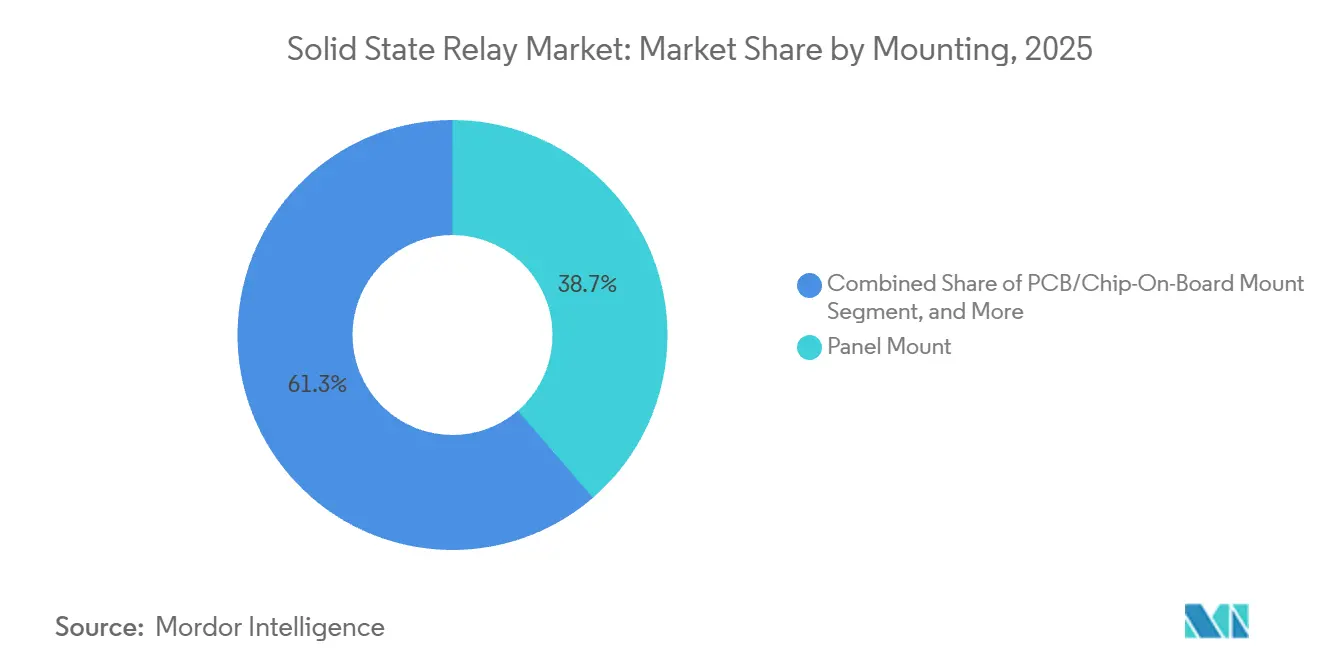
- By mounting configuration, panel-mount designs led with 38.67% of the solid state relay market share in 2025, while DIN-rail variants are forecast to register a 7.11% CAGR through 2031.
- By output type, AC devices accounted for 46.23% of revenue in 2025; three-phase units are the fastest-growing, advancing at a 6.42% CAGR to 2031.
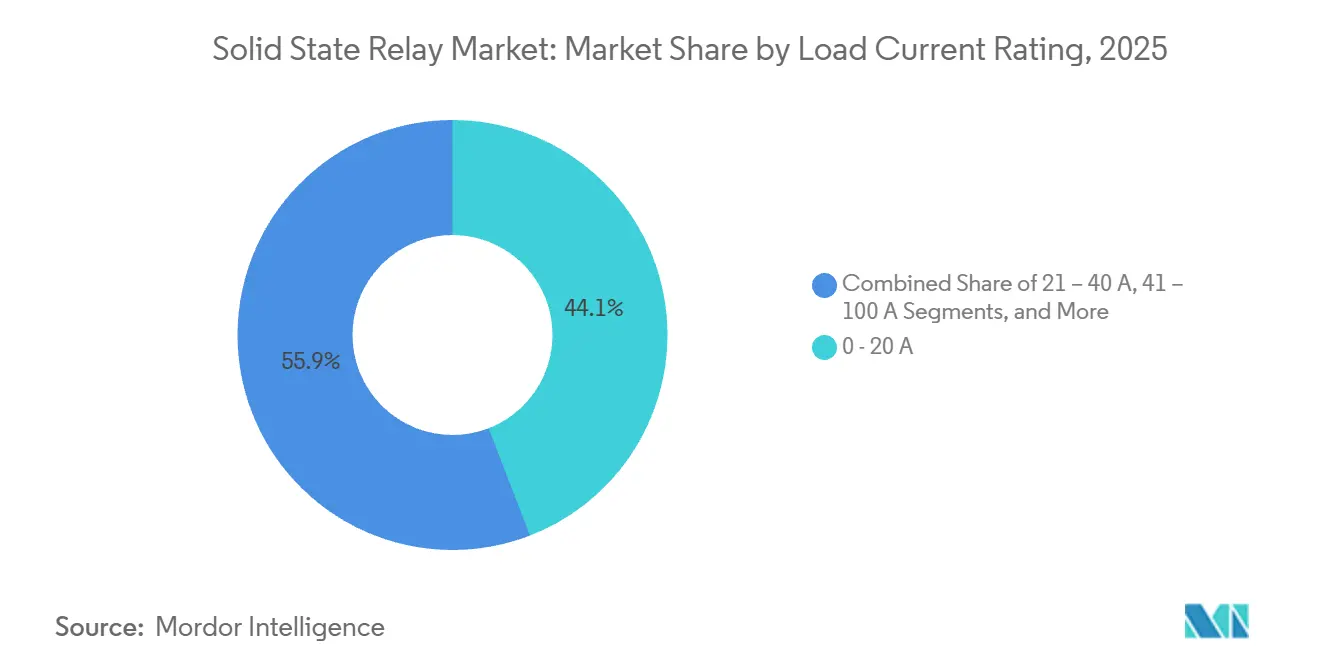
- By load-current rating, the 0-20 ampere bracket accounted for 44.13% of the solid state relay market size in 2025, whereas ratings above 100 amperes are poised to grow at a 6.64% CAGR through 2031.
- By application, industrial OEMs accounted for 31.26% of revenue in 2025, whereas energy and infrastructure installations are projected to expand at a 7.38% CAGR through 2031.
- By geography, Asia Pacific captured 42.32% of sales in 2025, whereas the Middle East is expected to post the fastest regional growth at a 7.23% CAGR by 2031.
Note: Market size and forecast figures in this report are generated using Mordor Intelligence’s proprietary estimation framework, updated with the latest available data and insights as of January 2026.
Market Trends and Insights
Drivers Impact Analysis of Solid State Relay Market*
| Driver | (~) % Impact on CAGR Forecast | Geographic Relevance | Impact Timeline |
|---|---|---|---|
| Increasing PV and Wind Farm Installations Demanding Arc-Free Switching | +0.8% | Global, concentrated in Asia Pacific, Middle East, and North America | Medium term (2-4 years) |
| Rising Retrofit of Electromechanical Relays in Smart Factories (Europe-led) | +0.9% | Europe (Germany, France, Italy), spillover to North America | Short term (≤ 2 years) |
| Grid-Edge Deployment of Solid-State Transfer Switches in North America Distribution Networks | +0.7% | North America (United States, Canada), early adoption in California and Texas | Medium term (2-4 years) |
| Miniaturisation Push in Medical Devices Elevating SSR Adoption (Asia Pacific OEMs) | +0.6% | Asia Pacific (Japan, South Korea, Taiwan), exports to global markets | Long term (≥ 4 years) |
| HVAC OEM Shift to Mercury-Free Components in Nordics and DACH Region | +0.5% | Europe (Sweden, Norway, Denmark, Germany, Austria, Switzerland) | Short term (≤ 2 years) |
| Growing Adoption of GaN SSRs in Quantum Computing Cryogenic Controls | +0.4% | North America and Europe (research hubs), limited commercial scale | Long term (≥ 4 years) |
| Source: Mordor Intelligence | |||
Increasing PV and Wind Farm Installations Demanding Arc-Free Switching
More than 500 GW of new solar and wind capacity came online during 2024, and the associated inverter, battery, and tracker systems now require sub-millisecond disconnection that electromechanical contactors cannot guarantee without arc erosion.[1] Solid state relays meet IEEE 1547-2018 anti-islanding response times, eliminate arc flash events, and support SunSpec rapid-shutdown protocols embedded in California’s Title 24 building code. Utilities view SSRs as foundational elements in modular power blocks that combine bidirectional AC and DC paths, allowing asset owners to defer transmission upgrades while raising renewable penetration. Wind-turbine pitch systems have already shifted from hydraulic to electric servo drives, and three-phase SSRs prevent voltage transients that once tripped supervisory controllers. As bifacial modules and single-axis trackers lift daily switching cycles, the 10-million-cycle lifetime of SSRs neutralizes the higher acquisition price.
Rising Retrofit of Electromechanical Relays in Smart Factories
German, French, and Italian manufacturers are converting legacy panels to DIN-rail SSRs so that Ethernet and fieldbus links remain immune to electromagnetic noise from contact arcing. The German government earmarked EUR 1.2 billion (USD 1.41 billion) in 2024 for Industry 4.0 pilots, many of which specify touch-safe DIN modules that technicians can hot-swap without full line shutdowns. New three-phase contactors with embedded NRG BUS measurement let operators align power trends with machine cycles, creating a data loop that boosts energy efficiency. EU Ecodesign Regulation 2023/826 caps standby power at 0.5 W, favoring SSRs that draw microamp currents. In food-processing plants, sealed SSR housings prevent lubricant and particulate contamination, an increasingly decisive procurement criterion.
Grid-Edge Deployment of Solid-State Transfer Switches
Utilities in California and Texas install solid-state transfer switches at distribution nodes to keep critical loads online during wildfire-driven power-shutoff events. These switches pair 600 V, 100 A SSR modules with optical gate isolation, cutting the 50 ms delay typical of motor-driven transfer devices to sub-cycle intervals and avoiding voltage sag. DOE guidelines released in 2024 emphasize deterministic low-latency relaying, a specification met by SSR gate drivers communicating over IEC 61850 with jitter below 1 ms. Pilot circuits equipped with SSR-based reclosers coordinate seamlessly with inverter-based resources, providing underfrequency shedding without detaching net-generating feeders. Ongoing research into 15 kV silicon-carbide converters will further raise voltage requirements, strengthening demand for high-voltage SSR stacks.
Miniaturization Push in Medical Devices
Handheld ultrasound probes, surgical cautery pens, and wearable infusion pumps need relay footprints under 10 mm², a target only attainable with surface-mount SSRs that merge phototriac and gate-driver circuits in SOP-4 or SSOP outlines. Updated IEC 60601-1 guidance in Japan now tests leakage current on every patient-connected switch, and SSRs pass without the relay creepage distances mechanical contacts require. South Korean dental X-ray makers use SSR pulse control to cut patient radiation by 30% compared with thyratron solutions. Single-use endoscopic tools benefit from SSR disposability because there is no incentive to invest in gold-plated contacts for one-time instruments. As component counts in connected health wearables climb, SSRs free valuable board space for RF, sensing, and battery circuits.
Restraints Impact Analysis of Solid State Relay Market*
| Restraint | (~) % Impact on CAGR Forecast | Geographic Relevance | Impact Timeline |
|---|---|---|---|
| Higher Up-Front Cost Versus Electromechanical Relays | -0.6% | Global, most pronounced in price-sensitive building equipment and consumer electronics segments | Short term (≤ 2 years) |
| Thermal Management Challenges Beyond 40 A Load Current | -0.5% | Global, particularly in industrial automation and energy infrastructure applications | Medium term (2-4 years) |
| Electromagnetic Interference Susceptibility in High-Frequency Rail Traction | -0.4% | Europe and Asia Pacific rail networks | Medium term (2-4 years) |
| Limited Field-Replaceability in Mission-Critical Utilities | -0.3% | North America and Europe utility sectors | Long term (≥ 4 years) |
| Source: Mordor Intelligence | |||
Higher Up-Front Cost Versus Electromechanical Relays
SSRs still command a 200%–400% premium over like-for-like contactors because their bill of materials adds optocouplers, snubber networks, and thermal pads. OMEGA’s SSRDIN600 single-phase units list at AUD 184–228 (USD 120–148) versus AUD 40–60 for mechanical DIN relays, a gap that stalls adoption in HVAC compressors and white goods where replacement cycles exceed 10 years. Without standardized total-cost-of-ownership tools, facilities managers focus on first cost rather than downtime avoidance. Three-phase SSR contactors priced at AUD 550–565 (USD 358–367) also face competition from soft-start motor controllers that use thyristors without optical isolation. Rising automation in coil-winding and contact-stamping lines continues to push electromechanical relay prices downward faster than semiconductor cost curves.
Thermal Management Challenges Beyond 40 A Load Current
Silicon thyristor SSRs dissipate 1–2 W per ampere, requiring aluminum heat sinks that swell cabinet depth and add 200-600 g mass. Littelfuse’s SRP1 series, for instance, must be derated to 40 °C ambient unless forced-air cooling is added. In IP65 enclosures, heat buildup risks thermal runaway, a failure mode absent in contactors where coil heating is decoupled from load current. Weidmüller’s PSSR devices drop from 20 A at 55 °C to 12 A at 65 °C, complicating sizing in plastics extrusion lines. Silicon-carbide switches promise 70% lower losses, but these parts remain in sampling and lack the field history utilities expect.[2] Extra thermal-interface materials add USD 2–5 per unit and need periodic replacement under vibration, trimming the maintenance-free argument.
*Our forecasts treat driver/restraint impacts as directional, not additive. The impact forecasts reflect baseline growth, mix effects, and variable interactions.
Solid State Relay Market Segment Analysis
By Mounting:
DIN-Rail Variants Cement Gains in Modular CabinetsPanel-mount relays retained a 38.67% revenue slice in 2025, reflecting deep penetration of legacy machinery that favors screw-mounted devices on open backplates. The solid state relay market now tilts toward DIN-rail products that promise tool-less replacement, and these modules are on track for a 7.11% CAGR to 2031. Omron’s G3PE line reduces install time from 15 minutes to under 2 minutes by snapping onto standard rails, freeing technicians to perform maintenance during brief line pauses rather than full shutdown windows. Food-processing and pharmaceutical plants further endorse DIN form factors because touch-safe polycarbonate covers support stringent hygiene audits.
Demand also comes from European retrofit programs that integrate predictive maintenance via OPC UA. Carlo Gavazzi’s NRG-enabled contactors stream cycle counts and thermal headroom so operators can swap a failing module before unplanned outage. Although panel-mount units continue to dominate bespoke semiconductor equipment where vibration tolerance is critical, the robust clip mechanism of new DIN housings narrows that gap. PCB and chip-on-board SSRs thrive in consumer appliances because automated reflow drives cost down at scale, yet those segments struggle with sticker price. Plug-in SSRs survive in utility protection racks where octal sockets provide standardization that simplifies spares logistics. The drift toward DIN-rail also aligns with IEC 62314, which calls for finger-safe terminals that shield end users from live parts.

By Output Type:
Three-Phase Devices Accelerate on Motor-Control UpgradesAC SSRs covered 46.23% of 2025 revenue thanks to broad use in resistive heaters and lighting panels, but three-phase relays earn the growth spotlight with a 6.42% CAGR forecast through 2031. Industrial plants are modernizing star-delta and soft-start motor circuits, replacing bulky contactors whose vibrations and contact bounce shorten service life. Carlo Gavazzi’s latest RGC3P integrates metering so users can spot rising current harmonics that often precede bearing wear. In plastics extrusion, zero-cross switching eliminates voltage spikes that otherwise scar winding insulation.
DC SSRs remain vital to battery energy-storage systems and EV chargers, yet they battle intelligent power modules that embed drivers and temperature sensing in one package. Hybrid AC/DC relays hold niche positions in UPS systems where control logic sits on DC but load circuits switch AC, safeguarding continuity with minimal parts. For HVAC chillers in Europe, SSRs help meet standby power ceilings established by Ecodesign Regulation 2023/826 because they draw microamp control current in the off state.[3] As wide-bandgap devices enter mass production, three-phase SSRs rated to 660 V and 45 A will shrink further, blurring lines between relay, starter, and drive.
By Load Current Rating:
High-Current Designs Tap Heavy-Industry DemandRelays below 20 A contributed 44.13% of the solid state relay market size in 2025, buoyed by process controls, medical tools, and consumer appliances. Above 100 A, however, comes the structural uptrend, with this bracket targeting a 6.64% CAGR to 2031. Aluminum smelters and arc furnaces need contact-less switching that endures surge currents at cold start without welding contacts. Infineon’s silicon-carbide isolators unlock custom SSR stacks exceeding 1,000 V and 100 A while shrinking thermal footprints.
Yet thermal removal remains a hurdle. Engineers often parallel multiple 75 A SCR modules linked by current-sharing chokes, trading silicon cost for manageable heat dissipation. Emerging SiC designs may run at 150 A without liquid cooling, but their cost premium keeps adoption selective. Meanwhile, multi-channel low-current modules gain traction in distributed I/O blocks; eight or sixteen SSRs share one logic connector, trimming cabinet wiring.
By Application:
Utilities Propel the Fastest Revenue ClimbIndustrial OEM machinery produced 31.26% revenue in 2025, ranging from robot grippers to CNC brake circuits. The energy and infrastructure segment is set to rise 7.38% each year through 2031 as utilities roll out solid-state transfer switches and medium-voltage converters that handle bidirectional flows from rooftop solar and community storage.[4] In building equipment, HVAC makers weigh SSRs against price ceilings, limiting penetration to premium lines touting silent operation.
Food and beverage processors adopt SSRs inside sterilizers and conveyors where lubricants and arcing particles violate hygiene rules. Transportation sees SSR growth in EV chargers and rail signaling relays that must switch hundreds of times per day. Healthcare fills the miniaturization niche, embedding SOP-4 devices in portable pumps and scanners. Automotive engineers evaluate SSR battery disconnects that satisfy ISO 26262 diagnostics, though wide-scale rollout awaits lower SiC costs.
Geography Analysis
APAC Solid State Relay Market
Asia Pacific retained 42.32% revenue in 2025 because China controls the vertical stack of phototriac dies, SCR wafers, and heat-sink extrusion, letting domestic vendors undercut imported parts by up to 50% while meeting UL 508 and IEC 62314 certifications. Japan and South Korea supplement demand with high-density EV charging stations that rely on rapid AC switching, and Taiwan’s medical-electronics cluster specifies miniaturized SSRs for export-grade devices.
North America Solid State Relay Market
North America follows, propelled by United States utilities that equip substations with SSR-based reclosers to avoid flicker during wildfire preventive shutoffs. California and Texas dominate pilot projects, while Canada aligns adoption through feeder-automation funding. Mexico absorbs steady orders for SSR-controlled packaging and automotive lines serving the North American trade block.
Europe Solid State Relay Market
Europe leverages Industrie 4.0 grants and mercury-free directives. Germany, France, and the United Kingdom replace mechanical relays to comply with Regulation 2017/852 banning mercury switches in electrical equipment. DIN-rail units paired with predictive-maintenance analytics gain favor in retrofit programs supported by the EUR 1.2 billion (USD 1.41 billion) smart-factory budget.
GCC Solid State Relay Market
The Middle East secures the fastest CAGR at 7.23% as Saudi Arabia’s Vision 2030 funds gigawatt solar parks and the United Arab Emirates installs battery storage at the Mohammed bin Rashid Al Maktoum Solar Park. Utilities there choose SSRs for module-level power optimizers that must disconnect strings in milliseconds during sandstorm faults.
South America and Africa Solid State Relay Market
South America applies SSRs in remote mining and soy-processing plants, where limited technician access elevates the value of maintenance-free switches. Africa’s early deployments focus on telecom base stations and off-grid solar microgrids in Kenya and South Africa because low quiescent draw extends battery life.
Regulatory Landscape
Solid-state relay (SSR) design and procurement are shaped by safety and environmental compliance requirements that drive creepage/clearance, touch-safe terminals, and labeling across industrial and building-control installations. EN IEC 62314:2024 (solid-state relays) was confirmed in January 2026, reinforcing the role of IEC-aligned safety and functional requirements alongside widely used North American certifications such as UL 508 for industrial control equipment.
Trade and customs actions also affect SSR bill-of-materials and landed cost, especially when optocouplers, thyristors/TRIACs, and wide-bandgap devices are sourced across borders. In the United States, Section 232-related measures on certain semiconductor articles took effect in mid-January 2026, and U.S. Customs and Border Protection issued related operational guidance and mechanisms (including a CAPE portal process referenced by ECIA) that companies use to manage eligibility, entries, and potential refunds tied to shifting tariff treatment. This adds compliance workload for importers and distributors.
Value Chain Analysis
The SSR value chain starts with semiconductor materials and wafer processing (silicon, SiC, and GaN), then moves to discrete device fabrication (SCRs/TRIACs, MOSFET/IGBT devices in some architectures, optocouplers/isolators, and gate-driver ICs) and packaging elements such as substrates, copper leadframes, encapsulants, thermal interface materials, and heat-sink alloys. SSR manufacturers and branded relay suppliers assemble and test finished units, commonly using automated PCB assembly, encapsulation, and high-pot insulation verification (often in the 2,000-2,500 VAC class), before shipping through direct OEM channels and industrial distributors to panel builders, utilities, and machine makers.
Manufacturing and sourcing are geographically concentrated, with China providing cost-competitive assembly and supporting industrial clusters, while Japan, South Korea, and Taiwan provide higher-end semiconductor and electronics supply for miniaturized and higher-reliability products. Downstream, system integrators and cabinet builders influence form-factor selection (panel mount versus DIN-rail) and require certification portfolios (IEC and UL) for acceptance in industrial automation, energy infrastructure, and building equipment. At the same time, trade-policy volatility on semiconductor devices increases the value of multi-sourcing, design-for-substitution, and tighter tier-2 visibility for critical components such as isolators and power dies.
Competitive Landscape
The solid state relay market hosts moderate concentration. Omron, Panasonic, and Carlo Gavazzi keep share through vertically integrated phototriac output and broad safety listings, while Infineon, Vishay, and Broadcom target cost per channel by monolithically integrating gate drivers. Littelfuse differentiates with epoxy-free copper substrates that lower junction temperature and lift surge ratings. Carlo Gavazzi’s RGC3P family melds switching and NRG metering, giving customers harmonic signatures that feed predictive maintenance algorithms.
White-space opportunity lies in medium-voltage SSRs above 1 kV, where silicon-carbide modules could displace vacuum contactors in grid feeders. Another pocket is ultraminiature relays below 10 mm² for smart wearables. Chinese entrants challenge incumbents by leveraging domestic supply chains that shorten lead times and slash prices while still clearing IEC testing.
Strategic moves underscore the competitive tempo. Omron’s partnership with Cognizant embeds diagnostics that push cycle counts to cloud dashboards, foreshadowing service-based revenue. Rockwell Automation’s M100 electronic motor starter folds relay, overload, and Ethernet connectivity into one DIN-rail unit, redefining buying criteria for motor-control cabinets. Littelfuse publishes open reliability test results to sway specifiers toward its assemblies, positioning technical transparency as a sales lever.
Solid State Relay Industry Leaders
-
ABB Ltd.
-
Omron Corporation
-
Panasonic Holdings Corp.
-
Carlo Gavazzi Holding AG
-
Sensata Technologies (Crydom)
- *Disclaimer: Major Players sorted in no particular order
Solid State Relay Market Companies Covered in this Report
- ABB Ltd
- Omron Corporation
- Panasonic Holdings Corp.
- Carlo Gavazzi Holding AG
- Sensata Technologies (Crydom)
- TE Connectivity Ltd
- Vishay Intertechnology Inc.
- Fujitsu Ltd
- Broadcom Inc.
- Littelfuse Inc.
- Schneider Electric SE
- Rockwell Automation Inc.
- Infineon Technologies AG
- Omega Engineering Inc.
- Autonics Corporation
- Toshiba Corporation
- IXYS Integrated Circuits Division
- Siemens AG
- Celduc Relais
- Vicor Corporation
Market Opportunities and Future Outlook
White-space is most visible in higher-voltage and higher-reliability SSR architectures for grid-edge switching and infrastructure power conversion, where thermal performance, isolation integrity, and package-level heat removal drive adoption. In 2024, DOE guidance emphasized deterministic low-latency relaying for distribution automation, aligning with SSR-based transfer switching and recloser concepts already being piloted in states such as California and Texas, and keeping focus on stacks that can scale above 1 kV while maintaining fast, arc-free switching behavior.
Wide-bandgap devices and packaging advances also create room for smaller and cooler-running SSR designs in cabinets and compact equipment, where heat sinks and derating limit deployments above 40 A. In May to June 2026, power-semiconductor announcements such as Toshiba Electronic Devices and Storage Corporation trench-gate SiC MOSFET technology (focused on lower on-resistance and improved robustness) and Infineon Technologies CoolSiC G2 bidirectional switch introductions (750 V class, top-side-cooled packaging) illustrate the component-level pathway SSR makers use to reduce losses, raise power density, and push into applications like energy infrastructure, industrial motor-control retrofits, and miniaturized medical electronics constrained by footprint and leakage-current compliance (for example, patient-connected equipment governed by IEC 60601-1 test regimes referenced in Japan).
Recent Industry Developments in Solid State Relay Market
- January 2026: Littelfuse began sampling a dual-channel silicon-carbide SSR stack rated 1,200 V at 50 A per channel, targeting medium-voltage reclosers in United States distribution feeders. The sampling expands SSR design targets beyond traditional low-voltage cabinets and addresses the loss and thermal constraints that limit high-current silicon SSR deployments. It also signals tighter coupling between power-semiconductor roadmaps and utility-grade switching requirements.
- August 2025: Carlo Gavazzi unveiled RGC2P and RGC3P three-phase contactors featuring integrated NRG BUS energy monitoring. Integrating switching with metering supports predictive-maintenance and power-quality workflows inside Industry 4.0 cabinets, which is a key procurement criterion in retrofit programs. It also raises competitive pressure on standalone SSR offerings that lack diagnostics and data connectivity.
- August 2024: Panasonic issued product notifications covering VDE marking changes for multiple semiconductor (solid state) relay models, including AQG22112 and AQG22205. Such compliance-label and certification maintenance actions affect OEM documentation, part qualification, and downstream audit readiness, particularly in regulated industrial and building equipment exports. The notices also highlight how certification portfolios and labeling continuity influence preferred-supplier status in global channels.
Solid State Relay Market Report Scope and Research Methodology
Market Definition and Coverage
This market covers revenue generated from solid state relay (SSR) devices that switch electrical loads using semiconductor components, across industrial, building, mobility, and infrastructure use cases. We count the value of complete SSR units sold through direct and channel routes for both OEM fitment and retrofit replacements.
Scope exclusions: Exclusions include electromechanical and reed relays, solid-state circuit breakers, and semiconductor subassemblies that are only sold as part of larger power-conversion modules.
Segments Covered in This Report
- By Mounting
- Panel Mount
- PCB/Chip-On-Board Mount
- DIN-Rail Mount
- Plug-in/Socket Mount
- By Output Type
- AC Solid-State Relay
- DC Solid-State Relay
- AC/DC Hybrid Relay
- Three-Phase Solid-State Relay
- By Load Current Rating
- 0 - 20 A
- 21 - 40 A
- 41 - 100 A
- Above 100 A
- By Application
- Energy and Infrastructure (Renewables, Grid-Edge, UPS)
- Industrial OEM (Robotics, CNC, Packaging)
- Building Equipment (HVAC, Elevators, Fire Safety)
- Food and Beverage Processing
- Automotive and Transportation (EV Chargers, Railway Signalling)
- Industrial Automation (PLCs, Motion Control)
- Healthcare and Medical Devices
- Consumer Electronics and White Goods
- By Geography
- North America
- United States
- Canada
- Mexico
- South America
- Brazil
- Argentina
- Rest of South America
- Europe
- United Kingdom
- Germany
- France
- Spain
- Italy
- Rest of Europe
- Asia-Pacific
- China
- India
- Japan
- Australia
- South Korea
- Rest of Asia-Pacific
- Middle East
- Saudi Arabia
- United Arab Emirates
- Turkey
- Rest of Middle East
- Africa
- South Africa
- Kenya
- Rest of Africa
- North America
Data Sources, Market Sizing, and Validation
Desk Research
Early work starts with mapping the addressable SSR demand pool and the supply chain using public references, and then aligning terminology so pricing and volumes do not get mixed across relay families. Common anchors include government industrial production and manufacturing output series such as those published by the US Census Bureau, Eurostat, and national statistics offices, followed by trade and tariff line checks from sources such as UN Comtrade and customs dashboards.
To connect SSR demand to end applications, we also review standards and compliance signals from organizations such as IEC, UL, and NEMA, and then scan peer reviewed electronics and power semiconductor journals for switching, reliability, and thermal design trends that affect adoption. Company annual reports, investor decks, and product documentation are used to build a shortlist of relevant SSR form factors and typical price bands, and this is supplemented with paid subscriptions for company financials and intelligence, patents, and shipment-level import and export checks when geography coverage is needed. These desk research sources are illustrative, and many additional public documents were also consulted for data collection, validation, and clarification.
Primary Interviews and Surveys
Primary work was used to pressure test pricing and adoption assumptions that are hard to observe from public sources, especially across AC output, DC output, and mixed output SSR use cases. We spoke with a balanced mix of manufacturers, distributors, and OEM users, and coverage was kept global so the model could reflect different automation intensity and replacement cycles across regions.
Distribution of primary research fieldwork respondents
| Company type | Respondent position | Region |
|---|---|---|
| Top tier: 35% | CXOs: 16% | APAC: 43% |
| Mid tier: 48% | Functional/Unit leaders: 30% | EMEA: 34% |
| Smaller Players: 17% | Managers: 54% | Americas: 23% |
Market-Sizing & Forecasting
Sizing was built using top-down logic, where manufacturing output and automation investment indicators are translated into an SSR demand pool by applying usage intensity and replacement patterns for key switching applications. To keep the totals realistic, results are then cross-checked through selective bottom-up approximations, such as sampled ASP times estimated unit volumes by form factor, distributor channel checks, and supplier revenue sanity tests, and the model is adjusted when the two views do not align.
Key inputs used in the model include (as illustrative examples) industrial automation capex and machinery output, the installed base and refresh cycle of control panels and heaters, electrification related build activity, the split of AC versus DC load switching in typical applications, and observed ASP movement by current rating and packaging style. When gaps exist in bottom-up signals, we fill them using conservative ranges from interviews and then lock them to the top-down demand pool so the final number stays traceable. For forecasting, scenario analysis is used around automation spending and electrification growth, and those scenarios are translated into year-by-year adoption and price trajectories validated by experts before finalizing the curve.
Data Validation & Update Cycle
Outputs are validated through multiple checks, including comparing implied units against realistic replacement cycles, reviewing regional shares against trade signals, and stress testing price assumptions so they do not drift away from market reality. If a variance looks unusually large, we re-check the input series, revisit interview notes, and re-contact sources when the discrepancy cannot be explained.
Before publishing, the model and write-up go through multi-step analyst reviews so math consistency, definitions, and scope stay aligned across sections. Reports are refreshed annually, and interim updates are made when material events occur such as major policy changes, supply constraints, or sharp end-market slowdowns. Right before delivery, a final data pass is completed so clients receive the latest updated view.
Mordor Intelligence's Solid State Relay Market Size Versus Other Published Estimates
Published numbers for the solid state relay market can look far apart, even when the growth direction is similar, because each publisher chooses different product boundaries, base years, and pricing logic. Differences also come from how much of the value chain gets counted, and whether the estimate is tuned to unit shipments, revenue, or a mix of both.
Some external estimates appear to combine SSRs with adjacent solid-state switching products, or they use broader application baskets that can pull in converter subassemblies and related controls. In Mordor Intelligence's model, the value is limited to complete packaged SSR units sold into OEM and retrofit demand, and it excludes electromechanical and reed relays, solid-state circuit breakers, and embedded modules inside larger power electronics.
Benchmark comparison
| Source | Market Size | Gaps in Research Methodology |
|---|---|---|
| Mordor Intelligence | USD 659.79 M (2026) | |
| Industry Association A | USD 1.12 B (2022) | Uses an earlier base year and a broader product framing in the public summary, with limited clarity on whether adjacent solid-state switching products and wider application baskets are included, which can lift the total. |
| Regional Consultancy B | USD 1.54 B (2024) | Models a wider set of segmentation buckets and reports a larger 2024 value, and the public description does not clearly separate complete SSR units from embedded modules and nearby categories, which can expand the counted revenue. |
The spread in the table mainly comes from scope and base-year choices, followed by how pricing and category inclusion are handled when moving from units to revenue. Our approach stays transparent because it ties the market total back to a defined SSR device set, uses practical adoption and replacement drivers, and then runs cross-checks so the final value is repeatable and easy to audit.
Key Questions Answered in the Report
How large is the global solid state relay market in 2026?
The solid state relay market size reached USD 659.79 million in 2026, and it is forecast to climb to USD 869.03 million by 2031.
Which mounting configuration is growing fastest?
DIN-rail variants are expanding at a 7.11% CAGR because modular cabinets shorten replacement time and comply with touch-safe IEC 62314 requirements.
What drives three-phase solid state relay adoption?
Industrial facilities retrofit three-phase relays to cut voltage transients in motor starters, supporting a 6.42% CAGR through 2031.
Why is the Middle East posting the quickest regional growth?
Gigawatt-scale solar farms in Saudi Arabia and the United Arab Emirates need arc-free switching at module level, lifting regional demand at a 7.23% CAGR.
What is the primary restraint to wider SSR penetration?
Higher up-front cost versus electromechanical relays, often 200%–400% more expensive, delays uptake in price-sensitive HVAC and consumer appliances.
How do wide-bandgap semiconductors influence future designs?
Gallium nitride and silicon carbide cut on-state losses and allow junction temperatures above 175 °C, enabling compact SSRs suited to medical and quantum-computing gear.