
Solid State Drive (SSD) Market Size and Share
Market Overview
| Study Period | 2020 - 2031 |
|---|---|
| Market Size (2026) | USD 36.33 Billion |
| Market Size (2031) | USD 76.41 Billion |
| Growth Rate (2026 - 2031) | 16.03 % |
| Fastest Growing Market | Asia Pacific |
| Largest Market | Asia Pacific |
| Market Concentration | Medium |
Major Players *Disclaimer: Major Players sorted in no particular order Image © Mordor Intelligence. Reuse requires attribution under CC BY 4.0. | |
Solid State Drive (SSD) Market Analysis by Mordor Intelligence
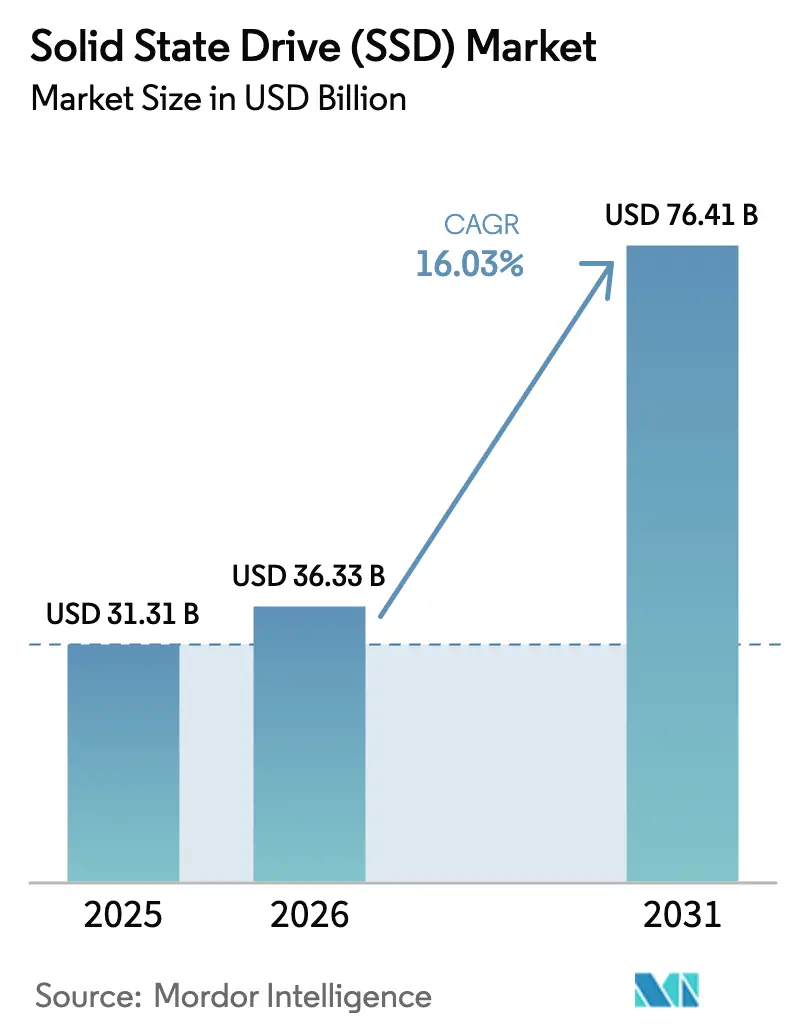
The Solid State Drive Market size is expected to grow from USD 31.31 billion in 2025 to USD 36.33 billion in 2026 and is forecast to reach USD 76.41 billion by 2031 at 16.03% CAGR over 2026-2031. Hyperscale and enterprise buyers are pivoting from legacy hard-disk shelves to NVMe flash to run generative AI training, vector databases, and real-time analytics at sub-millisecond latency, while edge-computing nodes in 5G base stations and autonomous vehicles add a second engine of demand. QLC cost parity with TLC, PCIe Gen5 bandwidth gains, and the migration from 2.5-inch U.2 to EDSFF modules all reinforce the adoption curve. Consumer sentiment also matters: gamers, content creators, and AI developers favor larger drives, pushing the above-2 TB band toward a 19.41% CAGR that tops the overall solid state drive market trajectory. On the supply side, five vertically integrated NAND makers account for roughly three-quarters of global output, yet rivalry remains intense as they race to 300-layer nodes, firmware-defined flash, and thermal innovations.
Key Report Takeaways
- By interface, PCIe and NVMe captured 62.34% solid state drive market share in 2025 while registering a 17.03% CAGR through 2031.
- By form factor, M.2 accounted for 47.11% of the solid state drive market size in 2025; EDSFF modules are forecast to grow at 18.12% CAGR to 2031.
- By technology, triple-level-cell NAND generated 58.56% of the revenue in 2025, whereas QLC NAND is expanding at an 18.12% CAGR as the endurance gap narrows.
- By capacity, the above-2 TB tier represented 19.41% of the solid state drive market size in 2025 and is the fastest-growing band at 19.41% CAGR.
- By end-user, client devices still accounted for 43.12% of revenue in 2025, and enterprise and data-center servers are advancing at an 18.72% CAGR, outpacing client devices.
- By sales channel, online retail is projected to grow at a 17.82% CAGR through 2031, eroding the share of offline stores and certain distribution channels.
- By geography, Asia Pacific held 46.73% revenue in 2025 and is expected to expand at an 18.67% CAGR, the strongest regional growth pace.
Note: Market size and forecast figures in this report are generated using Mordor Intelligence’s proprietary estimation framework, updated with the latest available data and insights as of January 2026.
Market Trends and Insights
Drivers Impact Analysis of Solid State Drive (SSD) Market*
| Driver | (~) % Impact on CAGR Forecast | Geographic Relevance | Impact Timeline |
|---|---|---|---|
| Rising Demand From AI/ML Data-Center Workloads | +4.2% | Global, concentrated in North America and Asia Pacific hyperscale hubs | Medium term (2-4 years) |
| Accelerating NVMe Adoption Across Enterprise Storage Arrays | +3.1% | Global, early adoption in North America and Europe enterprise segments | Short term (≤ 2 years) |
| Rapid Growth of Edge Computing Nodes in 5G and IoT | +2.8% | Asia Pacific and North America 5G infrastructure, global IoT deployments | Medium term (2-4 years) |
| Mainstreaming of PCIe 5.0 and EDSFF Form-Factors | +3.5% | North America and Asia Pacific data center markets, Europe enterprise | Short term (≤ 2 years) |
| Government Green-Data Policies Favor Flash Over HDDs | +1.4% | Europe (EU Energy Efficiency Directive), North America, China | Long term (≥ 4 years) |
| OEM Firmware-Defined Flash Creating New Upgrade Cycles | +1.3% | Global, concentrated in enterprise and hyperscale segments | Medium term (2-4 years) |
| Source: Mordor Intelligence | |||
AI and ML Workloads Reshape Data-Center Storage
Generative AI clusters now stream terabyte-scale parameter files from local NVMe tiers rather than network shares, and Meta’s 2025 report showed Llama 3 training pulling 2.4 exabytes of flash, up 60% from 2024. PCIe Gen5 drives offering more than 10 GB/s sequential writes are therefore replacing SATA and early-generation PCIe devices. Edge AI compounds demand autonomous vehicles ship with 4 TB to 8 TB SSDs for onboard inference, and every millisecond saved translates into safer control loops. Nvidia highlighted at GTC 2025 that storage I/O, not GPU cycles, cap many AI pipelines. Hyperscalers have shifted budgets accordingly, viewing flash as an operating-expense reducer because they can increase VM density per rack and lower power draw once latency is removed from the data path.
Enterprise NVMe Uptake Accelerates Legacy Replacement
NVMe crossed a 60% shipment threshold for enterprise arrays in 2025, and NVMe-over-Fabrics is displacing SAS and Fibre Channel because it brings tenfold throughput at similar reliability. Dell’s PowerStore uses NVMe-oF zoning to hit 7 million IOPS, making array consolidation economical.[1]Dell Technologies, “Supply-Chain Update FY 2025,” investors.delltechnologies.com The NVMe 2.0 spec added zoned namespaces and key-value commands that cut CPU cycles, so buyers are scrapping SATA shelves years ahead of depreciation. PCIe Gen4 satisfies mixed workloads today, yet early adopters already specify Gen5 for analytics clusters, turning protocol migration into the fastest lever for solid state drive market growth.
Edge-Computing Nodes Boost Demand Beyond the Core
Telcos cache CDN assets at 5G macro sites, slicing backhaul 38% and enabling cloud gaming and augmented-reality services, as Ericsson’s 2025 study confirmed. Tesla embeds 2TB SSDs in its autonomous platform for over-the-air model updates, demonstrating that automotive use cases increasingly rely on local flash storage. Industrial IoT gateways, point-of-sale kiosks, and rugged edge servers all need extended temperature tolerance and power-loss protection, creating premium niches within the broader solid state drive market.
PCIe 5.0 Bandwidth and EDSFF Density Reach the Mainstream
Intel Sapphire Rapids and AMD Genoa unlocked real Gen5 deployments, and attach rates topped 40% of new servers by mid-2025. Heat output climbed to 18 W per drive, yet Microsoft Azure cut cooling energy 22% by adopting E1.S drives that streamline airflow. Meta’s Open Rack V3 mandates E3.S, and Alibaba shifted 80% of its 2025 procurement to EDSFF, proving that density wins once rack slots become scarce. As PCIe Gen6 sampling starts in 2027, flash suppliers are already prototyping thermally efficient controller silicon to sustain performance without throttling.
Restraints Impact Analysis of Solid State Drive (SSD) Market*
| Restraint | (~) % Impact on CAGR Forecast | Geographic Relevance | Impact Timeline |
|---|---|---|---|
| High ASP Volatility Due to NAND Bit Oversupply | -2.7% | Global, acute in regions dependent on spot-market procurement | Short term (≤ 2 years) |
| Supply-Chain Concentration Risk in NAND Wafer Manufacturing | -1.8% | Global, acute in regions dependent on Taiwan and South Korea fabrication | Medium term (2-4 years) |
| Thermal Management Challenges in Ultrathin Client Devices | -1.2% | Global, concentrated in consumer laptop and mobile workstation segments | Short term (≤ 2 years) |
| Growing Security-Certification Costs for Enterprise Drives | -0.6% | North America and Europe enterprise segments, government procurement | Long term (≥ 4 years) |
| Source: Mordor Intelligence | |||
Pricing Volatility Clouds Procurement
Quarterly NAND prices swung 35% during 2024-2025, compressing OEM margins and forcing buyers to lock in 24-month contracts to avoid budget shortfalls. Excess wafer starts in 2023 combined with rapid QLC conversions pushed the solid state drive market into oversupply, dropping consumer SSD ASPs 28% year-on-year. Smaller brands lacking die or controller plants felt the squeeze most, underscoring that vertical integration is an insurance policy against price cycles.
Concentration Exposes the Supply Chain to Shock
Taiwan and South Korea house 68% of global NAND capacity; a 2024 earthquake idled 15% of Kioxia output and lifted spot prices 12% within weeks. Incentive programs under the U.S. CHIPS and Science Act and EU Chips Act promise local fabs but none will reach volume before 2027.[2]U.S. Department of Commerce, “CHIPS and Science Act Overview,” commerce.gov Until then, any geopolitical or seismic event at Asia’s fabrication hubs threatens the delivery schedules that keep the solid state drive market running.
*Our forecasts treat driver/restraint impacts as directional, not additive. The impact forecasts reflect baseline growth, mix effects, and variable interactions.
Solid State Drive (SSD) Market Segment Analysis
By Form Factor:
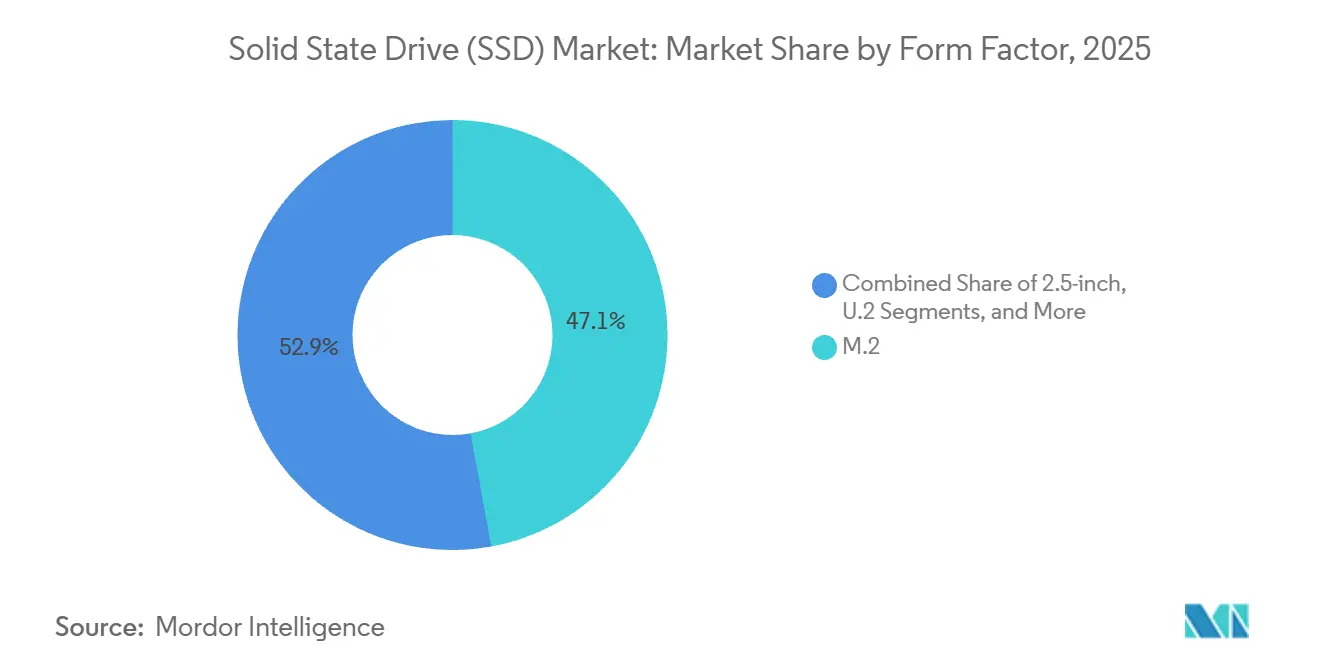
EDSFF Momentum Redefines Rack EconomicsM.2 drives generated 47.11% of 2025 revenue as laptops, SFF desktops, and consoles standardized on the gum-stick layout. However, the solid state drive market is pivoting in the data center; EDSFF E1.S, E1.L, and E3.S modules are forecast to post an 18.12% CAGR through 2031, the highest among form factors. Meta’s Open Rack V3 now accommodates 32 E3.S drives per 1U server, 33% more than U.2 bays, reducing floor space and cooling costs per petabyte.[3]Open Compute Project, “Open Rack V3 Specification,” opencompute.org
Samsung’s upcoming 64 TB E1.L showcases why hyperscalers prefer the elongated shell thermal spreader across the PCB, which avoids throttling even under 18 W write loads. Outside hyperscale halls, EDSFF uptake lags because traditional IT shops lack tool-free trays and budget for new chassis. Yet Alibaba’s 80% EDSFF procurement mix signals that scale tips the cost balance, so EDSFF should eclipse U.2 for fresh deployments before 2029. Meanwhile, add-in cards stay niche at <5% share, mostly in workstations and scientific clusters craving direct x16 bandwidth.



By Interface:
NVMe Consolidates Dominance While SATA FadesNVMe over PCIe claimed 62.34% of revenue in 2025 and is marching toward ubiquity at a 17.03% CAGR. NVMe’s lean command set halves CPU overhead compared to AHCI, and its multi-queue depth aligns perfectly with modern core counts. Conversely, SATA slid below 25% as motherboards drop ports or repurpose lanes for USB 4. SAS clings to dual-port enterprise arrays, yet its share is under 8% because NVMe-oF meets the same redundancy target with five times the throughput.
The adoption of PCIe Gen5 raises the solid-state drive market size for NVMe even faster. Dell’s PowerEdge Gen5 servers ship NVMe as the default, offering SATA only on special, build-to-order SKUs. Looking ahead, PCIe Gen6’s PAM-4 signaling promises equal bandwidth at lower watts, keeping NVMe firmly at the center of product roadmaps while legacy protocols linger only in brownfield refresh cycles.
By Technology:
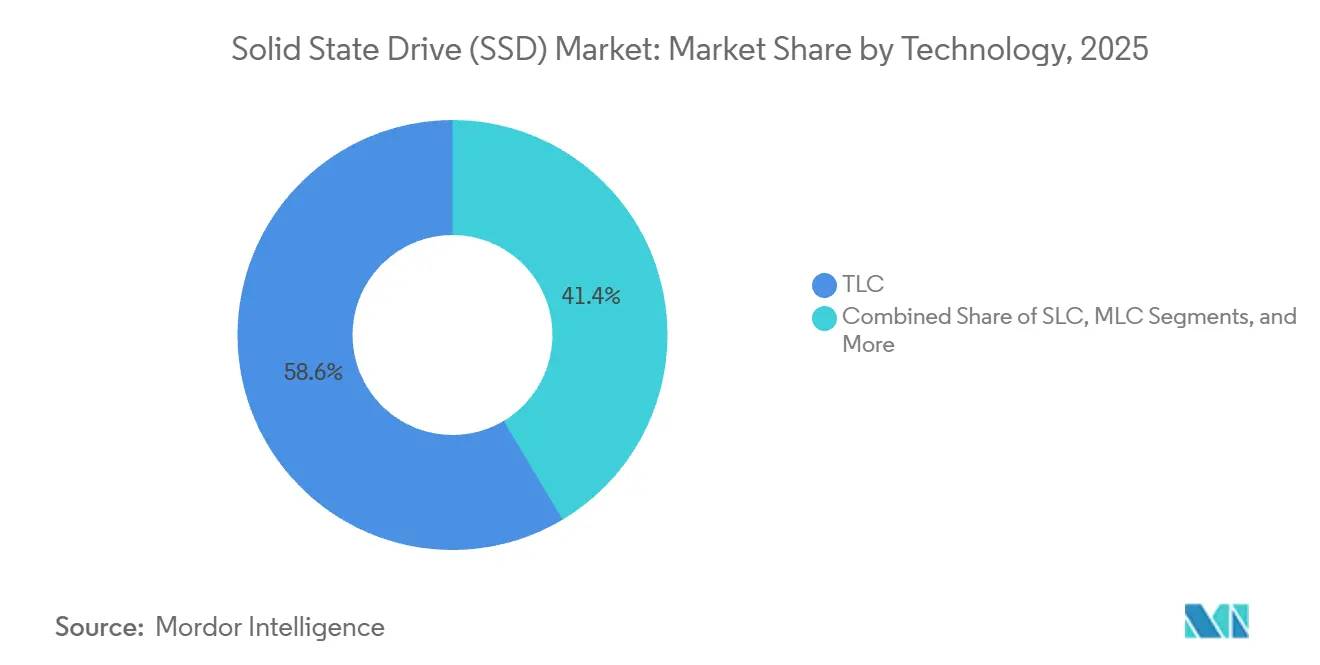
QLC Approaches TLC PerformanceTriple-level-cell NAND retained a 58.56% share in 2025, balancing cost and endurance, while QLC is the growth star, with an 18.12% CAGR. Micron’s 232-layer QLC clocks 600 TBW for 2 TB drives, hitting 90% of TLC endurance by caching writes in dynamic SLC regions. This advance enables hyperscalers to store cold data on QLC, shaving the cost per gigabyte by 30% in tiers such as AWS Glacier.
SLC and MLC remain in industrial and automotive gear where -40 °C to 125 °C ratings and >10,000 cycle endurance outweigh price. PLC entered pilot tape-out at SK hynix in late 2025, but its sub-1,000-cycle ceiling keeps it in archival niches for now. Net-net, the solid-state drive market will bifurcate, with QLC for read-heavy caches and TLC/SLC for sustained writes, driven more by workload profile than any top-line specification.
By Capacity:
High-Density Drives Outpace the PackThe 500 GB-1 TB tier still shipped the most units in 2025, holding 39.41% share, yet buyers are moving up. Drives above 2 TB will log a 19.41% CAGR through 2031, as 4K video edits, AAA games exceeding 200 GB, and local AI datasets outgrow smaller volumes. Nvidia’s developer survey reported that 62% of ML engineers store datasets on local SSDs to avoid network latency.
Samsung priced its 8 TB M.2 at USD 799 in 2025, signaling mainstream viability for capacities that once required enterprise form factors. Sub-500 GB models, once prevalent in entry laptops, shrank to <12% share thanks to falling die costs. The 1 TB-2 TB bracket remains the sweet spot for corporate boot volumes and VDI images, while studio workstations and data-center boot nodes race past 4 TB to simplify RAID layouts.
By End User:
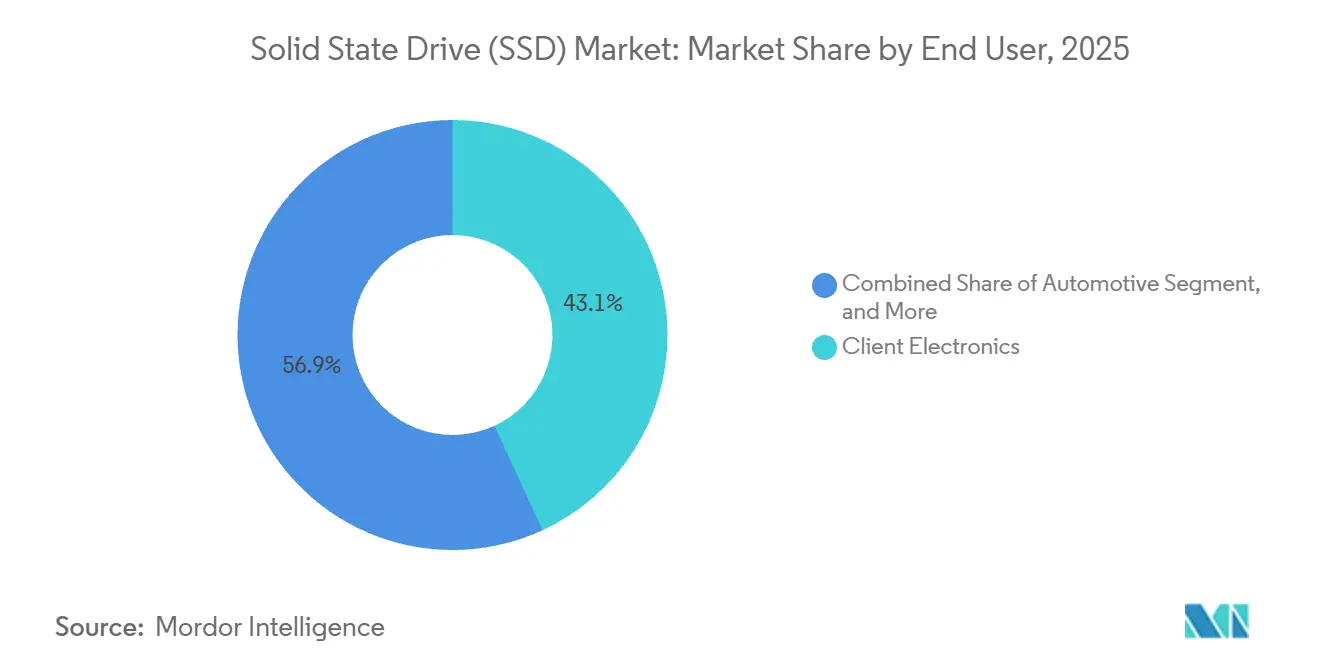
Servers and Edge Nodes Lead GrowthClient devices still accounted for 43.12% of revenue in 2025, yet enterprise and data-center servers are expected to rise at an 18.72% CAGR through 2031. Microsoft Azure and AWS each bought more than 500,000 SSDs per quarter in 2025 to feed AI inference clusters. At the edge, 5G nodes with local flash sliced backhaul offer a 38% reduction, according to Ericsson, providing telcos with an immediate OPEX payback.
Industrial and automotive niches demand rugged, AEC-Q100-qualified drives; Tesla embeds 2 TB SSDs in its self-driving stack, and BYD followed suit in 2025. These segments carry 3x-5x price premiums but lower unit volumes. Client refresh cycles remain steady, yet the revenue mix swings toward servers and edge boxes where capacity and endurance outweigh pure ASP.
By Sales Channel:
E-Commerce Gains GroundOEM deals still account for 51.84% of revenue, as hyperscalers and PC builders sign multi-year contracts for guaranteed supply and custom firmware. Even so, online marketplaces are expected to post a 17.82% CAGR through 2031 as DIY builders and SMB IT shops increasingly adopt transparent pricing. Amazon logged a 28% unit surge in 2025 as PCIe Gen5 upgrade kits became widely available.
Retail shelves in brick-and-mortar stores fell to a <10% share as same-day delivery reached most metro zip codes. OEMs now operate direct-to-consumer portals, but volumes remain tiny next to entrenched e-commerce giants. Over the long haul, real-time inventory APIs and net-30 payment add-ons will blur the distinction between distribution and retail, consolidating the solid state drive market around digital channels.
Geography Analysis
APAC Solid State Drive (SSD) Market
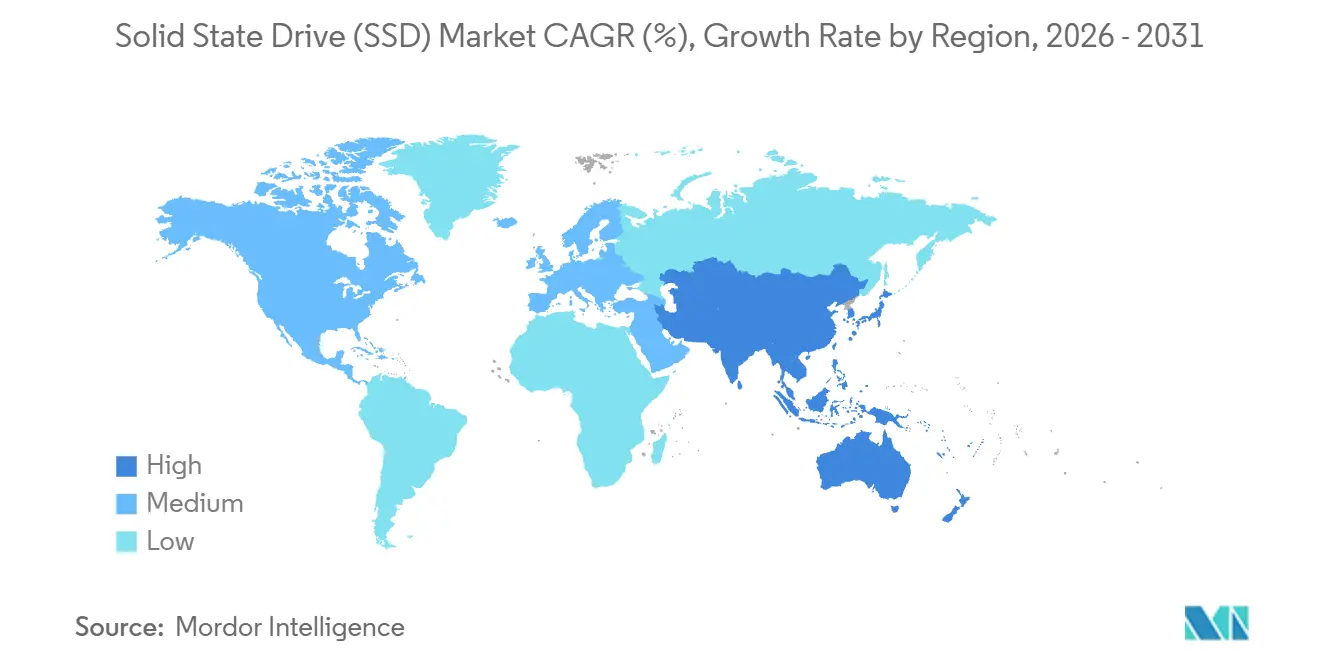
The Asia Pacific region controlled 46.73% of the revenue in 2025 and is expected to advance at an 18.67% CAGR, benefiting from both increased wafer output and local consumption. Samsung, SK hynix, and Kioxia operate 200-layer fabs in South Korea, Taiwan, and Japan, which significantly influence global cost curves. In contrast, Alibaba Cloud has deployed 1.2 exabytes of flash for domestic AI training. India posted a 32% increase in enterprise SSD purchases as the Digital India agenda drove new banking and e-gov workloads. The region’s growth faces geopolitical and earthquake risks, yet no alternative hub can yet match its cost structure.
North America and Europe Solid State Drive (SSD) Market
North America and Europe generated approximately 38% of the revenue in 2025. Azure and AWS each inserted half a million SSDs per quarter to support the growing demand for generative AI traffic. U.S. CHIPS funding supports Micron’s USD 15 billion New York fab, slated for a 2028 start-up, with early output focusing on DRAM before adding NAND. Europe’s GDPR and pending Data Act are prompting colocation centers to stock local flash, while the EU Chips Act earmarks EUR 43 billion (USD 50.30 billion) for onshore fabs; yet, none have yet reached pilot runs.
MEA and South America Solid State Drive (SSD) Market
Middle East and Africa and South America together yielded about 15% revenue. Saudi Arabia’s NEOM specified NVMe edge storage for its smart-city grid, while South African banks adopted flash to meet instant-payment mandates. Brazilian retailers saw a 24% unit rise in 2025, though import tariffs temper high-capacity adoption. Power grid instability and limited fiber still curb enterprise rollouts, yet year-on-year growth rates eclipse global averages as digital transformation leapfrogs legacy IT.
Mordor Intelligence provides coverage of the solid state drive (ssd) market across other key regional markets. Detailed country-level analysis extends to China incorporating local coverage and market participation, as required.

Regulatory Landscape
SSD vendors and buyers operate under tightening requirements for verifiable data sanitization and security certification, which directly shape enterprise procurement and lifecycle management. In the United States, NIST SP 800-88 Revision 2 (published September 2025) formalizes Clear, Purge, and Destroy categories for storage media and directs implementers to flash-specific mechanisms via IEEE 2883-2022, reinforcing the shift away from magnetic-era practices for SSD end-of-life handling. Security validation also remains a procurement gate for self-encrypting NVMe drives, with FIPS 140-3 validations used in regulated and government-adjacent deployments (for example, Samsung received initial validation for NVMe TCG Opal SSC SEDs in November 2024, with an update recorded in January 2026).
Sustainability and regional conformity requirements add a parallel compliance layer. The European Union enacted Regulation (EU) 2024/1781 (Ecodesign for Sustainable Products Regulation) in June 2024, creating a framework under which future ICT product requirements can extend to data storage devices, while China issued GB 46864-2025 in December 2025 with technical requirements for information sanitization of electronic products, effective January 1, 2027. Separately, SSD products sold through consumer channels face country-specific safety and conformity schemes, including Indias BIS framework for external solid-state storage devices under IS 13252 (Part 1): 2010, which influences labeling, testing, and channel readiness for brands shipping portable and external SSDs.
Value Chain Analysis
The SSD value chain starts with NAND flash wafer manufacturing and process equipment, then moves to controller silicon, firmware IP, and DRAM (for caching on many enterprise designs), followed by packaging substrates and passives. Assembly and test integrate NAND packages with controllers into standard form factors (M.2, U.2, and EDSFF), after which OEM/direct deals supply hyperscalers, server OEMs, and storage-array vendors, while distributors and online retail serve client and prosumer segments. Vertical integration shapes industry leverage: five NAND makers control roughly three-quarters of global output, giving them control over die allocation, qualification cycles, and long-term supply agreements.
Recent supply-chain signals highlight both concentration risk and multi-node transition effects. Taiwan and South Korea host a large share of NAND capacity, and earthquake-related disruptions have shown how quickly spot pricing and lead times can react, keeping risk management central for buyers without long-term contracts. Upstream constraints extend beyond wafers as AI-driven advanced packaging expansion increases competition for materials used in SSD controller substrates, creating overlapping bottlenecks. On the technology side, suppliers are retiring older nodes while moving to higher-layer 3D NAND and new module standards, exemplified by Kioxias plan to phase out 2D NAND and early 3D nodes with a final order deadline of September 30, 2026, and Kioxia and SanDisk starting production of their 10th-generation 3D flash at Kitakamis Fab2 (K2) in July 2026, which supports downstream availability for higher-capacity client and enterprise SSDs.
Competitive Landscape
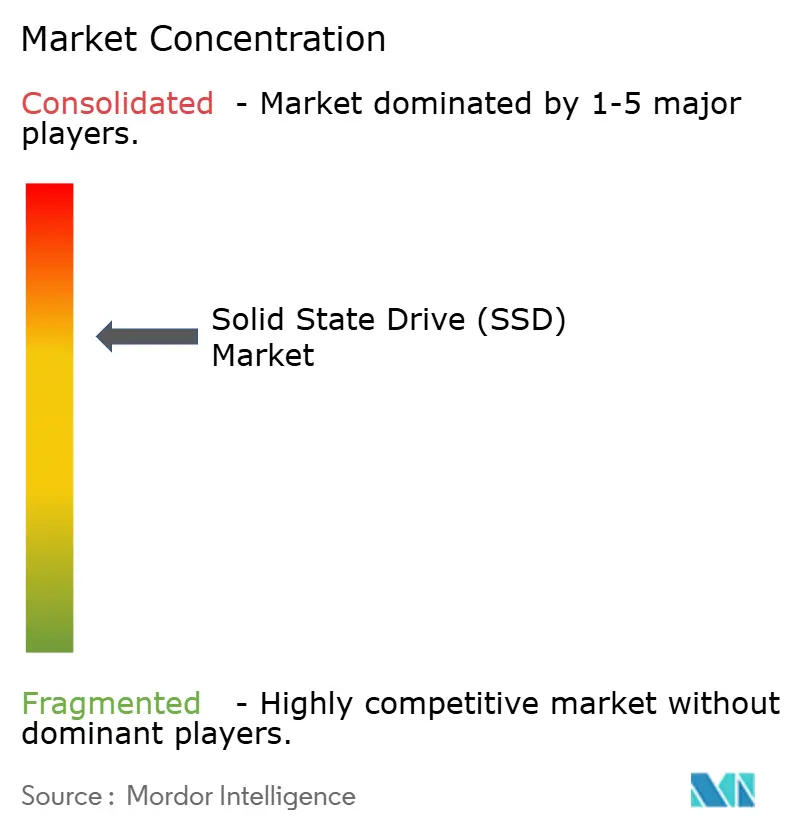
The solid state drive market remains moderately concentrated, with Samsung, SK hynix, Micron, Kioxia, and Western Digital collectively owning roughly 75% of NAND bits; yet, rivalry is fierce. Samsung’s vertical stack combines NAND, DRAM, and controllers, cutting time to market. Micron’s USD 15 billion New York fab diversifies its geography and pursues CHIPS subsidies, although volume is expected to arrive only in 2028. Western Digital co-develops BiCS 8 with Kioxia to share USD 3 billion node costs.
Smaller challengers attack niches. Solidigm optimizes QLC for CDN workloads, while YMTC leverages a 321-layer Xtacking die to win price-sensitive Chinese tenders. Automotive SSDs require a temperature tolerance of -40 °C to 125 °C and a ten-year retention period, enabling Samsung to secure design wins with Tesla and BYD. Computational-storage startups raised USD 200 million in 2025, embedding FPGAs in drives for on-disk SQL filters. Patent activity in phase-change heat sinks and graphene spreaders reflects a shared problem: cooling 18 W Gen5 drives without throttling. NVMe 2.0, ratified in 2025, formalizes computational storage commands and telemetry hooks, providing innovators with a standards-based runway.[4]NVM Express, “NVMe 2.0 Specification,” nvmexpress.org
Solid State Drive (SSD) Industry Leaders
Samsung Electronics Co., Ltd.
Western Digital Corporation
Kioxia Holdings Corporation
SK hynix Inc. (incl. Solidigm)
Micron Technology, Inc.
- *Disclaimer: Major Players sorted in no particular order
Solid State Drive (SSD) Market Companies Covered in this Report
- Samsung Electronics Co., Ltd.
- Western Digital Corporation
- Kioxia Holdings Corporation
- SK hynix Inc. (incl. Solidigm)
- Micron Technology, Inc.
- Seagate Technology Holdings plc
- Kingston Technology Corporation
- ADATA Technology Co., Ltd.
- Transcend Information, Inc.
- Corsair Memory, Inc.
- Sabrent
- Silicon Motion Technology Corp.
- Phison Electronics Corporation
- Intel Corporation (Optane)
- Marvell Technology, Inc.
- Patriot Memory
- Team Group Inc.
- Mushkin Enhanced MFG
- Microsemi (Microchip Technology)
- Violin Systems LLC

Market Opportunities and Future Outlook
A whitespace is opening around AI-optimized enterprise storage stacks where interface speed, power efficiency, and thermal design are becoming product differentiators rather than table-stakes. PCIe Gen5 deployments already pushed per-drive heat loads toward 18 W in data centers, and hyperscalers have adopted airflow-friendly EDSFF designs in part to reduce cooling energy (for example, Azure reported a 22% cooling-energy reduction tied to E1.S adoption in the current study context). This shifts opportunity toward controllers, firmware, and module designs that maintain QoS under sustained AI ingestion and checkpointing, while also meeting security and sanitization requirements that increasingly influence government and regulated procurement.
On the supply side, the transition to newer 3D NAND architectures and bonding approaches is creating room for differentiated enterprise and high-capacity client SSD portfolios, particularly where QLC endurance and firmware-defined flash features align with read-heavy AI and content workloads. Recent, in-scope evidence of this roadmap acceleration includes Samsung commencing mass production of its PM1763 enterprise SSD in July 2026 using PCIe 6.0, 9th-generation V-NAND, and a 4 nm controller aimed at AI and HPC servers, and Kioxia and SanDisk beginning production of 10th-generation 3D flash at Kitakami in July 2026 to raise bit density. As platform roadmaps extend beyond PCIe 6.0, controller vendors also signal a new upgrade cycle: Silicon Motion has confirmed active development of PCIe Gen7 enterprise controller architecture, underscoring how interface transitions propagate opportunities across controllers, modules (EDSFF), qualification services, and OEM integration.
Recent Industry Developments in Solid State Drive (SSD) Market
- July 2026: Samsung Electronics began mass production of the PM1763 enterprise SSD, integrating PCIe 6.0 connectivity with 9th-generation V-NAND and a 4 nm controller targeted at AI and HPC servers. The launch reinforces a shift from client-led refresh cycles to enterprise roadmaps optimized for high-throughput, latency-sensitive workloads, and it raises the competitive bar for controller efficiency and thermal design in next-generation server platforms.
- March 2025: Kioxia introduced the LC9 Series 122.88 TB NVMe SSD built on 8th-generation BiCS FLASH and PCIe 5.0 for AI training clusters. By pushing capacity density and bandwidth together, the product supports higher flash-per-rack configurations that align with EDSFF adoption and helps hyperscale buyers reduce the number of drive bays required per petabyte.
- June 2024: The European Union enacted Regulation (EU) 2024/1781, the Ecodesign for Sustainable Products Regulation, establishing a framework for future sustainability requirements that can extend to ICT hardware including data storage. This policy direction elevates compliance considerations such as lifecycle documentation and product sustainability attributes alongside performance and endurance metrics for SSD vendors selling into Europe.


Solid State Drive (SSD) Market Report Scope and Research Methodology
Market Definition and Coverage
This market covers revenue generated from solid state drives (SSDs) sold for use in computing, consumer electronics, industrial equipment, and enterprise storage and servers, across common form factors and interfaces where NAND flash storage is the core technology.
Scope exclusions: We exclude external USB flash sticks, hybrid HDD products, and refurbished or gray-market SSD sales from this sizing.
Segments Covered in This Report
- By Form Factor
- 2.5-inch
- M.2
- U.2
- PCIe Add-in Card
- EDSFF
- Other Form Factors
- By Interface
- SATA
- PCIe/NVMe
- SAS
- By Technology (NAND Type)
- SLC
- MLC
- TLC
- QLC
- Other NAND Types
- By Capacity
- Up to 500 GB
- 500 GB - 1 TB
- 1 TB - 2 TB
- Above 2 TB
- By End-user/Application
- Client Electronics (Laptops, Desktops)
- Enterprise/Data-Center Servers
- Industrial and Embedded Systems
- Automotive
- Other End-user/Application
- By Sales Channel
- Direct/OEM
- Distribution and Resellers
- Online Retail
- By Geography
- North America
- United States
- Canada
- Mexico
- South America
- Brazil
- Argentina
- Rest of South America
- Europe
- Germany
- United Kingdom
- France
- Italy
- Spain
- Russia
- Rest of Europe
- Asia Pacific
- China
- Japan
- South Korea
- India
- Australia
- New Zealand
- Rest of Asia Pacific
- Middle East
- United Arab Emirates
- Saudi Arabia
- Turkey
- Rest of Middle East
- Africa
- South Africa
- Nigeria
- Kenya
- Rest of Africa
- North America
Data Sources, Market Sizing, and Validation
Desk Research
Desk work starts by setting a clean boundary for what counts as an SSD sale, and then building a first draft view of demand and supply signals. We lean on public datasets and standards bodies, such as the US International Trade Commission trade data tools, UN Comtrade, OECD ICT indicators, and industry standards materials from groups such as JEDEC and PCI-SIG, because they help anchor device definitions and shipment-related context.
To make the model usable by year and region, we also review public financial filings and investor presentations from SSD and NAND value chain participants, along with reputable press coverage of pricing cycles and capacity additions. For supporting detail, we use paid subscriptions for company financials and news intelligence, plus patent databases to track controller and NAND technology direction when it impacts pricing assumptions. These desk research sources are illustrative, and many other public and paid references were also used for data collection, validation, and clarification during the study.
Primary Interviews and Surveys
Primary work is used to pressure test the desk model using expert interviews and structured surveys with SSD OEMs, controller and NAND ecosystem participants, distributors and channel partners, and large buyers such as data center and enterprise storage teams. The discussions stayed global so we could compare pricing pressure, supply tightness, and adoption timing across major demand pools, and then triangulated the inputs before totals were finalized.
Distribution of primary research fieldwork respondents
| Company type | Respondent position | Region |
|---|---|---|
| Top tier: 36% | CXOs: 12% | APAC: 45% |
| Mid tier: 49% | Functional/Unit leaders: 35% | EMEA: 35% |
| Smaller Players: 15% | Managers: 53% | Americas: 20% |
Market-Sizing & Forecasting
Sizing is built using a top-down demand pool approach where device shipments and storage attach rates are reconstructed for key end markets, and then translated into SSD revenue using interface and form factor mix plus average selling price ranges. In practice, inputs such as PC and notebook shipments, server and storage system deployments, SSD penetration by workload, typical capacity per drive, and NAND pricing cycle direction are tracked because these are the levers that move revenue the most.
The totals are then corroborated using selective bottom-up checks, such as rolling up a sample of supplier and channel revenue disclosures, and using sampled ASP times estimated unit volumes to see if the market lands in a reasonable band. When a local market has thin public signals, gaps are handled by using proxy indicators (like import-export patterns and regional device shipment shares) and then validating them with interview feedback.
For forecasting, scenario analysis is applied around NAND price swings, enterprise refresh timing, and client device upgrade cycles, since these typically shift volume and ASP together. The final forecast path is accepted only after the scenario outputs align with expert consensus on adoption speed for NVMe and higher capacity drives.
Data Validation & Update Cycle
Validation is done through repeated cross-checks so the market value is not driven by one data series. We compare outputs to independent signals like reported storage revenue trends, shipment momentum indicators, and pricing movement patterns, and then investigate variances that exceed expected ranges by region or end-use.
Before sign-off, the model is reviewed in steps, including assumption checks, arithmetic checks, and logic checks across the historical and forecast years. The report is refreshed annually, and interim updates are triggered when major supply shifts, pricing inflections, or policy changes materially affect the outlook. Right before delivery, a fresh pass is completed so clients receive the most current view available at that time.
Mordor Intelligence's Solid State Drive Market Estimate Compared With Other Published Estimates
Published SSD market numbers often do not match, and it usually comes back to what products are counted, which years are treated as the base, and how ASP movement is handled during NAND pricing cycles. Geography coverage also matters because enterprise and client demand can peak at different times by region.
Key gap drivers show up in practical places, like whether external flash storage is grouped into SSDs, whether refurbished units are included, and whether forecasts assume a smooth ASP curve instead of a cycle. Some estimates also start from a revenue figure that is not reconciled with shipment and capacity signals, which can push the total up or down depending on the price period chosen.
Benchmark comparison
| Source | Market Size | Gaps in Research Methodology |
|---|---|---|
| Mordor Intelligence | USD 36.33 B (2026) | |
| Global Consultancy A | USD 72.81 B (2025) | Uses an earlier base year with a larger stated revenue pool and does not clearly separate new SSD shipments from adjacent storage categories or refurb flows, which can inflate the counted value in a strong pricing year. |
| Industry Publisher B | USD 41.57 B (2025) | Forecast starts from a different year boundary and uses broader segmentation language, which can lead to different inclusion of client versus enterprise devices and a different ASP progression assumption over the cycle. |
Shipment momentum signals, form factor mix shifts, and the NAND price cycle checks are what keep Mordor Intelligence's figure tied to the defined SSD demand pool rather than a broader storage revenue bucket. Reading the table together, the spread is mainly explained by base year choice and category boundaries, so a consistent scope and repeatable checks help keep the number stable from update to update.


Key Questions Answered in the Report
What is the projected value of the solid state drive market by 2031?
It is forecast to reach USD 76.41 billion by 2031, growing at a 16.03% CAGR.
Which interface is overtaking SATA in new deployments?
PCIe-based NVMe leads with 62.34% share in 2025 and continues to expand as SATA retires.
Why are hyperscalers adopting EDSFF drives?
EDSFF increases drive density per rack unit and cuts cooling energy by more than 20%, improving total cost of ownership.
Is QLC NAND ready for enterprise workloads?
Yes, 232-layer QLC now delivers 600 TBW for 2 TB drives, about 90% of entry-level TLC endurance in read-heavy environments.
Which region grows fastest through 2031?
Asia Pacific leads at an 18.67% CAGR thanks to concentrated NAND output and surging local demand.
What limits PCIe Gen5 SSD adoption today?
Drives dissipate up to 18 W, so many data centers must upgrade cooling to avoid throttling.
Page last updated on:


 Your data is secure and never sold or shared.


