
Solar Powered Irrigation System Market Size and Share
Market Overview
| Study Period | 2021 - 2031 |
|---|---|
| Market Size (2026) | USD 61.60 Billion |
| Market Size (2031) | USD 117.58 Billion |
| Growth Rate (2026 - 2031) | 13.50 % |
| Fastest Growing Market | Africa |
| Largest Market | Asia Pacific |
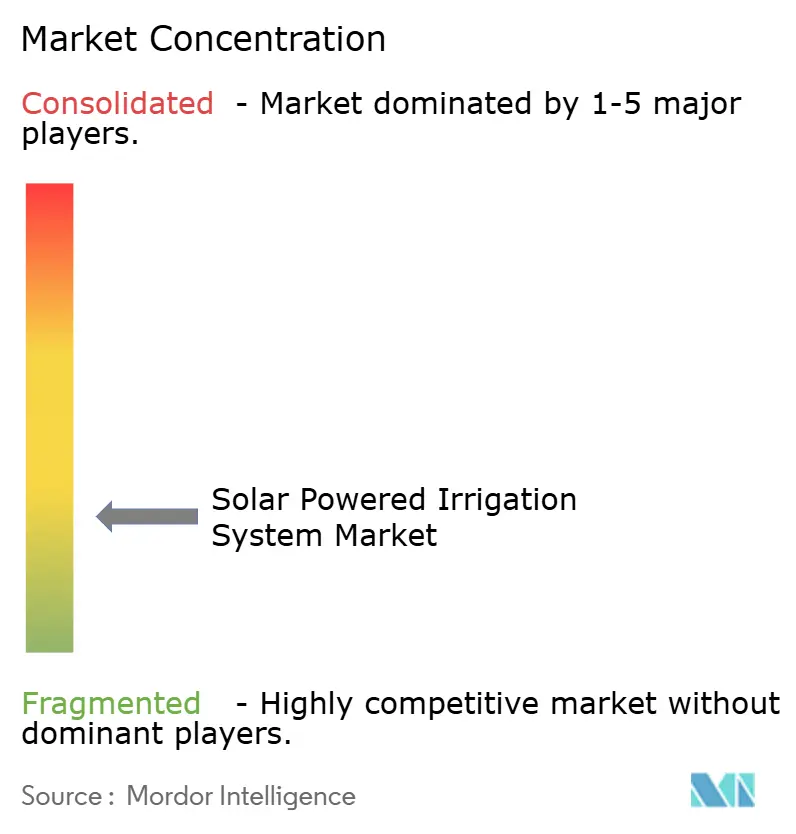
| Market Concentration | Low |
Major Players *Disclaimer: Major Players sorted in no particular order Image © Mordor Intelligence. Reuse requires attribution under CC BY 4.0. | |
Solar Powered Irrigation System Market Analysis by Mordor Intelligence
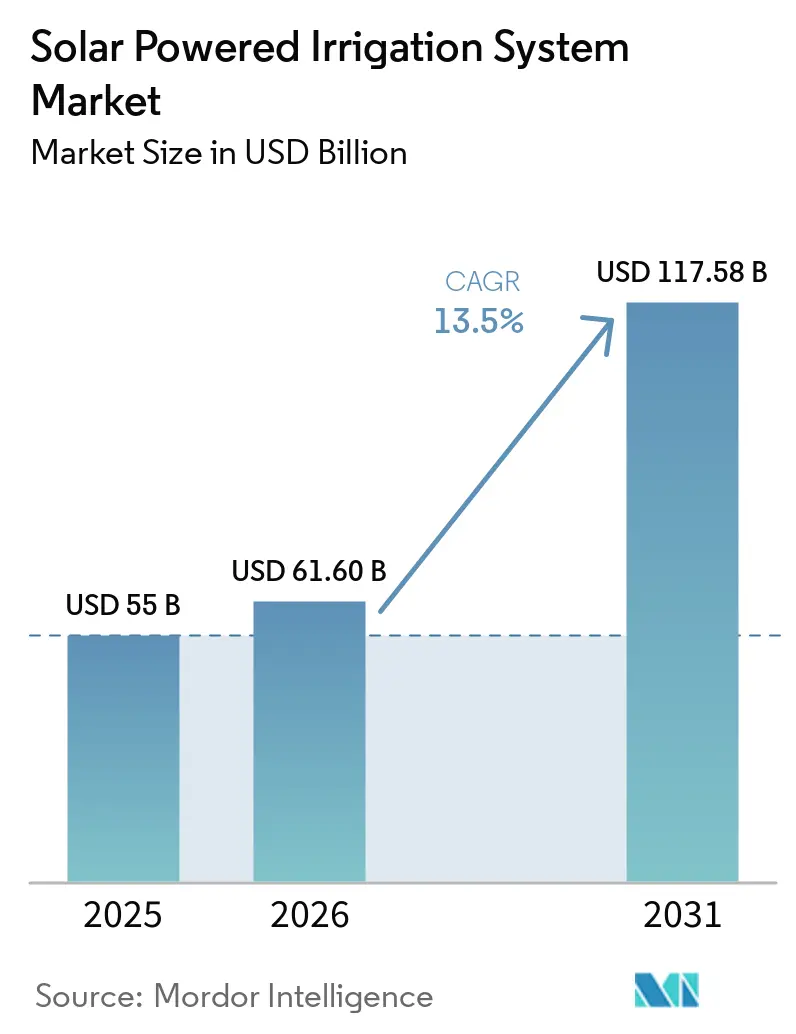
The solar-powered irrigation system market was valued at USD 55.00 billion in 2025 and is projected to grow from USD 61.60 billion in 2026 to USD 117.58 billion by 2031, registering a CAGR of 13.5% during the forecast period (2026-2031). Declining photovoltaic module prices, advancements in cell efficiencies, and government incentives in countries such as India, Kenya, and China are reducing payback periods and driving adoption, despite rising wafer prices. In India, the 2026 budget nearly doubled the allocation for the PM-KUSUM scheme, leading to a significant increase in standalone pump installations. Furthermore, decreasing diesel subsidies and rising grid-electricity tariffs are improving the operating economics of photovoltaic pumps in regions such as sub-Saharan Africa and South Asia. The market remains fragmented, with regional specialists operating alongside multinational companies, which are increasingly focusing on data-driven agronomic services to sustain profitability.
Key Report Takeaways
- By product type, submersible pumps led with the largest 54% of the solar powered irrigation system market share in 2025. The floating pumps market size is projected to expand at the fastest 19.3% CAGR from 2026 to 2031.
- By irrigation system, drip irrigation captured the largest 42.5% of the solar powered irrigation system market share in 2025. The drip irrigation market size is anticipated to advance at the fastest 18.7% CAGR from 2026 to 2031.
- By power rating (HP), systems up to 3 HP contributed the largest 48.3% of the solar powered irrigation system market share in 2025. Units above 10 HP will post the fastest 20.4% CAGR from 2026 to 2031.
- By component, solar panels accounted for the largest 35.2% of the solar powered irrigation system market share in 2025. The controllers market size is forecast to grow at the fastest 21.5% CAGR from 2026 to 2031.
- By end‐user, smallholder farms held the largest 61% of the solar powered irrigation system market share in 2025. Commercial farms market size projected to grow at the fastest 16.2% CAGR from 2026 to 2031.
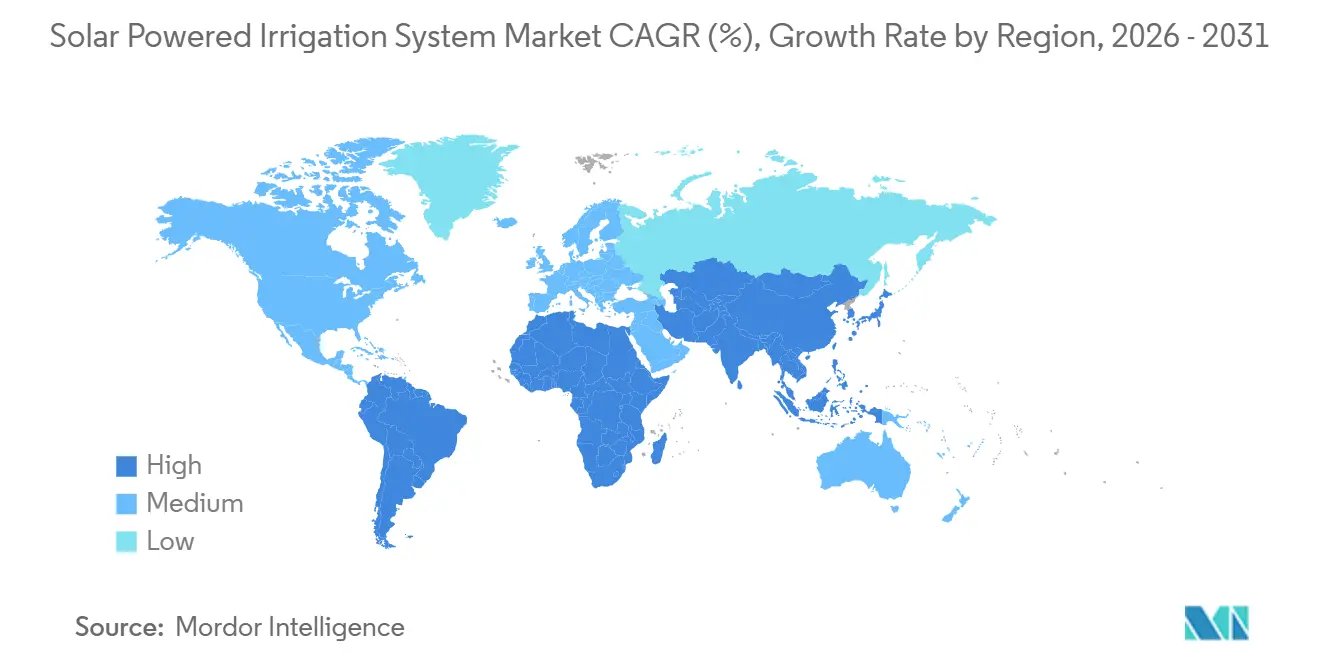
- By geography, Asia-Pacific controlled the largest 45.1% of the Solar Powered Irrigation System market share in 2025, and Africa market size is record to grow at the fastest CAGR of 17.9% from 2026 to 2031.
Note: Market size and forecast figures in this report are generated using Mordor Intelligence’s proprietary estimation framework, updated with the latest available data and insights as of January 2026.
Market Trends and Insights
Drivers Impact Analysis of Solar Powered Irrigation System Market*
| Driver | (~) % Impact on CAGR Forecast | Geographic Relevance | Impact Timeline |
|---|---|---|---|
| Declining photovoltaic module prices and rising efficiency | +2.8% | Global, strongest in Asia-Pacific and sub-Saharan Africa | Medium term (2–4 years) |
| Government subsidies and incentive programs | +3.2% | India, Kenya, China, Mediterranean Europe, Middle East and North Africa | Short term (≤ 2 years) |
| Escalating diesel and grid-electricity costs | +2.5% | South Asia, sub-Saharan Africa, South America, Middle East | Short term (≤ 2 years) |
| Agrivoltaic dual-land-use adoption | +1.8% | India, China, Mediterranean Europe, arid Middle East | Long term (≥ 4 years) |
| Pay-as-you-grow equipment leasing via carbon-credit revenues | +1.5% | East Africa, West Africa, South Asia | Medium term (2–4 years) |
| AI-driven pump-sizing optimization tools | +1.2% | North America, Europe, Asia-Pacific, smallholder cooperatives globally | Long term (≥ 4 years) |
| Source: Mordor Intelligence | |||
Declining Photovoltaic Module Prices and Rising Efficiency
Declining photovoltaic module prices and ongoing advancements in efficiency are improving the cost-effectiveness of solar-powered irrigation systems. Reduced module costs lower the initial capital investment, while enhanced efficiency boosts energy output per unit area, reducing system size and simplifying installation. These advancements are particularly beneficial in off-grid agricultural areas with high cost sensitivity. For example, crystalline silicon solar module prices were approximately USD 0.11 per watt in 2024, driven by global oversupply and increased manufacturing scale, making solar irrigation systems more accessible to farmers [1].
Government Subsidies and Incentive Programs
Government support mechanisms are significantly contributing to the adoption of solar-powered irrigation systems by alleviating the financial challenges farmers face. These initiatives include capital subsidies, concessional financing, and performance-linked incentives, collectively improving affordability and facilitating deployment, especially in rural and off-grid areas. Such policies boost investment confidence and promote large-scale adoption among both smallholder and commercial farming sectors. For instance, India’s PM-KUSUM scheme has an approved budget of INR 34,422 crore (USD 3.71 billion) in 2025 to support the installation of solar pumps and decentralized renewable energy solutions in agriculture [2].
Escalating Diesel and Grid-Electricity Costs
Increasing diesel prices and rising grid electricity tariffs are improving the economic feasibility of solar-powered irrigation systems, particularly in regions with unreliable energy access. Farmers using diesel pumps encounter high and variable fuel costs, which substantially increase irrigation expenses and reduce profit margins. Solar-powered systems provide a stable, low-operating-cost alternative, supporting enhanced long-term financial sustainability. Solar irrigation pumps can reduce irrigation costs compared to diesel-powered pumps, making them a cost-effective solution and driving the adoption of solar-based irrigation technologies.
Agrivoltaic Dual-Land-Use Adoption
Agrivoltaic systems are increasingly being adopted as they allow for the concurrent use of land for agricultural production and solar energy generation, enhancing land-use efficiency and farm income potential. By positioning elevated solar panels above crops, these systems help create a favorable microclimate that aids in moisture retention and mitigates heat stress, particularly in water-scarce regions. This integrated approach is gaining popularity in semi-arid agricultural areas to boost productivity and resilience. Agrivoltaic systems improve water-use efficiency in crop cultivation.
Restraints Impact Analysis of Solar Powered Irrigation System Market*
| Restraint | (~) % Impact on CAGR Forecast | Geographic Relevance | Impact Timeline |
|---|---|---|---|
| High up-front capital expenditure | -2.1% | Sub-Saharan Africa, South Asia, smallholder regions worldwide | Short term (≤ 2 years) |
| Solar-resource intermittency and need for storage | -1.4% | South Asia monsoon belts, Central Africa cloud zones, Andean highlands | Medium term (2–4 years) |
| Counterfeit low-efficiency panels eroding farmer trust | -0.8% | South Asia, Sub-Saharan Africa, Middle East | Short term (≤ 2 years) |
| Lack of interoperability among IoT pump controllers | -0.5% | Global, most severe in multi-vendor markets without standards | Long term (≥ 4 years) |
| Source: Mordor Intelligence | |||
High Up-Front Capital Expenditure
High initial investment continues to be a significant barrier to the adoption of solar-powered irrigation systems, especially for smallholder farmers with limited access to financing. The expenses associated with solar pumps, installation, and related infrastructure pose affordability challenges, despite the potential for long-term savings on fuel and electricity. This issue is particularly evident in developing agricultural economies, where farm incomes are relatively low, and access to credit is constrained. Solar irrigation pump systems typically range in cost from USD 2,000 to USD 10,000, depending on their capacity and configuration.
Solar-Resource Intermittency and Need for Storage
Variability in solar irradiance impacts the efficiency and reliability of solar-powered irrigation systems, particularly in regions with seasonal cloud cover and inconsistent sunlight availability. Reduced solar output during periods of peak irrigation demand can limit water availability, necessitating the use of backup solutions such as diesel generators or battery storage. These alternatives increase system costs and operational complexity, which can hinder adoption among small-scale farmers. Solar-powered irrigation systems may experience some output reductions under low irradiance conditions, disrupting irrigation consistency during crucial growing periods.
*Our forecasts treat driver/restraint impacts as directional, not additive. The impact forecasts reflect baseline growth, mix effects, and variable interactions.
Solar Powered Irrigation System Market Segment Analysis
By Product Type:
Submersible Pumps Anchor Market DominanceSubmersible pumps led with the largest 54% of the solar powered irrigation system market share in 2025. Their dominance is driven by strong suitability for deep borewell applications and consistent performance in groundwater-dependent regions across Asia and Africa. These pumps operate efficiently under submerged conditions, ensuring durability, reduced maintenance, and stable water output for irrigation needs. Increasing groundwater extraction and declining water tables further reinforce demand, making submersible systems essential for reliable irrigation infrastructure in both smallholder and commercial farming environments globally.
The floating pumps market size is projected to expand at the fastest 19.3% CAGR from 2026 to 2031. Growth is driven by rising adoption in aquaculture, reservoirs, and water bodies where land constraints limit traditional installations. Floating systems reduce evaporation losses and enable dual use with floating solar panels, improving efficiency and land utilization. Increasing investments in water-based agriculture and renewable energy integration are projected to accelerate adoption, particularly in Southeast Asia and other regions with abundant surface water resources and expanding irrigation requirements.
By Irrigation System:
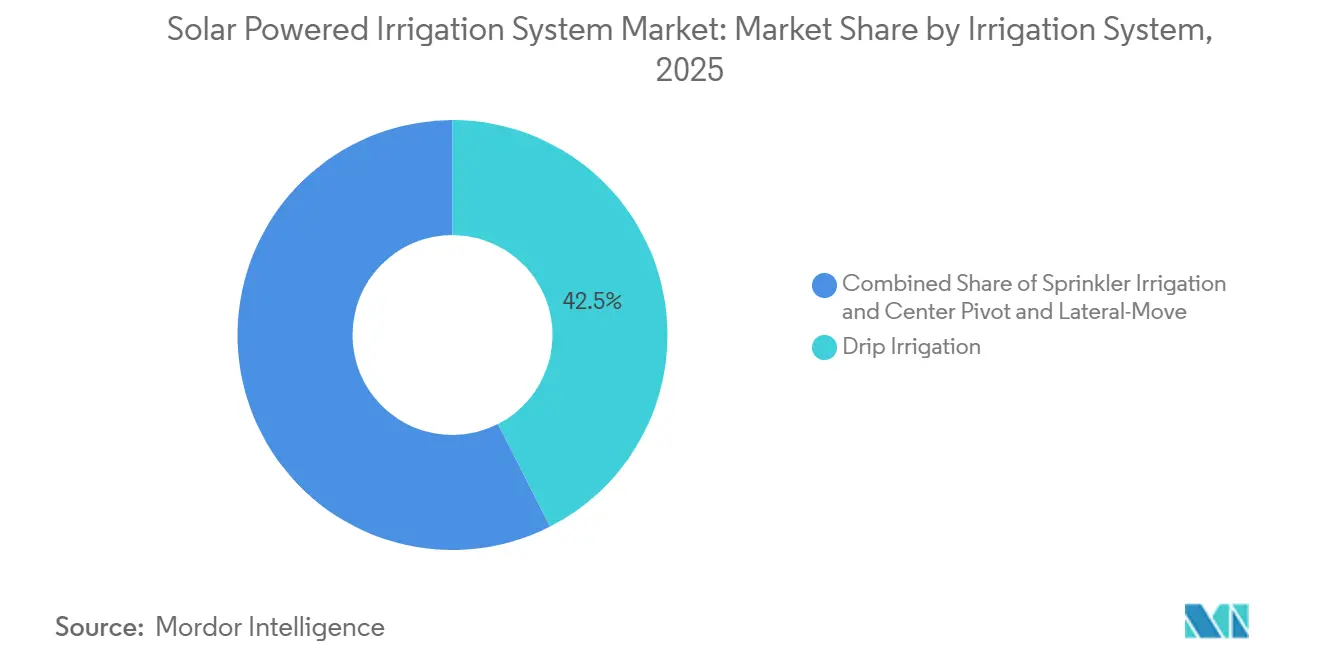
Drip Leads Efficiency MandatesDrip irrigation captured the largest 42.5% of the solar powered irrigation system market share in 2025. Adoption is driven by its ability to deliver precise water supply directly to plant roots, minimizing losses and improving crop productivity. These systems operate at lower pressure, reducing energy consumption and enhancing compatibility with solar-powered setups. Increasing water scarcity and regulatory mandates for efficient irrigation practices are further strengthening adoption across agricultural regions, particularly in areas facing groundwater depletion and stringent water-use regulations.
The drip irrigation market size is anticipated to advance at the fastest 18.7% CAGR from 2026 to 2031. Growth is supported by continuous technological advancements, including automated flow control, sensor integration, and smart irrigation scheduling. These innovations improve water-use efficiency and reduce labor requirements, making drip systems attractive for both smallholder and commercial farms. Expanding awareness regarding sustainable farming practices and increasing government incentives for micro-irrigation adoption are projected to sustain strong demand for drip irrigation solutions in solar-powered irrigation applications globally.
By Power Rating:
Sub-3 HP Prevails Among SmallholdersSystems up to 3 HP accounted for the largest 48.3% of the solar-powered irrigation system market share in 2025. These systems are predominantly used by smallholder farmers due to their affordability and suitability for small landholdings with limited irrigation needs. Their low energy consumption and ease of installation make them particularly suitable for rural and resource-constrained areas. The increasing availability of subsidies and financing options is further driving adoption, enabling farmers to shift from diesel-powered pumps to cost-effective solar irrigation systems without compromising irrigation efficiency.
Systems above 10 HP market size are anticipated to grow at the fastest 20.4% CAGR from 2026 to 2031. This growth is attributed to rising demand from commercial farms that require high-capacity irrigation systems for large-scale agricultural operations. These systems facilitate mechanized farming and the cultivation of water-intensive crops, especially in regions with extensive farmland. Increased investments in agricultural modernization and electrification are projected to support the adoption of high-capacity solar pumping systems, enhancing operational efficiency and reducing reliance on fossil fuel-based irrigation methods.
By Component:
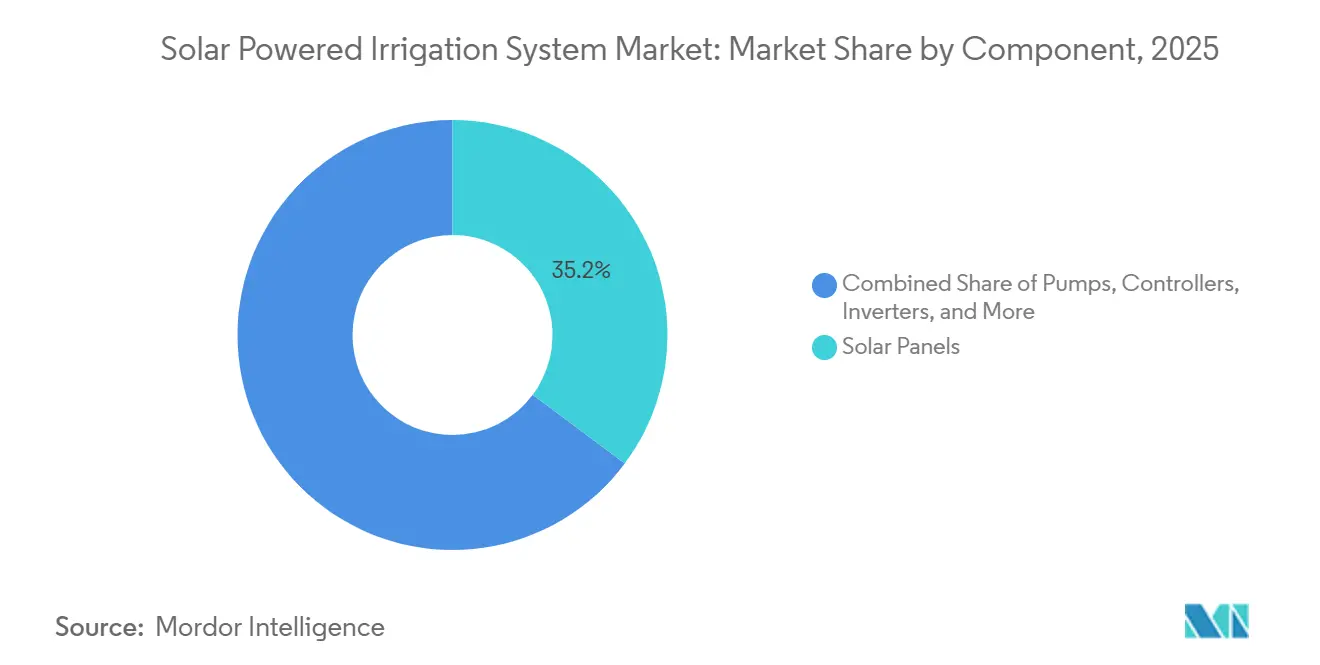
Panels Dominate Revenue, Controllers Scale FastSolar panels are projected to account for the largest share of 35.2% in the solar-powered irrigation system market in 2025. This dominance highlights their critical role in energy generation and their significant contribution to the overall system cost. Ongoing advancements in photovoltaic efficiency and decreasing manufacturing costs are improving system affordability and performance. The growing adoption of high-efficiency panels is increasing energy output while reducing system size requirements, making solar irrigation systems more accessible to a wider range of farmers across various agricultural regions.
The controllers market size is anticipated to grow at the fastest CAGR of 21.5% from 2026 to 2031. This growth is attributed to the increasing integration of smart technologies that facilitate automation, real-time monitoring, and efficient energy management. Advanced controllers enhance pump performance by optimizing operations based on solar irradiance and irrigation needs, thereby improving overall system efficiency. The rising emphasis on precision agriculture and digitalization is projected to drive the adoption of intelligent control systems, improving reliability and simplifying operations in solar-powered irrigation applications.

By End-User:
Smallholders Drive Volume, Commercial Farms Inflate ValueSmallholder farms accounted for the largest share, 61%, of the solar-powered irrigation system market in 2025. This dominance is attributed to the widespread presence of small-scale farms and government support programs aimed at improving affordability. Solar irrigation systems reduce reliance on diesel pumps, thereby lowering operating costs and enhancing farm productivity. Financing models, such as pay-as-you-grow, further improve accessibility, allowing smallholders to adopt solar solutions without substantial upfront investments, particularly in developing regions with limited access to credit facilities.
The commercial farms market size is anticipated to grow at the fastest CAGR of 16.2% from 2026 to 2031. This growth is driven by the increasing adoption of large-capacity irrigation systems and advanced technologies that improve operational efficiency. Commercial farms benefit from economies of scale and are more inclined to invest in high-performance solar solutions. The rising demand for sustainable agriculture and cost optimization is encouraging large-scale farms to transition to solar-powered irrigation systems, fostering long-term market growth across both developed and emerging economies.
Geography Analysis
Asia-Pacific is projected to account for the largest 45.1% of the solar-powered irrigation system market share in 2025. This dominance is attributed to robust government programs, increasing agricultural demand, and the rapid deployment of solar irrigation systems in countries like India and China. Expanding manufacturing capacities and favorable policy frameworks are enhancing affordability and accessibility in the region. Meanwhile, Africa is experiencing accelerated adoption due to rising energy costs, increased investments, and the growing need for reliable irrigation solutions in agriculture-dependent economies.
Africa's market size is projected to grow at the fastest CAGR of 17.9% from 2026 to 2031. In the Asia-Pacific, growth is driven by sustained investments in renewable irrigation infrastructure and the integration of advanced irrigation technologies. Africa’s rapid expansion is supported by innovative financing models, such as pay-as-you-grow, and the increasing adoption of solar solutions in off-grid regions. Additionally, rising diesel costs and limited grid access are accelerating the transition to solar-powered irrigation systems in developing agricultural economies.
Regional growth dynamics are influenced by policy support, energy cost pressures, and the increasing adoption of sustainable irrigation technologies in agricultural economies. Asia-Pacific benefits from strong institutional frameworks and advanced manufacturing capabilities, while Africa is emerging as a key growth hub due to improved access to financing and renewable energy solutions. Kenya's National Irrigation Sector Investment Plan (NSIP) irrigation strategy involves an investment of Sh598 billion (USD 4.6 billion) over a 10-year period to expand irrigation infrastructure [3]. This funding initiative aims to enhance farmer accessibility and expedite the adoption of solar irrigation solutions.
Competitive Landscape
Market concentration remains fragmented, with key players such as Grundfos Holding A/S, Bernt Lorentz GmbH and Co. KG, Shakti Pumps (India) Limited, Tata Power Solar Systems Limited, and Franklin Electric Co., Inc. significantly influencing the competitive landscape. Key players are combining solar pumps with drip irrigation systems, fertigation units, and remote monitoring platforms to provide comprehensive farm solutions. This approach facilitates recurring revenue streams through maintenance services, software subscriptions, and performance monitoring. Additionally, companies are prioritizing product standardization and modular designs to streamline installation and minimize deployment time.
Technological differentiation is increasingly focused on smart controllers, automation, and digital monitoring solutions aimed at improving operational efficiency. Companies are investing in advanced inverters and intelligent control systems to optimize pump performance based on solar irradiance and irrigation requirements. Companies are prioritizing the combination of solar and hybrid pumping technologies to improve irrigation reliability and energy efficiency. In 2023, Xylem Inc. entered into a global distribution agreement with Bernt Lorentz GmbH & Co. KG to expand solar-powered pumping solutions in agricultural markets.
New entrants are targeting niche segments by providing flexible, modular, and cost-effective solutions designed to meet specific agricultural needs. Developments such as mobile solar irrigation units and pay-as-you-grow financing models are enhancing accessibility for smallholder farmers in developing regions. These approaches reduce upfront investment barriers, promoting wider adoption of solar irrigation technologies. The focus on customization, ease of installation, and innovative financing is influencing the competitive landscape of the market.
Solar Powered Irrigation System Industry Leaders
-
Grundfos Holding A/S
-
Shakti Pumps (India) Limited
-
Bernt Lorentz GmbH & Co. KG
-
Franklin Electric Co., Inc.
-
Tata Power Solar Systems Limited
- *Disclaimer: Major Players sorted in no particular order
Solar Powered Irrigation System Market Companies Covered in this Report
- Grundfos Holding A/S
- Franklin Electric Co., Inc.
- LORENTZ GmbH
- Tata Power Solar Systems Limited
- Shakti Pumps (India) Limited
- C.R.I. Pumps Private Limited
- Jain Irrigation Systems Limited
- Bright Solar Limited
- JNTech Renewable Energy Co., Ltd.
- Ecozen Solutions Private Limited
- Novergy Energy Solutions Private Limited
- Valmont Industries, Inc.
- Lubi Industries LLP
- American West Windmill & Solar Company, LLC
Recent Industry Developments in Solar Powered Irrigation System Market
- January 2026: Valmont Industries, Inc. acquired the remaining 80% stake in Rational Minds, a Canada-based engineering firm specializing in advanced irrigation controls, communication, and connectivity. This acquisition enhances the digital and smart irrigation capabilities of the Valley Irrigation platform, facilitating the development of more efficient, technology-driven irrigation systems.
- July 2025: Grundfos Holding A/S installed a solar-powered irrigation system at Mont Rouge Estate in South Africa, combining a 750 kWp solar PV installation with its pump solutions. This system facilitates reliable drip irrigation for olive farming, reduces reliance on grid electricity, and enhances energy efficiency.
- July 2024: Rivulis Irrigation Ltd. acquired a stake in Phytech, an agri-tech company focused on plant monitoring and irrigation optimization. This investment strengthens the integration of precision irrigation technologies with water delivery systems, promoting greater efficiency in solar-powered irrigation applications.
Global Solar Powered Irrigation System Market Report Scope
A solar powered irrigation system uses photovoltaic (PV) panels to generate electricity for operating water pumps, providing a sustainable and cost-effective alternative to diesel or grid-powered irrigation, especially in off-grid and remote farming areas. The solar powered irrigation system market report is segmented by product type (submersible pumps, surface pumps, floating pumps), irrigation system (drip irrigation, sprinkler irrigation, center pivot and lateral-move), power rating (up to 3 HP, 3.1 to 10 HP, above 10 HP), component (solar panels, pumps, controllers, and inverters), end-user (smallholder farms, commercial farms, greenhouses, livestock watering), and geography (North America, South America, Europe, Asia-Pacific, Middle East, and Africa). The market forecasts are provided in terms of value (USD).
| Submersible Pumps |
| Surface Pumps |
| Floating Pumps |
| Drip Irrigation |
| Sprinkler Irrigation |
| Center Pivot and Lateral-Move |
| Up to 3 HP |
| 3.1 to 10 HP |
| Above 10 HP |
| Solar Panels |
| Pumps |
| Controllers |
| Inverters |
| Smallholder Farms |
| Commercial Farms |
| Greenhouses |
| Livestock Watering |
| North America | United States |
| Canada | |
| Mexico | |
| Rest of North America | |
| South America | Brazil |
| Argentina | |
| Rest of South America | |
| Europe | Germany |
| France | |
| United Kingdom | |
| Russia | |
| Rest of Europe | |
| Asia-Pacific | China |
| India | |
| Japan | |
| Australia | |
| Rest of Asia-Pacific | |
| Middle East | Saudi Arabia |
| United Arab Emirates | |
| Rest of Middle East | |
| Africa | South Africa |
| Kenya | |
| Rest of Africa |
| By Product Type | Submersible Pumps | |
| Surface Pumps | ||
| Floating Pumps | ||
| By Irrigation System | Drip Irrigation | |
| Sprinkler Irrigation | ||
| Center Pivot and Lateral-Move | ||
| By Power Rating (HP) | Up to 3 HP | |
| 3.1 to 10 HP | ||
| Above 10 HP | ||
| By Component | Solar Panels | |
| Pumps | ||
| Controllers | ||
| Inverters | ||
| By End-user | Smallholder Farms | |
| Commercial Farms | ||
| Greenhouses | ||
| Livestock Watering | ||
| By Geography | North America | United States |
| Canada | ||
| Mexico | ||
| Rest of North America | ||
| South America | Brazil | |
| Argentina | ||
| Rest of South America | ||
| Europe | Germany | |
| France | ||
| United Kingdom | ||
| Russia | ||
| Rest of Europe | ||
| Asia-Pacific | China | |
| India | ||
| Japan | ||
| Australia | ||
| Rest of Asia-Pacific | ||
| Middle East | Saudi Arabia | |
| United Arab Emirates | ||
| Rest of Middle East | ||
| Africa | South Africa | |
| Kenya | ||
| Rest of Africa | ||
Key Questions Answered in the Report
What is the projected value of solar powered irrigation worldwide by 2031?
The market is forecast to reach USD 117.58 billion by 2031, expanding at a 13.5% CAGR from 2026 to 2031.
Why are floating pumps growing so quickly?
They post the fastest 19.3% CAGR because aquaculture ponds and floating photovoltaic arrays eliminate land-competition issues and curb evaporation losses.
Which region is projected to grow fastest through 2031?
Africa shows the fastest 17.9% CAGR, supported by solar irrigation adoption and Kenya’s results-based financing initiatives.
Which product type currently dominates sales?
Submersible pumps lead with the largest 54% revenue share because they satisfy deep-well needs in India, Kenya, and Brazil.