
Sodium Silicate Market Size and Share
Market Overview
| Study Period | 2020 - 2031 |
|---|---|
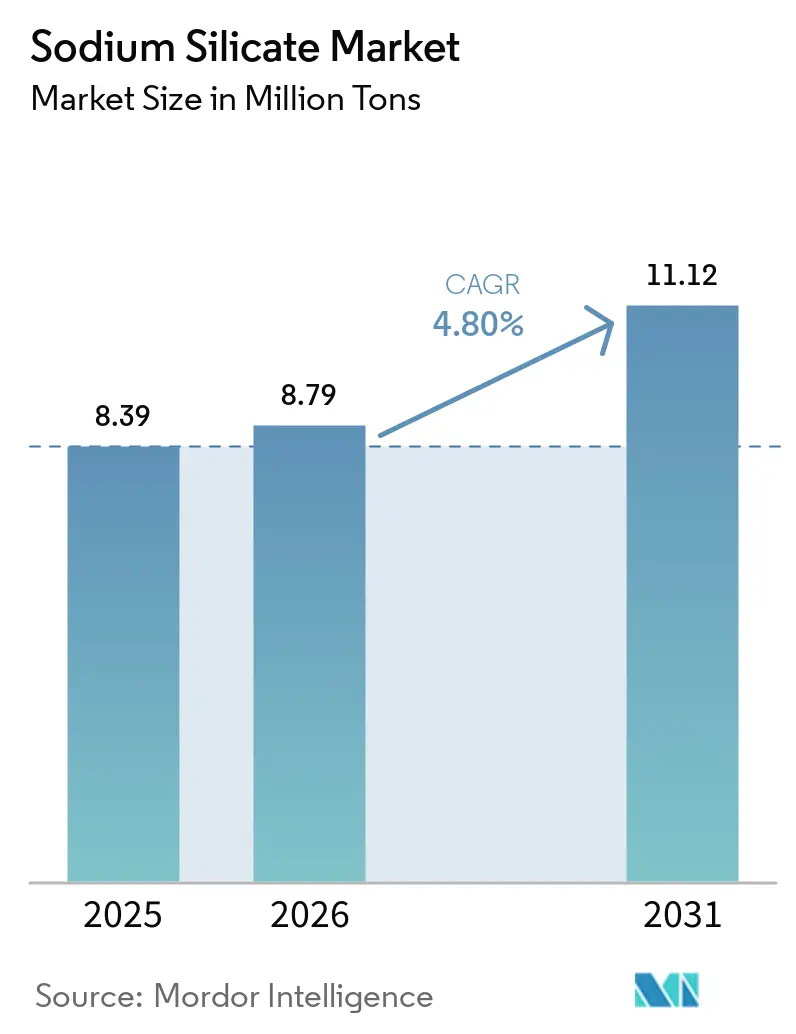
| Market Volume (2026) | 8.79 Million tons |
| Market Volume (2031) | 11.12 Million tons |
| Growth Rate (2026 - 2031) | 4.80 % |
| Fastest Growing Market | Asia-Pacific |
| Largest Market | Asia-Pacific |
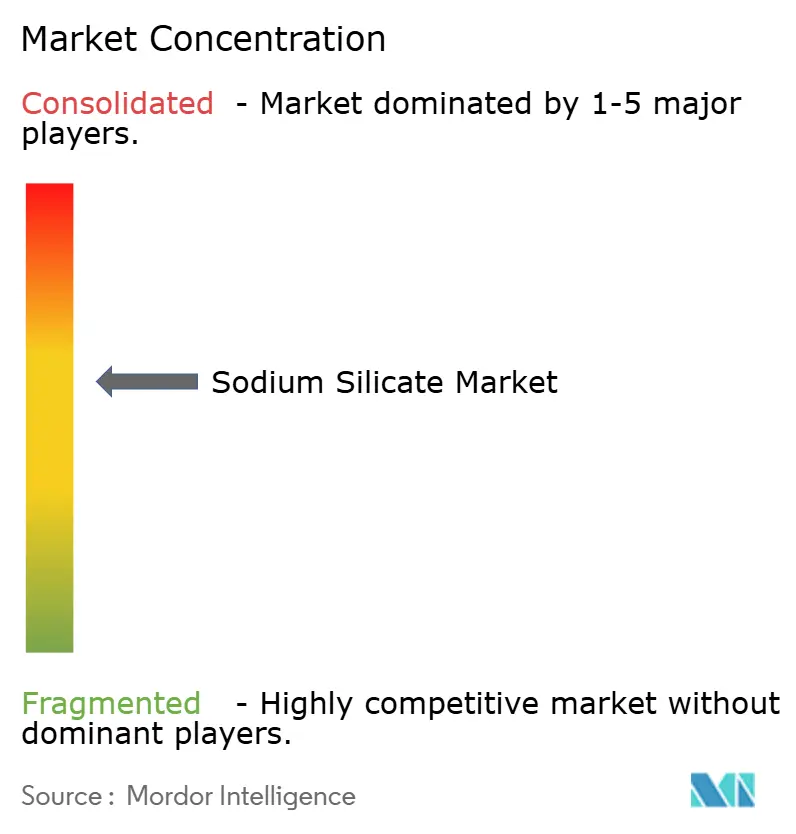
| Market Concentration | Medium |
Major Players *Disclaimer: Major Players sorted in no particular order Image © Mordor Intelligence. Reuse requires attribution under CC BY 4.0. | |
Sodium Silicate Market Analysis by Mordor Intelligence
The Sodium Silicate market size is expected to grow from 8.39 million tons in 2025 to 8.79 million tons in 2026 and is forecast to reach 11.12 million tons by 2031 at 4.8% CAGR over 2026-2031. The expansion reflects the chemical’s growing relevance in applications that support resource-efficient manufacturing and circular economy practices. Increased adoption in detergent formulations, advanced adhesive systems, and low-carbon construction materials underpins volume growth, while demand for high-purity grades lifts the overall value trajectory. Competitive differentiation hinges on process automation, product customization, and vertical integration, enabling leading suppliers to maintain resilient margins despite fluctuations in raw material prices. Regulatory tightening in major economies deepens the moat for well-capitalized producers that can meet stricter effluent and workplace safety standards; yet, these same rules also catalyze innovation in eco-friendly formulations and closed-loop recycling.
Key Report Takeaways
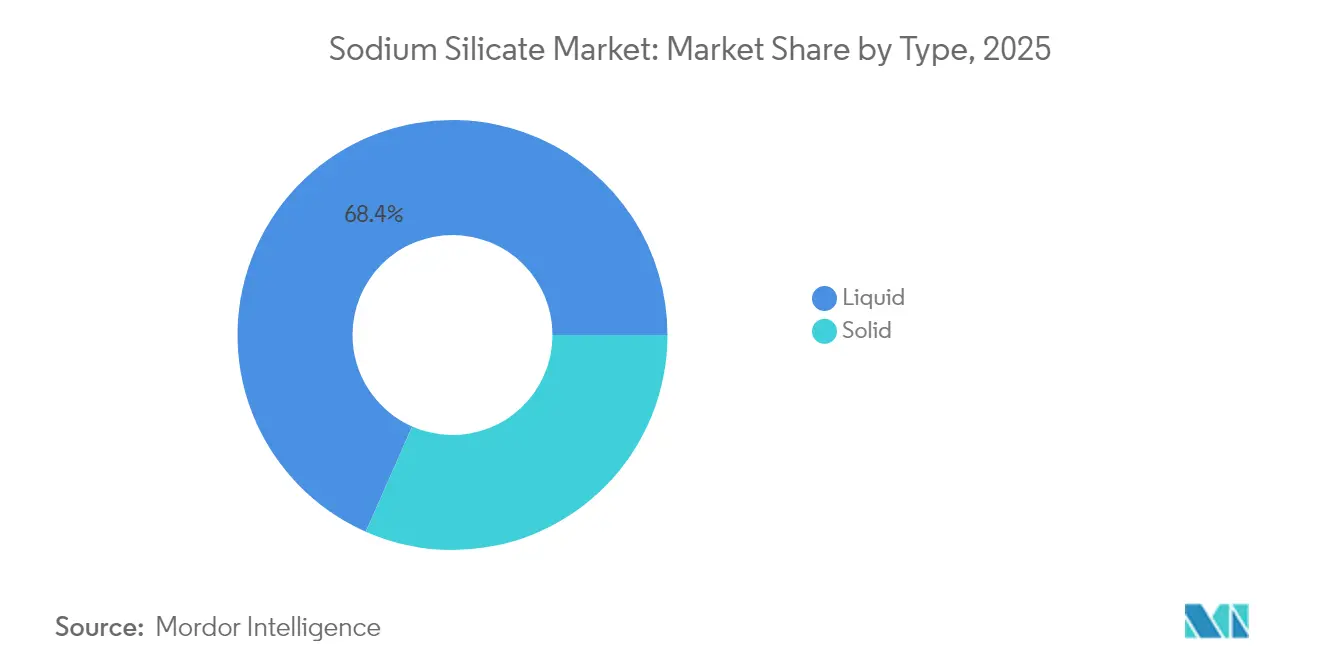
- By type, liquid sodium silicate held 68.39% of the Sodium Silicate market share in 2025. Moreover, liquid sodium silicate is forecast to grow at a 5.05% CAGR to 2031.
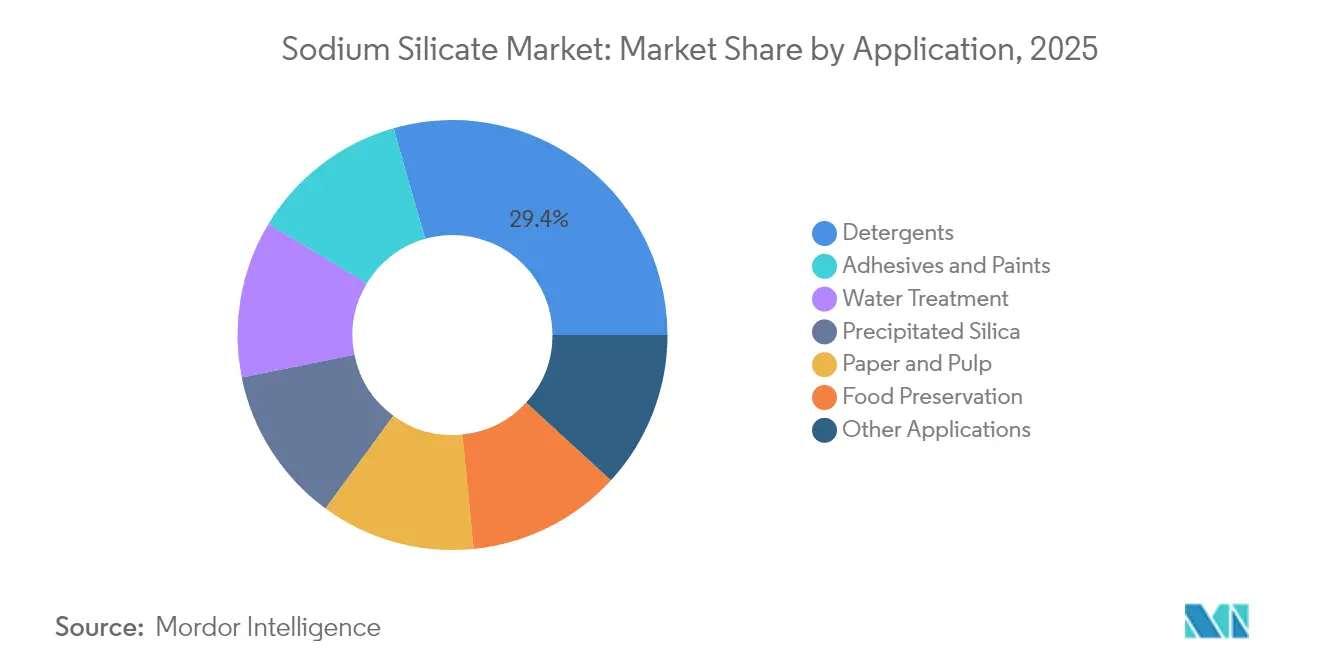
- By application, the detergent segment accounted for a 29.42% share of the Sodium Silicate market size in 2025. By application, adhesives and paints are expected to post the fastest 5.39% CAGR through 2031.
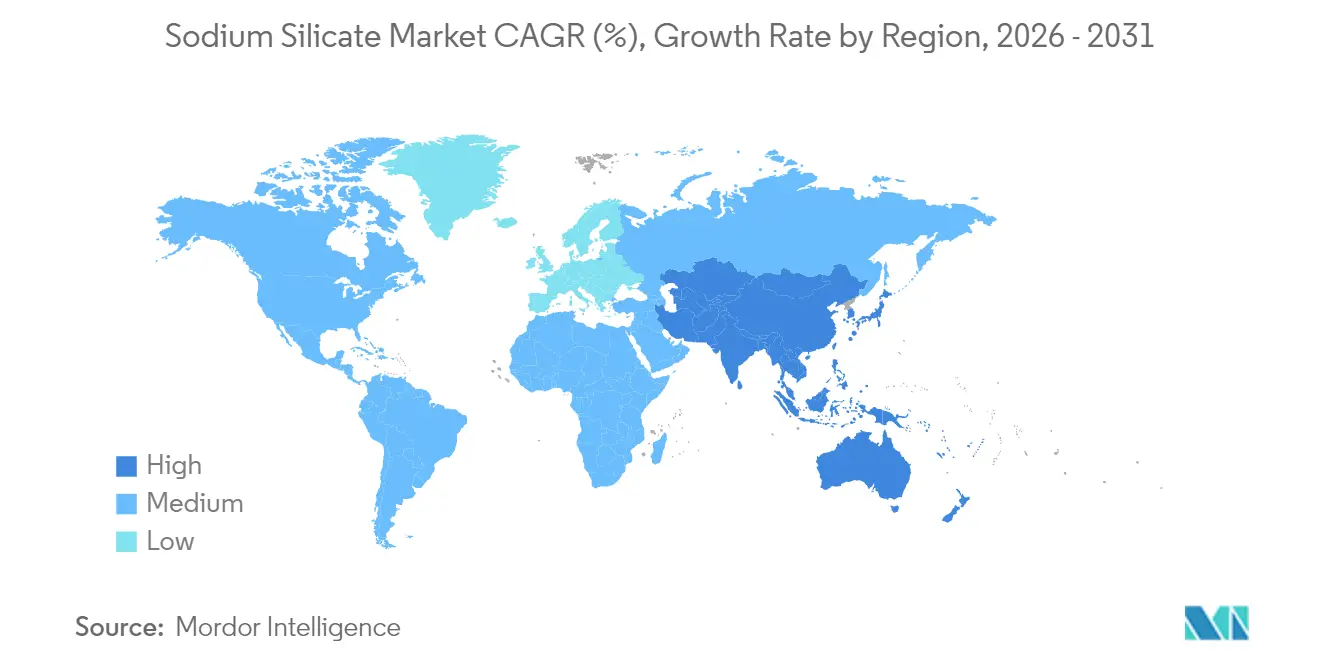
- By geography, the Asia-Pacific region led with a 42.12% volume share in 2025; it is set to expand at a 5.70% CAGR between 2026 and 2031.
Note: Market size and forecast figures in this report are generated using Mordor Intelligence’s proprietary estimation framework, updated with the latest available data and insights as of 2026.
Market Trends and Insights
Drivers Impact Analysis of Sodium Silicate Market*
| Driver | (~) % Impact on CAGR Forecast | Geographic Relevance | Impact Timeline |
|---|---|---|---|
| Mounting demand for waste-paper recycling | +0.8% | Global, concentrated in North America & Europe | Medium term (2-4 years) |
| Rising usage of precipitated silica in "green" tyres | +1.2% | Global, led by Asia-Pacific automotive hubs | Long term (≥ 4 years) |
| Growth of powder detergents in low-income economies | +0.9% | Asia-Pacific, Middle East & Africa | Short term (≤ 2 years) |
| Rapid industrial-scale uptake of geopolymer cement | +1.1% | Global, early adoption in Australia, Europe | Long term (≥ 4 years) |
| Circular-economy push for closed-loop glass recycling | +0.7% | Europe, North America, expanding to Asia-Pacific | Medium term (2-4 years) |
| Source: Mordor Intelligence | |||
Mounting Demand for Waste-Paper Recycling
Government mandates for higher recycled-content packaging accelerate the use of sodium silicate in flotation deinking processes[1]“Enhanced Brightness in Deinked Pulps,” BioResources, bioresources.ca. Modern mills consume 8–12 kg of sodium silicate per ton of recovered paper, and the chemical’s alkalinity control prevents ink particle re-agglomeration, allowing printers to meet exacting brightness and cleanliness standards. Demand intensifies as plastic substitution drives an additional fiber requirement, especially in Europe, where the Single-Use Plastics Directive prompts converters to shift toward paper-based formats. Suppliers able to deliver consistent pH buffering grades secure long-term contracts with integrated paper groups.
Rising Usage of Precipitated Silica in “Green” Tires
Each ton of precipitated silica requires roughly 1.3 tons of sodium silicate feedstock, creating a direct pull-through effect as tire makers lower rolling resistance to meet evolving fuel-economy labeling rules. High-purity sodium silicate grades with narrow silica-to-soda ratios command premium prices because they yield silica with controlled surface area and porosity—critical parameters for next-generation electric vehicle tires. Capacity additions in Southeast Asia reinforce regional demand momentum.
Growth of Powder Detergents in Low-Income Economies
Powder laundry products remain the value option in emerging economies. Local formulators maintain sodium silicate inclusion levels at 8–15% to maximize sequestration and anti-caking efficiency in humid climates. As urbanization drives retail penetration, supply agreements increasingly stipulate granular silicate grades tailored for high-speed spray-drying operations, ensuring free-flowing detergent powders on store shelves.
Rapid Industrial-Scale Uptake of Geopolymer Cement
Government-funded infrastructure pilots in Australia and the European Union showcase geopolymer concrete that cuts lifecycle CO₂ by up to 80% compared with Portland cement. Sodium silicate serves as the primary alkaline activator, dissolving aluminosilicate precursors at ambient temperatures and enabling rapid strength development. Public procurement targets for low-carbon building materials are expected to lock in structural demand over the next decade.
Restraints Impact Analysis of Sodium Silicate Market*
| Restraint | (~) % Impact on CAGR Forecast | Geographic Relevance | Impact Timeline |
|---|---|---|---|
| Health and safety hazards of high-alkali silicates | -0.60% | Global, stricter enforcement in developed markets | Short term (≤ 2 years) |
| Volatility in soda-ash prices | -0.90% | Global, acute impact in import-dependent regions | Short term (≤ 2 years) |
| Tightening EU effluent-discharge limits on silicate liquor | -0.80% | Europe | Medium term (2-4 years) |
| Competitive threat from bio-based binders in foundry cores | -0.50% | Global, initial penetration in North America and Europe | Long term (≥ 4 years) |
| Source: Mordor Intelligence | |||
Health and Safety Hazards of High-Alkali Silicates
Regulators classify concentrated sodium silicate as corrosive, prompting stricter workplace exposure limits and tighter personal protective equipment mandates[2]“Workplace Hazardous Materials Information System,” Health Canada, hwc.gc.ca. Small and mid-size users face higher compliance costs, which can delay adoption in price-sensitive industries such as craft foundries and micro-scale detergent blenders. Large producers that embed advanced closed-loop handling systems and remote monitoring safeguard operations and credibility with downstream customers.
Volatility in Soda-Ash Prices
Soda ash accounts for up to 45% of the Sodium Silicate manufacturing cost. While prices softened in late 2024, historical cycles show sharp rebounds tied to energy-price shifts and export policies in key producing nations. Contract buyers are increasingly adding hedging clauses to supply agreements, but margin compression remains a near-term risk for producers unable to pass through cost spikes to end-users. Geographic diversification of soda-ash sourcing is rising on boardroom agendas across Europe and South America.
*Our forecasts treat driver/restraint impacts as directional, not additive. The impact forecasts reflect baseline growth, mix effects, and variable interactions.
Sodium Silicate Market Segment Analysis
By Type:
Liquid Grades Extend Their LeadLiquid products controlled 68.39% of the sodium silicate market in 2025 and are projected to expand at a 5.05% CAGR through 2031. Automated feed systems in water-treatment plants favor liquid chemistry because they eliminate dissolution lag and enable tighter dosage control. Concentrated 50° Baumé innovations deliver 25% freight savings while preserving reactivity, a benefit that resonates with export-oriented detergent makers. Solid beads and powder forms retain relevance where shelf life, remote storage, or ultrahigh alkalinity are paramount, yet the value gap narrows as logistics-optimized liquids capture incremental territory.
Manufacturers utilize membrane filtration to fine-tune silica-to-soda ratios in liquid grades, resulting in performance-tailored intermediates for high-purity precipitated silica and specialty adhesive applications. This machinery-intensive capability creates technological barriers to entry, particularly in regions where utilities and skilled labor are scarce. Portfolio breadth in liquids explains why integrated suppliers sustain higher EBITDA margins and secure long-term supply agreements with multinational fast-moving consumer goods companies.



By Application:
Detergent Leadership with Adhesives AcceleratingDetergents supplied 29.42% of total demand in 2025, translating into 2.47 million tons of sodium silicate feedstock. Growth remains linked to middle-class expansion in South and Southeast Asia, where cost-sensitive consumers prioritize powder formulations. Meanwhile, the adhesives and paints segment is forecast to rise at a 5.39% CAGR, driven by infrastructure projects that specify mineral adhesives for fire resistance and by automotive body shops transitioning to water-glass-based paints for lightweight substrates.
Precipitated silica production remains a robust offtake stream as global tire makers align with stricter fuel-efficiency scoring. Water-treatment utilities adopt silicate blends for corrosion inhibition in aging distribution networks, a trend reinforced by federal infrastructure budgets. Food preservation, although niche, is gaining momentum as studies reveal up to 79.7% fungal inhibition in stored maize at a 100 mM sodium silicate dosage. Overall, widening end-use diversity cushions demand against cyclical swings in any single application vertical.
Geography Analysis
APAC Sodium Silicate Market
The Asia-Pacific region accounts for the largest share of global consumption at 42.12% in 2025. Domestic producers in China, including facilities such as Taicang Sinoch’s 300,000-ton plant, back-integrate from soda ash to solid and liquid silicates, supporting exports across Southeast Asia. India’s detergent industry accelerates the installation of spray-drying towers that rely on liquid silicate dosing control, while Australia fosters the early adoption of geopolymer cement in government-funded transport projects.
North America Sodium Silicate Market
North American demand benefits from federal spending on water infrastructure upgrades that specify silicate-based corrosion inhibitors. Shale-basin operators use sodium silicate as a drilling fluid additive that stabilizes clay formations, keeping regional offtake stable even when overall rig counts fluctuate. Premium electronics-grade volumes cluster along the West Coast semiconductor corridor, where high-purity grades support the fabrication of scratch-free glass.
Europe Sodium Silicate Market
Europe maintains a quality-over-quantity orientation. Stricter effluent discharge rules under the Water Framework Directive increase compliance costs but also favor producers equipped with closed-loop water recycling systems. Consolidation trends, such as Qemetica’s November 2024 acquisition of PPG’s silica assets, tighten supply in precipitated-silica value chains that primarily feed the regional tire industry. Demand for closed-loop glass recycling chemicals further anchors volume stability.

Value Chain Analysis
The upstream value chain is anchored in two critical inputs, high-purity silica sand and alkali (primarily soda ash, and in some routes caustic soda), with energy intensity as a key cost and risk lever due to the high-temperature fusion step (typically about 1,100 to 1,600 degrees C) used to produce sodium silicate glass that is later dissolved to make liquid grades. Soda ash cost volatility is especially consequential because it represents a large share of manufacturing cost, which pushes producers toward feedstock diversification and, where feasible, upstream integration.
Midstream processing typically converts fused glass (cullet) into commercial forms (liquid, beads, powders) and increasingly includes purification and ratio control steps to supply higher-spec intermediates for precipitated silica and performance-grade applications. Downstream, sodium silicate moves through bulk chemical logistics to detergent formulators, pulp and paper mills (deinking), water utilities (corrosion control blends), precipitated silica producers (tire value chains), adhesives and paints, and ceramics, where it acts as a deflocculant and binder to improve slurry rheology and green strength. Technology-driven pull from advanced use cases is visible in ceramics R&D, including a July 2025 study validating a mixed phosphate-sodium silicate additive (CERADIT+) for floor tile production, linking silicate chemistry to densification and firing efficiency goals in industrial operations.
Competitive Landscape
The Sodium Silicate market is moderately concentrated. Multinationals such as BASF, PQ Corporation, and Tokuyama lead in terms of capacity scale, R&D depth, and technical support coverage, while regional specialists capture niche domestic demand through proximity and cost agility. Integrated players that own feedstock, production, and downstream precipitated-silica assets enjoy cross-segment synergies and cushion margin exposure to soda-ash swings. Geographic diversification of manufacturing footprints hedges against trade-policy risk and currency volatility.
Sodium Silicate Industry Leaders
PQ Corporation
QEMETICA
BASF
Nippon Chemical Industrial CO., LTD.
Tokuyama Corporation
- *Disclaimer: Major Players sorted in no particular order
Sodium Silicate Market Companies Covered in this Report
- Alumina doo Zvornik
- BASF
- C Thai Group
- QEMETICA
- Evonik Industries
- Gujarat Multi Gas Base Chemicals Pvt Ltd
- Hindcon Chemicals Ltd.
- Kiran Global Chem Ltd.
- Nippon Chemical Industrial Co. Ltd.
- Nouryon
- Occidental Petroleum Corporation
- PQ Corporation
- Silmaco
- Tokuyama Corporation
- W. R. Grace & Co.-Conn.

Market Opportunities and Future Outlook
Consolidation and portfolio reshaping in Europe create room for customers that want continuity of supply, grade rationalization, and technical service across multiple end uses. In practice, the binding agreement for PQ to take over BASF's silicate business, including the Dusseldorf/Holthausen production assets, with closing targeted in the second half of 2026, can trigger procurement re-qualification cycles. That dynamic tends to open procurement opportunities for alternative suppliers and regional tolling as customers re-check detergent, water-treatment, and specialty-grade sourcing requirements.
Capacity additions and permitting activity in India highlight incremental demand centers and opportunities for localized supply to reduce freight and working-capital burdens for liquid grades. In February 2026, Unison Metals Limited commenced commercial production at a new 38,000 MT capacity sodium silicate facility in Dhamatvan, Ahmedabad, and a separate 28,800 MTPA sodium silicate project in the Siyarpali-Mahuapali Industrial Area (Raigarh, Chhattisgarh) received Consent to Establish in June 2026. Alongside these investments, the market continues to build higher-value outlets where tighter specifications matter, such as sodium silicate feedstock for precipitated silica in lower-rolling-resistance tires and silicate-based activators used in geopolymer cement pilots. This supports demand for customized ratios and cleaner production systems, not only commodity-like volumes.
Recent Industry Developments in Sodium Silicate Market
- May 2026: BASF and PQ entered a binding agreement to transfer BASF's silicate business to PQ, including production assets at the Dusseldorf/Holthausen site, with closing targeted in the second half of 2026. The deal accelerates consolidation in European silicates and can shift contracting dynamics for customers that rely on consistent liquid-grade supply and technical support.
- February 2026: Unison Metals Limited commenced commercial production at its new Specialty Chemicals Division facility in Dhamatvan, Ahmedabad, adding 38,000 MT of sodium silicate manufacturing capacity. The start-up improves local availability for Indian detergent, construction-chemicals, and industrial users that benefit from shorter lead times for bulk liquid deliveries.
- November 2024: Qemetica finalized the acquisition of PPG Industries' precipitated silica business, expanding its downstream footprint linked to sodium silicate feedstock. This vertical integration tightens the connection between sodium silicate production and tire-industry demand for precipitated silica, strengthening Qemetica's position across the silicate-to-silica chain in Europe and North America.


Sodium Silicate Market Report Scope and Research Methodology
Market Definition and Coverage
This market covers sodium silicate (often called water glass) sold as solid or liquid forms and used across industrial applications where it acts as a binder, builder, or process aid. We size demand across major consuming industries and regions using consistent product scope and end-use mapping.
Scope exclusions: The sizing excludes downstream products where sodium silicate is only an embedded input and the final product is priced and traded separately (for example, finished detergents or paper).
Segments Covered in This Report
- By Type
- Solid
- Liquid
- By Application
- Adhesives and Paints
- Detergents
- Food Preservation
- Precipitated Silica
- Paper and Pulp
- Water Treatment
- Other Applications
- By Geography
- Asia-Pacific
- China
- India
- Japan
- South Korea
- Rest of Asia-Pacific
- North America
- United States
- Canada
- Mexico
- Europe
- Germany
- United Kingdom
- Italy
- France
- Rest of Europe
- South America
- Brazil
- Argentina
- Rest of South America
- Middle East and Africa
- Saudi Arabia
- South Africa
- Rest of Middle East and Africa
- Asia-Pacific
Data Sources, Market Sizing, and Validation
Desk Research
Desk research sets the base context for production, trade, and end-use movement of sodium silicate, before assumptions are tested in the field. We refer to public sources such as USGS minerals information, UN Comtrade trade statistics, U.S. International Trade Commission data, Eurostat industrial indicators, and chemical safety and classification references such as ECHA, which help align definitions and typical use patterns.
In parallel, we review company annual reports, investor presentations, and reputable news coverage to track capacity additions, plant utilization commentary, and pricing direction. Where structure is available, paid database subscriptions are used for company financials, patent landscaping, and import and export shipment level checks so the model inputs stay grounded. These sources are illustrative and not exhaustive, and many other public references were used during data collection, validation, and clarification.
Primary Interviews and Surveys
Primary interviews help confirm what portion of sodium silicate demand sits in detergents, paper and pulp, water treatment, adhesives and coatings, and precipitated silica routes, and how this mix shifts by region. We speak with manufacturers, distributors, and large end users across APAC, EMEA, and the Americas so pricing logic, grade splits (solid versus liquid), and realistic adoption drivers are validated before finalizing totals.
Distribution of primary research fieldwork respondents
| Company type | Respondent position | Region |
|---|---|---|
| Top tier: 33% | CXOs: 13% | APAC: 37% |
| Mid tier: 52% | Functional/Unit leaders: 38% | EMEA: 37% |
| Smaller Players: 15% | Managers: 49% | Americas: 26% |
Market-Sizing & Forecasting
The core model uses a top-down approach where production and trade data reconstruct apparent consumption by region, then allocate into key application demand pools. Results are checked with selective bottom-up approximations, including sampled supplier volume indications, channel checks for typical product form splits, and sanity checks on volume-to-value translation when required.
In this market, key inputs include regional detergent output trends, paper and pulp operating rates, construction activity signals tied to adhesives and coatings usage, water treatment infrastructure spending cues, and precipitated silica demand direction from rubber and tire activity. For forecasting, scenario analysis is layered on top of a time series view, because growth is often driven by a few end markets moving at different speeds, and can swing with energy and freight conditions. Where direct data is thin, gaps are handled with conservative ranges from interviews, then narrowed through cross-checks against trade flows and end-use indicators.
Data Validation & Update Cycle
Outputs are validated through multi-step checks where modeled regional totals are compared with independent signals such as trade balance direction, capacity announcements, and realistic end-use consumption ranges discussed in interviews. If the variance looks unusual, the assumptions are reopened, and targeted follow-up calls are used to clarify the driver rather than smoothing it into the average.
Before sign-off, the full model goes through internal peer review so unit logic, conversion factors, and regional splits remain consistent. Reports are refreshed annually, with interim updates when material events occur, such as large capacity changes or demand shocks. Immediately before delivery, we do a fresh scan of recent public developments to keep the published view current.
Mordor Intelligence's Sodium Silicate Market Size Compared Against Other Published Estimates
Published market sizes for sodium silicate often differ because the underlying scope and measurement unit vary, and because pricing and conversion assumptions are not always made transparent. Differences can also reflect whether the estimate is anchored to trade and production reality, or instead extends into broader downstream value chains.
A common split is whether a study sizes sodium silicate in physical volume (tons) versus revenue in USD, and whether liquid and solid grades are treated consistently across applications such as detergents, paper and pulp, water treatment, adhesives and paints, and precipitated silica. Some estimates also use a single global average price, which can overstate value in regions where low-cost grades dominate, and understate it where higher purity demand is rising, a scope choice kept explicit in the volume-first approach referenced by Mordor Intelligence.
Benchmark comparison
| Source | Market Size | Gaps in Research Methodology |
|---|---|---|
| Mordor Intelligence | USD 0.00 B (2026) | |
| Global Research Publisher A | USD 7.84 B (2025) | Revenue-based sizing is presented with its own base year, and the estimate can shift materially depending on the assumed average selling price and currency timing, which are not always broken out by grade and region. |
| Industry Data Firm B | USD 11.80 B (2024) | Higher totals can come from broader inclusion choices, such as counting adjacent silicate categories or using an elevated global price level, and from limited visibility into how application splits are validated across regions. |
The comparison shows that most of the spread comes from unit choice and what gets counted inside the definition, followed by how average price is carried forward into the forecast. By keeping the demand pool tied to end-use volumes and then checking it against trade and industry operating signals, the final number stays traceable to clear steps and inputs that can be rechecked over time.


Key Questions Answered in the Report
What volume growth is expected for global sodium silicate demand by 2031?
Consumption is forecast to rise from 8.79 million tons in 2026 to 11.12 million tons in 2031, representing a 4.80% CAGR.
Which region will contribute the most incremental tonnage through 2031?
Asia-Pacific will add the largest absolute volume, underpinned by expanding detergent and construction industries.
Why are liquid grades gaining share over solid forms?
Liquid products eliminate dissolution steps, enable automated dosing, and newer 50° Baumé grades cut freight volumes by 25%.
How do soda-ash price swings affect producer margins?
Soda ash represents up to 45% of production cost, so price spikes can compress margins unless offset by contract pass-through or diversified sourcing.
Which emerging application offers the fastest growth outlook?
Adhesives and paints are set to register the highest CAGR at 5.39% thanks to infrastructure build-out and automotive lightweighting.
Page last updated on:


 Your data is secure and never sold or shared.


