
Sodium Bicarbonate Market Size and Share
Market Overview
| Study Period | 2021 - 2031 |
|---|---|
| Market Size (2026) | USD 5.27 Billion |
| Market Size (2031) | USD 6.82 Billion |
| Growth Rate (2026 - 2031) | 5.21 % |
| Fastest Growing Market | North America |
| Largest Market | Asia-Pacific |
| Market Concentration | Medium |
Major Players *Disclaimer: Major Players sorted in no particular order Image © Mordor Intelligence. Reuse requires attribution under CC BY 4.0. | |
Sodium Bicarbonate Market Analysis by Mordor Intelligence
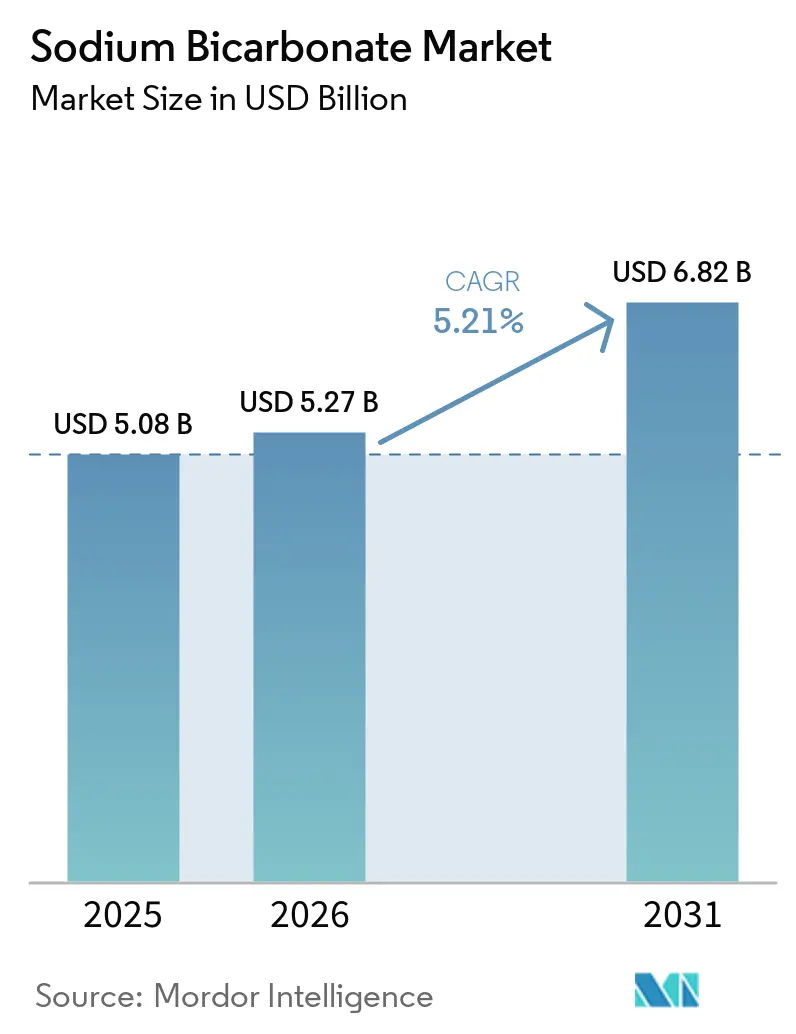
The Sodium bicarbonate market size was valued at USD 5.08 billion in 2025 and estimated to grow from USD 5.27 billion in 2026 to reach USD 6.82 billion by 2031, at a CAGR of 5.21% during the forecast period (2026-2031). The sodium bicarbonate market is moving forward on the back of demand from both industrial emission control and higher-value uses in food and healthcare. Dry sorbent injection systems that use sodium bicarbonate can deliver SO₂ removal rates above 99%, which supports wider use of the sodium bicarbonate market in flue gas treatment where compliance certainty matters. The sodium bicarbonate market is also benefiting from rising use in antacid formulations, effervescent tablets, and hemodialysis concentrates, which gives producers exposure to more stable specialty demand. Producers in the sodium bicarbonate market are directing capital toward specialty grades and lower-carbon production routes, as seen in Tata Chemicals Europe’s pharmaceutical-grade investment in Northwich and Solvay’s continued focus on bicarbonate applications. The main risk for the sodium bicarbonate market remains its dependence on soda ash economics, because large upstream capacity additions can weaken pricing even when volumes continue to expand.
Key Report Takeaways
- By grade, food grade held 35.48% of sodium bicarbonate market share in 2025, while pharma grade is projected to grow at a 6.55% CAGR through 2031.
- By form, powder accounted for 62.36% of the sodium bicarbonate market share in 2025, while liquid is forecast to expand at a 6.18% CAGR through 2031.
- By application, food and beverages held a 32.48% share in 2025, while industrial is projected to grow at a 6.52% CAGR through 2031.
- By geography, Asia-Pacific accounted for 38.31% of the sodium bicarbonate market size in 2025, while North America is expected to grow at a 6.48% CAGR through 2031.
Note: Market size and forecast figures in this report are generated using Mordor Intelligence’s proprietary estimation framework, updated with the latest available data and insights as of January 2026.
Global Sodium Bicarbonate Market Trends and Insights
Drivers Impact Analysis*
| Drivers | (~) % Impact on CAGR Forecasts | Geographic Relevance | Impact Timeline |
|---|---|---|---|
| Growing Demand for Flue Gas Treatment and Emission Control | +1.4% | Global, with core gains in EU, North America, Japan, South Korea, and MEA industrial corridors | Medium term (2-4 years) |
| Rising Applications in Food Processing and Bakery Production | +1.2% | Global, strongest in Asia-Pacific, North America | Short term (≤ 2 years) |
| Preference for Non-Toxic and Environmentally Friendly Chemicals | +0.8% | North America, Europe, Australia, with spillover to urban APAC markets | Medium term (2-4 years) |
| Increasing Demand for High-Purity Specialty Grades | +0.7% | North America, Europe, Japan, India, with spillover to South Korea | Long term (≥ 4 years) |
| Growth in Industrial Cleaning Applications | +0.4% | North America and Europe core, with spillover to APAC emerging industrial zones | Medium term (2-4 years) |
| Increasing Demand in Animal Feed and Livestock Industries | +0.4% | Asia-Pacific, North America, South America | Short term (≤ 2 years) |
| Source: Mordor Intelligence | |||
Growing Demand for Flue Gas Treatment and Emission Control
The sodium bicarbonate market is gaining from tighter emissions control rules at waste-to-energy plants and industrial combustion facilities. Dry sorbent injection using sodium bicarbonate is increasingly preferred where operators need a water-free acid-gas treatment route with simpler retrofit needs. Research published in RSC Advances showed that sodium bicarbonate achieved SO₂ and NO removal efficiencies above 90% when the temperature-to-oxygen ratio stayed above 1 and oxygen content exceeded 5%. A 2025 engineering study also found that producing sodium bicarbonate on site from captured CO₂ at waste-to-energy plants is economically viable, which can lower logistics costs and create captive demand inside the sodium bicarbonate market. In February 2026, the European Commission revised soda ash benchmark values under the emissions trading framework, which supports the broader compliance backdrop that is favoring sodium bicarbonate in regulated industrial settings[1]Source: European Commission, “Commission Implementing Regulation (EU) 2026/389 of 23 February 2026 Amending Implementing Regulation (EU) 2021/447 as Regards the Determination of a Revised Soda Ash Benchmark Value for the Year 2025,” eur-lex.europa.eu.
Rising Applications in Food Processing and Bakery Production
The sodium bicarbonate market continues to benefit from the compound’s wide functional role in bakery, confectionery, and processed food manufacturing. Food-grade sodium bicarbonate serves as a leavening agent, pH buffer, and acidity regulator, which keeps it relevant across many packaged food categories. A 2025 technical report from the U.S. Department of Agriculture confirmed its use in meat products, baked goods, baking mixes, and cocoa processing, and also noted its authorization in the European Union as food additive E500(ii)[2]Source: United States Department of Agriculture Agricultural Marketing Service, “Technical Report, Sodium Bicarbonate, Handling,”ams.usda.gov. Food grade led the sodium bicarbonate market with a 35.48% share in 2025, which reflects broad demand rather than a narrow single-use base. In this part of the sodium bicarbonate market, producers with halal, kosher, and other quality credentials are better placed to win preferred-supplier status with large food manufacturers.
Preference for Non-Toxic and Environmentally Friendly Chemicals
The sodium bicarbonate market is also supported by a steady shift toward safer and lower-impact chemical inputs. Sodium bicarbonate is used across household care, personal care, and light industrial cleaning because it offers a non-toxic and biodegradable profile that fits current product reformulation needs. The UK government’s Budget 2025 decision to exempt certain natural gas used for sodium bicarbonate production from the Climate Change Levy from Spring 2026 improves the cost position of lower-carbon manufacturing routes. That measure is especially helpful for integrated producers that make sodium bicarbonate from soda ash with captive upstream supply. In the sodium bicarbonate market, this demand trend is strongest in North America and Western Europe, but it is also gaining ground in urban Asia-Pacific consumer categories.
Increasing Demand for High-Purity Specialty Grades
The sodium bicarbonate market is seeing faster growth in specialty grades than in standard commodity volumes. Demand is being supported by hemodialysis concentrates, antacid formulations, effervescent tablets, and other regulated pharmaceutical uses that require tightly controlled purity. Tata Chemicals Europe approved a £60 million capital investment in November 2024 to build a 180,000-ton-per-year pharmaceutical-grade sodium bicarbonate facility in Northwich, and the project is intended to triple current UK pharmaceutical-grade production capacity. Tata Chemicals also commissioned 140,000 MT of sodium bicarbonate capacity at Mithapur in FY2025, which brought total installed bicarbonate capacity there to 290,000 MTPA and strengthened India’s role in higher-value and feed-related supply. In the sodium bicarbonate market, these moves show that scale, certification, and production route are becoming more important together rather than separately.
Restraints Impact Analysis*
| Restraints | (~) % Impact on CAGR Forecasts | Geographic Relevance | Impact Timeline |
|---|---|---|---|
| Competition from Alternative Emission Control Technologies | -0.3% | Global, most acute in North America and Europe where wet scrubbing infrastructure exists | Medium term (2-4 years) |
| Stringent Quality Requirements for Pharmaceutical and Food Grades | -0.3% | North America, Europe, Japan, with the highest barriers in regulated healthcare markets | Long term (≥ 4 years) |
| Rising Transportation, Freight, and Global Logistics Costs | -0.2% | Global, most pronounced for export-dependent producers and island markets | Short term (≤ 2 years) |
| Increasing Energy, Water, and Utility Expenses in Sodium Bicarbonate Manufacturing | -0.2% | Europe and China | Medium term (2-4 years) |
| Source: Mordor Intelligence | |||
Competition from Alternative Emission Control Technologies
The sodium bicarbonate market still faces competition from established flue gas treatment technologies. Wet flue gas desulfurization systems that use limestone remain embedded in many large coal power plants, which limits sodium bicarbonate dry injection to retrofit projects and to industrial units where wet systems are less practical. This restraint is strongest in North America, where the installed base of wet FGD equipment remains large even as emissions requirements become tighter. The sodium bicarbonate market also competes with selective catalytic reduction systems and activated carbon injection at waste-to-energy sites, because those technologies can draw from the same compliance budgets for certain pollutants. Even so, sodium bicarbonate remains attractive where operators value simple handling, lower water dependence, and quicker implementation.
Stringent Quality Requirements for Pharmaceutical and Food Grades
The sodium bicarbonate market faces a different limit in premium grades, where compliance requirements raise both cost and execution complexity. Pharmaceutical-grade producers must meet pharmacopeial and manufacturing standards that require consistent analytical control, clean production environments, and detailed qualification work. These requirements can slow new capacity ramp-up in the sodium bicarbonate market even when demand is growing faster than average. Food-grade suppliers also face layered compliance obligations tied to food additive rules and customer-specific certifications, including export-facing quality expectations. As a result, larger integrated producers are better able to absorb compliance costs than smaller regional suppliers, which can narrow the field in regulated applications.
*Our forecasts treat driver/restraint impacts as directional, not additive. The impact forecasts reflect baseline growth, mix effects, and variable interactions.
Segment Analysis
By Grade: High-Purity Demand Lifts Specialty Grade Premium
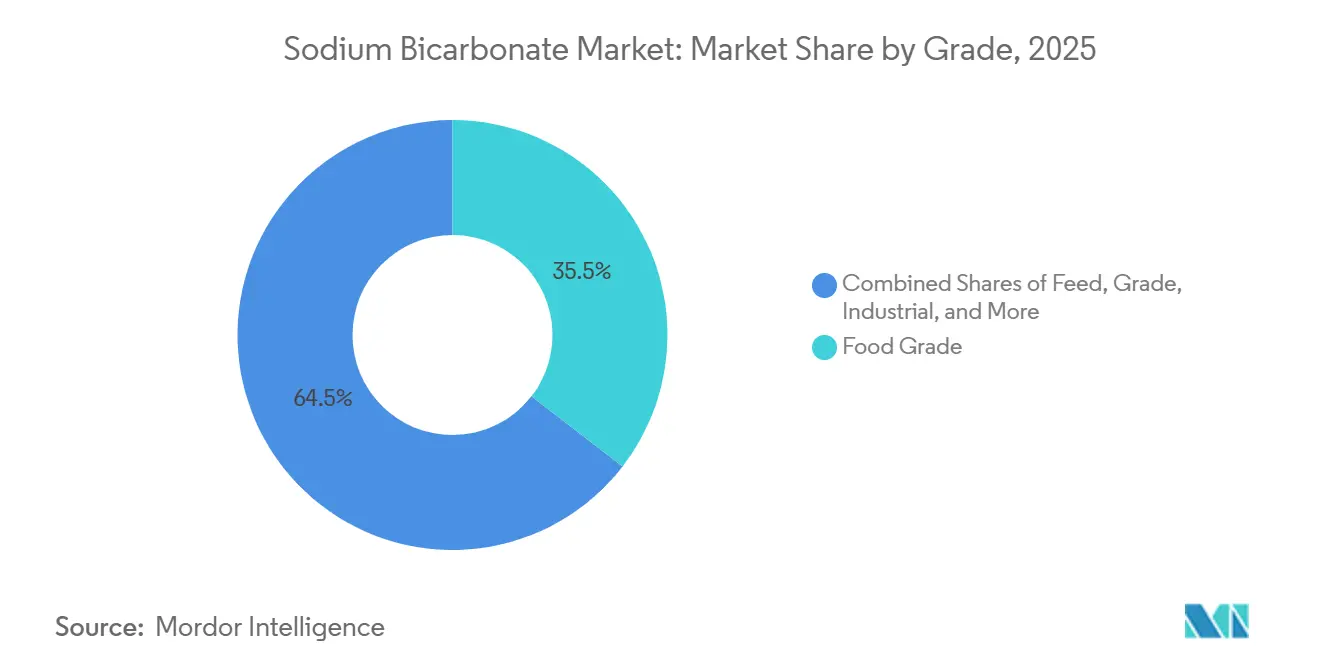
Food grade accounted for 35.48% of the sodium bicarbonate market size in 2025, making it the largest grade segment in the study. Its leadership comes from broad use as a leavening agent, pH buffer, and acidity regulator across bakery, dairy, snack food, and beverage applications. The U.S. Department of Agriculture’s 2025 technical report confirmed its handling and use across several food categories and also referenced its EU authorization as E500(ii). Pharma grade is the fastest-growing grade segment in the sodium bicarbonate market and is projected to grow at a 6.55% CAGR from 2026 to 2031.
Tata Chemicals Europe’s EUR 60 million investment in Northwich shows how producers are committing large capital to pharmaceutical-grade output before the current supply gap narrows. Industrial grade and feed grade made up the balance of volume and remained important to the sodium bicarbonate industry because they are tied to heavy industrial use and to livestock nutrition. Industrial grade serves flue gas treatment, paper processing, textile manufacturing, and fire suppression, which links it closely to cyclical but broad demand. Feed grade works as a rumen buffer, an electrolyte regulator, and an aquaculture pH agent, and a 2025 study in the Indian Journal of Animal Nutrition supported its performance benefits in feedlot lambs[3]Source: Q. S. Sahib, H. A. Ahmed, Ifla Aafaq Sheikh, G. G. Ganai, I. A. Ganai, and A. M. Ganai, “Effect of Feeding Exogenous Buffer (Sodium Bicarbonate) as Feed Additive on the Performance of Feedlot Lambs,” Indian Journal of Animal Nutrition, epubs.icar.org.in.



By Form: Powder Dominates, Liquid Emerges as Fastest-Growing Vector
Powder accounted for 62.36% of the sodium bicarbonate market in 2025, which kept it well ahead of all other forms. Its lead reflects wide use across flue gas desulfurization systems, baking applications, and animal feed blending, where dry handling and easy dispersion are important. Powder also fits the operating needs of large-volume users because it can move through established storage, dosing, and mixing systems with less complexity. For the sodium bicarbonate market, this form remains the baseline product in both industrial and consumer-facing applications.
Liquid sodium bicarbonate is the fastest-growing form in the sodium bicarbonate market and is projected to expand at a 6.18% CAGR from 2026 to 2031. Growth is being driven by pharmaceutical manufacturing, where inline aqueous dosing is preferred for hemodialysis concentrate preparation and buffering functions. This form also creates a different supply pattern because transport and storage are more specialized than for powder. Crystal and pellet products remain smaller in the sodium bicarbonate market, but they serve niche uses in water treatment dosing, controlled-release agricultural applications, and selected food production settings.
By Application: Industrial Overtakes Established Segments in Growth Rate
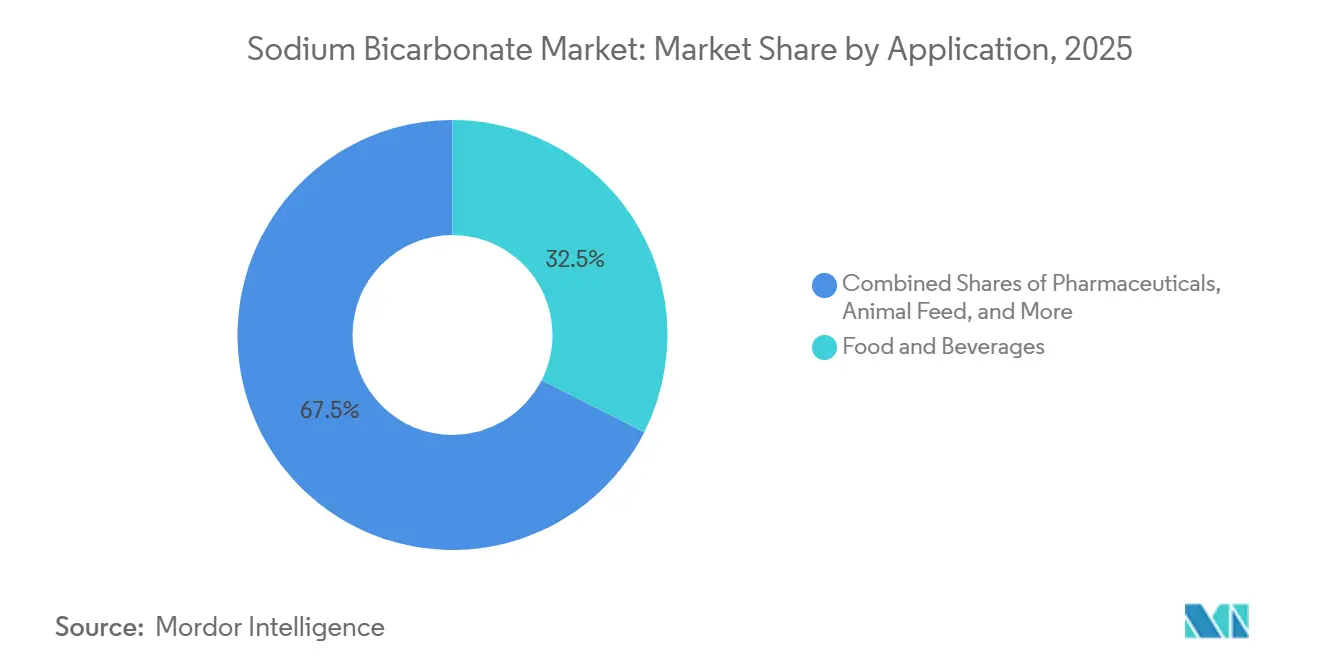
Food and beverages held 32.48% of the sodium bicarbonate market size in 2025, which made it the largest application segment. The segment is supported by the compound’s functional role in leavening, buffering, and acidity control across a wide range of packaged foods. Regulatory acceptance also strengthens its position, including its EU food additive authorization noted in the USDA technical report. Pharmaceuticals remained another important part of the sodium bicarbonate market because antacids, effervescent products, and hemodialysis systems require higher-purity material.
Animal feed is smaller by share, but it is gaining support in the sodium bicarbonate market as intensive livestock systems expand and producers use buffers to support animal performance. Research published in May 2025 in the Indian Journal of Animal Nutrition added to the evidence for sodium bicarbonate use in feedlot lamb nutrition. Industrial is the fastest-growing application in the sodium bicarbonate market and is projected to grow at a 6.52% CAGR from 2026 to 2031, driven by stricter emissions compliance across Europe, North America, and Northeast Asia. Water treatment and the others category, which includes personal care, household cleaning, cosmetics, and textile processing, add further demand where pH control and non-toxic performance matter.
Geography Analysis
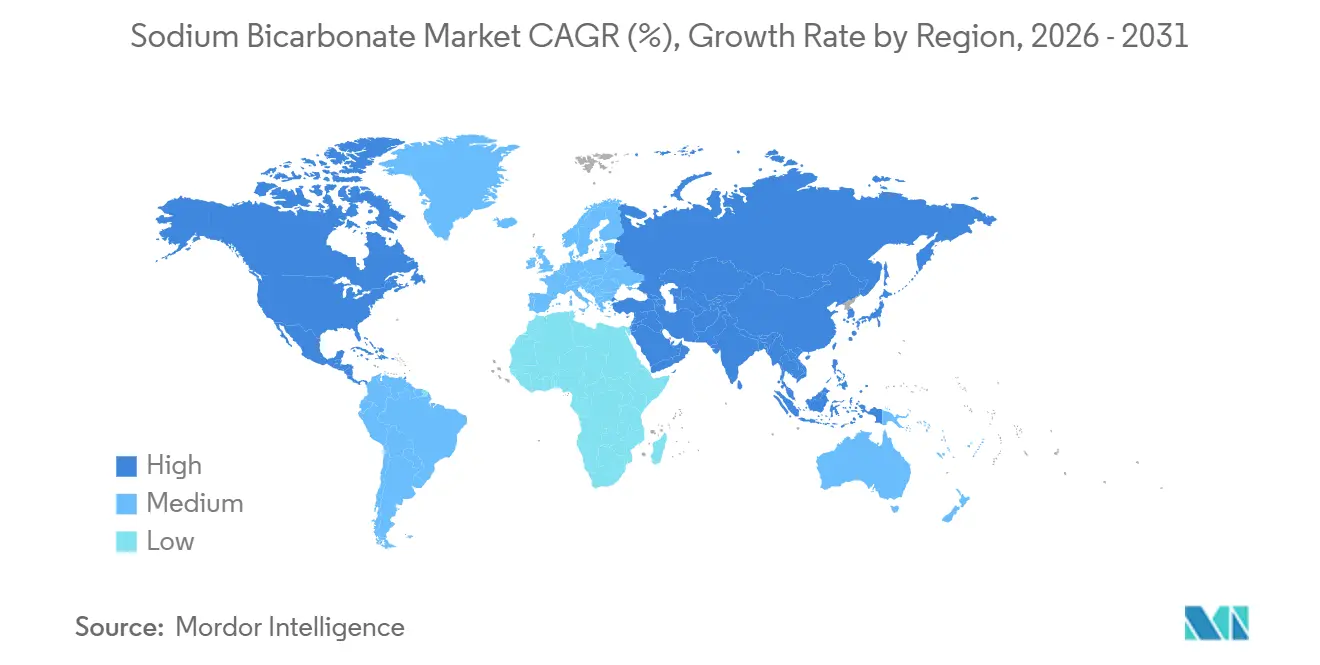
Asia-Pacific accounted for 38.31% of the sodium bicarbonate market in 2025, making it the largest regional segment. The region’s lead comes from China’s scale in supply and from broad demand across food, industrial, feed, and pharmaceutical grades. India is emerging as the second major growth center in the sodium bicarbonate market after Tata Chemicals commissioned 140,000 MT of new bicarbonate capacity at Mithapur in FY2025. Japan and South Korea remain quality-sensitive markets, with stronger demand for food-grade and pharmaceutical-grade material than for low-spec commodity volumes. New capacity additions at Inner Mongolia Boyuan’s Alashankou project show that the regional supply base in the sodium bicarbonate market is still expanding.
North America is the fastest-growing region in the sodium bicarbonate market and is projected to expand at a 6.48% CAGR through 2031. The United States is benefiting from tighter emissions compliance, a push to localize parts of the pharmaceutical supply chain, and steady demand for cleaner-label food ingredients. Canada and Mexico provide more stable support through food processing and animal feed demand, which helps balance project-based industrial consumption. Europe remains a mature but important part of the sodium bicarbonate market, with Germany, France, and the United Kingdom anchoring pharmaceutical and flue gas treatment demand. Policy support also matters here, including the EU regulatory framework on emissions and the UK Climate Change Levy exemption for sodium bicarbonate produced from soda ash using carbon dioxide, which takes effect in Spring 2026.
South America and the Middle East and Africa remain longer-horizon growth regions in the sodium bicarbonate market. Brazil and Argentina support demand through livestock and feed applications, while Colombia and Peru are building larger packaged food bases that can lift food-grade use over time. In the Middle East, the UAE and Saudi Arabia are adding chemical processing and wastewater treatment capacity that supports sodium bicarbonate demand. In Africa, South Africa, Nigeria, Morocco, and Egypt show demand across food, industrial, and water treatment uses, and current import dependence leaves room for future local capacity investment in the sodium bicarbonate market.

Competitive Landscape
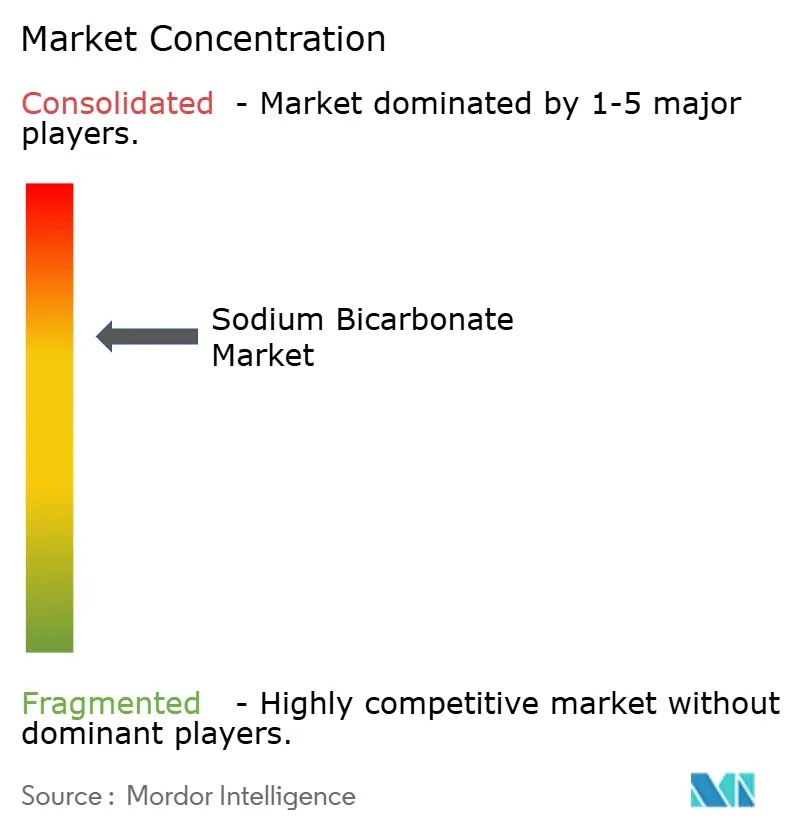
The sodium bicarbonate market is moderately concentrated at the global level, with Solvay holding the leading position outside China while Inner Mongolia Boyuan and Shandong Haihua remain important on Chinese volume. Solvay stated in its third-quarter 2025 results that bicarbonate sales were very resilient and slightly up year on year despite broader soda ash weakness. That performance shows that the sodium bicarbonate market is not driven only by commodity chemical conditions. Solvay has continued to prioritize bicarbonate applications through products and platforms such as Solvair Marine and Alve One. Its SOLVAir dry sorbent process also gives the company a strong position where customers need predictable compliance outcomes in the sodium bicarbonate market.
Chinese producers remain strongest on cost and scale, but moving deeper into premium applications is harder because the sodium bicarbonate market for food, feed, and pharma grades needs tighter quality systems and broader customer qualification. Inner Mongolia Boyuan’s Q1 2026 filing disclosed sodium bicarbonate production capacity of 1.5 million MT per year in operation, with further additions progressing at Alashankou. That scale matters in commodity supply, but it does not guarantee the same position in specialty grades inside the sodium bicarbonate market. Producers such as Tata Chemicals Europe, Novacap Group, and Church & Dwight are better placed in selected specialty pockets where certification, customer trust, and proximity to regulated end users matter more than absolute tonnage.
Strategic moves since 2024 show a clear split between efficiency upgrades and specialty expansion in the sodium bicarbonate market. Tata Chemicals Europe approved a £60 million investment in a 180,000-ton pharmaceutical-grade plant in Northwich, and Tata Chemicals also commissioned 140,000 MT of new bicarbonate capacity at Mithapur in FY2025. Solvay optimized soda ash output at Torrelavega in February 2026 while keeping sodium bicarbonate operations at the site unaffected, which points to selective portfolio management rather than a pullback from bicarbonate. Captured-CO₂-based on-site production models discussed at PSE 2025 also point to a narrower but credible competitive risk in waste-to-energy uses within the sodium bicarbonate market
Sodium Bicarbonate Industry Leaders
Solvay S.A.
Church and Dwight Co., Inc.
Tata Chemicals Limited
Natural Soda LLC
Tosoh Corporation
- *Disclaimer: Major Players sorted in no particular order

Recent Industry Developments
- February 2026: Solvay announced an optimization of soda ash production capacity at its Torrelavega plant in Spain, reducing output from 600 kt to 420 kt effective Q3 2026, with an explicit statement that sodium bicarbonate operations at the site remain unaffected. The measure is part of Solvay's broader strategy to strengthen global asset competitiveness while continuing to invest selectively in bicarbonate as a priority growth category.
- March 2025: Tata Chemicals commissioned 140,000 MT of sodium bicarbonate capacity and 230,000 MT of soda ash capacity at its Mithapur, India facility, bringing total installed bicarb capacity to 290,000 MTPA. The company simultaneously commissioned 70,000 MT of pharmaceutical-grade salt capacity in Middlewich, UK, signaling a strategic move toward value-added specialty chemistry in its UK operations.
- November 2024: Tata Chemicals Europe Limited's board approved a £60 million (~INR 655 crore) capital investment to construct a 180,000-ton-per-year pharmaceutical-grade sodium bicarbonate facility in Northwich, UK, tripling current UK pharmaceutical-grade production capacity.


Global Sodium Bicarbonate Market Report Scope
| Pharma Grade |
| Food Grade |
| Industrial Grade |
| Feed Grade |
| Powder |
| Liquid |
| Crystal |
| Pallets |
| Food and Beverages |
| Pharmaceuticals |
| Animal Feed |
| Water Treatment |
| Industrial |
| Others |
| North America | United States |
| Canada | |
| Mexico | |
| Rest of North America | |
| Europe | Germany |
| United Kingdom | |
| France | |
| Italy | |
| Spain | |
| Netherlands | |
| Sweden | |
| Poland | |
| Belgium | |
| Rest of Europe | |
| Asia-Pacific | China |
| India | |
| Japan | |
| Australia | |
| South Korea | |
| Vietnam | |
| Indonesia | |
| Thailand | |
| Singapore | |
| Rest of Asia-Pacific | |
| South America | Brazil |
| Argentina | |
| Chile | |
| Peru | |
| Colombia | |
| Rest of South America | |
| Middle East and Africa | United Arab Emirates |
| Saudi Arabia | |
| South Africa | |
| Nigeria | |
| Egypt | |
| Morocco | |
| Turkey | |
| Rest of Middle East and Africa |
| By Grade | Pharma Grade | |
| Food Grade | ||
| Industrial Grade | ||
| Feed Grade | ||
| By Form | Powder | |
| Liquid | ||
| Crystal | ||
| Pallets | ||
| By Applications | Food and Beverages | |
| Pharmaceuticals | ||
| Animal Feed | ||
| Water Treatment | ||
| Industrial | ||
| Others | ||
| By Geography | North America | United States |
| Canada | ||
| Mexico | ||
| Rest of North America | ||
| Europe | Germany | |
| United Kingdom | ||
| France | ||
| Italy | ||
| Spain | ||
| Netherlands | ||
| Sweden | ||
| Poland | ||
| Belgium | ||
| Rest of Europe | ||
| Asia-Pacific | China | |
| India | ||
| Japan | ||
| Australia | ||
| South Korea | ||
| Vietnam | ||
| Indonesia | ||
| Thailand | ||
| Singapore | ||
| Rest of Asia-Pacific | ||
| South America | Brazil | |
| Argentina | ||
| Chile | ||
| Peru | ||
| Colombia | ||
| Rest of South America | ||
| Middle East and Africa | United Arab Emirates | |
| Saudi Arabia | ||
| South Africa | ||
| Nigeria | ||
| Egypt | ||
| Morocco | ||
| Turkey | ||
| Rest of Middle East and Africa | ||


Key Questions Answered in the Report
How large is the sodium bicarbonate sector in 2026?
It stands at USD 5.27 billion in 2026 and is projected to reach USD 6.82 billion by 2031 at a CAGR of 5.21%.
Which region leads global demand and supply?
Asia-Pacific led with a 38.31% share in 2025, supported by China’s production scale and broad regional demand across grades and applications.
What is driving faster growth in North America?
North America is projected to grow at a 6.48% CAGR through 2031 because of tighter emissions compliance, pharmaceutical supply localization, and steady food demand.
Which grade is growing the fastest?
Pharma grade is the fastest-growing grade segment with a 6.55% CAGR through 2031, supported by hemodialysis, antacids, and other regulated uses.
Page last updated on:


 Your data is secure and never sold or shared.


