
Market Overview
| Study Period | 2021 - 2031 |
|---|---|
| Forecast Data Period | 2026 - 2031 |
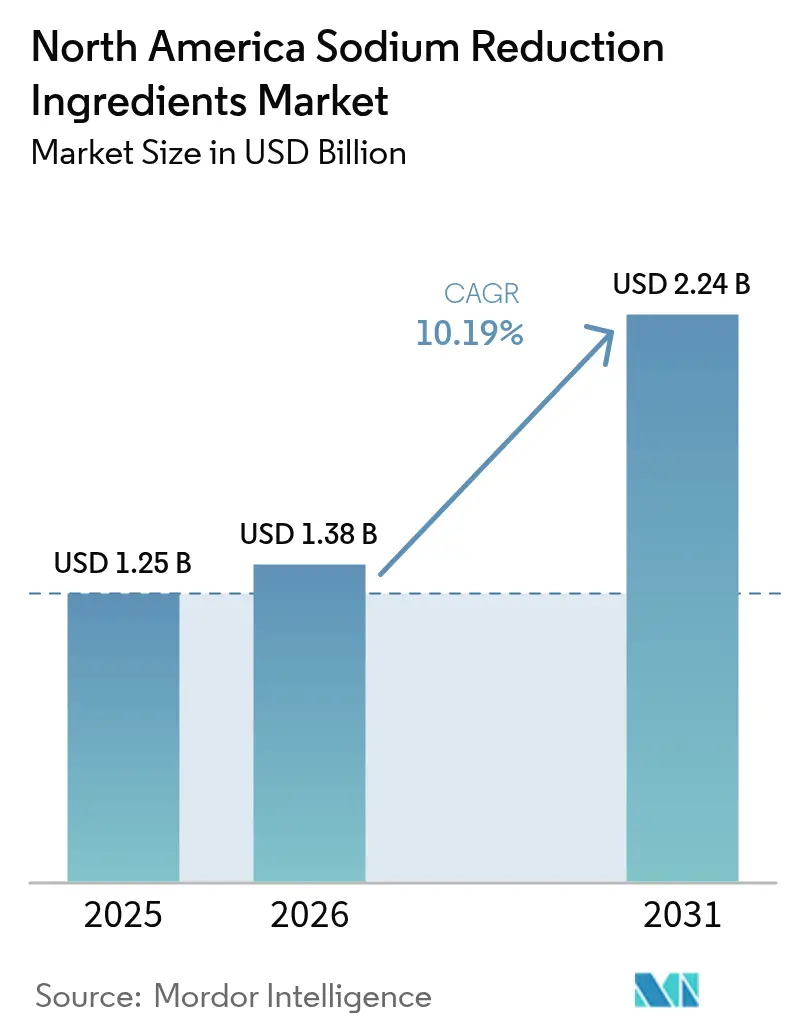
| Base Year Market Size (2025) | USD 1.25 Billion |
| Market Size (2026) | USD 1.38 Billion |
| Market Size (2031) | USD 2.24 Billion |
| Growth Rate (2026 - 2031) | 10.19 % |
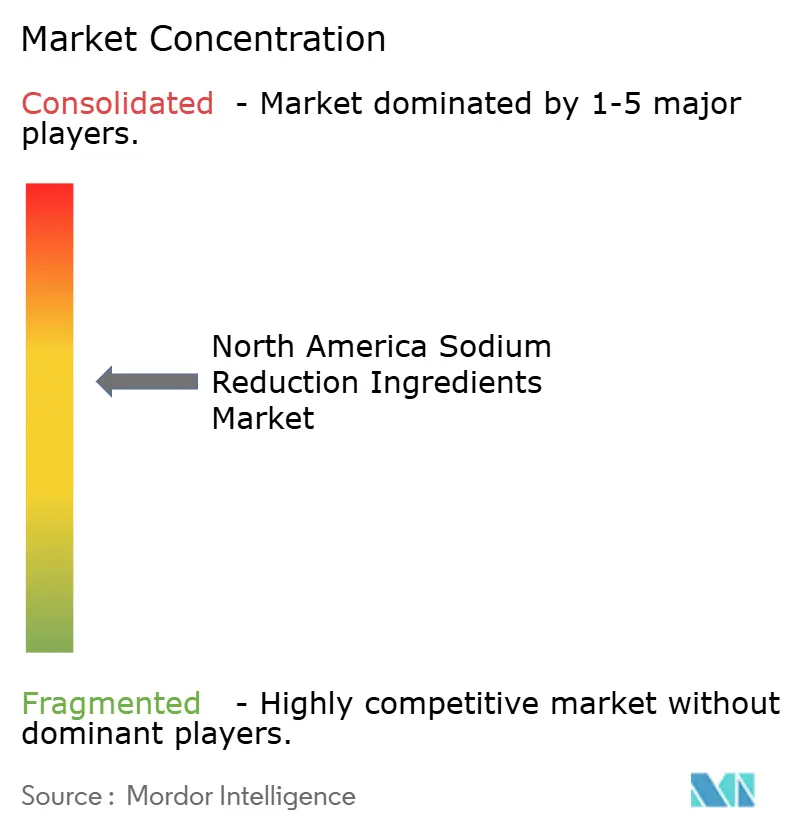
| Market Concentration | Medium |
Major Players *Disclaimer: Major Players sorted in no particular order Image © Mordor Intelligence. Reuse requires attribution under CC BY 4.0. | |
North America Sodium Reduction Ingredients Market Analysis by Mordor Intelligence
The North America sodium reduction ingredient market size in 2026 is estimated at USD 1.38 billion, growing from 2025 value of USD 1.25 billion with 2031 projections showing USD 2.24 billion, growing at 10.19% CAGR over 2026-2031. Heightened regulatory action, led by the FDA’s Phase II voluntary sodium targets, is compressing reformulation timelines, while front-of-pack warnings in Mexico and a pending “high in” symbol in Canada strengthen regional alignment. Institutional buyers, such as school districts, have added week-average sodium limits to bid specifications, creating priority demand for validated potassium-sodium blends and yeast extracts. Consumer awareness of hypertension has risen as the CDC reports that nearly half of U.S. adults are affected, pushing retail sales of low-sodium SKUs and encouraging meal-kit operators to adopt stricter internal limits. Meanwhile, AI-driven formulation tools are cutting development time by simulating taste interactions in silico, allowing producers to commercialize sodium-reduced snacks and condiments in under a year.
Key Report Takeaways
- By product type, mineral salts led with 48.62% of the North America sodium reduction ingredient market share in 2025, while yeast extracts are forecast to expand at a 12.62% CAGR through 2031.
- By form, powders and granules accounted for 67.84% of the value in 2025, whereas liquid formats are expected to advance at a 11.84% CAGR between 2026 and 2031.
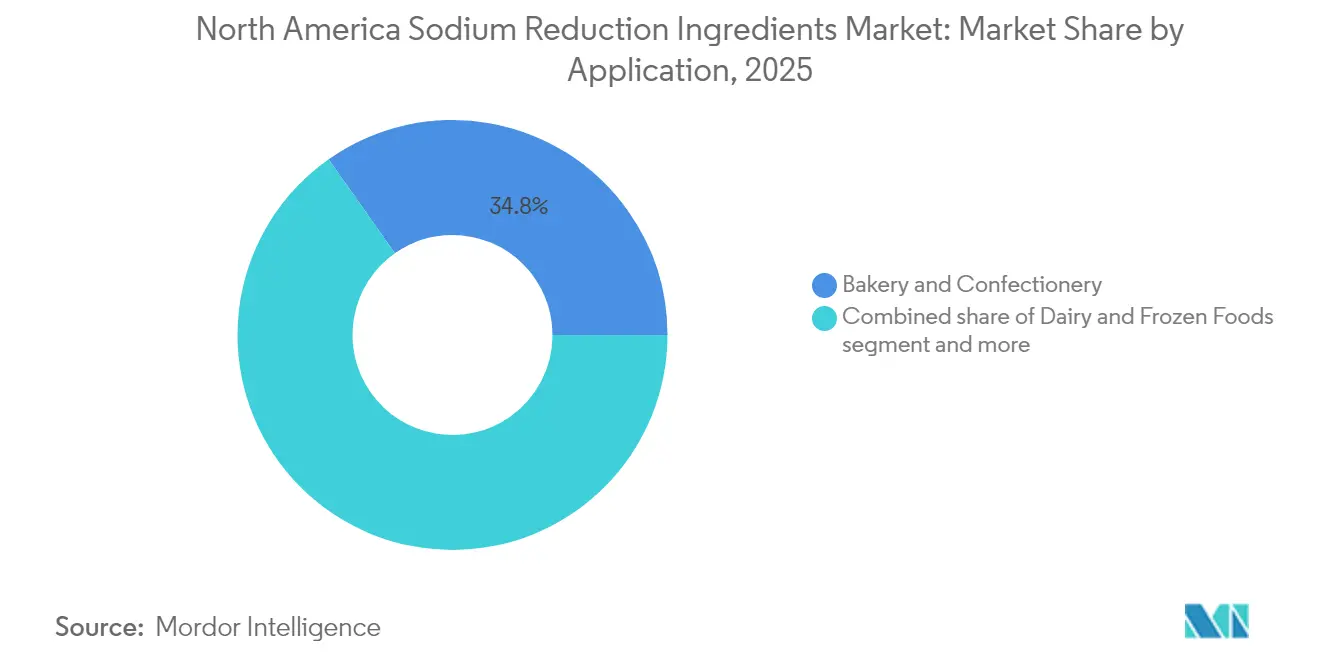
- By application, bakery and confectionery captured 34.77% of revenue in 2025; condiments, seasonings, and sauces are projected to grow at a 12.42% CAGR to 2031.
- By geography, the United States represented 61.88% of 2025 sales, while Mexico is poised to register an 11.44% CAGR through 2031.
Note: Market size and forecast figures in this report are generated using Mordor Intelligence’s proprietary estimation framework, updated with the latest available data and insights as of 2026.
Market Trends and Insights
Drivers Impact Analysis of North America Sodium Reduction Ingredients Market*
| Driver | (~) % Impact on CAGR Forecast | Geographic Relevance | Impact Timeline |
|---|---|---|---|
| FDA Phase-II voluntary sodium targets accelerate reformulation | +2.1% | United States, with spillover to Canada and Mexico aligning with FDA guidance | Medium term (2-4 years) |
| Growing consumer awareness of hypertension and CVD risks | +1.6% | North America-wide, with highest penetration in urban U.S. markets and Canadian provinces with active health campaigns | Long term (≥ 4 years) |
| Advances in potassium-salt blends and umami enhancers | +1.2% | United States and Canada, with early adoption in premium and organic segments | Medium term (2-4 years) |
| AI-driven formulation platforms for customised low-sodium solutions | +1.0% | United States, concentrated in R&D hubs (California, New York, Illinois) | Short term (≤ 2 years) |
| Plant-based meat and dairy analog boom needing sodium cutbacks | +1.5% | United States and Canada, with emerging traction in Mexico's urban centers | Medium term (2-4 years) |
| Procurement push from meal-kit and food-service operators | +1.1% | United States, particularly in metropolitan areas with high meal-kit penetration | Short term (≤ 2 years) |
| Source: Mordor Intelligence | |||
FDA Phase-II Voluntary Sodium Targets Accelerate Reformulation
The FDA’s August 2024 Phase II voluntary sodium targets, aiming to lower the average American intake to ~2,750 mg/day, have accelerated reformulation efforts across packaged foods, with Phase I data showing that ~40% of categories are meeting or nearing the targets[1]Source: U.S. Food and Drug Administration, “Sodium Reduction,” FDA.gov. The December 2024 update to the “healthy” nutrient-content claim, capping sodium at 10% of the daily value (230 mg) per reference amount, effectively disqualifies many legacy bakery, snack, and condiment products. USDA school meal sodium limits, phased in from 2025-2026 and enforced via weekly averages starting in July 2027, are driving the adoption of pre-validated ingredients among institutional buyers[2]Source: U.S. Department of Agriculture, “School Meal Sodium Limits,” USDA.gov. FDA guidance allowing “potassium salt” as an alternative label for potassium chloride has eased consumer confusion, but voluntary compliance results in uneven reformulation among smaller manufacturers. Meanwhile, New York City’s sodium warning icon rule, expanded under Assembly Bill A8860B, pressures foodservice suppliers to use mineral-salt blends and yeast extracts to meet menu-item thresholds.
Growing Consumer Awareness of Hypertension and CVD Risks
Hypertension affects 48% of U.S. adults, about 119.9 million people, with 90% exceeding the recommended daily sodium intake of 2,300 mg, averaging 3,400 mg, according to the CDC[3]Source: Centers for Disease Control and Prevention, “Salt,” CDC.gov. This public health burden drives demand for “low-sodium” and “reduced-sodium” products, which require a 25% or 50% sodium reduction under FDA labeling rules. A 2024 Peru-based clinical trial demonstrated that a 75% sodium chloride/25% potassium chloride substitute reduced new hypertension incidence by 50% and lowered blood pressure by ~2 mmHg, supporting the cardiovascular benefits of potassium-enriched formulations. High-sodium condiments, such as soy sauce exceeding 750 mg per tablespoon, have drawn regulatory scrutiny from the American Heart Association. Meanwhile, Health Canada’s 2012 voluntary targets aimed to reduce the average intake to 2,760 mg by 2017, illustrating the impact of sustained public health campaigns[4]Source: Health Canada, “Sodium Policy,” Canada.ca. Front-of-pack labeling initiatives, including Canada’s proposed “high in” symbol and Mexico’s NOM-051 “EXCESS SODIUM” warnings, coupled with PROFECO audits in 2024, are further increasing consumer awareness and encouraging reformulation at retail.
Advances in Potassium-Salt Blends and Umami Enhancers
Potassium chloride can replace sodium on a 1:1 basis, allowing for up to 50% sodium reduction in processed meats when paired with taste-masking agents. However, its bitter and metallic notes typically limit substitution to 20–30% by weight, as per Norway’s VKM protocol (2021). Cargill’s Potassium Pro Ultra Fine, optimized for plant-based meat analogs, achieves a 20–35% reduction by utilizing smaller particle sizes to enhance coverage and mitigate bitterness. Enzymatic treatments that generate glutamate and branched-chain amino acids can reduce sodium by ~20% while maintaining umami. Yeast extracts blended with adenosine monophosphate (AMP) or L-arginine help block bitterness and enhance saltiness. Patented combinations of lysine monohydrochloride, potassium chloride, and succinic acid support clean-label formulations. Cheese applications have successfully substituted 30–50% of the potassium chloride with umami enhancers, highlighting the category-specific effectiveness of mineral-salt blends.
AI-Driven Formulation Platforms for Customised Low-Sodium Solutions
Advanced digital and AI-driven platforms are accelerating sodium-reduction innovation in North America. DSM-Firmenich’s TASTECOMPASS® models taste interactions in silico, cutting formulation cycles from 18 to under 12 months. Unilever’s 2023 zero-salt Knorr stock cube, developed using computational flavor design, replaced sodium entirely with yeast extracts and mineral salts, demonstrating AI’s ability to bypass traditional trial-and-error. Firmenich’s AI-generated flavor molecules create bespoke umami profiles for high-sodium plant-based proteins, while Tate & Lyle’s Sensation™ tool recommends texture and mouthfeel adjustments to offset blandness in bakery and dairy applications. Kerry’s Sodium Reduction Simulator with TasteSense Salt enables up to 40% sodium reduction in snacks without potassium chloride, addressing hyperkalemia concerns, and MANE’s SENSE CAPTURE™ program uses sensory analytics to identify subtle flavor gaps, speeding regulatory approval for “low-sodium” and “reduced-sodium” claims.
Restraints Impact Analysis of North America Sodium Reduction Ingredients Market*
| Restraint | (~) % Impact on CAGR Forecast | Geographic Relevance | Impact Timeline |
|---|---|---|---|
| Potassium-chloride bitterness and metallic off-notes | -0.8% | North America-wide, with acute challenges in snack and bakery applications | Short term (≤ 2 years) |
| Higher ingredient cost vs. common salt | -0.7% | United States and Canada, particularly affecting mid-tier processors with tight margins | Medium term (2-4 years) |
| Hyper-kalemia safety limits in at-risk populations | -0.6% | United States and Canada, concentrated among CKD patients and those on RAAS inhibitors | Long term (≥ 4 years) |
| Supply tightness for specialty yeast and nucleotide extracts | -0.5% | North America-wide, with bottlenecks in yeast-extract production capacity | Short term (≤ 2 years) |
| Source: Mordor Intelligence | |||
Potassium-Chloride Bitterness and Metallic Off-Notes
Potassium chloride’s bitter and metallic taste remains the main barrier to broader adoption, as sodium ions block bitterness receptors while potassium does not. Norway’s VKM protocol (2021) supports a realistic substitution of 20–30% in processed foods, but reaching 50%, as needed for “reduced-sodium” claims, requires taste modulators such as adenosine monophosphate, L-arginine, or yeast extracts, which increases formulation complexity and cost[5]Source: Norwegian Scientific Committee for Food and Environment, “Potassium Chloride Substitution Protocol,” vkm.no. Cargill’s Potassium Pro Ultra Fine achieves 20–35% sodium reduction in plant-based meats, though acceptance drops sharply above 40%. While adenosine monophosphate can block bitterness and L-arginine enhances saltiness, these modulators are not universally GRAS-approved, which limits their clean-label use. Cheese has achieved 30–50% substitution with umami enhancers, but bakery and snack products remain challenged by potassium’s metallic aftertaste.
Higher Ingredient Cost vs. Common Salt
Potassium-based salt substitutes and yeast extracts carry significant price premiums, with potassium salts costing 1.1-14.6 times more than sodium chloride and low-sodium condiments 2-3 times higher than conventional products, compressing margins for mid-tier processors in snacks and bakery. Yeast extracts, containing 5-10% glutamate, remain costly due to the fermentation and extraction processes, with supply improvements from Angel Yeast’s 11,000-tonne Baiyang plant and Asahi’s acquisition of Leiber GmbH only partially easing the lead times of 8-12 weeks. Specialty ingredients, such as Corbion’s PURASAL potassium lactate, priced three to four times higher than sodium lactate, limit adoption despite their functional benefits. Industry investment, such as ADM’s USD 269 million R&D spend in 2024 on taste-modulation platforms, underscores the need for innovation to deliver cost-effective sodium reduction beyond simple substitution.
*Our forecasts treat driver/restraint impacts as directional, not additive. The impact forecasts reflect baseline growth, mix effects, and variable interactions.
North America Sodium Reduction Ingredients Market Segment Analysis
By Product Type:
Mineral Salts Anchor Share, Yeast Extracts SurgeMineral salts dominated the North America sodium reduction ingredients market in 2025, capturing 48.62% of revenue, led by potassium chloride due to its 1:1 sodium replacement ratio and broad regulatory acceptance across bakery, meat, and snack applications. Potassium chloride enables up to 50% sodium reduction in processed meats when paired with taste-masking agents, with Cargill’s Watkins Glen, New York, facility reflecting the strategic focus on food-grade supply. Other mineral salts, including magnesium sulfate, potassium lactate, and calcium chloride, serve niche roles. Corbion’s PURASAL potassium lactate provides both preservation and sodium-replacement functionality, while its Verdad Essence WH100 extends applications into bakery mold inhibition. Yeast extracts, containing ~5% free glutamate and 10% total glutamate, are increasingly blended with nucleotide extracts to mask potassium’s metallic notes, supported by Angel Yeast’s 11,000-tonne Baiyang plant, which addresses supply constraints delaying condiment reformulation.
Amino acids and glutamates are gaining traction in plant-based meat applications, where DSM-Firmenich’s Maxavor® RYE LS process flavor delivers savory depth while enabling 20–30% sodium reductions. Enzymatic treatments generating glutamate and branched-chain amino acids have also proven to reduce sodium by ~20% in savory foods, validating amino-acid platforms. The “Others” segment, including proprietary blends and novel modulators, is benefiting from innovations like Kerry’s TasteSense Salt, which achieves up to 40% sodium reduction in snacks without potassium chloride, and MANE’s SENSE CAPTURE™ system, which identifies flavor gaps in sodium-reduced prototypes. Consolidation is shaping the yeast-extract space, exemplified by Asahi Group Foods’ 2025 acquisition of Leiber GmbH, with the segment’s projected 12.62% CAGR through 2031 outpacing mineral salts as manufacturers increasingly prioritize umami-rich, clean-label solutions.




By Form:
Powder Dominates, Liquid Gains in BeveragesPowder and granule formats dominated the North American sodium reduction ingredients market in 2025, holding a 67.84% share due to their compatibility with dry-blend seasonings, bakery mixes, and snack toppings, where heterogeneous salt distribution can achieve up to 50% sodium reduction without compromising taste. Technologies like Tate & Lyle’s SODA-LO hollow sodium bicarbonate microspheres enable similar reductions in baked goods while maintaining leavening and clean-label compliance. Salt microspheres are increasingly used in surface-salted snacks, and Cargill’s Potassium Pro® Ultra Fine powder reduces bitterness in plant-based meats for dry-blend applications.
Liquid formats are projected to grow at a 11.84% CAGR from 2026 to 2031, driven by beverage and sauce applications that require in-line dosing for flavor consistency and reduced batch variability. Corbion’s PURASAL® potassium lactate liquid supports sodium reduction while extending shelf life via antimicrobial activity, and liquid yeast extracts maintain umami intensity in condiments and sauces, enabling 17–50% sodium reductions. DSM-Firmenich’s TasteElements toolkit and Givaudan’s Nutri TasteSolutions Sodium provide liquid and powder solutions for plant-based proteins, sauces, and extrusion processes, enhancing formulation precision and operational efficiency across diverse processing environments.
By Application:
Bakery Leads, Condiments AccelerateBakery and confectionery led the North American sodium reduction ingredients market in 2025, capturing a 34.77% share, driven by high baseline sodium levels and advances in sodium bicarbonate substitution technologies. Tate & Lyle’s SODA-LO hollow microspheres enable up to 50% sodium reduction in baked goods while maintaining leavening and clean-label compliance. Corbion’s Verdad® Essence WH100 natural mold inhibitor addresses microbial stability challenges in lower-sodium formulations. Studies on heterogeneous salt distribution confirm that strategic crystal placement can reduce sodium by ~50% without compromising sensory properties in bread and savory biscuits.
Condiments, seasonings, and sauces are projected to grow at a 12.42% CAGR from 2026 to 2031, fueled by consumer health awareness and industry initiatives such as Kraft Heinz’s 2023 commitment to reduce sodium in BBQ sauces and salad dressings. Yeast extracts, with ~5% free glutamate, are increasingly used in the reformulation of soy and fish sauces, supported by Angel Yeast’s 11,000-tonne Baiyang facility. Other applications, including dairy and frozen foods, meat products, and snacks, also contribute significantly. Snacks, for instance, leverage Kerry’s TasteSense Salt for up to 40% sodium reduction without potassium chloride, while meat products adopt potassium lactate and yeast extracts to maintain flavor while complying with “reduced-sodium” claims.
Geography Analysis
United States Sodium Reduction Ingredients Market
The United States dominated the North American sodium reduction ingredients market in 2025, accounting for 61.88% of the regional share, driven by regulatory and public health initiatives. The FDA's Phase II voluntary sodium targets (August 2024) and the December 2024 update to the “healthy” nutrient-content claim, which caps sodium at 230 mg per reference amount, are accelerating reformulation efforts across packaged foods. USDA school meal sodium limits, effective from the 2025–2026 school year and enforced via weekly averages from July 2027, are prompting institutional buyers to pre-validate sodium-reduced SKUs, while New York City’s sodium warning icon rules and California’s state-level disclosure legislation create further downstream pressure. CDC data showing 48% of adults with hypertension and 90% exceeding the recommended sodium intake reinforce retail demand for “low-sodium” and “reduced-sodium” claims. Investments such as Cargill’s expansion of its Watkins Glen Potassium Pro® facility, Kerry’s TasteSense Salt, and DSM-Firmenich’s TASTECOMPASS® predictive system highlight the U.S. leadership in AI-driven and formulation-focused R&D.
Canada Sodium Reduction Ingredients Market
Canada maintains a smaller but stable share, shaped by Health Canada’s 2012 voluntary sodium targets, which achieved an 8% reduction in average intake to 2,760 mg/day by 2017. Proposed front-of-pack “high in” sodium symbols, aligned with FDA thresholds, are expected to harmonize reformulation strategies for manufacturers serving both markets. North American ingredient supply chains are increasingly integrated, exemplified by Tate & Lyle’s 2024 Sensation™ formulation tool, which leverages machine learning to optimize texture and mouthfeel in sodium-reduced foods. Provincial health campaigns in Ontario and British Columbia have heightened consumer awareness of hypertension and cardiovascular risk, driving demand for low-sodium SKUs across dairy, bakery, and snack categories.
Mexico, Central America and the Caribbean Sodium Reduction Ingredients Market
Mexico is forecast to grow at 11.44% CAGR through 2031, driven by NOM-051 front-of-pack “EXCESS SODIUM” warnings, COFEPRIS and PROFECO compliance audits, and rising urbanization and flexitarian trends. Regulatory pressures are prompting manufacturers to adopt potassium chloride blends and yeast extracts, though price sensitivity remains a barrier, with low-sodium condiments costing 2–3× more than conventional products. Ingredient suppliers such as Angel Yeast are expanding into the Mexican condiment and snack markets, while plant-based meat analogs exceeding 400 mg sodium per 4-ounce serving present opportunities for validated sodium-reduction solutions. Smaller Caribbean and Central American markets remain nascent but are expected to benefit from spillover demand as multinational manufacturers harmonize low-sodium formulations across the region.
Regulatory Landscape
In the United States, sodium reduction is shaped by the FDA's category-based voluntary framework and by enforceable labeling rules. FDA issued draft Phase II voluntary sodium reduction goals (Edition 2) in August 2024, building on Phase I progress where FDA's 2022 preliminary assessment found about 40% of food categories met or were within 10% of Phase I targets. At the same time, compliance for on-pack claims continues to be governed by 21 CFR Part 101 (including sodium-related nutrient content and health claim provisions), tightening the practical room for legacy formulations that rely on high sodium for taste and preservation.
Across Canada, Health Canada continues to run voluntary sodium reduction targets for processed foods (2020-2025) and has moved labeling pressure closer to shelf via front-of-package requirements. A June 27, 2025 interim assessment of sodium reduction progress provides the latest government checkpoint on industry performance. Front-of-package labeling rules requiring a high-in sodium symbol became effective in January 2026, making label-driven reformulation and portfolio screening a priority for manufacturers shipping the same SKUs across the US-Canada corridor. Mexico's NOM-051 "EXCESS SODIUM" warning framework remains a regional alignment force for packaged foods sold in North America, reinforcing the need for validated ingredient systems that can hit sodium thresholds without compromising sensory acceptance.
Value Chain Analysis
The value chain starts with upstream mineral supply and purification of key inputs such as potassium chloride and other mineral salts, followed by food-grade processing, blending, and application engineering by ingredient suppliers and flavor houses. In North America, companies such as Cargill, Kerry, and Corbion operate in the high-value middle of the chain, combining mineral salts with yeast extracts, fermentation-derived savory notes, and taste modulators. They then support customers through pilots, sensory validation, and claim-ready reformulation aligned with FDA and Health Canada sodium programs.
Downstream, packaged-food manufacturers, foodservice operators, and institutional buyers translate targets into specifications and tenders, creating pull-through demand for turnkey systems. This includes powders for dry blends and snacks, as well as liquids for sauces and dosing-controlled lines. A recurring constraint is food-grade potassium chloride availability and logistics, with a meaningful share of supply imported into the United States. Additional friction also comes from regulatory and commercialization lead times for novel taste modulators in Canada. As a result, the most advantaged suppliers are those that pair secure mineral sourcing with scalable fermentation-based capacity (yeast and nucleotide extracts), supported by applications teams that can deliver category-specific solutions for bakery, condiments, snacks, and meat.
Competitive Landscape
The North American sodium reduction ingredients market exhibits moderate concentration, led by major players such as Cargill, Kerry Group, Tate & Lyle, Givaudan, and DSM-Firmenich. However, white-space opportunities are emerging in AI-driven formulation platforms and enzymatic taste-masking systems that mitigate potassium chloride’s sensory limitations. Strategic moves focus on vertical integration and technology acquisition: Asahi Group Foods’ 2025 acquisition of Leiber GmbH secures yeast-extract supply across Europe, while ADM’s 2024 purchases of Revela Foods, FDL, and Totally Natural Solutions, backed by USD 269 million in R&D, underscore the focus on taste-modulation capabilities. Cargill’s Watkins Glen expansion for Potassium Pro® potassium chloride addresses specialty mineral-salt supply bottlenecks, and Angel Yeast’s 11,000-tonne Baiyang plant positions the company to capture 8.5% CAGR demand growth for yeast extracts. Smaller innovators, including NuTek Natural Ingredients and Salt of the Earth, leverage proprietary mineral-salt blends to serve niche organic and clean-label segments, though limited scale constrains their distribution relative to incumbents.
Technology is increasingly the main differentiator in sodium-reduction solutions. DSM-Firmenich’s TASTECOMPASS® predictive modeling reduces formulation cycles from 18 to under 12 months by simulating taste interactions, while Kerry’s May 2024 TasteSense Salt platform enables up to 40% sodium reduction in snacks without potassium chloride, addressing hyperkalemia concerns. Academic-industry partnerships, such as the Michigan State University patent covering lysine monohydrochloride, potassium chloride, and succinic acid combinations, validate taste-masking innovations for commercial use. Corbion’s AI-powered Listeria control and refrigerated-food protection expansions address microbial-stability challenges in sodium-reduced formulations, compensating for higher water activity at lower salt levels.
Regulatory compliance is increasingly embedded in procurement and innovation strategies. FDA GRAS status, ISO 22000 food-safety certification, and third-party verification are now baseline requirements for institutional and food-service channels. Angel Yeast’s September 2025 FDA GRAS approval for AngeoPro yeast protein exemplifies the regulatory rigor required for market entry, ensuring that sodium-reduction ingredients not only meet functional and sensory standards but also satisfy safety and traceability expectations across North American supply chains.
North America Sodium Reduction Ingredients Industry Leaders
Givaudan SA
Tate & Lyle Plc
Kerry Group Plc
DSM-Firmenich
Cargill Inc.
- *Disclaimer: Major Players sorted in no particular order
North America Sodium Reduction Ingredients Market Companies Covered in this Report
- Cargill Inc.
- Kerry Group plc
- Tate & Lyle plc
- Givaudan SA
- DSM-Firmenich
- Sensient Technologies Corp.
- Corbion NV
- Archer Daniels Midland Co. (ADM)
- Dr. Paul Lohmann GmbH & Co. KGaA
- Jungbunzlauer AG
- Innophos Holdings Inc.
- ICL Food Specialties
- Solina Group
- Salt of the Earth Ltd.
- Lesaffre (Biospringer & Ohly)
- Advanced Food Systems Inc.
- NuTek Natural Ingredients
- Angel Yeast Co. Ltd.
- K+S Aktiengesellschaft (Morton Salt)
- LoSalt Ltd.
Read Analysis of North America Sodium Reduction Ingredients Companies

Market Opportunities and Future Outlook
Canada's front-of-package high-in sodium symbol becoming effective in January 2026 creates a near-term compliance-driven whitespace for ingredient suppliers that can help brands rework sodium while preserving taste and keeping labels straightforward. This is most visible in categories where reformulation collides with shelf-life and safety requirements, increasing demand for integrated systems that combine sodium reduction with microbial control and stability support, rather than relying on potassium chloride substitution alone.
In the United States, the FDA's August 2024 Phase II voluntary sodium targets, together with enforceable labeling requirements under 21 CFR Part 101, keep multi-category reformulation programs active and elevate the role of application labs and taste-modulation platforms. ADM's May 2026 investment of USD 26 million to expand its Erlanger, Kentucky facility, increasing reformulation capabilities by 40%, is a clear signal that suppliers are scaling domestic reformulation infrastructure to support customers facing shorter iteration cycles and multi-market harmonization across the US, Canada, and Mexico. Platform-based launches also support adoption: Ajinomoto Health & Nutrition North America introduced Salt Answer and Palate Perfect in June 2025 with sodium-reduction positioning (up to 30%), reinforcing the shift toward modular toolkits that can be tuned by category and risk group, including approaches that reduce reliance on higher potassium loads.
Recent Industry Developments in North America Sodium Reduction Ingredients Market
- May 2026: ADM invested USD 26 million to expand its Erlanger, Kentucky facility, increasing reformulation capabilities by 40%. The added applications and processing capacity supports faster iteration for sodium-reduced foods, helping brands and co-manufacturers execute multi-category changes under tightening labeling and public health pressure.
- April 2025: Corbion launched Verdad Essence WH100, a natural mold inhibitor positioned for bakery formulations. By addressing microbial stability challenges that can intensify when salt is reduced, the launch complements sodium-reduction programs where water activity management becomes a limiting factor for clean-label baked goods.
- December 2024: Corbion expanded its refrigerated-food protection portfolio by integrating potassium lactate and calcium propionate solutions for meat and dairy applications. The addition strengthens preservation toolkits that can offset functionality lost during sodium reduction, supporting processors that need to maintain safety margins while lowering salt.


North America Sodium Reduction Ingredients Market Report Scope and Research Methodology
Market Definition and Coverage
This market covers ingredients and additive systems that help food and beverage producers reduce sodium in finished recipes without losing the expected taste and functionality. It includes mineral salt based options, yeast extracts, amino acids and glutamates, and related solutions sold in liquid or powder forms across North America.
Scope exclusions: It excludes finished packaged foods, consumer salt substitutes sold as retail products, and clinical or pharma grade dietary interventions.
Segments Covered in This Report
- By Product Type
- Amino Acids and Glutamates
- Mineral Salts
- Potassium Chloride
- Magnesium Sulphate
- Potassium Lactate
- Calcium Chloride
- Yeast Extracts
- Others
- By Form
- Powder/Granules
- Liquid
- By Application
- Bakery and Confectionery
- Condiments, Seasonings and Sauces
- Dairy and Frozen Foods
- Meat and Meat Products
- Snacks
- Others
- By Country
- United States
- Canada
- Mexico
- Rest of North America
Data Sources, Market Sizing, and Validation
Desk Research
Desk work starts with building the demand context and the rules that shape reformulation across the United States, Canada, and Mexico. We review public health guidance and sodium targets from sources such as the US FDA, and we pull nutrition and chronic disease statistics from bodies such as the CDC, Health Canada, and Mexico health agencies where data is available.
To link reformulation pressure to addressable usage, trade and production signals are reviewed through sources such as the US Census Bureau and Statistics Canada, along with customs trade data and food category output indicators from industry associations and peer reviewed journals on food science. Company annual reports, investor presentations, press releases, and product specification sheets are used to clarify ingredient positioning and typical use cases. When it helps confirm assumptions, we use paid subscription inputs for company financials, patents, and shipment level trade checks selectively. These desk research sources are illustrative, and many other public references are also used for data collection, cross checks, and clarification.
Primary Interviews and Surveys
Primary work is used to test how sodium reduction ingredients are selected, priced, and actually used across key food categories, and then to sanity check country level adoption patterns. We speak with a mix of ingredient suppliers, blenders, distributors, and food manufacturers. Coverage is balanced across North America so our assumptions do not get anchored to one country's reformulation cycle.
Distribution of primary research fieldwork respondents
| Company type | Respondent position |
|---|---|
| Top tier: 38% | CXOs: 15% |
| Mid tier: 40% | Functional/Unit leaders: 41% |
| Smaller Players: 22% | Managers: 44% |
Market-Sizing & Forecasting
Sizing is built using a top-down approach where food category output and reformulation exposure are used to reconstruct the addressable demand pool for sodium reduction solutions across North America. The model is then corroborated with selective bottom-up approximations, such as sampled price per kg by ingredient class, typical inclusion rates, and supplier and channel checks, so totals can be adjusted when a number looks too optimistic.
Inputs are kept practical and traceable, and include indicators such as packaged food production volumes in sodium sensitive categories, the pace of label and recipe changeovers, the mix shift between mineral salts and yeast extract based solutions, typical dosage ranges by application, and observed pricing movement tied to raw material cost and formulation complexity. Where data is thin for a smaller country or a niche application, proxy relationships from similar food categories are used, and the implied penetration is validated with interview feedback.
For forecasting, we primarily use scenario analysis supported by a small set of explanatory variables that can be refreshed each year. These include processed food output trends, regulatory and voluntary sodium target timelines, and the expected adoption curve of salt replacers in bakery, snacks, and meat products. Assumptions are kept consistent across countries, and differences are introduced only when primary insights show a clear change in reformulation intensity or ingredient preference.
Data Validation & Update Cycle
Validation is done through repeated checks that compare model outputs with independent signals, such as country level packaged food output direction, ingredient pricing ranges, and trade flow movements for relevant ingredient families. Outliers are reviewed in steps, first by the analyst building the model, and then by a second analyst review that challenges the key multipliers and conversion factors before sign-off.
If a new regulation, a notable reformulation wave in a major food category, or a sharp input cost shift shows up in the signals we track, we re-contact selected interviewees and re-run the most sensitive parts of the model. Reports are refreshed annually, with interim updates made when material events can reasonably change adoption or pricing. Before delivery, a final pass is performed so clients receive the latest updated view rather than an older snapshot.
Mordor Intelligence's North America Sodium Reduction Agents Market Market Size Compared Against Other Published Estimates
Different published market sizes for sodium reduction agents can vary even when the topic sounds the same, because scope boundaries and counting rules are not consistent. The biggest drivers usually come from what is treated as an ingredient system versus a finished product, which countries are included under North America, and whether estimates are anchored on food production exposure or on supplier revenue snapshots.
Food category level reformulation exposure and dosage reality checks from bakery, meat, snacks, and seasonings are the evidence that keeps Mordor Intelligence's estimate tied to a repeatable demand pool, instead of being pushed upward by broad inclusion of adjacent flavor enhancers and retail salt substitutes.
Benchmark comparison
| Source | Market Size | Gaps in Research Methodology |
|---|---|---|
| Mordor Intelligence | USD 1.25 B (2025) | |
| Industry Publisher A | USD 2.03 B (2024) | Uses a global study split to North America using share allocation, which can over-include adjacent ingredient categories and can differ on what counts as an in-scope sodium reduction system. |
| Industry Publisher B | USD 1.50 B (2024) | Applies a regional breakout from a broader global definition, and the year and currency timing differences can shift the North America number even when growth direction matches. |
Taken together, the spread is mainly explained by definition boundaries, base year choice, and how demand is reconstructed from real food production and reformulation signals. By keeping the inputs tied to clear application pools and then rechecking pricing and penetration with interviews, our model stays easy to follow and practical to update as the market moves.


Key Questions Answered in the Report
What is the projected value of the North America sodium reduction ingredient market in 2031?
The market is forecast to reach USD 2.24 billion by 2031, growing at a 10.19% CAGR over 2026-2031.
Which product type is expanding fastest in sodium-reduction formulations?
Yeast extracts are expected to grow at a 12.62% CAGR through 2031 as they mask off-notes and add umami depth.
How are U.S. regulations influencing ingredient demand?
FDA Phase II voluntary targets and USDA school meal limits push food makers to adopt validated low-sodium blends ahead of 2027 compliance checks.
Why are liquid sodium-reduction ingredients gaining popularity?
Beverage and sauce producers use in-line dosing to maintain flavor consistency, driving liquids at a 11.84% CAGR.
What competitive edge do AI formulation tools provide?
Platforms like TASTECOMPASS® reduce development cycles to under a year by modeling taste interactions digitally, lowering R&D cost and risk.
Page last updated on:


 Your data is secure and never sold or shared.


