
Smart Well Market Size and Share
Market Overview
| Study Period | 2021 - 2031 |
|---|---|
| Market Size (2026) | USD 8.67 Billion |
| Market Size (2031) | USD 10.98 Billion |
| Growth Rate (2026 - 2031) | 4.83 % |
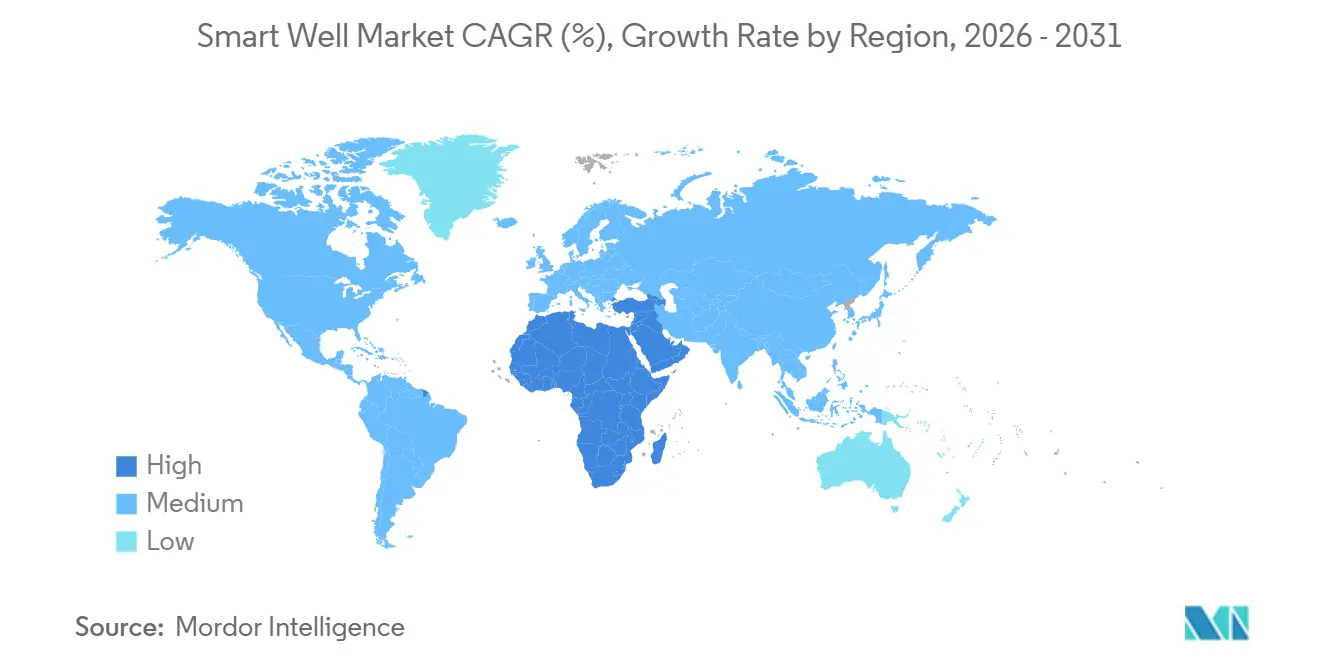
| Fastest Growing Market | Middle East and Africa |
| Largest Market | North America |
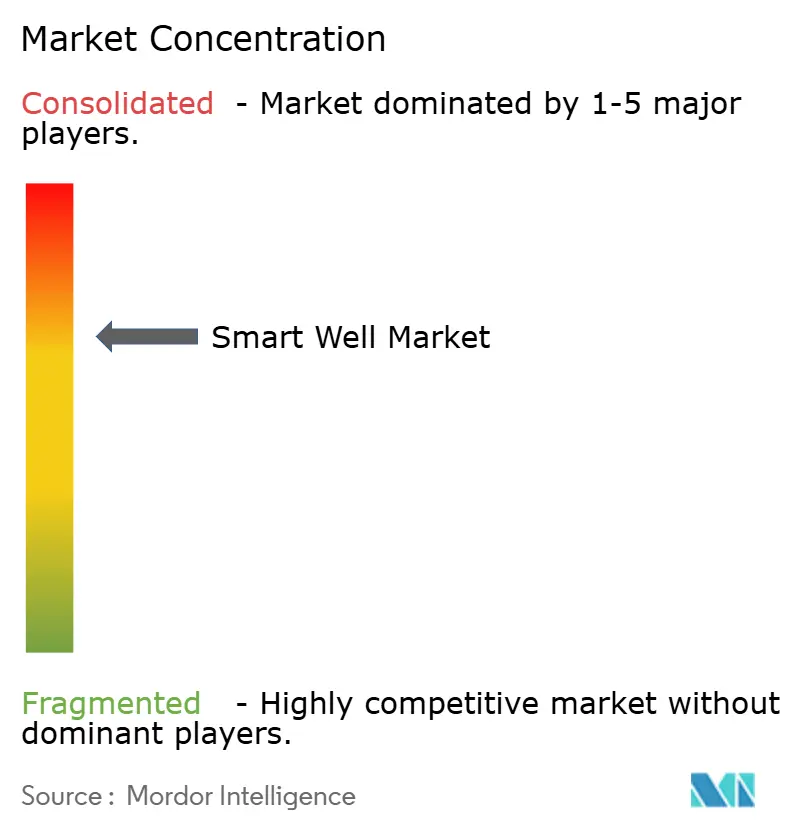
| Market Concentration | Medium |
Major Players *Disclaimer: Major Players sorted in no particular order Image © Mordor Intelligence. Reuse requires attribution under CC BY 4.0. | |
Smart Well Market Analysis by Mordor Intelligence
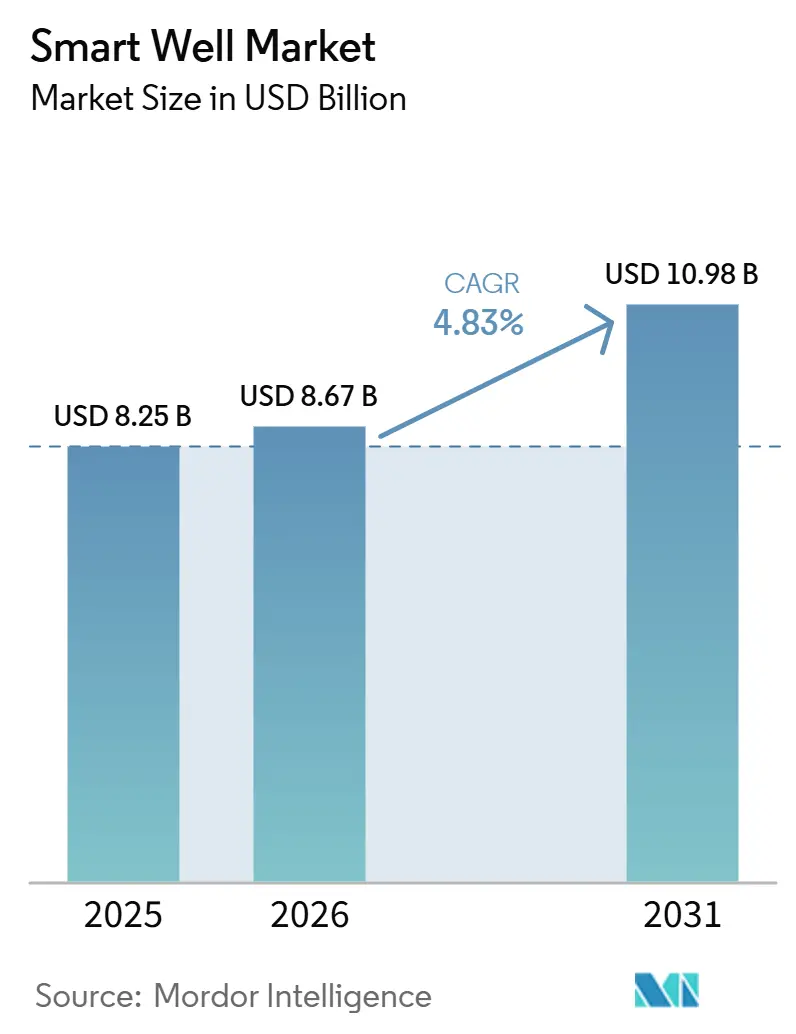
The Smart Well Market size is projected to expand from USD 8.25 billion in 2025 and USD 8.67 billion in 2026 to USD 10.98 billion by 2031, registering a CAGR of 4.83% between 2026 to 2031. Operators are slowing raw production growth and emphasizing capital discipline, directing more free cash toward dividends and balance-sheet repair. Single-zone systems held a 55.5% share in 2025, while multi-zone technology is advancing at a faster pace, as compartmentalized control delivers incremental barrels from aging fields without requiring new surface pads. Interval Control Valves (ICVs) led component revenue at 33.1% in 2025, while downhole sensors are gaining momentum as fiber-optic Distributed Acoustic Sensing (DAS) becomes standard for real-time surveillance and carbon-storage monitoring. Horizontal wells accounted for 47.6% of installations in 2025, with multilateral completions rising as Middle Eastern projects unlock bypassed pay zones. Onshore applications dominated with 62.0% of deployments in 2025, while offshore deepwater projects in Brazil and Guyana are driving a 7.8% CAGR, supported by strict remote-control requirements in water depths beyond 2,000 m.
Key Report Takeaways
- By technology, single-zone configurations held a 55.5% revenue share in 2025; multi-zone systems are forecast to grow at a 6.3% CAGR through 2031.
- By component, intelligent completion valves (ICVs) captured 33.1% of the smart well market share in 2025, while downhole sensors are projected to record the highest CAGR at 7.4% through 2031.
- By well type, horizontal completions accounted for 47.6% of the smart well market size in 2025, while multilateral completions are forecast to grow at a 7.1% CAGR through 2031.
- By application, onshore deployments held a 62.0% share of the smart well market in 2025, while offshore installations are forecast to grow at a 7.8% CAGR through 2031.
- By geography, North America held a 36.3% share in 2025, while the Middle East and Africa region is forecast to grow at a 7.2% CAGR through 2031.
Note: Market size and forecast figures in this report are generated using Mordor Intelligence’s proprietary estimation framework, updated with the latest available data and insights as of January 2026.
Market Trends and Insights
Drivers Impact Analysis of Smart Well Market*
| Driver | (~) % Impact on CAGR Forecast | Geographic Relevance | Impact Timeline |
|---|---|---|---|
| Aging brownfields demand zonal control | +1.2% | Middle East, North Sea, US Gulf Coast | Long term (≥ 4 years) |
| Offshore deep-water field surge in Brazil & Guyana | +0.9% | Brazil, Guyana, spillover to West Africa | Medium term (2-4 years) |
| Real-time optimization cuts OPEX 15-25% | +1.4% | Global, early adoption in North America and Middle East | Short term (≤ 2 years) |
| All-electric completions unlock HP/HT wells | +0.8% | North Sea, Middle East, deep-water Gulf of Mexico | Medium term (2-4 years) |
| Fiber-optic DAS for CCUS monitoring | +0.5% | North America, Europe, Australia | Long term (≥ 4 years) |
| Source: Mordor Intelligence | |||
Aging brownfields demand zonal control
Fourth-decade fields in the Middle East, the North Sea, and the US Gulf Coast face rising water cuts and gas breakthrough. Saudi Aramco installed 78 smart wells with 135 permanent downhole monitoring systems to shut off high-water zones without workovers, extending plateau production.[1] Chevron connected more than 1,500 Permian Basin wells to real-time telemetry, reducing workover frequency and deferring new water-handling infrastructure. Although a smart completion adds USD 0.5–1.5 million compared to a conventional string, avoiding two workovers, each costing USD 2–5 million, shortens the payback period. Standardized sensors and modular surface controllers now allow mid-tier operators to deploy zonal control at lower integration risk. Interoperability standards such as API Spec 17D and ISO 10423 further reduce vendor lock-in.
Offshore deep-water surge in Brazil & Guyana
Brazil’s pre-salt province and Guyana’s Stabroek block require smart completions to manage multilayer carbonates under 15,000 psi wellhead pressure. ExxonMobil’s Yellowtail project includes 26 subsea wells with intelligent completions that balance pressure across fault blocks.[2] Petrobras selected multi-zone systems for the Búzios field, where 2,000 m water depths drive demand for all-electric actuators that cut umbilical weight 15–20%.[3] Fiber-optic DAS identifies sand ingress and tubing leaks without mechanical gauges, which is critical when intervention costs exceed USD 10 million per well. Supply chain constraints for subsea connectors and corrosion-resistant alloys can delay first oil by up to six months.
Real-time optimization cuts OPEX 15-25%
Linking intelligent completions to artificial-lift controllers enables 15-25% OPEX savings. Devon Energy achieved 3-5% production uplift by adjusting gas-lift rates every 15 minutes using downhole pressure data. China's Changqing field automated 120,000 wells, reducing energy use by 50% and labor costs by 30%. Closed-loop fracturing in the Eagle Ford reduced completion time by 12% and water use by 18% through real-time feedback. The shift from monthly tests to continuous monitoring increases cybersecurity risks; U.S. agencies now require incident reporting within 24 hours.
All-electric completions unlock HP/HT wells
High-pressure/high-temperature reservoirs operating above 10,000 psi and 150°C have historically caused elastomer degradation in hydraulic lines. Electric ICVs rated for 175°C and 20,000 psi extend system life to 15 years. Halliburton's SmartFleet Electris platform eliminates surface hydraulic units, reducing topsides weight and simplifying umbilical routing. Baker Hughes installed electric valves in Norway's Johan Castberg field, while Saudi Aramco specified the technology for the 12,000 psi Jafurah gas development. Despite a USD 0.3–0.8 million premium per well, operators accept the cost in cases where rigless intervention may exceed USD 10 million.
Restraints Impact Analysis of Smart Well Market*
| Restraint | (~) % Impact on CAGR Forecast | Geographic Relevance | Impact Timeline |
|---|---|---|---|
| High upfront CAPEX & complexity | -0.9% | North America shale, emerging markets | Short term (≤ 2 years) |
| Oil-price volatility curbs capex | -1.1% | Global, pronounced in marginal offshore projects | Short term (≤ 2 years) |
| Cyber-security risk in open control | -0.3% | Digitally connected fields worldwide | Medium term (2-4 years) |
| Alloy supply-chain pinch | -0.4% | Offshore regions using CRA materials | Medium term (2-4 years) |
| Source: Mordor Intelligence | |||
High upfront CAPEX & complexity
Smart completions add 30-50% to well costs before first production. A deep-water multi-zone string can require an additional USD 2-4 million, which presents a challenge for independents when crude trades near USD 70/bbl. A 2025 Halliburton survey of 150 E&P firms found that 42% cited "limited in-house expertise" as the primary barrier. Managed-service offerings from Schlumberger and Baker Hughes convert capital expenditure into multi-year operating fees, though this shift complicates project economics.
Alloy Supply-Chain Pinch
Corrosion-resistant alloys such as 22Cr duplex stainless steel face 9- to 12-month lead times, as production is concentrated in a few European and Asian mills. Subsea tree builders and completion vendors compete for the same billets, delaying offshore schedules by 6 to 9 months. Alternative 13Cr variants require extensive API 5CRA and NACE MR0175 testing, which can add up to two years to procurement timelines to qualification.[4]
*Our forecasts treat driver/restraint impacts as directional, not additive. The impact forecasts reflect baseline growth, mix effects, and variable interactions.
Smart Well Market Segment Analysis
By Technology:
Multi-zone Systems Scale in Aging FieldsSingle-zone configurations held a 55.5% revenue share in 2025, while multi-zone completions are growing at a 6.3% CAGR through 2031 as operators seek selective control over three to five reservoir layers from a single wellbore. Saudi Aramco's Khurais program demonstrated that independently actuated ICVs can shut off rising water without shutting in the entire well, preserving oil flow while reducing workover frequency. Schlumberger's ResFlow AICD 2M reduced water and gas inflow by up to 90% in Oman, raising oil output fivefold and validating the economics of multi-zone hardware. Single-zone systems still dominate shale plays where speed and cost discipline matter most, but their share is expected to decline as brownfield operators retrofit legacy wells.
By Component:
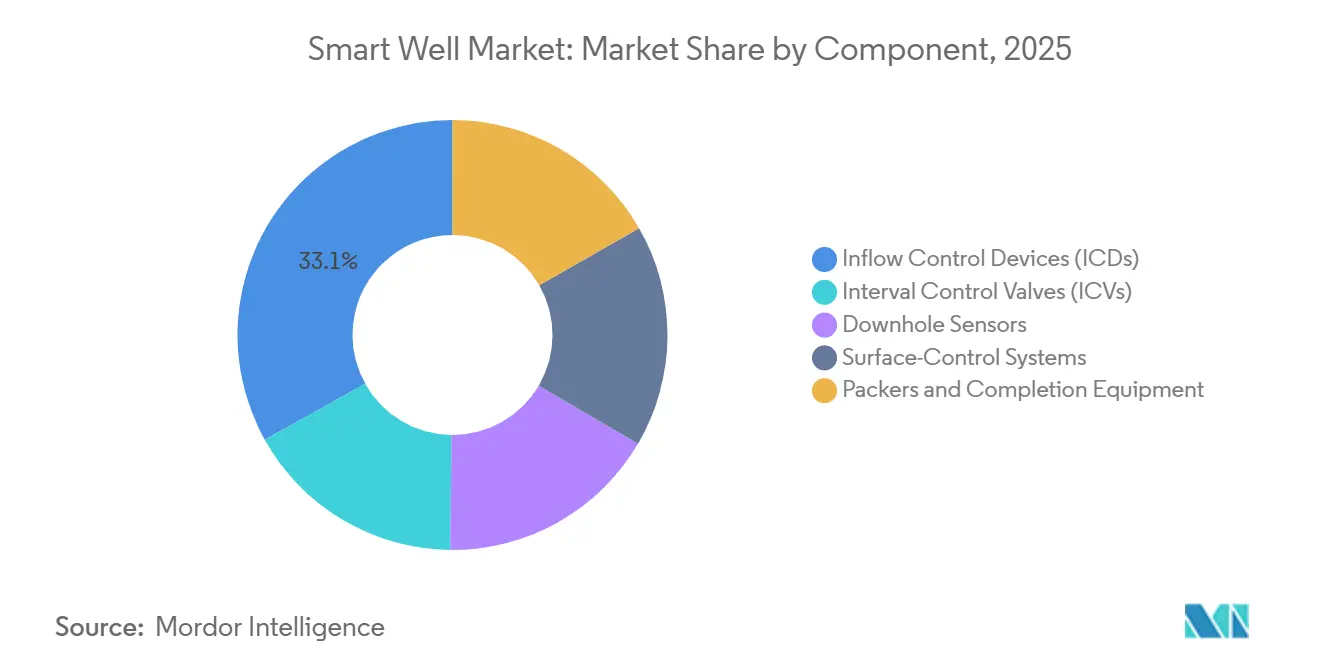
Sensors Outpace HardwareICVs accounted for 33.1% of component revenue in 2025, while downhole sensors represent the fastest-growing segment at a 7.4% CAGR. Baker Hughes' SureVIEW fiber platform converts a single optical strand into tens of thousands of pressure, temperature, and acoustic data points, enabling engineers to adjust ICVs before production decline occurs. Commodity items such as packers, sleeves, and mandrels now compete primarily on price, while software-integrated sensor suites command premium margins.

By Well Type:
Multilateral Completions Gain ShareHorizontal wells accounted for 47.6% of smart completions in 2025, while multilateral designs are growing at 7.1% per year as Middle East and North Sea operators avoid the need for new surface slots. Halliburton's FlexRite system surpassed 400 junctions in 2025, indicating that TAML Level 5 multilateral architecture has become routine. Vertical wells remain a niche application in low-cost onshore fields, where smart strings are used primarily for water shut-off.
By Application:
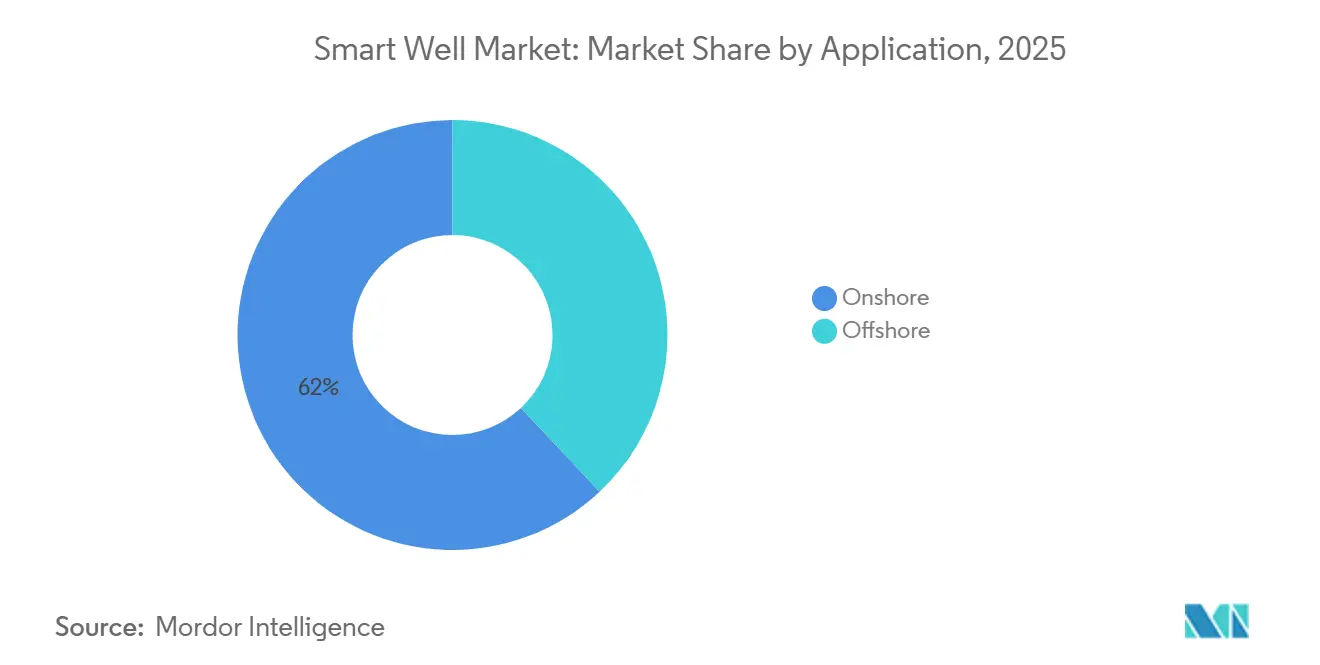
Offshore Demand AcceleratesOnshore projects accounted for 62.0% of 2025 installations. However, offshore deepwater projects in Brazil and Guyana are expanding at a 7.8% CAGR, as pre-salt carbonates require remote zonal control under 2,000 m of water. Subsea wells cost upward of USD 100 million, making the additional USD 3 million for an intelligent completion string a relatively small increment that can reduce intervention visits over two decades.
Geography Analysis
North America Smart Well Market
North America accounted for 36.3% of the market share in 2025, supported by more than 1,500 digitally connected Permian wells that Chevron manages in real time, reducing OPEX by 15%–20%. Growth is moderating as shale operators prioritize free cash flow over rig additions, shifting incremental demand toward retrofit packages rather than greenfield pads.
MEA Smart Well Market
The Middle East and Africa region is growing at a 7.2% CAGR, driven by ADNOC's USD 920 million digitalization program covering 2,000 wells and Saudi Aramco's all-electric strings in the 12,000 psi Jafurah gas field. National oil companies maintain capital budgets independent of short-term price fluctuations, providing suppliers with predictable multiyear backlogs.
APAC and South America Smart Well Market
Asia-Pacific and South America show selective adoption. China's Changqing field automated 120,000 wells, reducing energy use by 50% and labor by 30%. Petrobras ordered multi-zone systems for Búzios, where water depths exceed 2,000 m and temperatures reach 120 °C. ExxonMobil's Yellowtail project will install 26 smart subsea wells to balance pressure across fault blocks.
Europe Smart Well Market
Europe's mature North Sea assets rely on multilateral retrofits to maximize production before decommissioning, with Halliburton's 400th FlexRite junction installation reflecting the technology's mainstream adoption.
Competitive Landscape
The global smart well market is moderately consolidated. Schlumberger's Performance Live, Halliburton's iCruise, and Baker Hughes' Leucipa platforms now win bids on algorithm speed and cyber-hardening rather than valve metallurgy. Niche challengers, including InflowControl, Tendeka, and Welltec, exploit autonomous inflow-control devices that throttle water without surface commands, prompting incumbents to consider equity stakes or partnerships. Weatherford's 2025 purchase of Aker Solutions' intervention unit consolidated work-over capability and opened a retrofit pathway for aging strings. Vendors now advertise compliance with IEC 62443 and NIST frameworks to address operator concerns over ransomware exposure.
Smart Well Industry Leaders
-
Schlumberger
-
Halliburton
-
Baker Hughes
-
Weatherford
-
NOV
- *Disclaimer: Major Players sorted in no particular order
Smart Well Market Companies Covered in this Report
- AFGlobal Corporation
- Aker Solutions ASA
- Baker Hughes Company
- CGG S.A.
- Emerson Electric Co.
- Expro Group Holdings N.V.
- Halliburton Company
- Intelligent Wellhead Systems Inc.
- National Oilwell Varco, Inc. (NOV)
- Nine Energy Service, Inc.
- Packers Plus Energy Services Inc.
- Petrofac Limited
- Schlumberger Limited (SLB)
- Siemens Energy AG
- TechnipFMC plc
- Tendeka B.V.
- Weatherford International plc
- Welltec A/S
Recent Industry Developments in Smart Well Market
- September 2025: Halliburton has unveiled the Turing electro-hydraulic control system, marking a significant advancement in its SmartWell intelligent completions technology. This cutting-edge system establishes a benchmark in reservoir flow control, applicable across all completion scenarios. Its implementation not only enhances recovery rates but also minimizes the number of wells needed.
- July 2025: SLB completed the USD 7.1 billion ChampionX acquisition, gaining chemicals and digital tools that unlock USD 400 million annual synergies.
- June 2025: Chevron and Halliburton launched intelligent hydraulic fracturing in Colorado, executing closed-loop stage design without human intervention.
- June 2025: Baker Hughes secured a multi-year Azerbaijan contract to deploy electric submersible pumps and the Leucipa automation suite across 150 wells.
Global Smart Well Market Report Scope
A smart well (or intelligent well) is a petroleum extraction well equipped with down-hole sensors and interval control valves (ICVs) that allow operators to remotely monitor and control pressure, temperature, and flow rates from specific reservoir zones. It maximizes production and extends reservoir life by managing water/gas inflow without physical intervention.
The global smart well market report is segmented by technology, component, well type, application, and geography. By technology, the market is segmented into single-zone smart wells and multi-zone smart wells. By component, the market is segmented into inflow control devices, interval control valves, downhole sensors, surface-control systems, packers & completion equipment. By well type. The market is segmented into vertical, horizontal, and multilateral. By application, the market is segmented into onshore and offshore. The report also covers the market size and forecasts for the global smart well market in 18 countries across major regions. For each segment, the market sizing and forecasts have been done on the basis of value (USD).
| Single-zone Smart Well |
| Multi-zone Smart Well |
| Inflow Control Devices (ICDs) |
| Interval Control Valves (ICVs) |
| Downhole Sensors |
| Surface-Control Systems |
| Packers and Completion Equipment |
| Vertical |
| Horizontal |
| Multilateral |
| Onshore |
| Offshore |
| North America | United States |
| Canada | |
| Mexico | |
| Europe | Germany |
| United Kingdom | |
| France | |
| Italy | |
| NORDIC Countries | |
| Russia | |
| Rest of Europe | |
| Asia-Pacific | China |
| India | |
| Japan | |
| South Korea | |
| ASEAN Countries | |
| Rest of Asia-Pacific | |
| South America | Brazil |
| Argentina | |
| Rest of South America | |
| Middle East and Africa | Saudi Arabia |
| United Arab Emirates | |
| South Africa | |
| Egypt | |
| Rest of Middle East and Africa |
| By Technology | Single-zone Smart Well | |
| Multi-zone Smart Well | ||
| By Component | Inflow Control Devices (ICDs) | |
| Interval Control Valves (ICVs) | ||
| Downhole Sensors | ||
| Surface-Control Systems | ||
| Packers and Completion Equipment | ||
| By Well Type | Vertical | |
| Horizontal | ||
| Multilateral | ||
| By Application | Onshore | |
| Offshore | ||
| By Geography | North America | United States |
| Canada | ||
| Mexico | ||
| Europe | Germany | |
| United Kingdom | ||
| France | ||
| Italy | ||
| NORDIC Countries | ||
| Russia | ||
| Rest of Europe | ||
| Asia-Pacific | China | |
| India | ||
| Japan | ||
| South Korea | ||
| ASEAN Countries | ||
| Rest of Asia-Pacific | ||
| South America | Brazil | |
| Argentina | ||
| Rest of South America | ||
| Middle East and Africa | Saudi Arabia | |
| United Arab Emirates | ||
| South Africa | ||
| Egypt | ||
| Rest of Middle East and Africa | ||
Key Questions Answered in the Report
What is the market size of global smart well market in 2031?
The Smart Well Market size is projected to expand from USD 8.25 billion in 2025 and USD 8.67 billion in 2026 to USD 10.98 billion by 2031, registering a CAGR of 4.83% between 2026 to 2031.
Which region is growing fastest in smart completions?
The Middle East and Africa region leads with a 7.2% CAGR as national oil companies fund multiyear digital programs.
Why are multi-zone systems displacing single-zone hardware?
Multi-zone strings let operators shut off unwanted water or gas in specific layers, raising recovery without extra wells.
How do electric ICVs benefit HP/HT reservoirs?
They remove hydraulic fluids that degrade above 150 °C, extending completion life to 15 years and cutting intervention risk.
What cybersecurity standard do operators request from vendors?
Most procurement teams now cite IEC 62443 compliance for industrial-control equipment.
What is the global smart well market size in 2026?
The global smart well market size is estimated at USD 8.67 billion in 2026, up from USD 8.25 billion in 2025.