
Market Overview
| Study Period | 2021 - 2031 |
|---|---|
| Forecast Data Period | 2026 - 2031 |
| Historical Data Period | 2021 - 2024 |
| Growth Rate | 2.07 % |
| Market Concentration | Medium |
Major Players *Disclaimer: Major Players sorted in no particular order Image © Mordor Intelligence. Reuse requires attribution under CC BY 4.0. | |
Europe Well Intervention Market Analysis by Mordor Intelligence
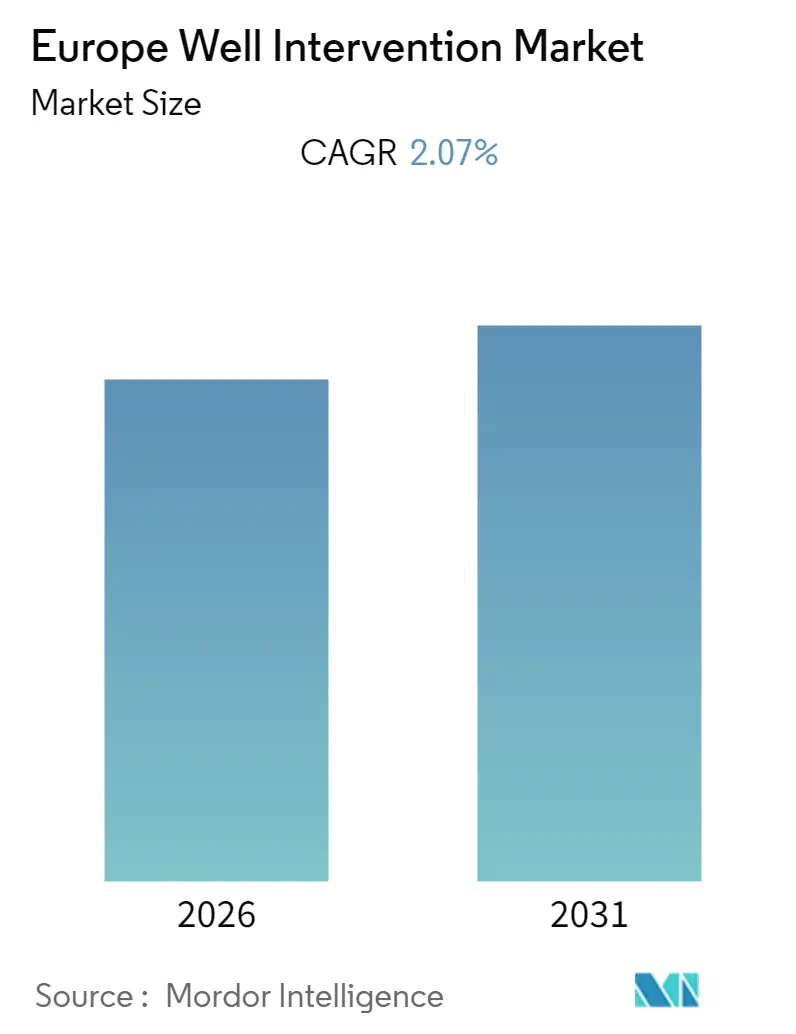
The Europe Well Intervention Market size is expected to register a CAGR of greater than 2.07% during the forecast period.
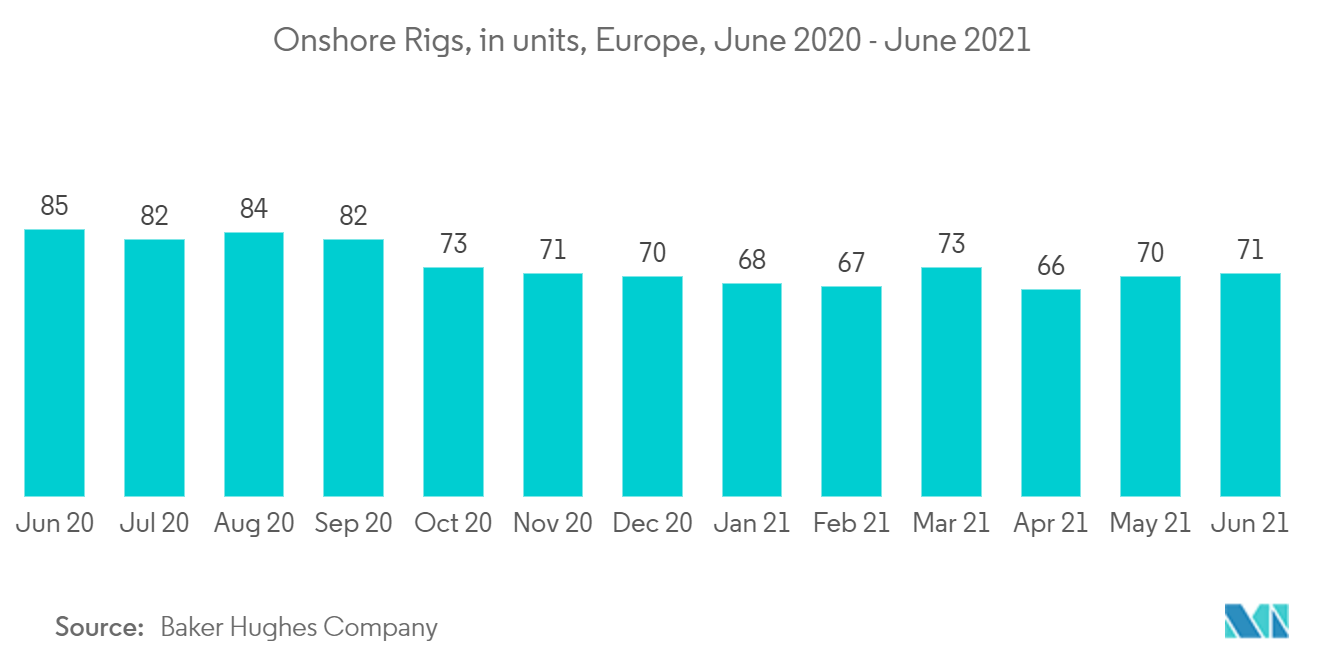
- The onshore is expected to have the maximum market share in 2021. Onshore drilling encompasses all the drilling sites on dry land and accounts for 65% of Europe's oil production rigs.
- The increasing oil and gas discoveries in the Norwegian Continental Shelf and off the coast of the Mediterranean Sea have led to the creation of new investment opportunities for the players.
- Norway is estimated to make significant growth in the well intervention market, especially due to sanctions on Russia in 2022.
Note: Market size and forecast figures in this report are generated using Mordor Intelligence’s proprietary estimation framework, updated with the latest available data and insights as of 2026.
Market Trends and Insights
Onshore Segment to Dominate the Market
- Onshore drilling encompasses all the drilling sites located on dry land and accounts for 65% of Europe's oil and gas production rigs. Onshore drilling is similar to offshore drilling but without the difficulty of deep water between the platform and the oil.
- The global crude oil prices have shown signs of recovery and are improving at a good pace, and the onshore projects are easier to kick-start than offshore. Therefore, due to the recovery of crude oil prices, onshore projects are expected to record significant growth over the forecast period and drive the well intervention market.
- The Russia-Ukraine conflict has opened many diverse issues for sites in Russia. However, the Russian oil and gas industry is independent of European and US companies. Several international companies have announced plans to divest their interests from Russian oil and gas projects, which are mostly onshore. This factor is expected to hinder the market's growth as the wells require expertise and investments from Europe and North America.
- For instance, Shell PLC announced plans to exit its joint ventures with Gazprom and related entities in response to events in Ukraine. The assets include a 27.5% stake in the onshore field Sakhalin-II LNG complex on Sakhalin Island and a 50% interest in the onshore Salym Petroleum Development and the Gydan energy venture in Siberia.
- Hence, the onshore segment is expected to dominate the well intervention market. However, the sanctions on the largest oil and natural gas producer in Europe-Russia are expected to hinder the market's growth.
Norway to Grow Significantly
- Although Russia is the most important exporter of oil and natural gas in the region, the sanctions imposed by European and North American countries are expected to have dire results for the Russian industry. However, these sanctions can act as a boon for the Norwegian oil and gas sector, the second-biggest natural gas producer in the region.
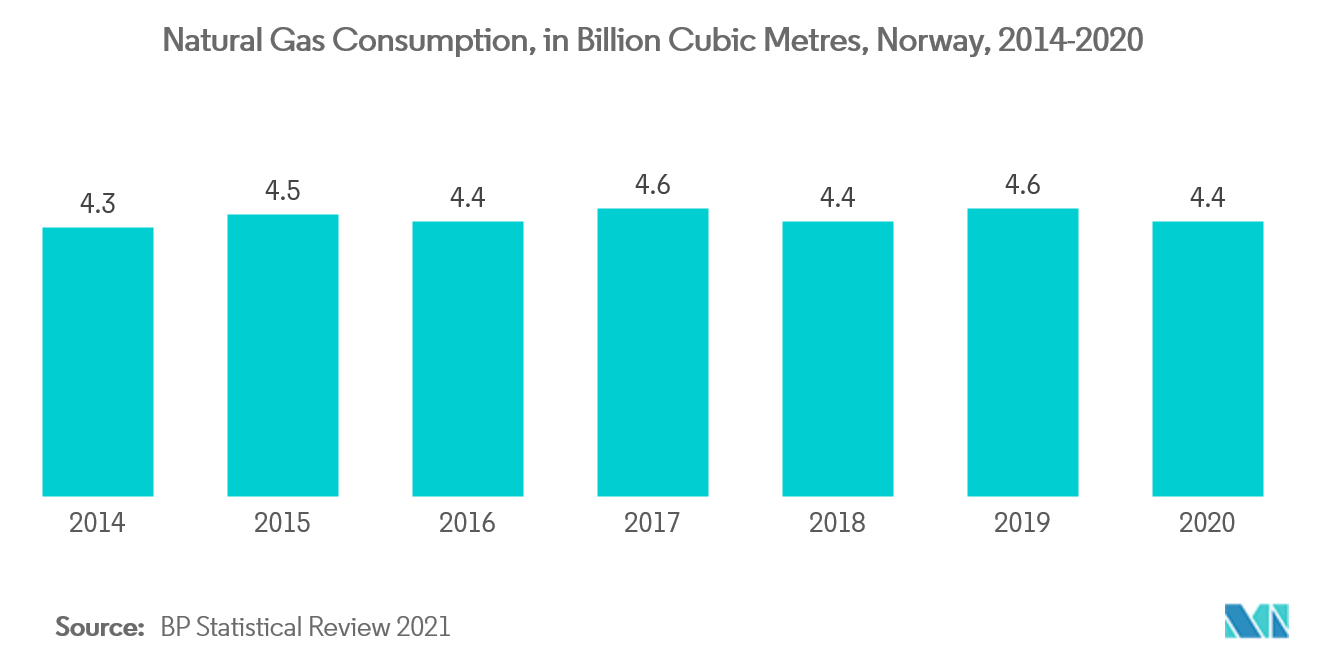
- In 2021, natural gas demand was expected to recover to its pre-crisis levels and increase slightly during the forecast period. In 2020, the consumption of natural gas in the country was around 4.4 billion cubic meters (bcm), which decreased primarily due to COVID-19 from around 4.6 bcm in 2019, which can be seen in an uptick in the number of distributed licenses.
- For instance, in January 2021, Norwegian Petroleum Directorate announced that the authorities of Norway offered 30 companies with ownership interests in a total of 61 production licenses on the Norwegian Shelf in the Awards in Predefined Areas (APA ) 2020. Out of the 61 new production licenses, 34 were awarded in the North Sea region, which exhibits 18% of undiscovered oil and gas potential in the country.
- Furthermore, in December 2020, Equinor and its license partners agreed to invest around NOK 3 billion in the North Sea Statfjord Øst field to improve recovery by approximately 23 million barrels of oil. The installation of a pipeline for gas lift, modifications on Statfjord C, and drilling of new wells have been planned to start in 2022, while the production is likely to be scheduled for 2024. All through this, well intervention tools are expected to be used.
- In recent years, companies previously involved in the oil and gas activities in the North Sea have become more focused on reducing greenhouse gas emissions from the industry. Norway is seriously targeting to achieve the short-term goals set by European Union for 2030, which are significant steps in achieving zero carbon emissions by 2050. Overall, this factor led to the creation of more carbon-neutral models with companies using various upstream technologies to reduce greenhouse gas emissions.
- Hence, Norway is expected to grow significantly in the market due to its increasing exploration activities and the demand from countries in Europe for reliable natural gas due to sanctions on Russia.
Regulatory Landscape
In Europe, offshore well intervention is framed by Directive 2013/30/EU on the safety of offshore oil and gas operations. The directive requires operators to submit major hazard and well-related documentation to a competent authority before commencing offshore well operations, and to implement an independent verification scheme for safety-critical elements such as well design and well control. These requirements shape intervention planning, barrier management, and documentation for well integrity work across the North Sea and other offshore provinces.
Environmental compliance is also tightening around emissions and discharges. Regulation (EU) 2024/1787 on methane emissions introduces obligations to identify, map, and mitigate methane emissions, including from closed and abandoned oil and gas wells, and it restricts venting and routine flaring. This increases the compliance workload that often links to well integrity checks and remediation interventions. For offshore chemical use, the OSPAR Commission framework (including HOCNF requirements and Decision 2023/02 amending the offshore chemicals decision) reinforces pre-screening, substitution expectations for hazardous substances, and stronger data requirements from chemical suppliers before discharge, which in turn influences the fluid selection and treatment programs used during intervention campaigns.
Value Chain Analysis
The Europe well intervention value chain begins with upstream operators defining well integrity and production enhancement scope, typically for mature assets in the North Sea. This is followed by service contracting and engineering design, with large oilfield service providers (SLB, Halliburton, Baker Hughes, Weatherford) anchoring integrated delivery across wireline, coiled tubing, pumping, downhole tools, and well control equipment. Regional specialists also support niche needs such as subsea and well access hardware, well engineering, and intervention execution. Contracting structures can include long-term alliances and frame agreements, as well as campaign-based procurement tied to offshore vessel availability and seasonal windows.
Key inputs include high-grade tubing and tool steels, downhole electronics and sensors, and chemical systems that must meet offshore environmental requirements, including OSPAR/HOCNF expectations and wider EU chemical compliance. Execution depends on logistics, offshore vessel and rig slots (including riserless light well intervention vessel capacity), and the availability of certified well control equipment and competent crews. Bottlenecks often come from constrained access to specialized offshore intervention vessels and longer lead times for specific subsea intervention spreads, which can cascade into scheduling conflicts across multi-well campaigns, particularly in Norway and the UK Continental Shelf.
Competitive Landscape
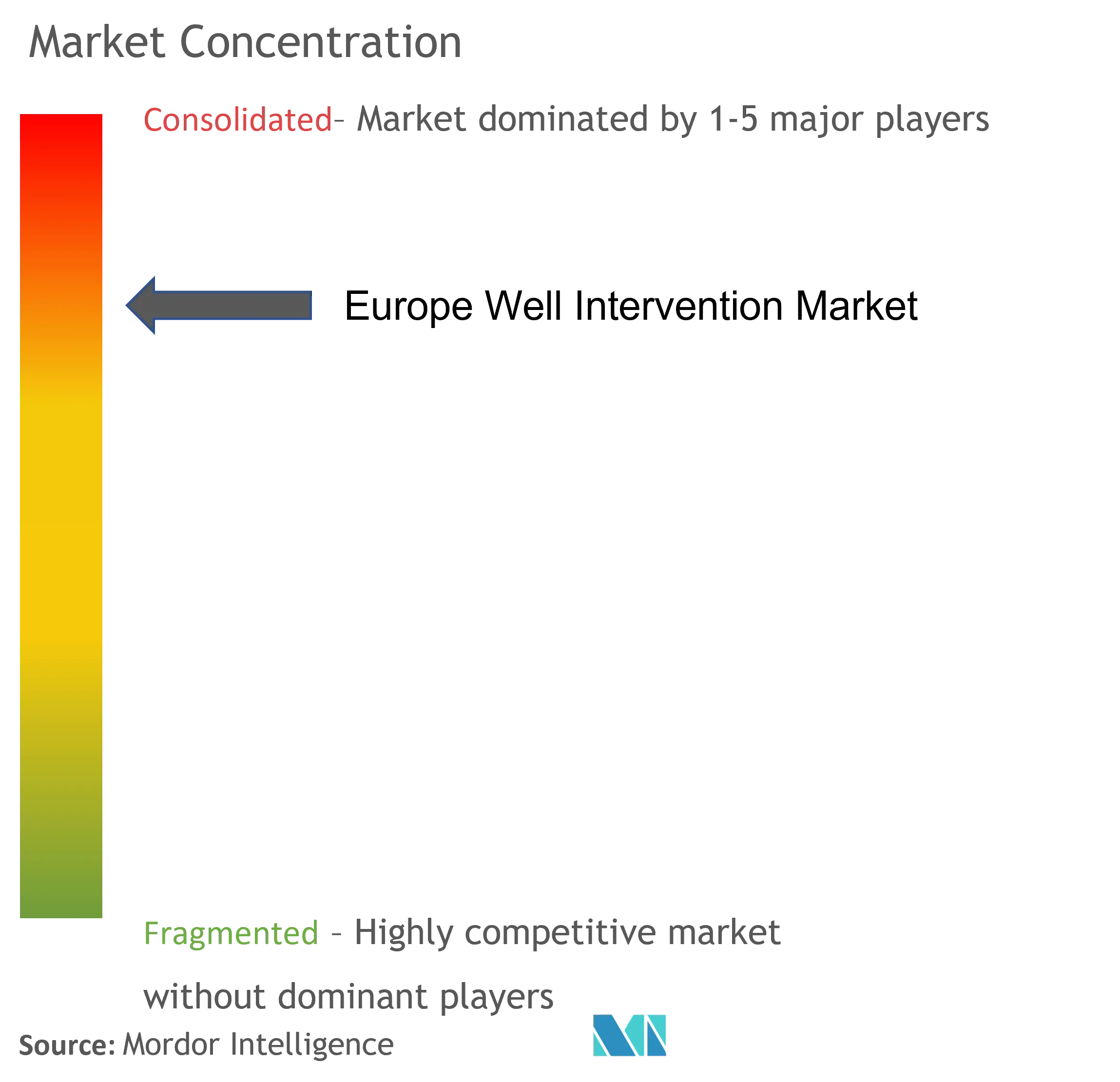
The European well intervention market is moderately consolidated. Some of the key players include Schlumberger Limited, Halliburton Company, China Oilfield Services, Weatherford International PLC, and Baker Hughes Company.
Europe Well Intervention Industry Leaders
-
Schlumberger Limited
-
Halliburton Company
-
China Oilfield Services
-
Baker Hughes Company
-
Weatherford International PLC
- *Disclaimer: Major Players sorted in no particular order
Europe Well Intervention Market Companies Covered in this Report
- Halliburton Company
- Baker Hughes Company
- Schlumberger Limited
- Weatherford International Ltd
- Vallourec SA
- National Oilwell Varco Inc.
- Scientific Drilling International Inc.
- China Oilfield Services Ltd
Market Opportunities and Future Outlook
A material opportunity is emerging around well integrity, remediation, and emissions-focused work scopes as operators respond to the EU Methane Regulation (Regulation (EU) 2024/1787). The regulation places new emphasis on identifying and reducing emissions, including from closed and abandoned wells. As a result, intervention demand is shifting toward diagnostic work, barrier repair, and remediation activities alongside traditional production uplift services, especially in mature basins where legacy well populations and late-life assets are concentrated.
On the offshore technology and execution side, North Sea programs continue to create room for faster, lower-footprint intervention methods and integrated service models. In 2026, Aker BP and DeepOcean reported completing a subsea intervention at Idun Nord (Skarv area) using a control room-based approach that cut operational time from two weeks to 12 hours. This example supports the commercial pull for remote-enabled workflows. New well access hardware is also targeting efficiency in subsea access, with Expro launching the Solus single shear and seal ball valve system for subsea well access in 2026, designed to replace conventional dual-valve requirements for certain use cases. Operator sourcing in Norway supports multi-service delivery, illustrated by Equinor extending multi-year arrangements for integrated drilling, well services, and wireline intervention with Baker Hughes in 2026, which reinforces demand for bundled capabilities covering intervention planning, execution, and supporting well services.
Recent Industry Developments in Europe Well Intervention Market
- May 2026: Baker Hughes announced the extension of two multi-year contracts with Equinor to deliver integrated drilling and well services and wireline intervention for North Sea assets. The extensions reinforce demand for integrated workflows and technology-enabled well services on the Norwegian Continental Shelf, supporting sustained intervention activity tied to mature field operations.
- June 2025: Halliburton received a five-year contract from Repsol Resources UK to provide rigless intervention as well as drilling and completion services for UK North Sea platform assets. The award consolidates a multi-year service scope under a single provider, aligning intervention delivery with broader well lifecycle work on brownfield infrastructure.
- January 2024: The European Union offshore safety framework under Directive 2013/30/EU continued to underpin permitting and well control expectations for offshore well operations, including intervention planning and independent verification requirements. Operators and service companies maintained compliance focus on documented well integrity management and competent-authority oversight as a prerequisite for offshore execution.
Europe Well Intervention Market Report Scope and Research Methodology
Market Definition and Coverage
For this methodology, the Europe well intervention market covers the revenues generated from services and related job execution used to restore, maintain, or improve oil and gas well performance after drilling, across European onshore and offshore fields.
Scope exclusions: We exclude routine upstream drilling and completion spending that is not tied to an intervention job, as well as downstream refining and retail fuel activities.
Segments Covered in This Report
- Location of Deployment
- Onshore
- Offshore
- Geography
- United Kingdom
- Russia
- Norway
- Rest of Europe
Data Sources, Market Sizing, and Validation
Desk Research
Desk research was used to set the factual base of the model and to keep Europe-specific activity indicators consistent across countries. We referred to public energy and hydrocarbon statistics such as those from Eurostat, national petroleum regulators, and offshore safety authorities, followed by published rig and well activity summaries from industry associations and reputable trade press. Where available, tender notices and contract award announcements were screened because they help clarify which intervention scopes were actually ordered, and in what time window.
To avoid building the market on one data stream, the model also uses annual reports and investor presentations to understand revenue exposure to intervention work, fleet deployment commentary, and recent pricing direction. Patent and standards references were checked at a high level when they signaled meaningful changes in tool adoption or work practices. In addition, we used a paid subscription for company financials and another for shipment-level import and export checks when equipment movements could explain short-term utilization shifts. The desk sources mentioned above are illustrative, and many other public and subscription sources were also reviewed for collection, cross-checking, and clarification.
Primary Interviews and Surveys
Primary work focused on validating the intervention demand pool and the way it converts into billable job revenue by country and by onshore-offshore split. We spoke with a mix of service-side practitioners, asset-side operations and integrity teams, and supporting specialists who track planning cycles, job frequency, and the practical drivers behind deferred or accelerated campaigns. Because this is a Europe-focused market, coverage was balanced across key producing basins and operator types, and assumptions were rechecked when desk signals and field feedback did not align.
Distribution of primary research fieldwork respondents
| Company type | Respondent position |
|---|---|
| Top tier: 28% | CXOs: 15% |
| Mid tier: 50% | Functional/Unit leaders: 30% |
| Smaller Players: 22% | Managers: 55% |
Market-Sizing & Forecasting
Sizing starts from a top-down build where country-level well stock, producing asset mix, and intervention intensity signals are used to reconstruct an annual service spend pool, which is then split into onshore and offshore using reported activity patterns. To keep the estimate grounded, selective bottom-up checks are used in parallel, such as sampled job counts multiplied by typical day rates, plus a sanity review of revenue exposures discussed in public filings.
Inputs that mattered most for Europe included offshore brownfield workload, workover and maintenance cadence on mature wells, the balance of platform-based versus subsea activity, and the direction of service pricing as utilization tightens or loosens. We also treated operator maintenance budgets and regulatory integrity requirements as practical constraints that shape when intervention work is brought forward. For the forecast, scenario analysis is used so the baseline can reflect different paths for European upstream spending, offshore project timelines, and cost inflation, and then the final trajectory is aligned to the consensus ranges shared by interviewed experts. When bottom-up data were thin in smaller countries, gap handling was done through peer-country intensity ratios and then revalidated through channel feedback before totals were finalized.
Data Validation & Update Cycle
Model outputs were checked against independent signals, including upstream capex direction, rig and well activity context, and public commentary on intervention backlogs and vessel or crew utilization where relevant. Any sharp year-to-year moves were reviewed in more detail, and assumptions were revisited if the change could not be explained by a clear activity or pricing driver.
Before sign-off, the work is reviewed in steps, starting with logic checks inside the model, followed by an independent read-through of the key inputs and calculations by another analyst. Reports are refreshed annually, and interim updates are triggered when material events affect European upstream activity or service pricing. Right before delivery, we do a final pass to ensure recent public developments are reflected in the numbers and narrative.
Mordor Intelligence's Europe Well Intervention Market Size Measured Against Other Published Estimates
Published market sizes for Europe well intervention do not always match because teams define the market boundary differently, and they also choose different base years, pricing curves, and country coverage rules. In practice, the biggest swings usually come from how offshore-heavy work is counted, whether adjacent drilling or completion items get mixed in, and how quickly price inflation is applied in the early forecast years.
The table shows a wide spread for the 2024 value, and in Mordor Intelligence's model the total is limited to intervention job revenues across onshore and offshore in Europe, with country roll-ups aligned to the report scope rather than broader oilfield services spend buckets.
Benchmark comparison
| Source | Market Size | Gaps in Research Methodology |
|---|---|---|
| Mordor Intelligence | USD 4.73 B (2024) | |
| Industry Publisher A | USD 7.10 B (2024) | This figure can rise when well intervention is grouped with adjacent production services, and when offshore activity is expanded using optimistic vessel utilization and faster day-rate increases. |
| Syndicated Report B | USD 4.73 B (2024) | The headline year value aligns, but published forecasts can diverge when different assumptions are used for offshore project timing, currency conversion timing, and annual price escalation through 2030. |
Looking across the three figures, most of the difference is explained by scope boundaries and how quickly pricing and offshore workload are scaled into the forecast years. By tying the total to repeatable activity and spend drivers, and then stress-testing it with field feedback, the final estimate stays traceable and easier to reconcile when clients apply it to their own asset plans.
Key Questions Answered in the Report
What is the current Europe Well Intervention Market size?
The Europe Well Intervention Market is projected to register a CAGR of 2.07% during the forecast period (2026-2031)
Who are the key players in Europe Well Intervention Market?
Schlumberger Limited, Halliburton Company, China Oilfield Services, Baker Hughes Company and Weatherford International PLC are the major companies operating in the Europe Well Intervention Market.
What years does this Europe Well Intervention Market cover?
The report covers the Europe Well Intervention Market historical market size for years: 2021, 2022, 2023, 2024 and 2025. The report also forecasts the Europe Well Intervention Market size for years: 2026, 2027, 2028, 2029, 2030 and 2031.