
Market Overview
| Study Period | 2021 - 2031 |
|---|---|
| Forecast Data Period | 2026 - 2031 |
| Base Year Market Size (2025) | 4.29 gigawatt |
| Market Volume (2026) | 4.44 gigawatt |
| Market Volume (2031) | 5.26 gigawatt |
| Growth Rate (2026 - 2031) | 3.45 % |
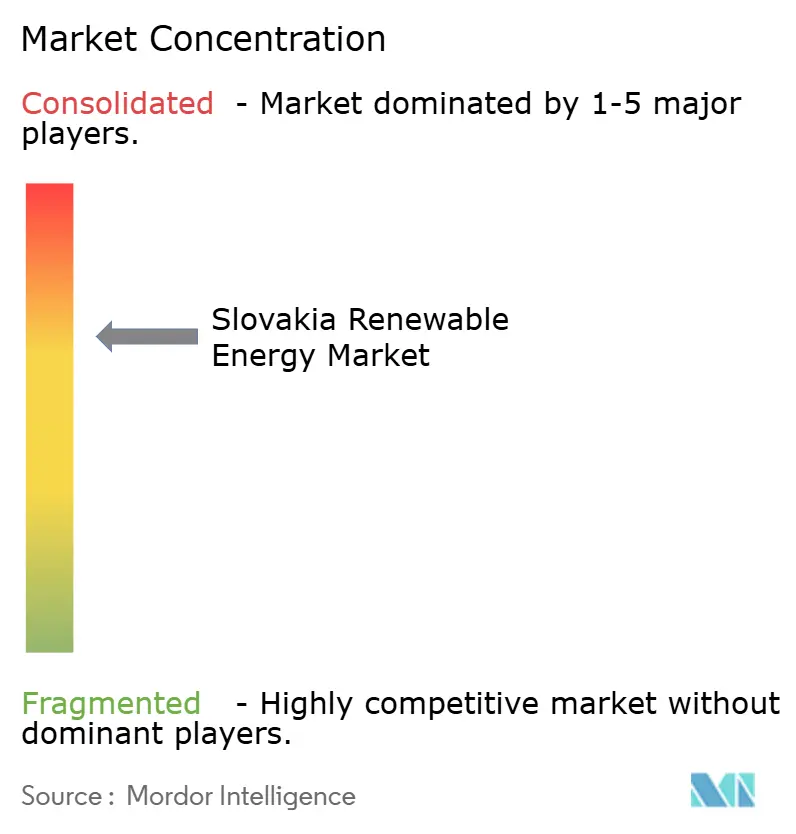
| Market Concentration | Medium |
Major Players
*Disclaimer: Major Players sorted in no particular order Image © Mordor Intelligence. Reuse requires attribution under CC BY 4.0. |
|
Slovakia Renewable Energy Market Analysis by Mordor Intelligence
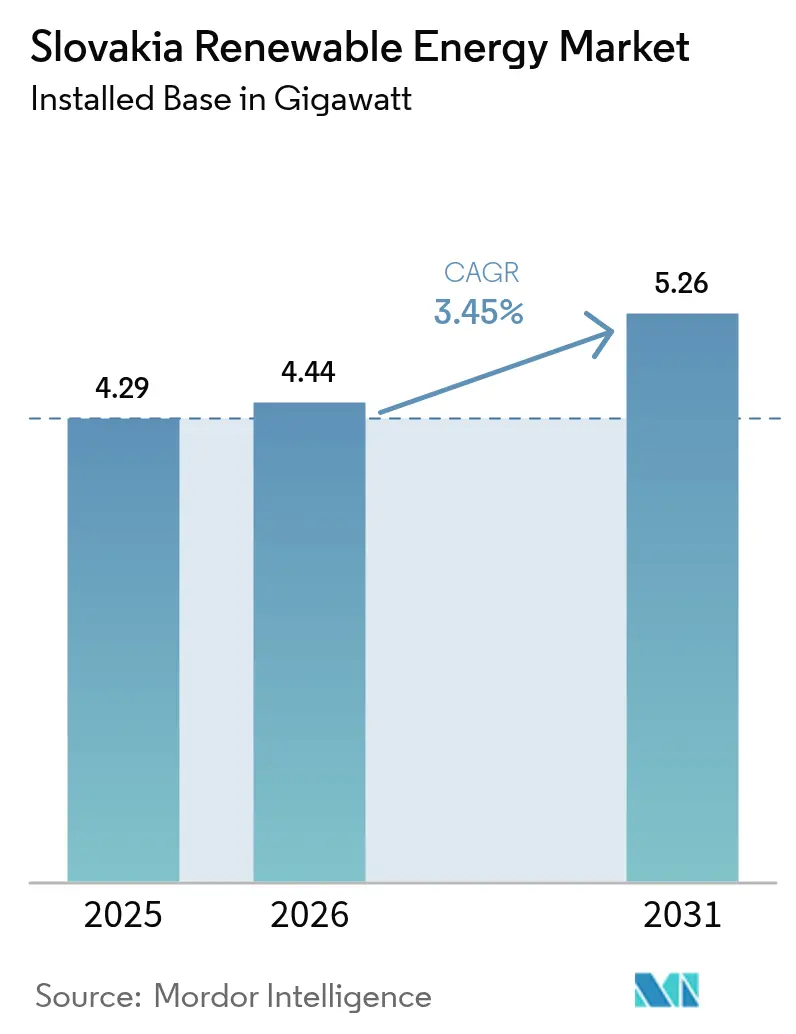
Slovakia Renewable Energy Market size in 2026 is estimated at 4.44 gigawatt, growing from 2025 value of 4.29 gigawatt with 2031 projections showing 5.26 gigawatt, growing at 3.45% CAGR over 2026-2031.
Momentum arises from EU Fit-for-55 and Renewable Energy Directive (RED III) compliance requirements, escalating climate-linked funding streams, and strategic grid reinforcements that ease historical interconnection bottlenecks. The market’s moderate but steady growth also reflects Slovakia’s unique energy architecture in which nuclear plants supply nearly two-thirds of domestic electricity, creating a “nuclear lock-in” that structurally caps the share of intermittent renewables. Hydropower leverages mature infrastructure and topography to preserve its leadership position, while falling solar photovoltaic (PV) levelized cost of electricity (LCOE) ignites a new build cycle and attracts foreign technology partnerships. Corporate power-purchase agreements (PPAs) are accelerating as heavy industry seeks price stability amid carbon-pricing expansion, and recently amended environmental-impact-assessment (EIA) rules shorten permitting pathways, signaling a more supportive regulatory stance.
Key Report Takeaways
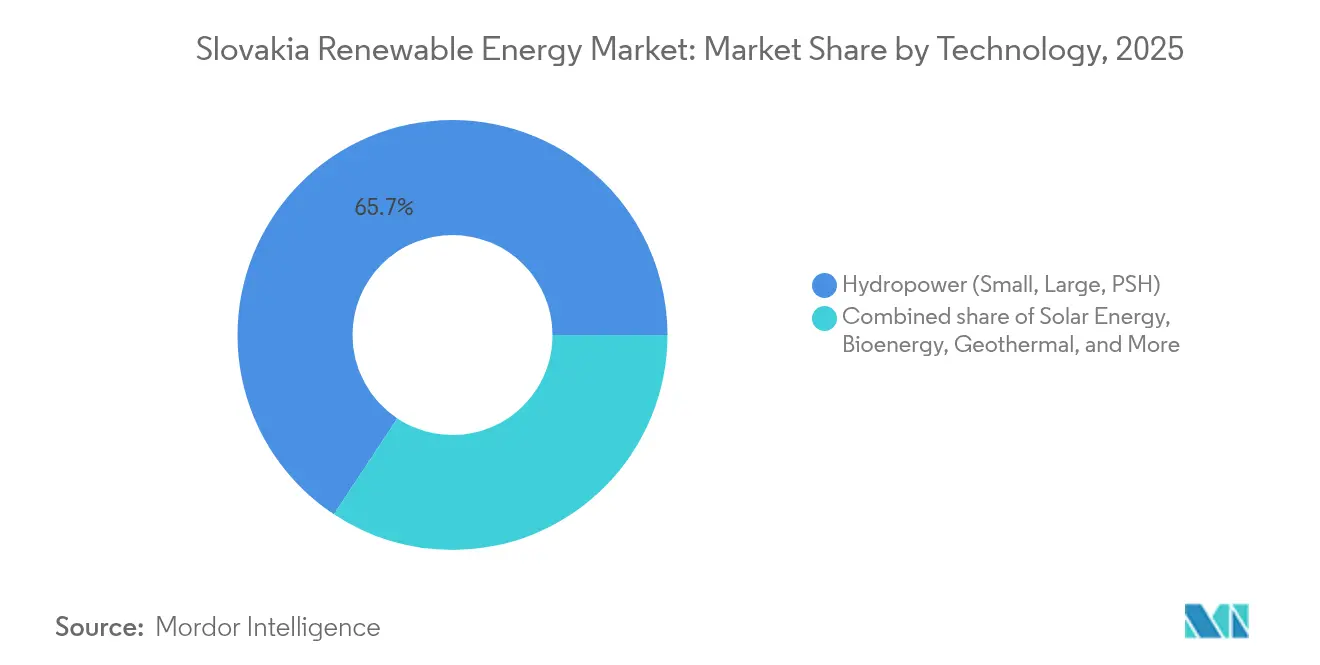
- By technology, hydropower commanded 65.70% of Slovakia's renewable energy market share in 2025, whereas solar energy is forecast to grow at a 8.75% CAGR through 2031.
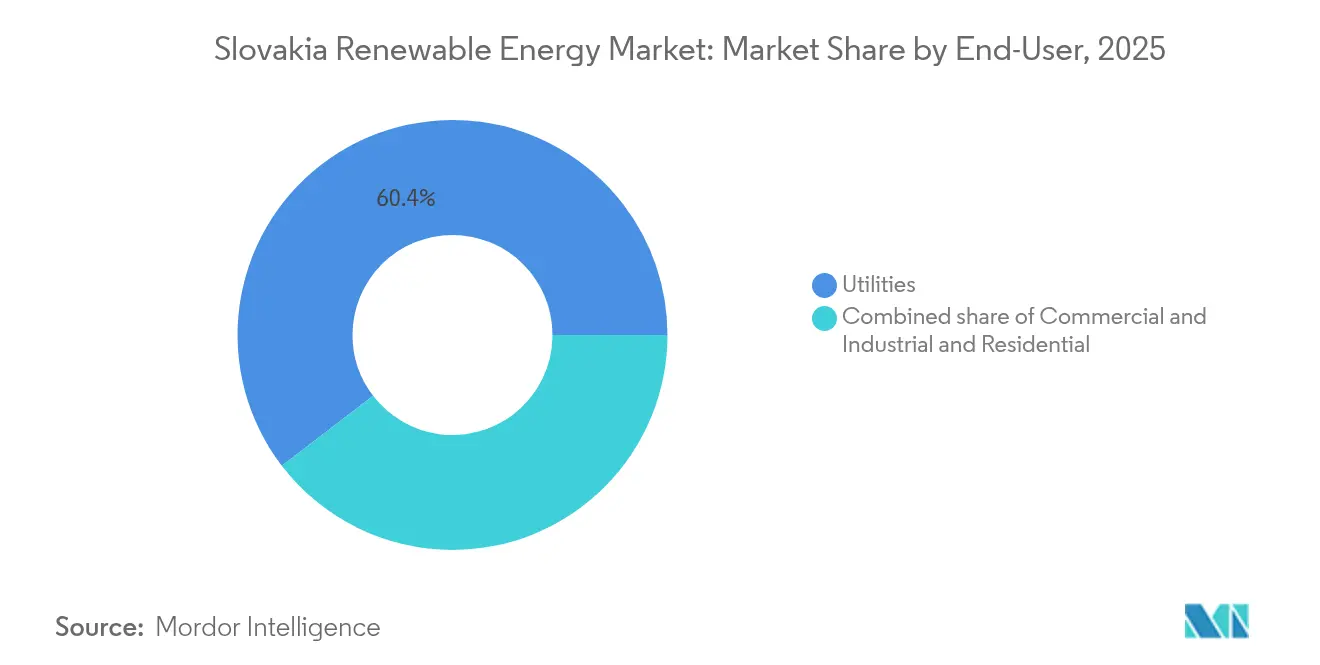
- By end-user, utilities held 60.40% of the Slovakia renewable energy market size in 2025, while commercial and industrial applications are projected to expand at a 7.35% CAGR between 2026 and 2031
- Európska energetická a priemyselná holding-owned Slovenské elektrárne, EPH, and SEPS together controlled about 57.20% of installed capacity in 2025.
Note: Market size and forecast figures in this report are generated using Mordor Intelligence’s proprietary estimation framework, updated with the latest available data and insights as of 2026.
Slovakia Renewable Energy Market Trends and Insights
Drivers Impact Analysis*
| Driver | (~) % Impact on CAGR Forecast | Geographic Relevance | Impact Timeline |
|---|---|---|---|
| EU Fit-for-55 & RED III compliance pressures | +1.2% | EU-wide, concentrated in Slovakia | Medium term (2-4 years) |
| Declining LCOE of solar PV & on-shore wind | +0.8% | Global, with regional Slovak benefits | Short term (≤ 2 years) |
| EU funded grid-interconnection upgrades | +0.6% | Central Eastern Europe, Slovakia focus | Long term (≥ 4 years) |
| Rising corporate PPAs from heavy industry | +0.5% | National, concentrated in industrial regions | Medium term (2-4 years) |
| Pumped-storage upgrades for grid flexibility | +0.3% | National, mountainous regions | Long term (≥ 4 years) |
| Agrivoltaic pilots on land-consolidation farms | +0.2% | Rural Slovakia, pilot regions | Long term (≥ 4 years) |
| Source: Mordor Intelligence | |||
EU Fit-for-55 & RED III Compliance Pressures Drive Accelerated Deployment
Slovakia must raise renewable energy to 23% of final consumption by 2030 under its updated National Energy and Climate Plan, a target that narrowly trails the European Commission’s 24% guidance and the REPowerEU ambition of 42.5%. The looming gap intensifies project pipelines, and infringement proceedings for slow permitting hastened the December 2024 EIA Act overhaul that tightens statutory deadlines and lifts capacity thresholds subject to full assessments. Carbon-pricing expansion via the EU Emissions Trading System (ETS) and scheduled ETS2 launch for buildings and transport in 2027 will push electricity demand higher, spurring renewable additions as clean electrification becomes the least-cost compliance route.[1]OECD Economy Surveys, "Addressing housing market challenges in the Slovak Republic," oecdecoscope.blog Administrative fines up to EUR 1.6 million embed a powerful enforcement mechanism that raises the opportunity cost of non-compliance for developers and utilities, reinforcing momentum across the Slovakia renewable energy market.
Declining LCOE Creates Competitive Advantage for Solar and Wind Technologies
Average utility-scale solar PV costs fell below EUR 40/MWh in 2024, enabling 274 MW of new capacity, triple the yearly average of the prior decade, once the 2021 “stop-status” grid-connection freeze was lifted. Sekisui Chemical’s memorandum with the Economy Ministry to localize lightweight perovskite PV production underscores investor confidence, with ¥10 billion (USD 68 million) earmarked for a pilot plant. Wind development regained traction, evidenced by 942 MW under environmental assessment, though permitting spans multiple agencies, and community opposition persists.[2]Publications Office, “Regulation (EU) 2022/869 on guidelines for trans-European energy infrastructure,” eur-lex.europa.eu As cost parity extends to hybrid projects that blend PV, wind, and storage, developers can arbitrage complementary generation profiles, moderating grid-balancing penalties that have historically dampened intermittent uptake in the Slovakia renewable energy market.
EU-Funded Grid Infrastructure Upgrades Enable Regional Integration
Slovakia’s inclusion in the North–South Interconnection (NSI) East corridor prioritizes a fourth 400 kV CZ–SK interconnector (500 MW) targeted for 2035 commissioning, a direct response to current congestion that limits renewable dispatch. Projects of Common Interest (PCI) status accelerates permitting and unlocks Connecting Europe Facility grants that cover up to 50% of eligible costs. Complementary smart-grid schemes, ACON with the Czech Republic and Danube InGrid with Hungary, modernize distribution automation, raising distributed-generation hosting capacity. National TSO SEPS released 170 MW of additional PV and wind connection rights in 2024, yet still lags the EU-mandated 70% cross-border capacity availability benchmark. Pumped hydro upgrades at Čierny Váh enhance upward and downward regulation reserves, providing the flexibility needed to integrate intermittent additions and sustaining grid stability for the Slovakia renewable energy market.
Corporate Power-Purchase Agreements Emerge from Industrial Energy-Security Concerns
Slovak heavy industry, notably automotive and metal producers, intensified renewable procurement to hedge volatile wholesale prices after the 2022 gas crisis. Utility-scale auctions transitioned from feed-in tariffs to feed-in premiums, aligning remuneration with market signals and creating depth for bilateral PPAs. Cross-border virtual PPAs, such as the agreement between T-Mobile Czech Republic and Slovak Telekom, illustrate how corporates lock in multi-year pricing while sidestepping residual domestic regulatory hurdles. Demand is further fueled by looming Scope 3 supply-chain mandates under the EU’s Corporate Sustainability Reporting Directive, encouraging Tier 1 suppliers to secure traceable clean electricity. Bankability of deals improves as lenders discount counterparty risk tied to carbon exposure, solidifying PPAs as a mainstream offtake route in the Slovak renewable energy market.
Restraints Impact Analysis*
| Restraint | (~) % Impact on CAGR Forecast | Geographic Relevance | Impact Timeline |
|---|---|---|---|
| Grid congestion & limited cross-border capacity | -0.9% | National grid, cross-border points | Medium term (2-4 years) |
| Lengthy multi-agency permitting cycles | -0.7% | National, all project types | Short term (≤ 2 years) |
| Sparse local component supply chain | -0.4% | National, concentrated in western industrial regions | Medium term (2-4 years) |
| Eco-activism opposing small hydro projects | -0.3% | Regional, mountainous areas with sensitive ecosystems | Long term (≥ 4 years) |
| Source: Mordor Intelligence | |||
Grid Congestion Constrains Renewable Integration Despite Infrastructure Investments
A nuclear-heavy generation mix shapes grid-dispatch protocols that favor large, stable output, leaving little residual headroom for intermittent sources at critical nodes. While SEPS has allocated fresh capacity, sections of the 400 kV backbone remain constrained, and the EU-imposed 70% transmission-capacity-allocation rule exposes compliance risks. Interconnection points with the Czech Republic (Lanzhot) and Ukraine (Velké Kapušany) experience seasonal congestion that forces curtailment or redispatch of renewable output, reducing revenue certainty for project sponsors.[3]Taylor Wessing, “Oil & Gas Laws and Regulations in Slovakia 2024,” ceelegalmatters.com Distribution grids, predominantly operated by SPP-Distribúcia, also require substantial reinforcement to accommodate two-way power flows from rooftop PV and community projects. Unless grid digitalization and capacity upgrades keep pace, the Slovakia renewable energy market will face diminished growth prospects relative to its policy potential.
Multi-Agency Permitting Cycles Create Development Timeline Uncertainty
Renewable projects navigate approvals across 72 district offices with overlapping jurisdiction, often duplicating document requests and prolonging decision cycles past 30 months.[4]Marián Bošanský and Marek Mariak, “Environment & Climate Change Laws and Regulations Slovakia 2025,” iclg.com The December 2024 EIA Act amendment raises screening thresholds and imposes time-bound consultation windows, but practical implementation remains untested. Some sectoral laws restrict administrative appeals, funneling grievances directly to courts, which can add 6-12 months before a final investment decision. Non-transferability of certain licenses complicates project-financing structures that rely on special-purpose vehicles, and shifting municipal zoning plans introduces further unpredictability. These frictions elevate financing costs and compress the viable pipeline, tempering the otherwise positive trajectory of the Slovak renewable energy market.
*Our forecasts treat driver/restraint impacts as directional, not additive. The impact forecasts reflect baseline growth, mix effects, and variable interactions.
Segment Analysis
By Technology: Hydropower Leadership and Solar Acceleration Reshape the Mix
Hydropower represented 65.70% of the renewable capacity within the Slovakia renewable energy market share in 2025, capitalizing on established dams along the Váh and Danube rivers. The segment benefits from predictable runoff patterns and existing pumped-storage capability that also supplies ancillary services. However, incremental expansion is largely limited to efficiency uprates and small-hydro refurbishments. Solar energy, while starting from a lower base, posted the highest growth, with utility-scale additions driving a projected 8.75% CAGR to 2031. This acceleration positions PV to chip away at hydropower’s dominance and raise the Slovakia renewable energy market by more than 0.58 GW over six years.
The wind segment has only 3 MW installed but boasts a 942 MW pipeline under assessment, indicating pent-up potential should permitting hurdles ease. Bioenergy advances through biomethane retrofits of legacy agricultural digesters, illustrated by EnviTec’s Bierovce and Ožďany plants that deliver grid-quality gas. Geothermal emerges as an untapped resource, with Košice’s EUR 56.2 million project on track for 30 MWt by 2028, aided by Just Transition funding. Marine renewables are excluded from domestic build-out owing to Slovakia’s landlocked geography, yet local firms participate in EU ocean-energy supply chains through Horizon programs, diversifying revenue streams without affecting domestic generation totals.



By End-User: Utilities Retain Scale Advantage While Industrial Offtake Gains Traction
Utilities accounted for 60.40% of the Slovakia renewable energy market size in 2025, anchored by Slovenské elektrárne’s fleet and the territorial distribution monopolies of ZSE, SSE, and VSE. Their grid access, balance-sheet strength, and obligation to serve create a natural advantage in tender participation and project financing. Nonetheless, the commercial and industrial (C&I) segment is projected to clock a 7.35% CAGR, propelled by decarbonization mandates cascading through automotive, steel, and electronics supply chains.
Residential adoption lags due to electricity retail tariffs that remain 3.5 times higher than gas on an energy-equivalent basis, dampening heat-pump economics despite generous Green Households vouchers. Recovery and Resilience Plan grants earmark EUR 528 million to retrofit 30,000 homes, potentially nudging rooftop PV and heat-pump uptake. Meanwhile, virtual PPAs enable multinational telecom and technology firms to procure renewable electricity across borders, demonstrating new pathways for demand aggregation beyond traditional utility structures, and intensifying competition within the Slovakia renewable energy market.
Geography Analysis
Slovakia’s central European location positions it as a transit hub in the continental grid, yet its own renewable integration is hampered by the nuclear-weighted baseload that occupies transmission headroom. Western regions, home to automotive clusters around Bratislava and Trnava, drive C&I renewable demand through corporate decarbonization targets, while hosting rooftop PV growth supported by mature distribution grids. Hydropower assets cluster along rivers traversing mountainous northern and central zones, where topographical features enable both run-of-river and pumped-storage installations, stabilizing frequency and voltage across the Slovakia renewable energy market.
Eastern districts benefit from EU Just Transition funds earmarked for coal-phase-out and industrial diversification, as exemplified by the Košice geothermal concession that leverages deep hydrothermal reservoirs to supply district heating. Rural southern counties exhibit high solar insolation and expansive agricultural land suitable for agrivoltaics, aligning with pilot programs that co-locate PV with crop production. Cross-border interconnectors with Austria, Hungary, Poland, and the Czech Republic deliver both export and import flexibility, but also expose domestic renewables to curtailment when congestion protocols prioritize nuclear dispatch.
National participation in the Hydrogen Interconnection (HI) East corridor will unlock low-carbon-hydrogen trade routes post-2030, complementing renewable electricity with green molecules for hard-to-abate sectors. Landlocked geography precludes coastal resource exploitation, but Slovak engineering firms contribute components to tidal- and wave-energy demonstrators in other EU states, capturing ancillary value while maintaining focus on domestic renewable generation assets. As regional grid codes converge under the European Network of Transmission System Operators for Electricity, Slovak grid operators must harmonize balancing-reserve requirements, thereby elevating the technical sophistication of the Slovak renewable energy market.
Regulatory Landscape
Slovakia's renewable energy regulation is shaped by the national energy policy set by the Ministry of Economy of the Slovak Republic, alongside tariff and network oversight administered by the Regulatory Office for Network Industries (RONI) under Act No. 250/2012 Coll. A key update is Act No. 259/2025 Coll. (approved September 2025), which amends the Energy Act, the Renewables Act (Act No. 309/2009 Coll.), and the Regulation Act, with provisions taking effect from 1 January 2026 and additional phased effectiveness from 1 September 2026.
The 2026 changes broaden the framework for electricity sharing and energy communities, introduce elements linked to hydrogen economy certification, and strengthen RONI's powers, while also driving grid-capacity optimization through more flexible connection arrangements for renewables. On the support and pricing side, RONI continues to issue price decisions for renewable electricity (for example, decision 0028/2025/E-OZ), which set feed-in premium parameters and corrections and support a more market-linked remuneration approach for new projects.
Value Chain Analysis
Slovakia's renewable value chain begins with project origination and permitting, including site control, environmental screening/EIA, grid-connection applications, and municipal approvals. It moves into engineering, procurement, and construction, and then long-term operations that rely on balancing and offtake arrangements, including corporate PPAs.
Generation is still anchored by incumbent producers such as Slovenské elektrárne. Hydropower and pumped-storage assets managed by state-linked operators, including Vodohospodarska vystavba, provide flexibility services that support intermittent solar growth. Midstream bottlenecks are shaped by regulated networks, with transmission run by SEPS and distribution and retail supply dominated by the regional incumbents (ZSE, SSE, VSE) and their successor operating structures, which influence connection timing, curtailment risk, and hosting-capacity upgrades. Limited local component manufacturing and the pace of grid reinforcement also increase reliance on imported PV modules, inverters, and storage systems, and the post-end-2025 shift toward flexible connection contracts and evolving renewable-support eligibility conditions pushes developers toward stronger grid studies, storage pairing, and more market-based offtake structures.
Competitive Landscape
Market structure remains moderately concentrated: Slovenské elektrárne provides 71% of national electricity, largely from nuclear, whereas hydropower, biomass, and emerging solar capacity diversify generation but do not yet disrupt incumbent dominance. Regional distributors ZSE (E.ON-controlled), SSE, and VSE retain exclusive service areas, influencing connection timelines and tariff structures that shape renewable project economics. Foreign technology partnerships increasingly define competitive differentiation, illustrated by Sekisui Chemical’s perovskite PV venture and InoBat’s battery alliance with Gotion Hi-Tech, which together localize high-value manufacturing capability.
Niche innovators broaden the landscape: Solargis supplies granular irradiation data that optimizes PV siting, while GA Drilling’s geothermal tools target hard-rock reservoirs, reducing drilling cost curves. EU Important Projects of Common European Interest (IPCEI) grants reduce capital-expenditure hurdles for first-of-a-kind facilities, enabling domestic firms to scale alongside incumbents rather than confront insurmountable entry barriers. Corporate PPAs shift bargaining power toward large industrial offtakers, encouraging international utilities and traders to enter Slovakia’s market to aggregate demand and backstop supply.
Grid-modernization contracts open new revenue streams for digital-solution providers, as SEPS and distribution operators deploy advanced metering and automated switchgear to comply with EU cybersecurity and interoperability rules. Although incumbents maintain strategic advantages in legacy assets and customer bases, technological convergence, capital inflows, and evolving policy frameworks signal a gradual transition toward a more pluralistic and competitive Slovak renewable energy market.
Slovakia Renewable Energy Industry Leaders
-
Slovenské elektrárne, A.S.
-
Axpo Holding AG
-
ČEZ Slovensko s.r.o.
-
Západoslovenská energetika (ZSE/E.ON)
-
GreenWay Infrastructure s.r.o.
- *Disclaimer: Major Players sorted in no particular order

Market Opportunities and Future Outlook
System flexibility and network modernization are key areas of whitespace as intermittent solar additions face constrained grid hosting capacity. This increases demand for battery energy storage systems (BESS), hybridization, and grid-automation solutions.
The opportunity is supported by announced financing and programs, including the European Investment Bank's EUR 350 million loan (announced December 2025) backing ZSE's multiyear distribution-network modernization to facilitate renewable integration, and the European Commission's February 2026 CEF grant of EUR 62.63 million for Slovenske elektrarne's SE Integrator upgrade at Cierny Vah, which combines pumped storage with an 80 MW/160 MWh battery. Large-scale storage and flexibility also point to a pipeline for long-duration assets and related EPC and equipment supply, reinforced by the government's February 2026 designation of the Malinec-Latky pumped-storage project as an investment of significant importance (planned 1,200 MW to 2,400 MW). On the demand side, opportunities focus on corporate procurement and cross-border structuring (virtual PPAs) as industrial buyers seek traceable clean electricity for EU compliance reporting. The updated NECP submitted in April 2025 raises the 2030 renewable-energy share target to 25% of final energy consumption, which sustains policy pull for new build and repowering where permitting and connections clear.
Recent Industry Developments
- February 2026: The European Commission approved a EUR 62.63 million Connecting Europe Facility grant for Slovenske elektrarne's SE Integrator project to upgrade the Cierny Vah pumped-storage plant into a hybrid asset with an 80 MW/160 MWh battery. The project strengthens fast-response flexibility on Slovakia's system and provides a template for pairing storage with legacy hydro to manage solar-driven variability.
- December 2025: The European Investment Bank approved a EUR 350 million loan to support ZSE's multiyear program to modernize and reinforce electricity distribution networks in Slovakia. The funding targets network capacity and resiliency upgrades that directly affect renewable interconnection timelines and the hosting capacity for distributed solar.
- July 2025: ZSE Energia, a.s. and Vychodoslovenska energetika a.s. completed a merger to operate under Energetika Slovensko, a.s., while continuing to use the ZSE and VSE brands. Consolidation at the supply and distribution-interface level streamlines customer-facing operations and can influence how corporate renewable offerings and grid-connection processes are standardized across regions.


Research Methodology Framework and Report Scope
Market Definition and Coverage
For this methodology, the Slovakia renewable energy market is defined as installed renewable power capacity connected to the country's grid, tracked in gigawatts across the main renewable technologies and end users.
Scope exclusions: We exclude renewable energy revenues, electricity prices, and cross-border renewable certificate trading because these are value measures and do not represent installed capacity.
Segmentation Overview
-
By Technology
- Solar Energy (PV and CSP)
- Wind Energy (Onshore and Offshore)
- Hydropower (Small, Large, PSH)
- Bioenergy
- Geothermal
- Ocean Energy (Tidal and Wave)
-
By End-User
- Utilities
- Commercial and Industrial
- Residential
Data Sources, Market Sizing, and Validation
Desk Research
Desk research started by pulling Slovakia's official energy and electricity statistics, then aligning those series with internationally comparable definitions. Sources such as the International Energy Agency, Eurostat, the European Commission energy datasets, and IRENA were used to review historical renewable capacity additions and the direction of policy targets.
To keep the model grounded in what is actually buildable, we also reviewed national grid operator and regulator publications for connection rules and reporting series. After that, we checked association websites and reputable press for project announcements and commissioning timelines. Company filings and investor presentations were used to sanity check capacity references for major asset owners and developers, and a paid subscription for company financials and news helped confirm ownership changes and commissioning dates when public reporting was unclear. These desk research sources are illustrative only, and many other public references were also used for data collection, validation, and clarification.
Primary Interviews and Surveys
Interviews and surveys with renewable project developers, utilities, equipment distributors, grid specialists, and commercial and residential energy decision-makers in Slovakia help clarify commissioning dates, project pipelines, capacity additions, utilization expectations, and pricing assumptions. Respondents also identify gaps in secondary records, which are used to adjust and recheck the market estimates.
Distribution of primary research fieldwork respondents
| Company type | Respondent position |
|---|---|
| Top tier: 30% | CXOs: 15% |
| Mid tier: 50% | Functional/Unit leaders: 30% |
| Smaller Players: 20% | Managers: 55% |
Market-Sizing & Forecasting
Our core sizing uses a top-down reconstruction of installed renewable capacity by technology, where national and EU capacity series are converted into a consistent GW dataset and then adjusted for commissioning lags and retirements. After that, we apply selective bottom-up checks, such as rolling up a sample of announced projects into expected COD calendars and comparing implied additions against the official time series.
Inputs were selected to match how Slovakia's renewable buildout moves in practice. Key variables include annual capacity additions by technology, expected retirement and repowering schedules, grid connection availability, permitting throughput, and the relative pace of utility-scale versus distributed installations. Because hydropower tends to be stable and solar and wind are more sensitive to approvals and grid, these technology-specific fingerprints help keep the forecast realistic rather than purely trend driven.
Forecasting was done using scenario analysis, with a central case guided by expert consensus, then upside and downside cases reflecting faster or slower permitting and interconnection outcomes. Where bottom-up project visibility was incomplete, we handled gaps by applying conservative completion ratios to the pipeline and then rebalancing totals back to observed historical build patterns.
Data Validation & Update Cycle
Validation is done in steps so unusual jumps are caught early. Model outputs are compared with independent signals like official capacity totals, technology-specific additions, and policy-driven target ranges, and then any variance is reviewed and explained before results are finalized.
If an assumption creates an outlier, we re-check the source series, revisit the conversion logic, and then re-contact primary respondents when the issue looks structural rather than a one-off data artifact. Reports are refreshed annually, and interim updates are triggered when material events happen, such as major policy changes, grid rule revisions, or large project commissioning shifts. Before delivery, a final analyst pass is completed so the client receives the latest updated view.
Mordor Intelligence's Slovakia Renewable Energy Market Sizing Compared With Other Published Estimates
Published market sizes for Slovakia renewable energy do not always line up because firms are not measuring the same thing, even when the title looks identical. Differences usually come from the chosen unit (capacity versus revenue), which technologies are counted, and the time period and currency handling behind the final figure.
Some external publications roll the market up as a revenue pool that blends electricity sales, investment flows, and sometimes even heating fuels into one USD number. Mordor Intelligence counts installed renewable power capacity in Slovakia in GW and keeps the total tied to commissioned assets, which also avoids price-driven inflation that can distort comparisons.
Benchmark comparison
| Source | Market Size | Gaps in Research Methodology |
|---|---|---|
| Mordor Intelligence | USD 4.44 B (2026) | |
| Global Consultancy A | USD 2.94 B (2026) | Uses a revenue-based definition that can include energy sales and related spending, so the market total moves with power prices and accounting scope rather than installed capacity. |
| Industry Publisher B | USD 2.50 B (2023) | Reports value in USD for an earlier base year, and the figure is sensitive to assumed price escalation and what parts of the renewable value chain are included. |
The table shows that the spread is mostly explained by unit choice and what is being counted, not just different math. By keeping the market tied to installed capacity and validating additions through official series plus primary timing checks, the resulting estimate stays traceable to clear buildout drivers and repeatable steps over time.


Key Questions Answered in the Report
How large is the Slovakia renewable energy market in 2026?
Installed renewable capacity reached 4.44 GW in 2026, led by hydropower’s 65.70% share.
What CAGR is expected for Slovak renewables through 2031?
Aggregate capacity is projected to grow at a 3.45% CAGR, hitting 5.26 GW by 2031.
Which segment grows fastest within Slovak renewables?
Solar PV is forecast to expand at a 8.75% CAGR thanks to falling costs and improved permitting.
Why are corporate PPAs gaining traction in Slovakia?
Heavy industry seeks long-term price stability and carbon-compliance benefits amid EU ETS expansion.
What limits large-scale wind deployment in Slovakia?
Lengthy multi-agency permitting and public opposition constrain the 942 MW project pipeline.
How will grid upgrades influence renewable growth?
New interconnectors and smart-grid projects add capacity headroom, enabling more solar and wind integration.
Page last updated on:





