
Market Overview
| Study Period | 2021 - 2031 |
|---|---|
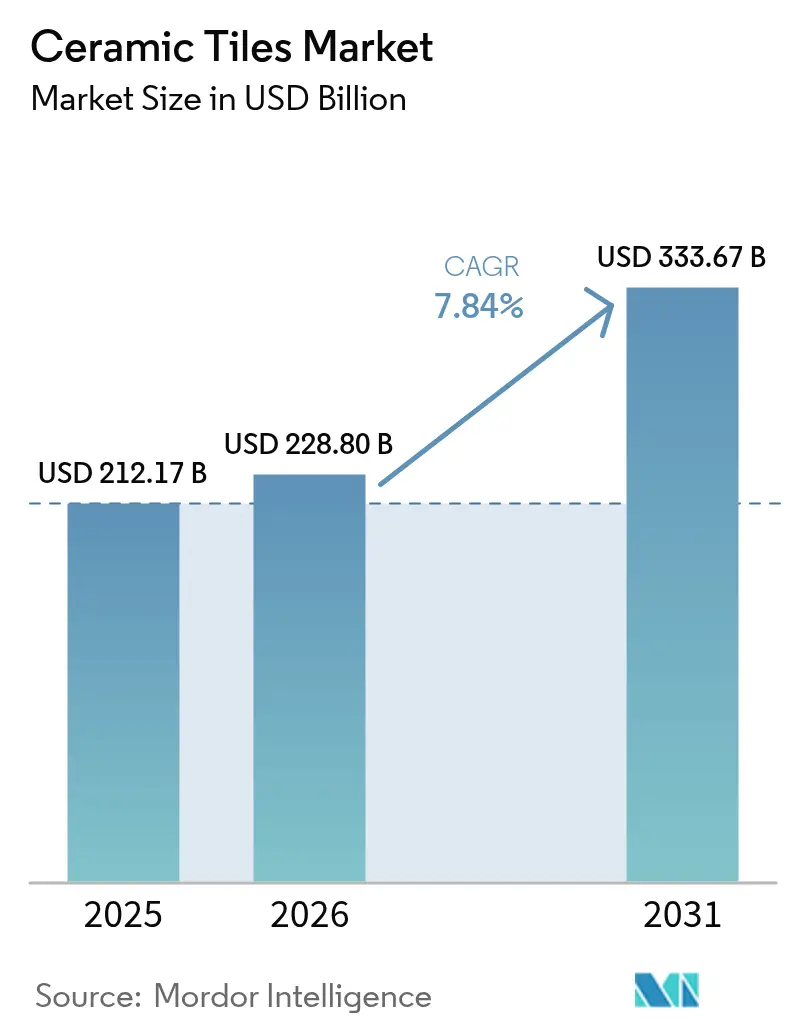
| Market Size (2026) | USD 228.80 Billion |
| Market Size (2031) | USD 333.67 Billion |
| Growth Rate (2026 - 2031) | 7.84 % |
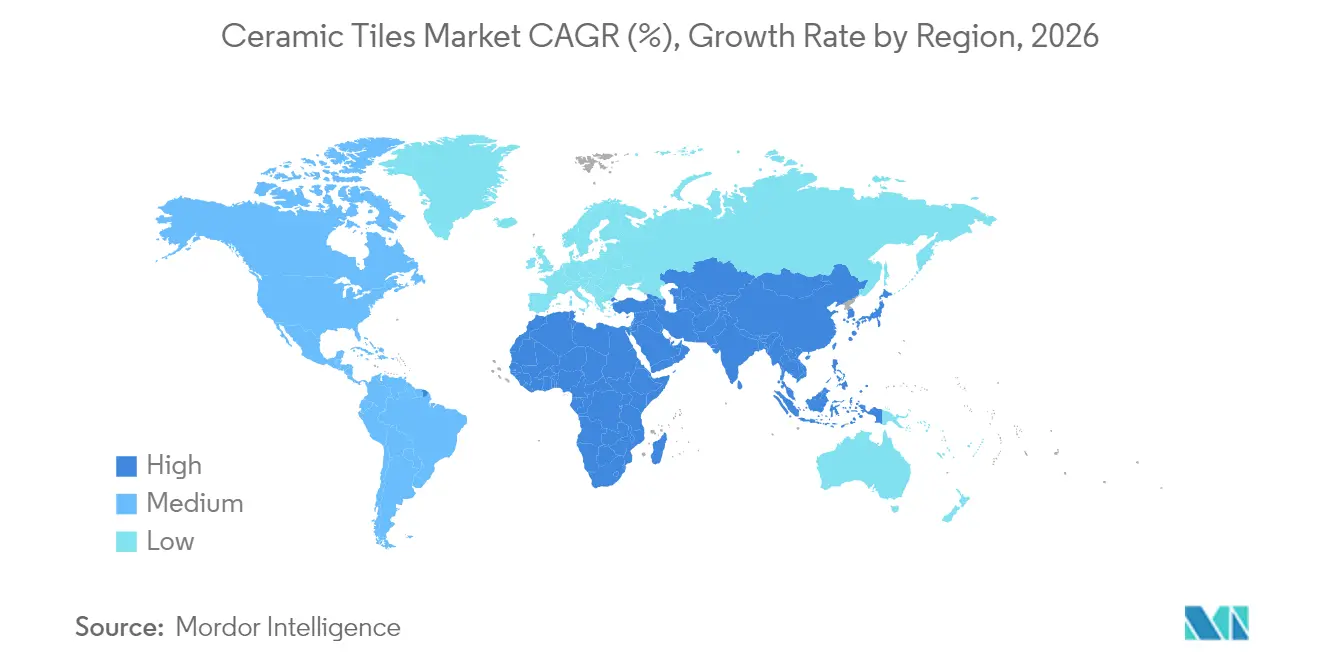
| Fastest Growing Market | Asia Pacific |
| Largest Market | Asia Pacific |
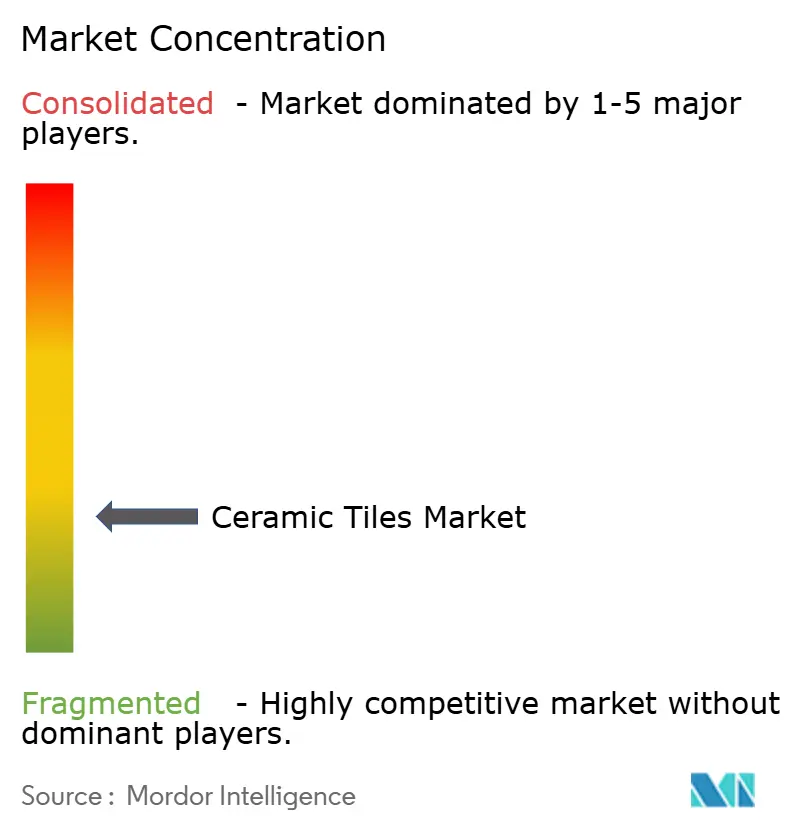
| Market Concentration | Low |
Major Players *Disclaimer: Major Players sorted in no particular order Image © Mordor Intelligence. Reuse requires attribution under CC BY 4.0. | |
Ceramic Tiles Market Analysis by Mordor Intelligence
The ceramic tiles market size in 2026 is estimated at USD 228.8 billion, growing from 2025 value of USD 212.17 billion with 2031 projections showing USD 333.67 billion, growing at 7.84% CAGR over 2026-2031. Steady public-sector infrastructure outlays, rapid urban migration in Asia-Pacific, and consumers’ preference for durable, easy-to-clean surfaces anchor this expansion. New government spending packages in the United States and ongoing metro, airport, and smart-city developments in India and Southeast Asia are enlarging the addressable base for flooring and cladding products. Demand also benefits from technology that prints hyper-realistic stone, wood, and metallic effects on porcelain bodies, enabling premiumization without the price volatility of natural materials. Environmental regulations in Europe accelerate the rollout of low-carbon kilns and waste-based raw mixes, while online retail channels broaden product availability and price transparency worldwide.
Key Report Takeaways
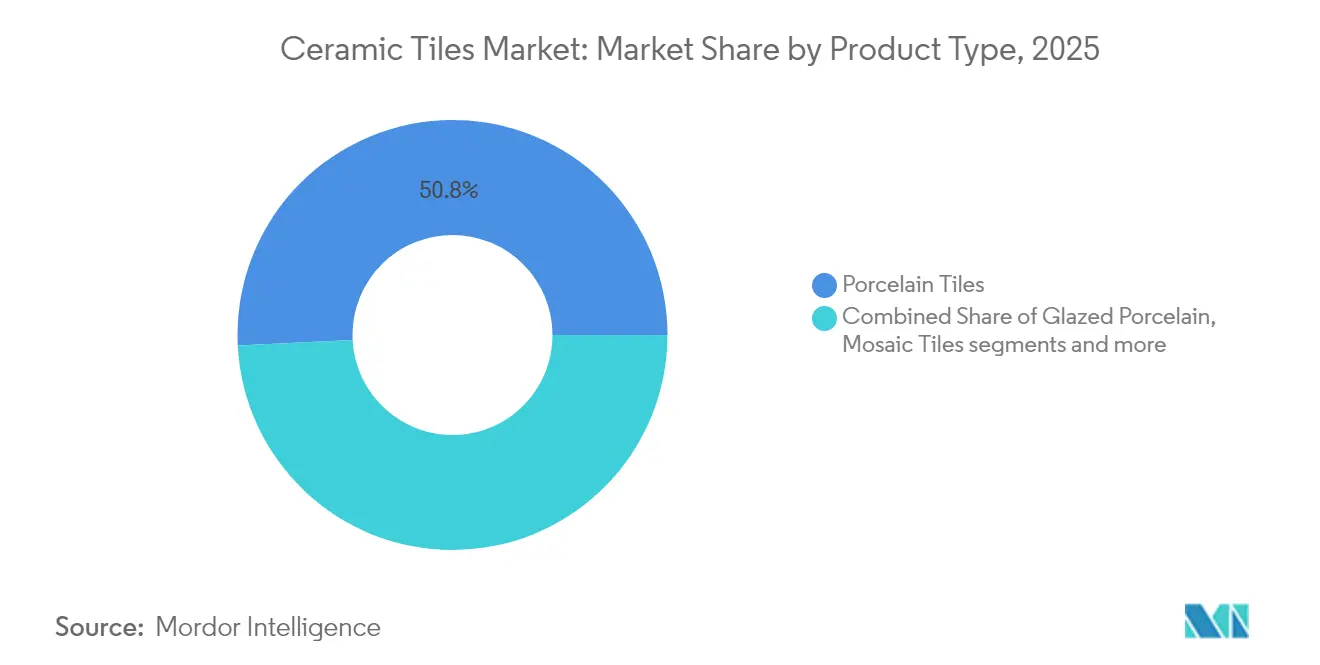
- By product type, porcelain tiles led with 50.78% of the ceramic tiles market share in 2025; glazed porcelain is forecast to post the fastest 8.42% CAGR through 2031.
- By application, floor tiles accounted for 48.22% of the ceramic tiles market size in 2025, while wall tiles are advancing at the highest 8.16% CAGR to 2031.
- By end-user, the residential segment held 54.62% revenue share in 2025; the commercial segment records the swiftest 7.76% CAGR through 2031.
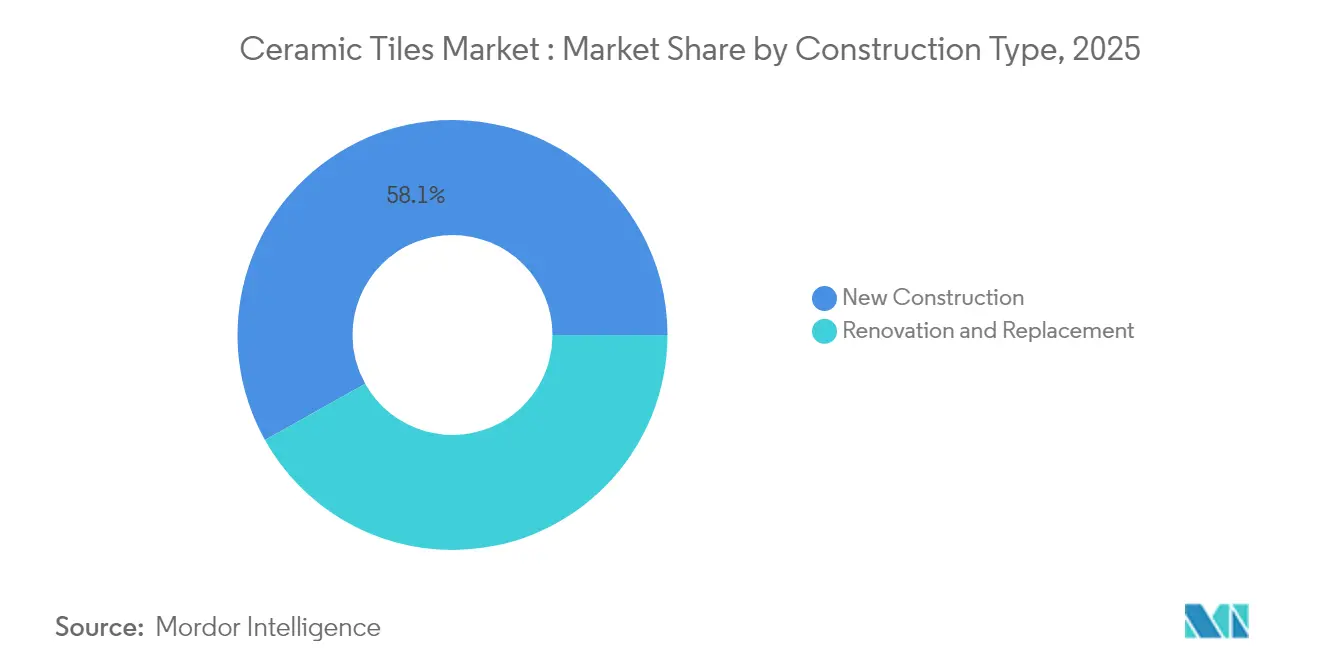
- By construction type, new construction captured 58.12% of the ceramic tiles market size in 2025, yet renovation and replacement are expanding faster at 7.52% CAGR.
- By distribution channel, independent retailers and home centers commanded a 41.75% share in 2025; online retail is growing at a 10.31% CAGR.
- By geography, Asia-Pacific dominated with 47.12% market share in 2025 and also posts the strongest 8.33% CAGR through 2031.
- The ceramic tiles market is moderately fragmented. The five largest players, Mohawk Industries, Grupo Lamosa, SCG Ceramics, Kajaria Ceramics, and RAK Ceramics, collectively hold major market share in 2024.
Note: Market size and forecast figures in this report are generated using Mordor Intelligence’s proprietary estimation framework, updated with the latest available data and insights as of 2026.
Market Trends and Insights
Drivers Impact Analysis of Ceramic Tiles Market*
| Driver | (~) % Impact on CAGR Forecast | Geographic Relevance | Impact Timeline |
|---|---|---|---|
| Growing Construction and Infrastructure Development | +2.1% | Global, with concentration in Asia-Pacific and North America | Long term (≥ 4 years) |
| Increasing Demand for Aesthetic and Durable Flooring Solutions | +1.8% | Global, particularly Europe and North America premium segments | Medium term (2-4 years) |
| Growing Preference for Eco-Friendly and Sustainable Products | +1.3% | Europe and North America, spreading to Asia-Pacific | Medium term (2-4 years) |
| Advancements in Manufacturing Technology | +1.0% | Global, led by European and Asian manufacturers | Long term (≥ 4 years) |
| Rising Disposable Income and Changing Lifestyle | +0.9% | Asia-Pacific and emerging markets | Medium term (2-4 years) |
| Increasing Ageing Building Infrastructure and Demand for Renovation Activities | +0.7% | North America and Europe, expanding to Asia-Pacific | Short term (≤ 2 years) |
| Source: Mordor Intelligence | |||
Construction and infrastructure expansion
Global capital spending on transport corridors, energy plants, and mixed-use complexes is stimulating large-volume orders for the ceramic tiles market. In the United States, multiyear federal programmed collectively allocate USD 1.2 trillion to roads, bridges, semiconductor fabs, and clean-energy facilities, generating sustained demand for heavy-duty porcelain specified in factories and data centers. China’s Belt and Road Initiative drives tile-intensive rail stations and housing in partner economies, while ASEAN governments raise civil works budgets that favor flooring products with 30-year service lives. Suppliers of aggregates and cement report double-digit revenue growth, signaling robust downstream consumption of ceramic surfacing.
Demand for aesthetic, durable surfaces
Designers increasingly combine visual impact with performance, fuelling the uptake of large-format planks and marble-look slabs. Inkjet printers replicate veining and metallic highlights that rival quarried stone, but at lower weight and in repeatable colourways. Format growth—porcelain boards up to 1.8 m by 3.6 m—reduces grout lines and conveys seamless continuity valued in open-plan offices and luxury residences. Quick-fire glazes cut production cycles, enabling frequent style introductions that mirror fashion trends. The ceramic tiles market also gains share versus hardwood in kitchens and basements where moisture resistance is critical. Architects specify anti-static finishes for electronics assembly floors, widening functional appeal beyond décor.
Preference for eco-friendly products
Circular-economy targets push European producers to reclaim kiln heat, recycle sludge, and replace virgin clay with industrial by-products. Italian plants now recycle up to 100% of unfired scrap and operate high-efficiency burners that cut CO₂ per square meter by one-fifth compared with 2010 levels. Research in Poland proves that incorporating mining waste lowers raw-mix cost by up to 35% while retaining flexural strength above 40 MPa for stoneware bodies. Green certifications increasingly influence retail purchases, especially in Germany and the Nordic region. Government procurement guidelines that favor low-carbon building materials amplify this shift and open export opportunities for compliant Asian producers.
Manufacturing technology advances
Automation, vision systems, and AI-driven process control elevate yield and uniformity. Plant-wide execution platforms adjust kiln curves in real time, trimming energy and scrap. Next-generation piezoelectric printheads apply selective digital glazing, reducing overspray and pigment waste. Integrated pressing-firing lines shorten lead times, letting manufacturers switch designs within hours to meet online order patterns. Equipment vendors promote modular service contracts that spread capex and guarantee uptime, allowing mid-size firms to scale competitively and thereby expand the ceramic tiles market.
Restraints Impact Analysis of Ceramic Tiles Market*
| Restraint | (~) % Impact on CAGR Forecast | Geographic Relevance | Impact Timeline |
|---|---|---|---|
| High Installation and Maintenance Costs | -1.4% | Global, particularly impacting price-sensitive segments | Short term (≤ 2 years) |
| Fragility and Risk of Cracking | -1.2% | Global, with higher impact in seismic zones and extreme climate regions | Medium term (2-4 years) |
| Raw Material Price Volatility | -1.1% | Global, with acute impact in import-dependent regions | Medium term (2-4 years) |
| Environmental Concerns in Manufacturing | -0.8% | Europe and North America leading, expanding to Asia-Pacific | Long term (≥ 4 years) |
| Source: Mordor Intelligence | |||
High installation and maintenance costs
Skilled tile setters remain scarce in many developed markets, lifting labour rates and extending project timelines. Large-format porcelain slabs need specialised lifting rigs and epoxy grouts, adding 15-25% to installation budgets versus standard 60 cm products. Where homeowners can install floating vinyl planks themselves over a weekend, ceramic renovations require professional waterproofing and sub-floor preparation. Industry associations have stepped up certification schemes, yet supply of certified crews lags demand, tempering short-run volume growth, especially in refurbishments.
Raw material price volatility
Feldspar, zircon, and natural gas prices fluctuate with mining disruptions and geopolitical events, eroding producer margins. Mohawk Industries incurred USD 41 million in extra input costs in Q1 2025, underscoring exposure to upstream swings[1]Source: Mohawk Industries, “Q1 2025 Results,” mohawkindustries.com. Portuguese mineral studies confirm that Na-feldspar blends aid fast-firing but command premium prices, whereas K-feldspar enhances strength yet is geographically uneven in supply. European gas-price spikes prompt kiln fuel switching to LPG or hydrogen pilots, though adoption costs remain high for smaller plants. Hedging and multi-sourcing strategies alleviate but do not eliminate volatility risk.
*Our forecasts treat driver/restraint impacts as directional, not additive. The impact forecasts reflect baseline growth, mix effects, and variable interactions.
Ceramic Tiles Market Segment Analysis
By Product Type:
Porcelain Dominance Drives Premium ShiftPorcelain tiles secured 50.78% of the ceramic tiles market share in 2025 owing to water-absorption rates below 0.5% and frost resistance that suits outdoor plazas and transit hubs. Glazed porcelain, aided by inkjet decoration, is projected to register an 8.42% CAGR through 2031, outpacing glazed ceramic and mosaic formats. Consumers perceive its colour-through body and abrasion class ≥ PEI IV as proof of longevity, encouraging substitution for marble in hotel lobbies and airports.
The segment’s momentum lifts the overall ceramic tiles market as manufacturers leverage continuous kilns to mass-produce large thin slabs for façades, reducing structural load yet retaining impact strength. Mosaic tiles, though niche, capture share in luxury spas were artisanal aesthetics command price premiums. Copper-glaze innovations offering antimicrobial action broaden use in food-handling zones and hospitals, illustrating how product diversification underpins sustained revenue growth.



By Application:
Floor Tiles Lead While Wall Segments AccelerateFloor installations represented 48.22% of the ceramic tiles market size in 2025 driven by mandatory specification in wet areas and heavy-traffic corridors. Slip-resistant porcelain and industrial-grade quarry tiles dominate commercial kitchens, warehouses, and transit stations, ensuring baseline volume stability.
Wall applications, posting an 8.16% CAGR to 2031, flourish as architects deploy textured and 3D surfaces for feature walls, hotel receptions, and retail backdrops. Expanded design palettes increase average selling prices, and easy-clean glazes meet hospitality hygiene codes. Roof and façade uses remain concentrated in Mediterranean and Andean regions where ceramic’s thermal mass and hail resistance are valued, while countertop, pool, and niche applications collectively extend total addressable demand.
By End-User:
Residential Foundation Supports Commercial GrowthHomebuilding and do-it-yourself renovation kept the residential segment at 54.62% share in 2025: homeowners favor porcelain in kitchens and bathrooms to lift resale values and curb water damage risk. Developer-built multifamily housing in rapidly urbanizing economies ensures baseline demand and encourages distributors to stock value-priced SKUs.
Commercial projects, however, provide the fastest 7.76% CAGR as office landlords and retailers pivot to antimicrobial, low-VOC surfaces that reassure occupants. High-use arenas, schools, and healthcare facilities specify rectified porcelain planks for resilience and aesthetics. Industrial plants adopt acid-resistant tiles for clean rooms and chemical process floors, diversifying the ceramic tiles market revenue base.
By Construction Type:
New Projects Lead Despite Renovation MomentumNew construction kept 58.12% of the ceramic tiles market size in 2025, buoyed by greenfield housing tracts and public-sector megaprojects that integrate flooring at the blueprint stage. Bulk purchases lower per-unit logistics cost, reinforcing price competitiveness versus luxury vinyl and engineered hardwood.
Renovations grow at 7.52% CAGR through 2031 as mid-life buildings in the United States, Europe, and Japan require interior refreshes to meet post-pandemic wellness norms. Thin-tile overlays allow upgrades without demolition, shortening downtime for hotels and malls. Government-funded retrofit schemes aimed at energy efficiency further propel replacement demand.
By Distribution Channel:
Traditional Retail Faces Digital DisruptionIndependent retail outlets and home-center chains together controlled 41.75% share in 2025, leveraging showroom vignettes and accredited installer referrals to convert walk-in traffic. Regional distributors consolidate to expand assortments and logistics reach.
E-commerce, advancing at 10.31% CAGR, reshapes purchase journeys: high-definition configurators let consumers visualize bathrooms in augmented reality, and sample-box services cut decision cycles. Manufacturers pilot direct-to-site fulfilment for contractors, bypassing intermediaries on large commercial orders. Hybrid click-and-collect models, therefore, emerge as the default omnichannel format for the ceramic tiles market.
Geography Analysis
APAC Ceramic Tiles Market
Asia-Pacific accounted for 47.12% of global revenue in 2025 and is forecast to compound to 8.33% annually through 2031, anchored by mass urban housing, metro extensions, and export-oriented production clusters. China’s inland provinces add capacity close to clay deposits, while India scales smart-city and affordable-housing schemes that stipulate vitrified flooring. Vietnam’s 100-plus manufacturers, concentrated in the north, rely on imported chemicals for glazes but still achieved a combined output mix of 80% glazed and 20% porcelain tiles in 2024. ASEAN trade agreements allow duty-free flows, favouring regionally integrated supply chains.
North America Ceramic Tiles Market
North America presents a mature but strategically important arena where domestic producers hedge against future antidumping duties. US tile consumption eased to 264.5 million m² in 2024 amid high mortgage rates, yet federal outlays on semiconductor and battery plants underpin long-term volume. Mohawk Industries leverages vertically integrated Tennessee and Texas kilns to shorten lead times and secure public-project specifications. Canada funds hospital and transit refurbishments that increasingly stipulate low-carbon materials, while Mexico’s Grupo Lamosa operates plants across Latin America to diversify currency exposure.
EMEA Ceramic Tiles Market
Europe, while posting an 18% output drop in 2023 due to energy spikes, still accounts for 50% of global tile-machinery exports assopiastrelle.it. Italy’s closed-loop plants recycle 100% of unfired scrap, showcasing environmental leadership. Spain advances hydrogen-kiln pilots to meet EU Net-Zero targets, while Poland’s clay shortages force higher imports and spot-price volatility. In the Middle East and Africa, Egypt produces 200 million m² annually using low-cost shale resources, and the UAE’s Ras Al Khaimah cluster hosts 40,000 industrial registrants, fuelling related surface-finishing demand.

Regulatory Landscape
Ceramic tiles sold into the European Union fall under the Construction Products Regulation (CPR) (EU) No 305/2011 and the harmonized product standard EN 14411:2016, which define performance requirements, test methods, and conformity assessment for CE-marking. Trade policy also shapes cross-border flows, as the EU maintains definitive anti-dumping duties on ceramic tiles from China under Commission Implementing Regulation (EU) 2024/493, increasing the compliance and documentation burden on importers and distributors.
Sustainability-related requirements are tightening through standards and national programs. In April 2026, CEN released EN 17160:2026, which sets Product Category Rules for Environmental Product Declarations (EPDs) for ceramic tiles and formalizes the lifecycle assessment data needs used for procurement and specification. In China, GB/T 35610-2024 (green product assessment for ceramic tiles) took effect on May 1, 2025, and GB/T 47396-2026 was published on March 31, 2026 to guide evaluation of energy-saving and carbon-reducing technologies in building and sanitary ceramics (with implementation scheduled for October 1, 2026), pushing manufacturers toward documented efficiency and emissions performance.
Value Chain Analysis
The ceramic tiles value chain starts with upstream raw materials (clay, feldspar, zircon and other minerals) and energy inputs, then moves into processing for bodies, glazes, pigments, and inks supplied by specialty chemical producers. Manufacturing covers spray drying, pressing, glazing and digital decoration, firing in kilns, rectification, polishing, and packaging, with tile machinery and kiln OEMs providing equipment and automation. Standards and testing requirements influence product design and quality control across the chain, and ISO/TC 189 provides international standardization for ceramic tiles, including test methods for dimensions, wear resistance, and slip resistance, which supports exportability and specification in commercial projects.
Downstream, tiles are distributed through channels that include distributors, independent retailers and home-center chains, direct sales to contractors, and an expanding online retail channel that changes sampling, visualization, and jobsite delivery practices. Industry coordination bodies such as the World Ceramic Tiles Forum (WCTF) connect national associations (including ASCER, Anfacer, and TCNA) on topics such as trade statistics and sustainability regulation, affecting product declarations and market access. Bottlenecks highlighted across the value chain include concentrated critical raw material supply zones, especially for feldspar, exposure to energy-price swings for kiln firing, and logistics risks such as damage rates for large-format tiles and customs-clearance complexity for cross-border shipments. These pressures encourage clustering and localized supplier partnerships in manufacturing ecosystems such as Morbi, Gujarat.
Competitive Landscape
The ceramic tiles market is moderately fragmented. The five largest players—Mohawk Industries, Grupo Lamosa, SCG Ceramics, Kajaria Ceramics, and RAK Ceramics—collectively hold an estimated mid-30% revenue share, leaving room for regional specialists. Scale advantages accrue from captive clay mines, in-house frit plants, and continent-wide distribution hubs.
Firms pursue vertical integration and geographic diversification. Mohawk expanded capacity by 30 million m² through a new Tennessee factory, while Grupo Lamosa bought Spain’s Baldocer unit to enter premium Mediterranean segments. SCG Ceramics merges Thai and Vietnamese networks to secure raw-material continuity and cut freight times to Australia.
Technological differentiation intensifies: KEDA Industrial’s “digital factory” suite bundles IoT sensors, machine-vision sorters, and predictive maintenance, enabling small plants to replicate best-in-class yield. Producers also develop antibacterial glazes and solar-reflective roof tiles to address evolving building codes. Private-equity interest in machinery suppliers—exemplified by One Equity Partners backing Gruppo Siti B&T—signals confidence in capital equipment cycles tied to broader ceramic tiles market growth.
Ceramic Tiles Industry Leaders
Mohawk Industries
Grupo Lamosa
SCG Ceramics PCL
Kajaria Ceramics
RAK Ceramic
- *Disclaimer: Major Players sorted in no particular order
Ceramic Tiles Market Companies Covered in this Report
- Mohawk Industries
- Grupo Lamosa
- SCG Ceramics Public Co. Ltd.
- Kajaria Ceramics Ltd.
- RAK Ceramics
- Pamesa Grupo Empresarial
- Guangdong Newpearl Ceramics
- Johnson Tiles
- Ceramic Industries Ltd.
- Porcelanosa Grupo
- Centura Tile
- Interceramic
- Florida Tile
- Villeroy & Boch
- Crossville Inc.
- Marazzi Group
- Iris Ceramica Group
- Noritake Co., Inc.
- Somany Ceramics
- Emser Tile*

Market Opportunities and Future Outlook
Sustainability compliance and verifiable product environmental data create whitespace for producers to industrialize EPD-ready portfolios and low-carbon manufacturing, particularly for public procurement and commercial specifications. The April 2026 release of CEN EN 17160:2026 (Product Category Rules for EPDs for ceramic tiles) increases the practical value of standardized lifecycle reporting, while China has advanced green and decarbonization frameworks through GB/T 35610-2024 (effective May 1, 2025) and the publication of GB/T 47396-2026. Process innovation is also moving beyond incremental efficiency, as the LIFECERAM initiative led by Instituto de Tecnologia Ceramica (Universitat Jaime I) and partners targets 65% water savings and a 30% reduction in carbon dioxide emissions through dry milling approaches, offering a concrete differentiation path for manufacturers and equipment suppliers focused on resource intensity and compliance readiness.
Capacity additions and product-mix upgrades toward glazed porcelain and large-format slabs support differentiated offerings and faster replenishment in regional hubs. In April 2026, PT Arwana Citramulia Tbk initiated operations at Plant 4D in Ogan Ilir, South Sumatra, adding 5.5 million square meters of annual capacity. SCG Decor announced investments exceeding THB 1.6 billion for technology upgrades and line conversions in Vietnam and Thailand connected to glazed porcelain capacity expansion. In June 2026, Porcelanosa announced an expansion at its Plant 4 facility in Vila-real, Spain, doubling large-format porcelain output to 2.4 million square meters annually using new SACMI production lines. In June 2026, Anjani Tek Tiles committed about INR 200 crore to expand capacity with a planned greenfield facility in Eluru, Andhra Pradesh, reinforcing opportunities tied to large-format, higher-value SKUs, regional availability, and improved service levels for contractors and omnichannel retail.
Recent Industry Developments in Ceramic Tiles Market
- April 2026: SCG Decor Public Company Limited (SCGD) announced investment of over THB 1.6 billion across Vietnam and Thailand production bases under its Regional Optimization program, including line conversions and added glazed porcelain capacity. The announcement concentrates production into fewer, higher-throughput lines and supports a shift toward higher value added glazed porcelain formats, affecting regional supply availability across ASEAN.
- April 2025: The US Department of Commerce finalized affirmative countervailing duty determinations covering ceramic tile imports from India. The decision increases compliance scrutiny around origin and subsidy findings and changes landed-cost dynamics for importers and distributors supplying the US tile channel.
- July 2024: Transom Capital merged Virginia Tile with Galleher to form a nationwide distribution platform spanning ceramics, hardwood, and installation supplies. The combined footprint strengthens procurement leverage and logistics reach, supporting contractors and retailers with a wider surface-category assortment from a consolidated channel partner.


Ceramic Tiles Market Report Scope and Research Methodology
Market Definition and Coverage
For this study, the market covers factory-gate revenues earned from ceramic tiles sold for flooring and wall covering uses across residential and non-residential construction, reported in USD for the global total.
Scope exclusions: It excludes tile installation labor, adhesives and grouts, stone and other non-ceramic coverings, and retailer and distributor margins beyond the manufacturer selling price.
Segments Covered in This Report
- By Product Type
- Porcelain Tiles
- Glazed Ceramic Tiles
- Unglazed Ceramic Tiles
- Mosaic Tiles
- Others
- By Application
- Floor
- Wall
- Roofing
- Others
- By End-User
- Residential
- Commercial
- Industrial
- By Construction Type
- New Construction
- Renovation and Replacement
- By Distribution Channel
- Independent Retailers
- Large Home Centers
- Online Retail
- Direct Sales to Contractors
- By Geography
- North America
- Canada
- United States
- Mexico
- South America
- Brazil
- Peru
- Chile
- Argentina
- Rest of South America
- Asia-Pacific
- India
- China
- Japan
- Australia
- South Korea
- South East Asia (Singapore, Malaysia, Thailand, Indonesia, Vietnam, and Philippines)
- Rest of Asia Pacific
- Europe
- United Kingdom
- Germany
- France
- Spain
- Italy
- BENELUX (Belgium, Netherlands, and Luxembourg)
- NORDICS (Denmark, Finland, Iceland, Norway, and Sweden)
- Rest of Europe
- Middle East and Africa
- United Arab Emirates
- Saudi Arabia
- South Africa
- Nigeria
- Rest of Middle East and Africa
- North America
Data Sources, Market Sizing, and Validation
Desk Research
To set the market boundaries and build a clean starting dataset, we relied on publicly available construction and manufacturing indicators that can be checked year over year. Sources used include UN Comtrade trade statistics for tile-related HS codes, national statistics offices for construction output, and central bank and IMF macro series for inflation and exchange rates.
We also screened industry association releases and technical publications (for example, ceramic and building-material journals) to validate product definitions and demand linkages. Company annual reports, investor presentations, and earnings call notes were used to understand pricing moves, capacity additions, and regional mix shifts. In addition, a paid subscription for company financials and intelligence and an import and export shipment-level database were used selectively to cross-check producer footprints and trade directionality. These desk sources are illustrative, and many other public references were used for data collection, validation, and clarification.
Primary Interviews and Surveys
Primary work focused on conversations with manufacturers, distributors, and large buyers tied to construction, renovation, and specification activity across APAC, EMEA, and the Americas. The discussions covered average selling price movements, format and material mix (including porcelain share), channel shifts, and capacity utilization to close gaps left by public datasets. Respondent input was then used to confirm assumptions and calibrate the final market totals before forecasting.
Distribution of primary research fieldwork respondents
| Company type | Respondent position | Region |
|---|---|---|
| Top tier: 25% | CXOs: 17% | APAC: 48% |
| Mid tier: 56% | Functional/Unit leaders: 33% | EMEA: 32% |
| Smaller Players: 19% | Managers: 50% | Americas: 20% |
Market-Sizing & Forecasting
The core model starts with a top-down demand pool build-up that ties ceramic tile consumption to construction activity and renovation intensity by region, then converts this demand into value using price series adjusted for mix changes. Where the picture was less consistent, we added selective bottom-up checks such as sampled supplier roll-ups and channel checks, and we used ASP multiplied by plausible volume ranges to keep the totals realistic.
Key inputs used in the model include new housing starts and completions, non-residential floor area additions, renovation and replacement spending trends, import and export flows for ceramic tiles, and average selling price progression by major region. During sizing, adjustments were also made for shifts toward larger formats and porcelain-heavy mixes because those tend to change the realized price per square meter. For forecasting, scenario analysis used region-level drivers, and then the path was sanity-checked with expert views on construction cycles, energy cost sensitivity in tile firing, and planned capacity additions.
Data Validation & Update Cycle
Outputs are validated through repeated cross-checks against independent signals, such as trade balances, construction output trends, and the direction of tile pricing discussed by market participants. Variances are reviewed in multiple analyst passes, and if an outlier region or year appears, we re-check the underlying driver series and re-contact sources when needed.
The report is refreshed annually, and interim updates are made when major events change demand or pricing assumptions, such as large capacity changes, trade disruptions, or sharp currency moves. Before delivery, we run a final update sweep so the numbers reflect the most recent public data releases and field feedback.
Mordor Intelligence's Global Ceramic Tiles Market Estimate Compared With Other Published Estimates
Published market values for ceramic tiles often do not match because the scope definition and the value point in the chain can change from one publisher to the next. Differences also come from how pricing is handled over time, how trade is treated, and how often assumptions are refreshed.
Trade flow directionality and construction output trends were used to keep Mordor Intelligence's 2026 estimate tied to a factory-gate revenue view, instead of including retail margins or installation spend. In addition, the model separates porcelain and other ceramic mixes in pricing logic, and it avoids counting adjacent surface materials that can look similar in broad building-finish totals.
Benchmark comparison
| Source | Market Size | Gaps in Research Methodology |
|---|---|---|
| Mordor Intelligence | USD 228.80 B (2026) | |
| Global Consultancy A | USD 226.41 B (2025) | Uses a different base year and a revenue definition that can blend manufacturer and channel revenues, which changes the value point and makes year-to-year comparison sensitive to pricing assumptions. |
| Industry Data Publisher B | USD 102.00 B (2024) | Defines value closer to producer and importer revenues at nominal wholesale prices and explicitly excludes several downstream cost elements, so the total is structurally lower than a broader factory-gate revenue view. |
The spread in the table is mainly explained by the year selected and, more importantly, what is counted as market value along the selling chain. By keeping the scope tied to tile revenues and validating the totals with construction and trade signals, the final number stays transparent and repeatable for clients doing planning and benchmarking.


Key Questions Answered in the Report
What is the current size of the ceramic tiles market?
The ceramic tiles market generates USD 228.8 billion in 2026.
How fast is the ceramic tiles market expected to grow?
It is forecast to grow at a 7.84% CAGR and reach USD 333.67 billion by 2031.
Which is the fastest growing region in Ceramic Tiles Market?
Asia Pacific is estimated to grow at the highest CAGR over the forecast period (2026-2031).
Which region leads in ceramic tile consumption?
Asia-Pacific holds 47.12% of global revenue and posts the quickest 8.33% CAGR through 2031.
What years does this Ceramic Tiles Market cover?
The report covers the Ceramic Tiles Market historical market size for years: 2021, 2022, 2023, 2024 and 2025. The report also forecasts the Ceramic Tiles Market size for years: 2026, 2027, 2028, 2029, 2030 and 2031.
Why are porcelain tiles so dominant?
Porcelain’s low water absorption, high strength, and aesthetic versatility delivered 50.78% market share in 2025.
How is e-commerce changing tile distribution?
Online channels, expanding at 10.31% CAGR, let buyers visualize rooms, order samples, and schedule direct site delivery, prompting hybrid retail models.
Page last updated on:


 Your data is secure and never sold or shared.


