
Market Overview
| Study Period | 2020 - 2031 |
|---|---|
| Forecast Data Period | 2026 - 2031 |
| Historical Data Period | 2020 - 2024 |
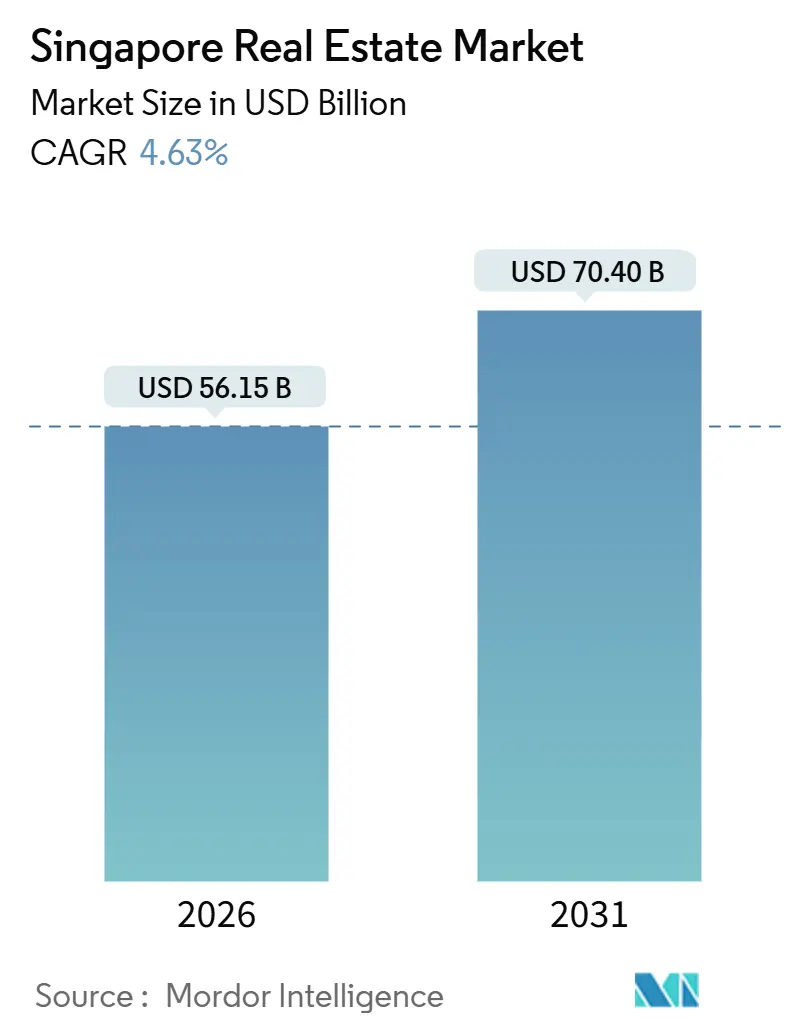
| Market Size (2026) | USD 56.15 Billion |
| Market Size (2031) | USD 70.40 Billion |
| Growth Rate (2026 - 2031) | 4.63 % |
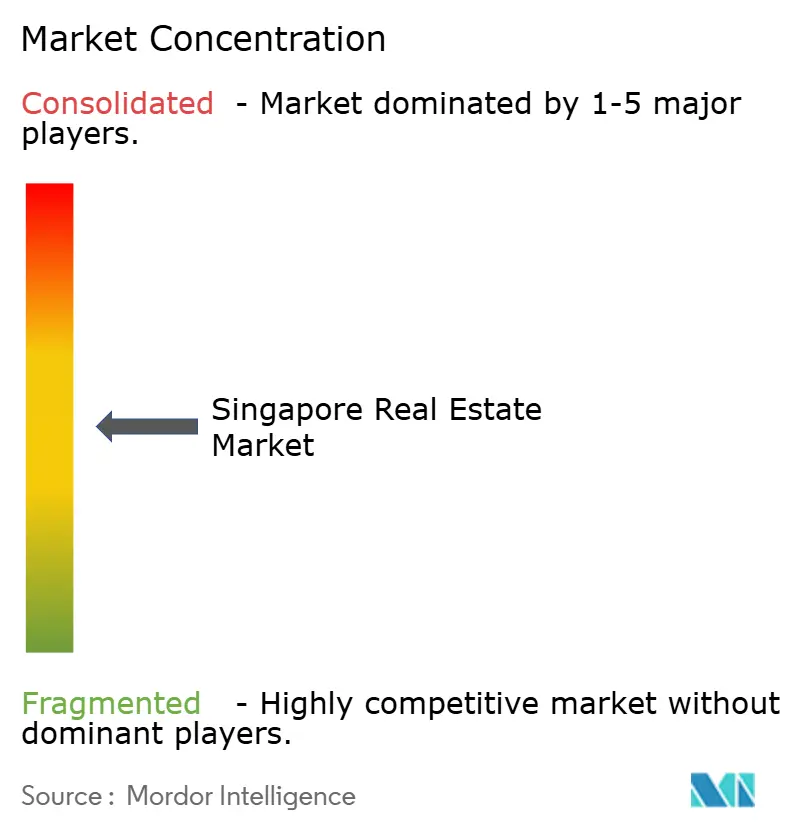
| Market Concentration | Medium |
Major Players *Disclaimer: Major Players sorted in no particular order Image © Mordor Intelligence. Reuse requires attribution under CC BY 4.0. | |
Singapore Real Estate Market Analysis by Mordor Intelligence
The Singapore Real Estate market size is USD 56.15 billion in 2026 and is projected to reach USD 70.4 billion by 2031, reflecting a 4.63% CAGR. The Singapore Real Estate market continues to benefit from safe-haven demand, tight supply in central office districts, and a steady flow of household buyers supported by formal savings and policy clarity. A high level of market participation by licensed agents, coupled with measured liquidity across residential and commercial assets, supports balanced price discovery. Government-led urban redevelopment programs and green building incentives remain key anchors for long-term value creation in the Singapore Real Estate market. Targeted cooling measures and strict credit frameworks keep speculative activity contained, which helps align price trends with economic fundamentals in the Singapore Real Estate market.[1]https://www.cea.gov.sg/
Key Report Takeaways
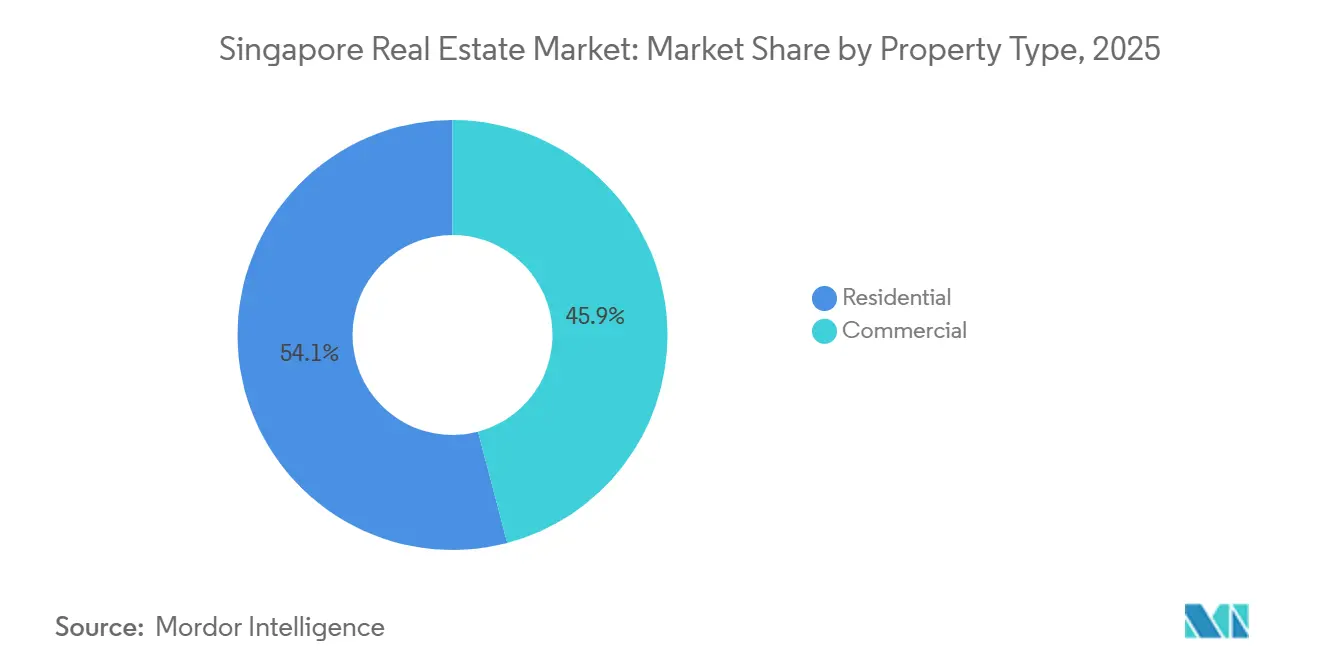
- By property type, Residential led with 54.1% revenue share in 2025, while Commercial is forecast to expand at a 5.44% CAGR through 2031.
- By business model, Sales held a 63.2% share in 2025, while Rental is projected to grow at a 5.30% CAGR to 2031.
- By end-user, Individuals and Households accounted for 70.1% of 2025 revenue, while Corporations and SMEs are expected to record the fastest growth at a 5.59% CAGR.
- By geography, the Core Central Region held a 43.1% share in 2025, while the Rest of Central Region is on track to grow at a 5.99% CAGR through 2031.
Note: Market size and forecast figures in this report are generated using Mordor Intelligence’s proprietary estimation framework, updated with the latest available data and insights as of January 2026.
Singapore Real Estate Market Trends and Insights
Drivers Impact Analysis*
| Drivers | (~) % Impact on CAGR Forecast | Geographic Relevance | Impact Timeline |
|---|---|---|---|
| Government-backed urban planning spurring long-term development | +1.2% | National, with early gains in Greater Southern Waterfront precincts | Long term (≥ 4 years) |
| Strategic positioning as a regional business hub supporting office and mixed-use growth | +0.9% | CCR CBD, business parks in Changi Business Park, and one-north | Medium term (2-4 years) |
| Robust foreign investor interest driven by political stability and strong legal frameworks | +0.8% | Global, concentrated in CCR and RCR for premium assets | Long term (≥ 4 years) |
| Booming e-commerce and advanced manufacturing driving logistics and industrial demand | +0.7% | OCR industrial zones such as Jurong, Tuas, Woodlands, and prime corridors near Tuas Mega Port | Short term (≤ 2 years) |
| Sustained demand in the luxury and high-end residential segment from global UHNWIs | +0.6% | CCR Districts 9-11, Sentosa Cove | Medium term (2-4 years) |
| Rising adoption of smart and sustainable building technologies | +0.5% | National, with pilot projects in Marina South and Punggol Digital District | Medium term (2-4 years) |
| Source: Mordor Intelligence | |||


Government-Backed Urban Planning Spurring Long-Term Development
The Urban Redevelopment Authority’s planning framework, including the transformation of the Greater Southern Waterfront, expands the supply of mixed-use and housing options over a multi-decade horizon in the Singapore Real Estate market. Port relocation and new precinct development create pathways to re-balance density and enhance liveability, with a clear sequence of transport, coastal protection, and community infrastructure investments. The pipeline around city-fringe sites and mature estates aligns new housing with transit nodes and social amenities, which supports price stability through broader access and reduces cross-island commuting. Government Land Sales continue to anchor investor expectations around bid discipline, location advantages, and integrated designs in the Singapore Real Estate market. Over time, these measures build a steady foundation for demand while reducing concentrations of obsolescent stock across the city.[2]https://www.ura.gov.sg/Corporate
Strategic Positioning as a Regional Business Hub Supporting Office, Co-working, and Mixed-Use Growth
Singapore’s role as a regional headquarters location continues to reinforce CBD office fundamentals through steady leasing, low vacancy, and a flight to quality. Vacancy in Core CBD Grade A assets narrowed to 4.7% in the third quarter of 2025, which indicates demand resilience in the Singapore Real Estate market. Limited near-term completions in prime districts, combined with sustained professional services and finance hiring, continue to favor newer green-certified assets. Flexible workspace offerings complement this trend by providing turnkey options to occupiers that prefer short commitments while waiting for clearer macro signals in the Singapore Real Estate market. The Central Business District Incentive Scheme and Strategic Development Incentive Scheme, both overseen by the Urban Redevelopment Authority, encourage adaptive reuse of older buildings to mixed-use formats, which supports long-run grade improvement in the stock. Together, these dynamics reinforce a premium for centrally located, efficient, and sustainable projects in the Singapore Real Estate market.[3]https://www.cushmanwakefield.com/en
Booming E-Commerce and Advanced Manufacturing Driving Logistics and Industrial Real Estate Demand
Logistics and high-spec industrial assets benefit from a blend of port automation, just-in-time inventory strategies, and demand from technology and biomedical tenants. Tuas Mega Port processed 41.1 million TEUs in 2024 and targets 65 million TEUs at full build-out, which strengthens the need for multi-story ramp-up facilities close to maritime gateways in the Singapore Real Estate market. Industrial supply has been pre-committed at high rates, while island-wide vacancy is projected to tighten through 2027, reflecting structurally healthy absorption. Prime logistics rents and high-tech factory rents firmed as occupiers sought power redundancy, automation readiness, and green certifications. Policy support, including land use and lease extensions linked to capital investment, reduces risk on long-cycle industrial projects in the Singapore Real Estate market. Active portfolio moves by listed trusts, such as selective acquisitions near Tuas, illustrate capital rotation toward this theme.
Sustained Demand in the Luxury and High-End Residential Segment from Global UHNWIs
Despite tighter stamp duties, well-capitalized buyers continue to target prime non-landed homes in central precincts for own-stay needs and wealth diversification in the Singapore Real Estate market. Launches of well-located projects in established districts recorded strong initial take-up in 2025, signaling a resilient appetite for premium-located inventory. The broader upgrader pipeline is sustained by public housing delivery that supports orderly transitions into the private market over time. Policy clarity and a strong legal framework continue to anchor long-run demand in the Singapore Real Estate market. This dynamic keeps activity concentrated in high-quality assets with immediate liveability and amenity advantages.
Restraints Impact Analysis*
| Restraints | (~) % Impact on CAGR Forecast | Geographic Relevance | Impact Timeline |
|---|---|---|---|
| Stringent cooling measures and stamp duties tempering speculative residential investment | -1.1% | National, most acute in the CCR luxury segment | Short term (≤ 2 years) |
| Limited land supply and high land acquisition costs constraining new development | -0.9% | National, severe in CCR and prime RCR locations | Long term (≥ 4 years) |
| Geopolitical and economic headwinds impacting foreign capital flow and tenant demand | -0.8% | Global influence, concentrated impact on CBD offices and prime residential | Medium term (2-4 years) |
| Supply-demand imbalances in select asset classes | -0.6% | Suburban retail in OCR, fringe office locations outside the CBD core | Medium term (2-4 years) |
| Source: Mordor Intelligence | |||
Stringent Cooling Measures and Stamp Duties Tempering Speculative Residential Investment
Additional Buyer’s Stamp Duty remains a key tool in shaping residential demand composition, with a 60% rate applied to foreign buyers since April 2023 in the Singapore Real Estate market. The Seller’s Stamp Duty regime, extended to a four-year holding period in July 2025, further disincentivizes short-term flipping and supports more stable resale activity. Macroprudential measures like the Total Debt Servicing Ratio cap help ensure that borrowing remains prudent relative to income levels, which sustains financial stability for households. These frameworks preserve market integrity while reducing volatility in the Singapore Real Estate market. The result is a clearer emphasis on end-user needs and long-run value rather than speculative momentum.
Limited Land Supply and High Land Acquisition Costs Constraining New Development
Singapore’s finite landmass and zoning allocations create persistent scarcity that shapes pricing and bidding behavior, particularly in central precincts of the Singapore Real Estate market. Government Land Sales remain competitive, and average land rates rose in 2025 as developers priced location, transit integration, and amenity depth into pro formas. Industrial zoning and lease policies channel heavy uses to specific districts, reducing conversion optionality in the near term. Longer-dated reclamation and relocation timelines delay the full impact of new supply relief for core residential and mixed-use sites. In this context, developers focus on product differentiation and sustainability credentials to defend margins within the Singapore Real Estate market.
*Our forecasts treat driver/restraint impacts as directional, not additive. The impact forecasts reflect baseline growth, mix effects, and variable interactions.
Segment Analysis
By Property Type: Commercial Leads Growth Despite Residential Dominance
Residential commanded a 54.1% share in 2025, underscoring its role as the largest revenue contributor in the Singapore Real Estate market. HDB resale transactions reached 28,986 in 2025, which indicates steady end-user movement and supports upgrader pathways over time. Commercial assets are the fastest-growing subsegment at a 5.44% CAGR through 2031, supported by low CBD vacancy and a continued flight to quality in the Singapore Real Estate market. Core CBD Grade A vacancy tightened to 4.7% in the third quarter of 2025, which reinforces landlord pricing power at the top end. Industrial and logistics benefit from port automation and pre-commitments in advanced manufacturing, which support sustained absorption and balanced rental growth.
Within Residential, non-landed homes remain the most liquid format for upgraders and new entrants, while landed segments are structurally supply-constrained. In Commercial, office dominates the subsegment revenue, followed by retail and logistics, although logistics has the strongest cyclical tailwind as e-commerce share stabilizes at higher levels. Retail portfolios in suburban catchments benefit from near-full occupancy and healthy rental reversion, reflecting resilient household spending patterns tied to essential services. Data center exposure within industrial portfolios continues to expand, as illustrated by acquisitions of high-spec assets that are fully leased to digital and financial services tenants in the Singapore Real Estate market. Green certification, energy efficiency, and embedded smart systems are increasingly central to asset differentiation across all property types in the Singapore Real Estate industry.

By Business Model: Rental Segment Gains Share Amid Sales Cycle Maturity
Sales held a 63.2% share in 2025, which reflects strong new-launch activity and a steady resale base in the Singapore Real Estate market. Rental is the fastest-growing channel at a 5.30% CAGR through 2031, supported by flexible office demand, expatriate leasing in prime districts, and master leases in logistics that embed annual escalations. Office renewals have been the path of least resistance for many tenants as fit-out costs and relocation capex remain high, which helps sustain occupancy in newer schemes. Residential leasing in upper-tier precincts remains supported by corporate housing budgets, which keep vacancy low in prime projects. Industrial leasing is underpinned by longer-weighted lease expiries and clear rent steps, enabling stable cash flow visibility for landlords in the Singapore Real Estate market.
Primary sales continue to capture strong upgrader interest at accessible quantum bands, while institutional capital focuses on stabilized income-producing assets for predictable yields. In the rental channel, turnkey office suites and build-to-suit industrial facilities help occupiers manage near-term uncertainty while preserving growth options. Leasing demand within high-spec industrial and data center properties has remained resilient, reflecting the infrastructure requirements of digital economy tenants in the Singapore Real Estate industry. Regulatory frameworks, including leverage limits for REITs, support disciplined capital management and preserve balance sheet flexibility across cycles. These features strengthen the durability of the rental growth outlook relative to the maturing sales cycle in the Singapore Real Estate market.
By End-user: Corporates and SMEs Drive Fastest Growth
Individuals and Households represented 70.1% of 2025 revenue, which highlights the centrality of owner-occupiers and renters in the Singapore Real Estate market. Corporates and SMEs are the fastest-growing cohort at a 5.59% CAGR through 2031, led by technology, life sciences, and professional services demand for high-quality office and high-spec industrial space. Public housing launches and targeted policies maintain an orderly upgrade path for households, which supports a stable base of private demand over time. Corporate leasing expanded across CBD and city-fringe nodes in 2025, supported by low vacancy and better building performance standards in the Singapore Real Estate market. This segment mix drives complementary needs for retail podiums, logistics backbones, and integrated community facilities.
Individuals and Households continue to prioritize connectivity, proximity to schools, and access to amenities, which favors launches in mature and centrally linked estates. Corporate demand concentrates in prime CBD towers and in decentralized business parks where talent access and cost efficiency align with long-run workplace strategies. SMEs often prefer strata office or flexible space formats to reduce capex burdens, while larger firms consolidate into fewer, better buildings with modern specifications in the Singapore Real Estate market. Green Mark incentives and gross floor area bonuses steer corporate users to higher-performance assets, accelerating adoption of sustainable design. As these patterns reinforce, the end-user mix supports multi-year investments into mixed-use precincts and smart building capabilities in the Singapore Real Estate market.


Geography Analysis
The Core Central Region accounted for a 43.1% revenue share in 2025, while the Rest of Central Region is projected to post the fastest growth at a 5.99% CAGR through 2031, with the Outside Central Region expanding at a 4.8% CAGR. In the Core Central Region, limited new Grade A supply and favorable tenant demand kept vacancy tight, which supported sustained rental performance at the upper end of the Singapore Real Estate market. Adaptive reuse frameworks in the CBD encourage the conversion of older buildings into mixed-use schemes that blend office, hospitality, and residential uses. Recent prime launches in District 10 achieved high sell-through, which signals healthy absorptive capacity for well-located premium projects in the Singapore Real Estate market. The Core Central Region outlook remains anchored by the scarcity of buildable land and ongoing corporate concentration in the CBD.
The Rest of the Central Region captured 36.7% of 2025 revenue and benefits from an active pipeline of integrated developments near MRT interchanges, which aligns live-work-play needs and supports upgrader demand in the Singapore Real Estate market. New projects linked to strong transport nodes recorded robust initial take-up, which indicates that accessibility and amenity depth help narrow price gaps to the core. Decentralized office nodes in the Rest of the Central Region continue to attract tenants seeking rent savings relative to CBD towers without giving up connectivity. Industrial and high-spec assets near city-fringe clusters complement this story, with acquisitions and asset enhancement by listed trusts reflecting long-cycle confidence in the Singapore Real Estate market. As redevelopment accelerates under incentive schemes, asset quality improves and diversifies the set of investable properties across this geography.
The Outside Central Region contributes 20.2% of 2025 revenue and remains the affordability anchor for first-time buyers and families prioritizing space, supported by a steady pipeline of public and private launches. Industrial dominance is a hallmark of this geography, where clusters in Jurong and Tuas remain central to manufacturing and logistics in the Singapore Real Estate market. Tuas Mega Port’s throughput and automation objectives underpin continued demand for nearby logistics facilities and multi-user factories. Lease frameworks that reward plant and machinery investment improve capex visibility and encourage modernization of existing facilities. New green building standards help newer suburban developments achieve lower operating costs and support stable yields that attract long-term owners in the Singapore Real Estate market.
Regulatory Landscape
Singapore real estate operates under a multi-agency framework spanning land use, developer licensing, estate agency conduct, and financial stability. URA anchors planning and development controls (including Government Land Sales and developer licensing conditions), MAS sets macroprudential rules for property lending (including the Total Debt Servicing Ratio framework) and transaction-related policy levers such as Seller's Stamp Duty, while the Council for Estate Agencies (CEA) governs estate agents and enforces professional and conduct requirements.
Recent tightening has increased compliance depth across both transactions and development execution. Parliament enacted the Anti-Money Laundering and Other Matters (Estate Agents and Developers) Act 2025 (April 2025). MAS extended the Seller's Stamp Duty holding period to four years in July 2025 alongside higher SSD rates. In 2026, URA introduced frameworks that can disqualify developers from land sales and impose sales suspensions for up to five years (effective 22 May 2026). URA also issued revised developer guidelines on AML/CP&TF in July 2026, reinforcing customer due diligence and risk assessment expectations.
Value Chain Analysis
Singapore's real estate value chain is closely linked to the Built Environment ecosystem, starting with statutory planning and land release (URA), then moving to development origination (developers, REIT sponsors, and private funds), design and engineering (architects, engineers, and specialist consultants), construction delivery (main contractors and specialist trades), and finally commercialization through agency networks (licensed brokers and sales teams) and leasing channels. Capital intermediation runs in parallel through banks and debt markets governed by MAS macroprudential requirements, while valuation, legal conveyancing, and due diligence support underwriting and transaction execution across both sales and rental models.
Downstream, asset operations and property management shape occupancy, sustainability performance, and lifecycle outcomes, with government programs influencing process and productivity. The Building and Construction Authority's Industry Transformation Map emphasizes Integrated Planning and Design, Advanced Manufacturing and Assembly, and Sustainable Urban Systems, while Integrated Digital Delivery connects stakeholders from design through facility management. Supply-chain efficiency initiatives also include Integrated Construction Parks (for example, co-location at Jurong Port) to consolidate activities such as batching, precast, and storage, reducing logistics frictions for developers and contractors working across residential, commercial, and industrial projects.
Competitive Landscape
Competition features two reinforcing models, with capital-light managers scaling through third-party funds and developers deploying balance sheets to originate and deliver projects in the Singapore Real Estate market. The top listed and private platforms operate across office, retail, industrial, and hospitality, using active asset management, green retrofits, and recycling to drive returns. On the development side, disciplined bidding and product differentiation are central to sustaining margins under land scarcity and higher build standards. Government incentives for sustainability and adaptive reuse reward early movers with better leasing outcomes and stickier cash flows in the Singapore Real Estate market.
Developers and REITs executed targeted acquisitions and divestments in 2025 to optimize portfolios and improve balance sheets. City Developments Limited completed the divestment of its South Beach stake for S$834 million (USD 617.2 million), which supported deleveraging objectives while preparing the platform for future deployments in and beyond Singapore. CapitaLand Ascendas REIT announced multiple acquisitions of industrial and logistics assets that were fully occupied with in-place escalations, demonstrating a preference for cash flow visibility in the Singapore Real Estate market. Frasers Logistics & Commercial Trust entered the domestic logistics segment with a Green Mark Platinum asset near Tuas, reweighting its portfolio toward growth categories. Select platforms continued to recycle capital from non-core assets to fund higher-yielding opportunities and to align with sustainability targets.
Market structure in residential development remains concentrated, with top bidders capturing a large share of Government Land Sales in 2025 as average land rates rose alongside demand for integrated, transit-linked sites in the Singapore Real Estate market. The mix of strategies points to continued focus on bulk leasing, tenant quality, and ESG-driven value creation, which is now embedded in underwriting and design. Green building commitments and smart operations help reduce operating costs, raise tenant satisfaction, and extend asset lifecycles across portfolios. Across both models, execution discipline and capital recycling remain the primary tools for navigating land scarcity and policy guardrails in the Singapore Real Estate market.
Singapore Real Estate Industry Leaders
PropNex Realty Pte Ltd
ERA Realty Network Pte Ltd
Huttons Asia Pte Ltd
OrangeTee & Tie Pte Ltd
SRI Pte Ltd
- *Disclaimer: Major Players sorted in no particular order

Market Opportunities and Future Outlook
Urban redevelopment and decentralization programs create investable whitespace in integrated mixed-use precincts and city-fringe nodes, where planning certainty supports phased pipeline formation. Master Plan 2025, as the gazetted statutory land-use blueprint, provides a long-horizon framework for new housing estates and redevelopment, while URA land release actions add visible near-term catalysts. These include the July 2026 release of a White site for tender to advance the Jurong Lake District. In practice, these planning signals support opportunities for developers and landlords that can structure integrated schemes around transit connectivity, amenity depth, and adaptive reuse of older stock under URA incentive programs.
A second opportunity cluster is centered on delivery modernization and compliance-led digitization that can reduce cycle time and improve cost control for new builds and major retrofits. BCA initiatives such as mandatory CORENET X submissions for larger new projects from October 2025 (with wider coverage targeted by October 2026), and the April 2026 Buildability Type Approval pathway for Kit-of-Parts adoption on projects with GFA of at least 5,000 sqm, expand demand for standardized design and IDD-enabled workflows alongside construction industrialization. The refreshed Built Environment Industry Digital Plan also provides roadmaps for digital solutions, cybersecurity, and skills, which supports proptech and platform-led offerings across design, approvals, construction, and building operations.
Recent Industry Developments
- July 2026: Urban Redevelopment Authority released a White site for tender to advance development in the Jurong Lake District. The land release provides a concrete near-term pipeline anchor for mixed-use and commercial-led decentralization outside the traditional CBD. It also increases competitive emphasis on integrated masterplanning and transit-linked design as developers position bids.
- October 2025: Monetary Authority of Singapore extended the holding period for Seller's Stamp Duty to four years and revised SSD rates for residential properties. The change reinforced policy guardrails against short-hold transactions and supported a demand mix tilted toward longer-horizon owner-occupiers and investors. Developers and agencies also adjusted go-to-market strategies around hold-time sensitivity and resale timing.
- April 2024: Infocomm Media Development Authority published a refreshed Built Environment Industry Digital Plan outlining digital solution roadmaps, cybersecurity and data protection guidance, and skills development pathways. The update strengthened enterprise-level adoption of digital workflows across design, approvals, construction, and facilities operations. It also expanded the addressable market for software-enabled delivery, compliance tooling, and data-driven building management capabilities.


Research Methodology Framework and Report Scope
Market Definition and Coverage
For this methodology, the market is defined as the value of property sales and rental revenues generated by real estate buildings located in Singapore, converted to USD using annual average exchange rates. It is intended to reflect active demand and monetized usage across key property uses.
Scope exclusions: Land-bank flips, REIT share trading activity, and stand-alone facilities management service fees are excluded from this market size.
Segmentation Overview
- By Property Type
- Residential
- Apartments & Condominiums
- Villas & Landed Houses
- Commercial
- Office
- Retail
- Logistics
- Others (industrial real estate, hospitality real estate, etc.)
- Apartments & Condominiums
- By End-user
- Individuals / Households
- Corporates & SMEs
- Others
- By Region
- Core Central Region (CCR)
- Rest of Central Region (RCR)
- Outside Central Region (OCR)
- Residential
Data Sources, Market Sizing, and Validation
Desk Research
Desk work was used to anchor the model to real, repeatable public signals, and then to keep assumptions within what the Singapore market can actually absorb year to year. We referenced official releases and statistical series such as from the Singapore Department of Statistics, the Urban Redevelopment Authority, the Housing and Development Board, and the Monetary Authority of Singapore, then added macro context from sources such as the World Bank and IMF.
Beyond official data, we also reviewed company annual reports, investor presentations, and audited financial statements to understand the revenue mix between development sales and recurring rental income, then to cross-check demand cycles. Where needed, we used a paid subscription for company financials and intelligence, and another for shipment level trade and import export indicators linked to construction inputs. In practice, those trade indicators were used mainly to validate timing and direction, rather than to directly size the market. These examples are not exhaustive, and many other sources were used for data collection, validation, and research clarification.
Primary Interviews and Surveys
Primary interviews and surveys were run to confirm which portion of activity is truly transacting versus being planned, and to sanity-check the rental and sales assumptions used in the model. We spoke with a mix of developers, brokers, property managers, lenders, and large occupier-side respondents, and we revisited assumptions when a clear difference showed up between stakeholder groups within the same property cycle.
Distribution of primary research fieldwork respondents
| Company type | Respondent position |
|---|---|
| Top tier: 26% | CXOs: 13% |
| Mid tier: 56% | Functional/Unit leaders: 38% |
| Smaller Players: 18% | Managers: 49% |
Market-Sizing & Forecasting
Sizing starts with a top-down reconstruction where transaction and leasing activity is rebuilt from Singapore housing and private property indicators, planning pipeline signals, and reported rental movements. This activity is then converted into value using practical price and rent assumptions. We then corroborate the totals with selective bottom-up approximations, such as sample checks of project sales values, rental roll-ups for major asset categories, and observed pricing ranges shared by market participants.
A few inputs that matter most in Singapore were treated as explicit drivers in the model, including private and public housing transaction volumes, average transacted prices, rental index movement, vacancy and occupancy direction, new supply completions and pipeline, and interest rate and credit tightening signals. For forecasting, scenario analysis was used so base, slower, and faster paths can be tested around supply delivery timing and demand rebound, and the final path was aligned to what primary respondents saw as realistic for the next few years. When a bottom-up check could not cover a sub-area cleanly, the gap was handled through conservative ratio-based allocation tied back to official activity indicators, and then reviewed again during validation.
Data Validation & Update Cycle
Model outputs are checked against independent signals, such as whether implied sales value aligns with observed price bands and whether rental value movement stays consistent with reported index direction. Large variances trigger deeper review, where assumptions are re-tested, outliers are removed, and, when needed, selected respondents are re-contacted to confirm what changed in the market.
Before sign-off, the work is reviewed in steps so that input choices, conversions to USD, and year-by-year logic are consistent and explainable. Reports are refreshed annually, with interim updates when material events occur, and right before delivery we do a fresh pass so clients receive the latest updated view.
Mordor Intelligence's Singapore Real Estate Market Size Compared With Other Published Estimates
Published market sizes for Singapore real estate can look far apart because groups do not always count the same revenue pools, and they may anchor to different base years or conversion timings. Differences also show up when one estimate leans more on forecast optimism while another stays closer to observed transaction and rental signals.
The biggest gap drivers in this market are whether the estimate counts only property sales or also includes rental revenues, how mixed-use projects are treated, and whether financial market activity like REIT share trades is mistakenly blended into a real-economy measure. Currency conversion can add spread too, since some figures use a single spot rate while others rely on annual averages, and refresh cadence matters when price moves quickly and policy changes shift demand expectations.
Benchmark comparison
| Source | Market Size | Gaps in Research Methodology |
|---|---|---|
| Mordor Intelligence | USD 56.15 B (2026) | |
| Global Consultancy A | USD 59.08 B (2024) | Uses an earlier base year and a different forecast window, and its scope description is broader, which can shift what gets counted between development sales and rental revenues. |
| Industry Analytics B | USD 93.60 B (2023) | Appears to include a wider valuation style pool and may blend adjacent categories, which can inflate totals versus a transaction and rent revenue view aligned to building activity. |
The spread across sources mainly comes down to what is being measured and when, rather than a simple math issue. By keeping the market tied to Singapore-located building sales and rental revenues, excluding REIT share trading and stand-alone facilities management fees, and converting using annual average rates, the estimate stays closer to observable demand signals, a choice applied by Mordor Intelligence near the end of the modeling process.


Key Questions Answered in the Report
What is the size and growth outlook for the Singapore Real Estate market to 2031?
The Singapore Real Estate market size is USD 56.15 billion in 2026 and is projected to reach USD 70.4 billion by 2031 at a 4.63% CAGR.
Which segments lead and which are growing fastest within the Singapore Real Estate market?
Residential led with 54.1% of revenue in 2025, while Commercial is the fastest-growing at a 5.44% CAGR through 2031.
How do policy measures affect demand in the Singapore Real Estate market?
ABSD and SSD frameworks reduce speculative activity, while TDSR maintains prudent borrowing, which stabilizes demand and price trends.
Which geographies are most attractive in the Singapore Real Estate market?
The Core Central Region held a 43.1% share in 2025, and the Rest of Central Region is the fastest-growing at a 5.99% CAGR, supported by integrated transit-linked projects.
What is driving logistics and industrial demand in the Singapore Real Estate market?
Port automation and throughput at Tuas Mega Port, together with advanced manufacturing, continue to drive pre-commitments and rental stability.
What strategic moves did leading players make in 2025 in the Singapore Real Estate market?
Major moves included South Beach divestment by City Developments Limited and multiple industrial acquisitions by CapitaLand Ascendas REIT and Frasers Logistics & Commercial Trust.
Page last updated on:


 Your data is secure and never sold or shared.


