
Shoulder-fired Weapons Market Size and Share
Market Overview
| Study Period | 2020 - 2031 |
|---|---|
| Market Size (2026) | USD 11.15 Billion |
| Market Size (2031) | USD 14.59 Billion |
| Growth Rate (2026 - 2031) | 5.51 % |
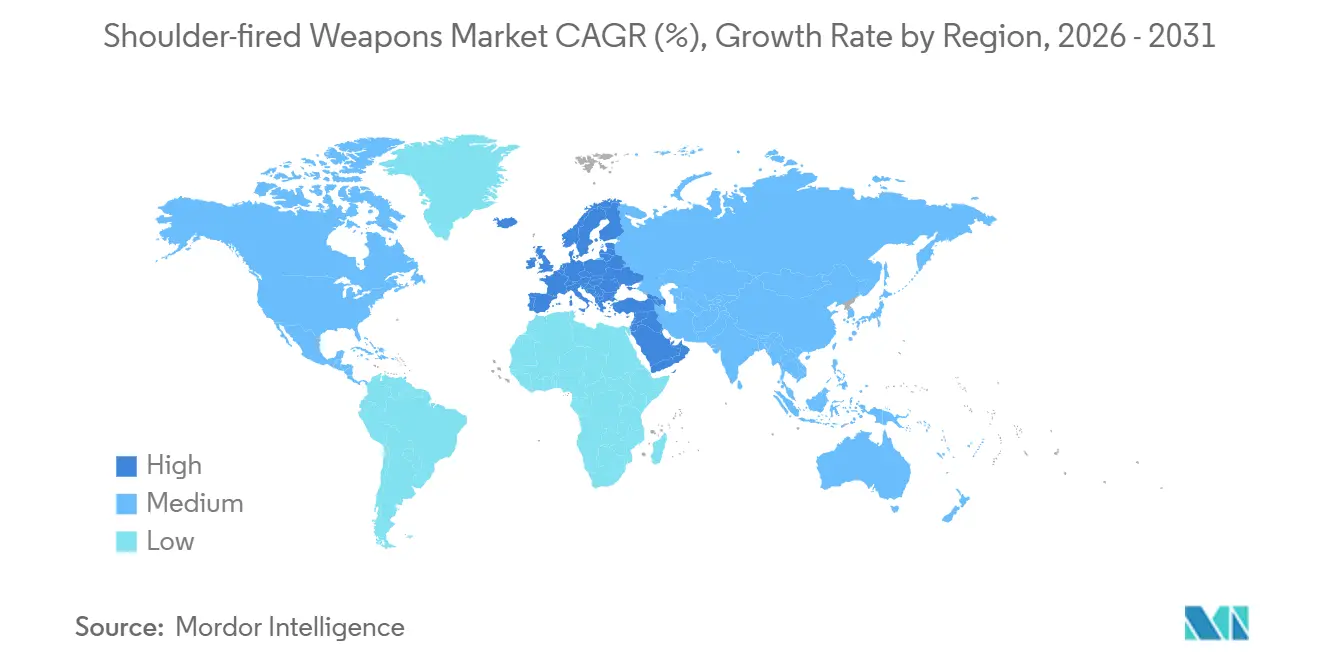
| Fastest Growing Market | Middle East |
| Largest Market | Asia Pacific |
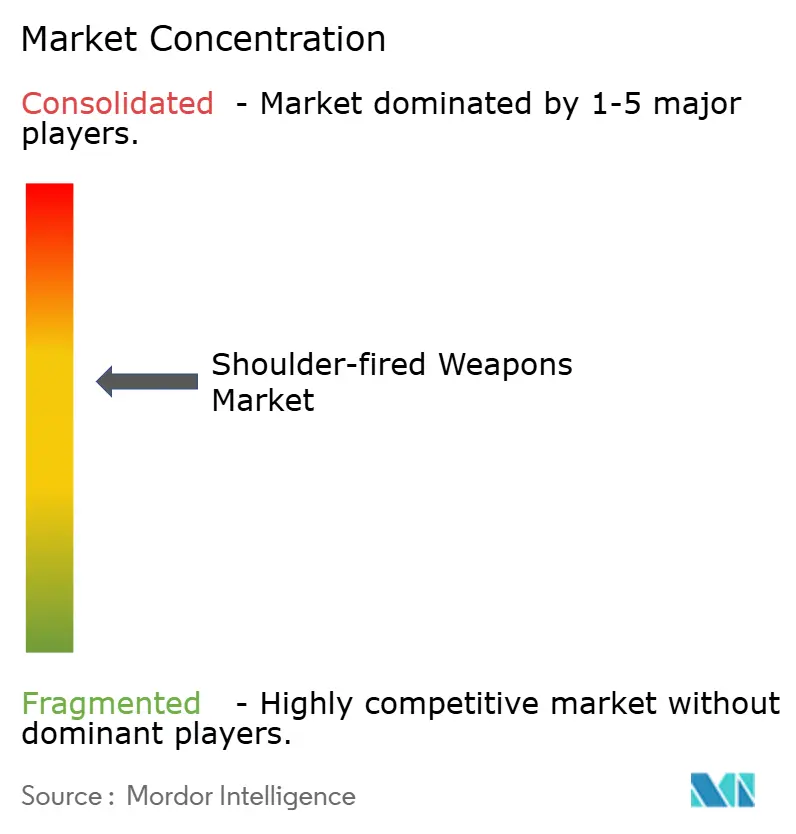
| Market Concentration | Medium |
Major Players *Disclaimer: Major Players sorted in no particular order Image © Mordor Intelligence. Reuse requires attribution under CC BY 4.0. | |
Shoulder-fired Weapons Market Analysis by Mordor Intelligence
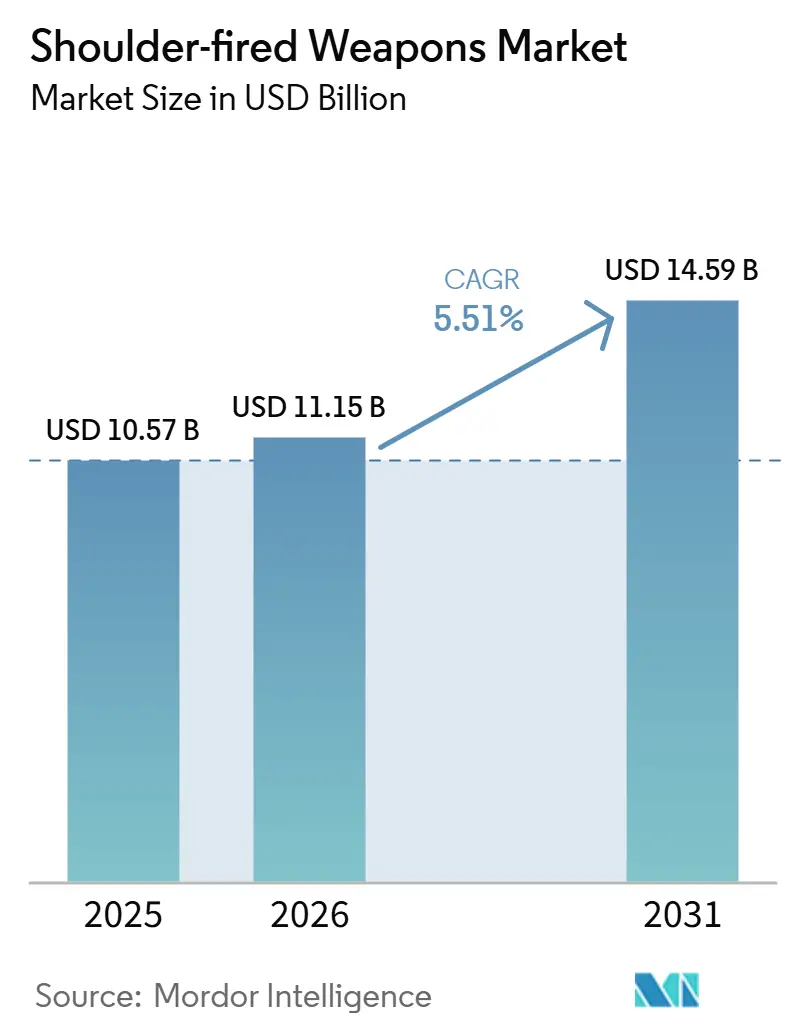
The shoulder-fired weapons market size is expected to grow from USD 10.57 billion in 2025 to USD 11.15 billion in 2026 and is forecast to reach USD 14.59 billion by 2031 at 5.51% CAGR over 2026-2031. Several interlocking trends sustain this expansion in market size. First, infantry units now face heavy armor, drones, and fortified positions inside densely populated areas; portable precision launchers let them respond without waiting for artillery or airpower. Second, the Russia-Ukraine war shifted procurement from peacetime pacing to surge production, reopening dormant missile lines and prompting suppliers to triple or quadruple monthly output. Third, Asia-Pacific programs emphasize indigenous design and joint ventures, lifting volumes for seeker electronics and advanced fire-control units. Fourth, homeland-security agencies and border guards increasingly adopt man-portable air-defense systems to counter cheap drones, widening the end-user base. Finally, lighter carbon-fiber launch tubes and soft-launch propulsion stages cut combat loads, encouraging special-operations forces to carry multi-role launchers on long-range patrols.
Key Report Takeaways
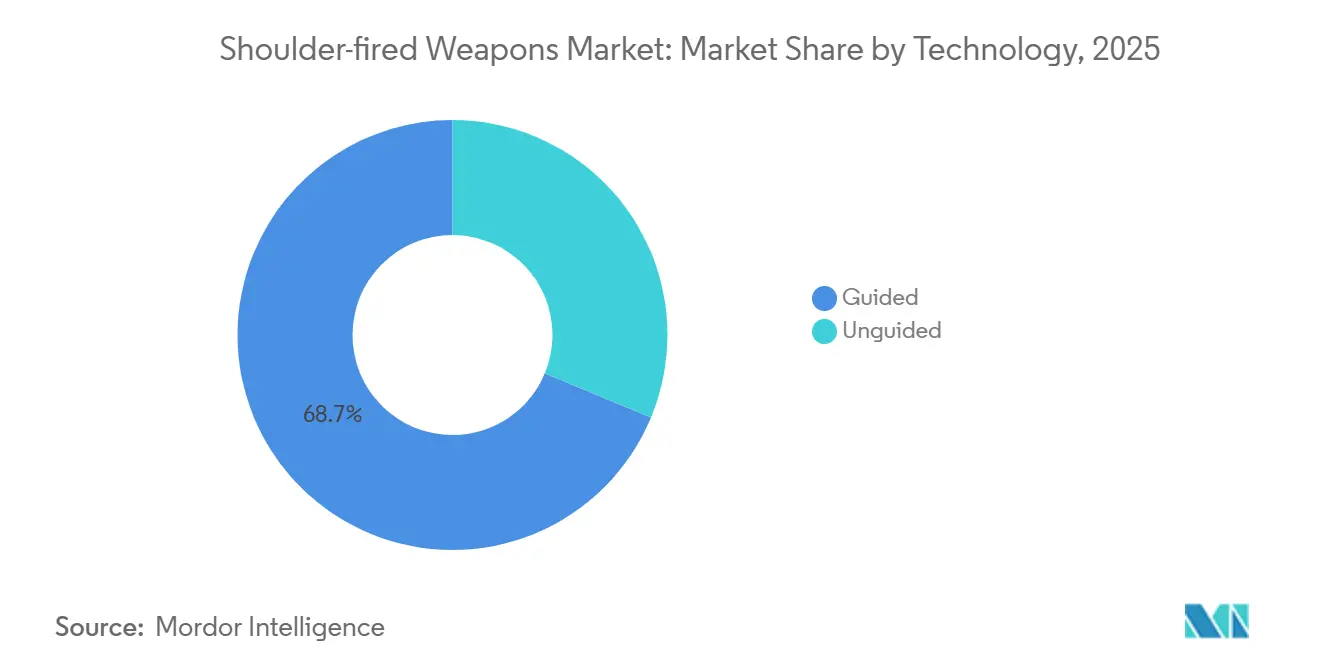
- By technology, guided systems held 68.74% of the shoulder-fired weapons market share in 2025; unguided systems will post the fastest segment CAGR at 7.64% to 2031.
- By weapon type, anti-tank guided missile (ATGM) launchers commanded 35.07% of the shoulder-fired weapons market size in 2025, while MANPADS are forecast to grow at an 8.41% CAGR through 2031.
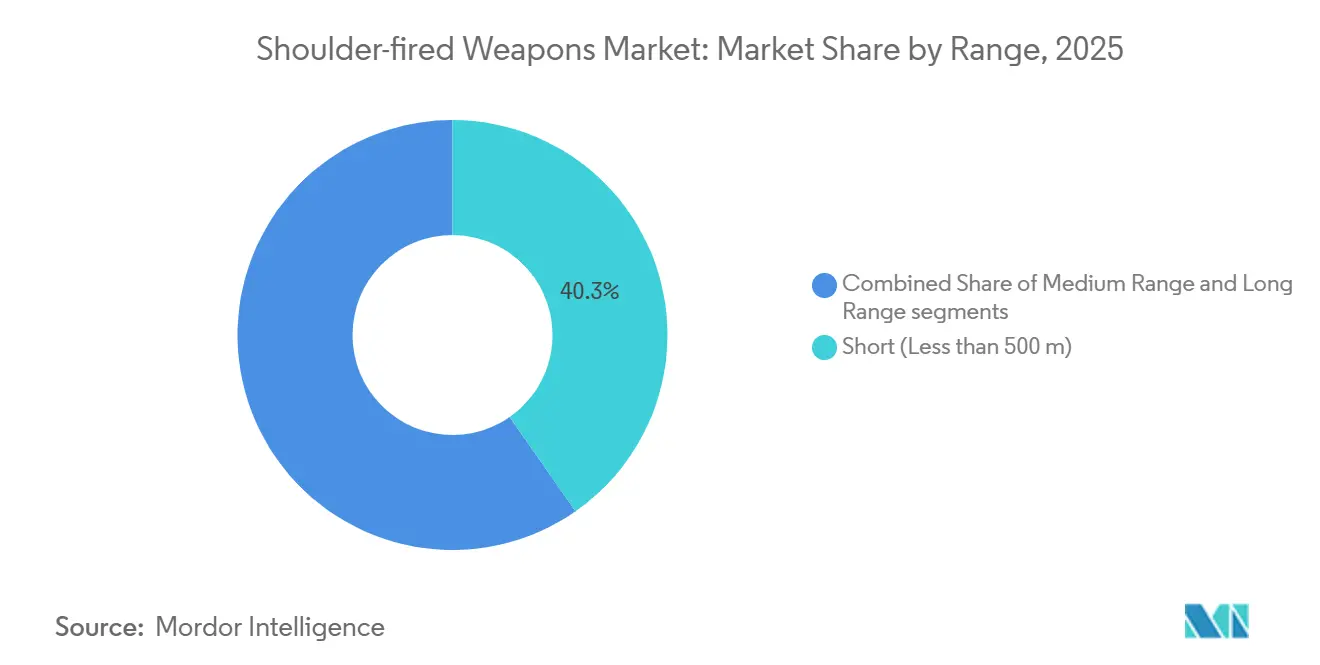
- By range, short-range systems captured 40.31% of the shoulder-fired weapons market in 2025; the long-range category is projected to expand at a 7.58% CAGR between 2026 and 2031.
- By projectile component, launchers/tubes led with 53.57% revenue share in 2025; fire-control and sighting systems are projected to register the highest CAGR of 8.83% to 2031.
- By end-user, armies accounted for 54.88% of the shoulder-fired weapons market in 2025, while homeland security agencies are forecast to grow at an 8.62% CAGR through 2031.
- By region, Asia-Pacific held 32.12% of global revenue in 2025; the Middle East and Africa region is forecast to grow at a 9.21% CAGR through 2031.
Note: Market size and forecast figures in this report are generated using Mordor Intelligence’s proprietary estimation framework, updated with the latest available data and insights as of 2026.
Global Shoulder-fired Weapons Market Trends and Insights
Drivers Impact Analysis*
| Driver | (~) % Impact on CAGR Forecast | Geographic Relevance | Impact Timeline |
|---|---|---|---|
| Intensifying asymmetric warfare demand for portable anti-armor solutions | +1.0% | Middle East, Africa, Eastern Europe | Short term (≤ 2 years) |
| Accelerated defense modernization amid territorial disputes | +0.8% | Asia-Pacific, Europe, Middle East | Medium term (2-4 years) |
| Geopolitical conflicts prompting rapid inventory replenishment | +1.2% | North America, Europe, global allies | Short term (≤ 2 years) |
| Rising need for cost-effective MANPADS for counter-UAV missions | +0.6% | Middle East, Europe, Asia-Pacific | Medium term (2-4 years) |
| Global expansion of special forces requiring lightweight multi-role launchers | +0.5% | NATO members and other advanced militaries | Medium term (2-4 years) |
| Industrial localization policies leading to indigenous launcher production | +0.4% | Asia-Pacific, Middle East, Latin America | Long term (≥ 4 years) |
| Source: Mordor Intelligence | |||
Intensifying Asymmetric Warfare Driving Demand for Portable Anti-Armor
Irregular forces, urban militias, and small expeditionary platoons increasingly face main battle tanks inside narrow streets and rugged valleys. Since 2024, global acquisitions of next-generation anti-tank missiles rose 37%, spearheaded by Saab’s fourfold boost to NLAW output and Lockheed Martin’s 2.5-times increase in Javelin shipments. Programmable tandem warheads, reduced minimum-range fuzes, and soft-launch motors allow dismounted squads to defeat reactive armor without exposing themselves to backblast. The shoulder-fired weapons market, therefore, benefits from every frontline that relies on infantry over heavy formations.
Accelerated Defense Modernization Programs Driven by Territorial Disputes Worldwide
Rising sovereignty concerns move parliaments to allocate larger capital budgets for quick-reaction firepower. Asia-Pacific defense outlays climbed to USD 411 billion in 2023, with Japan procuring 300 Carl-Gustaf launchers for 2025 delivery and India perfecting its man-portable ATGM. Similar trajectories appear in Northern Europe, where Finland and Sweden revamp Arctic brigades, and in the Gulf, where lightweight launchers complement layered missile shields. Long-term industrial plans bundle seeker production with domestic final assembly, pulling electronics firms into the shoulder-fired weapons market while anchoring supply chains close to end-users.
Geopolitical Conflicts Triggering Rapid Replenishment of Depleted Shoulder-Launched Inventories
The Russia-Ukraine war consumed thousands of missiles in months, draining NATO stockpiles. Washington shipped nearly one-third of its Javelin inventory overseas, compelling annual capacity to rise from 1,000 to 2,500 rounds. Saab raised NLAW throughput to 400,000 units per year, and RTX won a USD 139 million Stinger components contract that runs until 2027. Similar replenishment drives appear in Poland, the United Kingdom, and the Baltic states. Faster procurement cycles shorten research timelines, send multi-year funding to firms, and lift the overall shoulder-fired weapons market trajectory by an estimated +1.2 percentage points on the five-year CAGR.
Rising Need for Cost-Effective MANPADS in Global Counter-UAV Missions
Uncrewed aerial vehicles now range from micro-quadcopters to jet-powered drones. Traditional surface-to-air missile batteries struggle to match their low cost. Modern MANPADS with imaging-infrared seekers and proximity fuzes close that gap for a fraction of the price. Poland’s Piorun system scored high shoot-down rates in Ukraine and secured a 100-launcher export to Estonia. The US Army guides an extended-range Stinger upgrade that uses an improved motor to reach small drones at 6 km. Homeland security agencies test similar kits for refinery and airport defense, deepening civilian demand for the shoulder-fired weapons market.[1]US Department of Homeland Security, “Counter-UAS Pilot Programs,” dhs.gov
Restraints Impact Analysis*
| Restraint | (~) % Impact on CAGR Forecast | Geographic Relevance | Impact Timeline |
|---|---|---|---|
| Stringent ITAR and MTCR export controls limiting market access | -0.7% | Non-NATO-aligned nations worldwide | Medium term (2-4 years) |
| High back-blast and collateral risk curbing urban RPG deployment | -0.5% | Regions with urban conflict zones | Short term (≤ 2 years) |
| Budget shifts to precision-guided munitions reducing unguided launcher buys | -0.6% | Europe, North America, advanced Asian economies | Medium term (2-4 years) |
| Rising anti-armor drone swarms reducing demand for short-range ATGMs | -0.9% | Technologically advanced militaries worldwide | Medium term (2-4 years) |
| Source: Mordor Intelligence | |||
Stringent ITAR and MTCR Export Controls Limiting Market Access
The US Munitions List and the Missile Technology Control Regime restrict the transfer of shoulder-launched missiles and seeker electronics. Exporters must secure end-user certificates, delay lead times, and raise compliance costs. Buyers not aligned with NATO often shift toward suppliers in China or opt for simpler recoilless rifles, shaving 0.7 percentage points from baseline growth in the shoulder-fired weapons market.
Rising Anti-Armor Drone Swarms Reducing Demand for Short-Range ATGMs
Loitering munitions such as Israel Aerospace Industries’ Rotem Alpha or Teledyne FLIR’s Rogue 1 attack armor at a lower cost per kill and keep operators farther from counter-fire. Russian forces demonstrated quadcopters firing Fagot missiles, proving feasibility. Budget reallocations toward drone arsenals can displace procurement of shoulder-launched missiles, subtracting roughly 0.9 percentage points from forecast CAGR.
*Our forecasts treat driver/restraint impacts as directional, not additive. The impact forecasts reflect baseline growth, mix effects, and variable interactions.
Segment Analysis
By Technology: Guided Systems Extend Precision Reach
Guided solutions generated USD 7.27 billion in revenue during 2025, representing 68.74% of the shoulder-fired weapons market. Integration of compact imaging seekers and inertial navigation chips, once exclusive to larger missiles, allows infantry to defeat moving armor from outside return-fire range. The shoulder-fired weapons market size for unguided systems will grow at a 7.64% CAGR trajectory. South Korea’s Raybolt block upgrade blends a fiber-optic data-link with a motor capable of 5 km standoffs, showing how indigenous R&D narrows technology gaps. Unguided rockets still appeal where cost trumps accuracy. Yet, their share shrinks yearly because new soft-launch designs and programmable fuzes make guided rounds safer in tight urban alleys and better against reactive armor.
Rising adoption of soldier-worn thermal sights has further tilted procurement toward guided profiles. Cloud-based training aides now shorten operator qualification to days, not months, enabling conscripts to fire advanced missiles effectively during their first deployment cycles. The switchover accelerates as production volumes rise and unit prices fall. Overall, competitive differentiation moves from propulsion hardware to software-defined seekers, supplying fertile ground for smaller electro-optics firms to enter the shoulder-fired weapons market.



By Weapon Type: ATGMs Anchor Revenue, MANPADS Pace Growth
ATGM launchers represented 35.07% of the shoulder-fired weapons market share. Their sustained appeal stems from proven lethality against armored columns, as in Ukraine. The category receives continuous block upgrades: Javelin’s lightweight CLU and warhead refresh land in US formations by 2025, breakingdefense.com. Though smaller in 2025, MANPADS will post the highest segment CAGR of 8.41%, buoyed by drone threats and the need for cost-effective dome defenses around forward bases. Estonia’s large Piorun framework deal underlines European appetite for modern shoulder-fired air-defense tools.
Recoilless rifles enjoy renewed interest because new rounds give them anti-structure punch without breaching treaties. The US Army’s USD 16 million Carl-Gustaf M4 order validates this trend. RPGs and SLAW categories maintain relevance in budget-constrained forces but lose relative growth to smarter systems. The shoulder-fired weapons market, therefore, tilts toward multi-mission payloads, modular launch tubes, and electronic fuze programming within a single family of launchers.
By Range: Long-Range Uptick Challenges Short-Range Dominance
Short-range models, under 500m, delivered 40.31% of the shoulder-fired weapons market size in 2025. They dominate dismounted patrol engagements where line-of-sight distances are compressed. Yet longer-range innovations are closing the gap. South Korea's extended Raybolt and Israel's Spike SR upgrade cross the 2 km threshold while remaining man-portable, fostering a 7.58% CAGR for long-range systems through 2031. Medium-range categories balance portability and standoff but face overlap as modular tubes accept booster cartridges to alter reach in the field.
Lightweight carbon-fiber launch canisters and high-energy propellants have cut overall carriage weight by 20% since 2022, allowing long-range shots without sacrificing patrol endurance. As more armies demand engagements beyond reactive armor's reach, the shoulder-fired weapons market gradually equalizes revenue across all range bands. Urban doctrine requires ultra-short engagement windows, so soft-launch and reduced back-blast designs keep short-range systems integral to clearing operations.
By Projectile Component: Fire-Control Electronics Drive New Value
Launchers and tubes accounted for 53.57% of the shoulder-fired weapons market. Historically, they absorbed the largest share because procurement programs buy the tube once and reorder missiles later. In contrast, fire-control and sighting sub-systems will grow 8.83% annually as armies retrofit legacy launchers. Smart Shooter’s SMASH overlay, tested by Israeli forces, turns a standard optical rifle sight into an algorithm-driven fire-control system that locks onto moving targets and times bolt release. Saab’s FCD 558, combined with programmable HE 448 rounds, lets an operator choose point-detonate, airburst, or delay modes seconds before firing.
As sensors age faster than steel tubes, militaries budget recurring upgrades for clips-on thermal imagers and wireless data-links, creating an annuity stream within the shoulder-fired weapons market. Projectiles remain significant because every training cycle and live operation consumes missiles, but electronics now command higher margins and innovation intensity.
By End-User: Army Dominance, Homeland-Security Upside
Army formations procured around 54.88% of the shoulder-fired weapons market size. Brigade combat teams rotate through contested zones more often and must replenish stock after each live-fire exercise. Special forces account for a smaller slice yet set performance benchmarks, pulling the market toward lighter, multi-role tubes under 7 kg, such as the Carl-Gustaf M4. Homeland security and law enforcement bodies will post the highest CAGR at 8.62% as border patrols confront drone incursions. The US Department of Homeland Security’s open trials of kinetic C-UAS options highlight a new user community traditionally absent from missile procurement.Navies and air forces focus on perimeter defense of coastal bases and airfields, where portable launchers fill gaps between fixed batteries and heavy SAMs. Their share remains stable but could rise if unmanned surface and aerial threats proliferate. Altogether, shifting mission demands broaden the addressable user base, keeping the shoulder-fired weapons market on a steady upward trajectory.
Geography Analysis
Asia-Pacific generated USD 3.39 billion, equal to 32.12% of 2025 global revenue, and remains the largest regional slice of the shoulder-fired weapons market. Territorial disputes in the South China Sea and the Himalayan frontier push governments to equip infantry with credible anti-armor deterrents. Japan’s 2025 Carl-Gustaf order modernizes an inventory fielded over four decades ago. The Philippines seeks Javelins while integrating BrahMos shore-based missiles to discourage gray-zone incursions. India’s MPATGM test flights, featuring day/night imaging and top-attack profiles, signal a maturing domestic supply chain. These events suggest a durable requirement for portable precision weapons and sustain a pipeline of regional co-production deals.
North America maintains a strong but evolving demand. After large transfers to Ukraine, the United States must restore Javelin, Stinger, and tube-launched systems to mandated readiness levels, underpinning multi-year contracts with Lockheed Martin, RTX, and Northrop Grumman. A new Javelin lightweight launcher enters service in 2025, improving cold-weather reliability for Arctic units. Canada plans to augment its Carl-Gustaf holdings to align with NATO munition interchangeability goals. Consequently, the shoulder-fired weapons market in North America benefits from both replenishment and modernization.
Europe’s market complexion shifted the most after February 2024. NATO states emptied inventories early in the conflict, then issued urgent operational requirements. Saab reacted by scaling NLAW output; Rheinmetall partnered with MBDA to develop laser counter-drone pods, hinting at a layered defense ecosystem. The UK’s replacement program for Javelin seeks a next-generation round to bypass tank active-protection systems. Poland procured additional Javelins and pursues its home-grown Pirat ATGM to hedge supply risk. Europe, therefore, acts as both a volume buyer and a technology incubator.
The Middle East and Africa shoulder-fired weapons market will rise at a 9.21% CAGR to 2031. Israel’s USD 5.2 billion umbrella contract for Iron Dome, David’s Sling, and Iron Beam underscores regional willingness to invest in layered air defense. Turkey’s Roketsan demonstrated the Karaok missile’s 50 m “dive” kill profile, proving domestic innovation capacity and supporting export pitches to Gulf clients. African demand is varied: while established suppliers face export-control delays, Chinese firms establish showrooms in West Africa, bundling armored vehicles with QN-202 launchers. These dynamics suggest sustained growth on the southern arc.
Latin America represents a smaller opportunity but shows episodic spikes, driven by border tensions and anti-crime operations. Chile evaluated Spike SR rounds for mountain infantry, while Brazil’s army complements its Astros II MLRS with Alacrán disposable anti-structure launchers. Budget headwinds temper large acquisitions, yet fleet rationalization plans could convert stockpiled legacy RPGs to newer recoilless rifles.

Competitive Landscape
Industry concentration is moderate. RTX Corporation, Lockheed Martin Corporation, Saab AB, and Rafael Advanced Defense Systems Ltd. dominate guided missiles, accounting for over half of 2025 revenue. Saab’s long-term purchase agreements with Japan and Poland reinforce its Carl-Gustaf franchise, while RTX collaborates with Rafael to assemble Spike NLOS lines in the United States. Lockheed Martin leverages digital twin tools to trim Javelin production lead times and has proposed a common missile canister adaptable to ground, air, and naval launch cells.
New partnerships aim beyond classical tubes. Rheinmetall AG and MBDA Germany co-develop a 20 kW naval laser, which will integrate into shipboard air-defense suites and could later appear in portable backpacks. Teledyne FLIR, traditionally a sensor house, released the Rogue 1 loitering munition in 2024, positioning itself at the intersection of drone and missile markets. Smart Shooter, Elbit Systems, and Hensoldt invest in AI fire-control stacks that retrofit onto existing launchers, capturing value without selling full missiles.
Chinese vendors, led by NORINCO, expand in regions constrained by Western ITAR. They ship the QN-202 micro-ATGM bundled with VN-1 infantry carriers, targeting African peacekeeping customers. Israel Aerospace Industries pushes Rotem Alpha drone kits to combine loitering and top-attack effects in one small air vehicle, challenging short-range ATGM budgets. Overall, incumbents defend their share through vertical integration and service contracts, while challengers exploit asymmetric niches like anti-drone munitions to enter the shoulder-fired weapons market.
Shoulder-fired Weapons Industry Leaders
Lockheed Martin Corporation
RTX Corporation
MBDA
RAFAEL Advanced Defense Systems Ltd.
Saab AB
- *Disclaimer: Major Players sorted in no particular order

Recent Industry Developments
- April 2025: The Philippines acquired a second BrahMos battery from India.
- February 2025: Lockheed Martin won a USD 139 million order from the US Army for Stinger fuse/warhead assemblies, deliveries by November 2027.
- January 2025: Roketsan’s Karaok missile scored a 50 m dive-profile hit during trials.
- March 2024: Poland signed a large Carl-Gustaf framework deal with Saab AB.


Research Methodology Framework and Report Scope
Market Definitions and Key Coverage
Our study defines the shoulder-fired weapons market as all new, factory-built, man-portable launchers and associated missiles or rockets, such as anti-tank guided missile (ATGM) launchers, MANPADS, recoilless rifles, rocket-propelled grenade launchers, and shoulder-launched assault weapons, procured by military forces, special operations units, and domestic security agencies worldwide. Systems refurbished from existing inventory or mounted permanently on vehicles are tracked only as contextual demand indicators, not as market revenue.
Scope exclusion: Crew-served artillery pieces and vehicle-integrated missile turrets fall outside the stated boundary.
Segmentation Overview
- By Technology
- Guided
- Unguided
- By Weapon Type
- Man-Portable Air Defense Systems (MANPADS)
- Rocket-Propelled Grenade Launchers (RPGs)
- Anti-Tank Guided Missile (ATGM) Launchers
- Recoilless Rifles
- Shoulder-Launched Assault Weapons (SLAWs)
- By Range
- Short ( Less than 500 m)
- Medium (500 m to 2 km)
- Long (Greater than 2 km)
- By Projectile
- Launcher/Tube
- Projectile/Missile
- Fire-Control and Sighting Systems
- By End-User
- Army
- Navy
- Air Force
- Special Operations Forces
- Homeland Security and Law Enforcement
- By Geography
- North America
- United States
- Canada
- Mexico
- South America
- Brazil
- Rest of South America
- Europe
- United Kingdom
- Germany
- Russia
- Rest of Europe
- Asia-Pacific
- China
- India
- Japan
- South Korea
- Rest of Asia-Pacific
- Middle East and Africa
- Middle East
- Israel
- Saudi Arabia
- Rest of Middle East
- Africa
- South Africa
- Rest of Africa
- Middle East
- North America
Detailed Research Methodology and Data Validation
Primary Research
Mordor analysts spoke with program managers from NATO and Indo-Pacific armies, ordnance officers who manage stockpiles, and aerospace OEM engineers to validate average selling prices, shelf-life assumptions, and the surge procurement patterns triggered by recent conflicts. Follow-up surveys with defense financiers and logistics officers helped us reconcile inventory drawdown rates with planned replenishment orders.
Desk Research
We began with open defense statistics, including annual military expenditure from SIPRI, import-export tallies under UN Comtrade HS codes 9301/9304, and the IISS "Military Balance" order-of-battle tables. Procurement line-items in U.S. Budget Justification Books, EU Tenders Electronic Daily, and parliamentary defense committee minutes supplied unit volumes and contract values. News and specifications were verified through Jane's and Defense News, while D&B Hoovers and Global Security offered paid snapshots on prime contractors' delivery schedules. This list is illustrative; many additional public and subscription sources informed the desk phase.
Market-Sizing & Forecasting
A top-down build began by isolating shoulder-fired allocations within capital weapon budgets across 22 focus nations, which are then converted using historical contract pricing to annual dollar outlays. Select bottom-up checks, supplier shipment disclosures, and sampled ASP x volume for five leading models ground the totals. Key variables include real defense spending, infantry modernization milestones, live-fire training consumption, average unit cost by guidance type, and conflict-driven replenishment ratios. Multivariate regression with three lags on defense budgets and conflict intensity indexes produces the 2025-2030 forecast curve.
Data Validation & Update Cycle
Outputs run through variance flags against independent arms-transfer data and shipment manifests. Senior reviewers sign off once discrepancies fall within 3%. Reports refresh yearly, and material contract awards trigger immediate revisions before delivery.
Why Mordor's Shoulder-fired Weapons Baseline Stands Secure
Published figures often differ because firms pick dissimilar weapon mixes, update calendars at different speeds, and treat replenishment surges unevenly.
Key gap drivers include whether ammunition is bundled with launchers, the cut-off year for Ukraine-related rush orders, and how currency shifts are handled at contract signature versus delivery.
Benchmark comparison
| Market Size | Anonymized source | Primary gap driver |
|---|---|---|
| USD 10.57 B (2025) | Mordor Intelligence | - |
| USD 7.20 B (2024) | Global Consultancy A | Excludes unguided RPG and recoilless rifles; last update mid-2024 |
| USD 7.57 B (2024) | Regional Consultancy B | Bundles only army demand, omits homeland security users |
| USD 7.91 B (2024) | Trade Journal C | Uses list prices without country-specific discount factors |
The comparison shows that once guided and unguided launchers, cross-service demand, and post-2024 replenishment contracts are folded in, Mordor's balanced approach yields a larger yet defensible baseline that clients can trace back to transparent variables and repeatable steps.


Key Questions Answered in the Report
How large is the shoulder-fired weapons market in 2026?
The shoulder-fired weapons market is valued at USD 11.15 billion in 2026 and is set to grow at a 5.51% CAGR over 2026-2031 to 2031.
Which technology segment leads the market?
Guided systems dominate with 68.74% revenue share because precision seekers and soft-launch motors have become affordable for infantry units.
What is driving the surge in MANPADS demand?
The rapid spread of low-cost drones has created an urgent need for portable air-defense layers that are cheaper and faster to deploy than traditional SAM batteries.
Why is the Asia-Pacific region in front?
Territorial disputes and large-scale modernization programs in Japan, India, and the Philippines push procurement, giving the region 32.12% of global revenue in 2025.
How are export controls shaping competition?
ITAR and MTCR rules limit sales of advanced launchers to non-allied states, allowing Chinese vendors to gain share in regions where Western firms face licensing delays.
Are drone swarms replacing short-range ATGMs?
Loitering munitions offer a cost-effective alternative for some missions, but armies still rely on shoulder-launched missiles for instant, line-of-sight strikes.
Page last updated on:


 Your data is secure and never sold or shared.


