
Semi-Automatic And Manual Filling Equipment Market Size and Share
Market Overview
| Study Period | 2020 - 2031 |
|---|---|
| Market Size (2026) | USD 5.48 Billion |
| Market Size (2031) | USD 6.39 Billion |
| Growth Rate (2026 - 2031) | 3.10 % |
| Fastest Growing Market | Asia Pacific |
| Largest Market | Asia Pacific |
| Market Concentration | Medium |
Major Players *Disclaimer: Major Players sorted in no particular order Image © Mordor Intelligence. Reuse requires attribution under CC BY 4.0. | |
Semi-Automatic And Manual Filling Equipment Market Analysis by Mordor Intelligence
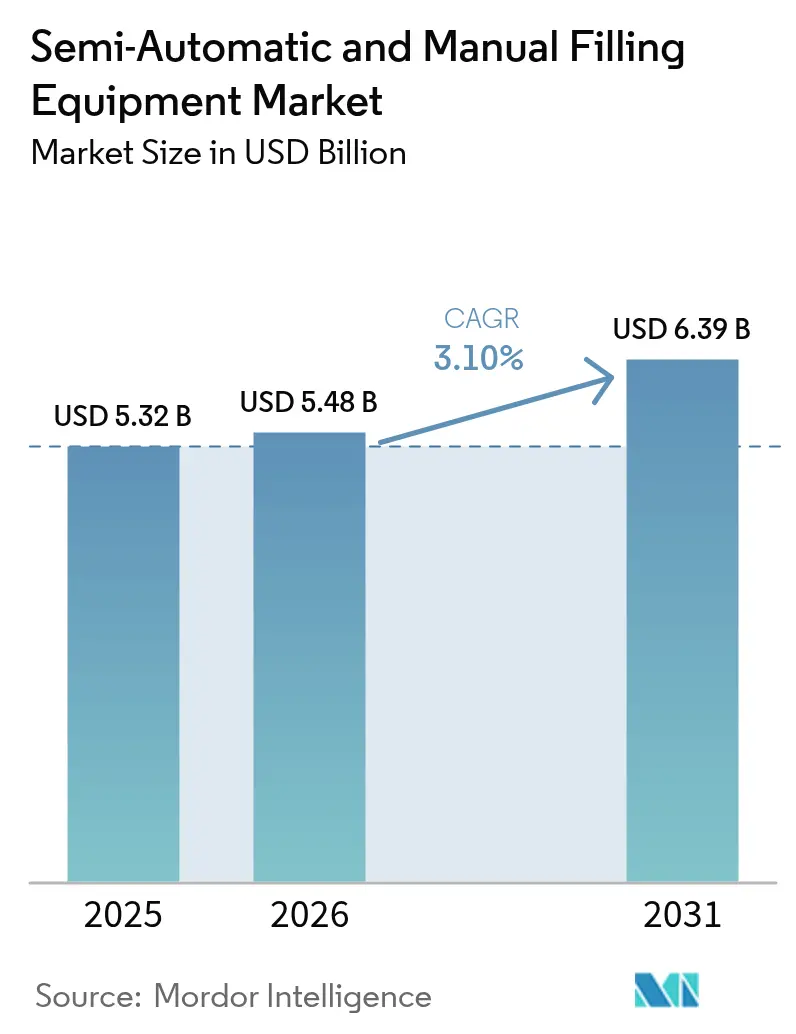
The Semi-Automatic and Manual filling equipment market size in 2026 is estimated at USD 5.48 billion, growing from 2025 value of USD 5.32 billion with 2031 projections showing USD 6.39 billion, growing at 3.10% CAGR over 2026-2031. Current expansion hinges on steady demand for adaptable, lower-capital-expenditure machinery that helps manufacturers align throughput with fluctuating order volumes while complying with tightening food and drug regulations. Semi-automatic systems hold 86.43% of the 2024 Semi-Automatic and Manual filling equipment market share because they combine modest automation benefits with quick format changeovers that suit mid-scale enterprises. Craft beverage growth, personalized pharma batches, and modular upgrades that create incremental capacity all reinforce purchasing activity. Competitive intensity remains high as European incumbents and emerging Asian vendors offer modular designs and built-in data logging to satisfy electronic batch record rules.
Key Report Takeaways
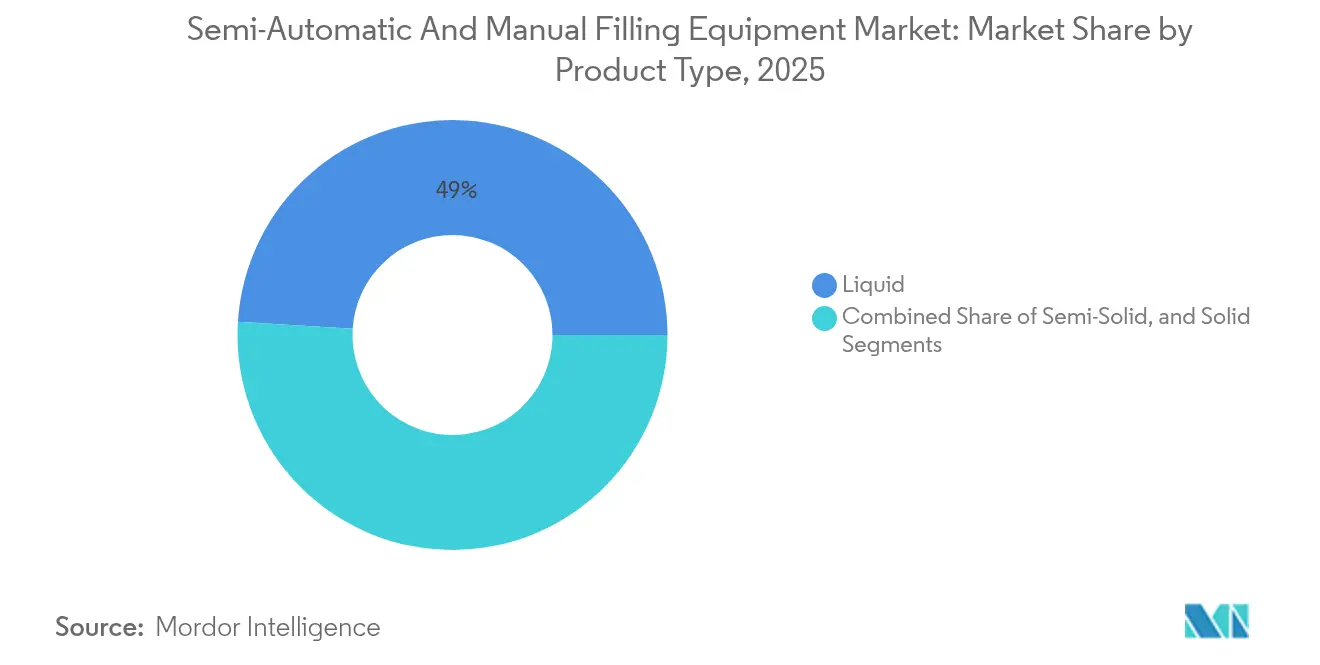
- By product type, liquid applications captured 49.02% of the semi-automatic and manual filling equipment market share in 2025.
- By end-user industry, the market size for food processing is forecast to advance at a 4.12% CAGR through 2031.
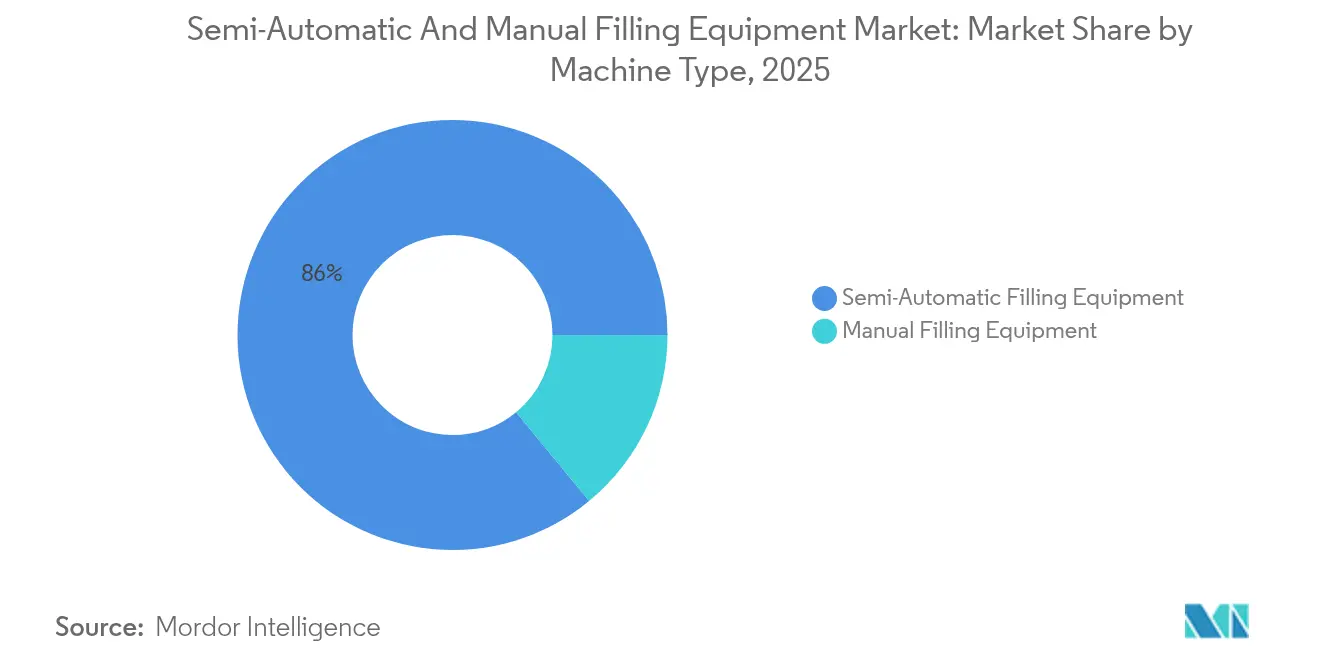
- By machine type, semi-automatic systems captured 85.96% of the semi-automatic and manual filling equipment market share in 2025.
- By container type, the market size for pouches and sachets is forecast to advance at a 3.78% CAGR through 2031.
- By geography, Asia-Pacific captured 43.12% of the semi-automatic and manual filling equipment market share in 2025.
Note: Market size and forecast figures in this report are generated using Mordor Intelligence’s proprietary estimation framework, updated with the latest available data and insights as of 2026.
Market Trends and Insights
Drivers Impact Analysis of Semi-Automatic And Manual Filling Equipment Market*
| Driver | (~) % Impact on CAGR Forecast | Geographic Relevance | Impact Timeline |
|---|---|---|---|
| Accelerated Adoption of Modular Semi-Automatic Lines by SME Food Processors | +0.8% | Global, early gains in Asia-Pacific and North America | Medium term (2-4 years) |
| Surge in Low-Volume Personalised Pharma Production Needing Manual Fillers | +0.6% | North America and EU, expanding to Asia-Pacific | Long term (≥ 4 years) |
| Expansion of Craft Beverage Brands Demanding Flexible Filling Solutions | +0.5% | North America core, spill-over to EU and APAC | Short term (≤ 2 years) |
| Regulatory Push for E-Batch Records Spurring Smart Semi-Automatic Retrofits | +0.4% | Global, led by FDA and EU compliance regions | Medium term (2-4 years) |
| Retail Refill-Station Boom Boosting Portable Manual Fillers | +0.3% | EU & North America, emerging urban Asia-Pacific | Long term (≥ 4 years) |
| Micro-Factory Growth in Emerging Economies Favouring Low-CAPEX Manual Kits | +0.4% | APAC core, expanding to MEA and South America | Medium term (2-4 years) |
| Source: Mordor Intelligence | |||
Accelerated Adoption of Modular Semi-Automatic Lines by SME Food Processors
Small and mid-size food companies are investing in modular semi-automatic equipment that permits stepwise scale-up while meeting preventive-control mandates under 21 CFR Part 117.[1]U.S. Food and Drug Administration, “Advanced Manufacturing,” FDA.gov Plug-and-play fillers minimize installation downtime, let processors run seasonal stock-keeping units without extensive retooling, and support the Semi-Automatic and Manual filling equipment market by extending machine life through incremental module swaps. Equipment houses are bundling cloud-based monitoring to capture production data that auditors now request at line-level granularity. Modular skid frames also facilitate relocation when processors move to new food-grade premises, thereby preserving earlier capital investments.
Surge in Low-Volume Personalised Pharma Production Needing Manual Fillers
The move toward patient-specific treatments has increased demand for manual and semi-automatic fillers with precise dose control, suitable for batches that rarely exceed several thousand units. FDA guidance on advanced manufacturing highlights equipment agility over sheer speed. Manual fillers support clinical trial lots and orphan-drug runs where changeovers are frequent and stringent cleaning verification is mandatory. Vendors are integrating closed-loop weight checks and single-use product paths to reduce the risk of cross-contamination. This niche solidifies the Semi-Automatic and Manual filling equipment market, as pharmaceutical buyers favor flexible skids over fixed-format, high-speed lines.
Expansion of Craft Beverage Brands Demanding Flexible Filling Solutions
Alcohol and Tobacco Tax and Trade Bureau data indicate continued growth in licensing among small breweries, cideries, and ready-to-drink cocktail producers.[2]Alcohol and Tobacco Tax and Trade Bureau, “Annual Statistical Report,” TTB.gov Craft players need fillers that shift between bottle sizes, can ends, or keg units in minutes, and semi-automatic variants satisfy this agility gap. Machine builders answer with universal clamps, servo-driven capping heads, and recipe storage for carbonated or nitrogen-infused products. The craft wave thus keeps the Semi-Automatic and Manual filling equipment market vibrant in North America and increasingly in Europe and Asia, where local specialty brands follow similar business models.
Regulatory Push for E-Batch Records Spurring Smart Semi-Automatic Retrofits
FDA 21 CFR Part 211 and parallel EU rules press companies to capture real-time batch data. Retrofitting legacy semi-automatic stations with sensors for temperature, volume, torque, and time stamps provides compliance without scrapping useful hardware. Suppliers now bundle edge-device gateways and validation packs that directly map into electronic batch record platforms. These upgrades extend equipment lifecycles, strengthen audit readiness, and support incremental digitalization, feeding continued purchasing within the Semi-Automatic and Manual filling equipment market.
Restraints Impact Analysis of Semi-Automatic And Manual Filling Equipment Market*
| Restraint | (~) % Impact on CAGR Forecast | Geographic Relevance | Impact Timeline |
|---|---|---|---|
| High Maintenance and Downtime Costs for Semi-Automatic Machines | -0.7% | Global, particularly affecting emerging markets | Short term (≤ 2 years) |
| Skilled-Operator Shortages in Developing Regions | -0.5% | APAC emerging markets, MEA, and South America | Medium term (2-4 years) |
| Global Phase-Out of Legacy Pneumatics Inflating Retrofit Spend | -0.4% | Global, higher impact in established regions | Long term (≥ 4 years) |
| Volatile Food-Grade Lubricant Pricing Raising Total Cost of Ownership | -0.3% | Global, with raw-material price swings | Short term (≤ 2 years) |
| Source: Mordor Intelligence | |||
High Maintenance and Downtime Costs for Semi-Automatic Machines
Semi-automatic fillers introduce pneumatics, servo drives, and PLCs that need scheduled servicing and skilled troubleshooting. Replacement parts for proprietary valves or sensors can be costly, and unplanned stoppages disrupt delivery timetables. ISO/TC 313 prescribes preventive protocols that smaller firms sometimes defer, compounding wear and increasing mean-time-to-repair.[3]International Organization for Standardization, “ISO/TC 313 Packaging Machinery,” ISO.org Resulting OPEX concerns temper purchasing decisions in cash-constrained enterprises within the Semi-Automatic and Manual filling equipment market.
Skilled-Operator Shortages in Developing Regions
Plant expansions in APAC and MEA outpace vocational-training capacity, leaving a gap in technicians able to calibrate nozzles, set torque limits, or run validation cycles. Vendors have begun shipping video-guided maintenance modules and smartphone AR overlays, yet adoption is gradual where internet bandwidth is limited. Skills scarcity curbs utilization rates and slows new deployments in those regional slices of the Semi-Automatic and Manual filling equipment market.
*Our forecasts treat driver/restraint impacts as directional, not additive. The impact forecasts reflect baseline growth, mix effects, and variable interactions.
Semi-Automatic And Manual Filling Equipment Market Segment Analysis
By Product Type:
Diversified Material Handling Expands Revenue PotentialLiquid formats generated 49.02% of the revenue in 2025, illustrating an enduring alignment between standard nozzle designs and throughput for beverages, pharmaceuticals, and cosmetics. That share anchors the Semi-Automatic and Manual Filling Equipment market, as high-viscosity pumps and CIP-enabled manifolds keep productivity steady. Semi-solid products, although a minority, chart a 3.92% CAGR on the back of premium skincare balms and topical medicines that demand air-free pistons for precise dosing. Vendors bundle heated jackets and vacuum-assist modules to manage viscosity fluctuations, protecting dose repeatability. Solid dosing remains a specialized field that involves capsule filling, seasoning sachets, or vitamin powder sticks, which rely on gravimetric augers versus volumetric pistons. Growth here hinges on the popularity of nutraceuticals rather than mass throughput.
Regulatory attention spans every product class. FDA food-contact rules, as outlined in 21 CFR Part 177, require stainless steel wetted components and gaskets to be rated for high-temperature sanitation. The same rules also apply to cosmetic and OTC factories that share equipment between edible and topical SKUs. For solids and semi-solids, single-use contact kits simplify cleaning and demonstrate to auditors that batch segregation is airtight.



By End-User Industry:
Beverage Strength Holds While Food AcceleratesBeverages accounted for 24.41% revenue in 2025, reflecting entrenched bottle-and-can infrastructure and sustained craft-brew licensing expansion. Carbonated drink reformulations, hard seltzers, and functional waters continue to require accurate degassing or foam-control modules, which are typically found in semi-automatic lines. Food processing, however, is on pace for a 4.12% CAGR as SME snack and sauce producers convert home-grown processes into commercial volumes. Compliance with the Preventive Controls rule encourages them to purchase pre-validated fillers for allergen changeovers, thereby nudging penetration higher. Pharmaceuticals maintain incremental gains through personalized medicine and orphan-drug policies, which increase demand for flexible, small-footprint skids. Cosmetics and household goods, although smaller slices, leverage brand premiumization utilizing glass droppers, airless pumps, and recyclable aluminum to justify equipment retrofits that support non-traditional containers.
Cross-industry commonalities lie in audit expectations, including batch traceability, hygienic design, and minimized product loss. The Semi-Automatic and Manual filling equipment market, therefore, favors designs that replicate similar hygienic baselines while offering tooling quick swaps for divergent product viscosities.
By Machine Type:
Semi-Automatic Architecture Retains PrimacyMachine-type segmentation shows semi-automatic variants with an 85.96% stake and a 3.26% CAGR outlook. Control PLCs paired with manual oversight create the sweet spot for output per capital dollar, which is critical for mid-tier processors. Servo-driven pistons hit up to 40 cycles per minute while retaining hand-fed flexibility for specialty runs. Manual stations continue to sell into bespoke applications vial filling in clinical research, barrel-aged craft ales, or startup condiment lines, where operators require tactile control and visual feedback. Manual models also serve as pilot platforms preceding higher-throughput investments, ensuring a persistent, if niche, addressable pocket within the broader Semi-Automatic and Manual filling equipment market.
Safety regulations amplify the divergence. EU Machinery Directive 2006/42/EC obliges OEMs to integrate guards, e-stops, and interlocks, which can be more easily built into semi-automatic frames. Buyers appreciate the pre-certified CE badges that accelerate factory approvals and reduce insurance premiums.
By Container Type:
Flexible Packages Gain Ground Without Displacing Rigid LeadersRigid bottles and jars comprised 39.22% receipts in 2025, capitalizing on mature glass and PET supply chains plus consumer familiarity. Semi-automatic monoblocs with rotary turrets manage both carbonated and still liquids, ensuring continued factory reliance. Yet pouches and sachets are projected to grow at a 3.78% CAGR, driven by portability, e-commerce mailing efficiencies, and lower material footprints. Tube applications bring incremental upside for premium skincare and prescription creams, where airless dosing extends shelf life. Cans stay stable, tied to ready-to-drink spirit cocktails and energy drinks, fields that value metal’s barrier properties. The Semi-Automatic and Manual Filling Equipment market consequently sustains a spectrum of tooling kits, ranging from vacuum-grip spouts for doypacks to nitrogen-purge injectors that preserve the headspace of craft beer.
Standards such as 21 CFR Part 177 regulate resin migration, prompting OEMs to utilize UV-resistant polycarbonate shields and quick-release seals to facilitate allergen sanitation. Flexible packaging handling introduces mechanical challenges, including pouch neck support and crease avoidance, which spur R&D budgets and drive competitive IP filings.
Geography Analysis
APAC Semi-Automatic and Manual Filling Equipment Market
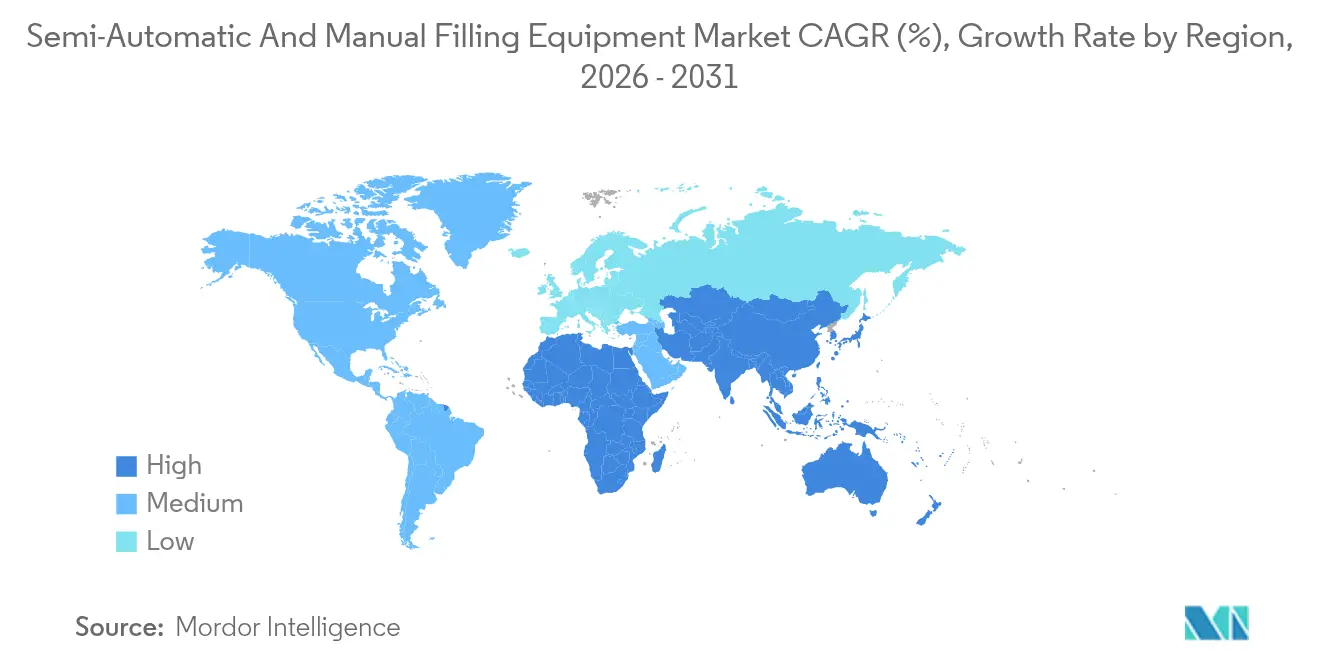
The Asia-Pacific region held 43.12% of the revenue in 2025 and is projected to advance at a 4.55% CAGR through 2031, making it both the largest and fastest-growing region within the Semi-Automatic and Manual filling equipment market. China’s National Medical Products Administration modernized dossier requirements, prompting pharma line refurbishments that favor data-logging fillers. Simultaneously, ASEAN snack brands are expanding their export footprints and adopting semi-automatic fillers that are compatible with halal and HACCP directives. Government grants for Industry 4.0 upgrades in South Korea and Singapore further subsidize smart retrofits.
North America Semi-Automatic and Manual Filling Equipment Market
North America’s mature base incrementally replaces legacy machines to embed electronic batch records and CIP manifolds. Craft beverage start-ups in the United States and Canada, buoyed by simplified licensing in several states, continue to make brisk manual filler purchases until scale justifies investments in servo-driven cappers. Food-safety litigation risk also motivates U.S. processors to prefer fillers with hygienic certifications, thereby sustaining the aftermarket revenue of the Semi-Automatic and Manual filling equipment market.
Europe Semi-Automatic and Manual Filling Equipment Market
Europe matches North American maturity but channels spending toward sustainability, lightweighting bottle projects, and refill kiosk pilots largely in the Benelux and Nordic countries. CE-marked equipment enjoys streamlined customs processing, facilitating EU manufacturers' exports to Middle East hubs. Meanwhile, European Union digital product-passport deliberations are steering capital toward traceability-enabled machines.
South America and MEA Semi-Automatic and Manual Filling Equipment Market
South America and the Middle East-Africa cluster trail in absolute terms, yet show rising micro-factory activity. Local snack flavors, herbal extracts, and artisanal household cleaners are entering domestic supermarkets, driving demand for entry-level manual kits. Currency volatility occasionally delays larger capex, but donor-financed food-security programs often bundle semi-automatic fillers into turnkey lines.

Regulatory Landscape
Compliance requirements for semi-automatic and manual filling equipment are shaped by food, pharmaceutical, and machinery-safety rules, with increasing emphasis on hygienic design, documentation, and data integrity. In the United States, FDA cGMP for finished pharmaceuticals under 21 CFR Part 211 includes controls for automatic, mechanical, and electronic equipment (for example, calibration and routine checks under 21 CFR 211.68), which supports demand for validated fillers and audit-ready data logging in regulated drug operations.
In Europe, machinery safety regulation is moving from the Machinery Directive 2006/42/EC toward Regulation (EU) 2023/1230, with a mandatory compliance deadline of January 20, 2027. That timetable is already shaping OEM redesign and recertification roadmaps. For food applications, documented good manufacturing practice for food-contact materials under Regulation (EC) No 2023/2006, along with harmonized standards such as EN 12463:2021 (safety and hygiene requirements for filling machines for pasty foodstuffs), informs material selection, cleanability expectations, guarding, and the documentation packages delivered with equipment.
Value Chain Analysis
The value chain for semi-automatic and manual filling equipment runs from R&D and application engineering to sourcing of metals and automation components, fabrication and assembly, and then distribution through OEM direct sales and integrators. The aftermarket spans spares, calibration, service, and validation support. Upstream inputs typically include stainless steel and aluminum structures (often produced via CNC machining, laser cutting, and TIG welding), plus core purchased components such as pumps and valves, servo motors, PLCs, HMI panels, and sensors that support repeatable dosing and basic data capture.
Execution bottlenecks tend to show up in the availability and lead times for higher-precision imported automation parts (servo drives, sensors, controllers), alongside the service layer needed to keep semi-automatic systems running with minimal downtime, especially in emerging regions where skilled-operator shortages are more common. On the downstream side, system integrators and regional service hubs handle installation, change-part tooling, and compliance documentation (IQ/OQ packs and calibration plans). Modular architectures and standardized spares also help OEMs and end users control total lifecycle costs and simplify retrofits that support electronic batch record and traceability requirements.
Competitive Landscape
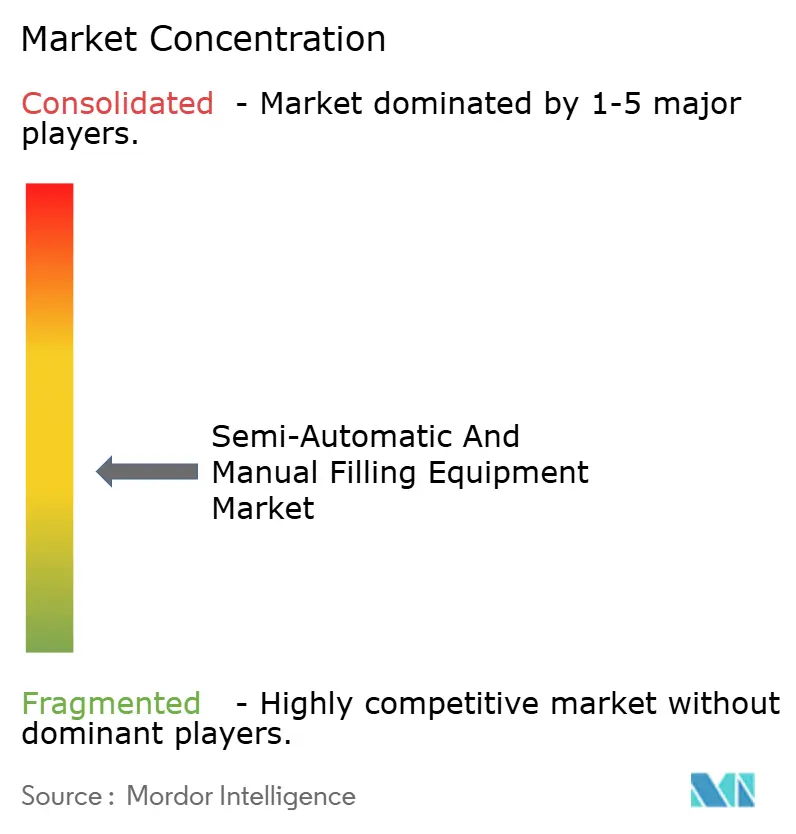
The Semi-Automatic and Manual filling equipment market remains fragmented. European stalwarts such as IMA Group, Syntegon Technology, Coesia, and GEA continue to command premium, compliance-ready portfolios. Asian challengers, particularly those from China and South Korea, offer cost-efficient modular frames, thereby narrowing the price gaps. U.S.-based ProMach and JBT Corporation rely on M&A to acquire niche technologies, such as craft-beer mobile fillers or vacuum-assisted tube fillers.
Strategic priorities cluster around Industry 4.0 features, predictive maintenance, OPC-UA connectivity, and AI-assisted anomaly detection. Patent races target quick-release tooling, servo-driven multi-format turrets, and real-time inline weight verification. Sustainability differentiators include low-energy pneumatic circuits and designs optimized for handling post-consumer-recycled resin. Pricing pressure persists, but post-sale service agreements and validation documentation add revenue resilience for established vendors.
Regional service hubs are proliferating in India, Thailand, and Mexico, thereby reducing lead times for parts and on-site technicians. Partnerships with local system integrators help Western brands adapt to domestic voltage standards and language interfaces. Meanwhile, emerging refill-station specialists provide boutique competition, though many license core valve technology from larger OEMs.
Semi-Automatic And Manual Filling Equipment Industry Leaders
IMA Group
Robert Bosch GmbH (Syntegon Technology GmbH)
ProMach Inc.
Coesia S.p.A.
GEA Group AG
- *Disclaimer: Major Players sorted in no particular order
Semi-Automatic And Manual Filling Equipment Market Companies Covered in this Report
- IMA Group
- Robert Bosch GmbH (Syntegon Technology GmbH)
- ProMach Inc.
- Coesia S.p.A.
- GEA Group AG
- Krones AG
- JBT Corporation
- Nordson Corporation
- Accutek Packaging Equipment Company, Inc.
- Liquid Packaging Solutions Inc.
- Neostarpack Co. Ltd.
- Universal Filling Machine Co.
- Vitro Phamra Company
- IC Filling Systems
- Shanghai Gieni Industry Co. Ltd.
- Jet Pack Machines Pvt Ltd.
- Lodha International LLP
- Machpack Process Machines Pvt. Ltd.
- Guangdong Rich Packing Machinery Co. Ltd.
- Shenzhen Penglai Industrial Corporation Limited
Read Analysis of Semi-Automatic And Manual Filling Equipment Companies

Market Opportunities and Future Outlook
White-space opportunities cluster around compliance-led retrofits and modular add-ons that help SMEs raise throughput without replacing installed bases. The market already shows a strong preference for semi-automatic architectures (85.96% share in 2025). At the same time, tightening pharmaceutical and food compliance requirements are translating into demand for retrofit kits that add calibrated sensors, time-stamped logging, and inspection-ready documentation aligned with FDA 21 CFR Part 211 expectations for controlled equipment use. In Europe, the shift to Regulation (EU) 2023/1230, with a January 20, 2027 compliance deadline, creates a defined upgrading window for both OEMs and end users, including safety functions, guarding, and controls on new builds and, where practical, refurbished frames.
Container diversification and hygiene standards also expand the addressable opportunity set for flexible, small-footprint platforms. Liquids account for 49.02% of revenue in 2025, while pouches and sachets are the fastest-growing container type within the report scope, increasing the need for tooling kits (pouch support, anti-crease handling, low-waste valves) that can be swapped quickly across SKUs. A related proof point is visible in suppliers presenting integrated line concepts and aseptic capability upgrades at Interpack 2026, reflecting active investment in higher-hygiene designs, faster changeovers, and data-ready architectures that can scale from semi-automatic stations into more integrated filling and packaging cells.
Recent Industry Developments in Semi-Automatic And Manual Filling Equipment Market
- April 2026: ProMach acquired Evolution BPS, a UK-based provider of packaging equipment and engineering services, expanding its local footprint in the UK and Ireland. The deal strengthens field service and project-engineering capacity that supports semi-automatic line installations, upgrades, and aftermarket response times for food and beverage users.
- April 2026: Syntegon launched RackSter, a steam-sterilizable, mobile multirack containment system designed for automated, gloveless aseptic parts transfer. This capability supports faster aseptic batch changeovers and contamination-risk reduction, aligning with pharma filling operations that increasingly prioritize validated handling and repeatable procedures.
- January 2025: IMA Group opened a pharmaceutical filling-equipment plant in Singapore, increasing its Asia-Pacific capacity to serve regional demand tied to personalized medicine and local regulatory filing needs. The investment improves proximity to fast-growing APAC customers and shortens delivery and support cycles for regulated filling applications.


Semi-Automatic And Manual Filling Equipment Market Report Scope and Research Methodology
Market Definition and Coverage
This market covers semi-automatic and manual machines used to fill solid, semi-solid, and liquid products into containers across industrial packaging lines. Values reflect equipment sales for filling tasks across common container formats used by manufacturers.
Scope exclusions: Fully automatic filling lines and downstream packaging equipment such as capping, labeling, and case packing are not counted in this sizing.
Segments Covered in This Report
- By Product Type
- Solid
- Semi-Solid
- Liquid
- By End-User Industry
- Food
- Beverage
- Pharmaceutical
- Cosmetics and Household
- Other End-User Industries
- By Machine Type
- Semi-Automatic Filling Equipment
- Manual Filling Equipment
- By Container Type
- Bottles and Jars
- Pouches and Sachets
- Cans
- Tubes
- Other Container Types
- By Geography
- North America
- United States
- Canada
- Mexico
- South America
- Brazil
- Argentina
- Rest of South America
- Europe
- Germany
- France
- United Kingdom
- Italy
- Spain
- Russia
- Rest of Europe
- Asia-Pacific
- China
- Japan
- India
- South Korea
- Australia
- Rest of Asia-Pacific
- Middle East and Africa
- Middle East
- Saudi Arabia
- United Arab Emirates
- Turkey
- Rest of Middle East
- Africa
- South Africa
- Egypt
- Nigeria
- Rest of Africa
- Middle East
- North America
Data Sources, Market Sizing, and Validation
Desk Research
Desk work starts by anchoring demand context and equipment adoption patterns across food, beverage, pharmaceutical, and cosmetics production. We reviewed public sources such as UN Comtrade trade statistics, US Census Bureau manufacturing data, Eurostat industrial production series, World Bank macro indicators, and OECD manufacturing indicators to track where packaging activity is expanding and where it is slowing.
To keep the supply side grounded, we screened company annual reports, investor presentations, and press releases for capacity additions, product launches, and channel focus. Patent databases were also reviewed to spot where semi-automatic formats are improving, for example changeover design and dosing accuracy. When needed, we used paid subscriptions for company financials and intelligence, plus a shipment-level import and export database, mainly to cross-check supplier footprint signals. The cited examples are illustrative only, since collection, validation, and clarification also used additional public and proprietary sources.
Primary Interviews and Surveys
Primary work was used to confirm what counts as semi-automatic versus manual in real buyer decisions, and to sanity check pricing and replacement cycles. We spoke with equipment manufacturers, distributors, system integrators, and end users across APAC, EMEA, and the Americas to validate assumptions around typical throughput needs, container mix, and compliance-driven upgrades, especially in regulated filling environments.
Distribution of primary research fieldwork respondents
| Company type | Respondent position | Region |
|---|---|---|
| Top tier: 31% | CXOs: 17% | APAC: 48% |
| Mid tier: 49% | Functional/Unit leaders: 31% | EMEA: 32% |
| Smaller Players: 20% | Managers: 52% | Americas: 20% |
Market-Sizing & Forecasting
Sizing is built using a top-down approach where manufacturing output and packaging activity indicators are used to reconstruct the addressable equipment spend, then filtered to the semi-automatic and manual share. In practice, this is shaped by end use production mix and the use cases where manual or semi-automatic equipment is preferred, such as small batch runs, frequent changeovers, and budget-constrained lines.
The model is corroborated using selective bottom-up approximations, including sampled average selling prices by machine category multiplied by likely unit demand ranges, plus channel feedback on order sizes. Key inputs include packaged food and beverage output trends, pharmaceutical production and compliance upgrade activity, container format shifts (bottles, jars, and bag formats), typical replacement and refurbishment cycles, and regional labor availability that influences automation choices. Where bottom-up coverage is thin in smaller countries, we fill gaps using proxy indicators such as industrial output and trade flows, then confirm with interview checks.
Forecasts are mainly built using scenario analysis, projecting the main demand drivers under a base case and then stress-testing with slower capex cycles and faster compliance-driven upgrades. Assumptions are kept traceable so a client can follow how activity indicators translate into adoption and pricing.
Data Validation & Update Cycle
Validation is handled through triangulation across independent signals, followed by outlier review before numbers are finalized. We compare growth paths with related packaging machinery trends, import and export movements for relevant equipment categories, and regional manufacturing momentum, then re-check any large variance against interview feedback.
A multi-step review process is followed, with calculations, conversions, and assumptions checked by another analyst before sign-off. The dataset is refreshed annually, and interim updates are triggered when material events occur, such as sharp currency shifts, regulatory changes that impact filling lines, or a clear step change in end user capital spending. Before delivery, the model receives a final pass so clients receive the most current view available.
Mordor Intelligence's Semi Automatic and Manual Filling Equipment Market Sizing Compared With Other Published Estimates
Published market sizes for this space can look far apart, even when the topic label is the same. The differences usually come from which equipment types are counted, which years are treated as the starting point, and how pricing and replacement demand are handled.
In semi-automatic and manual filling equipment, a common gap driver is whether estimates quietly include fully automatic lines or related packaging steps like capping and labeling, which can lift totals quickly. Another driver is the growth curve assumption, where some publishers lean on aggressive automation narratives without verifying the buying situations where manual and semi-automatic formats still persist. The spread also reflects refresh timing and how currency conversion is applied across regions with volatile exchange rates.
Benchmark comparison
| Source | Market Size | Gaps in Research Methodology |
|---|---|---|
| Mordor Intelligence | USD 5.48 B (2026) | |
| Industry Research Publisher A | USD 5.79 B (2023) | Uses an earlier base year and appears to blend broader operational metrics with market sizing, which can pull in adjacent equipment activity and inflate the value relative to a strict equipment-only scope. |
| Industry Research Publisher B | USD 6.50 B (2024) | Reports a higher starting value and a longer horizon, and the segmentation approach suggests a wider inclusion set and faster growth assumptions, which can raise the total if automation upgrades and operating modes are not separated cleanly. |
The table shows that scope control and starting-year choice explain much of the difference, especially when adjacent packaging equipment is mixed into the count. By tying the total to semi-automatic and manual filling equipment sales and validating pricing and replacement timing through field checks, the baseline stays more traceable to real buying patterns, which is the approach applied by Mordor Intelligence.


Key Questions Answered in the Report
What is the projected value of the Semi-Automatic and Manual filling equipment market by 2031?
The market is forecast to reach USD 6.39 billion by 2031, reflecting a 3.10% CAGR over 2026-2031.
Which region shows the fastest demand growth for filling equipment?
Asia-Pacific leads with a 4.55% CAGR through 2031, driven by pharmaceutical and food-processing expansion.
Why do semi-automatic machines dominate over manual alternatives?
Semi-automatic systems provide higher throughput and built-in safety features while remaining more affordable than full automation, capturing 85.96% share in 2025.
Which end-user segment is expanding quickest?
Food processing is advancing at a 4.12% CAGR as SME processors adopt compliant, flexible lines.
How are electronic batch record rules influencing equipment design?
Regulators now expect real-time batch data, prompting retrofits with sensors and connectivity to satisfy 21 CFR Part 211 and EU equivalents.
What container trend is reshaping filler specifications?
Demand for pouches and sachets is rising at a 3.78% CAGR, spurring development of pouch-support modules and low-waste dosing valves.
Page last updated on:


 Your data is secure and never sold or shared.


