
Riflescopes Market Size and Share
Market Overview
| Study Period | 2019 - 2031 |
|---|---|
| Market Size (2026) | USD 8.22 Billion |
| Market Size (2031) | USD 12.05 Billion |
| Growth Rate (2026 - 2031) | 7.95 % |
| Fastest Growing Market | Asia Pacific |
| Largest Market | North America |
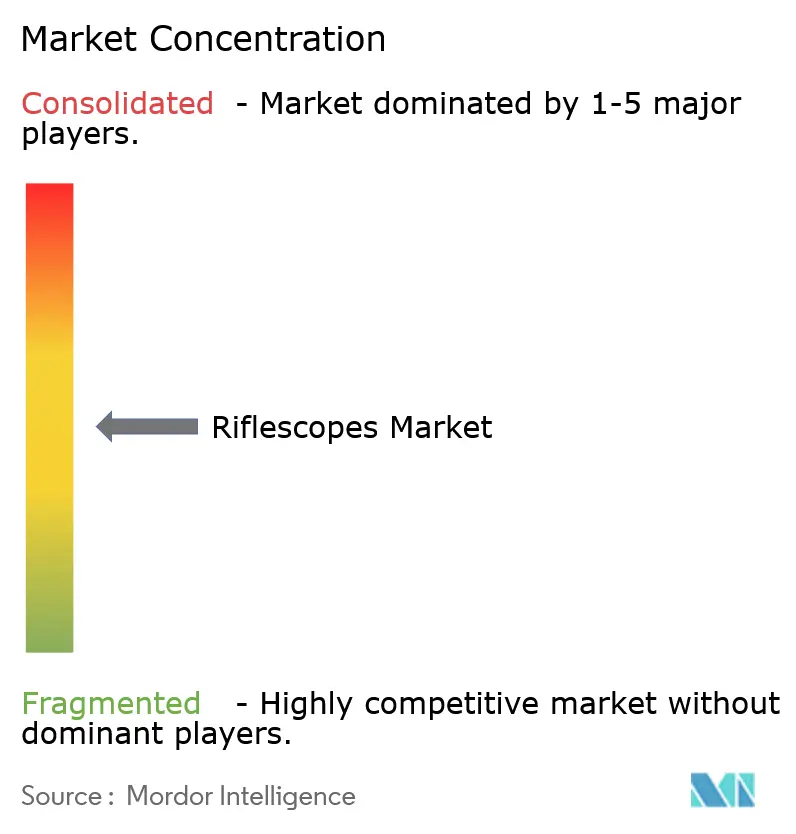
| Market Concentration | Medium |
Major Players *Disclaimer: Major Players sorted in no particular order Image © Mordor Intelligence. Reuse requires attribution under CC BY 4.0. | |
Riflescopes Market Analysis by Mordor Intelligence
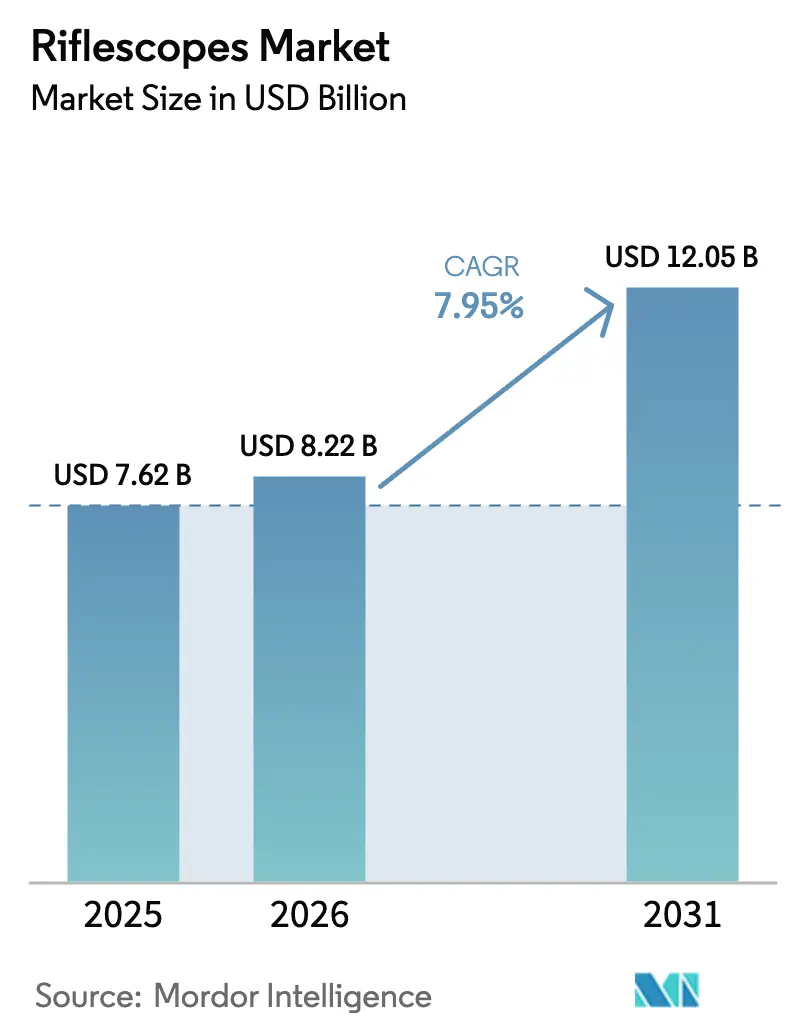
The riflescopes market size is expected to grow from USD 7.62 billion in 2025 to USD 8.22 billion in 2026 and is forecasted to reach USD 12.05 billion by 2031 at a 7.95% CAGR over 2026-2031. This growth curve is underpinned by an upswing in global defense budgets, resilient participation in recreational shooting, and the accelerated migration from passive glass to digitally enabled fire-control optics. US and allied infantry modernization programs are specifying smart scopes that fuse laser range-finding, environmental sensing, and active reticles, while consumer e-commerce channels are expanding access to mid-tier and premium optics. Simultaneously, falling thermal sensor costs and relaxed night-hunting rules in Europe and several US states are driving the adoption of thermal imaging toward mainstream use. Competitive dynamics reveal that premium incumbents are defending their share through military contracts and warranty differentiation, even as East Asian entrants are compressing price points with feature-rich reflex sights.
Key Report Takeaways
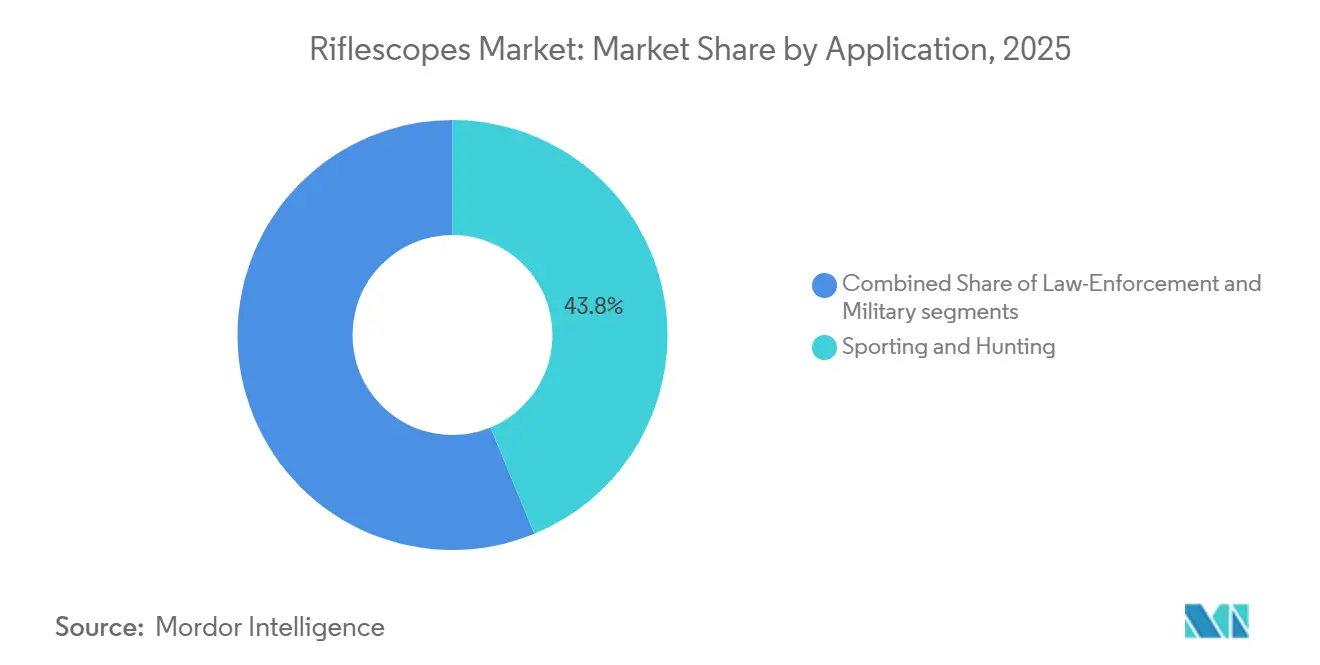
- By application, sporting and hunting led the riflescopes market with 43.78% market share in 2025, while law-enforcement procurement is advancing at a 9.78% CAGR through 2031.
- By sight type, telescopic configurations commanded 74.78% of the riflescopes market in 2025, whereas reflex and red-dot sights are growing at a 10.94% CAGR to 2031.
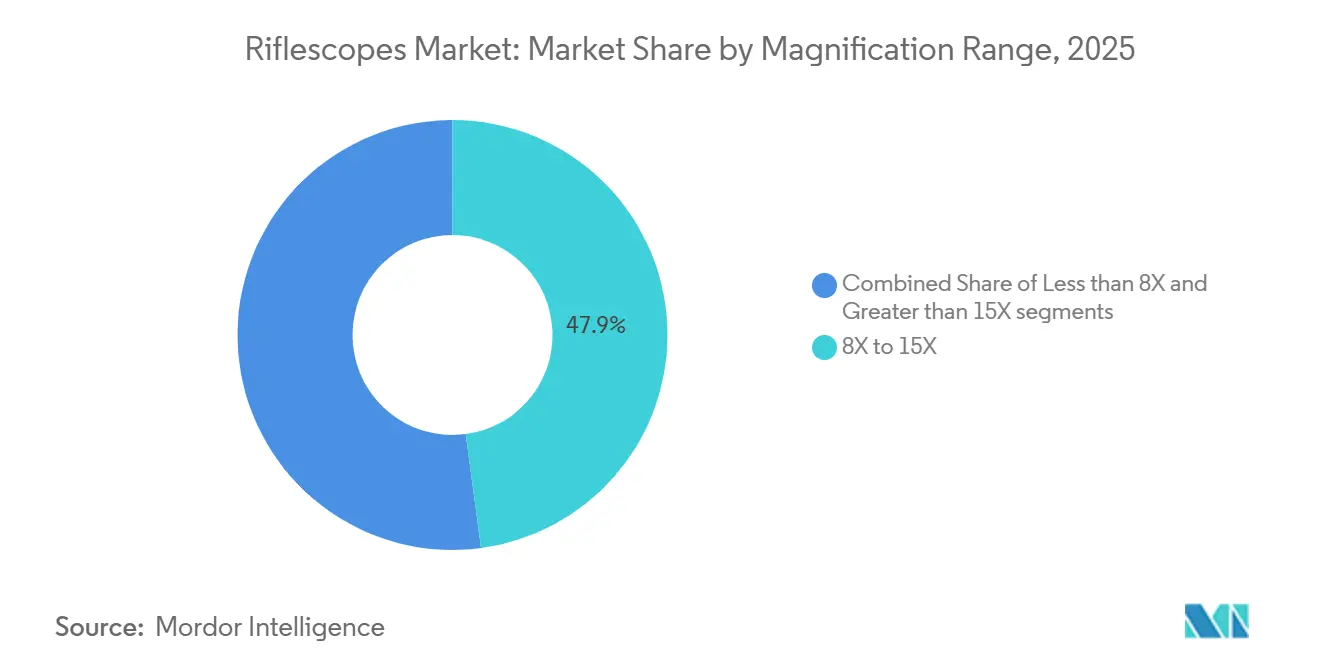
- By magnification range, 8X to 15X optics accounted for 47.89% of the riflescopes market size in 2025, yet scopes above 15X are set to expand at an 8.94% CAGR.
- By technology, electro-optical systems accounted for 51.27% of the riflescopes market share in 2025, with thermal imaging poised to grow at an 8.69% CAGR through 2031.
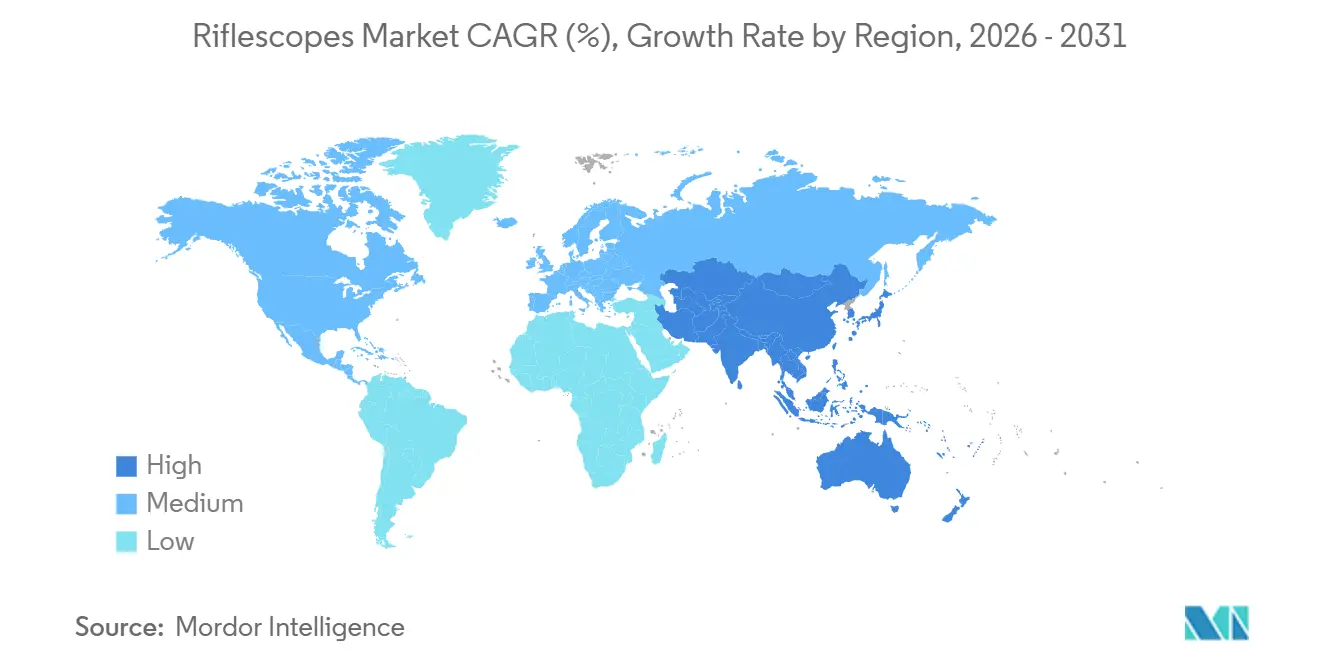
- By geography, North America held 40.12% of the riflescopes market in 2025, whereas Asia-Pacific is forecasted to deliver a 9.54% CAGR through 2031.
Note: Market size and forecast figures in this report are generated using Mordor Intelligence’s proprietary estimation framework, updated with the latest available data and insights as of January 2026.
Market Trends and Insights
Drivers Impact Analysis of Riflescopes Market*
| Driver | (~) % Impact on CAGR Forecast | Geographic Relevance | Impact Timeline |
|---|---|---|---|
| Rising global defense spending and infantry modernization programs | +1.20% | Global, especially North America and Asia-Pacific | Long term (≥ 4 years) |
| Rapid optical technology upgrades (HD glass, integrated range-finding) | +1.10% | Global | Medium term (2–4 years) |
| Growing participation in recreational shooting sports | +0.80% | North America, Europe | Medium term (2–4 years) |
| Expansion of e-commerce channels for hunting optics | +0.70% | North America, Europe, Asia-Pacific | Short term (≤ 2 years) |
| Escalating wild-boar populations driving night-hunting demand | +0.60% | Europe, North America | Medium term (2–4 years) |
| Emergence of AI-enabled “smart rifle” platforms | +0.30% | North America, select Asia-Pacific markets | Long term (≥ 4 years) |
| Source: Mordor Intelligence | |||
Growing Participation in Recreational Shooting Sports
US target-shooting participation stabilized at 47 million enthusiasts in 2022, creating a dependable upgrade cycle for mid-range and premium scopes.[1] Many shooters are transitioning from entry-level 3-9x glass to higher-magnification first-focal-plane models that support precision rifle disciplines. In Europe, Germany’s 1.4 million licensed shooters face recurring permit renewals, motivating them to spend more on optics to maximize the value of a limited firearms fleet. Consequently, the riflescopes market sees robust demand for premium European glass in Central Europe, while North American volume sustains competitive mid-tier brands. Growing female participation and collegiate-shooting programs add new customer cohorts who favor lighter, low-power variable optics. These factors collectively lift average selling prices and unit volumes across the riflescopes market.
Rising Global Defense Spending and Infantry Modernization Programs
World military outlays surged to USD 2,718 billion in 2024, the steepest annual increase since records began, and a sizable portion is earmarked for soldier-borne optics. The US Army’s XM157 program demonstrates a doctrinal appetite for electro-optical fire control systems that blend laser range-finding with atmospheric sensing.[2] Allied nations are following suit: Japan lifted its 2025 defense allocation by 16.4%, India is channeling USD 130 billion into domestically designed gear, and Australia’s 2024–2025 budget prioritizes AUKUS-aligned rifle-optic upgrades. Multi-spectral solutions that merge day, thermal, and laser channels are now standard requirements in special-operations solicitations, guaranteeing high-margin follow-on orders for firms with prior NATO stock numbers. These procurement waves not only boost immediate sales but also drive long-tail revenue through spares, training, and lifecycle upgrades.
Rapid Optical Technology Upgrades (HD Glass, Integrated Range-Finding)
HD extra-low-dispersion glass, onboard ballistic computers, and Bluetooth firmware updates have shifted from military exclusivity to mainstream sporting offerings within three years. Leica’s 2024 Calonox Sight features a 640×480 sensor and a 1,700-meter detection range, available for USD 4,500, making thermal imaging accessible to affluent hunters.[3] Burris’s Eliminator series auto-illuminates holdover points, eliminating the need for laminated drop charts. Driven by component-cost deflation, FLIR’s 12-micron detectors saw retail monocular prices drop from USD 800 to USD 599 between 2020 and 2024. This price drop enabled value brands to bundle feature-rich electronics for under USD 1,000. In retaliation, premium brands are now extending warranties and emphasizing their distinctive lens coatings. The riflescopes market is now mirroring consumer electronics trends, shifting from a traditional decade-long purchase pattern to shorter replacement cycles.
Expansion of E-Commerce Channels for Hunting Optics
Gross merchandise value at OpticsPlanet reached USD 347 million in 2024, with optics representing roughly 40% of transactions. Direct-to-consumer storefronts help brands like Vortex pocket higher margins; online revenue averaged USD 2.83 million per month in 2024. Digital storefronts also enable the rapid promotion of limited-run military-clone scopes, which fetch premium prices. However, ease of online ordering fuels counterfeit proliferation: Leupold continues to flag fake VX-3 optics on global e-marketplaces. Brands are therefore investing in serialization, blockchain-based provenance, and exclusive online bundles to preserve integrity and differentiate from copycats.
Restraints Impact Analysis of Riflescopes Market*
| Restraint | (~) % Impact on CAGR Forecast | Geographic Relevance | Impact Timeline |
|---|---|---|---|
| Stringent firearm-ownership and hunting regulations | –0.9% | Europe, Canada, parts of Asia-Pacific | Long term (≥ 4 years) |
| Proliferation of low-cost counterfeit scopes from East Asia | –0.6% | North America, Europe | Short term (≤ 2 years) |
| Shift toward unmagnified red-dot sights on modern sporting rifles | –0.8% | North America, Europe | Medium term (2–4 years) |
| Stricter lead-glass environmental directives raising production costs | –0.4% | EU member states | Medium term (2–4 years) |
| Source: Mordor Intelligence | |||
Stringent Firearm-Ownership and Hunting Regulations
Obtaining a German hunting license requires a 120-hour course and fees exceeding EUR 2,000 (USD 2,328.42), thereby narrowing the pool of potential optics buyers. France levies annual license costs of EUR 150-390 (USD 174.63-454.04) and caps magazine capacity at three rounds, thereby curbing demand for tactical-style scopes. The EU’s 2017/853 directive harmonizes stricter renewals and medical checks, further tightening civilian access.[4] These administrative and financial barriers reduce unit volumes but encourage remaining buyers to opt for high-end optics, thereby cushioning revenue while limiting the expansion of the riflescopes market.
Proliferation of Low-Cost Counterfeit Scopes from East Asia
Leupold’s serial-number look-up reveals a rising share of forgery queries on platforms such as AliExpress, where counterfeit VX-3 models sell for approximately one-quarter of the price of authentic models. The NRA uncovered fake Meprolight and Magpul sights that shattered under recoil, exposing users and agencies to liability. While Holosun’s legitimate USD 159 red-dot blurs price disparities, unchecked counterfeits erode consumer trust. Major brands combat the issue with holographic stickers and online authenticity portals, but enforcement lags due to jurisdictional hurdles. The riflescopes market, therefore, faces margin compression and potential safety recall costs in the entry-level tiers.
*Our forecasts treat driver/restraint impacts as directional, not additive. The impact forecasts reflect baseline growth, mix effects, and variable interactions.
Riflescopes Market Segment Analysis
By Application:
Law Enforcement Outpaces Legacy SegmentsLaw enforcement demand for electro-optical and thermal fusion sights is forecasted to grow at a 9.78% CAGR between 2026 and 2031, surpassing the broader riflescopes market. Sporting and hunting still account for 43.78% of the riflescopes market share in 2025, driven by 47 million US recreational shooters and Europe’s 1.5 million licensed hunters. Agency procurements bundle optics with new service rifles, illustrated by a USD 1.29 million NYPD package that included Nightforce scopes. Military contracts remain lumpy yet lucrative; SOCOM’s USD 96 million multi-application scope award in 2024 evidences premium pricing.
The riflescopes market size gains in law enforcement reflect modernization budgets that prioritize low-power variable and clip-on thermal devices for active-shooter scenarios. Sporting optics bifurcate: cost-sensitive buyers opt for scopes under USD 500 from China, while affluent hunters purchase scopes costing USD 2,000 or more. Government sales pipelines favor vendors with GSA schedules and proven durability metrics, creating barriers to entry for newer brands. Consequently, optics makers balancing civilian volume with institutional contracts will capture outsize market share gains in the riflescopes market.

By Sight Type:
Reflex Platforms Gain at Telescopic ExpenseTelescopic models still accounted for 74.78% of the riflescopes market revenue in 2025; however, reflex and red-dot platforms are projected to grow at a 10.94% CAGR through 2031. Aimpoint’s factory collaboration with Glock introduces enclosed red dots on service pistols, signaling institutional confidence in unmagnified optics. Meanwhile, Holosun’s solar-charging dots, priced at USD 235, reduce maintenance burdens.
Traditional scopes retain the lion’s share of the riflescopes market size for hunting and long-range target sports. Still, entry-level 3X to 9X SKUs are bleeding volume to 1X to 8X low-power variable optics and budget red dots. Market leaders, therefore, diversify with hybrid designs that embed fiber-optic illumination and quick-throw levers to stay relevant. The telescopic segment’s premium sub-category, however, enjoys insulated demand among precision rifle competitors and high-end hunters who value rugged turrets and lifetime warranties.
By Magnification Range:
Ultra-Long-Range Gains TractionMid-range 8X to 15X optics held a 47.89% market share in the riflescopes market in 2025, striking a balance between versatility and cost. Yet scopes above 15X will expand at an 8.94% CAGR as disciplines like King-of-2-Miles popularize 25X-plus optics. Nightforce’s 5X to 25X civilian variant, priced at USD 2,800-3,200, caters to this surge.
Low-power 1X to 4X and 1X to 6X products grow in absolute terms, but they concede market share as shooters either skip magnification entirely or opt for high-powered glass for ethical long-range shots. Digital overlays, such as Swarovski’s dS Gen II, which compute holdover in real-time, further differentiate ultra-long-range offerings. The riflescopes market therefore stratifies, with distinct buyer segments for dynamic carbine matches, mainstream hunting, and extreme-distance competitions.
By Technology:
Thermal Imaging Closes Gap on Electro-OpticalElectro-optical platforms still commanded 51.27% of the riflescopes market share in 2025; however, thermal imaging is advancing at an 8.69% CAGR. FLIR’s Scout TK price cut to USD 599 illustrates sensor cost erosion. Finland’s legal green light for thermal wild-boar hunts accelerates adoption, and Germany’s state derogations add further momentum.
Export-control ceilings cap resolution and frame rate on internationally shipped units, compelling vendors to maintain dual product lines. Nonetheless, thermal clip-ons that preserve existing zero positions are proving popular among hunters invested in premium day scopes. As a result, the riflescopes market size attributed to thermal devices will steadily converge toward that of electro-optical devices over the medium term.
Geography Analysis
North America Riflescopes Market
North America’s 40.12% of the riflescopes market in 2025 rested on the US’ defense-procurement pipeline and 47 million recreational shooters. The US Army’s XM157 rollout from 2026 ensures recurring spares demand, while SOCOM’s USD 96 million night-scope award in 2024 underscores appetite for multi-spectral systems. Canada’s 8% drop in license sales reflects demographic shifts, yet premium optics sales remain stable due to a committed core of hunters. Mexico’s consumer market is negligible due to stringent ownership rules, which limit optics demand to official agencies.
APAC Riflescopes Market
Asia-Pacific will chart a 9.54% CAGR to 2031, fueled by India’s USD 130 billion defense budget, Japan’s 16.4% spending hike, and Australia’s AUKUS-aligned modernization. South Korea directs part of its USD 44.9 billion allocation to advanced fire-control systems, boosting local optical manufacturing. China’s domestic night-vision market surpassed RMB 1 billion (USD 143.10 million) in 2019 and continues to grow at an annual rate of over 20% backed by localized detector production.
EMEA and South America Riflescopes Market
Europe’s riflescopes market expansion is tempered by strict licensing; Germany counts 400,000 hunters, France 1.1 million, and a preference for premium optics that rationalize high compliance costs. Thermal-scope uptake is climbing after Finland’s regulatory shift and Germany’s state derogations, while competitive-shooting circuits in the UK sustain high-magnification demand despite only 710,000 firearm certificates. Beyond Europe, the UAE and Saudi Arabia earmarked USD 28 billion and USD 75.8 billion, respectively, for defense in 2024, with infantry optics high on their procurement lists. South America remains nascent, though Brazil’s regulatory softening modestly lifts law-enforcement optics purchases. Africa’s fragmented economies limit broader adoption, aside from niche hunting-tourism demand in South Africa.
Regulatory Landscape
Regulation in the riflescopes market is shaped by firearm-access rules for civilian end users, and by export controls and sourcing rules for defense-grade and digitally enabled optics. In the United States, optics specially designed for firearms on the USML fall under ITAR (administered by the Directorate of Defense Trade Controls under the Arms Export Control Act), while many commercial optical sighting devices are controlled under the Export Administration Regulations (EAR) via BIS, including ECCN 0A504 in the Commerce Control List. These frameworks influence export-configured variants, including thermal and digital models, and they affect channel strategies for global brands serving both institutional and civilian demand.
Procurement and industrial policy add another compliance layer for suppliers serving military programs. The FY2026 NDAA, signed on December 18, 2025, includes requirements aimed at eliminating DoD reliance on optical glass, infrared materials, and optical systems sourced from covered nations by January 1, 2030. That timeline pushes primes and sub-tier suppliers to document origin and qualify alternate materials. Separately, BIS published revisions affecting licensing posture for optical sighting devices in 2025, highlighting how export licensing for optics can shift and change lead times and addressable export markets for US-based manufacturers.
Competitive Landscape
Global market concentration is moderate: the top five players, Leupold & Stevens Inc., Vista Outdoor, Vortex Optics, Burris Company, and Nightforce Optics, account for a significant share, leaving the remaining to a long tail of regional premium houses and price-aggressive Asian entrants. Premium incumbents, such as Leupold, Vortex, and Nightforce, defend their turf with military contracts, lifetime warranties, and high-quality glass, thereby reinforcing pricing power in the USD 1,500-plus bracket. East-Asian challengers like Holosun and HIKMICRO are nibbling away at the entry-level and mid-tier segments by offering solar-charged red dots and sub-USD 1,800 thermal optics.
Strategic moves trend toward vertical integration and direct-to-consumer playbooks. Vortex’s e-commerce channel alone generated nearly USD 34 million in annual online sales, enabling the swift launch of contract-clone optics without involving distributors. Aimpoint’s OEM partnership with Glock places its ACRO P-2 red-dot on factory pistols and guarantees institutional volume. On the technology front, Swarovski’s dS Gen II and Zeiss’s OLED overlays represent the push toward bright optics within the premium tier. Patent filings, including 12 by Vortex and multiple by Leupold from 2022 to 2024, underscore a pivot toward embedded sensors and modular rangefinder add-ons.
Regulatory compliance is emerging as a moat: EU lead-free mandates raise barriers for low-budget producers, while US export-control regimes restrict high-resolution thermal sales, favoring firms with dual product lines. Counterfeit risk persists; however, brands embracing serialization and blockchain provenance gain consumer trust. Overall, the riflescopes market is characterized by accelerated product cycles, higher feature density, and omnichannel sales strategies.
Riflescopes Industry Leaders
-
Nightforce Optics
-
Leupold & Stevens, Inc.
-
Revelyst (Vista Outdoor Operations LLC)
-
Sheltered Wings, Inc. d/b/a Vortex Optics
-
Burris Company (Beretta Holding S.A.)
- *Disclaimer: Major Players sorted in no particular order
Riflescopes Market Companies Covered in this Report
- Leupold & Stevens, Inc.
- Sheltered Wings, Inc. d/b/a Vortex Optics
- Burris Company (Beretta Holding S.A.)
- Nightforce Optics
- HENSOLDT AG
- SIG SAUER, Inc.
- Carl Zeiss AG
- Swarovski-Optik AG & Co KG
- Steiner Optik GmbH (Beretta Holding S.A.)
- Trijicon, Inc.
- Aimpoint AB
- Holosun Technologies, Inc.
- KAHLES GmbH
- Meopta s.r.o.
- BSA Optics
- Revelyst (Vista Outdoor Operations LLC)
- The Kinetic Group (Czechoslovak Group)
Market Opportunities and Future Outlook
Defense modernization is creating whitespace for integrated fire-control optics that combine direct-view optics with sensors, aiming lasers, and software-centric upgrades. In March 2026, the US Army issued a market survey for commercial off-the-shelf direct view optics, aiming lasers, and mounting hardware compatible with MIL-STD-1913 (Picatinny) rails for shoulder-fired weapons. The survey favors vendors with modular interfaces, rapid fielding readiness, and established mounting ecosystems. It also aligns with the report's shift toward digitally enabled fire-control optics, expanding opportunity for suppliers that can package optics, lasers, and mounts as interoperable kits rather than standalone scopes.
Counter-drone and moving-target engagement requirements are also broadening the use of smart-scope capabilities beyond niche special operations. Smart Shooter secured multiple 2026 follow-on awards across US military branches for SMASH fire control systems, including a May 2026 US Army follow-on contract and additional US Navy and US Marine Corps awards in June 2026, providing concrete procurement evidence for AI-assisted rifle optic and fire-control demand. On the commercial side, manufacturers continue to refresh premium and mid-tier portfolios with new optical architectures, such as FN Herstal's April 2026 PUREVIEW holographic micro red dot sight using waveguide technology. Together, these developments support near-term product differentiation in reflex and red-dot categories as customers trade up from legacy glass.
Recent Industry Developments in Riflescopes Market
- July 2026: Leupold and Stevens announced new illuminated reticle options for its Mark 4HD riflescopes, extending the family toward low-light and duty-oriented use cases. The update builds on the scope line while addressing demand for faster reticle acquisition in law-enforcement and tactical-style sporting applications.
- December 2025: Meprolight (SK Group) was awarded a contract by the armed forces of a Southern European country to provide its MIL-SPEC MVO 1-8x28 LPVO riflescopes for short- to mid-range tactical operations. The win supports premium pricing for ruggedized low-power variable optics and reinforces the role of NATO-aligned military requirements in shaping product roadmaps and qualification pathways.
- July 2024: US Special Operations Command awarded a USD 96 million multi-application scope contract, highlighting continued institutional spending on advanced soldier-borne optics. The award points to long-tail aftermarket opportunity through spares, training, and lifecycle support, and it raises the competitive bar for durability, standardization, and supply assurance among scope suppliers.
Riflescopes Market Report Scope and Research Methodology
Market Definition and Coverage
For this study, we define the riflescopes market as revenues generated from rifle mounted aiming optics sold for civilian, law enforcement, and military use, including conventional optical scopes and electronic aided scopes that support target acquisition.
Scope exclusions: Excludes firearm platforms, mounts and rings as standalone items, and non-rifle handheld optics unless they are sold as part of a riflescope unit.
Segments Covered in This Report
- By Application
- Sporting and Hunting
- Law-Enforcement
- Military
- By Sight Type
- Telescopic
- Reflex/Red-Dot
- By Magnification Range
- Less than 8X
- 8X to 15X
- Greater than 15X
- By Technology
- Electro-Optical
- Thermal Imaging
- Laser
- By Geography
- North America
- United States
- Canada
- Mexico
- South America
- Brazil
- Rest of South America
- Europe
- Germany
- United Kingdom
- France
- Russia
- Italy
- Rest of Europe
- Asia-Pacific
- China
- Japan
- India
- Australia
- Rest of Asia-Pacific
- Middle East and Africa
- Middle East
- Saudi Arabia
- UAE
- Rest of Middle East
- Africa
- South Africa
- Rest of Africa
- Middle East
- North America
Data Sources, Market Sizing, and Validation
Desk Research
Desk research was used to build the demand and supply context that sits behind the sizing model. We relied on public defense budget documents and procurement releases, plus international trade statistics for optical instruments from UN Comtrade and national customs agencies, to understand directionally where spending and shipments are moving.
To ground civilian demand, we reviewed participation and license indicators from state wildlife agencies (hunting licenses and tags) and national statistical agencies where leisure participation is tracked, then cross-referenced published safety and product standards from ISO and relevant national standards institutes. We also used patent databases to track feature evolution in electro-optical and thermal aiming, and we screened company annual reports, investor presentations, and reputable press for pricing cues and product mix commentary. Where available, we used select paid subscriptions for company financials and an import and export shipment-level database to cross-check results. The sources listed above are illustrative only, and many additional public references were consulted for data collection, cross-checking, and clarification.
Primary Interviews and Surveys
Primary work was run to pressure test what we saw in public sources and to fill the gaps that usually show up in pricing, channel mix, and feature adoption. We spoke with manufacturers, distributors and retailers, plus end user experts in civilian shooting, law enforcement purchasing, and defense oriented programs. Inputs from these interviews helped us validate assumptions around magnification mix, thermal and electro-optical penetration, and replacement cycles across regions.
Distribution of primary research fieldwork respondents
| Company type | Respondent position | Region |
|---|---|---|
| Top tier: 27% | CXOs: 18% | APAC: 46% |
| Mid tier: 53% | Functional/Unit leaders: 39% | EMEA: 34% |
| Smaller Players: 20% | Managers: 43% | Americas: 20% |
Market-Sizing & Forecasting
Sizing starts with a top-down build where defense procurement signals, civilian participation indicators, and trade flows are used to reconstruct the addressable spend on rifle aiming optics by region. Those totals are then split using observed mix indicators for sight type and technology, and we adjust year to year for price movement so value does not get overstated when volumes are stable.
To keep the numbers grounded, we corroborate the results with selective bottom-up approximations such as sampled ASP times unit volumes from channel checks, plus supplier revenue roll-ups for the largest product families where financial disclosure is available. Key model inputs include the share shift between telescopic and reflex style products, the magnification band mix (less than 8X, 8X to 15X, and greater than 15X), the adoption rate of thermal and electro-optical features, replacement cadence for heavily used units, and region level demand pull from hunting activity and institutional procurement cycles.
For forecasting, we used scenario analysis supported by a light multivariate regression check, where drivers like defense spend direction, civilian participation levels, and expected ASP drift were varied, then aligned to expert consensus from interviews. Where bottom-up evidence is thin for smaller regions or niche technologies, gaps are handled by applying conservative penetration curves and validating the resulting shares against trade and channel signals.
Data Validation & Update Cycle
Validation is done through multiple cross-checks so that no single data stream drives the full outcome. We compare modeled totals against independent signals such as trade value trends for relevant optical categories, public procurement activity, and implied unit economics derived from channel pricing, then investigate any sharp variance before sign-off.
A second analyst review is run to test assumptions, and follow-up calls are triggered when outliers appear in regional splits, technology adoption, or pricing progression. The report is refreshed on an annual cycle, with interim updates when material events occur, and a final pre-delivery check is completed so clients receive the latest view available at the time of release.
Mordor Intelligence's Riflescopes Market Size Compared With Other Published Estimates
Published market sizes for riflescopes often differ because each publisher makes slightly different calls on what to include, what year to anchor on, and how price movement is carried into the forecast. Even when the same product label is used, totals can shift based on whether reflex sights are counted with scopes, how electro-optical features are treated, and how currency conversion timing is handled across regions.
The main gap comes from whether reflex and red-dot sights, plus thermal imaging and laser enabled sight categories, are fully counted inside the riflescopes total, and how Mordor Intelligence keeps the scope to rifle mounted aiming optics with a consistent sight-type and technology split applied before ASPs are progressed year by year.
Benchmark comparison
| Source | Market Size | Gaps in Research Methodology |
|---|---|---|
| Mordor Intelligence | USD 8.22 B (2026) | |
| Industry Research Publisher A | USD 7.02 B (2024) | Anchors on an earlier base year and uses a different growth runway, and its public outline does not clearly show how sight-type inclusion and year-by-year ASP movement are standardized across regions. |
| Global Consultancy B | USD 8.23 B (2026) | Starts near the same year value, but differences in end-use weighting and how technology adoption is carried into pricing can change the implied trajectory versus a shorter forecast window. |
Across the table, the spread is mostly explained by what is counted as a riflescope product, plus the base year and price progression assumptions. Our write-up keeps the math traceable to observable demand signals and repeatable splits by sight type, magnification band, and technology, which makes it easier to reconcile year to year changes.
Key Questions Answered in the Report
How large is the riflescopes market in 2026 and how fast will it grow?
The riflescopes market size reached USD 8.22 billion in 2026 and is forecasted to grow at a CAGR of greater than 7.95%, hitting USD 12.05 billion by 2031.
Which application will add the most new revenue through 2031?
Law-enforcement agencies are projected to outpace all other segments with a 9.78% CAGR as they replace legacy glass with thermal-capable and rapid-acquisition optics.
What technology trend is reshaping product portfolios the fastest?
Thermal imaging is advancing at an 8.69% CAGR thanks to sensor cost declines and regulatory changes allowing night-hunting in Europe and parts of the US.
Which region offers the strongest growth outlook?
Asia-Pacific is expected to post a 9.54% CAGR, fueled by rising defense budgets in India, Japan, South Korea, and Australia.
How are brands protecting themselves against counterfeit optics?
Leading manufacturers now embed serial-number lookup tools, holographic seals, and blockchain-based provenance systems to help consumers verify authenticity and safeguard brand equity.
Why are red-dot sights challenging traditional low-power scopes?
Competitive shooting rules, law-enforcement preferences, and aggressive USD 159–USD 300 pricing from Asian suppliers have shifted demand toward unmagnified reflex sights for engagements within 100 meters.