
Large Caliber Ammunition Market Size and Share
Market Overview
| Study Period | 2020 - 2032 |
|---|---|
| Market Size (2027) | USD 7.26 Billion |
| Market Size (2032) | USD 9.51 Billion |
| Growth Rate (2027 - 2032) | 5.55 % |
| Fastest Growing Market | Asia-Pacific |
| Largest Market | North America |
| Market Concentration | Medium |
Major Players *Disclaimer: Major Players sorted in no particular order Image © Mordor Intelligence. Reuse requires attribution under CC BY 4.0. | |
Large Caliber Ammunition Market Analysis by Mordor Intelligence
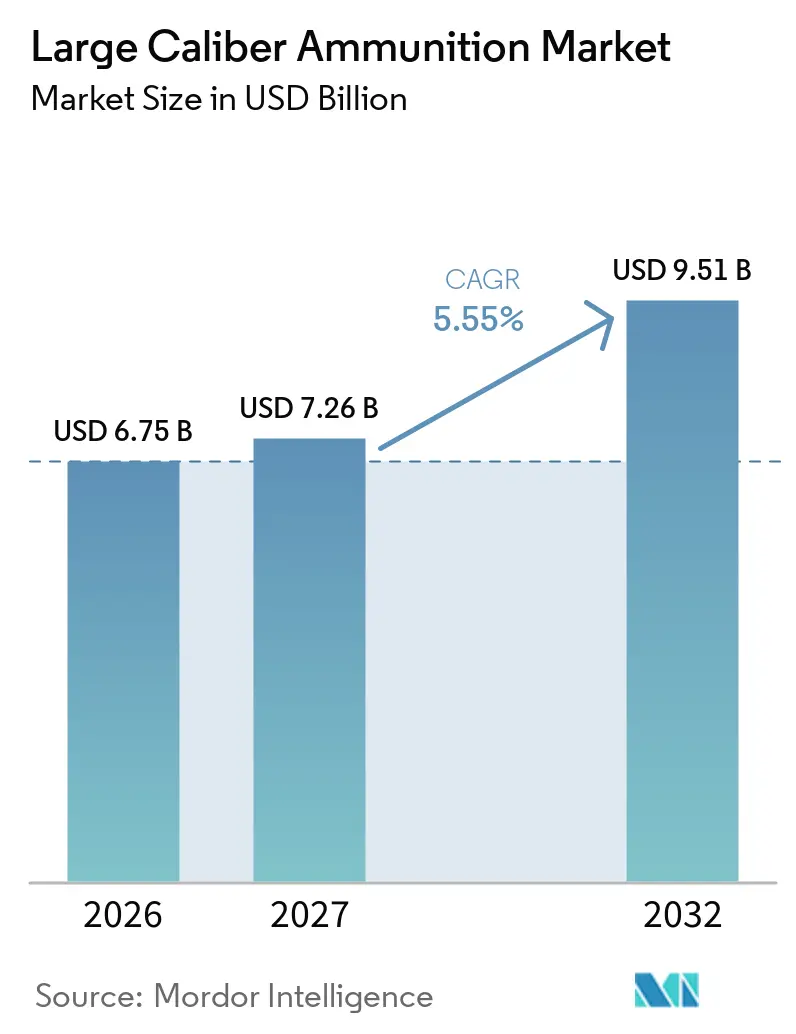
The large caliber ammunition market size was valued at USD 6.75 billion in 2026 and is projected to grow from USD 7.26 billion in 2027 to USD 9.51 billion by 2032, registering a 5.55% CAGR between 2027 and 2032. The opening forecast year reflects the effect of replenishment contracts that were placed before longer-term production capacity becomes available. Demand is supported by revised reserve requirements among NATO members and parallel readiness efforts among Indo-Pacific partners. Governments are moving from short procurement cycles to multi-year agreements that give producers clearer visibility into demand. The largest incremental buyers often lack complete domestic production chains, while established producers face large order backlogs. This pattern creates opportunities for localized production, secure input supply, and common qualification processes across allied markets
Key Report Takeaways
- By product type, artillery ammunition accounted for 38.91% share of the large caliber ammunition market in 2026, while mortar ammunition is projected to grow at a 7.37% CAGR through 2032.
- By end user, military procurement accounted for 55.27% share of the large caliber ammunition market in 2026, while law enforcement and homeland security are projected to grow at an 8.43% CAGR through 2032.
- By guidance, guided ammunition held 57.18% share of the large caliber ammunition market in 2026, while non-guided ammunition is projected to grow at a 6.68% CAGR through 2032.
- By component, fuzes held 39.72% share of the large caliber ammunition market in 2026, while propellants are projected to grow at an 8.58% CAGR through 2032.
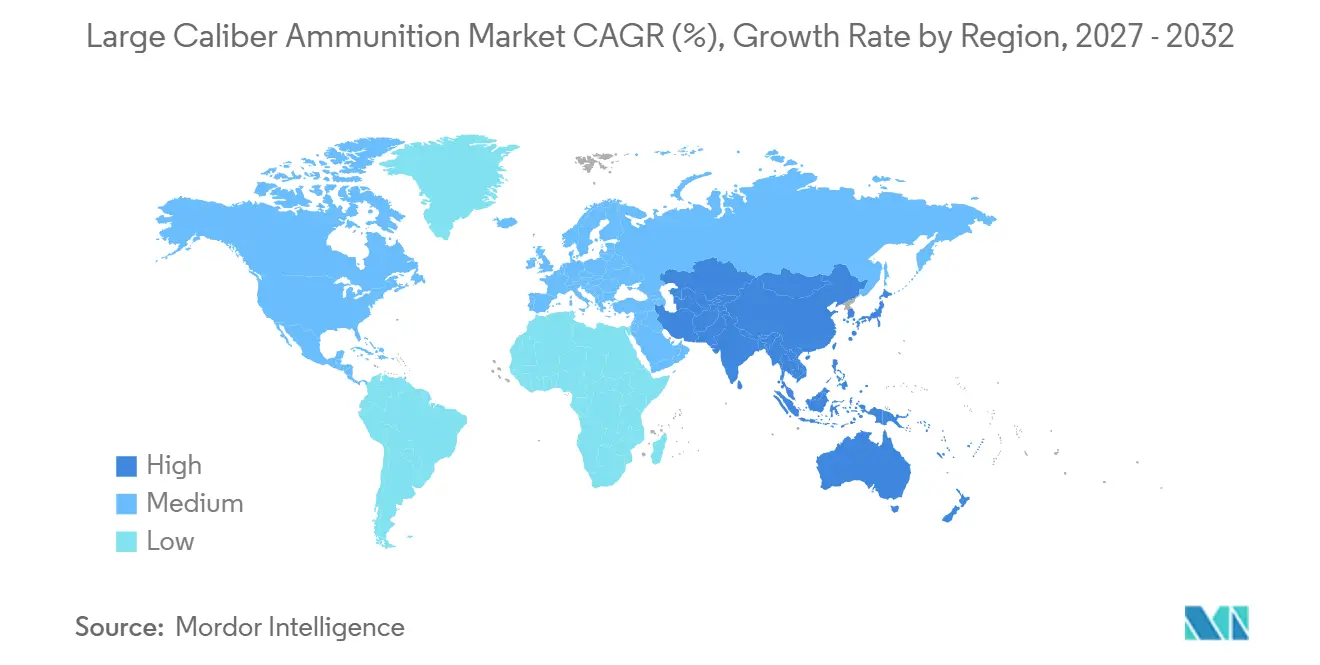
- By geography, North America held 46.72% share of the large caliber ammunition market in 2026, while Asia-Pacific is projected to grow at an 8.11% CAGR through 2032.
Note: Market numbers in this report are based on Mordor Intelligence's proprietary estimation framework, which combines nine months of actuals with Q4 projections for base year 2026.
Global Large Caliber Ammunition Market Trends and Insights
Drivers Impact Analysis*
| Driver | (~) % Impact on CAGR Forecast | Geographic Relevance | Impact Timeline |
|---|---|---|---|
| Defense stockpile replenishment and readiness procurement | +1.80% | Global, NATO core and Eastern Europe primary | Short term (≤ 2 years) |
| Artillery modernization and long-range fires investment | +1.20% | North America and Europe | Medium term (2-4 years) |
| Domestic production incentives and supply-security policies | +0.90% | Asia-Pacific, Europe, and North America | Medium term (2-4 years) |
| Precision-guided and extended-range ammunition adoption | +0.70% | North America and Europe | Long term (≥ 4 years) |
| Production localization around alliance interoperability standards | +0.50% | Europe and Asia-Pacific | Medium term (2-4 years) |
| Modular ammunition and platform-life extension programs | +0.40% | North America and Europe | Long term (≥ 4 years) |
| Source: Mordor Intelligence | |||
Defense Stockpile Replenishment and Readiness Procurement
The large caliber ammunition market is supported by efforts to restore reserves after years of procurement based on peacetime consumption. The US Department of Defense (DoD) reported that the Army had spent USD 4.5 billion on 155mm production infrastructure from February 2022 through September 2025. The same assessment recorded 36,000 155mm load, assemble, and pack rounds per month in March 2026, against an Army target of 100,000 rounds per month. This gap links demand to both finished shells and the industrial inputs needed to produce them. Rheinmetall received its first call-off under a NATO Support and Procurement Agency framework in February 2026 for 120mm tank ammunition, with an order value of around EUR 200 million (USD 236.16 million). Long-term call-offs can support steadier production schedules than one-time emergency orders.
Artillery Modernization and Long-Range Fires Investment
Long-range fire programs are increasing the technical demands placed on large-caliber rounds. General Dynamics Ordnance and Tactical Systems received a US Army ERAP contract in June 2026 for its Vulcano 155mm Guided Long Range round.[1] Rheinmetall and General Atomics also agreed in June 2026 to examine co-production of the Vektrex maneuverable 155mm munition. These programs extend demand beyond projectile bodies to guidance, fuzes, and modular propellant systems. Higher-pressure charge requirements for 52-caliber platforms also increase the importance of specialized chemical production. Producers that can validate complete round systems are better placed to serve these programs. The large caliber ammunition market, therefore, benefits from modernization spending even when basic replenishment needs begin to ease.
Domestic Production Incentives and Supply-Security Policies
Governments are using multi-year procurement, local-content requirements, and state-backed capacity programs to strengthen domestic supply. Munitions India Limited reported FY2025-2026 revenue of INR 10,954 crore (USD 1.3 billion), representing 33.35% growth from the prior year. The company's results reflect a stronger role for domestic procurement in India's ammunition supply chain. In Germany, Rheinmetall opened its Werk Niedersachsen facility in Unterlüß in September 2025 after less than 15 months of construction. The facility was designed to produce 140,000 155mm shells in 2026 and 350,000 in 2027. Such programs can alter supplier rankings because capacity is increasingly located near the countries' funding demand.
Precision-Guided and Extended-Range Ammunition Adoption
Guided rounds are moving closer to core procurement requirements for missions that require precision and flexible effects. Northrop Grumman received a multi-year US Army contract in June 2026 to produce the M1147 Advanced Multi-Purpose 120mm tank ammunition round. The M1147 uses programmable settings for point detonation, delay, and airburst functions. This type of round can replace multiple legacy types and reduce the range of ammunition that must be carried and managed. Demand for guidance and programmable fuze systems gives component specialists a larger role in round value. The large caliber ammunition market retains a distinct high-volume need for conventional rounds, but guided designs expand the addressable value of each platform.
Restraints Impact Analysis*
| Restraint | (~) % Impact on CAGR Forecast | Geographic Relevance | Impact Timeline |
|---|---|---|---|
| Explosives, propellant, and nitrocellulose bottlenecks | -0.70% | Europe and North America | Short term (≤ 2 years) |
| Qualification and safety certification lead times | -0.50% | Europe and Global | Medium term (2-4 years) |
| Budget volatility and multi-year contract dependence | -0.50% | Global | Medium term (2-4 years) |
| Digital guidance, fuze, and energetics integration complexity | -0.30% | North America, Europe, and Asia-Pacific | Long term (≥ 4 years) |
| Source: Mordor Intelligence | |||
Explosives, Propellant, and Nitrocellulose Bottlenecks
Propellant and nitrocellulose availability remain a material constraint on the large caliber ammunition market. Rheinmetall acquired Hagedorn-NC GmbH in April 2025 to secure a domestic source of nitrocellulose for military applications.[2] The action shows that control of energetic materials has become a production priority, rather than a routine procurement activity. A shortage at this stage limits the output of otherwise completed shell plants and filling lines. It can also delay delivery against contracts, even where the final assembly capacity exists. Producers with access to secure energy and propellant supplies can reduce this exposure, while companies reliant on external sources face greater delivery risk.
Qualification and Safety-Certification Lead Times
Qualification requirements can delay the conversion of newly installed capacity into fielded ammunition. Suppliers must demonstrate that rounds meet technical, safety, and performance requirements before national forces can accept deliveries. This process is particularly demanding when projectiles integrate new fuzes, guidance systems, or propellant configurations. Separate approvals across customer countries can add costs and delay revenue recognition. The resulting barrier favors producers with established test records and recognized manufacturing controls. The large caliber ammunition market may therefore experience a delay between public production announcements and sustained output.
*Our forecasts treat driver/restraint impacts as directional, not additive. The impact forecasts reflect baseline growth, mix effects, and variable interactions.
Segment Analysis
By Product Type: Artillery Shells Anchor Demand While Mortar Rounds Lead Category Growth
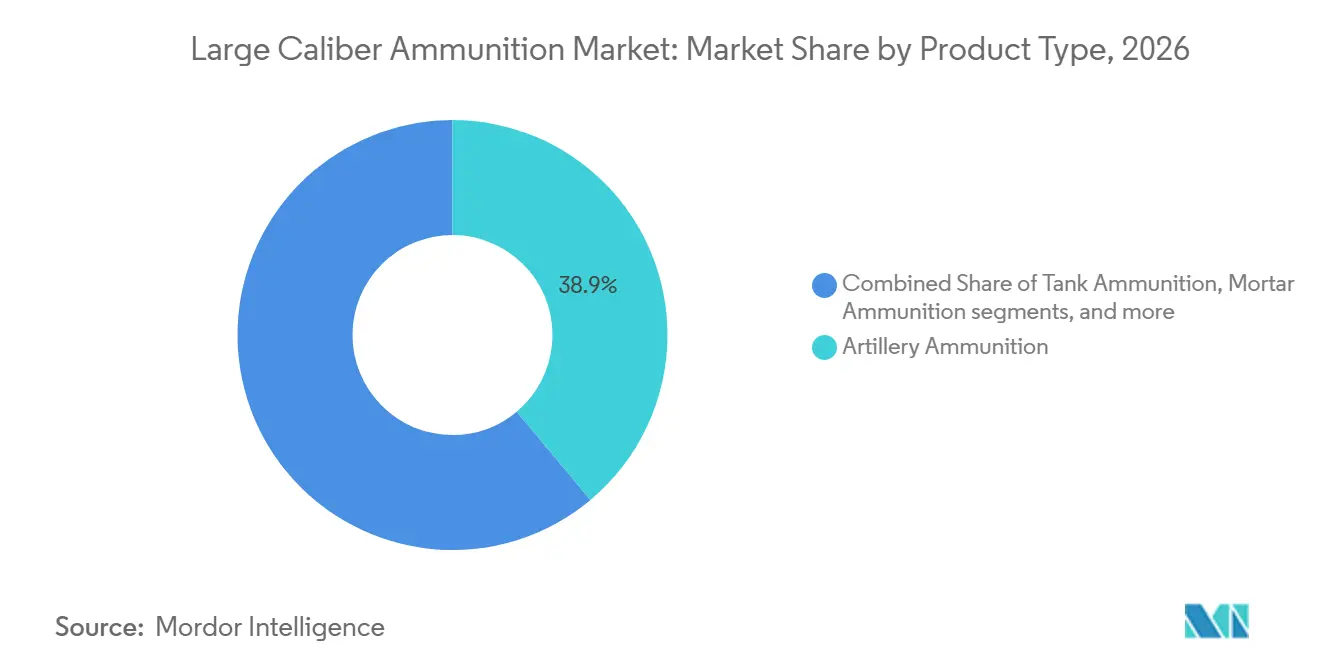
Artillery ammunition accounted for 38.91% of the large caliber ammunition market share in 2026, with 155mm rounds the primary driver of demand. Western replenishment programs and factory expansions remain heavily focused on this caliber. The US Army reported that its 155mm load, assemble, and pack capacity was 36,000 rounds per month in March 2026. Rheinmetall’s Unterlüß facility is planned to add a substantial 155mm output during 2026 and 2027.[3] Tank ammunition remains a secondary demand center, with Rheinmetall’s February 2026 call-off providing direct evidence of continued 120mm requirements.
Mortar ammunition is forecast to record the fastest product-type CAGR at 7.37% through 2032. Its growth is linked to decentralized infantry support, in which lighter crew-served systems can provide shorter response times. Mortar demand complements artillery demand because many forces are refreshing several fire-support categories simultaneously, and flexible lines can serve both high-volume 155mm orders and smaller-caliber requirements. Naval ammunition and rocket artillery remain relevant to platform modernization. The large caliber ammunition market is therefore anchored by artillery output, with mortar rounds contributing the strongest growth rate.

By End-Users: Military Procurement Commands Volume, Law Enforcement Accelerates from a Low Base
Military procurement accounted for 55.27% of the market share for large-caliber ammunition in 2026. Army orders are central because they include requirements for howitzer, tank, and mortar ammunition. Northrop Grumman’s multi-year M1147 contract shows sustained military demand for programmable tank ammunition. Military buyers use multi-year frameworks to protect production capacity and support stockpile planning, as shown by Rheinmetall’s NATO procurement framework for 120mm tank ammunition. This customer group continues to set the volume requirements that determine investment in manufacturing capacity.
Law enforcement and homeland security are forecast to be the fastest-growing end-user categories at an 8.43% CAGR through 2032. The segment begins with a smaller base than military procurement. Its expansion reflects the use of heavy-caliber systems by internal security and paramilitary agencies in selected countries, while also adding an alternative source of demand when military budget cycles are uneven. Suppliers must address the separate procurement rules and operational needs of these customers. The large caliber ammunition market depends on military buyers for scale, while this category creates a smaller but faster-growing demand stream.
By Guidance: Guided Rounds Lead in Revenue as Unguided Output Surges on Replenishment Demand
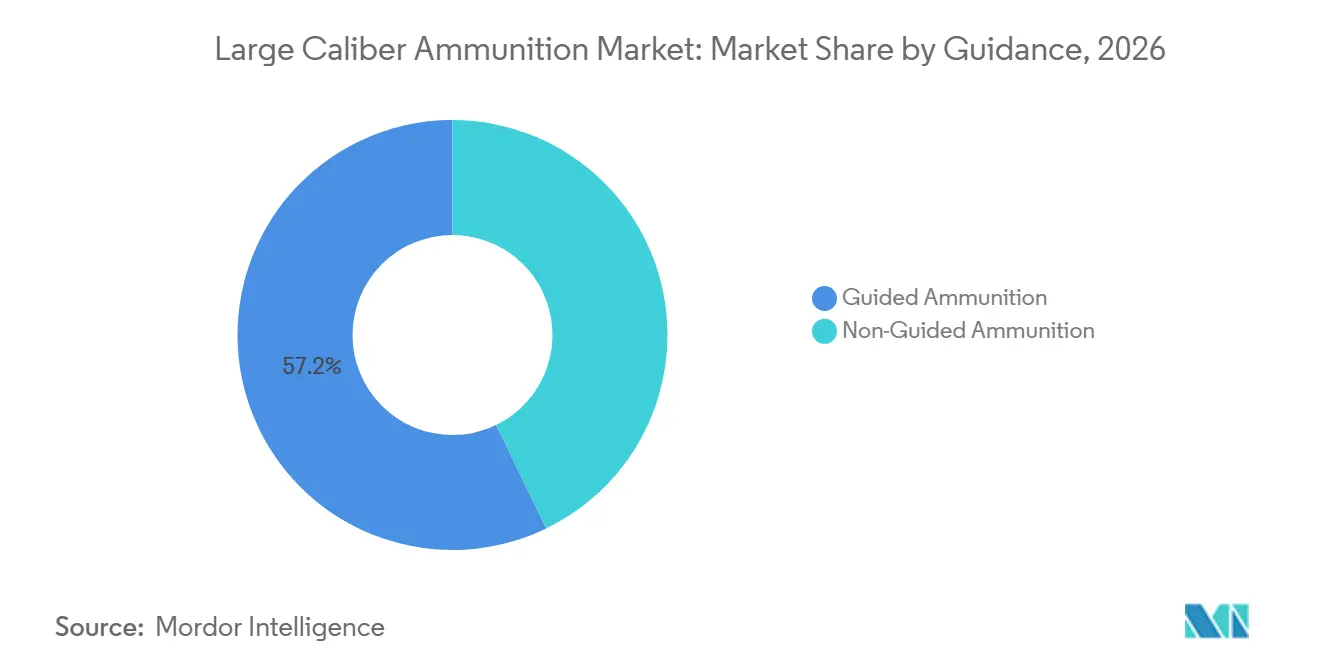
Guided ammunition accounted for 57.18% of the market share for large-caliber ammunition in 2026, reflecting the higher value of rounds that integrate guidance and programmable fuze functions. Northrop Grumman’s M1147 round illustrates how one programmable munition can cover point-detonation, delay, and airburst requirements. The US Army’s ERAP award to GDOTS further shows demand for extended-range guided 155mm designs. These systems can command greater per-round value and increase the role of specialist component suppliers and testing capabilities. Guided rounds, therefore, lead to revenue even when their physical output is below the volume of conventional production.
Non-guided ammunition is projected to expand at a 6.68% CAGR through 2032. Governments confronting stockpile gaps first need widely available standard rounds that can be delivered in volume. CSG stated that its large-caliber artillery and tank ammunition capacity exceeded 800,000 rounds on an annualized basis during the first quarter of 2026. This scale supports the replenishment cycle, while inventory recovery can shift procurement toward precision upgrades and extended-range capabilities. The large caliber ammunition market thus combines a high-value guided segment with a faster-growing non-guided segment.
By Component: Fuzes Lead in Value, Propellants Race to Close Sovereign Supply Gaps
Fuzes accounted for 39.72% of the market share for large-caliber ammunition in 2026, supported by the value of multi-mode and programmable technologies. The M1147 contract shows the role of fuze settings in creating a flexible ammunition effect for tank forces. Guidance-linked fuzes can increase the value captured by component specialists within the finished projectile. Primers, cartridge cases, projectile bodies, and warheads remain necessary parts of every round. Component security is increasingly linked to the ability to deliver complete ammunition systems.
Propellants are projected to grow at an 8.58% CAGR through 2032, reflecting both higher ammunition production and investment in sovereign energy supply. Rheinmetall’s acquisition of Hagedorn-NC was designed to strengthen its access to nitrocellulose for military applications. Propellant availability can limit finished-round output when chemical inputs are constrained, and it is a strategic entry point for companies serving domestic production policies. The large caliber ammunition market, therefore, places a premium on secure inputs and modular charge capability.
Geography Analysis
North America held 46.72% of the large caliber ammunition market share in 2026, supported by the US Army procurement, established industrial infrastructure, and regional manufacturing investment. The US DoD reported a monthly load, assembly, and pack capacity of 36,000 155mm rounds in March 2026. The Army projected 140,000 rounds per month by December 2027, subject to facility ramp-ups, and CSG began work on a Future Artillery Complex in Iowa during 2026. North America remains a key center of demand and production because its procurement base can support long-duration capacity commitments and the qualification of new lines.
Asia-Pacific is forecast to record the fastest regional CAGR at 8.11% through 2032. The region combines domestic capacity initiatives with strategic stockpile investment across South Korea, India, Japan, and Australia. Munitions India Limited’s FY2025-2026 revenue of INR 10,954 crore (USD 1.3 billion) points to the scale of domestic procurement activity in India. Regional manufacturers are gaining relevance as governments reduce dependence on overseas supply and seek capacity that can serve both national demand and regional export opportunities. This mix of domestic demand and industrial investment supports the region’s leading growth outlook.
Europe remains central to the large caliber ammunition market as it rebuilds stockpiles and expands capacity to meet NATO demand. Rheinmetall’s Unterlüß facility is scheduled to reach 350,000 155mm shells of annual output in 2027. Germany also supported a new ammunition factory in Lithuania through a November 2025 groundbreaking initiative. The Middle East and Africa remain secondary demand areas. At the same time, South America is more focused on legacy artillery systems.
Competitive Landscape
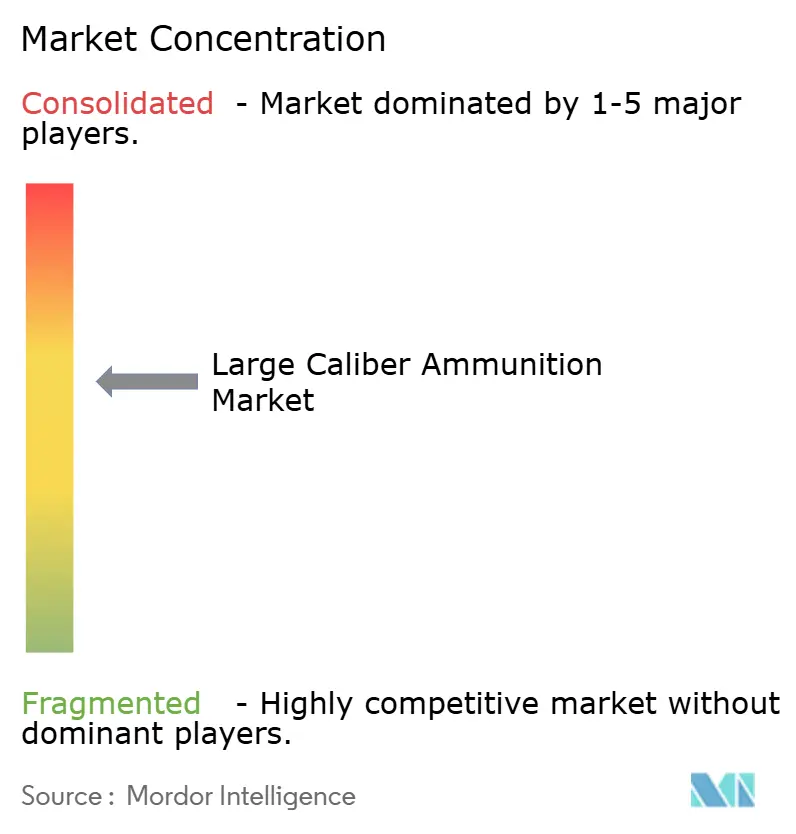
The large caliber ammunition market is moderately consolidated among tier-1 manufacturers, with NATO-aligned programs led by Rheinmetall AG, General Dynamics Corporation, BAE Systems plc, and Northrop Grumman Corporation. Rheinmetall strengthened vertical integration by acquiring Hagedorn-NC GmbH to secure nitrocellulose supply. It's February 2026, NATO Support and Procurement Agency call-off for 120mm tank ammunition, and its Unterlüß factory expansion shows a strategy built around long-term frameworks, material control, and final-round capacity. This approach can reduce exposure to input constraints and strengthen delivery certainty for allied customers.
Northrop Grumman is competing through multi-year US Army contracts and advanced ammunition designs. Its June 2026 M1147 contract supports its role in programmable 120mm tank ammunition. General Dynamics Ordnance and Tactical Systems is positioned in extended-range artillery through the June 2026 ERAP award for Vulcano 155mm Guided Long Range. CSG adds competitive pressure through high-volume artillery and tank ammunition capacity, which exceeded 800,000 rounds annually in the first quarter of 2026. Competition is taking place across conventional capacity, secure inputs, and higher-value guidance systems, rather than on a single production metric.
Within the large caliber ammunition market, opportunities are concentrated in propellant production, modular charges, and integrated guidance components. These areas address both current production bottlenecks and future precision requirements, while demonstrated quality and safety performance continues to favor established producers and qualified partners. New entrants can gain relevance when domestic policy provides funding, long-term demand, and an assured route to qualification.
Large Caliber Ammunition Industry Leaders
-
General Dynamics Corporation
-
Rheinmetall AG
-
Northrop Grumman Corporation
-
Nammo AS
-
BAE Systems plc
- *Disclaimer: Major Players sorted in no particular order
Recent Industry Developments
- June 2026: General Dynamics Ordnance and Tactical Systems (GDOTS) was awarded a US Army contract for a next-generation extended-range artillery projectile derived from the Vulcano 155 Guided Long Range system. The precision munition can achieve ranges of up to 70 km and uses GPS guidance with a Semi-Active Laser (SAL) terminal seeker. An alternative Far-Infrared seeker configuration is available for engaging sea targets and operating in GPS-contested environments.
- June 2026: Northrop Grumman was awarded a five-year US Army contract to produce the M1147 Advanced Multi-Purpose (AMP) 120mm tank ammunition for the M1 Abrams and international partners. The programmable munition consolidates the capabilities of four legacy rounds and supports point-detonate, point-detonate delay, and airburst modes against multiple target types.
Research Methodology Framework and Report Scope
Market Definition and Coverage
This market covers the value of large caliber ammunitions used on military platforms, counted as finished rounds supplied for use or stockpiling, across major regions, with the caliber range defined from 40 mm up to 155 mm.
Scope exclusions: Small arms and medium caliber rounds below 40 mm, along with weapons, launchers, and unrelated support services are not counted in this sizing.
Segmentation Overview
- By Product Type
- Artillery Ammunition
- 105mm
- 130mm
- 155mm
- 203mm
- Tank Ammunition
- 105mm
- 120mm
- 125mm
- Mortar Ammunition
- 60mm
- 81mm
- 120mm
- Naval Ammunition
- 57mm
- 76mm
- 127mm
- Rocket Artillery Ammunition
- 70mm
- 122mm
- Artillery Ammunition
- By End-User
- Military
- Air Force
- Army
- Navy
- Law Enforcement/Homeland Security
- Military
- By Guidance
- Guided Ammunition
- Non-Guided Ammunition
- By Component
- Fuzes
- Primers
- Propellants
- Projectiles and Warheads
- Cartridge Case
- Others
- By Geography
- North America
- United States
- Canada
- Mexico
- Europe
- United Kingdom
- France
- Germany
- Russia
- Rest of Europe
- Asia-Pacific
- China
- India
- Japan
- South Korea
- Rest of Asia-Pacific
- South America
- Brazil
- Rest of South America
- Middle East and Africa
- Middle East
- Saudi Arabia
- United Arab Emirates
- Rest of Middle East
- Africa
- South Africa
- Rest of Africa
- Middle East
- North America
Data Sources, Market Sizing, and Validation
Desk Research
We first defined the market boundaries and built demand indicators using public defense and trade references that can be checked and repeated. Source inputs included Stockholm International Peace Research Institute (SIPRI) releases, UN Comtrade trade statistics, NATO and national defense ministry publications, and US Government Accountability Office (GAO) procurement reviews, which helped map procurement cycles and stockpile priorities.
Next, we translated those signals into model inputs that can be consistently updated. This included national budget documents and parliamentary hearing notes, customs and shipment level trade patterns for relevant categories, and company annual reports and investor presentations for capacity and order commentary. Where disclosures were limited, we used a paid subscription for company financials, news, and patent lookups. The desk sources listed here are illustrative and not exhaustive, since other public references were also used for data collection, validation, and clarification.
Primary Interviews and Surveys
To pressure test the desk assumptions, we spoke with practitioners across procurement, manufacturing, and operations, including people familiar with artillery and mortar supply, naval ammunition planning, and testing and certification topics. We collected inputs across APAC, EMEA, and the Americas, which allowed us to compare procurement timing, replenishment behavior, and pricing movements, then use those differences to refine the final model.
Distribution of primary research fieldwork respondents
| Company type | Respondent position | Region |
|---|---|---|
| Top tier: 33% | CXOs: 12% | APAC: 51% |
| Mid tier: 49% | Functional/Unit leaders: 36% | EMEA: 31% |
| Smaller Players: 18% | Managers: 52% | Americas: 18% |
Market-Sizing & Forecasting
The core sizing starts with a top-down build where defense spending, ammunition procurement lines, and replenishment plans are translated into a demand pool for 40 mm to 155 mm rounds by region. After that structure is set, we apply selective bottom-up checks using a sampled roll-up of known supply capacity and order visibility, then run an ASP times volume reasonableness check for key calibers.
To keep the model practical, a few inputs were treated as main drivers, then updated through interviews and public signals. These drivers include artillery and mortar procurement cadence, stockpile rebuild targets, contract award timing, typical training versus operational consumption splits, and average selling price movement by caliber as materials and energy costs change. Where a country had limited disclosure, estimates were gap-filled using peer-country ratios tied to force structure and procurement frequency, then reviewed against observed tender activity and trade patterns.
For forecasting, scenario analysis was used so procurement spikes and step changes in replenishment could be captured rather than smoothed away. The scenarios were anchored on expected budget direction, planned platform readiness, and the timing of multi-year ammunition contracts that were repeatedly highlighted by interviewees.
Data Validation & Update Cycle
We triangulate outputs across more than one signal so a single data point does not dominate the result. Modeled totals are compared with procurement announcements, trade movements where applicable, and implied demand intensity drawn from stockpile rebuild discussions, and we investigate any large jumps before numbers are signed off.
Before publication, the model is reviewed in steps, including assumption checks and unit consistency checks, and follow-up outreach is triggered when pricing, contract timing, or caliber mix shifts meaningfully. Reports are refreshed annually, and interim updates are made when major procurement programs, conflicts, or policy changes materially alter demand. Right before delivery, an analyst performs a final pass so the output reflects the latest available information.
Mordor Intelligence's Large Caliber Ammunitions Market Size Compared Against Other Published Estimates
Different published market sizes can look far apart because the term large caliber is not used the same way by every study, and because some studies group product families that sit next to each other in procurement budgets. Timing also matters, since defense orders are often lumpy, and not every estimate accounts for contract year effects, currency conversion timing, and the split between training and operational demand.
Some external estimates include everything from 20 mm upward and often group aircraft cannon rounds and adjacent categories into the same total. Mordor Intelligence counts only 40 mm to 155 mm large caliber ammunitions and ties the totals to procurement and replenishment signals by end user and region, which reduces accidental overlap with medium caliber demand.
Benchmark comparison
| Source | Market Size | Gaps in Research Methodology |
|---|---|---|
| Mordor Intelligence | USD 335.53 M (2025) | |
| Industry Publisher A | USD 8.74 B (2025) | Uses a wider caliber starting point (20 mm+) and blends multiple weapon-system ammunition families, which can lift totals by pulling in categories outside 40 mm to 155 mm and by applying broader procurement value assumptions. |
| Research Outlet B | USD 3.37 B (2025) | Includes small and medium caliber bands (down to 12.7 mm) and platform groupings such as infantry weapons, which expands the counted demand pool and shifts the implied pricing mix compared with a strict large-caliber-only view. |
The table indicates that much of the spread comes from caliber cutoffs and bundled adjacent categories. By keeping the demand pool tied to clear caliber ranges, end-use procurement behavior, and repeatable checks on price and volume signals, the final value is easier to track and update year after year.
Key Questions Answered in the Report
What is driving demand for large-caliber ammunition?
Demand is supported by the replenishment of depleted stockpiles, military readiness requirements, artillery modernization, and investments in long-range fires and precision-guided ammunition.
Which ammunition product category is growing fastest?
Mortar ammunition is forecast to be the fastest-growing product category, expanding at a 7.37% CAGR through 2032, while artillery ammunition remains the largest category, accounting for 38.91% of the market in 2026.
Why are propellants important to the large-caliber ammunition supply chain?
Propellants are forecast to be the fastest-growing component category, at an 8.58% CAGR through 2032, as their availability can constrain finished-round production even when ammunition assembly capacity is available.
Which region leads large-caliber ammunition procurement?
North America led the market with a 46.72% share in 2026, supported by US Army procurement, stockpile replenishment, and investments in domestic ammunition production capacity.
Which region is expanding fastest through 2032?
Asia-Pacific is forecast to expand at an 8.11% CAGR through 2032, driven by investments in domestic ammunition production capacity, military modernization, and strategic stockpile replenishment.
Are guided or non-guided rounds growing faster?
Non-guided ammunition is forecast to grow faster, at a 6.68% CAGR through 2032, while guided ammunition accounted for the larger 57.18% revenue share in 2026, reflecting its higher value per round.
What are the key constraints affecting large-caliber ammunition production?
Supply constraints for propellants, explosives, and nitrocellulose, combined with qualification lead times, specialized manufacturing requirements, and dependence on multi-year procurement contracts, can constrain production expansion.
How is ammunition modernization influencing the market?
Modernization is increasing demand for precision-guided, extended-range, programmable, and multi-purpose ammunition, while modular designs and improved fuzing are enabling multiple target effects from fewer ammunition variants.