
United Arab Emirates Quick Commerce Market Size and Share
Market Overview
| Study Period | 2020 - 2031 |
|---|---|
| Forecast Data Period | 2026 - 2031 |
| Base Year Market Size (2025) | USD 179.31 Million |
| Market Size (2026) | USD 187.41 Million |
| Market Size (2031) | USD 233.78 Million |
| Growth Rate (2026 - 2031) | 4.52 % |
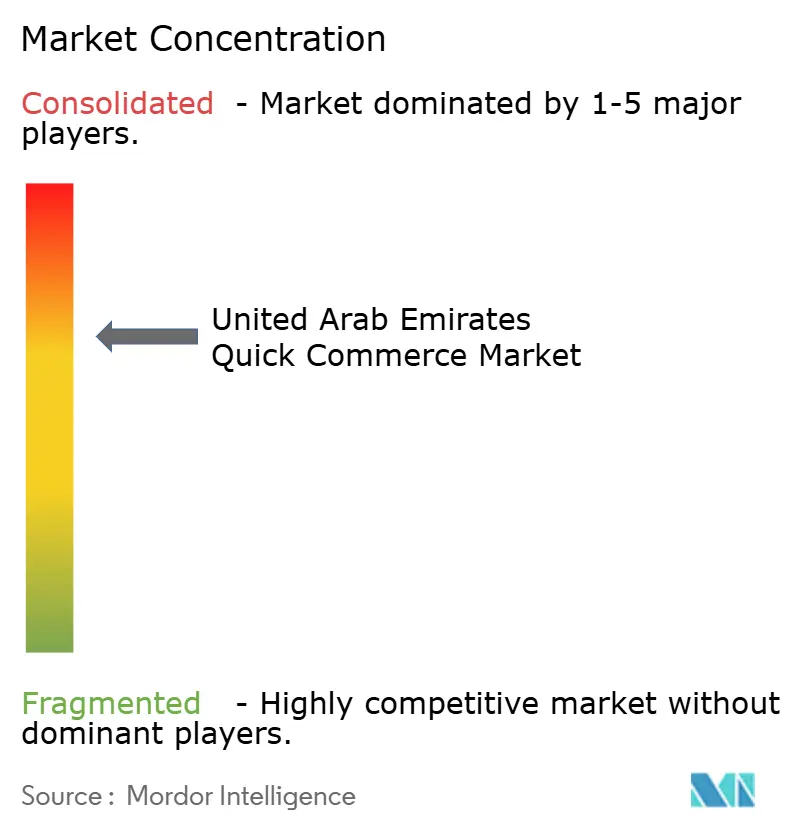
| Market Concentration | Medium |
Major Players *Disclaimer: Major Players sorted in no particular order Image © Mordor Intelligence. Reuse requires attribution under CC BY 4.0. | |
United Arab Emirates Quick Commerce Market Analysis by Mordor Intelligence
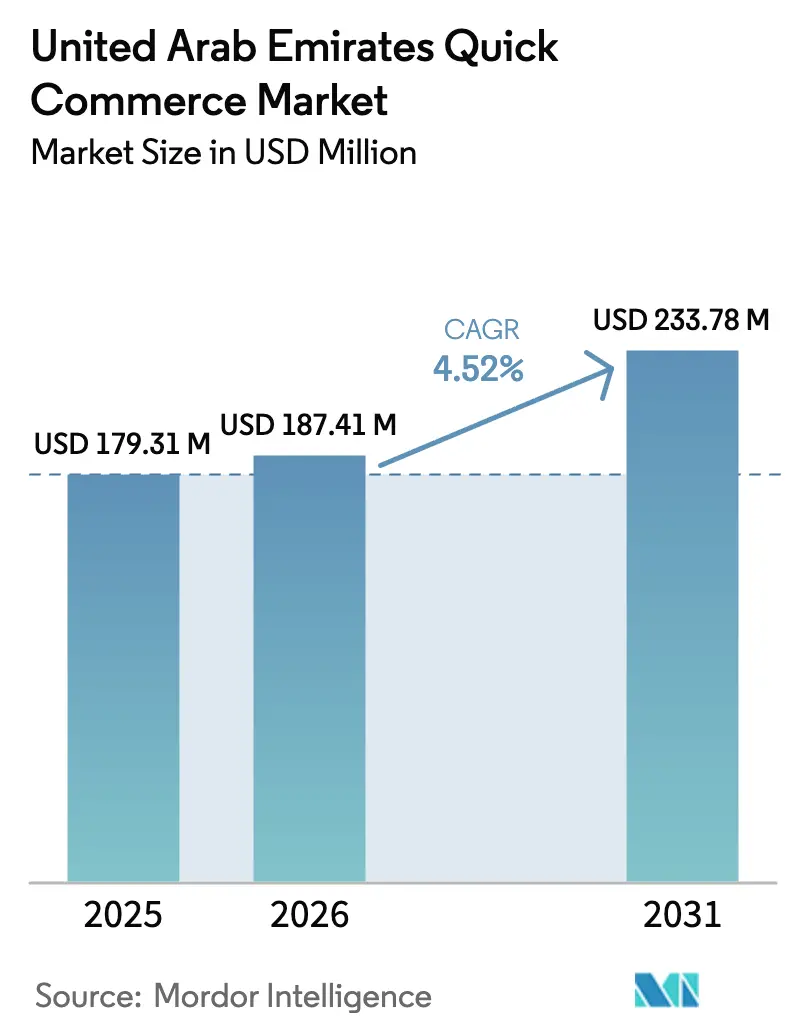
The United Arab Emirates quick commerce market size was valued at USD 179.31 million in 2025 and is estimated to grow from USD 187.41 million in 2026 to reach USD 233.78 million by 2031, at a CAGR of 4.52% during the forecast period (2026-2031). The measured expansion reflects a maturing ecosystem in which sovereign capital, micro-fulfillment infrastructure, and artificial-intelligence logistics converge to reset last-mile delivery economics. Platform operators are prioritizing density thresholds of 150-200 daily orders per dark store, while subscription models such as Deliveroo Plus and Talabat Pro improve customer lifetime value and dampen discount fatigue. Intensifying competition centers on ultra-fast 15-minute and sub-10-minute windows that push real-estate and labor costs higher, yet high smartphone penetration and digital-wallet adoption sustain repeat-purchase frequency. Regulatory guardrails, specifically Federal Decree-Law No. 33 of 2021, elevate labor expenses but also create a compliance moat that favors well-capitalized players.
Key Report Takeaways
- By product category, grocery and staples led with 50.87% revenue share of United Arab Emirates quick commerce market in 2025, while fresh produce and dairy is projected to expand at a 5.49% CAGR through 2031.
- By delivery time promise, the 11-30 minute band accounted for 54.61% of 2025 revenue of UAE quick commerce market, whereas the less-than-10 minute segment is forecast to grow at 6.02% CAGR to 2031.
- By city tier, Tier I metros captured 61.92% of 2025 demand, and Tier II cities are poised to advance at a 5.27% CAGR during 2026-2031.
Note: Market size and forecast figures in this report are generated using Mordor Intelligence’s proprietary estimation framework, updated with the latest available data and insights as of 2026.
United Arab Emirates Quick Commerce Market Trends and Insights
Drivers Impact Analysis*
| Driver | (~) % Impact on CAGR Forecast | Geographic Relevance | Impact Timeline |
|---|---|---|---|
| Surge in On-Demand Lifestyle Among Emirati Millennials | +1.2% | Tier I metros, spillover to Tier II cities | Short term (≤ 2 years) |
| High Smartphone Penetration and Digital Wallet Adoption | +0.9% | National, concentrated in urban Emirates | Medium term (2-4 years) |
| Strategic Investments by Sovereign Wealth Funds | +0.7% | National, anchored in Dubai and Abu Dhabi | Long term (≥ 4 years) |
| Expansion of Micro-Fulfillment Dark Stores | +0.6% | Tier I metros expanding to Tier II cities | Medium term (2-4 years) |
| AI-Driven Route Optimization for Hyper-Local Delivery | +0.5% | National, early adoption in Dubai and Abu Dhabi | Medium term (2-4 years) |
| Growing Appetite for Health-Focused Fresh Produce | +0.4% | Tier I metros, emerging in Tier II cities | Short term (≤ 2 years) |
| Source: Mordor Intelligence | |||
Surge In On-Demand Lifestyle Among Emirati Millennials
Millennials account for close to 60% of the UAE’s 10.08 million residents and prioritize convenience over price, which propels the United Arab Emirates' quick commerce market toward sub-30-minute fulfillment. Dual-income households in Dubai and Abu Dhabi earned median incomes above USD 80,000 in 2025, and they willingly pay premium fees for speed. Platforms respond by deploying predictive inventory algorithms that pre-position high-velocity SKUs within 2-3 kilometers of dense residential clusters, trimming delivery windows to 10 minutes. Noon scaled its Noon Minutes service to 12 dark stores across Dubai and Sharjah to capitalize on areas exceeding 200 transactions per square kilometer per day. Faster delivery feeds higher order frequency, reinforcing the density economics that underpin profitability.
High Smartphone Penetration And Digital Wallet Adoption
Smartphone penetration reached 96.4% in 2025, and digital-wallet usage climbed to 68% of adults, sharply lowering checkout friction. Cart abandonment rates shrank from 22% in 2023 to 14% in 2025 as one-click payment solutions took hold. Talabat and Noon processed 78% of 2025 orders through Apple Pay, Samsung Pay, or local wallets. Expatriates like Indians, Pakistanis, and Filipinos, representing 88% of the national population, show high digital literacy and accelerate repeat purchases. The UAE Central Bank’s Digital Payment Strategy targets 90% cashless transactions by 2026, ensuring continued momentum. Subscription programs flourish under this frictionless environment, boosting customer lifetime value by 30-35%.
Strategic Investments By Sovereign Wealth Funds
Abu Dhabi Investment Authority and Mubadala injected an estimated USD 1.2 billion into e-commerce and logistics assets during 2024-2025, underwriting automation, cold-chain upgrades, and fleet electrification that cut per-order emissions by up to 25%. The April 2025 ADNOC-Noon partnership converted 50 fuel stations into micro-fulfillment hubs, achieving 15-minute coverage across vast catchment areas. Mubadala’s backing of Noon’s autonomous ground-vehicle pilots in Dubai Marina and Yas Island furthers the UAE’s National Strategy for Artificial Intelligence 2031. Public-private synergy lowers financing risk for long-gestation infrastructure and accelerates the adoption of robotics and AI in last-mile operations.
Expansion Of Micro-Fulfillment Dark Stores
Operators opened roughly 80-100 micro-fulfillment centers across major Emirates through 2025, each covering 1-3 square kilometers and stocking 1,500-2,500 SKUs. Carrefour’s automated 10,000 square-meter Dubai facility processes 3,000 orders per hour, slicing labor costs by 30% and enabling same-day delivery across 90% of the city. Deliveroo established six HOP dark stores in Abu Dhabi, targeting 10-minute grocery drops.[1] Density remains the profit linchpin, compelling creative hybrid models in Tier II cities where rents are lower but order volumes trail Tier I by up to 35%.
Restraints Impact Analysis*
| Restraint | (~) % Impact on CAGR Forecast | Geographic Relevance | Impact Timeline |
|---|---|---|---|
| Intensifying Unit-Economics Pressure from Discounts | -0.8% | National, acute in Tier I metros | Short term (≤ 2 years) |
| Limited Late-Night Delivery Windows (Labor Rules) | -0.5% | National, governed by Federal Decree-Law No. 33 of 2021 | Medium term (2-4 years) |
| Rising Real-Estate Costs for Prime Dark Stores | -0.4% | Tier I metros (Dubai, Abu Dhabi) | Medium term (2-4 years) |
| Customer Fatigue from Push Notifications | -0.3% | National, concentrated in high-frequency cohorts | Short term (≤ 2 years) |
| Source: Mordor Intelligence | |||
Intensifying Unit-Economics Pressure From Discounts
Average promotional spend reached 18-22% of gross merchandise value in 2025, eroding margins and delaying breakeven.[2] Talabat’s customer-acquisition costs rose 25% year on year as first-order subsidies climbed to AED 40 (USD 10.89). Noon aims to curb subsidies by 5-7 percentage points annually, risking volume attrition if rivals keep spending. With 62% of users holding three or more app accounts, churn remains high. Subscription penetration below 15% of actives is insufficient to offset promotional drag.
Limited Late-Night Delivery Windows
Federal Decree-Law No. 33 caps daily work at eight hours and restricts night shifts, raising labor costs by up to 15% for platforms seeking 24-hour coverage.[3] Peak demand between 8 PM and 11 PM collides with mandated rest periods, curtailing service hours and ceding late-night sales to convenience stores. Annual leave and gratuity obligations add AED 8,000 (USD 2,178) - 12,000 (USD 3,268) per rider, widening the cost gap with gig-economy models used in other regions. Hybrid fleets mixing employees and freelancers remain constrained by unclear gig-worker status in Tier II corridors.
*Our forecasts treat driver/restraint impacts as directional, not additive. The impact forecasts reflect baseline growth, mix effects, and variable interactions.
Segment Analysis
By Product Category: Fresh Produce Accelerates Premiumization
The fresh produce and dairy segment is forecast to outpace the United Arab Emirates quick commerce market by nearly 100 basis points, expanding at 5.49% per year through 2031. Kibsons logged 35% growth in same-day orders for organic vegetables, grass-fed dairy, and free-range eggs in 2025. Grocery and staples retained 50.87% of 2025 revenue, anchored by pantry essentials that drive subscription bundles and stabilize unit economics. Snacks and beverages, personal care and OTC pharma, and home-care supplies together form about one-third of sales, with personal care climbing 4.8% as pharmacy tie-ups enable 30-minute delivery of vitamins and cosmetics.
Premium fresh demand spurs vertical-farming partnerships that cut food miles and extend shelf life by up to 50%. Regulatory adherence to Dubai Municipality cold-chain rules adds AED 3-5 per order but strengthens consumer trust. Electronics and accessories remain smaller but strategically important, driven by Careem’s 60-minute Quik Electronics service. Pet care and flowers, each under 3% of revenue, carry high average basket values that improve margins. Spinneys’ chef-prepared meal initiative broadens category scope and taps time-scarce professionals.


By Delivery Time Promise: Sub-10-Minute Windows Gain Traction
The less-than-10-minute segment is projected to grow 6.02% annually through 2031, the fastest among all delivery bands. Deliveroo, Amazon, and Talabat spearhead ultra-fast fulfillment, forcing incumbents to compress delivery radiuses to 1 kilometer in dense corridors such as Dubai Marina. The 11-30-minute band, holding 54.61% share in 2025, balances SKU breadth with economic density by serving 2-3 square kilometers per dark store. United Arab Emirates quick commerce market size gains from this tier as operators achieve break-even at 150-180 orders daily.
Capex intensity for sub-10-minute service is high due to prime rents topping AED 120 (USD 32.68) per square meter in Tier I districts. Predictive inventory based on weather and local events mitigates stock-outs, while AI rider allocation trims average delivery times by up to five minutes. The 31-60-minute window remains relevant for bulky items, using vans rather than motorbikes. Labor-law restrictions limit overnight coverage, so many platforms cap service at 11 PM, ceding nighttime demand to convenience retailers.
By City Tier: Secondary Corridors Present Growth Upside
Tier I metros delivered 61.92% of 2025 revenue, but Tier II cities are forecast to compound at 5.27% a year, surpassing the overall United Arab Emirates quick commerce market. Rental costs in Sharjah and Ajman trail Dubai by 30-40%, yet order volumes lag by up to 35%. Noon’s deployment of three Sharjah dark stores stocking 1,800 SKUs tailored to South Asian and Filipino tastes illustrates a hybrid spoke-and-hub model.
The UAE quick commerce market share in Tier II hinges on reaching 120-150 orders per dark store per day. Expatriate communities, which constitute up to 80% of Sharjah’s population, exhibit high digital literacy, supporting rapid adoption. Enforcement of labor rules is more flexible outside Dubai and Abu Dhabi, trimming per-rider labor costs by up to 12%. Tier III emirates remain subscale, accounting for less than 5% of revenue, with next-day delivery prevailing over quick commerce due to sparse demand and long distances.

Geography Analysis
Tier I metros, Dubai and Abu Dhabi, dominate the United Arab Emirates quick commerce market, together securing 61.92% of 2025 sales. Dubai houses around 60 dark stores clustered in Marina, Business Bay, Downtown, and JLT, each posting densities of 200-250 transactions per square kilometer daily. Abu Dhabi’s ecosystem is smaller yet expanding, powered by Deliveroo HOP and ADNOC-Noon fuel-station conversions, which cut real-estate costs and unlock 15-minute coverage.
Tier II cities such as Sharjah, Ajman, and Ras Al Khaimah contribute a rising share thanks to lower rents and underserved expatriate populations in the UAE quick commerce market. Sharjah’s 1.8 million residents show 65% digital-wallet adoption, and operators employ spoke-and-hub logistics from Dubai or local dark stores to serve 5-7 square-kilometer catchments. Order densities remain 25-35% lower than Tier I, necessitating promotional spend and hybrid fleets to reach breakeven.
Tier III emirates, Fujairah and Umm Al Quwain, remain peripheral. Sparse populations of 300-500 residents per square kilometer and long delivery radiuses of up to 90 kilometers hinder ultra-fast models. Platforms rely on regional warehouses for next-day delivery. Uniform federal regulations create consistent compliance costs, which weigh heaviest on operators lacking volume scale in these regions.
Regulatory Landscape
The UAE quick commerce operating environment sits under Federal Decree-Law No. 14 of 2023 on Trading by Modern Technological Means, which sets core obligations for digital trading and platform conduct, alongside baseline requirements from the Consumer Protection Law (Federal Decree-Law No. 15 of 2020) and the Personal Data Protection Law (Federal Decree-Law No. 45 of 2021). Enforcement tightened with Cabinet Resolution No. (200) of 2025 (in force from 28 November 2025), introducing an administrative violations and penalties schedule for e-commerce and platform breaches. Fines can reach AED 100,000, with potential platform closure for serious non-compliance.
Sector competition rules also affect merchant contracting in delivery-led marketplaces. The Federal Competition Law (Federal Decree-Law No. 36 of 2023) frames anti-competitive conduct, while the Ministry of Economy issued Ministerial Decision No. (32) of 2026 introducing a block-exemption approach for exclusive dealing agreements in food promotion and delivery services through digital platforms. This constrains long exclusivity periods and reinforces contestability among platforms. At the emirate level, Dubai Law No. (9) of 2022 regulating digital services adds a local compliance layer for platforms operating in Dubai, complementing federal requirements on transparency, complaint handling, and secure transactions.
Value Chain Analysis
The UAE quick commerce value chain begins with suppliers and brand owners (FMCG, fresh produce, dairy, and local producers), followed by importers and distributors and retailer partners that feed inventory into micro-fulfillment nodes such as dark stores and hybrid sites, including fuel-station-based hubs. Operators then manage demand generation and ordering through mobile apps, oversee catalog and pricing, execute picking and packing with temperature-controlled handling for fresh categories, and complete last-mile delivery through rider fleets and route-optimization systems to meet 10- to 30-minute service promises.
Payments and trust layers run across the chain. Digital payment gateways and wallet rails enable checkout and refunds, while customer-service workflows handle complaints, returns, and quality claims. Federal Decree-Law No. 14/2023 reinforces platform obligations around digital contracting and transparency, and Ministry of Economy-aligned requirements for complaint handling and secure payment methods push platforms to formalize merchant onboarding, customer dispute resolution, and data-handling practices. The contracting norms in food delivery marketplaces are increasingly shaped by exclusivity considerations following the Ministry of Economy Ministerial Decision No. (32) of 2026, influencing how platforms structure restaurant and merchant agreements and how suppliers allocate promotional spend across competitors.
Competitive Landscape
Twenty profiled operators vie for share in a moderately concentrated arena where the top five, Talabat, Noon, Careem, Amazon, and Deliveroo, control roughly 65-70% of revenue. Talabat’s USD 2 billion IPO funded aggressive M&A, including the USD 32 million InstaShop acquisition that removed overlapping dark stores and improved asset utilization. Pure-play platforms emphasize AI-driven logistics and ultra-fast delivery, while omnichannel grocers such as Carrefour, Lulu, Spinneys, and Choithrams exploit in-store footfall to cross-subsidize online orders and offer click-and-collect.
Technology capability is a decisive competitive lever. Carrefour’s robotic distribution center in Dubai processes 3,000 orders hourly, slashing per-item labor time, whereas Noon’s 30,000-square-meter KEZAD facility halves order-processing durations to six minutes. Vertical-farming alliances with Badia Farms and Pure Harvest create freshness differentiation and sustainability narratives. Low switching costs, 62% of users maintain accounts on three or more apps, pressure platforms to innovate loyalty propositions. Subscription penetration remains below 15%, so discount wars persist, straining margins for smaller entrants such as YallaMarket and El Grocer.
Market entry barriers rise as compliance costs climb. Labor regulations restrict late-night operations and impose mandatory benefits, while Dubai Municipality food-safety standards demand temperature-controlled packaging. Well-capitalized players absorb these expenses and leverage data to fine-tune inventory and routing, widening the competitive moat. Smaller operators risk acquisition or niche positioning in organic, halal, or cooperative formats.
United Arab Emirates Quick Commerce Industry Leaders
-
Talabat UAE Company LLC
-
Noon UAE Grocery Delivery LLC
-
Careem Networks FZ LLC
-
InstaShop Ltd
-
Deliveroo Dubai LLC
- *Disclaimer: Major Players sorted in no particular order
Market Opportunities and Future Outlook
The clearest whitespace is in expanding merchant supply and improving assortment economics without relying only on consumer discounting, especially as regulatory scrutiny around platform conduct and contracting increases. Ministerial Decision No. (32) of 2026, which addresses exclusive dealing in food promotion and delivery services through digital platforms, creates room for multi-homing restaurant and merchant strategies. For platforms, that shifts value toward winning supply through better terms, enablement, and operational tools rather than long exclusivity.
Infrastructure-linked models also offer a path to deepen coverage and compress costs through alternative sites and automation. The April 2025 ADNOC Distribution and Noon partnership converting 50 fuel stations into micro-fulfillment hubs supports 15-minute catchments and reduces dependence on prime retail rents. On the demand side, the UAE Central Bank-led push toward cashless payments, with a stated target of 90% cashless transactions by 2026, supports higher checkout conversion and subscription adoption. Category expansion beyond core grocery into adjacent high-urgency baskets, including personal care and OTC, electronics within 60 minutes, and premium fresh produce tied to cold-chain compliance, provides additional levers for basket size and frequency. At the same time, compliance investments tied to Federal Decree-Law No. 14/2023 and the penalty framework effective from 28 November 2025 create a barrier for platforms that can industrialize complaint handling, merchant governance, and secure payment operations at scale.
Recent Industry Developments
- April 2026: Noon UAE waived onboarding fees for Emirati-owned F&B businesses and implemented a five-year commission structure starting at 10%. The update expands SME participation in the quick commerce ecosystem and improves merchant economics, which can raise Noon's fulfillment density and strengthen its competitive position in UAE fast delivery.
- March 2026: Talabat launched initiative providing 100 rent-free cloud kitchen spaces to eligible UAE-founded restaurants until September 2026. This expands cloud-kitchen infrastructure to increase order throughput and improve asset utilization, reinforcing Talabat’s platform leverage.
- February 2026: Talabat published record-breaking 21% order surge for talabat mart on the first day of Ramadan 2026. This indicates strong user adoption and scalability for talabat mart during Ramadan, with implications for capacity planning and competitive dynamics.
Research Methodology Framework and Report Scope
Market Definition and Coverage
For this study, the UAE q-commerce market covers the value of orders placed through digital channels for ultra-fast delivery of everyday essentials to end consumers within the country. Orders are typically fulfilled via nearby stores or dark stores.
Scope exclusions: We exclude restaurant-only meal delivery, cross-border e-commerce fulfillment, and offline walk-in retail sales that are not ordered digitally for rapid delivery.
Segmentation Overview
- By Product Category
- Grocery and Staples
- Fresh Produce and Dairy
- Snacks and Beverages
- Personal Care and OTC Pharma
- Home and Cleaning Supplies
- Electronics and Accessories
- Pet Care
- Flowers and Gifts
- Other Product Categories
- By Delivery Time Promise
- Less than 10 Minutes
- 11-30 Minutes
- 31-60 Minutes and More
- By City Tier
- Tier I Metros
- Tier II Cities
- Tier III and Below
Data Sources, Market Sizing, and Validation
Desk Research
Desk research was used to build the basic demand story for quick commerce in the UAE, and to set guardrails around what is realistic for order frequency, basket sizes, and delivery-time promises. We referred to public sources such as UAE Federal Competitiveness and Statistics Centre releases, Dubai Economy and Tourism updates, UAE Central Bank payment and card-usage indicators, and telecom and digital adoption reporting from official portals. Where helpful, we also reviewed public customs and logistics signals, plus labor and regulation references that affect rider supply and cost assumptions.
To connect these signals to revenue, we cross-checked company filings, investor presentations, reputable press coverage, and app and web traffic commentary that indicates periods of higher demand (such as holidays and promotional windows). Select paid subscriptions were used only for company financials, structured news tracking, and patent lookups related to fulfillment and routing tools. The desk sources listed here are not exhaustive, and additional public documents and datasets were used for data collection, validation, and clarification.
Primary Interviews and Surveys
Primary work focused on validating how the market operates on the ground, including typical delivery-time promises, category mix, and what drives repeat ordering in dense neighborhoods. We interviewed and surveyed a mix of platform-side operators, last-mile and fulfillment specialists, and retail partners across major emirates, then used their input to confirm assumptions from desk research and to fill gaps where public data is limited.
Distribution of primary research fieldwork respondents
| Company type | Respondent position |
|---|---|
| Top tier: 36% | CXOs: 12% |
| Mid tier: 48% | Functional/Unit leaders: 33% |
| Smaller Players: 16% | Managers: 55% |
Market-Sizing & Forecasting
Market sizing starts from a top-down build that reconstructs the addressable order pool in the UAE using digital commerce penetration signals, urban density concentration, and the share of baskets that are time-sensitive enough to be pulled into sub-60-minute delivery. Once that demand pool is formed, it is translated into value through typical order size ranges and the observed mix of high-frequency categories that benefit from speed.
The totals were then corroborated using selective bottom-up checks, such as sampled monthly order volume ranges discussed in interviews, a sanity check on active customer base and order frequency, and ASP-by-category ranges to avoid overstating premium baskets. Key variables used in the model include delivery time promise adoption, average basket value progression, frequency of repeat orders per active user, product category share shifts (grocery and staples versus personal care and household), and the level of coverage by dark stores and nearby fulfillment points. Where company-level numbers were not available, gaps were handled through range-based estimates anchored to stated service areas and realistic throughput per fulfillment site.
For forecasting, scenario analysis was used so growth can be flexed based on changes in discount intensity, service-area expansion, and unit economics pressure. The chosen path was then aligned to what experts described as the most likely operating behavior over 2026 to 2031. We also stress-tested the forecast against expected changes in digital payment usage and city-level demand concentration so the curve does not depend on a single assumption.
Data Validation & Update Cycle
Validation is done through multiple cross-checks so single-source bias is reduced. We compare modeled revenue against independent signals such as app engagement trends, reported expansion or contraction in delivery coverage, and observable changes in delivery-time promises, then investigate any large variances before final sign-off.
Anomalies are flagged when implied order frequency, basket values, or growth rates drift away from what was heard in interviews or what is consistent with UAE digital retail indicators. If a variance cannot be explained, respondents are re-contacted and assumptions are revised, followed by a second analyst review to confirm the changes. Reports are refreshed annually, with interim updates when material events occur, and a final pre-delivery pass is completed so clients receive an updated view at the time of publication.
Mordor Intelligence's UAE Q Commerce Market Size Measured Against Other Published Estimates
It is common to see different published market sizes for UAE quick commerce, even when the labels appear similar at first glance. These differences typically come from what is counted as quick commerce revenue, how order value is defined, and how much the forecast depends on optimistic adoption curves.
Some published figures fold quick commerce into wider online grocery or convenience e-commerce value. Others also use broader GMV that can include discounts, fees, and non-rapid delivery baskets. In Mordor Intelligence's model, revenue is counted only for UAE end-consumer orders that are placed digitally and fulfilled under a rapid delivery promise, and then cross-checked with realistic order frequency and basket size ranges heard in primary interviews.
Benchmark comparison
| Source | Market Size | Gaps in Research Methodology |
|---|---|---|
| Mordor Intelligence | USD 179.31 M (2025) | |
| Industry Databook A | USD 1389.80 M (2025) | Uses a broader quick commerce GMV-style definition that can bundle wider e-commerce baskets and platform-level value adds, with limited transparency on rapid-delivery-only filtering and fee or discount treatment. |
| Advisory Release B | USD 75.20 M (2025) | Represents a narrower captured-revenue view that appears to undercount smaller fulfillment operators and non-core categories, and it does not clearly show how delivery-time promise eligibility was validated across emirates. |
The spread is largely explained by scope and counting logic, rather than only different growth expectations. By linking the estimate to delivery-time eligibility, category mix, and practical checks on order frequency and basket value, the number is easier to trace back to repeatable steps and to adjust when market conditions change.
Key Questions Answered in the Report
How large is the United Arab Emirates quick commerce market today?
The market stood at USD 187.41 million in 2026 and is projected to reach USD 233.78 million by 2031, growing at a 4.52% CAGR.
Which product category is expanding fastest within UAE quick deliveries?
Fresh produce and dairy is forecast to grow at 5.49% annually, outpacing overall sector growth due to demand for organic and locally farmed items.
What delivery-time segment is gaining the most traction?
Orders fulfilled in less than 10 minutes are set to rise at 6.02% CAGR, driven by ultra-fast services from Deliveroo, Amazon, and Talabat.
How are Tier II emirates contributing to growth?
Sharjah, Ajman, and Ras Al Khaimah are expected to compound at 5.27% annually as operators exploit lower rents and underserved expatriate customer bases.
Which factors most constrain profitability?
Aggressive discounting that lifts promotional spend to more than 18% of GMV and labor rules that restrict late-night shifts are the key margin pressures.
Who are the leading players in the UAE quick commerce space?
Talabat, Noon, Careem, Amazon, and Deliveroo constitute the top tier, collectively capturing roughly 65-70% of sector revenue.