
Prosthetic Liners Market Size and Share
Market Overview
| Study Period | 2020 - 2031 |
|---|---|
| Market Size (2026) | USD 296.62 Million |
| Market Size (2031) | USD 403.72 Million |
| Growth Rate (2026 - 2031) | 6.36 % |
| Fastest Growing Market | Asia Pacific |
| Largest Market | North America |
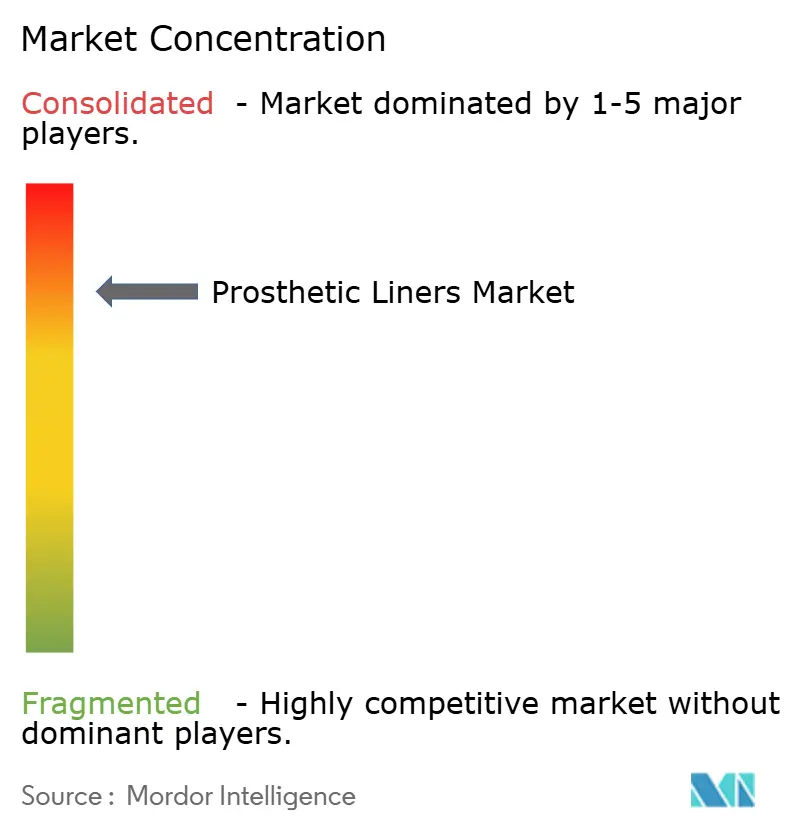
| Market Concentration | High |
Major Players *Disclaimer: Major Players sorted in no particular order Image © Mordor Intelligence. Reuse requires attribution under CC BY 4.0. | |
Prosthetic Liners Market Analysis by Mordor Intelligence
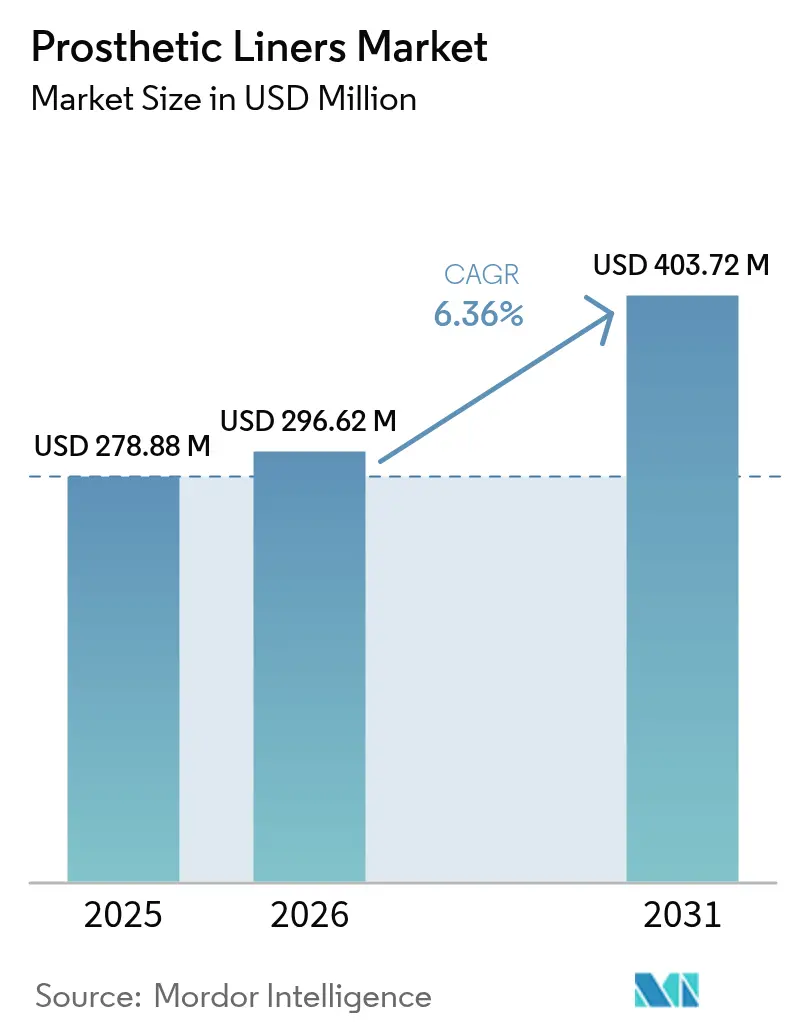
The Prosthetic Liners Market size was valued at USD 278.88 million in 2025 and estimated to grow from USD 296.62 million in 2026 to reach USD 403.72 million by 2031, at a CAGR of 6.36% during the forecast period (2026-2031). This expansion stems from the combined weight of diabetes-related amputations, rapid advances in medical-grade silicones, and payer policies that favor early investment in premium liners to avoid downstream complications. Clinical demand is also lifted by 3-D scanning workflows that compress chair time, raise first-fit success, and strengthen patient adherence [1]. Manufacturers that once leaned on conventional molding are racing to pair digital customization with lighter supply chains, even as a tighter ISO 10993 chemical-characterization regime reshapes R&D roadmaps. Institutional buyers now budget more for supply-chain resilience, mirroring a wider med-tech shift toward diversified raw-material sources. Within this climate the prosthetic liners market benefits from a steady inflow of diabetic and trauma patients who require frequent liner replacement cycles, anchoring multi-year revenue visibility for incumbents and entrants.
Key Report Takeaways
- By product type, lower-extremity liners held 64.68% of prosthetic liners market share in 2025, while upper-extremity units are set to register a 7.12% CAGR to 2031.
- By material, silicone captured 55.67% revenue in 2025; thermoplastic elastomers are the fastest riser at a 6.97% CAGR through 2031.
- By suspension style, pin-lock systems led with 55.35% share in 2025, whereas cushion designs are tracking a 7.03% CAGR to 2031.
- By thickness, 6 mm liners commanded 38.92% share in 2025; ≤ 3 mm profiles are expanding at a 7.01% CAGR until 2031.
- By end user, hospitals and clinics accounted for 64.83% demand in 2025, while ambulatory surgical centers show a 6.93% growth path to 2031.
- By geography, North America contributed 42.02% of 2025 revenue; Asia-Pacific is projected to advance at a 7.15% CAGR through 2031.
Note: Market size and forecast figures in this report are generated using Mordor Intelligence’s proprietary estimation framework, updated with the latest available data and insights as of 2026.
Market Trends and Insights
Drivers Impact Analysis of Prosthetic Liners Market*
| Driver | (~) % Impact on CAGR Forecast | Geographic Relevance | Impact Timeline |
|---|---|---|---|
| Rising incidence of diabetes-related amputations | +1.8% | North America, Europe, Global | Long term (≥ 4 years) |
| Growing number of road-traffic & industrial accidents | +1.2% | Asia-Pacific, MEA, South America | Medium term (2–4 years) |
| Expanding reimbursement coverage for advanced liners | +1.1% | North America, EU, Asia-Pacific | Medium term (2–4 years) |
| Rapid material innovation in medical-grade silicones | +0.9% | Global | Short term (≤ 2 years) |
| Mass-customized 3-D-scanned liners lowering refit rates | +0.7% | North America, EU → Global | Medium term (2–4 years) |
| Multi-patient sterilizable compression liners for clinics | +0.4% | Emerging markets, Global | Long term (≥ 4 years) |
| Source: Mordor Intelligence | |||
Rising incidence of diabetes-related amputations
Diabetes is reshaping global limb-loss epidemiology by pushing vascular disease ahead of trauma as the leading cause of lower-limb amputation. Peer-reviewed projections indicate limb-loss prevalence could jump 145% by 2060 if metabolic trends hold. The shift swells the addressable base for premium liners because diabetic amputees present fluctuating limb volumes and elevated infection risk, prompting prosthetists to specify breathable silicones with embedded antimicrobials. Payers now view such upgrades as cost-avoidance tools that lower readmission rates and ulcer-care outlays. Device makers that bundle diabetes-specific clinical education with liners gain a competitive foothold among hospital purchasing teams and value-based insurance networks.
Growing number of road-traffic & industrial accidents
Trauma remains a sizeable, demographically younger cohort that demands rugged liners capable of supporting high-activity lifestyles. A global prevalence study recorded 57.7 million traumatic amputees in 2017, with road injuries making up 15.7% and mechanical forces 10.4% of cases. Asia-Pacific registers the heaviest burden as urbanization and industrialization progress faster than occupational-safety frameworks. These patients seek durable liners with sensor-ready interfaces for activity tracking, which in turn nudges OEMs toward multi-material composites that can dissipate shear without adding bulk. Economic analyses tie fast return-to-work rates to higher-grade liner adoption, reinforcing payer willingness to reimburse performance-oriented models in trauma centers.
Expanding reimbursement coverage for advanced liners
Regulators continue to adjust fee schedules to reflect functional benefits rather than device class alone. In 2024 the US Medicare contractor network introduced discrete HCPCS modifiers that shorten claims cycles for advanced liner codes. Commercial insurers followed by amending policy language to cover microprocessor-compatible liners contingent on functional-level scoring. Parallel developments in Europe under value-based procurement models now reward demonstrable pressure-distribution gains or moisture-management metrics. These moves reduce out-of-pocket barriers, enabling prosthetic clinics to present premium liners as cost-neutral relative to conventional options when lifetime maintenance is factored.
Rapid material innovation in medical-grade silicones
Silicone suppliers have delivered new chemistries that meet USP Class VI and ISO 10993 while improving tear resistance and water-vapor transmission. Producers such as Elkem deploy proprietary cross-linking that raises tensile strength yet preserves elasticity, thereby mitigating the 90.9% dermatological-issue prevalence documented among liner users. Pilot studies with perforated silicone sleeves record a 4% skin-temperature drop alongside lower humidity levels, directly answering patient comfort pain points. The result is a value proposition rooted in outcome data rather than generic softness claims, helping justify premium pricing in tender bids.
Restraints Impact Analysis of Prosthetic Liners Market*
| Restraint | (~) % Impact on CAGR Forecast | Geographic Relevance | Impact Timeline |
|---|---|---|---|
| High average selling price of premium liners | −1.3% | Emerging markets, Global | Medium term (2–4 years) |
| Dermatological complications & heat-rash issues | −0.8% | Humid climates, Global | Short term (≤ 2 years) |
| Lack of liner-specific biocompatibility test standards | −0.6% | North America, EU | Long term (≥ 4 years) |
| Volatile medical-grade silicone supply chain | −0.5% | Asia-Pacific manufacturing hubs, Global | Medium term (2–4 years) |
| Source: Mordor Intelligence | |||
High average selling price of premium liners
Price remains the primary adoption hurdle when payer caps lag behind material-cost inflation. Advanced liners can retail at triple the price of entry models, and amputees typically need multiple replacements during the socket-life cycle. Economists note that a transtibial patient fitted at age 40 could face liner expenses across a 30-year horizon that rival household income levels in emerging economies. Multinational vendors have responded with tiered catalogues yet still confront sticker shock in self-pay markets, slowing penetration despite clear clinical benefits. Until reimbursement catch-up or cost-down innovation closes the gap, value offerings will dominate rural and low-income geographies.
Dermatological complications & heat-rash issues
Occlusive liners create a micro-environment prone to moisture build-up, bacterial colonization, and skin maceration. A frequently cited clinical audit found 90.9% of transtibial prosthesis users reporting at least one skin complaint tied to roll-on liners. Episodes of infection extend rehabilitation downtime and often necessitate costly wound care, directly eroding payer savings projected from premium products. Though perforated liners and antimicrobial coatings show promise, perfect equilibrium between airtight suspension and breathable comfort continues to elude designers, and clinical outcomes vary widely with climate and activity level.
*Our forecasts treat driver/restraint impacts as directional, not additive. The impact forecasts reflect baseline growth, mix effects, and variable interactions.
Prosthetic Liners Market Segment Analysis
By Product Type:
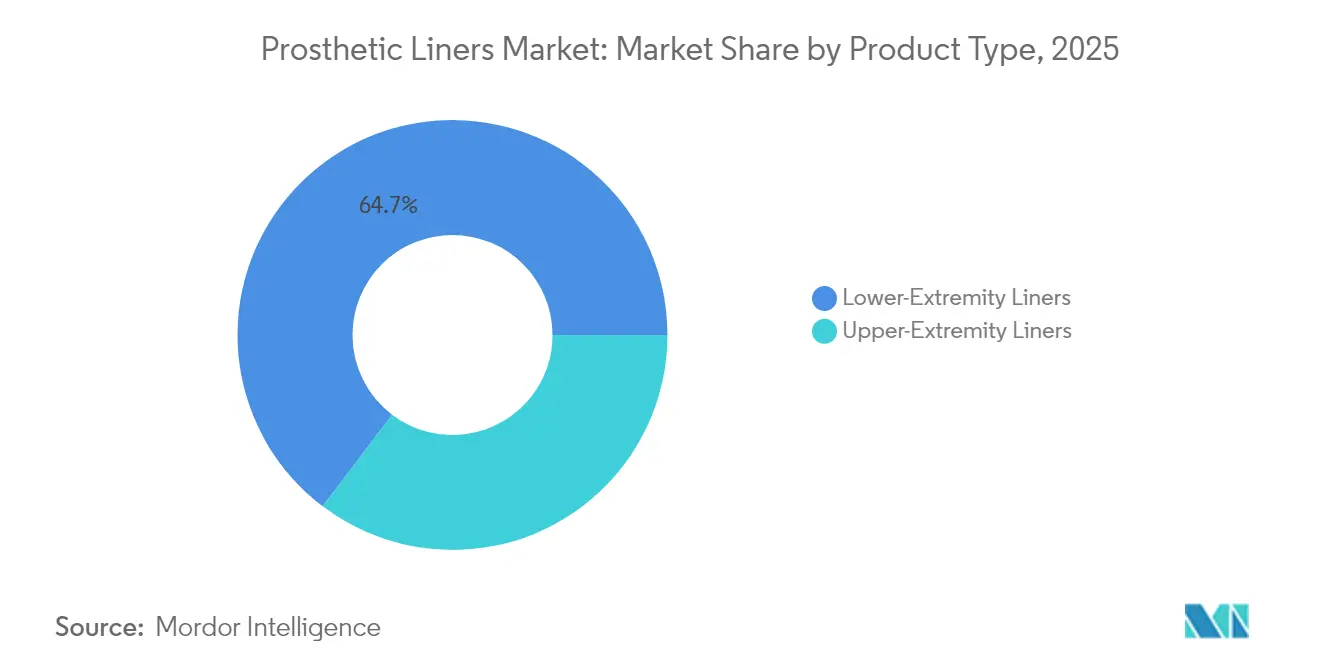
Lower-Extremity Dominance Drives VolumeLower-extremity devices generated 64.68% of prosthetic liners market revenue in 2025 on the back of high diabetes-linked transtibial and transfemoral caseloads. Hospitals value the stability that premium lower-limb liners bring to gait rehabilitation, and the category benefits from proven reimbursement codes that shorten the claim cycle. The prosthetic liners market size attributable to lower limbs is forecast to widen steadily through 2031 as vascular-disease prevalence rises. In contrast, upper-extremity liners are gaining momentum with a 7.12% CAGR tied to myoelectric hand adoption and growing clinical interest in partial-hand reconstruction.
Upper-extremity amputees skew younger and prioritize dexterity, which allows suppliers to position smart liners with embedded electrodes despite higher unit prices. Developers are also leveraging 3-D silicone printing to create anatomically contoured finger sheaths that marry cosmetic appearance with reliable suspension. As these niche breakthroughs scale, upper-limb penetration will expand overall prosthetic liners market addressability, reducing dependence on lower-limb volumes for topline growth.

By Material:
Silicone Leadership Faces TPE ChallengeSilicone maintained 55.67% dominance in 2025, benefitting from decades of clinical data proving hypoallergenic performance and long-wear durability. The material’s cross-link density preserves elasticity across temperature swings, a feature valued in both temperate and tropical regions. Despite this commanding position, thermoplastic elastomers are advancing at 6.97% CAGR to become the most disruptive rival. The prosthetic liners market size tied to TPE products remains modest but gains disproportionate mindshare because extrusion and injection-molding lines already installed for consumer goods can transition to medical output with minimal re-tooling.
TPE also supports rapid-cycle color matching and is compatible with fused-deposition 3-D printers, allowing localized production near clinics that lack silicone-curing ovens. Hybrid composite formulas that layer silicone interior surfaces with TPE exteriors are emerging to bridge comfort and cost norms. As payers in developing economies push for price-aligned outcomes, mid-tier TPE offerings will absorb volume from entry silicones, moving market dynamics toward a dual-material equilibrium.
By Suspension Mechanism:
Pin-Lock Maturity Versus Cushion InnovationPin-lock liners delivered 55.35% revenue in 2025 because prosthetists trust their mechanical latch to resist axial displacement during high-impact activity. This segment’s entrenched protocols and training manuals ensure predictable outcomes, fostering prescriber confidence that offsets its heavier don-and-doff sequence. The prosthetic liners market share could erode gradually as cushion designs refine compression-gradient mapping and easy roll-on usability.
Cushion mechanisms, tracking a 7.03% CAGR, appeal to older and neuropathic cohorts who prioritize comfort and simple handling over maximum retention. Ventilated cushion models now channel perspiration through micro-valves, reducing epidermal stress in hot climates. Some developers integrate passive vacuum cups with cushion interfaces, blending the best of two paradigms without adding external pumps. If ongoing clinical trials confirm reduced pistoning under variable load, cushion uptake may accelerate in long-term care settings, redefining suspension best practice by decade close.
By Thickness Profile:
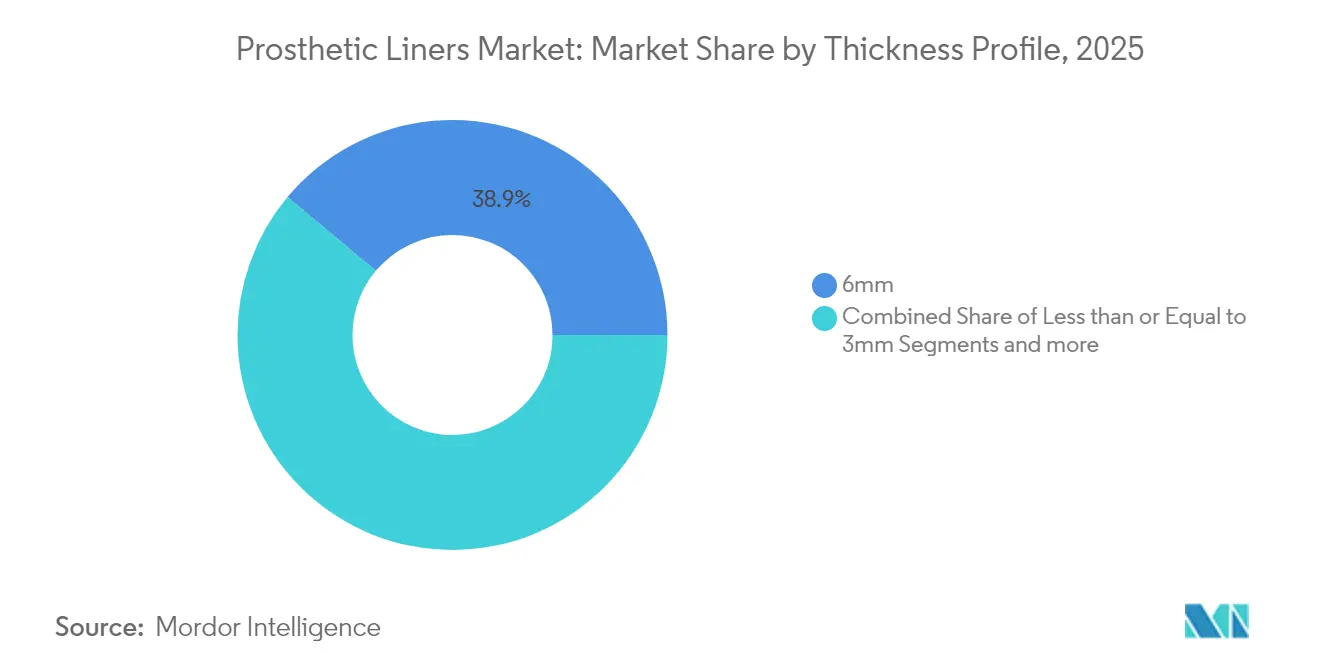
Clinical Preferences Drive 6 mm DominanceA 6 mm standard thickness controlled 38.92% of the segment in 2025 and remains the default prescription in most prosthetic centers. The prosthetic liners market size for this profile benefits from the balance it strikes between impact cushioning and socket clearance, simplifying inventory management for clinics. Thinner ≤ 3 mm liners, although only a subset today, are advancing at 7.01% CAGR, propelled by high-strength silicone blends that preserve protective function despite lower bulk.
Thinner walls boost proprioception and support minimalist socket designs that mimic the contralateral limb, an aesthetic edge welcomed by active users. Research from controlled case reports shows wound-closure timelines improve when liners supply uniform pressure with less distal bunching. Greater-than-9 mm formats still serve hypersensitive residual limbs but face constraints in modern low-profile hardware systems that prioritize range of motion. Over time, success of high-performance thin liners will depend on demonstrable reductions in volume fluctuation rather than lab tensile tests alone.
By End User:
Hospital Dominance Faces ASC DisruptionHospitals and integrated rehabilitation centers controlled 64.83% share in 2025, drawing on multidisciplinary care teams, insurer relationships, and complex-case throughput. Teaching hospitals in North America and Europe act as early evaluation sites for next-generation liners, giving manufacturers KOL endorsements that ripple through private practice networks. The prosthetic liners market size linked to hospital channels will rise more modestly than the broader market as case mix shifts out of inpatient pathways.
Ambulatory surgical centers, predicted to climb at 6.93% CAGR, leverage lower overhead and appointment agility to lure uncomplicated residual-limb cases. Cloud-based scanning kiosks have trimmed in-clinic time, making ASCs viable for socket plus liner delivery within a compressed timeline. Pay-for-performance insurance models also incentivize same-day mobilization milestones, a metric ASCs can hit using pre-configured liner libraries. Home-care and boutique prosthetic studios remain niche for now, constrained by reimbursement and logistics rather than consumer interest.
Geography Analysis
North America Prosthetic Liners Market
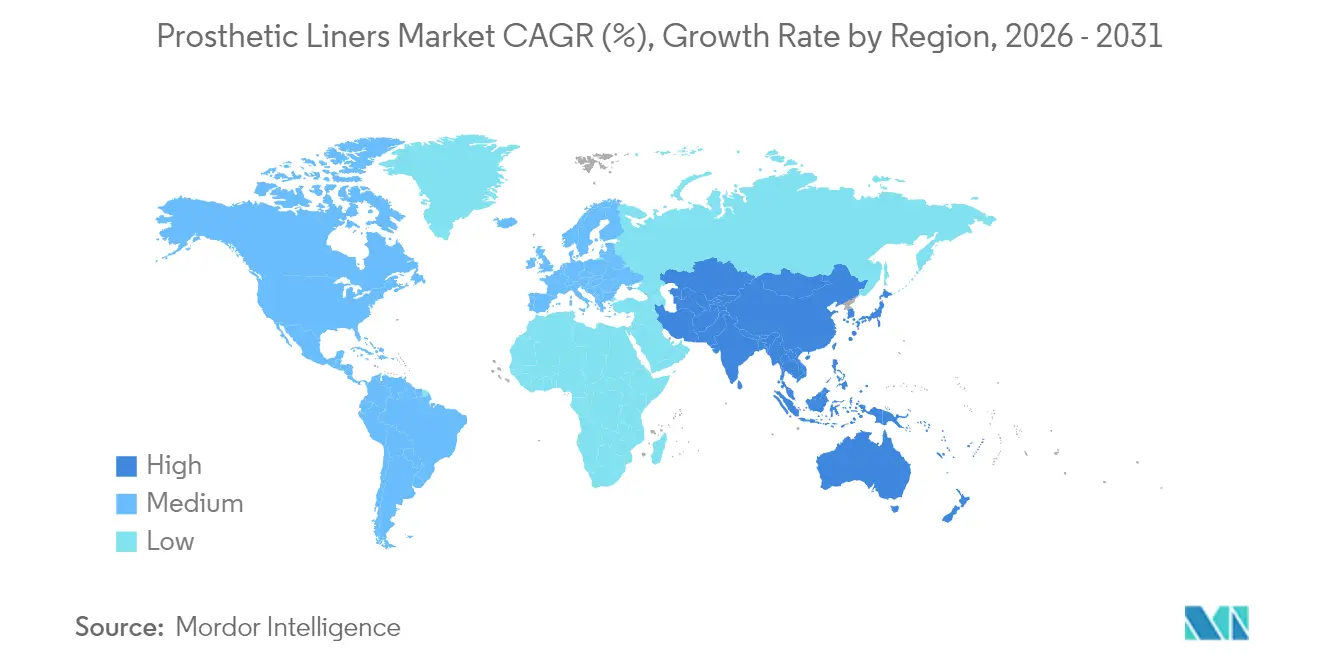
North America accounted for 42.02% of 2025 global revenue, supported by Medicare Part B rules that reimburse 80% of medically necessary prosthetic supplies once deductibles clear. The region’s dense prosthetist network and extensive diabetes-management programs ensure a steady inflow of candidates, while private insurers mirror federal coding, further smoothing advanced-liner uptake . FDA guidance updates that accept chemical-equivalency data in lieu of full animal testing have shortened time-to-market for incremental material tweaks, encouraging continuous portfolio refresh.
APAC Prosthetic Liners Market
Asia-Pacific stands out as the fastest-growing territory with a 7.15% CAGR thanks to rising household incomes, stimulative public-insurance pilots, and domestic manufacturing clusters that whittle logistics cost. China and India together recorded a sizable increase in amputation procedures, reflecting both urban trauma incidence and expanding chronic-disease screening. Regulators are harmonizing device rules with global ISO standards, enabling regional OEMs to submit single dossier sets for multiple ASEAN markets. That convergence will help the prosthetic liners market capture latent demand among the estimated tens of thousands of amputees who still rely on outdated suction socks.
Europe, Middle East and LATAM Prosthetic Liners Market
Europe posts stable yet slower growth, supported by public health systems that guarantee prosthetic access but impose rigorous post-market surveillance under the Medical Device Regulation framework. Germany, France, and the United Kingdom remain procurement strongholds where tender boards weigh real-world performance data heavily, pushing suppliers to generate multi-center outcome studies . Southern and Eastern European states show incremental volume expansion as EU structural funds improve rehabilitation infrastructure. Elsewhere, selected Middle Eastern and Latin American nations demonstrate nascent demand, although lower reimbursement ceilings and clinician shortages moderate adoption of premium liners.
Regulatory Landscape
Prosthetic liners are regulated as medical devices in major markets, with conformity routes shaped by whether the product is handled as a standard accessory or a custom-made component supplied on prescription. In Europe, Regulation (EU) 2017/745 (EU MDR) sets requirements such as technical documentation and post-market surveillance, which raises evidence and traceability expectations for suppliers selling into public tender systems. The United Kingdom follows UK MDR 2002 requirements, and MHRA guidance for specific medical devices is commonly used by manufacturers to interpret obligations for prosthetic components supplied through clinical channels.
Standards and biocompatibility testing frameworks shape material selection and validation pathways. ISO 10328:2016 is widely referenced for structural testing of lower-limb prosthetic components, and liner developers align design controls so their interfaces can be safely integrated with systems validated under comparable standards. Across markets, tighter chemical characterization and biocompatibility expectations for intact-skin-contact materials (often aligned to ISO 10993 approaches) are influencing how silicone and TPE formulations are qualified and documented, which in turn affects the lead time for incremental material updates and supplier change management.
Value Chain Analysis
Upstream inputs focus on medical-grade elastomers, primarily silicone, thermoplastic elastomers (TPE), and urethanes, along with additives and textiles used for reinforcement, surface finish, and donning aids. High-end liner manufacturing relies on consistent elastomer quality and controlled processing, with supply risk concentrated in specialized medical-grade feedstocks and compounding capability. Materials selection and process validation are closely tied to skin-contact performance targets (comfort, tear resistance, moisture handling) and compliance documentation, so qualified raw material suppliers and traceable batches act as key value drivers.
Midstream activities include formulation and compounding, molding or casting, and, for emerging workflows, additive manufacturing of TPE or silicone-based interfaces, followed by finishing, inspection, and packaging. Downstream distribution typically runs through prosthetic clinics, hospital rehabilitation centers, and integrated provider networks that fit liners as part of socket workflows and manage replacement cycles; many premium suppliers highlight direct-to-clinician models to protect clinical outcomes and reduce returns. Service layers such as scanning, digital design, and fabrication services (for example, custom-liner offerings tied to centralized fabrication centers) shorten iteration loops, but they require tighter coordination between clinics and manufacturers for sizing, customization, and replenishment.
Competitive Landscape
Market leadership is shared among a handful of multinational firms with vertically integrated silicone molding, direct-to-clinic sales teams, and regulatory science units that navigate cross-border submissions. These players lock in hospital accounts through continuing-education programs and loaner-inventory schemes that reduce downtime when refits are needed. Competitive churn now pivots on digital customization; the first mover to supply a seamless app-to-print workflow for replacement liners can capture recurring consumable revenue while raising switching costs for clinics.
Smaller innovators target white spaces such as pediatric sizes, upper-extremity specialty shapes, and sensorized liners that stream data to gait-analysis dashboards. Partnerships between liner manufacturers and bionic-hand producers are becoming common, allowing bundled reimbursement claims for integrated systems. In February 2024 Hanger deepened its prosthetic component portfolio by acquiring Fillauer, giving it an expanded distribution footprint and additional silicone expertise. Consolidation of this type squeezes mid-tier competitors that lack either scale or unique IP, nudging them toward contract manufacturing or niche therapeutic areas.
Regulatory policy continues to influence rivalry. The FDA’s 2024 refinement of ISO 10993 adherence for intact-skin devices reduced redundant test spending, freeing cash for R&D aimed at moisture-management breakthroughs. European Union vigilance audits meanwhile elevate post-market evidence thresholds, creating compliance drag for smaller entrants yet offering larger firms a differentiator through robust clinical-outcomes databases. Supply-chain risk mitigation has become a board-level theme, with some OEMs relocating a share of silicone compounding to secondary continents to hedge geopolitical shocks and raw-material spikes.
Prosthetic Liners Industry Leaders
-
Ossur
-
Ottobock
-
WillowWood Global LLC
-
Blatchford Limited
-
ALPS South, LLC
- *Disclaimer: Major Players sorted in no particular order
Prosthetic Liners Market Companies Covered in this Report
- Alps South LLC
- Blatchford
- Fillauer Europe
- Knite Rite
- Ortho Europe
- Ossur
- Ottobock
- Silipos Holding LLC
- Streifeneder ortho.production
- Willow Wood Global
- College Park Industries Inc.
- Proteor SAS
- Medi USA Inc.
- Steeper Group Ltd.
- Beckton Dickinson
- Engineered Silicone Products (ESP)
- Adaptive Prosthetics LLC
- Anatomic Concepts Inc.
- Ability Dynamics Inc.
- Capstone Medical Products
Market Opportunities and Future Outlook
Industrialized customization is a clear commercialization path, supported by actions that link 3D scanning to scalable manufacturing. After its OTWorld 2026 premiere in Leipzig, Ottobock introduced the iconiq 3D-printed silicone liner, using additive manufacturing to address persistent fit issues and to standardize personalization for eligible mobility users. This opens whitespace for clinics and manufacturers to adjust fitting pathways around digital capture, faster remakes, and tighter interface consistency, particularly in high-volume lower-extremity use where refit burden is meaningful.
Material innovation and microclimate management remain high-value lanes, since dermatological complications and heat-rash issues still constrain wear time and adherence. Work supported by the AAMI Foundation on antimicrobial SEBS for liners, reported in 2026, points to active R&D focused on bacterial reduction and fluid management, with adjacent interface-layer approaches (such as moisture and heat management underlays) offering an option to improve liner performance without changing socket architecture. In parallel, the June 2026 agreement for CVC Catalyst III to acquire a majority stake in WillowWood highlights investment appetite for liner platforms that combine recurring consumables with product development capacity and international expansion levers, reinforcing consolidation and scaled commercialization of premium interfaces.
Recent Industry Developments in Prosthetic Liners Market
- June 2026: CVC Catalyst III agreed to acquire a majority stake in WillowWood from Blue Sea Capital, the Arbogast family, and management. The transaction centers on expanding R&D and accelerating new product innovation across WillowWood's prosthetic liner and component portfolio. It also signals continued consolidation in a high-concentration market, potentially reshaping competitive intensity in clinic-facing channels.
- June 2026: Ottobock launched the iconiq 3D-printed silicone prosthetic liner, following its premiere at OTWorld 2026 in Leipzig. By industrializing personalized liner production through additive manufacturing, Ottobock strengthens its end-to-end digital fitting narrative and raises the bar for customization speed and repeatability. The launch reinforces a shift toward workflow-linked liners that can be positioned alongside complementary prosthetic systems.
- April 2024: Ossur hf received grant funding to develop an adjustable seal system that combines a textile sleeve with a vacuum skirt to address leakage challenges in transtibial users. The project targets suspension reliability and day-to-day comfort, two factors that drive replacement and upgrade decisions at the clinic level. It also reflects continued investment in interface engineering as a differentiator beyond material softness alone.
Prosthetic Liners Market Report Scope and Research Methodology
Market Definition and Coverage
This market covers the annual value of prosthetic liners worn on the residual limb to improve comfort and suspension inside a prosthetic socket, across upper and lower limb use. The sizing reflects liner sales in USD across included geographies and channels for both first-fit and replacement demand.
Scope exclusions: the sizing excludes prosthetic sockets, complete prosthetic limbs, stump socks, and adhesive sprays and related accessories.
Segments Covered in This Report
- By Product Type
- Upper-Extremity Liners
- Lower-Extremity Liners
- By Material
- Silicone
- Thermoplastic Elastomer (TPE)
- Others
- By Suspension Mechanism
- Pin-Lock Liners
- Cushion Liners
- Others
- By Thickness Profile
- Less than or Equal to 3mm
- 6mm
- Greater than or equal to 9mm
- By End User
- Hospitals and Clinics
- Ambulatory Surgical Centers
- Others
- By Geography
- North America
- United States
- Canada
- Mexico
- Europe
- Germany
- United Kingdom
- France
- Italy
- Spain
- Rest of Europe
- Asia-Pacific
- China
- Japan
- India
- Australia
- South Korea
- Rest of Asia-Pacific
- Middle East and Africa
- GCC
- South Africa
- Rest of Middle East and Africa
- South America
- Brazil
- Argentina
- Rest of South America
- North America
Data Sources, Market Sizing, and Validation
Desk Research
Desk work starts by grounding the demand pool, so we do not begin with company revenues alone. Public health and population signals are referenced from sources such as the US CDC, WHO, and the International Diabetes Federation to understand amputation risk factors and treated patient bases.
We also review government health statistics and reimbursement notes where available, along with publications and guidance from prosthetics and orthotics associations and rehabilitation bodies. For trade and supply-side context, we use customs and import-export datasets and broad medical device classification notes. Company annual reports, regulatory product information, investor decks, and reputable press help validate pricing direction, and patent databases are used to track liner material and suspension innovation claims. These examples are not exhaustive, and many other public sources were also used for data collection, validation, and clarification.
Primary Interviews and Surveys
Primary discussions focus on prosthetists, clinic owners, distributors, and liner-focused product and sales teams so assumptions on replacement frequency, payer coverage mix, and average selling prices can be pressure-tested. For a global view, inputs are balanced across mature reimbursement markets and faster-growing rehabilitation markets, and we revisit outliers when desk signals and field feedback do not line up.
Distribution of primary research fieldwork respondents
| Company type | Respondent position | Region |
|---|---|---|
| Top tier: 36% | CXOs: 13% | APAC: 41% |
| Mid tier: 42% | Functional/Unit leaders: 43% | EMEA: 36% |
| Smaller Players: 22% | Managers: 44% | Americas: 23% |
Market-Sizing & Forecasting
Sizing is built using top-down and bottom-up logic, where treated amputee populations and prosthetic fitting activity are used to reconstruct liner demand, and then value is derived using realistic price points by material and care setting. The model is then corroborated with selective bottom-up approximations, like sampled ASP times estimated unit volumes from channel checks, plus supplier and distributor sanity checks to keep totals practical.
Key inputs used in the model include amputee incidence and prevalence proxies (including diabetes and trauma trends), prosthetic fitting rates by care pathway, typical liner replacement cycles, share of silicone versus other materials, and payer coverage patterns that shift the mix between standard and premium liners. When local data is thin, we fill gaps using regional comparables and adjust only after re-checking with practitioners who see utilization differences in daily practice.
For forecasting, we rely on scenario analysis supported by a light multivariate view of the drivers above, since reimbursement changes and premium material adoption can move the market faster than population alone. The final forward path is aligned to what interviewees expect for replacement behavior, pricing progression, and access expansion over the forecast period.
Data Validation & Update Cycle
Outputs are validated through triangulation across independent signals, including demand-side indicators (fitting and replacement behavior) and supply-side checks (availability, channel mix, and pricing corridors). Variance checks are run at region and year levels so sudden jumps are flagged, explained, and corrected before sign-off.
A multi-step analyst review is followed, and any material mismatch triggers follow-up calls to re-test the assumption that caused the swing (often replacement cycles, pricing, or included channel scope). Reports are refreshed annually, with interim updates when major reimbursement, regulatory, or supply events materially change the outlook. Before delivery, an analyst performs a fresh pass so clients receive the latest updated view.
Mordor Intelligence's Prosthetic Liners Market Sizing Compared With Other Published Estimates
Different published numbers for prosthetic liners are common, mainly because the product scope and the demand counting logic are not always the same. A few studies size a wider prosthetics component set, while others narrow down to only one liner material or one care channel, which naturally changes the total.
The main gap comes from whether replacement liners are counted at realistic clinical refresh rates and whether adjacent accessories are bundled in the same value, where Mordor Intelligence counts liners as soft interface sleeves sold for first-fit and replacement only, and it keeps socks, adhesive sprays, sockets, and full prosthetic systems out of the total.
Benchmark comparison
| Source | Market Size | Gaps in Research Methodology |
|---|---|---|
| Mordor Intelligence | USD 296.62 M (2026) | |
| Trade Journal A | USD 352.62 M (2024) | Uses a different base year and applies broader product categorization and end-use framing, which can pull in adjacent prosthetic sub-categories and shift pricing assumptions versus liner-only counting. |
| Industry Research Bulletin B | USD 412.60 M (2025) | Starts from a higher current-year value that may reflect a wider channel set and a steeper ASP progression, and the public summary does not clearly separate liner-only revenues from other prosthetic consumables. |
Taken together, the spread mainly reflects year alignment, what gets included beside liners, and how replacement demand is converted into annual units and value. By keeping the demand pool tied to fittings and replacements, and then cross-checking implied unit volumes against clinic usage patterns, we get a balanced total that can be repeated with the same inputs.
Key Questions Answered in the Report
What is the current value of the prosthetic liners market?
The prosthetic liners market stands at USD 296.62 million in 2026 and is projected to reach USD 403.72 million by 2031.
Which region generates the highest revenue for prosthetic liners?
North America leads with 42.02% of 2025 global revenue, driven by comprehensive reimbursement and an extensive prosthetist network.
Which segment is expanding fastest within the prosthetic liners market?
Upper-extremity liners exhibit the fastest growth at a 7.12% CAGR thanks to rising adoption of advanced myoelectric prosthetics.
Why are thermoplastic elastomer liners gaining attention?
TPE liners grow at 6.97% CAGR because they combine lower production costs with compatibility for rapid 3-D printing customization.
How does reimbursement affect liner adoption?
Policy updates that recognize the long-term cost savings of premium liners reduce patient out-of-pocket expenses and accelerate uptake, especially in North America and Europe.
What is the main challenge to wider use of premium liners?
High selling prices, sometimes triple that of entry-level models, limit accessibility in emerging markets even when clinical benefits are clear.