
Precipitated Barium Sulphate Market Size and Share
Market Overview
| Study Period | 2019 - 2030 |
|---|---|
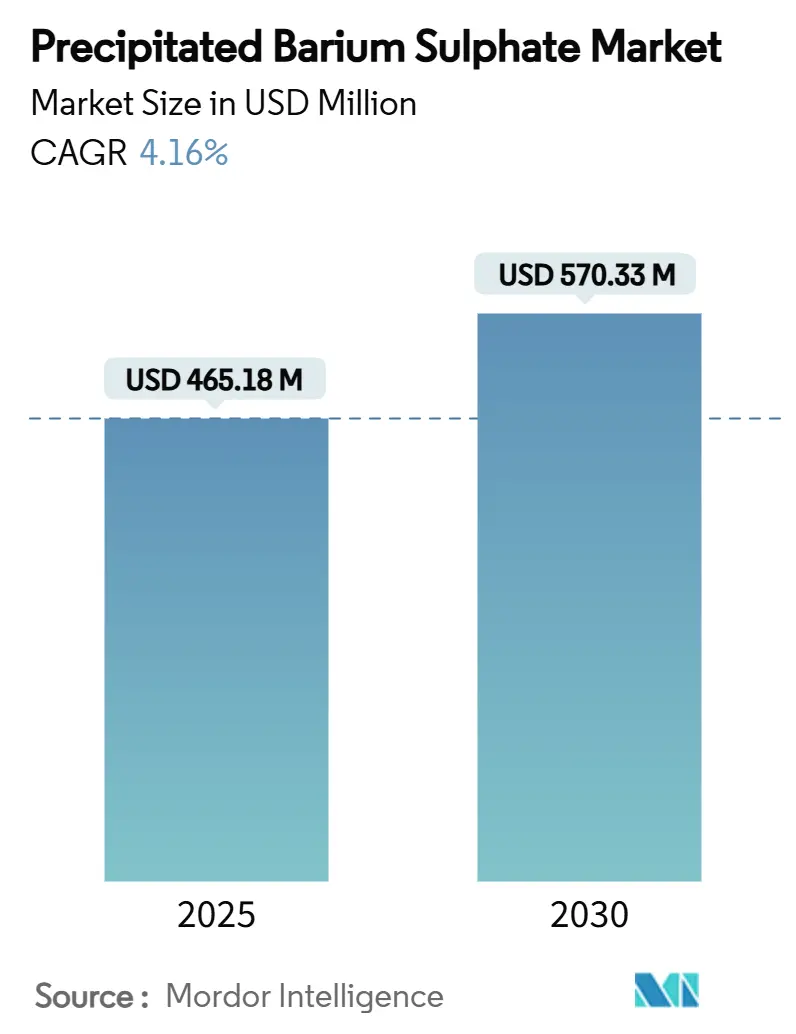
| Market Size (2025) | USD 465.18 Million |
| Market Size (2030) | USD 570.33 Million |
| Growth Rate (2025 - 2030) | 4.16 % |
| Fastest Growing Market | Asia Pacific |
| Largest Market | Asia Pacific |
| Market Concentration | Medium |
Major Players *Disclaimer: Major Players sorted in no particular order Image © Mordor Intelligence. Reuse requires attribution under CC BY 4.0. | |
Precipitated Barium Sulphate Market Analysis by Mordor Intelligence
The Precipitated Barium Sulphate Market size is estimated at USD 465.18 Million in 2025, and is expected to reach USD 570.33 Million by 2030, at a CAGR of 4.16% during the forecast period (2025-2030). Growth is propelled by the pigment’s unrivaled purity, narrow particle-size control, and 98.1% solar reflectance, which positions it as a cornerstone of ultra-white radiative-cooling coatings for energy-efficient buildings. Adoption in lithium-ion battery separator membranes, automotive plastics, and high-density concrete further enlarges demand as manufacturers prioritise optical brightness, chemical inertness, and radiopacity. Regulatory pressure for low-VOC (Volatile Organic Compound) and low-hazard formulations in North America and Europe accelerates the switch from natural barite to high-purity synthetic grades that assure compliance. Competitive strategies centre on continuous precipitation technology, microreactor processing, and surface-modification chemistry that deliver sub-micron particles while trimming energy use and wastewater volumes.
Key Report Takeaways
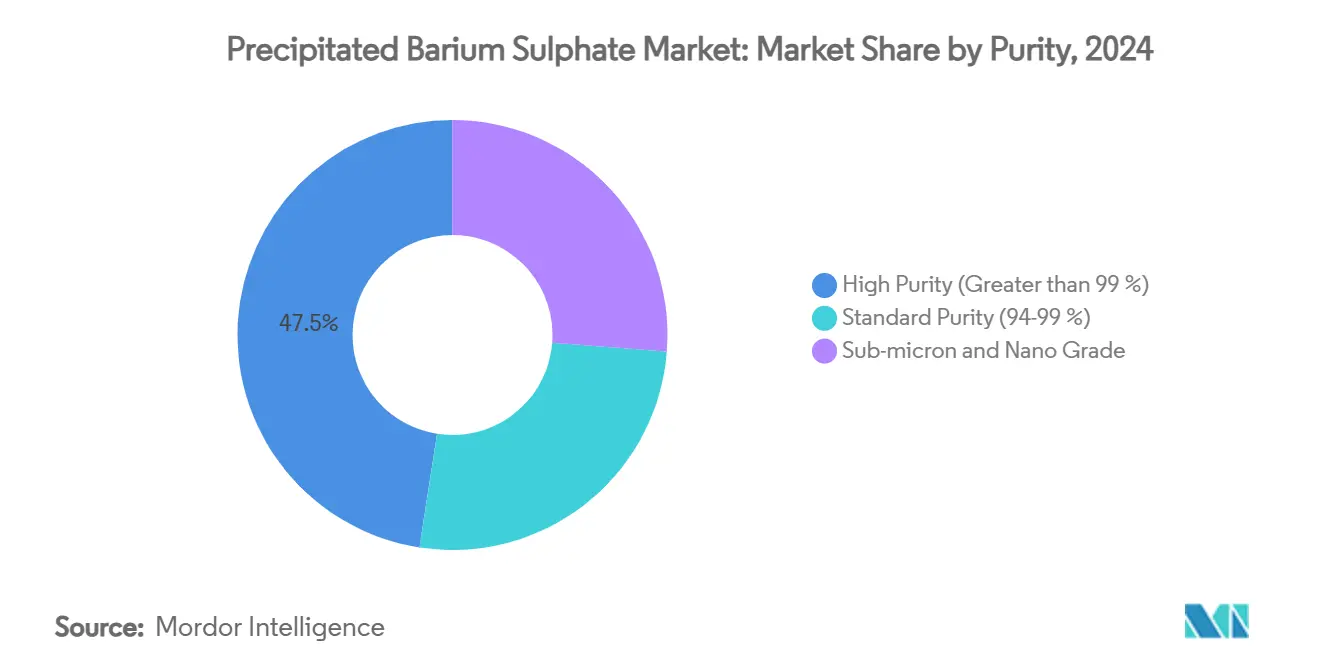
- By purity, High Purity (Greater than 99%) led with 47.54% of the Precipitated Barium Sulphate market share in 2024, while Sub-micron and Nano Grade are advancing at a 4.54% CAGR through 2030.
- By form, powder products captured 70.28% share of the Precipitated Barium Sulphate market size in 2024; Suspension/Slurry is projected to expand at a 4.47% CAGR between 2025 - 2030.
- By application, paints and coatings accounted for 42.81% of the Precipitated Barium Sulphate market size in 2024, whereas 3-D printing materials are expected to grow at the fastest 4.91% CAGR to 2030.
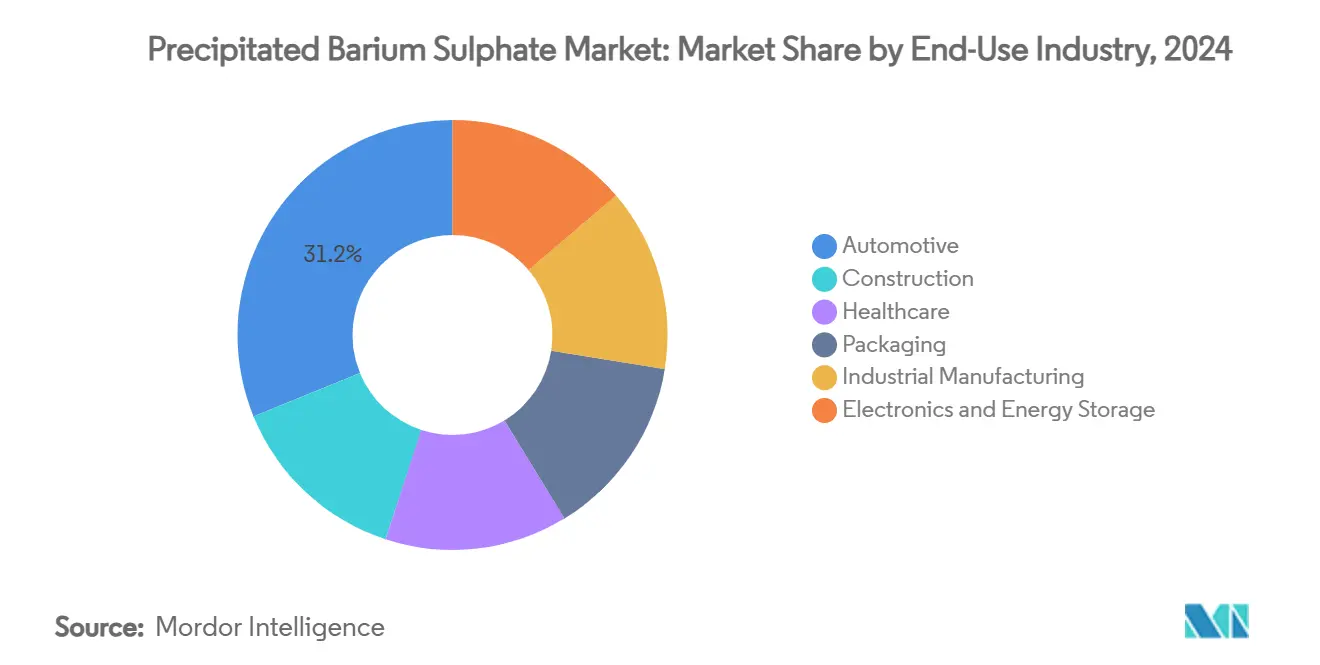
- By end-use industry, automotive activities controlled 31.18% of the Precipitated Barium Sulphate market share in 2024; electronics and energy storage is the quickest-growing end-use at 5.15% CAGR through 2030.
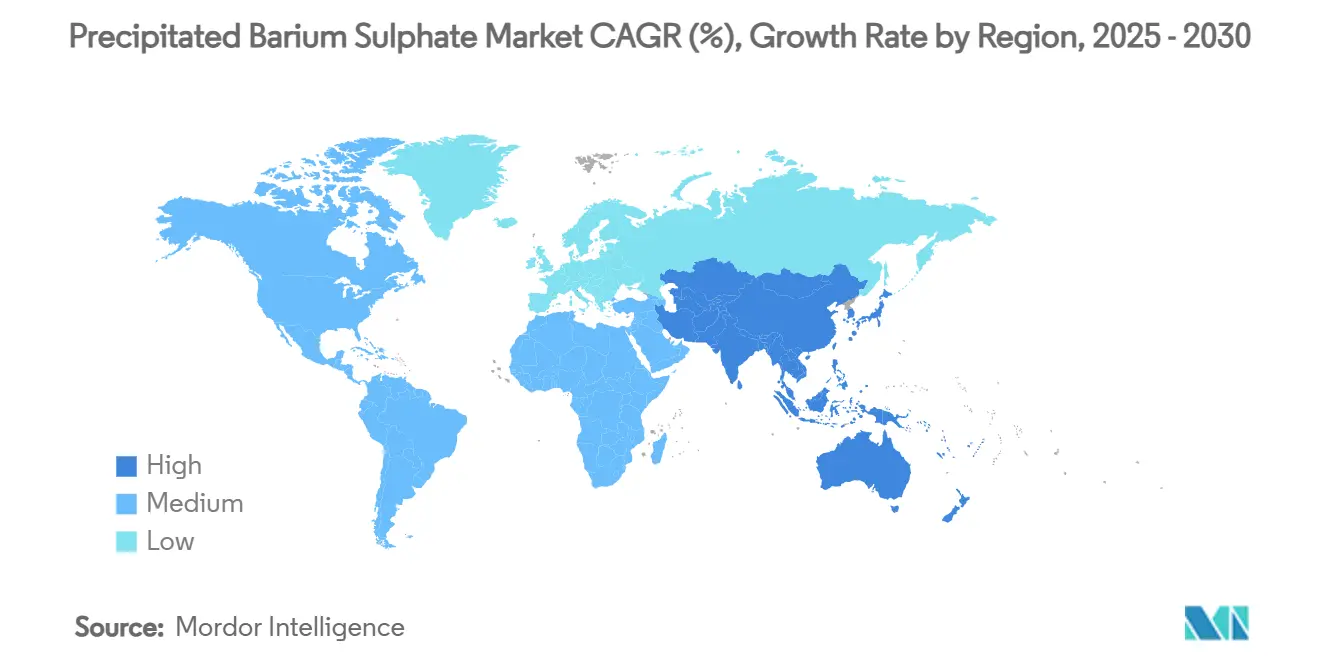
- By geography, Asia-Pacific dominated with 39.96% share in 2024, and is expanding at a 4.82% CAGR owing to China’s and India’s shift toward higher-value precipitated grades.
Note: Market size and forecast figures in this report are generated using Mordor Intelligence’s proprietary estimation framework, updated with the latest available data and insights as of January 2026.
Market Trends and Insights
Drivers Impact Analysis of Precipitated Barium Sulphate Market*
| Driver | (~) % Impact on CAGR Forecast | Geographic Relevance | Impact Timeline |
|---|---|---|---|
| Growing Demand in Paints and Coatings | +1.2% | Global, with concentration in Asia-Pacific and North America | Medium term (2-4 years) |
| Expanding Use in Plastics and Rubber | +0.8% | Global, particularly strong in automotive hubs | Long term (≥ 4 years) |
| Surge in Ultra-white Cool-roof Coatings Using Nano-barium Sulphate | +0.6% | North America & EU, expanding to APAC | Short term (≤ 2 years) |
| Adoption in Li-ion Battery Separator Membranes for EVs | +0.4% | APAC core, spill-over to North America and EU | Medium term (2-4 years) |
| Regulatory Push for Low-VOC, High-opacity Fillers | +0.3% | North America & EU, with regulatory adoption in APAC | Long term (≥ 4 years) |
| Source: Mordor Intelligence | |||
Growing Demand in Paints and Coatings
Architectural and industrial coating formulators intensify consumption of precipitated barium sulphate products to achieve ultra-white surfaces that deliver subambient cooling. A Purdue University study verified 98.1% solar reflectance and 6.1°C temperature reduction, advantages stemming from the pigment’s high refractive index and balanced band gap which scatter visible and near-infrared light while absorbing minimal solar energy[1]. Global net-zero commitments propel adoption in hot-climate regions where cooling loads dominate energy profiles. Coating makers also value the pigment’s chemical inertness that prevents yellowing and chalking under UV exposure. Scale-up, however, demands cleaner precipitation technologies to cut mining and process emissions so that embodied carbon does not offset operational energy savings. Suppliers with integrated waste-heat recovery and closed-loop water systems gain a competitive edge among sustainability-focused customers.
Expanding Use in Plastics and Rubber
Automotive original equipment manufacturers (OEMs) are increasingly dispersing precipitated barium sulfate powders into lightweight polymers for improved acoustics, scratch resistance, and CT-based quality monitoring. The filler’s 4.4 g/cm³ density improves sound damping, while nanoparticles less than or equal to 150 nm retain optical clarity and mechanical toughness. Surface treatment with dodecyl benzene sulfonic acid yields average particle sizes of 46 nm, which distribute evenly in polypropylene and polycarbonate matrices, thereby curbing agglomeration and ensuring uniform gloss. The pigment enhances abrasion resistance without elevating viscosity for rubber seals and hoses, preserving processing rates on multi-extrusion lines. As electric-vehicle platforms expand polypropylene use to reduce weight, demand for barium-based functional additives increases with the implementation of stringent interior noise standards.
Surge in Ultra-white Cool-roof Coatings Using Nano-barium Sulphate
Passive radiative-cooling developers deploy nano-grade precipitated barium sulphate to reach 92.5% solar reflectance and 96.0% thermal emittance inside the 8-13 µm atmospheric window, enabling theoretical cooling power of 117 W/m² under peak sun. Unlike titanium dioxide, barium sulphate’s phonon resonances fall outside visible wavelengths, eliminating a bluish tint and photo-catalytic degradation. Market demand clusters in California, Southern Europe, and the Gulf Cooperation Council, where building codes encourage energy-saving roofing materials. Durability remains a hurdle as UV, wind-driven rain, and airborne dust can dull infrared emissivity. Manufacturers are testing silicone-modified binders and fluorinated top coats to protect particle morphology while retaining radiative performance through a 20-year service life.
Adoption in Li-ion Battery Separator Membranes for EVs
Separator suppliers incorporate 3-5 wt% precipitated barium sulphate nanoparticles to raise thermal shutdown thresholds and maintain mechanical integrity under high-rate discharge. The pigment’s dielectric strength curtails micro-shorts, while radiopacity supports X-ray inspection of laminate uniformity. Asia-Pacific gigafactories demand pharmaceutical-grade purity to keep ionic contamination below 50 ppm (parts per million). As electric-vehicle makers extend warranties to 2030, separators must withstand 1,500 duty cycles without porosity loss. Barium sulphate’s inertness prevents hydrofluoric acid attack from electrolyte breakdown, enhancing safety metrics. Supply continuity has become a commercial differentiator, prompting separator makers to secure multi-year contracts with vertically integrated pigment suppliers.
Restraints Impact Analysis of Precipitated Barium Sulphate Market*
| Restraint | (~) % Impact on CAGR Forecast | Geographic Relevance | Impact Timeline |
|---|---|---|---|
| Availability of Substitutes | -0.7% | Global, with higher impact in cost-sensitive applications | Medium term (2-4 years) |
| Environmental and Health Concerns in Ba-bearing Effluents | -0.4% | Global, with stricter enforcement in developed markets | Long term (≥ 4 years) |
| High Electricity Intensity of Nano-scale Precipitation | -0.3% | Manufacturing regions with high energy costs | Short term (≤ 2 years) |
| Source: Mordor Intelligence | |||
Availability of Substitutes
Titanium dioxide and calcium carbonate continue to erode precipitated barium sulphate market penetration in commodity paint and plastic segments where high density, radiopacity, or extreme whiteness are non-critical. TiO₂ maintains lower unit volumes thanks to superior tinting strength, enabling formulators to achieve target gloss with less pigment. Calcium carbonate offers a 50-70% price discount and adequate brightness for interior wallboard coatings. Yet in medical imaging, contrast media, and cool-roof coats, the pigment remains unchallenged because competing fillers cannot match the attenuation coefficient or solar reflectance spectrum. Suppliers must articulate performance-per-dollar value to safeguard premiums in price-sensitive procurements and avoid commoditisation pressure.
Environmental and Health Concerns in Ba-bearing Effluents
The Environmental Protection Agency (EPA) caps barium in drinking water at 2 mg/L, while the Occupational Safety and Health Administration (OSHA) limits workplace total dust exposure to 15 mg/m³, forcing producers to invest in advanced wastewater treatment and dust-collection systems. Compliance adds operating costs that tilt the precipitated barium sulphate industry's competitive balance toward large integrated firms possessing capital for membrane ultra-filtration and zero-liquid-discharge circuits. End-of-life disposal guidelines for barium-laden paints and plastics grow stricter in the European Union (EU), where extended-producer-responsibility laws oblige manufacturers to finance the retrieval and safe treatment of construction debris. Consequently, downstream users now audit supplier environmental-management systems and ISO 14001 certification as part of procurement due diligence.
*Our forecasts treat driver/restraint impacts as directional, not additive. The impact forecasts reflect baseline growth, mix effects, and variable interactions.
Precipitated Barium Sulphate Market Segment Analysis
By Purity:
High-Purity Grades Anchor Premium ApplicationsHigh-purity material contributed USD 221.2 Million and 47.54% of the Precipitated Barium Sulphate market share in 2024, a leadership underpinned by its indispensable function in radiopaque medical devices and ultra-white architectural coatings. Pharmaceutical formulators require barium sulphate with less than or equal to 50 ppm trace metals to prevent adverse patient reactions, while cool-roof paint makers depend on high-purity to sustain 98% solar reflectance over decades. The precipitated barium sulphate market size for sub-micron and nano grades is forecast to grow at 4.54% CAGR through 2030 on the back of electronics, capacitor dielectrics, and separator membranes.
Production sophistication rises steeply once particle diameters drop below 200 nm because nucleation and growth rates must align within microseconds to avoid agglomeration. Pilot work using spinning disk reactors has demonstrated mean diameters of 16.4 nm while halving the energy footprint relative to batch precipitation. Continuous processes lower labour costs but require inline particle-size spectroscopy, automated antifoam control, and nanofiltration to recycle mother liquor. Producers that master these controls position themselves as solution partners rather than commodity suppliers, helping customers fine-tune slurry viscosity, rheology, and infrared emissivity.

By Form:
Powder Dominance Meets Suspension InnovationPowder grades commanded USD 327.0 Million or 70.28% of the Precipitated Barium Sulphate market size in 2024, sustained by widespread compatibility with twin-screw compounding, paint-mill dispersion, and rubber internal mixing. End-users value the ability to meter powder by weight and store it indefinitely in dry conditions, avoiding microbial growth. Yet suspensions and slurries are advancing at 4.47% CAGR because liquid systems yield superior dispersion, shorter mixing cycles, and lower workplace dust exposure, advantages prized in high-throughput automotive clear-coat lines.
Slurry formulations combine 70% solids content with dispersants and anti-settling agents, enabling a 12-month shelf life without particle sedimentation. The increasing use of robotic spray systems that recirculate coating baths is driving demand for ready-to-use formulations. Masterbatch pellets extend this concept to thermoplastics by embedding 80-wt% pigment in carrier resins that melt-blend seamlessly into injection moulding or extrusion. Although the initial price is higher, the use of masterbatch cuts plant-wide pigment cleaning downtime, an appealing trade-off for lean automotive suppliers.
By Application:
Coatings Leadership and 3-D Printing MomentumPaints and coatings accounted for USD 199.1 million, or a 42.81% share of the Precipitated Barium Sulphate market size in 2024, by meeting stringent opacity, weatherability, and whiteness targets across architectural façades and industrial enamels. Coating chemists pair barium sulphate with rutile titanium dioxide to optimize hiding power at lower total pigment volume concentration, thereby trimming resin demand and volatile organic compound (VOC) emissions. Plastics are the second-largest consumer segment where the pigment’s density offers noise damping in automotive door panels and impact resistance in consumer electronics housings.
3-D Printing Materials embody the fastest 4.91% CAGR as 3-D-printing powder suppliers incorporate barium sulphate to gain radiopacity that supports intraoperative CT navigation. Unlike iodinated coatings that wash out during sterilisation, barium sulphate remains stable at 134°C steam autoclave cycles, ensuring long-term contrast. Adhesives and sealants apply the pigment as a rheology controller to stop sag on vertical joints. Paper makers blend it in specialty labels to raise opacity, though digital media displacement moderates growth in this sub-segment.
By End-Use Industry:
Automotive Scale and Electronics UpswingAutomotive activities absorbed USD 145.0 Million or 31.18% of the Precipitated Barium Sulphate market demand in 2024, leveraging the filler in under-body coatings, acoustic foams, plastic dashboards, and tyre compounds. High-density concrete containing 25–40 wt% barium sulphate shields medical imaging suites and nuclear facilities, supporting the construction sector’s sizeable share.
Electronics and energy-storage users currently form a USD 80.0 Million niche but are tracking a 5.15% CAGR through 2030 as EV battery plants, 5G-enabled devices, and power-module producers specify barium sulphate for dielectric layers and thermal interface materials. Healthcare remains a steadfast market for contrast media and pharmaceutical excipients approved under the United States Pharmacopeia monograph. Packaging firms explore barium-filled barrier films to block oxygen and light in shelf-stable foods and nutraceuticals, but substitution economics with metalised foils moderate volume progression. Industrial manufacturing spans oil-field completion fluids, chemical catalysts, and specialty abrasives.
Geography Analysis
APAC Precipitated Barium Sulphate Market
Asia-Pacific retained 39.96% share of the Precipitated Barium Sulphate market in 2024 and is set for 4.82% CAGR until 2030 as China pivots from barite exporters to value-added nano-grade pigment production, and India supplies 1.6 Million tons of barite feedstock, ensuring raw-material security[2]. Government incentives in Jiangxi and Sichuan support microreactor adoption, while Japan’s electronics sector imports high-purity slurry for semiconductor lithography. South Korean battery firms sign multi-year offtake agreements to secure separator-grade pigment that meets less than 10 ppm chloride limits critical for cell longevity. Integrated supply chains linking Guangxi mines to Guangdong specialty-chemical clusters deliver cost and logistic advantages over rivals.
North America Precipitated Barium Sulphate Market
North America hosts tight air-quality rules that prefer synthetic over natural barite for low-VOC coatings and pharmaceutical formulations. United States cool-roof initiatives under California Title 24 accelerate barium sulphate uptake in elastomeric topcoats, while Mexico’s automotive corridor in Guanajuato applies barium-filled PP (Polypropylene) compounds in interior trims. Producers like Cimbar Resources benefit from proximity to Nevada barite reserves, cutting freight to Gulf Coast pigment plants. Trade-agreement certainty under the United States-Mexico-Canada Agreement (USMCA) encourages OEMs to localise supply lines, bolstering incremental volumes through 2030.
Europe Precipitated Barium Sulphate Market
Europe focuses on sustainability; the European Union (EU) Chemical Strategy for Sustainability prompts formulators to substitute substances of concern with inert fillers such as barium sulphate. Germany’s e-mobility drive raises separator-grade purchases, whereas Nordic public-procurement criteria increasingly specify cool-roof paints for municipal projects. The European Commission BAT (Best Available Techniques) reference document requires energy-intensive chemical sites to slash specific energy consumption, steering pigment makers toward heat-integration retrofits. United Kingdom specialty-paint innovators are trialling fluoropolymer-capped barium sulphate suspensions that withstand maritime exposure for offshore wind towers.
Competitive Landscape
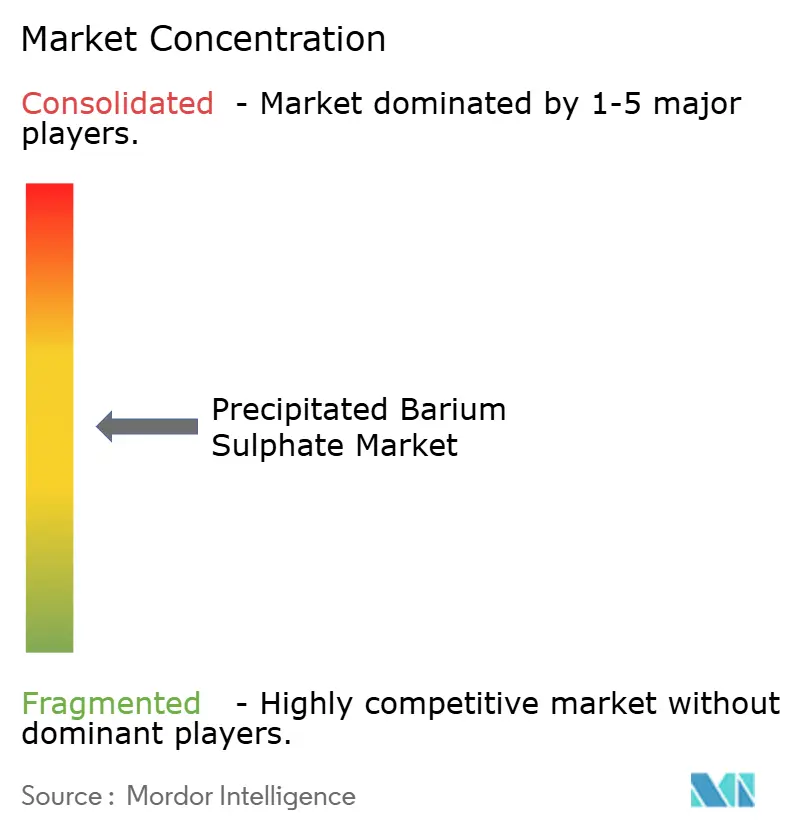
The Precipitated Barium Sulphate market is moderately consolidated with the presence of players, such as Solvay, Venator Materials PLC, Fengchen Group Co., Ltd., and Cimbar Resources, Inc. Solvay leverages its Blanc Fixe range, spanning 0.7–4 µm median particle sizes for applications from gloss furniture lacquers to battery separators. Cimbar Resources integrates upstream barite ore with downstream precipitation reactors, providing customers traceable ISO-9001 supply suited for Food and Drug Administration (FDA)-regulated pharmaceuticals. Pricing remains relatively stable owing to long-term supply agreements incorporating pass-through clauses for energy and sodium-sulfide feedstock. Freight constitutes up to 20% of delivered pigment cost; thus, regional hubs near customers reduce working-capital barriers and ensure just-in-time delivery for high-throughput paint and plastic plants.
Precipitated Barium Sulphate Industry Leaders
-
Cimbar Resources, Inc.
-
Fengchen Group Co., Ltd.
-
Venator Materials PLC
-
Solvay
-
SAKAI CHEMICAL INDUSTRY CO., LTD.
- *Disclaimer: Major Players sorted in no particular order
Precipitated Barium Sulphate Market Companies Covered in this Report
- Cimbar Resources, Inc.
- Fengchen Group Co., Ltd.
- Foshan Xintu Chemical Co., Ltd.
- Guandong Ximi New Material Technology Co., Ltd.
- Hoyonn Chemical Industry(HK) Co., Limited
- SAKAI CHEMICAL INDUSTRY CO., LTD.
- Shenzhou Jiaxin Chemical Co., Ltd.
- Solvay
- Venator Materials PLC
- Vishnu Chemicals
- Yunfu Hongzhi New Materials Co., Ltd.
Recent Industry Developments in Precipitated Barium Sulphate Market
- May 2024: The Environmental Protection Agency updated barium, calcium, manganese, and strontium oxide regulations under the Toxic Substances Control Act, reflecting ongoing regulatory attention to barium-containing compounds, such as Precipitated Barium Sulphate, and their industrial applications. This could substantially influence the market in the coming years.
- July 2023: Vishnu Chemicals announced the successful trials of its Precipitated Barium Sulphate and Sodium Sulphide. The company began production at its Srikalahasti, Andhra Pradesh facility, boasting a capacity of 30,000 TPA. The product is a filler in pure white powder coatings, achieving a glossy finish.
Global Precipitated Barium Sulphate Market Report Scope
| High Purity (Greater than 99 %) |
| Standard Purity (94-99 %) |
| Sub-micron and Nano Grade |
| Powder |
| Suspension/Slurry |
| Masterbatch |
| Paints and Coatings |
| Plastics |
| Rubber |
| Pharmaceuticals/Contrast Media |
| Adhesives and Sealants |
| Paper |
| 3-D Printing Materials |
| Automotive |
| Construction |
| Healthcare |
| Packaging |
| Industrial Manufacturing |
| Electronics and Energy Storage |
| Asia-Pacific | China |
| Japan | |
| India | |
| South Korea | |
| ASEAN Countries | |
| Rest of Asia-Pacific | |
| North America | United States |
| Canada | |
| Mexico | |
| Europe | Germany |
| United Kingdom | |
| France | |
| Italy | |
| Spain | |
| Russia | |
| NORDIC Countries | |
| Rest of Europe | |
| South America | Brazil |
| Argentina | |
| Rest of South America | |
| Middle East and Africa | Saudi Arabia |
| South Africa | |
| Rest of Middle East and Africa |
| By Purity | High Purity (Greater than 99 %) | |
| Standard Purity (94-99 %) | ||
| Sub-micron and Nano Grade | ||
| By Form | Powder | |
| Suspension/Slurry | ||
| Masterbatch | ||
| By Application | Paints and Coatings | |
| Plastics | ||
| Rubber | ||
| Pharmaceuticals/Contrast Media | ||
| Adhesives and Sealants | ||
| Paper | ||
| 3-D Printing Materials | ||
| By End-Use Industry | Automotive | |
| Construction | ||
| Healthcare | ||
| Packaging | ||
| Industrial Manufacturing | ||
| Electronics and Energy Storage | ||
| By Geography | Asia-Pacific | China |
| Japan | ||
| India | ||
| South Korea | ||
| ASEAN Countries | ||
| Rest of Asia-Pacific | ||
| North America | United States | |
| Canada | ||
| Mexico | ||
| Europe | Germany | |
| United Kingdom | ||
| France | ||
| Italy | ||
| Spain | ||
| Russia | ||
| NORDIC Countries | ||
| Rest of Europe | ||
| South America | Brazil | |
| Argentina | ||
| Rest of South America | ||
| Middle East and Africa | Saudi Arabia | |
| South Africa | ||
| Rest of Middle East and Africa | ||
Key Questions Answered in the Report
What is the current value size of the Precipitated Barium Sulphate market?
It is valued at USD 465.18 Million in 2025, with a projection to reach USD 570.33 Million by 2030.
Which region leads demand for precipitated barium sulphate?
Asia-Pacific holds 39.96% share and is expanding at a 4.82% CAGR due to China’s and India’s production scale-up.
Why is precipitated barium sulphate preferred in cool-roof paints?
The pigment provides 98.1% solar reflectance, enabling cooling that cuts air-conditioning loads in hot climates.
How is the material used in lithium-ion batteries?
Separator manufacturers add nano-grade barium sulphate to boost thermal stability and radiopacity for safety inspection.
What purity grade dominates sales?
High-purity grades command 47.54% market share because medical and energy applications require low impurities.