
Market Overview
| Study Period | 2021 - 2031 |
|---|---|
| Market Size (2026) | USD 3.72 Billion |
| Market Size (2031) | USD 6.02 Billion |
| Growth Rate (2026 - 2031) | 10.09 % |
| Fastest Growing Market | Asia Pacific |
| Largest Market | North America |
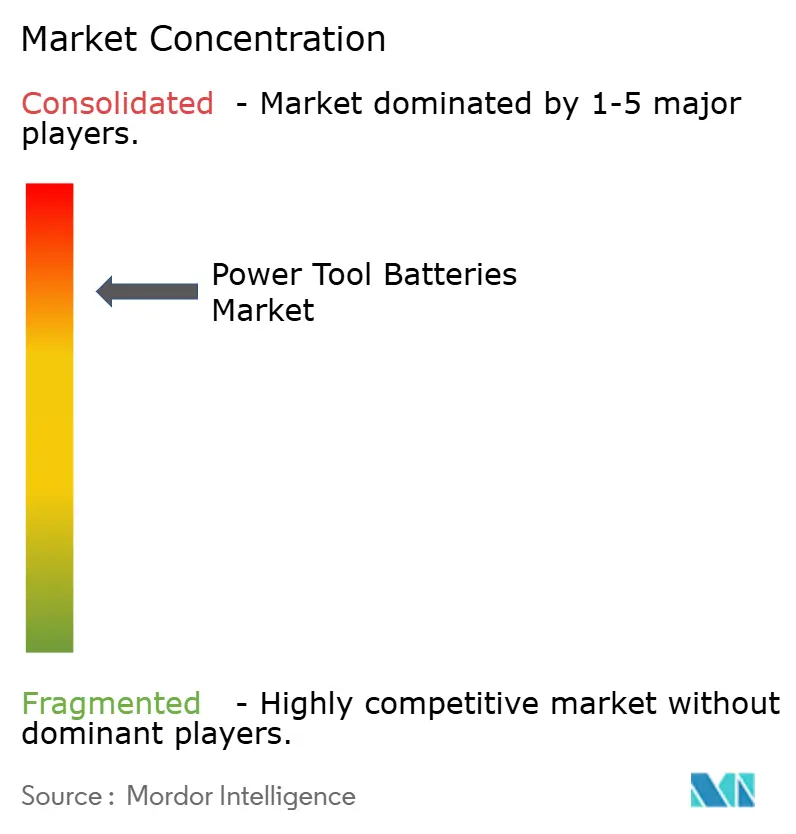
| Market Concentration | High |
Major Players *Disclaimer: Major Players sorted in no particular order Image © Mordor Intelligence. Reuse requires attribution under CC BY 4.0. | |

Power Tool Batteries Market Analysis by Mordor Intelligence
The Power Tool Batteries Market size is estimated at USD 3.72 billion in 2026, and is expected to reach USD 6.02 billion by 2031, at a CAGR of 10.09% during the forecast period (2026-2031).
Lithium-ion pack prices falling to USD 108 per kWh in 2025, 70% brushless-motor penetration in professional drills, and right-to-repair statutes that unlock aftermarket channels collectively reinforce the transition away from corded systems. Tool brands are extending 18-volt and 20-volt ecosystems to more than 300 SKUs, while 60-volt and 80-volt platforms broaden cordless reach into concrete cutting and demolition. Cylindrical cells still dominate, yet pouch architectures are growing swiftly on the back of 50% power-density gains demonstrated by the POWERSTACK line. Regionally, Asia-Pacific leads growth thanks to new 15 GWh lines in India and nickel-supply integration in Indonesia.
Key Report Takeaways
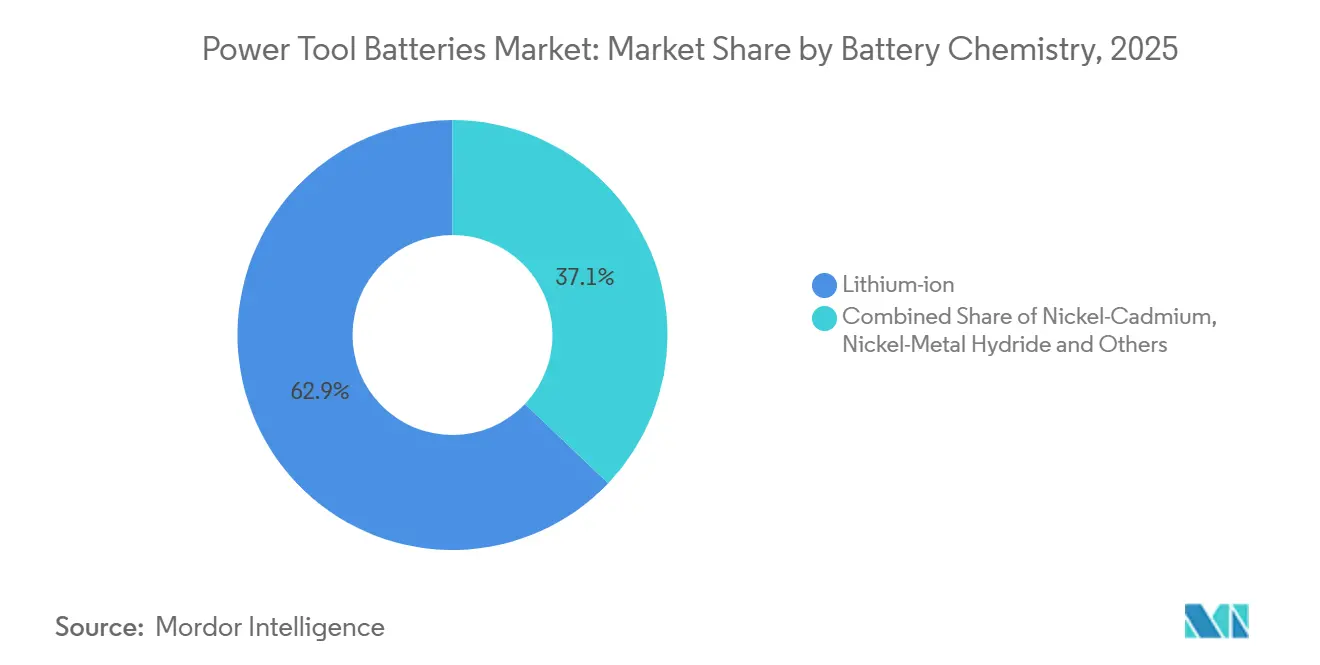
- By battery chemistry, lithium-ion held 62.9% power tool battery market share in 2025; the emerging-technologies segment is forecast to expand at a 21.5% CAGR through 2031.
- By cell format, cylindrical cells accounted for 42.5% of the power tool battery market size in 2025, while pouch cells are advancing at a 22.2% CAGR to 2031.
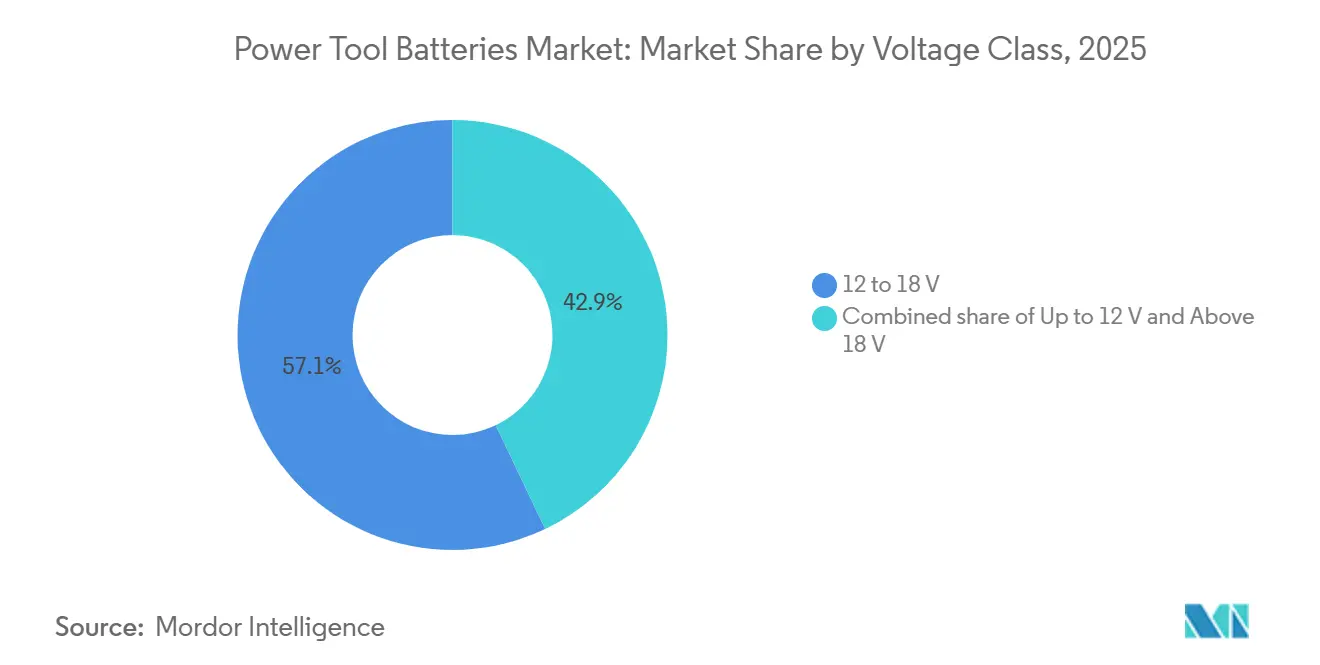
- By voltage class, the 12-to-18-volt segment captured 57.1% of power tool battery market share in 2025, whereas above-18-volt packs are projected to grow at 15.1% CAGR through 2031.
- By application, professional and industrial tools held a 44.7% share of the power tool battery market size in 2025, and outdoor power equipment is expanding at a 14.4% CAGR to 2031.
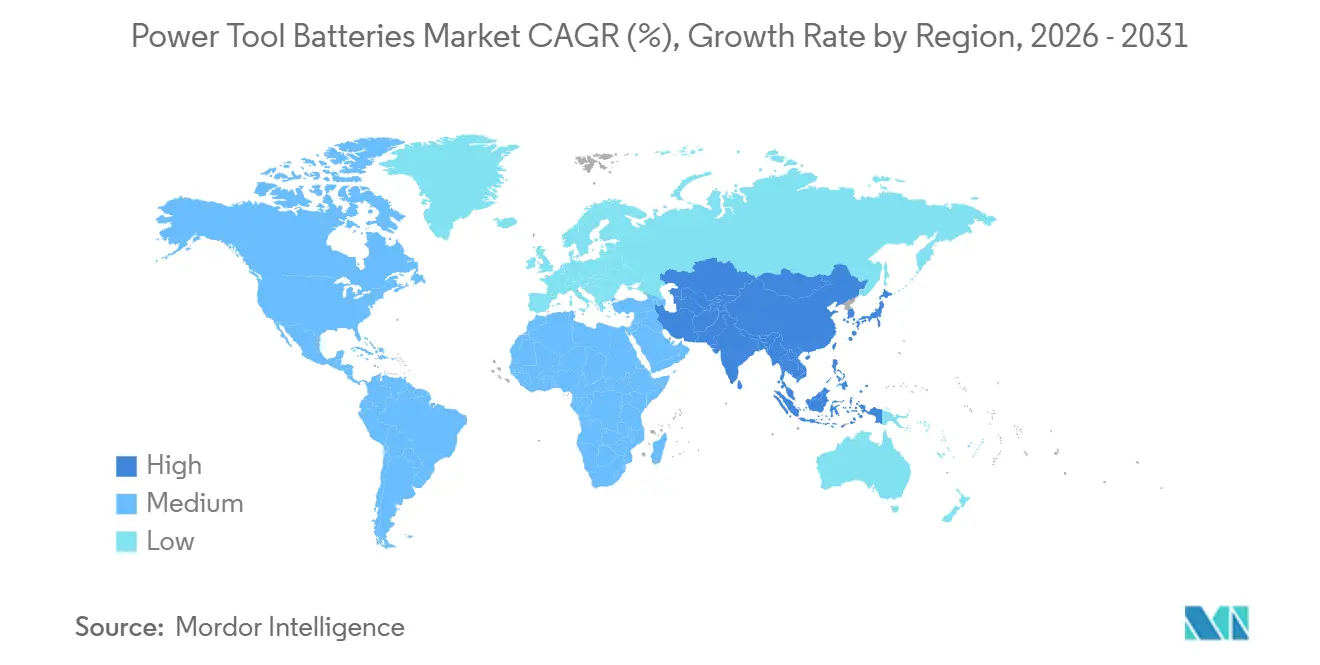
- By geography, North America commanded a 39.3% share of the power tool battery market, while Asia-Pacific is projected to grow at a robust 15.9% CAGR, continuing through 2031.
Note: Market size and forecast figures in this report are generated using Mordor Intelligence’s proprietary estimation framework, updated with the latest available data and insights as of January 2026.
Global Power Tool Batteries Market Trends and Insights
Drivers Impact Analysis*
| Driver | (~) % Impact on CAGR Forecast | Geographic Relevance | Impact Timeline |
|---|---|---|---|
| Accelerating shift from corded to cordless tools | 2.8% | Global, with highest intensity in North America and Europe | Medium term (2-4 years) |
| Rapid gains in Li-ion energy density and runtime | 2.3% | Global, led by Asia-Pacific cell manufacturing hubs | Long term (≥ 4 years) |
| OEM 18-volt and 20-volt platform expansion | 1.7% | North America and Europe core markets, spillover to APAC | Medium term (2-4 years) |
| Emergence of 60-volt and above heavy-duty cordless category | 1.4% | North America professional segment, expanding to Europe | Short term (≤ 2 years) |
| Brushless-motor penetration raising discharge demand | 1.2% | Global, concentrated in professional tool lines | Medium term (2-4 years) |
| Right-to-repair laws lifting aftermarket battery sales | 0.8% | United States (California, New York, Minnesota), EU member states | Long term (≥ 4 years) |
| Source: Mordor Intelligence | |||
Accelerating Shift from Corded to Cordless Tools
Cordless penetration crossed 78% in North American professional construction during 2025 after OSHA trip-hazard guidelines and falling lithium-ion costs tipped total cost-of-ownership economics decisively toward cordless.[1]U.S. OSHA, “Trip Hazard Mitigation Guidelines,” osha.gov Techtronic Industries reported 14% year-over-year cordless revenue growth in H1 2024 while corded sales fell 6%, confirming structural demand realignment. European public-works contracts above EUR 50,000 now specify zero-emission tools, pushing municipalities to battery platforms. Southeast Asian markets lag at 40% cordless share, but off-grid solar-plus-storage projects are spurring adoption in Indonesia and the Philippines. Collectively, these shifts underpin the double-digit expansion of the power tool battery market.
Rapid Gains in Li-ion Energy Density and Runtime
Nickel-manganese-cobalt energy density reached 285 Wh/kg in 2025, a 12% jump since 2022, due to silicon-anode and electrolyte tuning. Samsung SDI’s fifth-generation cylindrical cells extend runtime by 20% in the same 21700 footprint, enabling Makita’s lighter 18-volt, 6 Ah packs.[2]Samsung SDI, “Fifth-Generation 21700 Cells,” samsung.com LG Energy Solution disclosed 1,800-cycle durability at 80% depth-of-discharge, trimming annual battery replacement cost by 30% for contractors. Lithium-iron-phosphate is winning cost-sensitive consumer segments by offering a 3,000-cycle life despite a 15% density penalty. Solid-state pilot lines at QuantumScape and Solid Power promise 40% volumetric gains, but mass production before 2028 is unlikely.
OEM 18-Volt and 20-Volt Platform Expansion
Proprietary 18-volt or 20-volt ecosystems lock in about 85% of professional users, covering more than 300 SKUs per leading brand. Bosch’s AMPShare alliance pooled 200 compatible tools across three brands in 2024, countering multi-battery complexity for job-site fleets.[3]Bosch Power Tools, “AMPShare Alliance Announcement,” bosch.com Milwaukee’s M18 system generated USD 1.8 billion in battery and charger revenue in 2024, underscoring batteries as consumables rather than durables. California’s SB 244 obliges manufacturers to supply replacement batteries for seven years, lengthening platform life cycles and limiting connector redesign. The result is a deeper commitment to mid-voltage platforms that underpin the power tool battery market.
Emergence of 60-Volt and Above Heavy-Duty Cordless Category
Above-18-volt packs are growing at 15.1% as high-power applications pivot away from gasoline and pneumatics. DEWALT’s FLEXVOLT 60-volt line captured 12% of North American professional sales in 2025 by powering 9-inch grinders and concrete mixers. Makita’s 80-volt XGT system delivers 2,200 W, supplanting portable generators on framing sites. Hilti’s 36-volt portfolio anchors European uptake, where 230-volt mains are common but temporary distribution is pricey. Liquid-cooled packs in Milwaukee’s MX FUEL line maintain 50 A discharge without thermal shutdown, enabling full-shift productivity.
Restraints Impact Analysis*
| Restraint | (~) % Impact on CAGR Forecast | Geographic Relevance | Impact Timeline |
|---|---|---|---|
| High upfront cost of Li-ion packs | -0.6% | Global, most acute in price-sensitive emerging markets | Short term (≤ 2 years) |
| Thermal-runaway recalls denting consumer trust | -0.5% | North America and Europe, with regulatory scrutiny | Medium term (2-4 years) |
| Nickel and graphite supply volatility squeezing margins | -0.4% | Global, concentrated impact on cell manufacturers | Medium term (2-4 years) |
| Brand-locked battery ecosystems limiting cross-compatibility | -0.3% | Global, affecting multi-brand professional users | Long term (≥ 4 years) |
| Source: Mordor Intelligence | |||
High Upfront Cost of Li-ion Packs
Professional packs retail between USD 120 and USD 250, equal to 30–50% of a cordless kit price, slowing uptake among small contractors in India and Southeast Asia, where the premium exceeds two weeks’ wages. OEM mark-ups of 2.5–3× persist despite pack-level costs falling below USD 110 per kWh in 2025. India’s cordless penetration remains under 35% because affordability outweighs productivity gains. Retailers introduced zero-interest financing that lifted attachment rates 18% among first-time cordless buyers in 2024. CATL’s cell-to-pack architecture could shave 15% from pack prices by 2027, offering relief to the power tool battery industry.
Thermal-Runaway Recalls Denting Consumer Trust
The U.S. Consumer Product Safety Commission logged 18 tool-battery incidents in 2024, prompting 1.2 million unit recalls and USD 12 million in replacement costs at Stanley Black & Decker.[4]U.S. CPSC, “Lithium-Ion Incident Database,” cpsc.gov Lithium-ion cells can ignite above 150 °C, a risk heightened by high-rate charging and discharge in brushless tools. UL 2595 crush and propagation tests became mandatory in 2024, adding USD 50,000 to each certification cycle and raising entry barriers for smaller brands. Surveys show 22% of consumers cite safety as an adoption barrier, up from 14% in 2022, denting cordless conversion momentum. OEM investments in lithium-iron-phosphate and solid-state chemistries aim to curb thermal-runaway risks, but mass deployment remains years away.
*Our forecasts treat driver/restraint impacts as directional, not additive. The impact forecasts reflect baseline growth, mix effects, and variable interactions.
Segment Analysis
By Battery Chemistry: Emerging Technologies Challenge Li-ion Dominance
Lithium-ion retained 62.9% power tool battery market share in 2025 on the strength of nickel-manganese-cobalt and nickel-cobalt-aluminum blends that sustain 40 A discharge and 285 Wh/kg energy density. Nickel-cadmium receded to a single-digit share after EU cadmium bans, and nickel-metal-hydride persists only in niche lighting. The emerging-technologies cluster, solid-state, sodium-ion, and lithium-sulfur, will expand at 21.5% CAGR through 2031 as OEMs hedge against nickel supply shocks and seek chemistries with intrinsic thermal stability.
Solid-state prototypes recorded 800 Wh/L in 2025 pilot lines yet suffer sub-60% yields, delaying commercialization until at least 2028. CATL’s sodium-ion cells deliver 160 Wh/kg at one-third lithium-ion cost, suiting entry-level consumer tools where weight is secondary. Lithium-iron-phosphate now powers outdoor equipment thanks to 3,000-cycle durability and benign thermal behavior, despite 15% energy-density sacrifice. U.S. Department of Energy grants totaling USD 200 million to domestic solid-state plants illustrate policy backing for chemistries that diversify supply chains. These shifts diversify chemistry portfolios while sustaining the broader power tool battery market.



By Cell Format: Pouch Cells Gain Ground on Thermal Efficiency
Cylindrical cells accounted for 42.5% of the power tool battery market size in 2025, benefiting from high-speed 18650 and 21700 manufacturing lines that drive costs below USD 100 per kWh. Pouch cells are expanding at 22.2% CAGR because they deliver 15% volumetric efficiency and superior heat dissipation, enabling Stanley Black & Decker’s POWERSTACK packs to match 4 Ah runtime in a 2 Ah footprint.
LG Energy Solution grew pouch output 38% in 2025 on orders from Milwaukee and Ryobi, which prioritize lighter packs for overhead work. Prismatic cells maintain a 15% niche share in high-voltage applications where rigid enclosures aid heat sinking. Manufacturing complexity limits pouch adoption, flexible laminates need reinforced casings and careful automated handling, yet IEC 62133-2 nail-penetration rules enacted in 2024 standardize safety benchmarks and may accelerate tooling investments. Hybrid packs mixing cylindrical energy cells with pouch power cells, introduced by Panasonic in 2024, indicate format pluralism in the power tool battery industry.
By Voltage Class: High-Voltage Platforms Electrify Heavy Trades
The 12-to-18-volt segment controlled 57.1% power tool battery market share in 2025 due to decades of installed-base compatibility and more than 300 active tool models per brand. Above-18-volt systems - 36-volt, 60-volt, and 80-volt - are growing at 15.1% CAGR as contractors electrify concrete saws, rear-handle circular saws, and backpack blowers, tasks previously handled by gasoline or pneumatic power.
DEWALT’s FLEXVOLT captured 18% North American professional share in 2025 by auto-switching from series to parallel configurations to satisfy low- and high-voltage tools. Makita’s 80-volt XGT delivers 2,200 W and embeds liquid cooling to sustain 50 A discharge. Adoption skews toward North America, where USD 60-plus hourly labor costs justify USD 400–600 pack premiums, whereas European uptake is slower due to existing 230-V mains and lower wage differentials. UL is drafting > 100-V cordless-tool safety standards for 2027 that will govern arc-flash and insulation design, potentially adding further compliance costs.
By Application: Outdoor Equipment Electrification Accelerates
Professional and industrial tools commanded 44.7% of the power tool battery market size in 2025, as contractors demand runtime, ruggedness, and ecosystem breadth. Outdoor power equipment is the fastest-growing segment at 14.4% CAGR, propelled by California’s gasoline engine ban and consumer appetite for quieter lawn care.
Ego Power+ achieved 42% lawn-mower sales growth in 2025 with its 56-volt platform spanning 70 tools. Consumer DIY tools retain a 28% share for intermittent tasks, while specialty cordless systems, portable power stations, and site lighting command 6% share by leveraging battery cross-compatibility. Contractors average 4.2 battery packs per tool versus 1.8 for DIY users, magnifying consumables revenue streams. Outdoor tasks impose unique battery stresses: lawn-mower cycles require 60-90 min runtime, and leaf blowers draw continuous 40 A current, prompting innovations like Greenworks’ dual hot-swap system that extends runtime to two hours.
Geography Analysis
North America held 39.3% of revenue in 2025, anchored by 78% professional cordless penetration and high replacement cycles fueled by brushless upgrades. Electricians earn USD 62 per hour, incentivizing productivity-enhancing battery platforms despite premium prices. Canada’s infrastructure push lifted professional tool demand 9%, and Mexico’s nearshoring lifted industrial battery sales 14%, expanding the regional power tool battery market size. High-voltage adoption is deepest in the U.S., where 60-volt and 80-volt packs formed 22% of professional sales in 2025.
Asia-Pacific is the fastest-growing region at 15.9% CAGR through 2031, driven by Samsung SDI’s 15 GWh Tamil Nadu plant and CATL’s Indonesian nickel-backed expansion that lowers supply-chain risk. China’s market soared 18% in 2025, pushed by urban new-builds and e-commerce distribution into tier-3 cities. India lags at 35% cordless penetration, but gains policy tailwinds from 2024 battery PLI incentives, attracting LG Energy Solution and BYD investments. Australia and New Zealand accelerated outdoor equipment electrification, with battery mowers reaching 40% of 2025 retail sales due to local emissions ordinances.
Europe accounted for 24% in 2025, shaped by the EU Battery Regulation mandating 70% collection and 95% lithium recovery by 2030. Germany posted 7% professional battery growth on zero-emission construction subsidies, while the U.K. contracted 3% amid labor shortages. Nordic bans on gasoline lawn equipment pushed battery outdoor tools up 16% regionally, whereas Russia remained subscale due to sanctions, with nickel-cadmium retaining 30% local share. South America and the Middle East combined for 8% of global revenue, buoyed by Brazil’s construction rebound and UAE mega-projects, yet constrained by affordability gaps and distribution challenges.

Regulatory Landscape
Safety, sustainability, and end-of-life handling requirements for portable lithium-ion packs are tightening for power tools. In Europe, Regulation (EU) 2023/1542 (EU Battery Regulation) sets collection and recycling performance targets and adds product-facing obligations that affect pack design, labeling, and documentation, including a removability and replaceability requirement for portable batteries incorporated into appliances. The European Commission also issued updated guidance in July 2026 to support harmonized interpretation of the removability and replaceability rules, with Article 11 becoming applicable on 18 February 2027. This timing pushes manufacturers to avoid permanently bonded assemblies and to document compliance pathways where exceptions are claimed.
In the United States, lithium battery end-of-life management is being reshaped through the hazardous-waste framework. EPA action under RCRA has moved toward streamlining lithium battery handling via updates to the universal waste program, including a June 2025 proposal to create a distinct universal waste category for lithium batteries under 40 CFR Part 273 to improve safety and simplify collection and transport. Globally, compliance continues to be anchored by widely referenced safety standards for portable cells and packs (for example IEC 62133-2), while third-party certification requirements and recall scrutiny raise the cost and importance of validated battery management, pack robustness, and traceability across markets.
Competitive Landscape
The power tool battery market shows moderate consolidation: Bosch, Stanley Black & Decker, Techtronic Industries, Makita, and Hilti control roughly 60% of captive demand, while cell supply is fragmented among Samsung SDI, LG Energy Solution, CATL, BYD, and Panasonic. Vertical integration is rising; Techtronic Industries sourced 40% of cells internally in 2025 to shield margins from nickel spot-price swings that squeezed industry margins 200 bps. Patent filings in battery management surged 35% in 2024-2025, with Bosch’s predictive thermal algorithm patent enabling 1,500-cycle life and distinguishing its AMPShare platform.
Strategic alliances redraw boundaries: Bosch’s Power4All consortium pools 250 compatible 18-volt tools across ten brands, challenging Milwaukee’s single-brand ecosystem. Ego Power+ and Greenworks disrupted lawn-care by focusing solely on outdoor equipment and captured 18% North American lawn-mower share in 2025 without competing in traditional drills. Milwaukee’s ONE-KEY embeds Bluetooth in packs for fleet tracking and remote lockout, appealing to rental houses managing hundreds of units.
Cell makers hedge chemistry risk: CATL and BYD accelerated sodium-ion and lithium-iron-phosphate investments to escape nickel and cobalt volatility. UL 2595 and IEC 62133-2 compliance costs rose in 2024, adding USD 50,000 per product line and favoring incumbents with global testing labs. As aftermarket refurbishment scales under right-to-repair, OEMs embed cryptographic chips to validate genuine packs and protect high-margin consumables revenue.
Power Tool Batteries Industry Leaders
Techtronic Industries Company Limited
Stanley Black & Decker, Inc.
Makita Corporation
Robert Bosch GmbH
Hilti Corporation
- *Disclaimer: Major Players sorted in no particular order

Market Opportunities and Future Outlook
Regulatory-driven design change is creating a clearer whitespace for serviceable, modular battery packs and compliant aftermarket supply. The EU Battery Regulation (EU) 2023/1542 makes end-user removability and replaceability applicable from 18 February 2027 (with Commission guidance updated in July 2026), which increases demand for fastener-based housings, accessible connectors, and documentation that supports repair without proprietary processes. For power tool brands and cell suppliers, this supports standardized sub-assemblies (BMS, thermal interfaces, and enclosure components) that maintain brand-specific ecosystems while meeting removability requirements, and it strengthens the business case for certified replacement packs and refurbishment programs where right-to-repair statutes are expanding aftermarket channels.
Higher-voltage cordless penetration in heavy-duty applications is also increasing the addressable battery content per tool, particularly in concrete and outdoor equipment where duty cycles and discharge rates are high. Product shifts already visible in the market, including DEWALT POWERSHIFT using a 554 Wh battery system for concrete workflows and ongoing expansion of 40V-80V class platforms such as Makita XGT, point to demand for higher-capacity packs, improved thermal management, and fleet-focused features like pack-level diagnostics and tracking for contractors and rental houses. Safety standard updates further shape opportunities in application-specific pack and tool design, including IEC 62841-4-9:2026 (published 27 January 2026) for battery-powered chain saws, which increases demand for compliant battery platforms across outdoor power equipment subsegments.
Recent Industry Developments
- May 2026: Stanley Black & Decker announced the launch of CRAFTSMAN V20 ADVANCED batteries in 3Ah and 6Ah, featuring tabless cell technology. The update targets higher power delivery and heat management within an established 20V ecosystem, supporting longer runtimes in more demanding DIY tasks while reinforcing platform lock-in through battery upgrades.
- March 2026: Makita released a new 8.0Ah High Power Battery for its 40V max XGT system, positioning the pack for higher output versus prior models. The launch supports heavier-duty cordless use cases where sustained power and runtime are limiting factors, and it increases competitive pressure in above-18V segments that are displacing corded and gas tools.
- January 2024: Stanley Black & Decker introduced DEWALT POWERSHIFT, an electrified system for concrete jobsites built around a 554 Wh battery platform. By focusing on equipment workflows traditionally dominated by gas or corded solutions, the system increases battery content per tool and expands the performance envelope for cordless platforms in professional construction.


Research Methodology Framework and Report Scope
Market Definition and Coverage
This market covers rechargeable batteries used to power cordless tools, where the battery pack is sold with the tool or as a replacement pack for the installed base.
Scope exclusions: We exclude disposable primary cells and non-tool battery packs that are designed mainly for EVs, consumer electronics, and stationary storage.
Segmentation Overview
- By Battery Chemistry
- Lithium-ion
- Nickel-Cadmium
- Nickel-Metal Hydride
- Emerging Technologies
- By Cell Format
- Cylindrical
- Prismatic
- Pouch
- By Voltage Class
- Up to 12 V
- 12 to 18 V
- Above 18 V (incl. 60 V high-power)
- By Application
- Professional/Industrial Tools
- Consumer DIY Tools
- Outdoor Power Equipment
- Specialty Cordless Systems
- By Geography
- North America
- United States
- Canada
- Mexico
- Europe
- Germany
- United Kingdom
- France
- Italy
- Spain
- NORDIC Countries
- Russia
- Rest of Europe
- Asia-Pacific
- China
- India
- Japan
- South Korea
- ASEAN Countries
- Australia and New Zealand
- Rest of Asia-Pacific
- South America
- Brazil
- Argentina
- Chile
- Rest of South America
- Middle East and Africa
- Saudi Arabia
- United Arab Emirates
- South Africa
- Egypt
- Rest of Middle East and Africa
- North America
Data Sources, Market Sizing, and Validation
Desk Research
We start by collecting public signals that explain battery demand in tools and adjacent equipment. Useful inputs come from sources such as the US Energy Information Administration for battery and energy context, the US International Trade Commission database for cross-border battery and component flows, Eurostat and national statistics offices for industrial output and construction activity, and the International Energy Agency for broader battery supply chain indicators.
Next, we add market reality checks from company annual reports, investor presentations, product catalogs, and reputable press coverage of new battery platforms and voltage rollouts. When needed, our analysts also reference paid subscriptions for company financials and intelligence, patent databases for chemistry and pack-design direction, and an import and export shipment-level database to sanity-check supply availability. The desk research sources listed here are illustrative only, and many other public and subscription sources were also reviewed for data collection, validation, and clarification.
Primary Interviews and Surveys
We validate the desk view through expert interviews and structured surveys with battery pack suppliers, cell and component participants, tool-channel partners, and professional user groups. Because this is a global market, coverage is balanced across APAC, EMEA, and the Americas, so assumptions on pricing, replacement cycles, and cordless adoption are not shaped by one geography alone.
Distribution of primary research fieldwork respondents
| Company type | Respondent position | Region |
|---|---|---|
| Top tier: 26% | CXOs: 17% | APAC: 40% |
| Mid tier: 57% | Functional/Unit leaders: 29% | EMEA: 33% |
| Smaller Players: 17% | Managers: 54% | Americas: 27% |
Market-Sizing & Forecasting
Sizing is built using a top-down approach where production and trade data help reconstruct available battery supply, then filtered through the share that goes into cordless tools and related outdoor power equipment. To keep totals realistic, we corroborate them with selective bottom-up approximations, such as sampled battery-pack ASPs multiplied by shipment proxies, plus channel checks on replacement-pack sell-through.
A few market-specific inputs are tracked closely because they move the value pool in visible ways. The model reflects cordless tool penetration versus corded, the installed base that drives replacement demand, typical replacement timing by user type, average pack price by voltage class (up to 12 V, 12 to 18 V, and above 18 V), and the mix shift toward lithium-ion and higher-capacity packs. Where a clean roll-up is not possible, gaps are handled through conservative proxy ratios based on interview guidance, then cross-checked against tool shipments and battery import trends.
For forecasting, we lean on scenario analysis so the growth path can flex with construction cycles, DIY activity, and battery price movements. Assumptions for variables like voltage mix, chemistry transition speed, and price progression are reviewed with primary respondents, then updated until the year-on-year jumps look consistent with observed market behavior.
Data Validation & Update Cycle
Before finalizing, we run multiple validation steps so the numbers are not driven by one data series. Model outputs are compared against independent signals such as tool shipment direction, trade flow changes, and visible pricing of replacement packs, then outliers are investigated with follow-up calls where needed. If a region shows an unusual spike, we recheck the assumptions behind penetration, replacement, or ASP and revise them.
Internal reviews are completed in stages, starting from input checks and ending with a full logic walk-through before sign-off. Reports are refreshed each year, and interim updates are made when material events occur, such as large price resets, major capacity additions, or regulation changes impacting battery chemistry. Right before delivery, we scan the latest public updates again so clients receive a current view.
Mordor Intelligence's Power Tool Batteries Market Size Compared Against Other Published Estimates
Published market sizes for power tool batteries can differ because the counting rules are not the same, even when the topic name looks similar. The spread is usually caused by differences in which battery packs are included, the base year used, how pricing is averaged across voltage classes, and how quickly the model is refreshed when new platforms launch.
Tool shipment direction, replacement-pack pricing checks, and interview-based voltage mix validation are the evidence points that anchor Mordor Intelligence at USD 3.72 B (2026) for this market, instead of mixing in adjacent battery demand pools. Another frequent driver is scenario choice, because some publications embed more aggressive cordless conversion or a faster ASP climb without rechecking against trade and channel signals.
Benchmark comparison
| Source | Market Size | Gaps in Research Methodology |
|---|---|---|
| Mordor Intelligence | USD 3.72 B (2026) | |
| Global Consultancy A | USD 2.61 B (2024) | Uses an earlier base year and may apply a narrower definition around cordless tool batteries without fully normalizing ASPs across voltage classes and replacement versus new-tool demand. |
| Industry Publisher B | USD 2.91 B (2025) | Sets 2025 as the base and appears to apply different inclusion rules across tool and outdoor power equipment batteries, which can shift the counted demand pool and the implied price progression. |
Looking across the three figures, most of the gap can be traced back to base-year choice and to how voltage class mix and replacement demand are treated in the value build. By keeping assumptions tied to observable signals and then rechecking them with field feedback, the estimate stays transparent enough for teams to reproduce and stress-test.


Key Questions Answered in the Report
How large is the power tool battery market in 2026?
The power tool battery market size is USD 3.72 billion in 2026 and is projected to reach USD 6.02 billion by 2031.
Which chemistry leads power tool batteries today?
Lithium-ion dominates with 62.9% share in 2025 thanks to high energy density and discharge capability.
What segment is growing fastest?
Outdoor power equipment is the fastest-growing application, advancing at a 14.4% CAGR as gasoline bans take effect.
Why are 60-volt and 80-volt platforms gaining traction?
Higher-voltage packs power heavy-duty tools like concrete saws, replacing gas and pneumatic systems while maintaining runtime.
How do right-to-repair laws affect battery sales?
They require OEMs to supply replacement packs for seven years, opening a USD 600 million aftermarket and compressing OEM margins.
Page last updated on:


 Your data is secure and never sold or shared.


