
Portable Multi-Kettle Market Size and Share
Market Overview
| Study Period | 2020 - 2031 |
|---|---|
| Market Size (2026) | USD 210.43 Million |
| Market Size (2031) | USD 310.72 Million |
| Growth Rate (2026 - 2031) | 8.11 % |
| Fastest Growing Market | North America |
| Largest Market | Asia-Pacific |
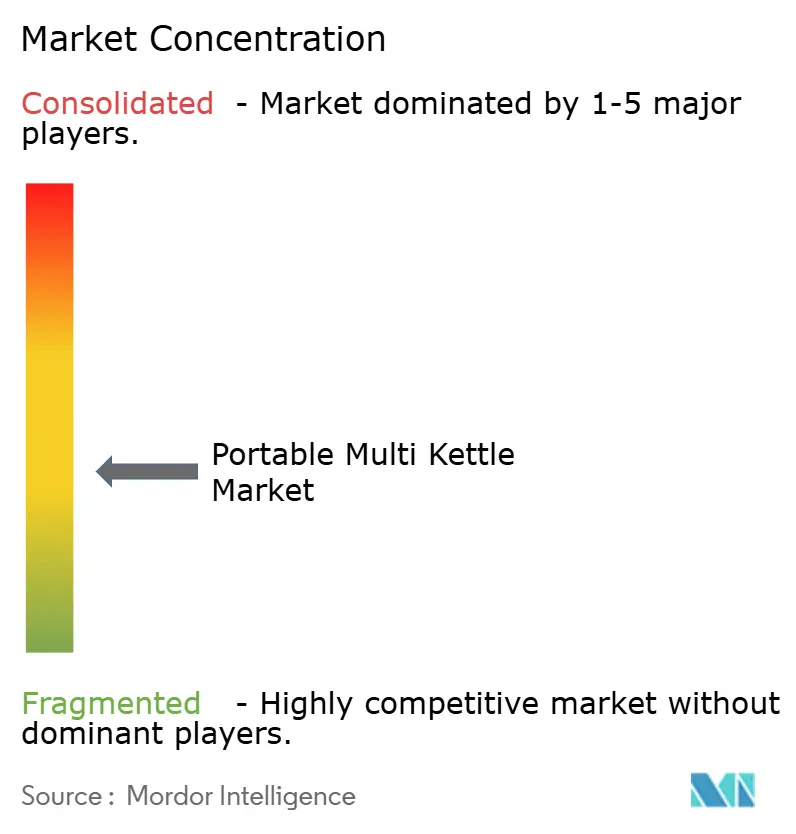
| Market Concentration | Medium |
Major Players *Disclaimer: Major Players sorted in no particular order Image © Mordor Intelligence. Reuse requires attribution under CC BY 4.0. | |
Portable Multi-Kettle Market Analysis by Mordor Intelligence
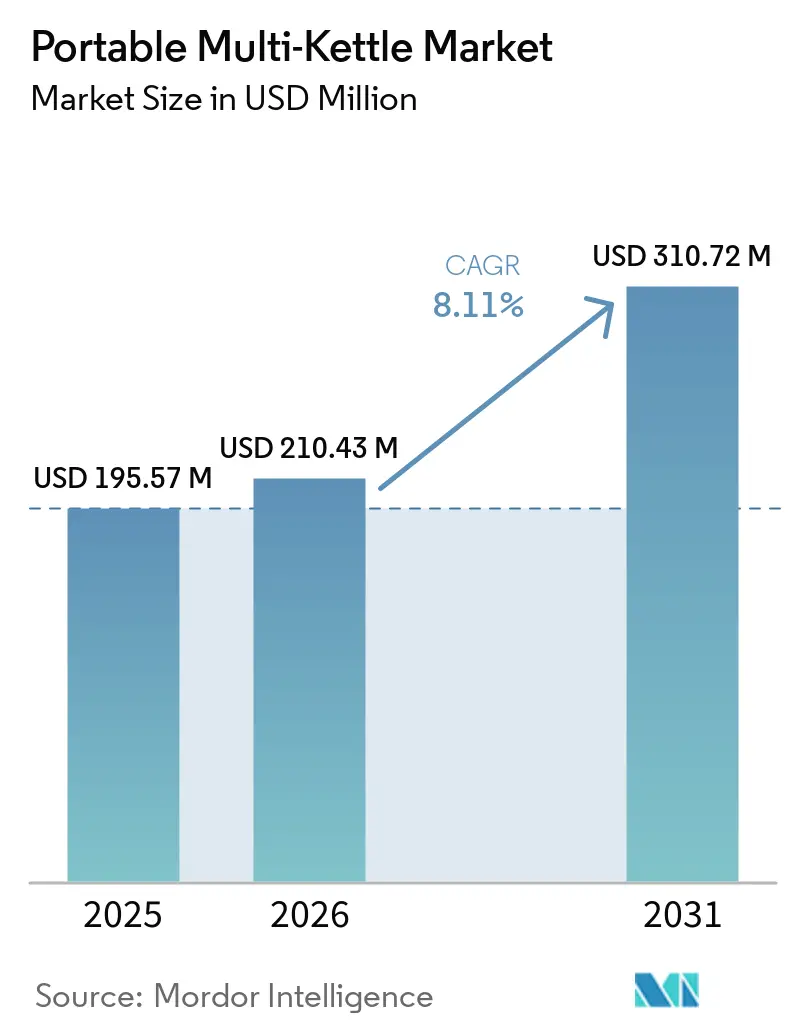
The portable multi-kettle market size was USD 195.6 million in 2025 and is projected to reach USD 310.7 million by 2031, at a CAGR of 8.11% from 2026 to 2031. The portable multi-kettle market is moving away from a basic travel kettle format, as buyers now expect a Compact & Space-Saving Design, Multi-Functional Heating & Cooking, and cleaner product finishes in a single appliance. The portable multi-kettle market is also gaining from travel demand, smaller urban living spaces, co-living formats, and a broader shift toward Portable Lifestyle Appliances that fit daily use beyond occasional trips[1]World Travel & Tourism Council, “Economic Impact Research 2025,” WTTC, wttc.org.. Product quality is becoming increasingly important in the portable multi-kettle market because insulated builds, stronger food-contact materials, and smarter temperature settings now influence how much consumers are willing to pay. Online discovery and Outdoor & Camping Utility are widening the addressable demand base, while tighter safety rules are making certification and consistent manufacturing more important for long-term brand credibility. This leaves the best growth space in the portable multi-kettle market for products that combine Travel-Friendly Convenience, Energy-Efficient Operation, and dependable performance across home, hospitality, commute, and outdoor use cases.
Key Report Takeaways
- By product type, Double-Wall or Insulated portable multi-kettles held a 42.4% share in the portable multi-kettle market in 2025, while Collapsible or Silicone-Body portable multi-kettles are projected to expand at an 8.92% CAGR through 2031.
- By capacity, the 0.81 to 1.2 L segment accounted for 47.8% of the portable multi-kettle market in 2025, while the less than 0.8 L segment is forecast to grow at an 8.67% CAGR through 2031.
- By material, Stainless-Steel Body kettles captureda 55.6% share in 2025 in the portable multi-kettle market, while Borosilicate-Glass Body kettles are expected to advance at 9.0% CAGR through 2031.
- By distribution channel, Multi-Brand Stores led with a 38.9% share in the portable multi-kettle market in 2025, while Online channels are projected to register a 9.18% CAGR through 2031.
- By geography, Asia-Pacific accounted for 34.7% of global revenue in 2025, while North America is set to post the fastest regional CAGR of 8.98% through 2031 in the portable multi-kettlee market.
Note: Market size and forecast figures in this report are generated using Mordor Intelligence’s proprietary estimation framework, updated with the latest available data and insights as of January 2026.
Global Portable Multi-Kettle Market Trends and Insights
Drivers Impact Analysis*
| Driver | (~) % Impact on CAGR Forecast | Geographic Relevance | Impact Timeline |
|---|---|---|---|
| Rising Demand for Multifunctional Compact Kitchen Appliances | +2.0% | Global, concentrated in East Asia, North America, and Western Europe | Medium term (2-4 years) |
| Growth of Travel & Outdoor Recreation | +1.6% | North America, Asia-Pacific, South America | Short term (≤ 2 years) |
| Expansion of E-Commerce Channels for Small Kitchen Appliances | +1.2% | Global, with accelerated impact in Southeast Asia and South America | Medium term (2-4 years) |
| Increasing Electrification and Disposable Income in Emerging Markets | +1.3% | Asia-Pacific, Africa, Western Asia | Long term (≥ 4 years) |
| Adoption by Co-Living and Micro-Apartment Operators | +0.5% | North America, Europe, Singapore | Medium term (2-4 years) |
| Integration of IoT & Temperature-Programming Features | +0.9% | North America, East Asia, Western Europe | Long term (≥ 4 years) |
| Source: Mordor Intelligence | |||
Rising Demand For Multifunctional Compact Kitchen Appliances Among Urban Millennials
Urban consumers are changing their purchase behavior in the portable multi-kettle market because they now judge small appliances by daily flexibility, storage efficiency, and ease of repeated use in tighter living spaces. Demand is moving toward Compact & Space-Saving Design because apartment kitchens, hotel counters, workspaces, and shared living spaces leave less room for single-purpose appliances like water boilers. The portable multi-kettle market benefits from this shift because one device can support tea, pour-over coffee, baby formula, instant meals, and simple Multi-Functional Heating & Cooking without adding clutter. Buyers are also placing greater value on finish quality, safer materials, better handle comfort, and simple temperature control, helping brands move the portable multi-kettle market beyond basic entry-level competition. This also supports a stronger demand for insulated designs that reduce reheating needs and make daily Energy-Efficient Operation easier in homes where electricity use and countertop space both matter. As a result, the portable multi-kettle market is becoming more resilient in the mid- and premium tiers because consumers are paying for convenience, usability, and everyday fit rather than just the lowest ticket price.
Growth Of Travel & Outdoor Recreation Boosting Portable Appliance Sales
Travel demand is expanding the user base of the portable multi-kettle market because more people need compact water-heating products for use outside the fixed home kitchen. Travel and Tourism contributed USD 11.6 trillion to global GDP in 2025 and supported 366 million jobs, which confirms the scale of mobility-linked spending that can support travel appliances. More than 52 million North American households camped in 2025. That level of participation keeps Outdoor & Camping Utility central to how brands position portable heating products for road trips, glamping, and extended outdoor stays. The United States outdoor recreation economy generated USD 696.7 billion in value added in 2024, which shows that travel gear and related convenience products sit within a large spending ecosystem [2]U.S. Bureau of Economic Analysis, “Outdoor Recreation Satellite Account, U.S. and States, 2024,” Bureau of Economic Analysis, bea.gov.. The portable multi-kettle market gains ground as Travel-Friendly Convenience and On-the-Go Beverage Preparation now matter to business travelers, leisure travelers, and outdoor users who want reliable hot water in settings with limited kitchen access. The same pattern is also driving institutional demand in the portable multi-kettle market, with glamping operators, stay providers, and hospitality groups increasingly viewing compact kettles as useful room or tent amenities.
Expansion Of E-Commerce Channels For Small Kitchen Appliances
Digital retail is changing how the portable multi-kettle market is discovered, because a compact appliance with several functions is easier to explain online than on a short in-store shelf label. The online channel is the fastest-growing route in the portable multi-kettle market, with a projected 9.18% CAGR through 2031, underscoring how strongly digital comparison is shaping category growth. This matters because portable products often require a clearer explanation of foldability, insulation, voltage suitability, capacity, and daily use benefits before consumers feel confident enough to upgrade from a cheaper option. The portable multi-kettle market also benefits when online storefronts bundle kettles with tea tools, travel organizers, and beverage accessories, as this makes the product feel like part of a broader portable routine. E-commerce is especially useful in underpenetrated regions where offline shelf space for premium Portable Lifestyle Appliances is limited, but smartphone access and delivery coverage are improving steadily. Over time, the portable multi-kettle market should benefit further from direct online sales, as brands can analyze reviews, returns, accessory pairing, and repeat buying with much greater clarity than in wholesale channels.
Integration Of IoT & Temperature-Programming Features Leveraging App Ecosystems
Smarter controls are becoming more relevant in the portable multi-kettle market because buyers increasingly want a product that supports more than a simple boil-and-stop routine. Temperature presets make a portable kettle more useful for tea, coffee, baby formula, and other beverage tasks where precision matters, strengthening the value of On-the-Go Beverage Preparation. Connected features also help the portable multi-kettle market move closer to a daily-use category, as users can build habits around preferred temperature settings, reheat timing, and routine beverage preparation. For manufacturers, app-linked usage data can support product development and direct communication, which is important as the portable multi-kettle market becomes more segmented by lifestyle and use occasion. The 2024 seventh edition of IEC 60335-2-15 also emphasizes the importance of remote operation and programmable electronic controls from a safety standpoint, thereby increasing the compliance burden on connected products. That means the portable multi-kettle market is likely to reward brands that can combine useful software features with safe electrical design, repeatable quality checks, and reliable, certified production.
Restraints Impact Analysis*
| Restraint | (~) % Impact on CAGR Forecast | Geographic Relevance | Impact Timeline |
|---|---|---|---|
| Price Sensitivity and Competition from Low-Cost Generic Kettles | -1.3% | Global, most intense in South and Southeast Asia and Africa | Medium term (2-4 years) |
| Safety Regulations and Product-Recall Risks from Heating-Element Failures | -0.7% | Global, with compliance burden concentrated in the European Union, North America, and China | Medium term (2-4 years) |
| Limited Battery-Powered/Cord-Free Heating Options | -0.5% | North America, Europe, and the outdoor recreation markets | Long term (≥ 4 years) |
| Restrictions on Use in Dormitories & Offices Due to Stringent Fire Codes | -0.4% | North America, Europe, institutional markets | Medium term (2-4 years) |
| Source: Mordor Intelligence | |||
Price Sensitivity And Competition From Low-Cost Generic Kettles
The portable multi-kettle market still faces a strong low-price challenge because basic heating formats can be copied quickly and sold through informal retail and open e-commerce channels. This creates a visible split between premium and mid-tier products with better insulation, materials, and controls, and low-cost versions that focus solely on visible function. The pressure is strongest in markets where consumers remain highly price sensitive and where certification, steel grade, silicone quality, and long-term durability are harder to communicate at the point of purchase. It also becomes more difficult for smaller brands when the cost of food-grade steel and heat-resistant silicone rises, because they cannot always pass those increases through without losing volume. The portable multi-kettle market, therefore, remains highly promotional at the lower end, even as stronger brands try to push the category toward better design, safer materials, and more reliable daily use.
Safety Regulations And Product-Recall Risks From Heating-Element Failures
Safety rules are a real brake on weaker participants in the portable multi-kettle market, as a single failure can damage trust across multiple retail channels simultaneously. IEC 60335-2-15:2024 introduced tighter requirements for accessible surface temperature, handle strength, overflow testing, impact resistance, and remote-operated controls, which increased the testing burden on kettle manufacturers [3]International Electrotechnical Commission, “IEC 60335-2-15:2024 Household and Similar Electrical Appliances, Safety, Part 2-15,” IEC, iec.ch.. This matters more in portable formats because users often handle the product in hotel rooms, office corners, small shared kitchens, and travel settings where safe external surfaces and dependable shut-off are expected. The challenge of compliance can be greater for silicone-heavy or foldable builds, as repeated heating cycles place greater stress on body stability and sealing performance than in standard rigid steel products. In the portable multi-kettle market, smaller suppliers with less control over component sourcing face a higher recall risk because a single-batch issue can disrupt retail access and drain working capital. The net effect is that safety regulation does not stop growth, but it does push the portable multi-kettle market toward certified manufacturers with stronger engineering, testing, and supplier oversight.
*Our forecasts treat driver/restraint impacts as directional, not additive. The impact forecasts reflect baseline growth, mix effects, and variable interactions.
Segment Analysis
By Product Type: Insulated Designs Lead, Collapsible Formats Disrupt
Double-Wall or Insulated portable multi-kettles held 42.4% of the portable multi-kettle market share in 2025, which made them the leading product type by revenue contribution. Their lead offers a practical benefit: they keep water or beverages warm longer and reduce the need for repeated plug-in reheating across hotels, co-living units, and office pantries. That directly supports Energy-Efficient Operation, especially in settings where users only need a short reheat cycle instead of a full boil several times per day. Insulated builds also improve handling comfort because outer surfaces are easier to manage, which matters in the portable multi-kettle market, where the appliance is often used on small counters or near soft luggage. These strengths make insulated products a natural fit for buyers who see the kettle as a daily-use tool rather than a backup item packed only for occasional travel.
The dominance of insulated products also says something broader about the portable multi-kettle industry, as consumers are linking compact size with better performance rather than accepting a trade-off between the two. Buyers now expect Compact & Space-Saving Design to come with quieter reheating, safer touch surfaces, and better heat retention, which strengthens the role of premium construction in category choice. Single-Wall products still matter in price-sensitive channels and some institutional purchases, especially where low upfront cost remains the main decision factor. Even so, their value proposition is becoming narrower as more users compare full-life convenience rather than the entry sticker alone. That is why insulated formats continue to anchor the portable multi-kettle market, even before more advanced connected or app-linked features are added.
Collapsible or Silicone-Body portable multi-kettles are projected to grow at an 8.92% CAGR through 2031, making them the fastest-growing product type in the portable multi-kettle market. Their appeal stems from clear luggage and storage benefits, as a foldable product can fit into carry-on travel, shared work stays, and weekend mobility routines with much less friction. Foldable / Collapsible Innovation matters most for people who travel often, live out of compact bags, or want a product that stores easily in a drawer after use. This gives the segment a stronger link to Travel-Friendly Convenience than rigid formats can usually offer, especially in business travel and backpack-led use cases. It also helps the portable multi-kettle market reach consumers who do not see themselves as traditional small-appliance buyers but still want reliable hot water wherever they stay.
Growth in collapsible models is also tied to Lightweight & Durable Construction, as users want a product that folds down without feeling disposable or unsafe during repeated heating cycles. This is where brand trust matters since the promise of portability only works when the material system remains stable and easy to clean over time. The portable multi-kettle market should see more feature migration as temperature displays and preset functions move from rigid premium models into portable folding formats. When that happens, the difference between insulated and collapsible products will rely less on basic functionality and more on user preferences, storage patterns, and travel frequency. That shift should keep collapsible products central to future expansion in the portable multi-kettle market, even if insulated formats remain the larger revenue base throughout most of the forecast period.




By Capacity: The 0.81–1.2 L Sweet Spot Anchors Volume, Sub-0.8 L Drives Premium Growth
The 0.81 to 1.2 L tier accounted for 47.8% of the portable multi-kettle market in 2025, making it the largest capacity segment. This range works well because it supports 1 or 2 servings, handles most beverage routines, and still fits into compact hotel rooms, co-living kitchens, and shared workplace shelves. It captures the most common usage pattern in the portable multi-kettle market: regular daily preparation without the bulk of a full household kettle. Users in this capacity band often want a product that can prepare tea, coffee, or simple meals while being easy to move, store, and clean between uses. That is why the segment sits at the center of both home-adjacent and travel-adjacent demand, rather than serving a single narrow use case.
The 0.81 to 1.2 L tier also benefits from a useful balance between Compact & Space-Saving Design and daily practicality, which is harder to achieve at the extreme of the capacity range. Larger sizes can feel less personal and harder to pack, while small sizes can limit convenience for pairs or repeated use during longer stays. This middle band, therefore, suits the portable multi-kettle industry because it works across travel, co-living, office, and light hospitality settings without forcing consumers to buy a second appliance. It also supports better attachment to accessories and daily routines, as the product feels substantial enough for regular use without being oversized for portable storage. As long as buyers keep looking for one appliance that can travel and still serve normal daily beverage needs, this capacity tier should remain the demand anchor.
The segment below 0.8 L is projected to grow at an 8.67% CAGR through 2031, making it the fastest-growing capacity band in the portable multi-kettle market. Its momentum reflects a more personal-use pattern, with consumers preferring small, mobile products that support On-the-Go Beverage Preparation rather than shared serving volume. This is the capacity range most linked to air travel, train travel, solo stays, and highly mobile work routines, where every item in a bag has a clear reason for being there. The format also blends well with Travel-Friendly Convenience because quick single-user preparation often matters more than holding enough water for a group. That changes how the product is positioned, with the kettle starting to resemble a personal device rather than a scaled-down household appliance.
The more than 1.2 L range still serves small-group travel, glamping clusters, and shared-use settings, but its growth is slower because some of that demand is shifting toward institutional procurement. In practical terms, larger formats are more relevant when the buyer is furnishing a small, shared space rather than buying for personal use. The portable multi-kettle market, therefore, shows a clear split between a mid-capacity mainstream and a smaller-format, fast-growth pocket focused on portability-led demand. That split should widen if mobile consumers continue to treat the kettle as part of their travel, office, or temporary-living kit. Capacity choice is no longer solely a volume decision in the portable multi-kettle market, as it now reflects the broader lifestyle context in which the product is used.
By Material: Stainless Steel Dominates, Borosilicate Glass Accelerates Fastest
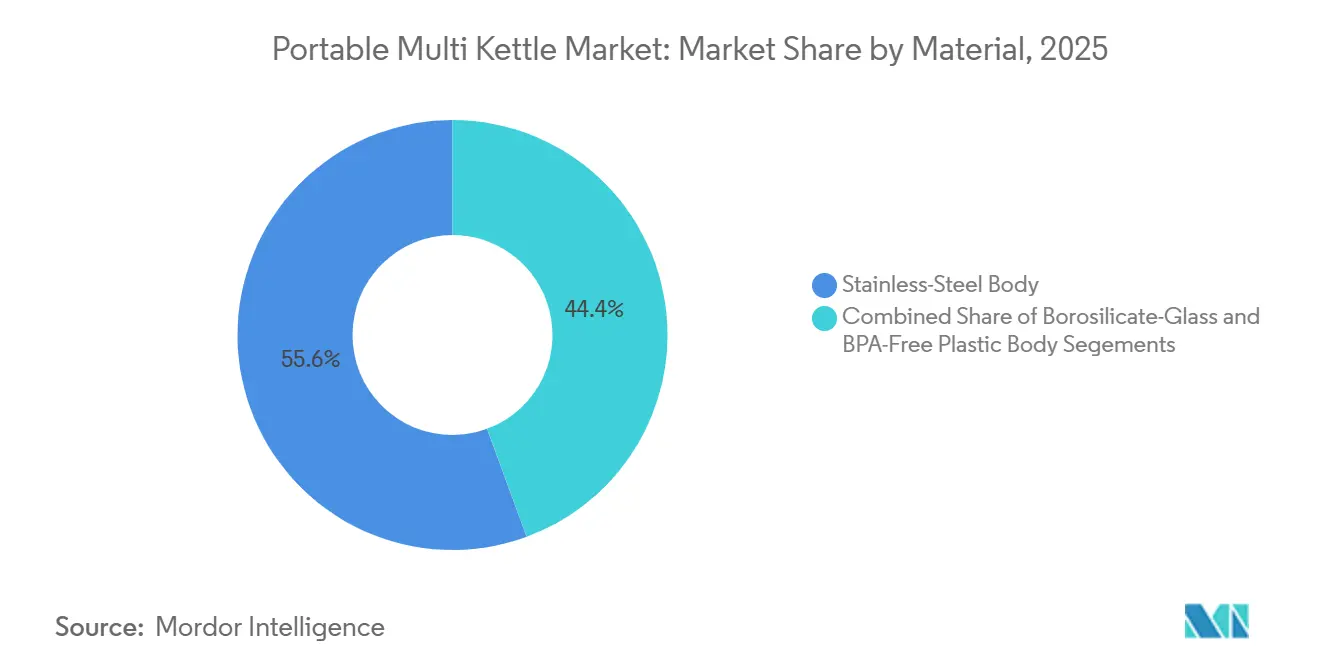
Stainless-Steel Body kettles captured 55.6% of the market share in 2025, giving them the strongest material position in the portable multi-kettle market. This lead reflects a durable trust advantage because stainless steel is easy to clean, feels more robust in daily handling, and aligns with consumer preference for inert food-contact surfaces [4]European Food Safety Authority, “Food Contact Materials,” EFSA, efsa.europa.eu.. Material confidence matters more in the portable multi-kettle market because the product often handles beverages and meal preparation in settings where users want quick cleaning and low odor retention. Stainless steel also fits premium positioning because different grades can support stronger messages about corrosion resistance, product longevity, and cleaner, repeated use. These qualities keep steel central to Lightweight & Durable Construction, which is one of the clearest purchase signals in better-specified portable kettles.
The material story also supports the portable multi-kettle industry because buyers often use steel as a simple visual cue for quality, especially when comparing products quickly on an e-commerce page. That cue becomes more powerful when the product is meant for repeated travel or shared-space use, since dents, stains, and long-term body stability can shape the user experience over time. BPA-related consumer caution also helps steel maintain a strong lead, even when brands continue to offer lighter plastic-based options at the lower end. Better steel construction can also support insulation performance and safer handling, which helps explain why material choice and product type often reinforce each other in the portable multi-kettle market. As the category continues to preimmunize, steel remains the clearest base material for buyers who want reliability without giving up portability.
Borosilicate-Glass Body kettles are projected to grow at a 9.0% CAGR through 2031, making them the fastest-growing material segment in the portable multi-kettle market. The appeal of glass lies in product transparency, a clean visual look, and the reassurance of seeing the heating and brewing process unfold directly during use. That makes glass especially attractive for tea and specialty beverage users who care about appearance, water clarity, and a more controlled preparation routine. It also appeals to consumers who want the kettle to feel like part of a broader home or travel setup rather than a strictly utilitarian appliance. Even in a compact category, design visibility can carry real value when buyers are deciding between a low-cost generic product and a more considered branded option.
BPA-Free Plastic Body products still have a role in the portable multi-kettle market, where low weight and lower entry pricing remain essential. These formats are useful for sub-0.8 L products and for travel-led buying, where every gram matters, but consumer trust in plastic remains more conditional than in steel or glass. Material choice is also becoming more complex because IEC 60335-2-15:2024 includes testing implications for different container types, which adds compliance weight to design decisions. That means the fastest-growing materials may not always be the easiest to launch at scale unless the manufacturer can handle testing, impact control, and consistent quality documentation. In the portable multi-kettle market, material selection is therefore a commercial and safety decision.
By Distribution Channel: Physical Stores Hold Share, Online Rewrites Growth Arithmetic
Multi-Brand Stores held a 38.9% share in 2025, making them the largest distribution format in the portable multi-kettle market. Physical retail still matters because many consumers discover portable kettles while browsing travel accessories, gift sections, or small kitchen appliances rather than searching for the category directly. In-store comparison also helps shoppers judge foldability, weight, finish quality, handle comfort, and size, supporting more confident purchases. That matters for the portable multi-kettle market because tactile judgment remains important when a product promises both portability and repeated high-heat use. Multi-brand shelves also expose the category to buyers who may not have planned to buy a kettle but do respond to good gifting or travel-use presentation.
Store-led discovery also supports Portable Lifestyle Appliances that need a little context before consumers understand why they differ from ordinary home appliances. That is especially true for products that combine Compact & Space-Saving Design with premium materials, since a physical display can communicate quality faster than a small package image. Exclusive brand stores play a narrower but useful role by presenting the kettle inside a more complete design or kitchen ecosystem. This helps premium brands position the product as part of a refined daily routine instead of a purely functional travel purchase. As a result, physical channels continue to matter in the portable multi-kettle market even as digital sales rise more quickly.
Online channels are projected to grow at a 9.18% CAGR through 2031, making them the fastest-growing channel in the portable multi-kettle market. Digital shelves make it easier to explain voltage compatibility, foldable formats, cleaning needs, beverage presets, and the breadth of use cases, which helps justify branded price points. Online selling is also useful in regions where offline distribution remains thin, but demand for Travel-Friendly Convenience and compact appliances is spreading through smartphone-led shopping. Brands benefit further because direct consumer data reveals return reasons, accessory attachment, and review language that can sharpen product planning. In the portable multi-kettle market, online growth is not only a channel shift but also a better feedback system for category development.
Geography Analysis
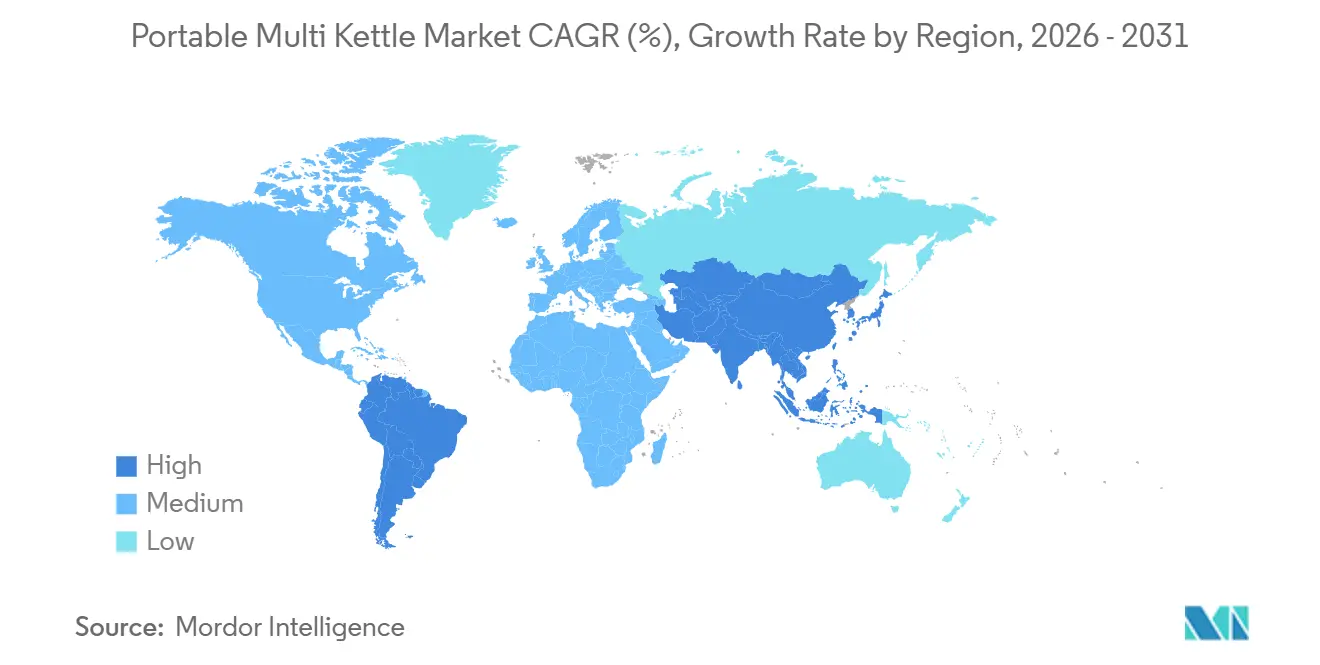
Asia-Pacific accounted for 34.7% of the market in 2025, making it the largest regional market for portable multi-kettles. The region benefits from China’s manufacturing depth and from strong consumer acceptance in Japan and South Korea for better-specified compact appliances. That combination gives the portable multi-kettle market a strong supply-and-demand center in one geography, which supports faster product iteration and broader price coverage. Japan remains important because variable-temperature control aligns well with tea preparation habits and with established familiarity with premium thermal products. Southeast Asia presents further opportunity, as rising urban populations are expanding demand for Compact & Space-Saving Design in smaller homes and for first-time branded appliance purchases.
North America is the fastest-growing major region, with an 8.98% CAGR through 2031, making it a standout growth engine in the portable multi-kettle market. More than 52 million North American households camped in 2025, underscoring Outdoor & Camping Utility's relevance to the purchase and use of compact heating appliances. The United States outdoor recreation economy generated USD 696.7 billion in value added in 2024, confirming that travel gear and related convenience purchases are part of a large, active spending base. The region also benefits from co-living and office-to-residential conversion activity, which supports compact shared kitchens and demand for smaller multi-use appliances. These patterns help drive growth in the portablemulti-kettlee market in North America, even though the broader appliance market is mature and highly competitive.

Competitive Landscape
The portable multi-kettle market is moderately fragmented, with the top 5 players accounting for a combined 42.0% share in 2025. That leaves room for many brands to participate, but the more defensible parts of the portable multi-kettle market now sit in insulated, better-finished, and certification-led product tiers. Competition is shifting away from basic boiling and toward material quality, heat retention, user comfort, ease of cleaning, and practicality in smaller spaces. This favors companies that can maintain design consistency and safety compliance across multiple countries rather than chasing low prices with lightly differentiated products. The result is a portable multi-kettle market that remains open at the low end but increasingly selective in the higher-value tiers, where repeat use and brand confidence matter more.
Recent company moves show how established brands are strengthening their position through product refinement rather than through scale alone. Tiger Corporation released the Sugo Karu series in September 2025, featuring lightweight construction, a steam-reducing lid, and a hygiene-focused spout cover, directly addressing friction points in portability and travel use. Tiger also released the PDZ-A30U, A40U, and A50U Microcomputer-Controlled Water Boiler & Warmer in the United States in April 2026, extending its premium hot-water management range into North America’s home-use channel. Zojirushi’s February 2026 fiscal 2025 results pointed to continued premium portfolio expansion in North America and Asia-Pacific, supporting further investment in mobility-oriented, higher-value hot-water formats. These moves suggest that steady product upgrades, geographic expansion, and stronger control over brand-led premium niches are shaping the portable multi-kettle market.
Another important feature of the portable multi-kettle market is that no major company has yet locked down a mainstream cord-free battery-heating format at a consumer-friendly price. That leaves a visible white space for future entrants, but it also shows how difficult it is to combine true portability with safe heat delivery and acceptable cost. Regulatory tightening under IEC 60335-2-15:2024 further supports larger, better-prepared brands, as certification now carries greater weight in product acceptance and retail continuity. The portable multi-kettle market should therefore remain fragmented overall, while stronger players gradually gain share in the premium and compliance-heavy parts of the category.
Portable Multi-Kettle Industry Leaders
Breville Group
Hamilton Beach Brands Holding Company
Koninklijke Philips N.V.
De'Longhi Appliances S.r.l.
Groupe SEB (Tefal, Krups)
- *Disclaimer: Major Players sorted in no particular order

Recent Industry Developments
- June 2026: Xiaomi launched the Mijia Instant Hot Water Dispenser (Ice Maker) in China, combining a multi-function hot-water dispensing, ice-making, and thermos station in a single unit with 2,050W heating, achieving 3-second hot water delivery and Mi Home app temperature control between 40°C–90°C, signaling Xiaomi's intent to expand the portable water-heating category into hybrid appliance formats.
- May 2026: Xiaomi launched the Mijia Constant Temperature Electric Kettle Titanium Steel Edition in China on the Youpin platform, featuring 316Ti food-grade titanium steel, the first mass-market kettle at this price point to use titanium steel interior construction with 1,800W heating and 24-hour 55°C temperature retention.
- September 2025: Tiger Corporation released the Sugo Karu series compact electric kettles (PCT-A120 1.2L and PCT-A150 1.5L) in Japan, designed as the brand's lightest compact kettle models at 730–770g, targeting the travel and portability use case with a steam-reducing lid and a new hygienic spout cover.
- August 2025: Xiaomi launched the Mijia Thermostatic Electric Kettle 3 Pro in China, featuring a 316L stainless steel inner liner, a 2.0L capacity, a dual-stage lid design, and precise 1°C temperature-step adjustment via the app from 40°C to 90°C.


Global Portable Multi-Kettle Market Report Scope
The portable multi-kettle market focuses on compact electric kettles designed primarily for household use. These kettles serve various functions in homes, from boiling water and maintaining temperatures to catering to specific needs such as brewing tea and coffee, preparing baby formula, and even whipping up simple meals. The market encompasses diverse product formats, including double-wall or insulated models, single-wall variants, and innovative foldable or collapsible silicone designs. Capacity options range from under 0.8 L and 0.81 to 1.2 L, to those exceeding 1.2 L. Material choices span stainless steel, borosilicate glass, and BPA-free plastic. Distribution channels are varied, featuring multi-brand outlets, exclusive brand stores, and a robust online presence. Geographically, the market spans North America, South America, Europe, Asia-Pacific, and the Middle East and Africa.
| Single-Wall Portable Multi-Kettles |
| Double-Wall/Insulated Portable Multi-Kettles |
| Collapsible/Silicone-Body Portable Multi-Kettles |
| Less than 0.8 L |
| 0.81 – 1.2 L |
| More than 1.2 L |
| Stainless-Steel Body |
| Borosilicate-Glass Body |
| BPA-Free Plastic Body |
| Multi-Brand Stores |
| Exclusive Brand Stores |
| Online |
| Other Distribution Channels |
| North America | United States |
| Canada | |
| Mexico | |
| South America | Brazil |
| Peru | |
| Chile | |
| Argentina | |
| Rest of South America | |
| Europe | United Kingdom |
| Germany | |
| France | |
| Spain | |
| Italy | |
| BENELUX (Belgium, Netherlands, Luxembourg) | |
| NORDICS (Denmark, Finland, Iceland, Norway, Sweden) | |
| Rest of Europe | |
| Asia-Pacific | India |
| China | |
| Japan | |
| Australia | |
| South Korea | |
| South-East Asia (Singapore, Malaysia, Thailand, Indonesia, Vietnam, Philippines) | |
| Rest of Asia-Pacific | |
| Middle East & Africa | United Arab Emirates |
| Saudi Arabia | |
| South Africa | |
| Nigeria | |
| Rest of Middle East & Africa |
| By Product Type | Single-Wall Portable Multi-Kettles | |
| Double-Wall/Insulated Portable Multi-Kettles | ||
| Collapsible/Silicone-Body Portable Multi-Kettles | ||
| By Capacity | Less than 0.8 L | |
| 0.81 – 1.2 L | ||
| More than 1.2 L | ||
| By Material | Stainless-Steel Body | |
| Borosilicate-Glass Body | ||
| BPA-Free Plastic Body | ||
| By Distribution Channel | Multi-Brand Stores | |
| Exclusive Brand Stores | ||
| Online | ||
| Other Distribution Channels | ||
| By Geography | North America | United States |
| Canada | ||
| Mexico | ||
| South America | Brazil | |
| Peru | ||
| Chile | ||
| Argentina | ||
| Rest of South America | ||
| Europe | United Kingdom | |
| Germany | ||
| France | ||
| Spain | ||
| Italy | ||
| BENELUX (Belgium, Netherlands, Luxembourg) | ||
| NORDICS (Denmark, Finland, Iceland, Norway, Sweden) | ||
| Rest of Europe | ||
| Asia-Pacific | India | |
| China | ||
| Japan | ||
| Australia | ||
| South Korea | ||
| South-East Asia (Singapore, Malaysia, Thailand, Indonesia, Vietnam, Philippines) | ||
| Rest of Asia-Pacific | ||
| Middle East & Africa | United Arab Emirates | |
| Saudi Arabia | ||
| South Africa | ||
| Nigeria | ||
| Rest of Middle East & Africa | ||


Key Questions Answered in the Report
What is driving growth in portable multi-kettles through 2031?
Growth is being supported by multifunction demand, travel use, online retail reach, and smaller living spaces, with the category projected to grow at 8.11% CAGR through 2031.
Which product type leads revenue today?
Double-Wall or Insulated products led with 42.4% share in 2025 because buyers value heat retention, safer handling, and more efficient repeated use.
Why are collapsible models gaining attention?
Collapsible formats are projected to grow at 8.92% CAGR because they offer Travel-Friendly Convenience, Foldable / Collapsible Innovation, and easier storage in compact travel settings.
Which region is growing fastest for portable multi-kettles?
North America is the fastest-growing major region, with a 8.98% CAGR through 2031, supported by camping activity, outdoor spending, and the growth of compact shared-living formats.
What material is most widely used in this category?
Stainless steel led with 55.6% share in 2025 because it combines durability, easy cleaning, and stronger consumer trust in food-contact use.
What is the biggest challenge for brands in this space?
The biggest challenge is balancing premium features and certified safety with strong price pressure from low-cost generic alternatives across many regional channels.
Page last updated on:





