
Portable Mini Refrigerator Market Size and Share
Market Overview
| Study Period | 2020 - 2031 |
|---|---|
| Market Size (2026) | USD 3.61 Billion |
| Market Size (2031) | USD 4.95 Billion |
| Growth Rate (2026 - 2031) | 6.52 % |
| Fastest Growing Market | Asia Pacific |
| Largest Market | North America |
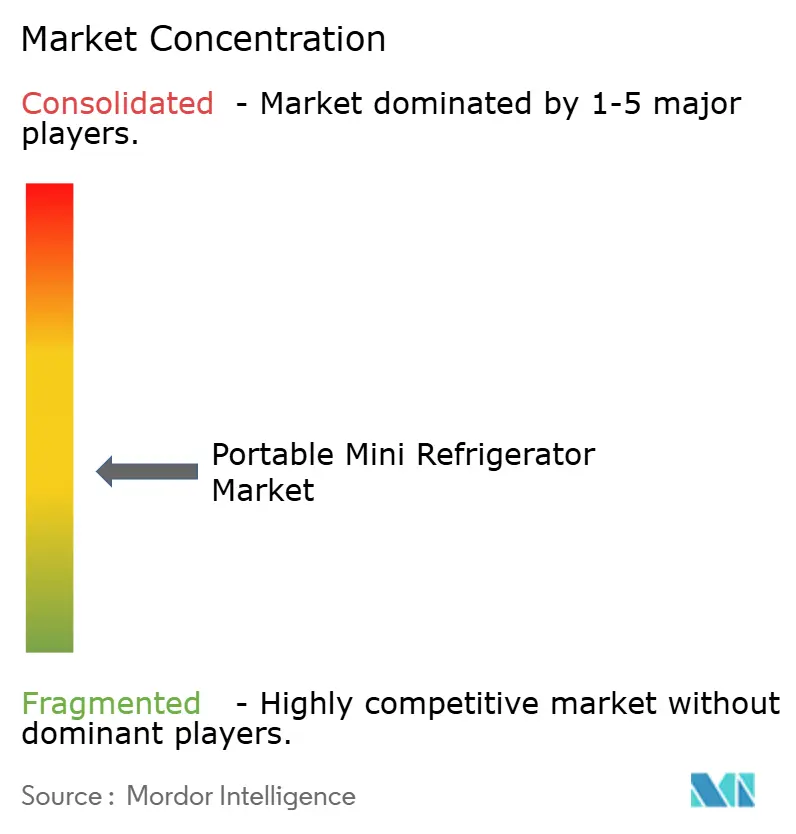
| Market Concentration | Medium |
Major Players *Disclaimer: Major Players sorted in no particular order Image © Mordor Intelligence. Reuse requires attribution under CC BY 4.0. | |
Portable Mini Refrigerator Market Analysis by Mordor Intelligence
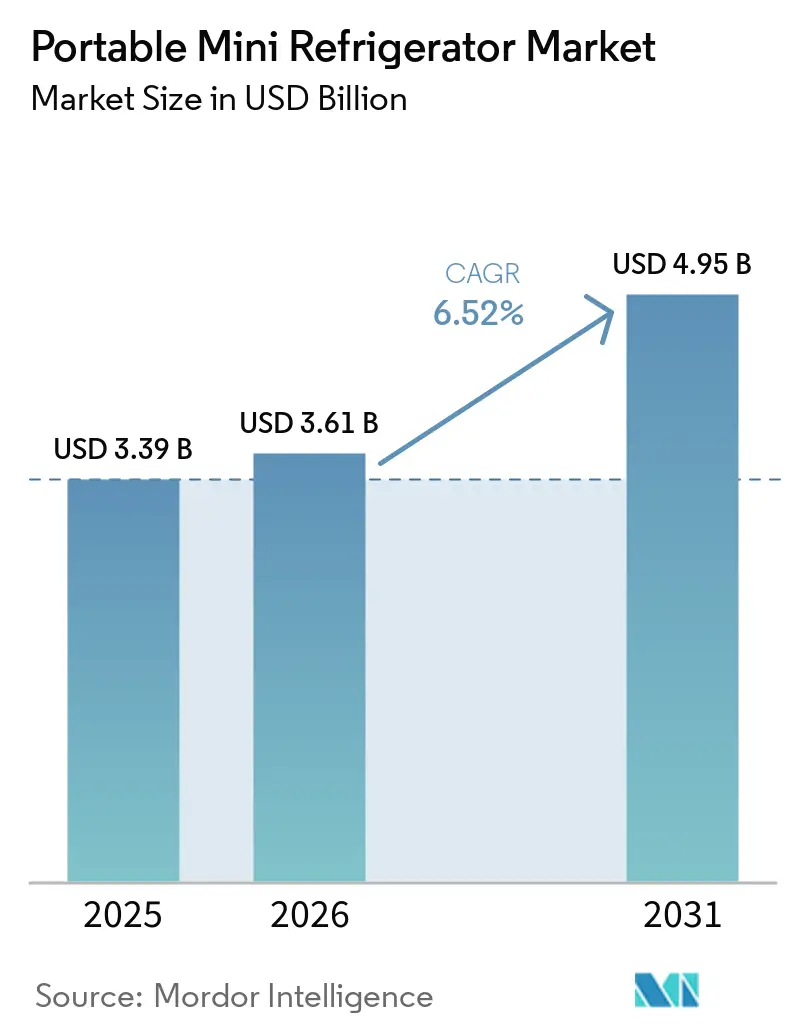
The Portable Mini Refrigerator Market size is projected to expand from USD 3.39 billion in 2025 and USD 3.61 billion in 2026 to USD 4.95 billion by 2031, registering a CAGR of 6.5% between 2026 and 2031. Regulatory phase-downs that restrict high-GWP hydrofluorocarbons are pushing up product refresh cycles and steering design choices toward R600a systems, stabilizing compliance roadmaps while improving unit efficiency. Advances in compact DC compressor platforms are enabling lighter, quieter, and lower-power portables that meet rising user expectations in RV, marine, and hospitality environments. Healthcare last-mile and point-of-care use cases are increasing the value of validated portable cold storage and powering procurement in specific clinical workflows where reliability and thermal precision are non-negotiable. Hospitality estates continue to test automation in minibars and room refrigeration, tying portable units and compact form factors to property management systems for energy and inventory control. At the same time, premium outdoor and vehicle-based users look for solar-ready dual-zone formats that pair easily with lithium batteries and charge controllers. The market benefits from converging macrotrends: sustained outdoor participation (342,220 RV units shipped in 2025, marking three consecutive years of growth per the[1]RV Industry Association, “RV Shipments End 2025 With 342,220 Units, Up 2.5% YoY,” Company Insights, rvbusiness.com, HFC regulatory phase-downs mandating R600a migration and accelerating refresh cycles, and compressor miniaturization breakthroughs that collapsed form factors while lifting coefficient of performance above 1.90 W/W. The portable mini refrigerator market is also seeing sharper price-performance positioning as established brands respond to direct-to-consumer challengers that package fridges with portable power stations and emphasize system-level convenience.
Key Report Takeaways
- By technology, compressor-based units led the portable mini refrigerator market with 61.20% market share in 2025, while thermoelectric units are projected to expand at a 7.78% CAGR through 2031.
- By capacity, ≤45 L held 39.15% of the portable mini refrigerator market share in 2025, whereas the 61–80 L range is forecast to grow at a 7.36% CAGR through 2031.
- By end-user, residential accounted for 50.44% of the portable mini refrigerator market share in 2025, while automotive, RV, and marine are expected to expand at an 8.03% CAGR through 2031.
- By distribution channel, B2C captured 63.46% of the portable mini refrigerator market share in 2025, whereas B2B is projected to grow at a 9.25% CAGR through 2031.
- By geography, North America held 37.76% of the portable mini refrigerator market share in 2025, while Asia-Pacific is forecast to grow at an 8.32% CAGR through 2031.
Note: Market size and forecast figures in this report are generated using Mordor Intelligence’s proprietary estimation framework, updated with the latest available data and insights as of January 2026.
Market Trends and Insights
Drivers Impact Analysis of Portable Mini Refrigerator Market *
| Driver | (~) % Impact on CAGR Forecast | Geographic Relevance | Impact Timeline |
|---|---|---|---|
| Outdoor recreation and RV/overlanding uptake sustains multi-year demand | 1.3% | Global, concentrated in North America (37.76% share), Asia-Pacific core with spill-over to Latin America and MEA | Medium term (2-4 years) |
| HFC phase-down accelerates transition to R600a/low-GWP designs and refresh cycles | 0.9% | Global, led by the United States EPA AIM Act and EU F-Gas Regulation compliance deadlines | Short term (≤ 2 years) |
| Advances in compact DC compressors (higher efficiency, lower noise, smaller form factors) | 1.1% | Global, early gains in premium segments (North America, Europe, Japan), cascading to value tiers in Asia-Pacific | Medium term (2-4 years) |
| E-commerce channel scale improves B2C access and assortment depth | 0.8% | Global, strongest in North America and Asia-Pacific urban centers, accelerating in tier‑2 cities | Short term (≤ 2 years) |
| Automated hotel minibars improve ROI, enabling estate-wide retrofit programs | 0.7% | North America, Europe, and the Middle East luxury and business hotel segments | Medium term (2-4 years) |
| Point-of-care and last‑mile medical cold chain expands portable use cases | 0.6% | Global, with early wins in Sub‑Saharan Africa, Southeast Asia, and rural North America for vaccine delivery | Long term (≥ 4 years) |
| Source: Mordor Intelligence | |||
Outdoor Recreation and RV/Overlanding Uptake Sustains Multi-Year Demand
North American outdoor recreation generated USD 1.257 trillion in gross economic output during 2024, supporting 5.2 million jobs and contributing 2.4% to national GDP, with the RV-related segment alone delivering USD 58.11 billion[2]U.S. Department of Commerce Bureau of Economic Analysis, “Phasedown of Hydrofluorocarbons, Notice of 2026 Allowance Allocations for Production and Consumption,” U.S. Department of Commerce Bureau of Economic Analysis, rvnews.com. Consistent shipments in the recreational vehicle ecosystem reinforce a base of installed and planned platforms that favor 12V compressor fridges for cold chain reliability during extended trips. Consumer cohorts entering van conversions and overlanding builds favor dual-zone cooling and ruggedized designs, which are shifting the portable mini refrigerator market toward premium compressors and robust insulation. Portability, silent operation, and space efficiency remain top factors in product selection when buyers kit out vehicles or small spaces for travel, remote work, or leisure. As more vehicles integrate power management, DC outlets, and solar prep kits, buyers can adopt portable cooling with fewer additional purchases, which increases confidence in multi-day storage of perishables and medications.
HFC Phase-Down Accelerates Transition to R600a/Low-GWP Designs and Refresh Cycles
The American Innovation and Manufacturing Act sets a clear path to an 85% reduction in HFC production and consumption by 2036, which moves manufacturers to certify next-generation portable units with R600a and other low-GWP refrigerants that satisfy both federal allowances and technology transition deadlines[3]Jordon Refrigeration, “Refrigerant Regulations 2026,” Company Insights, jordan.co.uk. The transition is already visible in portable platforms that standardize on isobutane, since it offers a very low GWP profile and compressor efficiency gains when matched to modern variable-speed control. Compliance raises near-term engineering and certification costs, yet it also resets the portable mini refrigerator market toward higher efficiency baselines, quieter duty cycles, and more precise temperature control. The refresh cycle advantage is material because legacy models relying on high-GWP blends face sunset risks in regulated markets, which encourage distributors and hospitality buyers to pivot procurement toward long-lived, compliant stock. Clear rules reduce uncertainty in product roadmaps, helping brands lock in component partnerships and plan inventory for compressors, controls, and insulation. As the phase down advances through the decade, the unit mix should skew further toward R600a portfolios that deliver better performance at lower power draw in compact footprints.
Advances in Compact DC Compressors (Higher Efficiency, Lower Noise, Smaller Form Factors)
Compressor miniaturization and control improvements are reducing size and noise while improving efficiency, expanding the addressable use cases in vehicles, boats, and compact living spaces. Embraco's Atom, unveiled at AWE 2025, pushed boundaries further: weighing 2.5 kg (30% lighter than the preceding FMS) and measuring under 110 mm, it achieves COP up to 1.90 W/W on R600a refrigerant while reducing energy consumption by over 25% compared to fixed-speed compressors and slashing noise up to 5 dB through polymeric discharge-line innovation and ultra-compact inverter integration. Variable-speed designs trim energy use compared with fixed-speed systems and also reduce cycling, which reduces acoustic signatures and improves perceived quality in quiet cabins and hotel rooms. These changes enable the portable mini refrigerator market to support longer runtimes on modest lithium capacities, more reliable performance at high ambient temperatures, and tighter temperature bands for sensitive contents. Lower vibration and smarter control add durability during vehicle motion and on rough terrain, which is important for off-grid trips and field operations. The technology roadmap prioritizes premium tiers, then cascades features down to mid-priced devices as component costs decline and volumes scale.
E-commerce Channel Scale Improves B2C Access and Assortment Depth
Digital buying journeys reduce discovery friction and expand the shelf for compact 12V and AC/DC models, increasing choice across diverse price points. Online storefronts make it easier to compare insulation, compressor types, and battery-integration features so that shoppers can evaluate runtime expectations and accessories before purchase. Sellers showcase bundle options with panels, batteries, and wiring kits, reducing complexity for first-time buyers and enabling confident installation in vehicles and small spaces. This visibility and convenience support the portable mini refrigerator market by turning niche product research into mainstream household or travel purchases. As returns and shipping logistics for heavy appliances continue to improve, more buyers gain the confidence to order portable cooling without in-store trials.
Restraints Impact Analysis of Portable Mini Refrigerator Market *
| Restraint | (~) % Impact on CAGR Forecast | Geographic Relevance | Impact Timeline |
|---|---|---|---|
| Thermoelectric (Peltier) performance limits constrain hot‑climate use | -0.4% | Middle East, India, Southeast Asia, and Sub‑Saharan Africa, where ambient temperatures reach above 40°C | Medium term (2-4 years) |
| Off‑grid power and battery constraints, plus total system cost for deep cooling | -0.3% | Overlanding and off‑grid segments globally, acute in price‑sensitive emerging markets | Medium term (2-4 years) |
| Minibar removal or downsizing in select hospitality formats | -0.2% | North America and Europe budget and midscale hotel chains | Short term (≤ 2 years) |
| Compliance and requalification costs for low‑GWP refrigerants and labeling | -0.1% | Global, especially APAC manufacturers exporting to regulated markets in the U.S. and EU | Short term (≤ 2 years) |
| Source: Mordor Intelligence | |||
Thermoelectric (Peltier) Performance Limits (Delta-T/COP) Constrain Hot-Climate Use
Peltier modules cool relative to ambient temperatures and typically cannot deliver deep refrigeration or freezing in sustained high-heat environments, which limits their utility for perishables or medical payloads in many outdoor or off-grid settings. Real-world COP values for thermoelectric systems tend to be lower than those of compressor heat pumps and degrade with wider temperature differentials, leading to higher energy use for limited cooling outcomes in hot weather. Stacked module configurations add complexity and can compound waste heat through multiple stages, eroding effective temperature deltas and increasing power draw. For many buyers in hot climates or on extended trips, this performance profile favors compressor models that can maintain safe food temperatures regardless of ambient conditions. Thermoelectric units have a niche for quiet, lightweight, and small-volume use in stable ambient environments where modest cooling is sufficient. These physics and use-case boundaries shape how the portable mini refrigerator market positions Peltier models in hospitality and personal-use scenarios.
Off-Grid Power/Battery Constraints and Total System Cost for Reliable Deep Cooling
Deep cooling over multiple days imposes significant demands on batteries, wiring, and charge sources, increasing the total cost of ownership for an off-grid bundle. Hot ambient temperatures raise duty cycles and increase daily amp-hour consumption, reducing effective autonomy unless users oversize batteries and plan solar coverage. Lithium batteries also lose capacity at low temperatures and need protection during charging in freezing conditions, which adds to system design complexity in winter climates. Many users accept the added weight and cost of lithium packs and solar kits because of the reliability and silence they deliver compared with engine idling or generator use. Buyers who do not require multi-day autonomy in high heat often choose smaller fridges or thermoelectric models because they are lighter and cheaper, even if they cannot freeze. This split results in two adoption paths: one for full off-grid autonomy and another for convenient, short-duration, or grid-tied applications that prioritize simplicity over endurance.
*Our forecasts treat driver/restraint impacts as directional, not additive. The impact forecasts reflect baseline growth, mix effects, and variable interactions.
Portable Mini Refrigerator Market Segment Analysis
By Technology:
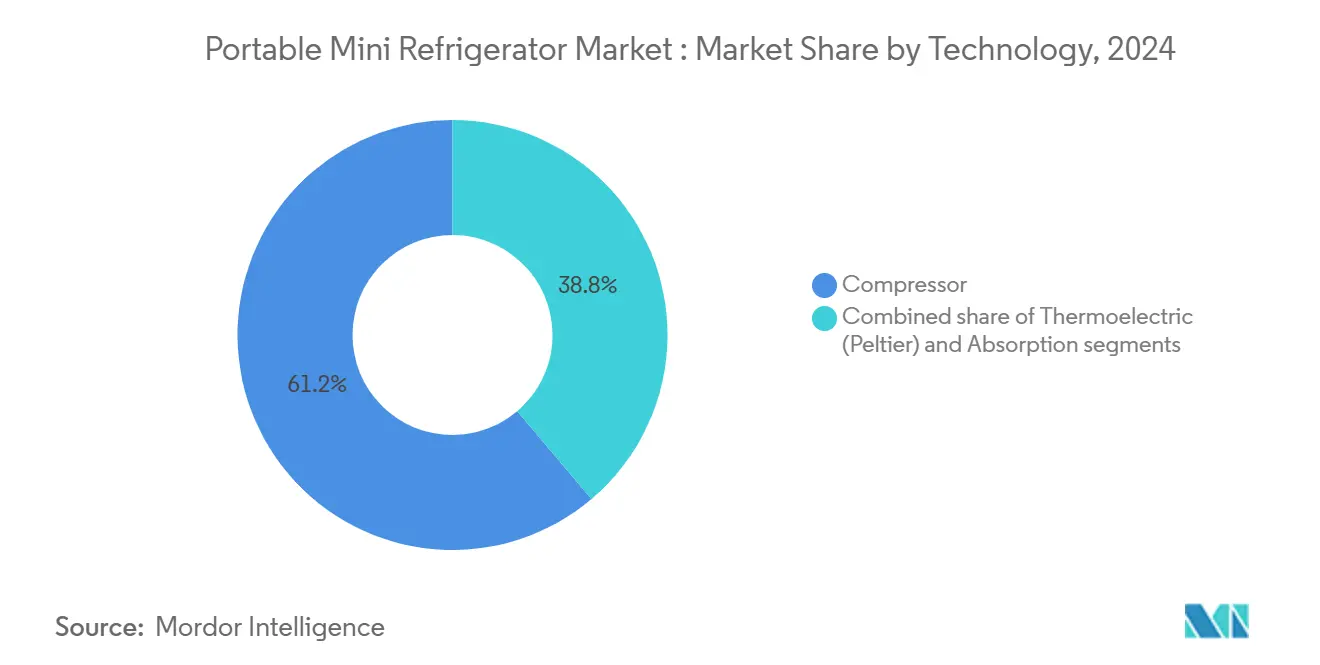
Compressor Dominance Meets Thermoelectric’s Silent NicheCompressor technology captured a 61.20% share in 2025, as users prioritized reliable cooling performance and stable runtime for extended trips and marine use, while thermoelectric models are projected to record the fastest growth with a 7.78% CAGR through 2031, as hospitality and small-space buyers value near-silent operation. The portable mini refrigerator market is increasingly defined by compressor efficiency and acoustic gains, which translate into longer autonomy on lithium packs and improved comfort in cabins and guest rooms. Manufacturers are rolling out compact compressors that raise COP and reduce energy draw, delivering real value in 30- to 80-liter formats where space and power are constrained. Variable-speed designs reduce cycling noise and improve part-load efficiency, addressing complaints about humming and vibration common to older units. Thermoelectric units continue to appeal in climate-controlled rooms and value tiers because they are quiet and light, even if they cannot match the deep cooling capability of compressors. Across both approaches, refrigerant compliance and sound pressure levels are shaping the preferred specifications in the portable mini refrigerator market.
Looking ahead, compressor portfolios that standardize on R600a and refined control electronics will likely anchor core growth, while Peltier models expand into specific hospitality and personal niches where ambient conditions are favorable. Buyers who take longer trips or need consistent freezing gravitate to compressor platforms for their performance in high ambient temperatures and better energy efficiency for the cooling achieved. Hospitality buyers and residential users in small apartments or dorms are likely to continue adopting thermoelectric models where a soft hum and simple installation are more important than deep cooling. The portable mini refrigerator market share mix between compressor and thermoelectric models will continue to reflect these distinct needs, with premium brands leaning into variable speed compressors and robust insulation, and value brands pursuing light, quiet thermoelectric packages supported by lower prices. Ecosystem partnerships for power systems will remain a differentiator for compressor-based offerings that target vans, trucks, and boats.



By Capacity:
Compact ≤45 L Leads, but 61–80 L Gains on Multi-Day DemandThe ≤45 L class held 39.15% share in 2025, led by day use, compact vehicles, and single-person households that value easy stowage and low weight in tight spaces. The portable mini refrigerator market reflects steady demand in this compact class, as it balances cost and portability while still handling drinks and short-trip food. The middle capacity bands serve small families and extended weekends that need more volume without crossing into the weight of expedition-grade formats. The 61–80 L range is set to post the strongest growth profile, with a 7.36% CAGR through 2031, as dual-zone freezer and fridge configurations spread across premium 12V models with rugged shells and improved insulation. These formats align with solar-ready and lithium-battery builds that vehicle adventurers and boaters trust for multi-day itineraries.
As models in the 61–80 L class optimize power consumption, handle vibration, and hold temperature more evenly across zones, they become primary refrigeration rather than a supplement to coolers. That shift increases the need for intuitive controls, low noise duty cycles, and integrated app monitoring for temperature and power draw. The portable mini refrigerator market benefits when users rely on these fridges as their main cold storage, as upgrades and accessories follow, including slide mounts, tie downs, and protective covers. Larger units above 80 liters will remain a smaller niche due to mass and size, serving expedition rigs, trailers, and commercial users who accept the footprint for extended autonomy. Across capacity tiers, compliance and compressor efficiency improvements will keep lowering the watt-hours per liter that buyers need to budget for off-grid operation.
By End-User:
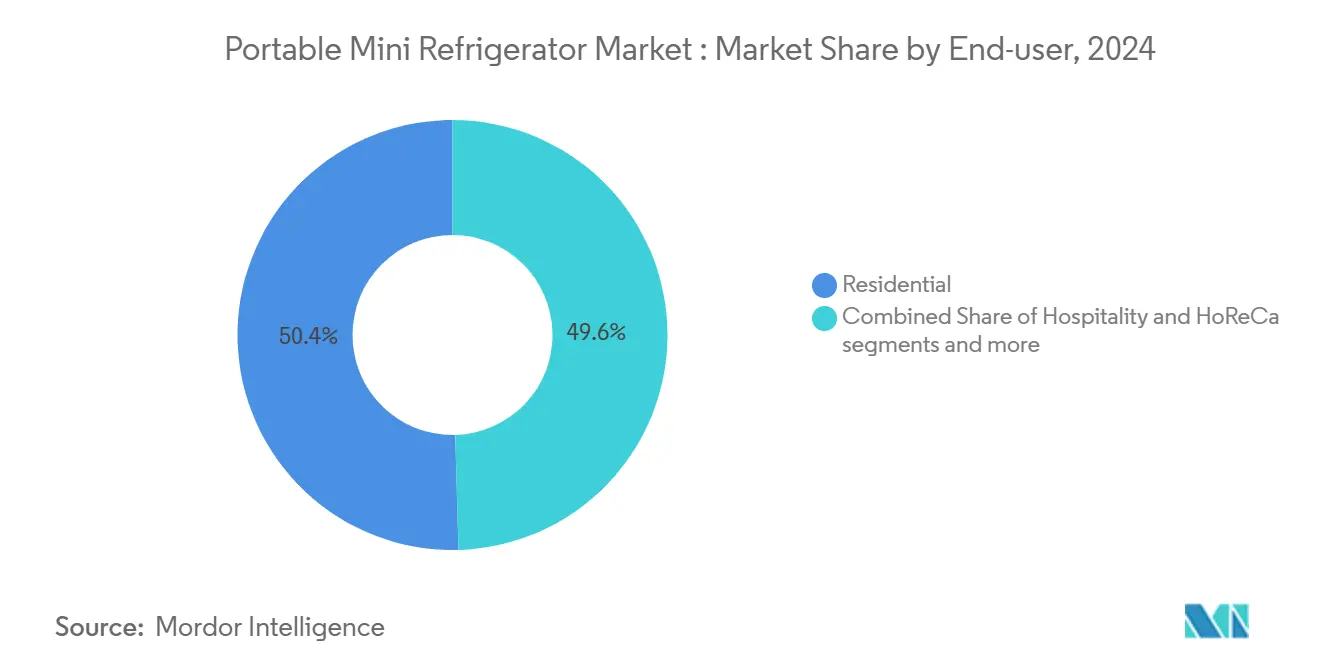
Residential Holds Share, but Automotive, RV, and Marine Surges FastestResidential applications held a 50.44% share in 2025, as home offices, dorms, and compact living spaces adopted portable and mini formats for beverages and overflow storage. The portable mini refrigerator market continues to grow in residential settings as models become quieter, more efficient, and easier to fit under desks or in small cabinets. Hospitality use is evolving toward automated minibar programs in higher-end properties, positioning compliant, low-sound compressor minibars as attractive estate-wide options. Healthcare and laboratory users need validated performance and often require units that demonstrate precise control and rugged construction, including portable refrigerators for field vaccination and sample transport. Field blood transport and pre-hospital care also use compact refrigerators that maintain tight bands for whole blood at scale.
Automotive, RV, and marine are projected to be the fastest-growing end-user segments, with an 8.03% CAGR through 2031, as electric vehicle platforms, vehicle power management, and solar prep improve integration paths. Buyers who combine portable fridges with lithium batteries and solar panels enjoy multi-day autonomy, eliminating the need for ice and reducing food waste. The portable mini refrigerator market benefits as more vehicles ship with 12V outlets and DC-DC chargers that simplify installs and maintain battery health during travel. Marine buyers continue to look for corrosion-resistant construction and tested cooling performance in hot, humid conditions, especially when a boat spends days at anchor. As off-grid capability becomes a baseline expectation, more portable units add connectivity and app-based temperature control to reduce uncertainty during long transits.
By Distribution Channel:
B2C Leads via E-Commerce, B2B Accelerates on Automation ROIB2C accounted for 63.46% share in 2025, reflecting the strength of online discovery for compact appliances and the convenience of direct delivery and easy returns. Direct-to-consumer formats give brands more control over messaging and enable bundled offers that pair fridges with portable power stations to create a smoother first-purchase experience. The portable mini refrigerator market leverages B2C channels to reach new users with side-by-side specifications and how-to content that reduces purchase friction for 12V systems and battery pairings. Multi-brand outdoor retailers still matter because they offer fit and mounting options, helping buyers choose sizes and accessories. B2C growth also reflects stronger support for app integration and customer service that can update firmware and resolve configuration questions.
B2B is expected to grow faster, at a 9.25% CAGR through 2031, as hospitality and healthcare buyers adopt automated, efficient, and telemetry-ready compact units. Hotel estates see value in automated minibars that reduce labor and improve billing accuracy, favoring quiet, energy-efficient fridges that meet refrigerant rules and integrate with property systems. Hospitals and clinics continue to demand portable cold storage with validated thermal performance and options for solar direct-drive or vehicle-powered operation. The portable mini refrigerator market aligns with B2B priorities by offering robust warranty terms, service networks, and documented performance that supports audits and compliance. Suppliers that can package hardware, software, and support will be best placed to grow share in B2B over the forecast window.
Geography Analysis
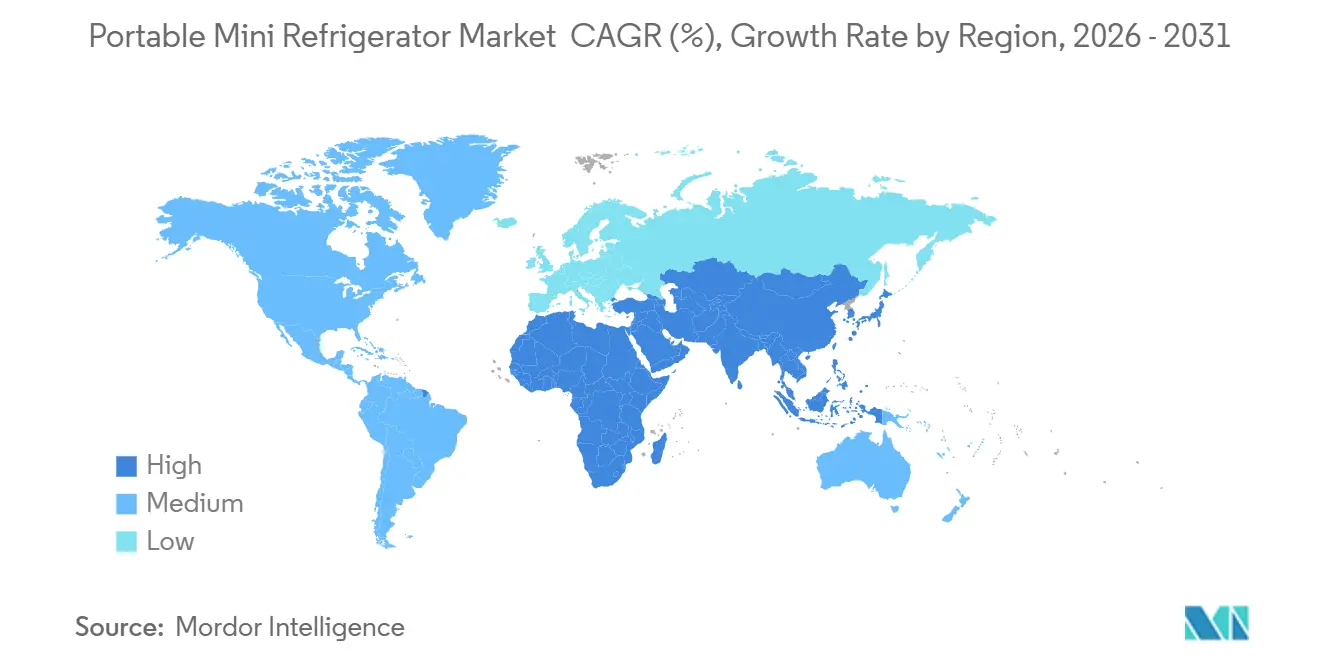
North America Portable Mini Refrigerator Market
North America held 37.76% share in 2025, supported by mature RV and boat ownership, strong off-grid recreation culture, and a wide dealer network that services compact compressor systems. The regulatory path under the AIM Act helps manufacturers align U.S. portfolios to low-GWP refrigerants and streamline compliance plans for portable lines. Hospitality deployments of compact fridges in guestrooms continue, with high-end properties focused on quiet operation and energy controls that can integrate with room systems. Residential adoption remains steady as mini fridges fill needs in dorms, home offices, and accessory dwelling units across the U.S. and Canada. The portable mini refrigerator market also gains from a broad base of vehicle power products that help users install, charge, and protect lithium storage during travel and at camp.
APAC Portable Mini Refrigerator Market
Asia-Pacific is forecast to record the fastest growth at 8.32% CAGR to 2031 as compact living and self-drive travel expand across several key countries. Portable fridges in smaller capacities fit well in apartments and micro living spaces, while also appealing to weekend travelers who need chillers for short road trips. The portable mini refrigerator market benefits from more vehicles offering 12V power and the increasing popularity of outdoor lifestyles in major metros and surrounding regions. Marine and fishing use also supports demand for ruggedized fridges in coastal markets. As e-commerce penetration deepens across the region, brands can reach new buyers and offer service through online channels and partnerships.
Europe Portable Mini Refrigerator Market
Europe shows steady adoption patterns tied to caravan tourism, strict environmental regulations, and a strong premium segment that values quiet, efficient compressors. The F-Gas framework and energy-efficiency directives push vendors toward low-GWP refrigerants and variable-speed designs, which reinforce total cost-of-ownership advantages in hospitality and residential settings. The portable mini refrigerator market aligns with these needs through R600a systems, improved insulation, and refined control electronics that reduce consumption. Northern markets also show interest in devices that can handle cold ambient starts and protect lithium packs in winter conditions. Southern destinations that draw seasonal caravan and marine travel support higher capacity formats that balance multi-day autonomy with manageable weight and footprint.

Competitive Landscape
The portable mini refrigerator market features a mix of established brands with dealer networks and emerging direct-to-consumer players that compete on price, performance, and bundled convenience. Incumbents continue to invest in quieter, more efficient compressor platforms that meet low-GWP requirements and deliver reliable operation in harsh environments. Dometic advanced premium compressor coolers with new insulation approaches and earned industry recognition, which signals continued emphasis on power draw and cooling depth in portable lines. Newer challengers package fridges with portable power stations and highlight user-friendly integration with solar and vehicle charging. As components converge on R600a compressors, app controls, and improved insulation, brands differentiate with warranties, service access, and accessory ecosystems.
Outdoor and overlanding specialists are also moving upstream into integrated vehicle platforms and RV products that include dual-zone fridges as standard equipment. ARB’s entry into North American camping towables with integrated battery and solar options shows how portable refrigeration anchors broader ecosystems that include power management and storage solutions. Brands lean on event showcases to integrate fridges into complete off-road builds, helping customers visualize multi-day travel systems and deepening trust in product durability. The portable mini refrigerator industry continues to emphasize quieter operation, stronger shells, and intuitive controls as part of a comprehensive use-case narrative across vehicles, boats, and small living spaces.
Partnerships and philanthropy also play a role in brand visibility and trust. Companies support conservation and medical programs through equipment donations, aligning portable products with mission-critical use in the field. Firms that can document validated performance with sensitive content and offer strong after-sales support will be well positioned in healthcare and emergency response settings. The portable mini refrigerator market will likely reward brands that deliver compliant refrigerants, efficient compressors, and proven durability, reinforced by clear documentation and robust warranty policies.
Portable Mini Refrigerator Industry Leaders
Dometic Group AB
Indel B S.p.A.
ARB 4x4 Accessories
Alpicool
Koolatron
- *Disclaimer: Major Players sorted in no particular order
Portable Mini Refrigerator Market Companies Covered in this Report
- Dometic Group AB
- Indel B S.p.A.
- Vitrifrigo (Indel B)
- ARB 4x4 Accessories
- ICECO
- Alpicool
- Koolatron
- Cooluli
- Truma
- National Luna
- SnoMaster
- EvaKool
- Engel
- Whynter
- Thetford (Norcold)
- Setpower
- BougeRV
- Haier
- Danby
- AstroAI

Recent Industry Developments in Portable Mini Refrigerator Market
- January 2026: Dometic Group AB entered into an exclusive partnership with Gemline, a promotional-products supplier with revenue of USD 136 million and ranked 14th in North America by Counselor Top 40. This agreement appoints Gemline as the sole distributor of Dometic products, including the 28 L CFX2 ice-free electric cooler that holds 36 cans, across the United States and Canada. This initiative expands Dometic's business-to-business distribution beyond traditional outdoor retailers such as REI, Bass Pro Shops, and Dick's Sporting Goods into corporate gifting and branded merchandise segments.
- January 2026: ARB 4x4 Accessories launched the ARB Earth Camper in the North American market. The base model is priced at USD 59,900, while the GT variant is priced at USD 69,950. The camper includes a 103-quart ARB ZERO dual-zone fridge or freezer, a REDARC Alpha 50 battery management system, lithium battery configurations ranging from 100 Ah to 400 Ah, and solar panels with capacities between 120 W and 260 W. This launch highlights a shift in the original equipment manufacturer channel, where portable refrigeration transitions from an aftermarket accessory to a standard factory-integrated feature.
- November 2025: ARB 4x4 Accessories presented a new integrated winch with 10 K and 12 K capacities and forged upper control arms designed for independent front suspension platforms at SEMA 2025. Additionally, powered-fridge-equipped builds of the 2025 Toyota 4Runner and Tacoma were showcased. This presentation emphasized the integration of portable fridges into comprehensive off-road systems that include armor, suspension, storage, and recovery components, targeting extended vehicle-based exploration.
- October 2024: Dometic Group AB introduced the CFX5 Series, available in capacities ranging from 25 L to 95 L and priced between USD 800 and USD 1,400. This series is the first to feature vacuum-insulated panels in Dometic electric coolers. The coolers are equipped with the VMSO 3.5 compressor, the most powerful in Dometic's product range, capable of cooling to -7 °F. The design reduces power consumption to below 60 W and achieves a lighter and more compact form through advanced, thinner insulation. The CFX5 Series received recognition, winning the ISPO Award 2025 and being named Cooler Product of the Year at the 2025 Outdoor Innovation Awards.


Global Portable Mini Refrigerator Market Report Scope
Portable mini refrigerators are compact, mobile cooling appliances designed to offer convenience and flexibility for storing food, beverages, and temperature-sensitive items. Unlike standard full-sized refrigerators, which are large and stationary, these miniature variants are specifically tailored for limited spaces, specialized uses, and on-the-go mobility. The portable mini refrigerator market is segmented by technology, capacity, end-user/application, distribution channel, and geography. By technology, the market is segmented into compressor, thermoelectric (Peltier), and absorption. By capacity, the market is segmented into ≤45 L, 46–60 L, 61–80 L, and >80 L. By end-user/application, the market is segmented into residential, hospitality & HoReCa, healthcare & laboratories, automotive, RV & marine, and others. By distribution channel, the market is segmented into B2C (including multi-brand stores, exclusive brand outlets, online, and other distribution channels) and B2B. By geography, the market is segmented into North America, South America, Asia-Pacific, Europe, the Middle East, and Africa. The report offers the market size in value terms in USD for all the above-mentioned segments.
| Compressor |
| Thermoelectric (Peltier) |
| Absorption |
| ≤45 L |
| 46–60 L |
| 61–80 L |
| >80 L |
| Residential |
| Hospitality & HoReCa |
| Healthcare & Laboratories |
| Automotive, RV & Marine |
| Others |
| B2C | Multi-Brand Store |
| Exclusive Brand Outlets | |
| Online | |
| Other Distribution Channel | |
| B2B |
| North America | United States |
| Canada | |
| Mexico | |
| South America | Brazil |
| Peru | |
| Chile | |
| Argentina | |
| Rest of South America | |
| Asia-Pacific | India |
| China | |
| Japan | |
| Australia | |
| South Korea | |
| South East Asia (Singapore, Malaysia, Thailand, Indonesia, Vietnam, and Philippines) | |
| Rest of Asia Pacific | |
| Europe | United Kingdom |
| Germany | |
| France | |
| Spain | |
| Italy | |
| BENELUX (Belgium, Netherlands, and Luxembourg) | |
| NORDICS (Denmark, Finland, Iceland, Norway, and Sweden) | |
| Rest of Europe | |
| Middle East and Africa | United Arab Emirates |
| Saudi Arabia | |
| South Africa | |
| Nigeria | |
| Rest of Middle East and Africa |
| By Technology | Compressor | |
| Thermoelectric (Peltier) | ||
| Absorption | ||
| By Capacity | ≤45 L | |
| 46–60 L | ||
| 61–80 L | ||
| >80 L | ||
| By End-user / Application | Residential | |
| Hospitality & HoReCa | ||
| Healthcare & Laboratories | ||
| Automotive, RV & Marine | ||
| Others | ||
| By Distribution Channel | B2C | Multi-Brand Store |
| Exclusive Brand Outlets | ||
| Online | ||
| Other Distribution Channel | ||
| B2B | ||
| By Geography | North America | United States |
| Canada | ||
| Mexico | ||
| South America | Brazil | |
| Peru | ||
| Chile | ||
| Argentina | ||
| Rest of South America | ||
| Asia-Pacific | India | |
| China | ||
| Japan | ||
| Australia | ||
| South Korea | ||
| South East Asia (Singapore, Malaysia, Thailand, Indonesia, Vietnam, and Philippines) | ||
| Rest of Asia Pacific | ||
| Europe | United Kingdom | |
| Germany | ||
| France | ||
| Spain | ||
| Italy | ||
| BENELUX (Belgium, Netherlands, and Luxembourg) | ||
| NORDICS (Denmark, Finland, Iceland, Norway, and Sweden) | ||
| Rest of Europe | ||
| Middle East and Africa | United Arab Emirates | |
| Saudi Arabia | ||
| South Africa | ||
| Nigeria | ||
| Rest of Middle East and Africa | ||


Key Questions Answered in the Report
What is the portable mini refrigerator market size outlook through 2031?
The portable mini refrigerator market size is projected to reach USD 4.95 billion by 2031, increasing from USD 3.39 billion in 2025 and USD 3.61 billion in 2026 at a 6.5% CAGR between 2026 and 2031.
Which technologies will lead to growth in the portable mini refrigerator market?
Compressor platforms hold the largest share today, and thermoelectric units are projected to grow fastest through 2031 as hospitality and small‑space buyers prioritize silent operation and simple installs.
Which capacity ranges are gaining traction among buyers?
≤45 L remains the most common for portability, while 61–80 L is the fastest‑growing range as dual‑zone models with better insulation and efficient compressors support multi‑day autonomy.
What are the strongest B2B use cases for portable mini refrigerators?
Hospitality estates adopt compact, compliant, and quiet minibars with automation potential, and healthcare organizations use validated portable units for vaccines, blood, and temperature‑sensitive medications.
How do refrigerant rules influence product design in this space?
United States HFC phase‑down rules and EU frameworks drive migration to low‑GWP refrigerants such as R600a, which encourages redesigns that also improve energy use, noise, and temperature control.
Where is geographic growth most attractive for vendors?
North America holds the largest share due to mature outdoor and vehicle markets, while Asia‑Pacific is expected to be the fastest‑growing region through 2031 as compact living and self‑drive travel expand.
Page last updated on:





