
Market Overview
| Study Period | 2020 - 2031 |
|---|---|
| Forecast Data Period | 2026 - 2031 |
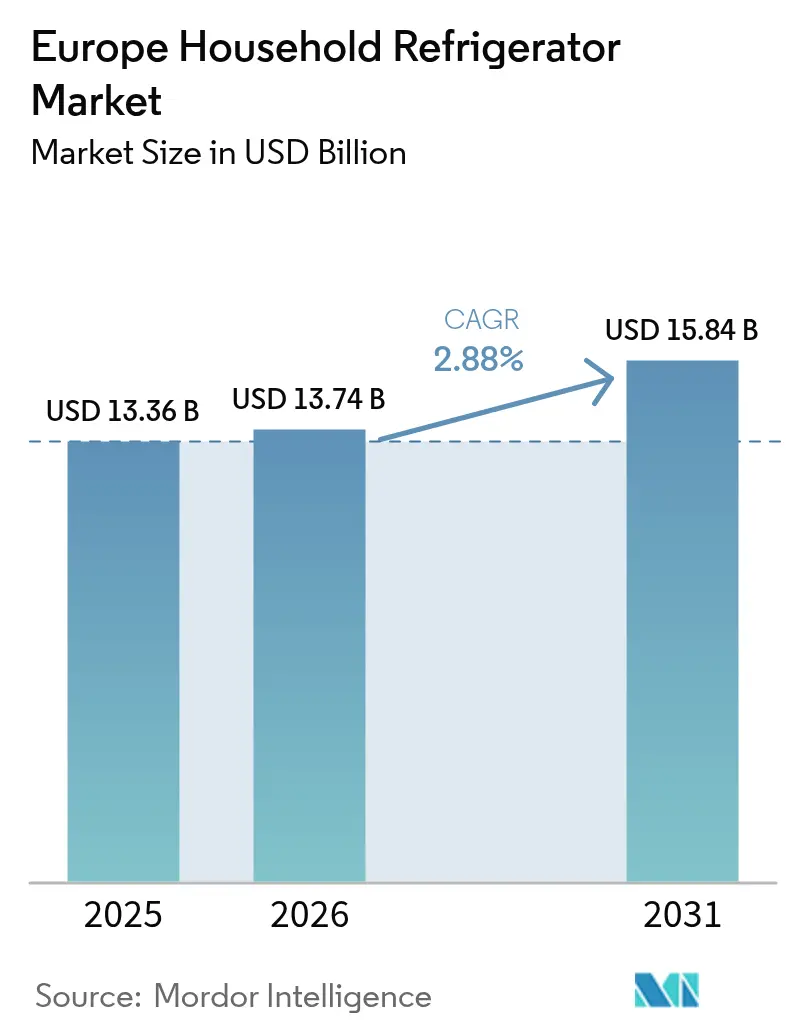
| Base Year Market Size (2025) | USD 13.36 Billion |
| Market Size (2026) | USD 13.74 Billion |
| Market Size (2031) | USD 15.84 Billion |
| Growth Rate (2026 - 2031) | 2.88 % |
| Market Concentration | Medium |
Major Players *Disclaimer: Major Players sorted in no particular order Image © Mordor Intelligence. Reuse requires attribution under CC BY 4.0. | |
Europe Household Refrigerator Market Analysis by Mordor Intelligence
The Europe household refrigerator market size is expected to grow from USD 13.36 billion in 2025 to USD 13.74 billion in 2026 and is forecast to reach USD 15.84 billion by 2031 at 2.88% CAGR over 2026-2031. The measured expansion reflects a maturing replacement-driven environment where EU energy labels, now recognized by 93% of consumers, push households toward higher-efficiency models[1]European Commission, “Energy Labelling and Ecodesign,” europa.eu. Regulatory moves such as the Right to Repair directive compel brands to hold spare parts for seven years, extending product lifecycles while still catalyzing upgrades when older units fail to meet new standards. Elevated electricity tariffs significantly higher than US averages—amplify consumer sensitivity to running costs, accelerating demand for A-class appliances. On the supply side, the F-gas regulation inflates prices for legacy refrigerants by up to 1,000%, nudging manufacturers toward propane and CO₂ systems that remain competitively priced at EUR 5-15 per kg. Within this policy-shaped arena, the European household refrigerator market experiences resilient volume even as value growth hinges on premium features, smart connectivity, and circular-economy compliance.
Key Report Takeaways
- By product, double-door refrigerators led with 33.60% revenue share of the Europe household refrigerator market in 2025, while French-door models are projected to post a 5.35% CAGR through 2031.
- By structure, freestanding units retained 67.40% share in 2025; built-in models hold the fastest trajectory at 5.70% CAGR to 2031.
- By capacity, models exceeding 15 cu ft accounted for 59.20% of the Europe household refrigerator market size in 2025 and are expected to grow at a 4.65% CAGR.
- By distribution channel, multi-brand stores dominated with a 44.30% share in 2025, yet online sales will expand at a 6.45% CAGR to 2031.
- By geography, Germany contributed 16.80% of 2025 revenue, whereas BENELUX is set to advance at 5.05% CAGR between 2026-2031.
Note: Market size and forecast figures in this report are generated using Mordor Intelligence’s proprietary estimation framework, updated with the latest available data and insights as of 2026.
Market Trends and Insights
Drivers Impact Analysis of Europe Household Refrigerator Market*
| Driver | (~) % Impact on CAGR Forecast | Geographic Relevance | Impact Timeline |
|---|---|---|---|
| EU Energy-Efficiency Regulations and Incentives | 0.80% | EU-wide, strongest in Germany, France, Netherlands | Medium term (2-4 years) |
| Rapid Smart-Appliance Penetration and IoT Interoperability | 0.60% | BENELUX, NORDICS, Germany | Long term (≥ 4 years) |
| High Replacement Demand from Ageing Installed Base | 0.70% | Germany, UK, France | Short term (≤ 2 years) |
| Expansion of Organised Retail and Last-Mile Cold-Chain Logistics | 0.30% | Germany, France, UK urban centers | Medium term (2-4 years) |
| VPP-Ready Refrigerators Enabling Demand-Response Revenues | 0.40% | NORDICS, Germany, Netherlands | | Long term (≥ 4 years) |
| Circular-Economy Subsidies for Refurbishment and Repair Schemes | 0.20% | France, Germany, Netherlands | Long term (≥ 4 years) |
| Source: Mordor Intelligence | |||
EU Energy-Efficiency Regulations and Incentives
The European Commission’s new Ecodesign for Sustainable Products Regulation is giving appliance makers an extra push. Under its 2025–2030 agenda, household devices take top billing, and manufacturers must now build products that last longer, can be repaired more easily, and carry clear labels showing their carbon footprint. The Ecodesign for Sustainable Products Regulation accelerates replacement cycles by requiring durability, repairability, and carbon disclosure across household refrigeration lines. Moving to a clear A-G energy scale eliminates label confusion while digital product passports allow authorities to trace registered models, phasing out non-compliant stock. Consumer savings reached EUR 90 billion in 2022 and are projected at EUR 150 billion by 2030, anchoring a policy-led runway for the European household refrigerator market.
Rapid Smart-Appliance Penetration and IoT Interoperability
The EU Code of Conduct for energy-smart appliances, launched in April 2024, harmonizes protocols so refrigerators seamlessly join demand-side flexibility programs[2]Joint Research Centre, “EU Code of Conduct on Energy-Smart Appliances,” jrc.ec.europa.eu. Commitments from Arçelik, Daikin, and Electrolux ensure compliant models within a year. LG’s 80% stake in Dutch platform Athom attaches Homey Pro’s 50,000-device ecosystem to its white-goods portfolio, affirming that connected features now justify premium pricing. Academic trials show home-energy management can cut household consumption by 57%, translating connectivity into measurable savings.
High Replacement Demand from Ageing Installed Base
Refrigerators bought before 2010 approach end-of-life just as newer rules tighten, igniting a replacement wave that shields volumes from macro-slowdowns. Average lifespans of 10-15 years mean non-A-class units incur high operating costs, propelling trade-ups despite inflation. BSH Hausgeräte sustained European share during a contracting 2024 market, illustrating how replacements underpin the European household refrigerator market. EU labels have already slashed average per-unit energy draw by 60% since 1994.
Expansion of Organised Retail and Last-Mile Cold-Chain Logistics
Wider coverage of specialist retailers and rapid-delivery services simplifies bulky-goods fulfilment, removing friction for online conversions. Urban hubs in Germany, France, and the UK lead turnkey installation offerings that speed adoption of larger, feature-rich models. Retailers exploit omnichannel data to target households nearing end-of-life cycles, raising replacement capture rates and supporting the European household refrigerator market.
Restraints Impact Analysis of Europe Household Refrigerator Market*
| Restraint | (~) % Impact on CAGR Forecast | Geographic Relevance | Impact Timeline |
|---|---|---|---|
| Volatile steel and compressor input costs | -0.50% | Germany, Italy production hubs | Short term (≤ 2 years) |
| Intensifying price competition from Chinese OEM imports | -0.30% | All EU markets | Medium term (2-4 years) |
| Consumer confusion over new EU energy labels | -0.20% | EU-wide | Short term (≤ 2 years) |
| Delivery delays from ADR rules on refrigerant or battery shipping | -0.10% | BENELUX, Germany corridors | Short term (≤ 2 years) |
| Source: Mordor Intelligence | |||
Volatile Steel and Compressor Input Costs
European manufacturers operate 130 plants that absorb wide swings in steel and compressor pricing, eroding margins just as energy costs run 2-3 times US levels[3]APPLiA, “Home Appliance Industry Economic Report,” applia-europe.eu. The new F-gas regime further inflates high-GWP refrigerant costs, forcing swift conversion to natural alternatives. BSH’s EUR 850 million R&D outlay in 2023 underscores the capex required to counter cost spikes via design efficiency.
Intensifying Price Competition from Chinese OEM Imports
Chinese shipments of 4.48 billion household appliances in 2024 place sustained deflationary pressure on mid-range segments. Cixi City alone exported RMB 2.41 billion worth of refrigerators, demonstrating persistent capacity buildup aimed at the European household refrigerator market. European players, therefore, lean into premium differentiation—energy savings, smart features, and robust after-sales—to safeguard pricing power.
*Our forecasts treat driver/restraint impacts as directional, not additive. The impact forecasts reflect baseline growth, mix effects, and variable interactions.
Europe Household Refrigerator Market Segment Analysis
By Product:
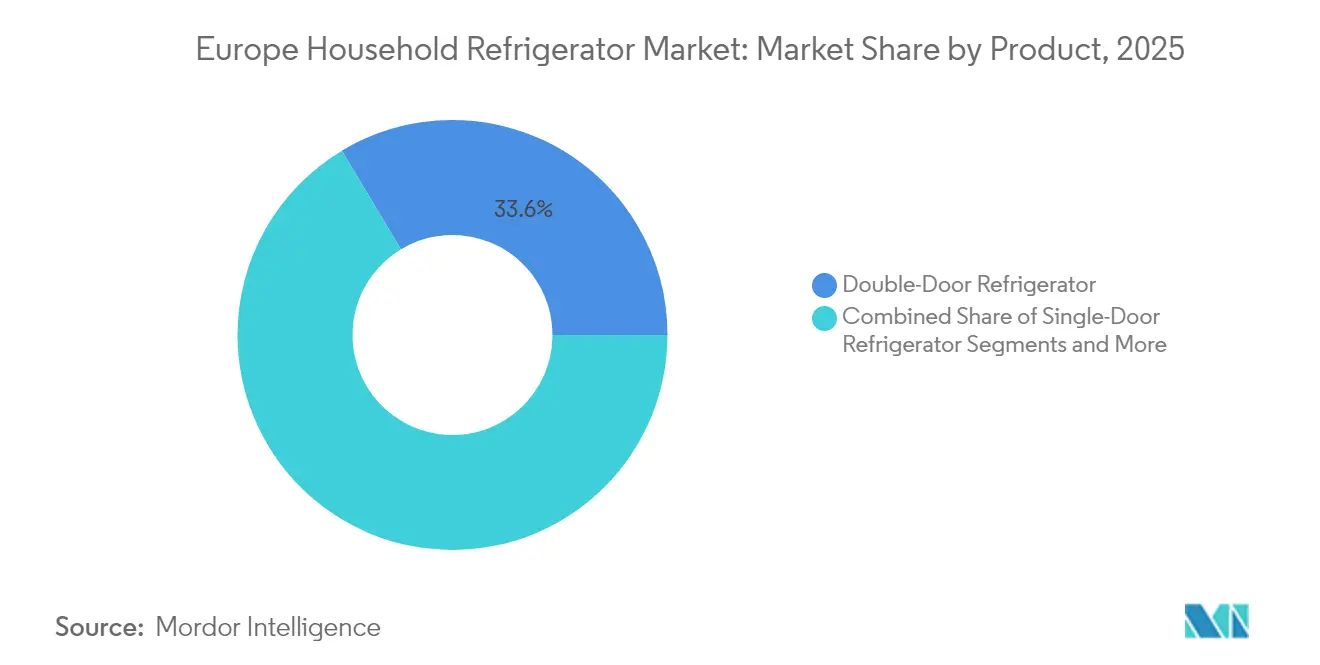
French-Door Innovation Drives Premium MigrationDouble-door formats anchored 33.60% of 2025 shipments, thriving on familiarity and mid-price positioning. French-door units, though still a minority, will sprint at 5.35% CAGR between 2026-2031, outpacing the European household refrigerator market’s overall rhythm. Yet rising urban affluence calls for wider shelf space and discreet vegetable drawers, propelling French-door adoption. The broader cabinet allows manufacturers to bundle multi-zone cooling, touchscreens, and camera-based inventory tracking that meet EU smart-appliance interoperability codes.Growth feeds off replacement demand: households with ageing double-door models weigh operating costs against the energy savings achievable with fresh A-class French-door offerings. BSH dedicates 5.5% of turnover to R&D, channelling funds into premium models that integrate Home Connect platforms for predictive maintenance. This reinforces brand stickiness and cushions margins amid Chinese pricing pressure, underlining why French-door innovation is pivotal for the European household refrigerator market.



By Structure:
Built-In Segment Accelerates Despite Freestanding DominanceFreestanding designs accounted for 67.40% of 2025 shipments, favored by renters and value-seekers who prize easy relocation. Built-in appliances, however, are poised for a 5.70% CAGR as renovation cycles in dense European cities emphasize seamless cabinetry. Energy-label reforms further encourage integrated units because owners anticipate keeping them for longer, diluting the upfront cost premium across an extended lifespan.Manufacturers respond with telescopic installation kits and slimmer compressor housings that reclaim cabinet depth without reducing capacity. The EU’s durability criteria, embedded in the Ecodesign regulation, align with built-in quality, ensuring lower failure rates and fewer service calls over 15-plus years. As kitchens evolve into open-plan social spaces, built-in formats satisfy aesthetic demands while helping brands capture high-margin upgrades in the Europe household refrigerator market.
By Capacity:
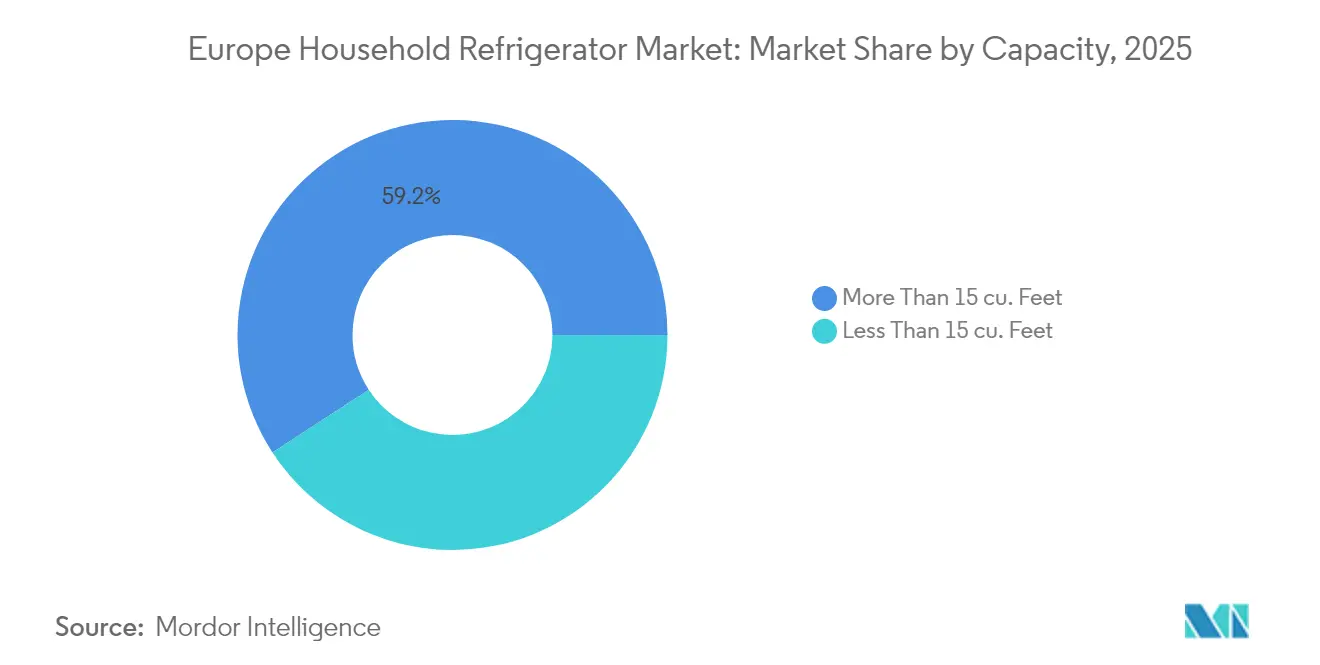
Large-Format Units Dominate Growth TrajectoryRefrigerators above 15 cu ft captured 59.20% of 2025 demand and will expand 4.65% annually, buoyed by bulk-shopping trends arising from hybrid work lifestyles. Enhanced compressor and insulation technologies let bigger cabinets achieve the same A-class ratings once exclusive to compact models, neutralizing energy-cost objections. The Europe household refrigerator market size for >15 cu ft units is projected to widen faster than any smaller category through 2031.Feature bundling intensifies in this size band: variable-speed compressors, humidity-controlled produce drawers, and door-within-door beverage zones make large units a canvas for upselling. Natural-refrigerant adoption is also simplest at scale because interior volume offsets any cost delta, strengthening compliance with tight F-gas quotas. Households thus view upsizing as both an energy and lifestyle upgrade, sustaining the capacity-led growth story.
By Distribution Channel:
Digital Transformation Reshapes Retail LandscapeTraditional multi-brand outlets still secure 44.30% of 2025 turnover, offering live demos and turnkey installation, critical for bulky goods. Online channels nevertheless clock 6.45% CAGR as logistics firms master two-man delivery, reverse pickup of old units, and on-site connection of water dispensers or home-hub networks. Covid-era comfort with high-ticket e-purchases persists, pushing brands to fine-tune web configurators that calculate lifetime energy savings—an argument compelling enough for cost-sensitive households facing elevated power tariffs.Exclusive brand stores extend the omnichannel spectrum, letting manufacturers retain margin and gather first-party usage data via IoT enrolment. Such telemetry supports personalized upsell campaigns and predictive maintenance alerts, locking customers into the European household refrigerator market’s premium ecosystem and limiting churn toward budget imports.
Geography Analysis
Europe Household Refrigerator Market
By geography, Germany contributed 16.80% of 2025 revenue, whereas BENELUX is set to advance at 5.05% CAGR between 2026-2031. Germany remains the anchor for the European household refrigerator market, combining a large population with stringent efficiency norms that compel timely replacements. Local buyers gravitate toward premium German-made brands, rewarding firms that align with emerging VPP services and offering ample headroom for connected, A-class French-door units. Domestic retailers benefit from well-funded financing programs that soften upfront costs, helping manufacturers defend price positioning even against import pressure.BENELUX adds high-margin momentum. Compact city apartments favor built-in formats, and household broadband penetration above 95% streamlines smart-appliance adoption. National grid operators in the Netherlands are among the first to issue dynamic-tariff contracts that pay consumers for flexible load shifting, catalyzing VPP-ready refrigerator sales. Belgium’s warranty-backed circular-economy subsidies further stimulate uptake of durable, repairable models, reinforcing compliance-value messaging.Elsewhere, France’s repairability index informs purchase decisions, while Spain and Italy pivot on tourism-driven second-home refurbishment that boosts medium-capacity demand. Nordic nations top per-capita spending on refrigeration and lead natural-refrigerant penetration, setting design standards envied by the wider Europe household refrigerator market. Collectively, these distinct trajectories create a pan-European tapestry that allows manufacturers to spread risk and tailor innovation strategies by region.
Regulatory Landscape
Household refrigerators in the EU are primarily regulated through Ecodesign and Energy Labelling requirements under Commission Regulation (EU) 2019/2019 and Commission Delegated Regulation (EU) 2019/2016, backed by the broader energy labelling framework in Regulation (EU) 2017/1369. The direction broadened in 2024 with the Ecodesign for Sustainable Products Regulation (ESPR, Regulation (EU) 2024/1781), which moves compliance beyond energy performance toward durability, repairability, and product information that supports circular-economy enforcement.
Refrigerant policy has tightened via Regulation (EU) 2024/573 (F-gas), which entered into force on 11 March 2024 and accelerates the phase-out of fluorinated gases, including restrictions relevant to domestic refrigeration applications. In parallel, the European Commission opened a review of existing Ecodesign and energy labelling rules for refrigerating appliances in May 2025, followed by a consultation window running from 4 December 2025 to 26 February 2026, with updated requirements targeted for 2026. In 2026, the Commission also introduced COM(2026) 565 to amend Regulation (EU) 2017/1369, aiming to simplify energy labelling administration and expand digital compliance options.
Value Chain Analysis
The value chain starts with upstream inputs and components (steel, plastics and insulation, compressors, electronics and sensors, and refrigerants), then moves through cabinet fabrication, cooling-system integration, assembly, testing, and registration or listing steps tied to EU product rules (Ecodesign and Energy Labelling) and associated product-information workflows. Compliance and design choices are increasingly feeding back into engineering and sourcing as the European Commission reviews refrigerating appliance rules (calls for contributions launched on 26 May 2025), and as ESPR-driven circularity requirements raise expectations around modular design, spare-part availability, and disassembly-friendly construction.
Manufacturing and final assembly are split between EU plants and imports, with EU production of large household appliances accounting for about 56% of total EU sales as of 2024, and key production clusters in Poland, Italy, Germany, and Sweden. Downstream, products are distributed through multi-brand retailers, exclusive brand outlets, and expanding online channels, where two-person delivery, installation, and old-unit take-back operate as service layers. Trade and cost dynamics also shape the chain: industry bodies such as APPLiA have flagged CBAM-related cost pressures for EU manufacturers and the perceived mismatch versus imported finished goods, while F-gas tightening increases the need for refrigerant transitions and compliant service ecosystems across the installed base.
Competitive Landscape
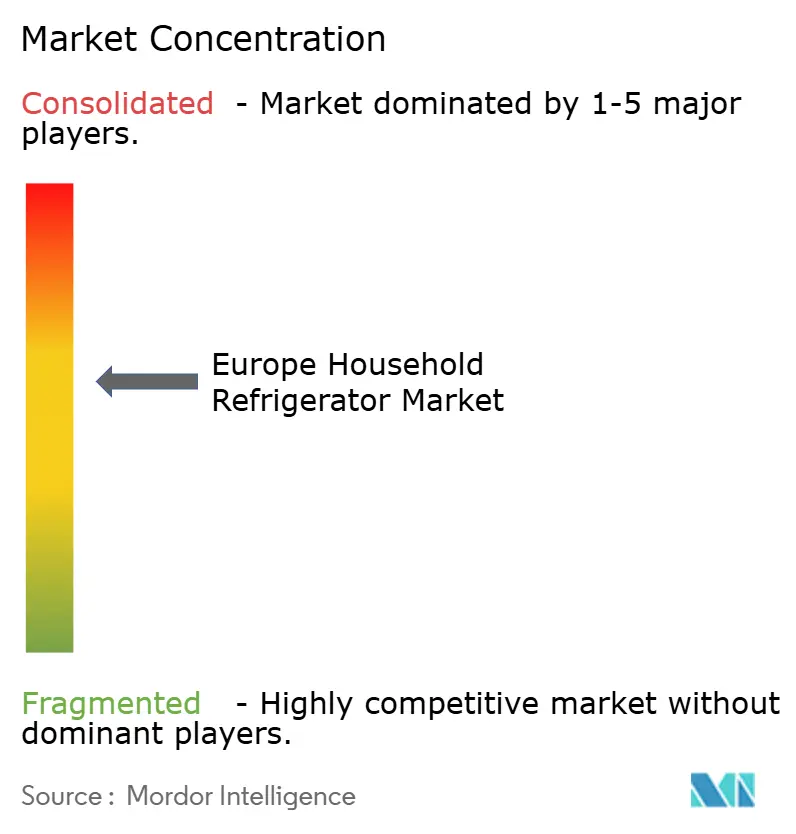
European refrigeration remains moderately concentrated. BSH Hausgeräte, Whirlpool (now Beko Europe), and Electrolux together controlled a significant share of shipments in 2024, each bulwarked by scale manufacturing, proprietary IoT ecosystems, and deep regulatory engagement. BSH’s EUR 850 million R&D commitment advances energy-efficient compressors and modular interiors attuned to EU durability mandates.
Tech acquisition underpins differentiation. LG’s purchase of Athom gives it the Homey Pro platform, instantly widening native compatibility and letting its refrigerators speak to 50,000 third-party devices—an edge in interoperability-driven Europe. Meanwhile, Midea’s acquisition of Küppersbusch’s parent provides a local flag for Chinese entry into premium niches, sidestepping quotas and offering German-heritage branding to counter skittish consumers.
Chinese OEMs nonetheless squeeze margins on value-led SKUs, flooding the channel with competitively priced freestanding models. European incumbents retaliate by accentuating after-sales reliability, natural-refrigerant leadership, and EU-compliant repair networks—advantages harder for importers to replicate. The next battleground lies in VPP-ready features, where early compliance with demand-response security protocols may cement first-mover preference across the Europe household refrigerator market.
Europe Household Refrigerator Industry Leaders
BSH Hausgeräte GmbH (Bosch-Siemens)
Whirlpool Corp.
Samsung Electronics Co. Ltd.
LG Electronics Inc.
Haier Smart Home Co. Ltd.
- *Disclaimer: Major Players sorted in no particular order
Europe Household Refrigerator Market Companies Covered in this Report
- BSH Hausgeräte GmbH (Bosch-Siemens)
- Whirlpool Corp.
- Samsung Electronics Co. Ltd.
- LG Electronics Inc.
- Haier Smart Home Co. Ltd.
- Liebherr-Hausgeräte GmbH
- Electrolux AB
- Midea Group
- Gorenje (Hisense)
- Miele & Cie. KG
- Arçelik A.Ş. (Beko, Grundig)
- Vestel Ticaret A.Ş.
- Smeg SpA
- CDA Group Ltd.
- Amica SA
- Candy Hoover Group
- Sharp Consumer Electronics
- Severin Elektrogeräte
- Atlant Inc.
- Panasonic Corporation
- Teka Group
- Winia Electronics

Market Opportunities and Future Outlook
Regulatory revision cycles are creating an identifiable redesign and portfolio-refresh window in Europe. The European Commission initiated a call for evidence in May 2025 to update ecodesign and energy labelling requirements for refrigerating appliances, and it ran a public consultation from 4 December 2025 to 26 February 2026, with updated rules targeted for 2026. This supports opportunities for manufacturers and retailers to monetize compliance-led upgrades, particularly as ESPR (Regulation (EU) 2024/1781) expands expectations around durability, repairability, and product information. That raises demand for models engineered for serviceability and for after-sales networks that can document compliant repairs and spare-parts availability.
Connectivity and digitalization investments provide another route to value capture, especially in premium and built-in segments where feature differentiation supports pricing. BSH has indicated continued emphasis on digitalization, AI, and IT infrastructure as part of its 2026 strategy, and its 2025 financial-year spend included 847 million euros in R&D and 463 million euros in future-oriented initiatives, which supports software-led features such as energy-management integrations, predictive maintenance, and interoperability. On the supply side, Electrolux announced in April 2026 a plan to optimize its global manufacturing footprint, backed by a rights issue of approximately SEK 9 billion, pointing to active restructuring that can help accelerate the rollout of EU-variant compliant SKUs and improve lead times for European channels.
Recent Industry Developments in Europe Household Refrigerator Market
- June 2026: BSH Home Appliances (via its India subsidiary) launched Bosch and Siemens four-door side-by-side refrigerators and highlighted a broader move into the mass market there through local manufacturing partnerships. Although the launch is outside Europe, it signals BSH's ongoing product-platform expansion and sourcing optionality that can influence global component allocation and feature roadmaps for its European refrigeration portfolio.
- April 2026: Electrolux Group announced a plan to optimize its global manufacturing footprint and organizational setup, supported by a fully underwritten rights issue of about SEK 9 billion. The program prioritizes agility and cost structure, which affects how quickly Electrolux can refresh EU-compliant refrigerator lineups and rebalance production between regions and plants.
- March 2026: BSH reported 847 million euros in R&D investment for the 2025 financial year and 463 million euros directed to future-oriented initiatives including digitalization and artificial intelligence. The spending reinforces an ongoing engineering focus on efficiency, connectivity, and compliance-ready product design as EU requirements tighten around energy performance, refrigerants, and circular-economy attributes.


Europe Household Refrigerator Market Report Scope and Research Methodology
Market Definition and Coverage
For this study, we define the Europe household refrigerator market as the value of new refrigerators purchased for home use across European countries, counted at the point of sale and expressed in current USD.
Scope exclusions: We exclude commercial refrigeration equipment, stand-alone freezers, and wine coolers, and we also exclude aftermarket repair services and extended warranties.
Segments Covered in This Report
- By Product
- Single-Door Refrigerator
- Double-Door Refrigerator
- Top Freezer
- Bottom Freezer
- Side-By-Side Door Refrigerator
- French-Door Refrigerator
- Other Refrigerators
- By Structure
- Built-In
- Freestanding
- By Capacity
- Less Than 15 cu. Feet
- More Than 15 cu. Feet
- By Distribution Channel
- Multi-Brand Stores
- Exclusive Brand Outlets
- Online
- Other Distribution Channels
- By Geography
- United Kingdom
- Germany
- France
- Spain
- Italy
- BENELUX (Belgium, Netherlands, Luxembourg)
- NORDICS (Denmark, Finland, Iceland, Norway, Sweden)
- Rest of Europe
Data Sources, Market Sizing, and Validation
Desk Research
Desk work starts with building a realistic demand pool and a clear scope line, before any number is modeled. We typically refer to public sources such as Eurostat datasets on trade and industrial production, European Commission policy and regulation pages (energy labeling, ecodesign, and refrigerant rules), and national statistics offices for household and housing indicators.
To keep the sizing practical, we also scan sources such as APPLiA publications on the European home appliance industry, customs and tariff schedules for appliance categories, and peer reviewed literature on refrigerants and efficiency trends that affect product mix and pricing. Company annual reports, investor materials, and reputable press coverage are used to understand replacement cycles, channel shifts, and pricing moves across major European markets. Where needed, we complement this with paid subscriptions for company financials and for shipment level import and export checks, mainly to reduce blind spots in smaller countries. These desk research sources are illustrative and not exhaustive, and we used many additional references to collect data, validate it, and clarify open questions.
Primary Interviews and Surveys
Primary work was used to pressure-test the desk assumptions and align the model with how the market behaves in real purchase decisions. We spoke with participants across manufacturers, distributors, retailers, and service ecosystem specialists, and then we validated country-level signals across major markets and the Rest of Europe to reduce over-reliance on any single data series.
Distribution of primary research fieldwork respondents
| Company type | Respondent position |
|---|---|
| Top tier: 30% | CXOs: 13% |
| Mid tier: 53% | Functional/Unit leaders: 35% |
| Smaller Players: 17% | Managers: 52% |
Market-Sizing & Forecasting
Market sizing is anchored in a top-down build where production, trade, and household demand signals are reconstructed into an annual value pool for household refrigerators in Europe. We then corroborate the totals using selective bottom-up checks, such as sampled average selling prices by major format and channel, along with reasonableness checks against visible supplier scale and retailer mix.
Key inputs that typically shape the model include replacement-led demand timing, housing completions and household formation trends, the split of purchases between built-in and freestanding formats, energy-label and refrigerant compliance shifts that change product mix, and average selling price movement by country and channel (online versus offline). When a variable is noisy in a smaller country, we fill the gap with proxy indicators tied to appliance penetration and income bands, and the assumption is validated again through interviews.
For forecasting, we mainly use scenario analysis supported by short time-series smoothing on the core demand drivers, since category growth in Europe is often steady and policy-driven rather than explosive. The final view is set only after the assumptions on mix and pricing are aligned with what industry participants expect over the next few years.
Data Validation & Update Cycle
Outputs are validated through triangulation across independent signals, followed by variance checks at the country level so outliers do not slip through due to one abnormal input. We also run logic tests that compare implied unit demand and price realization against what trade flows and channel commentary suggest, and then the model is reviewed in more than one analyst pass before sign-off.
The report is refreshed annually, and interim updates are triggered when a material event changes pricing, regulation timing, or demand conditions. Before delivery, we do a fresh scan of key indicators and re-contact sources if a mismatch appears, so clients receive an updated view rather than an older snapshot.
Mordor Intelligence's Europe Household Refrigerator Market Estimate Compared With Other Published Estimates
It is common to see different market values published for refrigerators in Europe, since the scope line is not always drawn in the same place and the pricing basis can vary by year and currency timing. Differences also show up when some estimates lean on shipment value, while others anchor demand to household purchases.
By checking trade and production signals and then refreshing the included product list each year, Mordor Intelligence keeps the value focused on household refrigerator purchases, which prevents totals from being lifted by commercial cabinets or stand-alone freezers that are sometimes grouped into broader counts.
Benchmark comparison
| Source | Market Size | Gaps in Research Methodology |
|---|---|---|
| Mordor Intelligence | USD 13.36 B (2025) | |
| Trade Publisher A | USD 65.84 B (2023) | Uses a wider refrigerator definition for Europe that appears to blend household and commercial demand, and it can also capture more value-chain stages rather than only end-market household purchases. |
| Industry Article B | USD 15.80 B (2026) | Anchors the market on a later year and puts more weight on premium and feature-heavy models, which can lift average pricing and growth assumptions versus a mix-normalized country roll-up. |
The table shows that most of the spread comes from scope and price-basis choices, not from small calculation differences. When the market is kept to household-only refrigerators and checked against practical country demand signals, the resulting value stays traceable to clear variables and can be repeated in future updates.


Key Questions Answered in the Report
What is the current value of the Europe household refrigerator market?
The market is valued at USD 13.74 billion in 2026 and is projected to reach USD 15.84 billion by 2031 at a 2.88% CAGR.
Which product segment is growing fastest?
French-door refrigerators are advancing at 5.35% CAGR, outpacing all other formats due to premium features and larger capacities.
How significant are online sales for refrigerators in Europe?
Online channels account for a smaller base today but are expected to expand at 6.45% CAGR, eroding the 44.30% share still held by multi-brand stores.
Why are natural refrigerants gaining traction?
High-GWP refrigerants face cost inflation up to 1,000% under EU F-gas rules, while propane and CO₂ remain stable, driving manufacturers toward low-impact alternatives.
What role do smart capabilities play in purchasing decisions?
EU interoperability standards and demand-response incentives make connected refrigerators more attractive, with studies showing up to 57% household energy savings when integrated into energy-management platforms.
How does the Right to Repair directive influence replacement cycles?
Although it mandates seven-year spare-parts availability, consumers often choose new A-class models because energy savings outweigh repair costs on ageing, less-efficient units, sustaining the replacement-driven Europe household refrigerator market.
Page last updated on:


 Your data is secure and never sold or shared.


