
Polypropylene Non-Woven Fabric Market Size and Share
Market Overview
| Study Period | 2021 - 2031 |
|---|---|
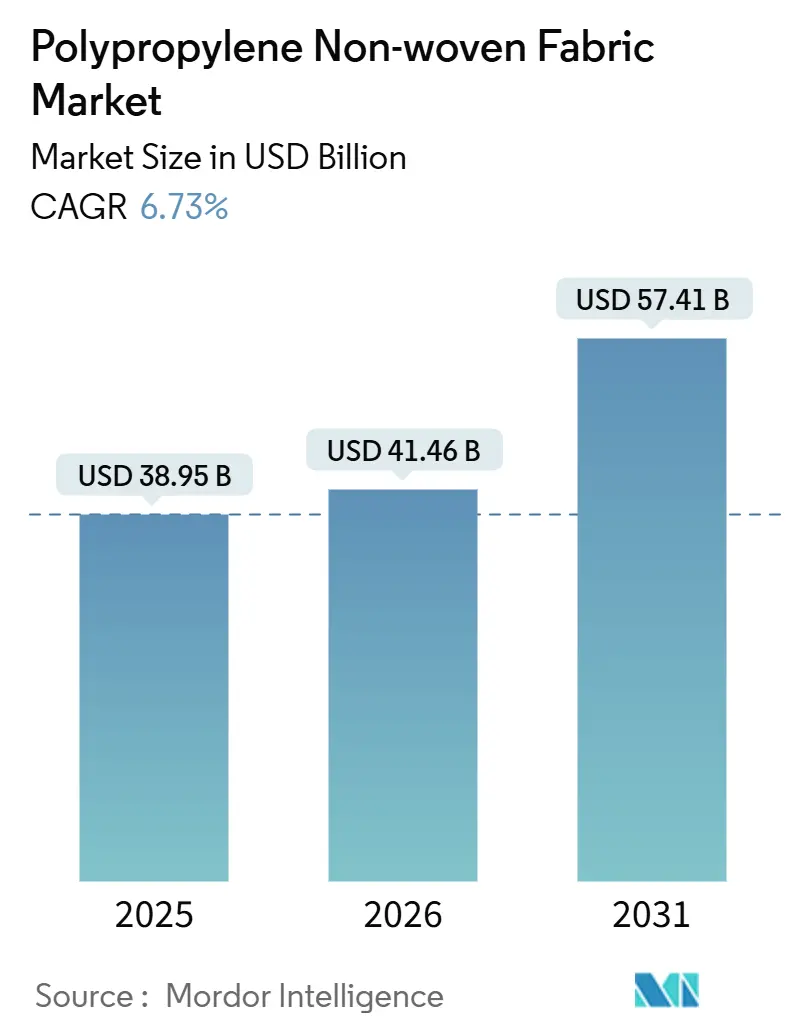
| Market Size (2026) | USD 41.46 Billion |
| Market Size (2031) | USD 57.41 Billion |
| Growth Rate (2026 - 2031) | 6.73 % |
| Fastest Growing Market | Asia Pacific |
| Largest Market | Asia Pacific |
| Market Concentration | Medium |
Major Players *Disclaimer: Major Players sorted in no particular order Image © Mordor Intelligence. Reuse requires attribution under CC BY 4.0. | |
Polypropylene Non-Woven Fabric Market Analysis by Mordor Intelligence
The Polypropylene Non-Woven Fabric Market size is expected to grow from USD 38.95 billion in 2025 to USD 41.46 billion in 2026 and is forecast to reach USD 57.41 billion by 2031 at 6.73% CAGR over 2026-2031. Persistent hygiene demand, accelerating institutional adoption of single-use medical systems, and regulatory mandates that favor monomaterial recyclable packaging are reshaping long-term supply and demand fundamentals. Upstream resin prices climbed 25.74% year-on-year by March 2026, yet the Polypropylene Non-Woven Fabric Market continues to attract investment because converters value the material’s processability, lightweight economics, and compatibility with spunbond and melt-blown technologies. Regional capacity waves, especially the 40.43 million-ton expansion scheduled across Asia-Pacific by 2030, are expected to realign trade flows, narrow feedstock cost spreads, and support localized production for protective equipment and packaging. Meanwhile, Europe’s Carbon Border Adjustment Mechanism and Packaging and Packaging Waste Regulation are recalibrating import competitiveness, prompting European Union (EU) and Middle Eastern producers to position lower-carbon grades as premium inputs for the Polypropylene Non-Woven Fabric Market.
Key Report Takeaways
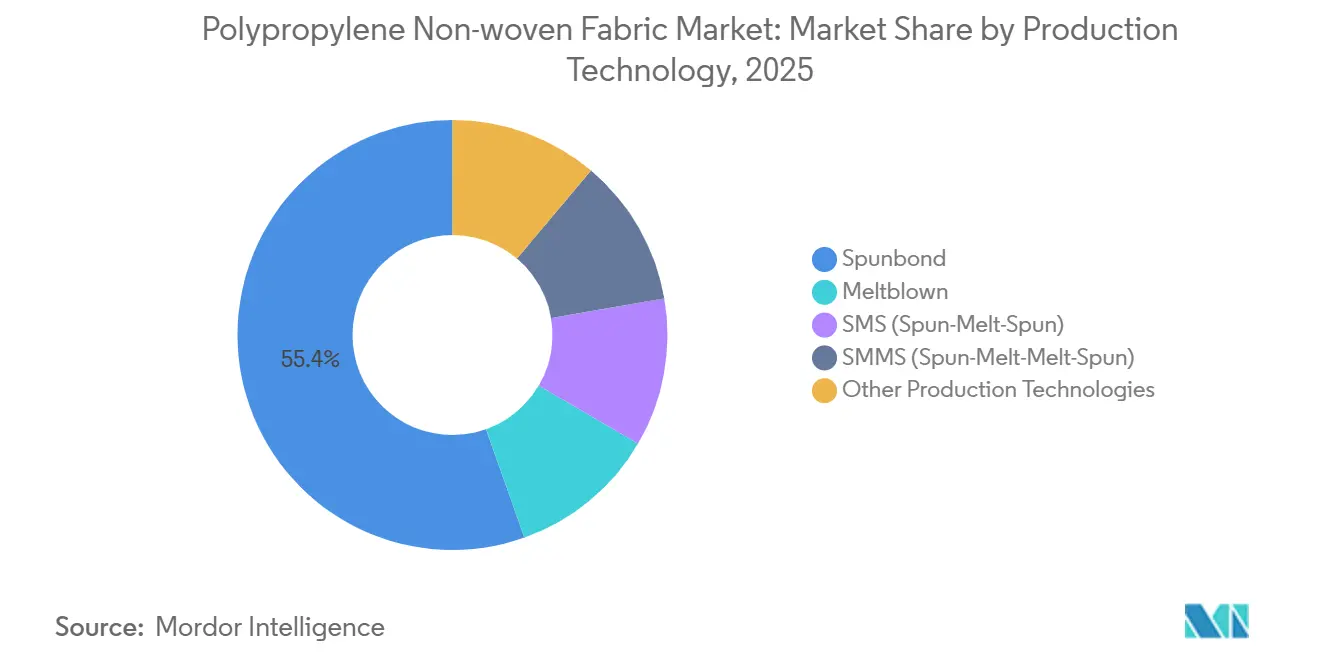
- By production technology, spunbond led with 55.44% of Polypropylene Non-Woven Fabric Market share in 2025, and meltblown is set to advance at a 6.87% CAGR through 2031.
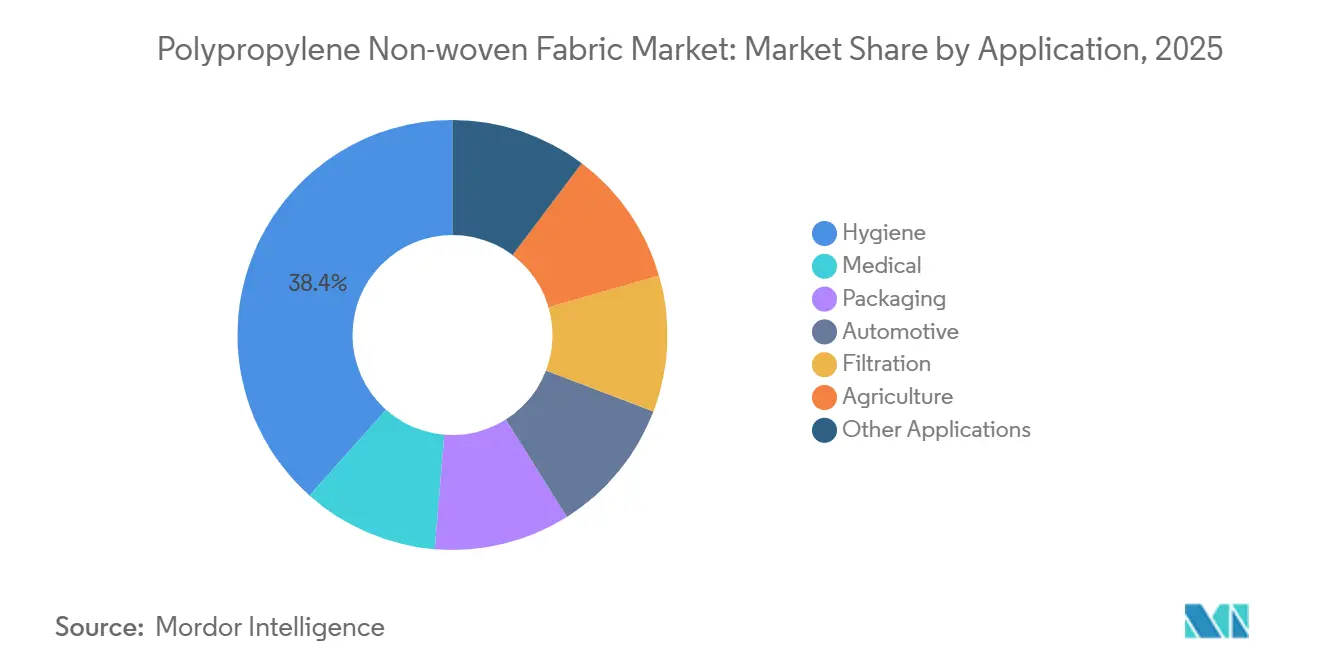
- By application, hygiene accounted for 38.40% of the Polypropylene Non-Woven Fabric Market size in 2025, while medical is projected to rise at a 6.91% CAGR between 2026 and 2031.
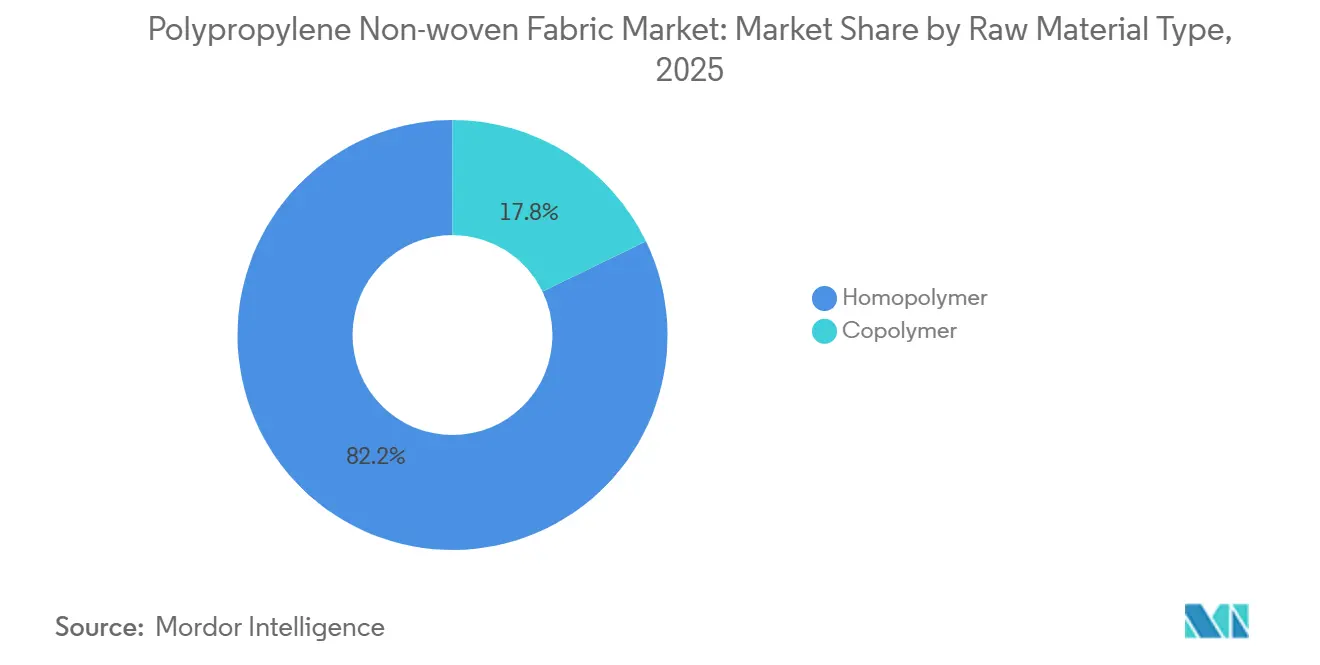
- By raw material type, homopolymer had the largest share of 82.18% in 2025, and copolymer's share is expected to increase at a CAGR of 6.81% during the forecast period (2026-2031).
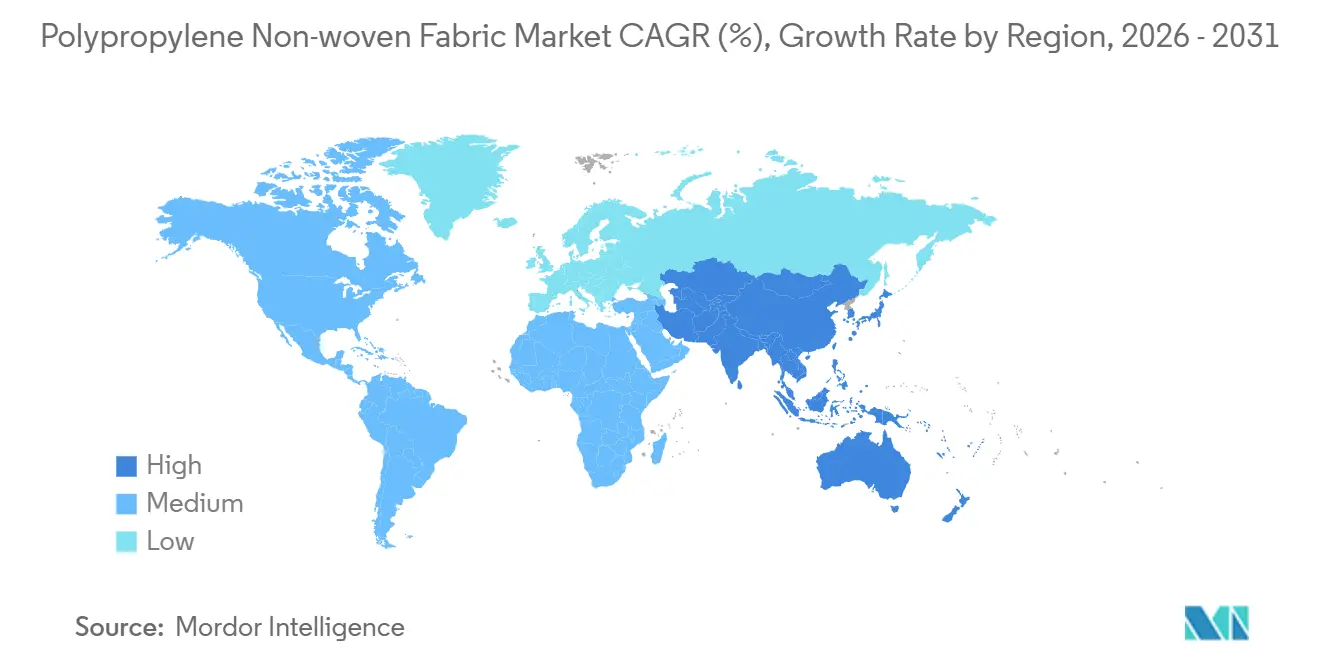
- By geography, Asia-Pacific commanded 42.67% revenue share in 2025 and is expected to post the fastest regional CAGR of 6.91% to 2031.
Note: Market size and forecast figures in this report are generated using Mordor Intelligence’s proprietary estimation framework, updated with the latest available data and insights as of January 2026.
Market Trends and Insights
Drivers Impact Analysis of Polypropylene Non-Woven Fabric Market*
| Driver | (~) % Impact on CAGR Forecast | Geographic Relevance | Impact Timeline |
|---|---|---|---|
| Growing demand in hygiene and medical disposables | +1.8% | Global, with concentration in Asia-Pacific and North America | Medium term (2-4 years) |
| Expanding usage in packaging industry | +1.2% | Global, led by Europe (PPWR compliance) and Asia-Pacific (e-commerce) | Medium term (2-4 years) |
| Lightweight, cost-effective material economics | +1.0% | Global, particularly automotive and packaging sectors | Long term (≥ 4 years) |
| Increasing utilization in agriculture | +0.7% | Asia-Pacific (China, India), South America, Middle East & Africa | Medium term (2-4 years) |
| Antimicrobial PP nonwovens enabling reusable PPE | +0.5% | North America, Europe, Asia-Pacific healthcare systems | Long term (≥ 4 years) |
| Source: Mordor Intelligence | |||
Growing Demand in Hygiene and Medical Disposables
Hygiene and medical disposables continue to underpin volume growth as diaper, feminine care, and incontinence products proliferate in emerging economies while hospital systems institutionalize single-use infection-control protocols. Polypropylene spunbond topsheets provide hydrophobic surfaces with air permeability around 1,868 mm/s, reducing fluid strike-through time versus cellulosic alternatives. Kimberly-Clark’s multi-site US manufacturing program, announced in 2025, underlines brand-owner confidence and increases domestic roll-goods procurement. Medical demand is outpacing hygiene on a percentage basis as SMS and SMMS composites achieve higher AAMI protection levels and as Tyvek sterilization wrap capacity additions support the surge in single-use medical devices. Industry reviews highlight a gap between gown barrier standards and real-world pathogen persistence, accelerating interest in validated antimicrobial polypropylene substrates. Collectively, these developments raise baseline consumption in the Polypropylene Non-Woven Fabric Market.
Expanding Usage in Packaging Industry
Brand owners are shifting toward monomaterial structures to comply with Europe’s 2030 recyclability targets, steering flexible packaging specifications toward high-purity, single-site polypropylene nonwovens. Borealis' 2026 scale-up of Borstar Nextension grades aims to supply this compliance-driven demand, offering improved sealing and mechanical recyclability for food contact and healthcare pouches. In logistics, breathable spunbond bags replace polyethylene films because they cut condensation damage during transport while maintaining printability for branding. Reuse and void-space caps embedded in the packaging regulation could depress some single-use volumes, yet they simultaneously create openings for durable nonwoven bag systems that satisfy reuse metrics. Near-term supply of food-grade recycled polypropylene remains tight, sustaining a premium that further differentiates virgin meltblown and spunbond rolls within the Polypropylene Non-Woven Fabric Market.
Lightweight, Cost-Effective Material Economics
Polypropylene’s density near 0.90 g/cm³ delivers meaningful vehicle weight savings, translating into fuel-economy gains and battery-range improvements for electric vehicles. Continuous-filament spunbond lines operating at up to 900 m/min keep manufacturing costs low, reinforcing the value proposition even as resin prices spike. February 2026 resin hikes of 4 cents per pound in the United States exemplify the volatility that converters face, yet integrated producers leverage captive feedstock to sustain margins and supply surety. Section 122 tariffs add another layer of uncertainty, pushing converters to lock in term contracts. Despite these headwinds, superior stiffness-to-weight performance continues to attract automotive, filtration, and building-and-roofing buyers into the Polypropylene Non-Woven Fabric Market.
Increasing Utilization in Agriculture
Spunbond grades in the 15-120 g/m² window are displacing polyethylene films across crop covers, mulch, and greenhouse shading because breathability curbs fungal growth while UV stabilizers extend field life. Tomato growers report 15% lower spoilage when using polypropylene mulch, illustrating tangible agronomic benefits. India and China lead export supply, backed by low-cost production and rising mechanized farming that favors durable, lightweight fabrics. Government subsidies for protected cultivation in ASEAN, Brazil, and Gulf states amplify demand, supporting a stable medium-term uplift in the Polypropylene Non-Woven Fabric Market. Environmental debates over biodegradability remain unresolved, driving research into additive-assisted degradation pathways without sacrificing fiber integrity during use.
Restraints Impact Analysis of Polypropylene Non-Woven Fabric Market*
| Restraint | (~) % Impact on CAGR Forecast | Geographic Relevance | Impact Timeline |
|---|---|---|---|
| Environmental and regulatory pressure on single-use plastics | -1.1% | Europe (PPWR, CBAM), North America (state-level bans), Asia-Pacific (China, India policies) | Medium term (2-4 years) |
| Polypropylene price volatility linked to crude oil | -0.8% | Global, with acute impact in import-dependent regions | Short term (≤ 2 years) |
| EU carbon border adjustment raising import cost | -0.4% | Europe (imports from non-EU), spillover to exporters in Asia, Middle East | Medium term (2-4 years) |
| Source: Mordor Intelligence | |||
Environmental and Regulatory Pressure on Single-Use Plastics
The EU Packaging and Packaging Waste Regulation, effective August 2026, obliges every pack format to meet at least grade C recyclability by 2030 and grade A or B by 2038, with recycled-content quotas escalating yearly. Extended producer responsibility fees penalize hard-to-recycle composites, directly affecting low-grammage commodity spunbond shopping bags and single-use tableware. A separate EU draft issued in September 2025 requires pellet-handling sites above 1,500 tons/year to certify risk-mitigation plans and exposes violators to fines up to 3% of Union turnover[1]. North-American states are adopting analogous bag bans and recycled-content laws, tightening the policy vice. While industrial, automotive, and geotextile nonwovens remain largely untouched, converters serving consumer packaging segments must accelerate design-for-recycling initiatives to retain market access within the Polypropylene Non-Woven Fabric Market.
Polypropylene Price Volatility Linked to Crude Oil
Current CBAM design captures only 39-60% of cradle-to-border emissions for polyolefins because upstream fossil feedstocks lie outside its scope, yet proposed extensions would lift coverage toward 95% and materially increase landed costs for high-emission Asian and Gulf producers. The Organization for Economic Co-operation and Development (OECD) simulations at EUR 80/ton CO₂ suggest downstream textiles, including nonwoven converters, absorb 83% of indirect value-added loss as higher input prices flow through supply chains[2]. Germany, the European Union (EU)’s largest importer, brings in over 900 kilotons of polypropylene annually; a tighter CBAM could re-route lower-carbon Middle-Eastern volumes into the bloc while squeezing price-based Asian suppliers. Converters unwilling or unable to switch to low-emission sources will face margin erosion, tempering growth in the Polypropylene Non-Woven Fabric Market.
*Our forecasts treat driver/restraint impacts as directional, not additive. The impact forecasts reflect baseline growth, mix effects, and variable interactions.
Polypropylene Non-Woven Fabric Market Segment Analysis
By Production Technology:
Meltblown Gains on Filtration MandatesSpunbond retained 55% of the Polypropylene Non-Woven Fabric Market share in 2025 owing to high-speed output and low unit costs that suit diapers, bags, and geotextiles. The Polypropylene Non-Woven Fabric Market size for spunbond grades exceeded USD 21 billion in the base year, yet its forecast CAGR lags niche technologies as saturation sets in. Melt-blown, projected to grow 6.87% annually, benefits from regulatory upgrades to N95 respirators, HVAC, and battery-electrode separators that demand fibers below 3 µm diameter. Composite SMS and SMMS structures marry spunbond strength with melt-blown filtration, capturing hospital gown and industrial filtration spend. Investments in Reicofil 5 and equivalent lines across North America, Turkey, and China illustrate the capital pivot. Hybrid lines that alternate hot-air and calender bonding extend the basis-weight range to 10-200 g/m², enabling automotive and roofing penetration.
Policy momentum compounds technical drivers. The US Department of Energy HVAC roadmap targets 50% energy reductions in commercial buildings by 2035, incentivizing high-efficiency melt-blown media; meanwhile, China’s 2026 indoor-air-quality standard caps PM2.5 at 35 µg/m³, spurring cabin-air and residential filter demand. Supply tightness during 2020-2021 underscored the necessity of domestic melt-blown capacity, justifying government incentives in India, Indonesia, and Brazil. Equipment suppliers report order pipelines stretching into 2028, supporting a healthy backlog for the Polypropylene Non-Woven Fabric Market.

By Application:
Medical Segment Outpaces HygieneHygiene applications commanded a 38.40% market share in 2025, encompassing baby diapers, adult incontinence, feminine care, and wet wipes, yet the medical segment is forecast to grow fastest at 6.91% CAGR through 2031, driven by institutionalized infection-control protocols, aging populations, and the shift toward single-use medical systems. Polypropylene spunbond nonwovens dominate diaper and incontinence product topsheets due to hydrophobic surfaces enabling rapid liquid strike-through.
Medical applications include surgical gowns, drapes, masks, sterilization wraps, and wound dressings, where SMS and SMMS composites meet AAMI protection levels and FDA 510(k) clearance requirements. DuPont completed its Tyvek Line 8 capacity expansion in 2025 to serve sterile medical packaging for billions of devices annually, underscoring secular growth in single-use medical systems. Automotive applications leverage polypropylene nonwovens for noise, vibration, and harshness (NVH) control in headliners, door panels, trunk linings, and floor systems.
By Raw Material Type:
Homopolymer Dominance PersistsHomopolymer grades held an 82.18% grip on Polypropylene Non-Woven Fabric Market share in 2025 because low melt-flow indices between 20-40 g/10 min process efficiently on spunbond lines. Copolymers, advancing at 6.81% CAGR to 2031, trade a 5-10% price premium for impact resistance and lower sealing temperatures, catering to agriculture fleece and automotive acoustics.
Borealis’ single-site Borstar Nextension technology embodies this shift by tailoring molecular architecture for superior clarity, purity, and seal integrity, critical for monomaterial pouch programs aiming at grade A recyclability. Downstream, converters leverage copolymer softness for acquisition-distribution layers in diapers, while hot-melt adhesives integrate better with modified polypropylene bases. Volatile comonomer costs limit adoption in price-sensitive segments, yet vertical integration allows majors to flex output toward higher-margin copolymers when crude-to-polymer spreads permit. Over the forecast horizon, homopolymer will remain the volume backbone of the polypropylene non-woven fabric industry, but copolymers steadily nibble share in technical niches.
Geography Analysis
APAC Polypropylene Non-Woven Fabric Market
Asia-Pacific controlled 42.67% of global demand in 2025 and is on track for a 6.91% CAGR through 2031 as China and India commission over 35 mt of integrated polypropylene capacity. Reliance’s 5.20 million tonnes per annum Jamnagar plant, slated for 2030, alone can feed more than 10 billion m² of spunbond fabric yearly, signaling an import-replacement strategy that elevates regional self-sufficiency. China’s Fujian Eversun pipeline and Indonesia’s Tuban complex likewise tighten the intra-Asia resin loop, reducing freight costs and carbon footprints. Converters take advantage, adding Reicofil and Oerlikon lines near end-markets to cut lead times and tailor basis-weight portfolios for local specifications.
North America Polypropylene Non-Woven Fabric Market
North America’s Polypropylene Non-Woven Fabric Market benefits from OEM reshoring moves. Kimberly-Clark’s USD 2 billion multi-state program and Avgol’s Reicofil 5 installation in North Carolina enhance supply resilience and reduce overreliance on Asian imports. Ahlstrom’s filter-media upgrade in Illinois, set for Q4 2026, will meet surging HVAC and EV filtration demand, underlining a structural pivot to domestic raw-material security. Resin price premiums remain a headwind, but domestic logistics savings and tariff avoidance partially offset higher feedstock costs.
EMEA and South America Polypropylene Non-Woven Fabric Market
Europe adds demand mainly through regulatory push for recyclable solutions. Borealis’ 2026 Burghausen investment lines up with PPWR deadlines, offering grades that unlock monomaterial pouches and sterilizable medical wrap markets. Germany’s polypropylene imports of 903 kt in 2024 illustrate dependence on intra-EU and Middle Eastern feedstock; CBAM adjustments could further redirect flows toward lower-carbon suppliers. South America and the Middle East & Africa remain emerging pockets, with Brazil’s protected-cultivation subsidies and Turkey’s twin 1 million tonnes per annum polypropylene projects expanding regional applicability of crop-protection and construction fabrics.
Competitive Landscape
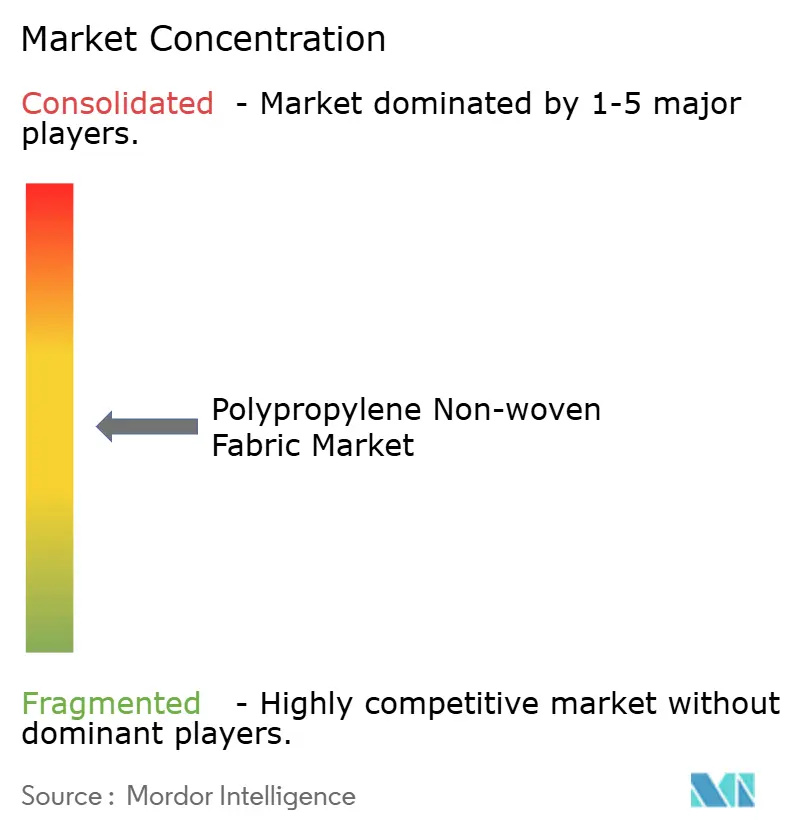
The Polypropylene Non-Woven Fabric Market is moderately fragmented. White-space innovation centers on antimicrobial and self-cleaning finishes. Plasma-treated halobutyl-coated fabrics demonstrate more than 99% antiviral efficacy, but commercial rollout awaits ISO 13485 validation and wash-cycle durability proofs. Meanwhile, energy-efficient line retrofits using variable-frequency drives and low-consumption heaters promise 15-20% power savings, answering sustainability audits from global Fast-Moving Consumer Goods (FMCG) buyers. Supply-chain consolidation, technology upgrades, and regulatory catalysts collectively raise competitive intensity across the polypropylene non-woven fabric industry.
Polypropylene Non-Woven Fabric Industry Leaders
-
Fitesa S.A.
-
Magnera
-
Freudenberg Group
-
Kimberly-Clark Worldwide, Inc.
-
Ahlstrom
- *Disclaimer: Major Players sorted in no particular order
Polypropylene Non-Woven Fabric Market Companies Covered in this Report
- Ahlstrom
- Amcor plc
- Asahi Kasei Advance Corp.
- Avgol Nonwovens
- Dalian Ruiguang Nonwoven Group
- Don & Low Ltd.
- DuPont
- Fibertex Nonwovens A/S
- Fitesa S.A.
- Freudenberg Group
- Glatfelter Corp.
- Johns Manville
- Kimberly-Clark Worldwide, Inc.
- Kingsafe Group
- Lydall Performance Materials
- Magnera
- Mitsui Chemicals Inc.
- PFNonwovens Holding
- Sandler AG
- Schouw & Co. (Fibertex Personal Care)
- Shandong Kangjie Nonwovens
- Sunshine Nonwoven Fabric Co.
- Suominen Corp.
- Toray Advanced Materials Korea Inc.
Recent Industry Developments in Polypropylene Non-Woven Fabric Market
- January 2026: Borealis GmbH invested EUR 49 million to expand the production of its Borstar Nextension polypropylene (PP) at its Burghausen facility in Germany. The investment enhanced the commercial production of single-site polypropylene (ssPP) grades to meet evolving market and regulatory demands in packaging, healthcare, mobility, and fibers.
- February 2025: Avgol opened its new high-speed, high-capacity flexible multiple beam nonwovens production line at its facility in Mocksville, United States. This investment is poised to propel the North American Polypropylene Non-Woven Fabric Market.
Global Polypropylene Non-Woven Fabric Market Report Scope
Non-woven polypropylene fabric is a durable, lightweight, and cost-effective synthetic material produced by bonding thermoplastic fibers through heat or mechanical processes rather than weaving. Known for being breathable, water-resistant, and chemically stable, it is widely used in medical masks, eco-friendly bags, agricultural covers, and industrial packaging.
The Polypropylene Non-Woven Fabric Market is segmented by production technology, application, raw material type, and geography. By production technology, the market is segmented into spunbond, meltblown, SMS (spun-melt-spun), SMMS (spun-melt-melt-spun), and other production technologies. By application, the market is segmented into hygiene, medical, packaging, automotive, filtration, agriculture, and other applications. By raw material type, the market is segmented into homopolymer and copolymer. The report also covers the market size and forecasts for polypropylene non-woven fabric in 17 countries across major regions. The market sizes and forecasts are provided in terms of value (USD).
Segmentation Overview
| Spunbond |
| Meltblown |
| SMS (Spun-Melt-Spun) |
| SMMS (Spun-Melt-Melt-Spun) |
| Other Production Technologies |
| Hygiene |
| Medical |
| Packaging |
| Automotive |
| Filtration |
| Agriculture |
| Other Applications |
| Homopolymer |
| Copolymer |
| Asia-Pacific | China |
| Japan | |
| India | |
| South Korea | |
| ASEAN Countries | |
| Rest of Asia-Pacific | |
| North America | United States |
| Canada | |
| Mexico | |
| Europe | Germany |
| United Kingdom | |
| France | |
| Italy | |
| Spain | |
| Russia | |
| Nordic Countries | |
| Rest of Europe | |
| South America | Brazil |
| Argentina | |
| Rest of South America | |
| Middle-East and Africa | Saudi Arabia |
| South Africa | |
| Rest of Middle-East and Africa |
| By Production Technology | Spunbond | |
| Meltblown | ||
| SMS (Spun-Melt-Spun) | ||
| SMMS (Spun-Melt-Melt-Spun) | ||
| Other Production Technologies | ||
| By Application | Hygiene | |
| Medical | ||
| Packaging | ||
| Automotive | ||
| Filtration | ||
| Agriculture | ||
| Other Applications | ||
| By Raw Material Type | Homopolymer | |
| Copolymer | ||
| By Geography | Asia-Pacific | China |
| Japan | ||
| India | ||
| South Korea | ||
| ASEAN Countries | ||
| Rest of Asia-Pacific | ||
| North America | United States | |
| Canada | ||
| Mexico | ||
| Europe | Germany | |
| United Kingdom | ||
| France | ||
| Italy | ||
| Spain | ||
| Russia | ||
| Nordic Countries | ||
| Rest of Europe | ||
| South America | Brazil | |
| Argentina | ||
| Rest of South America | ||
| Middle-East and Africa | Saudi Arabia | |
| South Africa | ||
| Rest of Middle-East and Africa | ||
Key Questions Answered in the Report
What is the current value of the Polypropylene Non-Woven Fabric Market?
The Polypropylene Non-Woven Fabric Market is valued at USD 41.46 billion in 2026 and is forecast to reach USD 57.41 billion by 2031.
Which segment is growing fastest?
Medical applications are expanding at a 6.91% CAGR as hospitals institutionalize single-use infection-control products.
Which region leads consumption?
Asia-Pacific accounts for 42.67% of 2025 demand and holds the highest 6.91% regional CAGR for the forecast period (2026-2031).
How will EU regulations affect polypropylene nonwovens?
The Packaging and Packaging Waste Regulation and Carbon Border Adjustment Mechanism push converters toward monomaterial recyclable grades and may raise import costs for high-emission resin.