
Polymerization Initiator Market Size and Share
Market Overview
| Study Period | 2021 - 2031 |
|---|---|
| Market Size (2026) | USD 4.11 Billion |
| Market Size (2031) | USD 5.14 Billion |
| Growth Rate (2026 - 2031) | 4.57 % |
| Fastest Growing Market | Asia-Pacific |
| Largest Market | Asia-Pacific |
| Market Concentration | Medium |
Major Players *Disclaimer: Major Players sorted in no particular order Image © Mordor Intelligence. Reuse requires attribution under CC BY 4.0. | |
Polymerization Initiator Market Analysis by Mordor Intelligence
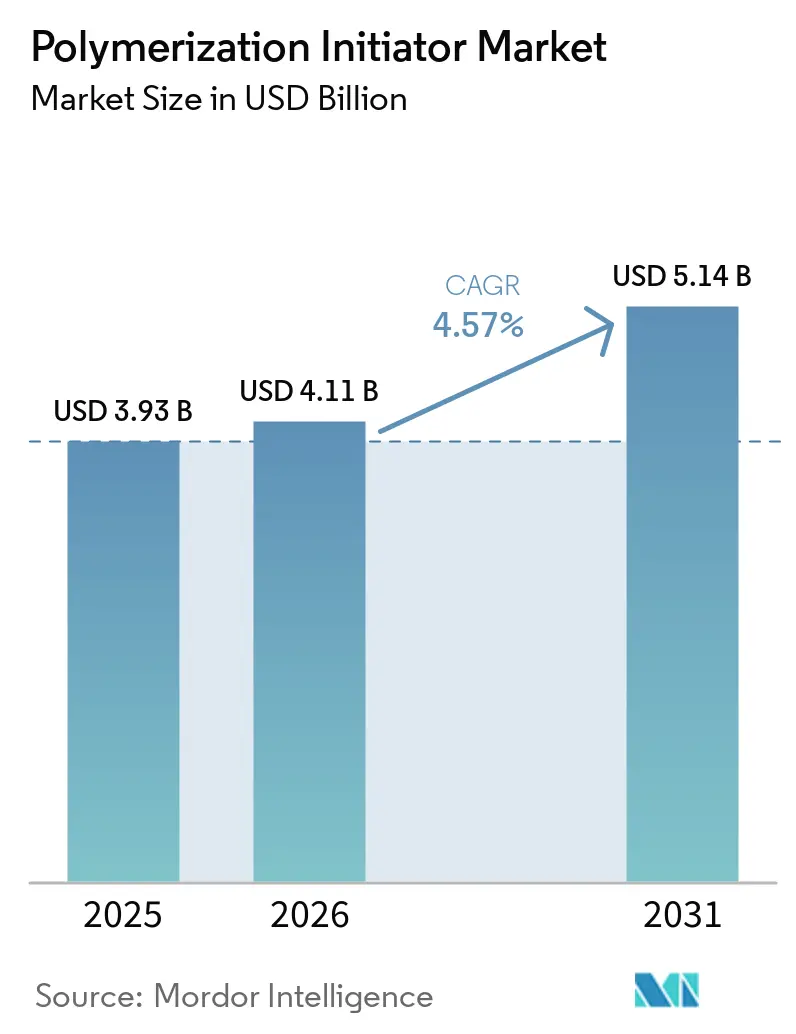
The Polymerization Initiator Market size was valued at USD 3.93 billion in 2025 and is estimated to grow from USD 4.11 billion in 2026 to reach USD 5.14 billion by 2031, at a CAGR of 4.57% during the forecast period (2026-2031). The polymerization initiator market is supported by demand from polyethylene, polyvinyl chloride, polypropylene, and engineering-grade resin production. Packaging, automotive electrification, construction activity, and electronics manufacturing continue to support polymer output and initiator consumption. Higher-specification polymers used in electronics and electric-vehicle battery components require more closely controlled polymerization conditions. This requirement increases the importance of initiator quality, decomposition behavior, and compatibility with processing conditions. Suppliers are therefore competing on application support, safety, and formulation performance in addition to supply reliability.
Key Report Takeaways
- By type, persulfate held 36.34% of the polymerization initiator market share in 2025 and is projected to advance at a 4.95% CAGR through 2031.
- By active species, free-radical held 70.12% of the polymerization initiator market share in 2025 and is projected to advance at a 5.34% CAGR through 2031.
- By application, polyethylene held 31.78% of the polymerization initiator market share in 2025, while polyvinyl chloride is projected to advance at a 5.62% CAGR through 2031.
- By geography, Asia-Pacific held 41.69% of the polymerization initiator market share in 2025 and is projected to advance at a 5.28% CAGR through 2031.
Note: Market size and forecast figures in this report are generated using Mordor Intelligence’s proprietary estimation framework, updated with the latest available data and insights as of January 2026.
Global Polymerization Initiator Market Trends and Insights
Drivers Impact Analysis*
| Driver | (~) % Impact on CAGR Forecast | Geographic Relevance | Impact Timeline |
|---|---|---|---|
| Rising Polymer Demand in Packaging, Automotive, Construction, and Electronics | +1.4% | Global, with primary gains in Asia-Pacific, North America, and Europe | Short term (≤ 2 years) |
| Expansion of High-Performance and Specialty Polymer Production | +1.1% | Global, led by China, Germany, South Korea, and Japan | Medium term (2–4 years) |
| Localized Initiator Manufacturing and Application Support in Asia-Pacific | +0.8% | Asia-Pacific core; spillover to MEA and South America | Medium term (2–4 years) |
| Demand for Controlled Decomposition and Process Efficiency | +0.6% | Global, with early adoption in North America and Europe | Short term (≤ 2 years) |
| Growing Adoption of Bio-Based and Sustainable Polymerization Processes | +0.4% | Europe and North America, with emerging adoption in APAC | Long term (≥ 4 years) |
| Source: Mordor Intelligence | |||
Rising Polymer Demand in Packaging, Automotive, Construction, and Electronics
Polymer processors use initiators in the production of materials for film, pipe, wire, and cable insulation, appliances, and transport applications. Demand from automotive electrification also broadens the range of polymer grades required by manufacturers. Celanese stated that specialty polymer demand for an artificial-intelligence server was 3 times greater than for a conventional server. This shift favors high-purity products with controlled decomposition temperatures and tighter process windows in the polymerization initiator market. The European Union Packaging and Packaging Waste Regulation entered into force in February 2025 and applied fully from August 2026. It established recycled-content requirements that begin from 2030 for specified packaging formats[1]European Parliament and Council, “Regulation (EU) 2025/40 on Packaging and Packaging Waste,” Official Journal of the European Union, eur-lex.europa.eu.
Expansion of High-Performance and Specialty Polymer Production
Specialty applications often require stable half-life characteristics, clean decomposition, and narrow temperature control. BASF began production from a controlled free-radical polymerization line in Nanjing in November 2025 for advanced dispersants used in automotive coatings. The project demonstrated the growing commercial use of precision polymerization methods in Asian production networks. The polymerization initiator market benefits when polymer producers move toward architectures that need tighter control of molecular structure. Suppliers can differentiate through decomposition selectivity, process consistency, and compatibility with sustainable resin systems. This shift does not displace conventional polymerization, but it increases the value of technical support in advanced applications.
Demand for Controlled Decomposition and Process Efficiency
Polyvinyl chloride, polyolefin, and cross-linked polyethylene producers are seeking shorter batch times and improved control of exothermic reactions. Nouryon stated that its Continuous Initiator Dosing technology can reduce polyvinyl chloride batch time by 20%-40% while enabling control of heat production during polymerization. The technology is intended to allow reaction arrest when needed and reduce runaway risk. These operating needs support demand for formulations that provide consistent release of reactive species. The polymerization initiator market is consequently moving beyond a narrow focus on purchase price in applications where throughput and safety have material operating value. Customers may place greater value on products that reduce downtime and support stable production.
Localized Initiator Manufacturing and Application Support in Asia-Pacific
Asia-Pacific represents the largest regional demand base and is the fastest-growing region in the polymerization initiator market. China’s petrochemical and chemical policy has identified high-end polyolefin materials as an area for industrial development. Local production and technical support are important because polymer processors require dependable access to reactive inputs. Nouryon doubled triethylaluminum capacity at Jiaxing in October 2025 to support polyethylene and polypropylene production. The company also announced plans to open an Organic Peroxides Innovation Center in Tianjin in 2026 for specialized application development and customer support.
Restraints Impact Analysis*
| Restraint | (~) % Impact on CAGR Forecast | Geographic Relevance | Impact Timeline |
|---|---|---|---|
| Hazardous Handling, Storage, and Transport Requirements | -1.0% | Global, with highest intensity in EMEA and North America | Short term (≤ 2 years) |
| Raw Material Price Volatility and Petrochemical Feedstock Exposure | -0.8% | Global, with concentrated impact in Asia-Pacific and Europe | Short term (≤ 2 years) |
| Qualification Risk from Process-Specific Initiator Formulations | -0.5% | Global, particularly in high-precision specialty polymer applications | Medium term (2–4 years) |
| Source: Mordor Intelligence | |||
Hazardous Handling, Storage, and Transport Requirements
Organic peroxides and persulfates are regulated hazardous materials that require specialized packaging, storage, and transport controls. The Agreement concerning the International Carriage of Dangerous Goods by Road 2025 updated classification and packaging provisions for self-reactive substances and organic peroxides[2]United Nations Economic Commission for Europe, “ADR 2025, Agreement Concerning the International Carriage of Dangerous Goods by Road,” UNECE, unece.org. The changes took effect on January 1, 2025, with a transition period for earlier rules through June 30, 2025. These requirements increase logistics complexity for the polymerization initiator market, particularly for suppliers serving multiple jurisdictions. Temperature control, approved packaging, and trained handling procedures raise the cost of serving dispersed customers. Established suppliers may retain an advantage because they already operate qualified logistics systems.
Raw Material Price Volatility and Petrochemical Feedstock Exposure
Polymerization initiator producers depend on feedstocks whose costs can change quickly with energy prices, transport conditions, and petrochemical cycles. Higher costs affect hydrogen peroxide, propylene oxide, and cumene derivative chains used in peroxide production. The polymerization initiator market can absorb some inflation where products provide clear process or safety benefits. Lower-grade applications are more exposed because customers may resist price increases. This difference can widen margins between technically differentiated and commodity-oriented product lines.
*Our forecasts treat driver/restraint impacts as directional, not additive. The impact forecasts reflect baseline growth, mix effects, and variable interactions.
Segment Analysis
By Type: Persulfate Leads Through Broad Functional Use
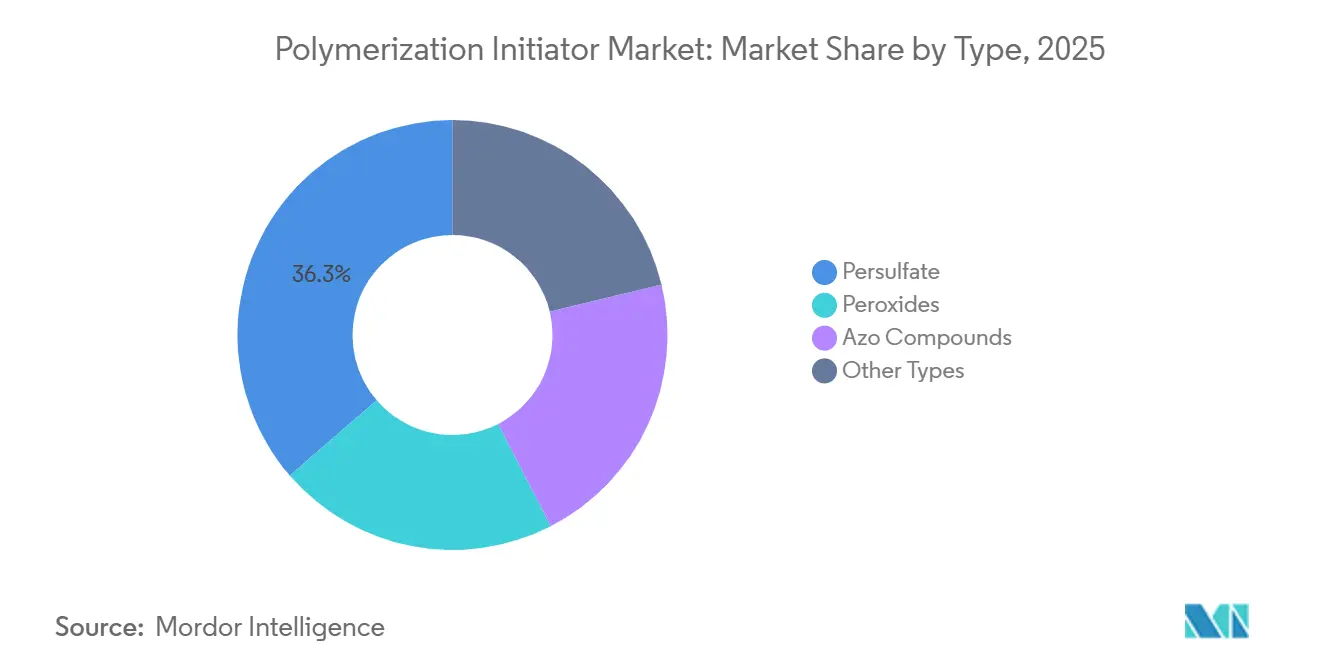
Persulfate held 36.34% of the polymerization initiator market revenue in 2025 and is projected to advance at a 4.95% CAGR through 2031. Its position reflects use in emulsion polymerization and in non-polymer oxidation applications. Ammonium persulfate and potassium persulfate are used in styrene-acrylate dispersions, vinyl acetate lattices, water-treatment polyacrylamides, textile sizing, and soil-remediation oxidation. This broad use supports demand across several customer groups. Persulfates also serve personal-care oxidation applications, which add demand beyond conventional plastics. Their functional range gives suppliers a more diversified revenue base than portfolios focused on a single polymer process.
Peroxides remain important for low-density polyethylene high-pressure processes, cross-linked polyethylene cable insulation, and polyvinyl chloride suspension polymerization. They also support renewable-energy composite curing, where controlled initiation is important to product performance. Azo compounds serve selected biomedical, electronics-grade, and high-purity applications because they form nitrogen-based byproducts. The polymerization initiator industry relies on each chemistry class for a distinct processing need. Product selection is therefore determined by polymer system, equipment design, required properties, and handling requirements rather than by a single performance measure.



By Active Species: Free-Radical Chemistry Leads Both Share and Growth
Free-radical held 70.12% of the polymerization initiator market revenue in 2025 and is projected to advance at a 5.34% CAGR through 2031. Their broad use reflects the commercial importance of radical-chain polymerization in polyethylene, polypropylene, polyvinyl chloride, acrylics, and styrene-based copolymers. Low-density polyethylene packaging film, acrylic dispersions, and specialty thermosets support continuing demand. The segment includes conventional processes as well as increasingly controlled radical methods. This breadth makes free-radical systems central to the polymerization initiator market. Suppliers serving this segment must meet both high-volume production needs and specialized application requirements.
Cationic initiators are used in epoxy resins, ring-opening polymerization, and ultraviolet-curable coatings. Their ability to polymerize oxygen-insensitive systems can be useful in electronics and photoresist applications. Anionic initiators, including organolithium compounds, support styrene-butadiene rubber, high-impact polystyrene, and thermoplastic elastomers. These processes require close control of molecular weight and block-copolymer architecture. Research on oxygen-tolerant, light-driven controlled polymerization continues to widen the scope for precision formulations in degradable specialty polymers.
By Application: Polyvinyl Chloride Growth Complements Polyethylene Dominance
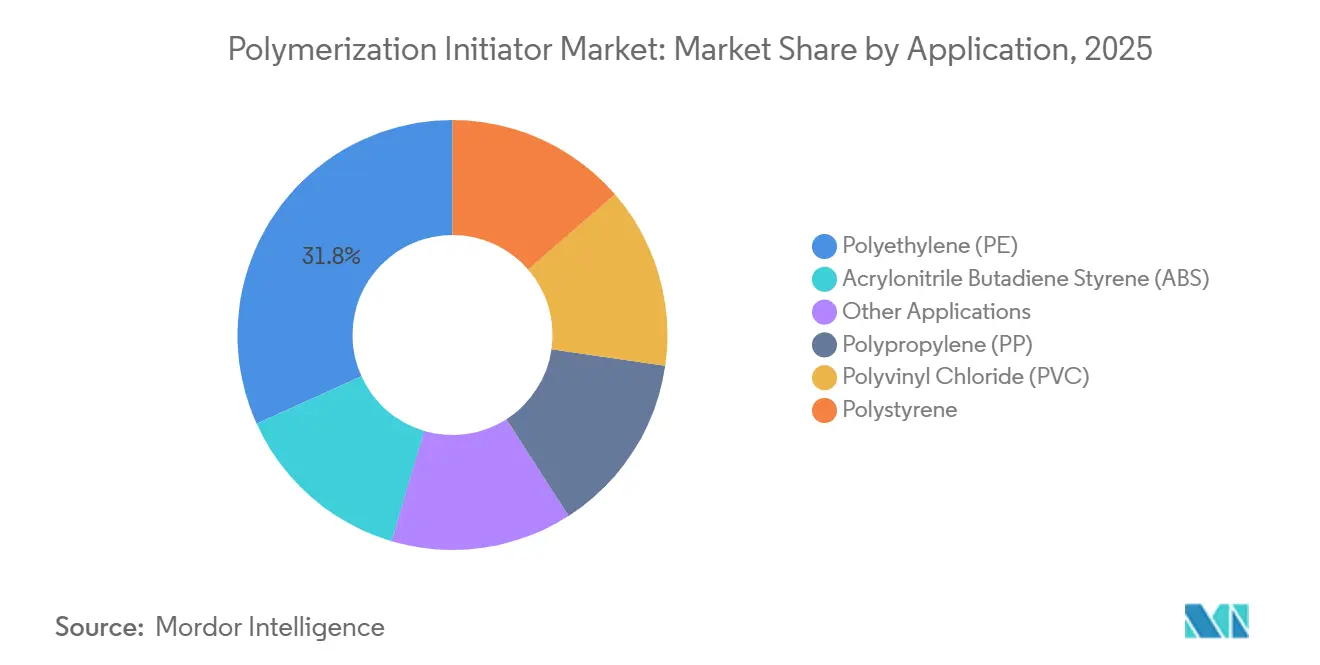
Polyethylene held 31.78% of the polymerization initiator market revenue in 2025, supported by low-density polyethylene films, wire and cable insulation, and high-density polyethylene pipes. Polypropylene uses persulfate and peroxide initiators in applications that include automotive trim, nonwoven fabrics, and medical packaging. Polystyrene and acrylonitrile butadiene styrene support demand from electronics housings, appliances, and 3D-printing filaments. Acrylic dispersions, specialty adhesives, and superabsorbent polymers provide additional demand as healthcare and agricultural applications expand.
Polyvinyl chloride is projected to advance at a 5.62% CAGR through 2031. Asia-Pacific absorbs much of the new capacity, which increases regional requirements for initiator supply. Dialkyl peroxides, peroxydicarbonates, and diperoxyketals are used in polyvinyl chloride production. Their thermal stability, half-life, and decomposition selectivity influence molecular-weight distribution and product quality. This makes technical selection important in suspension, emulsion, and mass polymerization processes.
Geography Analysis
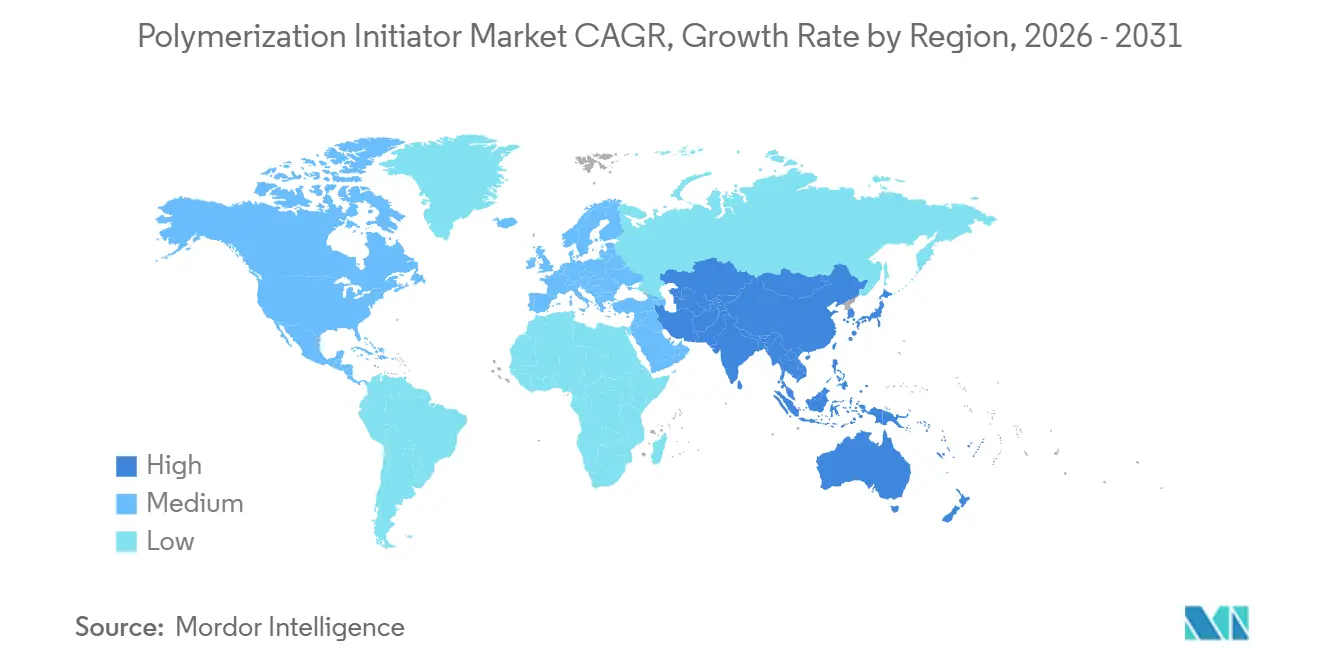
Asia-Pacific held 41.69% of the polymerization initiator market revenue in 2025 and is projected to advance at a 5.28% CAGR through 2031. China provides a large share of regional demand because it has extensive polyethylene, polypropylene, and polyvinyl chloride production. BASF inaugurated its Verbund site in Zhanjiang, China, in March 2026, following a EUR 8.7 billion investment (approximately USD 9.5 billion), and the site produces chemical products that include polyethylene intermediates and specialty chemicals. The site includes 18 plants and 32 production lines, with more than 70 products. Japan and South Korea add high-value demand through automotive, electronics, and advanced composite applications. These production centers support the use of specialized initiator systems with closely controlled performance.
North America benefits from packaging demand, large low-density polyethylene and polyvinyl chloride production on the Gulf Coast, and grid-modernization activity that supports cross-linked polyethylene cable demand. In Europe, Registration, Evaluation, Authorisation and Restriction of Chemicals (REACH) requirements and the European Union Green Deal are influencing product selection and safety practices. German infrastructure activity may also support construction-polymer demand during the second half of 2026.
South America and the Middle East and Africa are smaller but growing demand centers. Brazil and Argentina support demand through packaging, agriculture, and infrastructure uses of polyvinyl chloride and polyethylene. Brazil’s petrochemical integration can support regional peroxide production through feedstock availability. In the Middle East and Africa, domestic downstream petrochemical capacity and urbanization support polymer processing. Saudi Arabia’s Vision 2030 program supports wider industrial development and downstream processing activity. Temperature-sensitive shipments remain difficult in some sub-Saharan African markets. Regional distributors can therefore be important for reliable supply and compliant handling.

Competitive Landscape
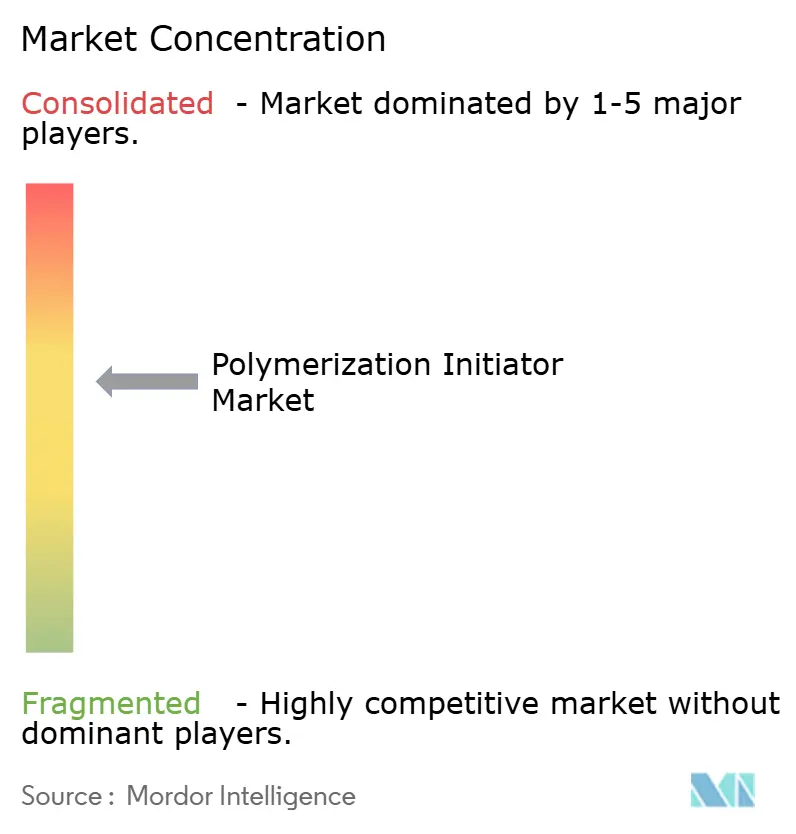
The polymerization initiator market is moderately concentrated, with the top five players including Arkema, Nouryon, United Initiators GmbH, LANXESS, and BASF. Scale in peroxide manufacturing, safety certification requirements, and temperature-controlled logistics create meaningful barriers to entry. These capabilities make it difficult for new suppliers to compete across several regions at once. Regional producers can still compete where they offer local service, cost advantages, or specialized products.
Leading companies are focusing on regional production, safer product formats, and controlled-decomposition technology. Nouryon’s Jiaxing capacity increase and planned Tianjin innovation center show how suppliers are aligning Asian manufacturing with application development. BASF’s Zhanjiang investment expands its position in a major downstream chemical production area. These moves reflect the importance of local access and technical alignment with polymer producers.
Product development is also directed toward lower-dust handling, controlled dosing, and systems suited to specialized resin production. Controlled radical polymerization creates opportunities for suppliers able to match initiator performance to defined reaction windows. Bio-based and lower-impact polymer production can further influence procurement requirements, particularly in Europe and North America. Supply reliability remains important because polymer processors need consistent inputs for continuous production. Companies with established safety processes and multi-region logistics can offer a stronger value proposition to large customers.
Polymerization Initiator Industry Leaders
Arkema
Nouryon
United Initiators GmbH
LANXESS
BASF
- *Disclaimer: Major Players sorted in no particular order

Recent Industry Developments
- March 2026: BASF inaugurated its world-scale Verbund site in Zhanjiang, China, including a 1 million metric tons per year ethylene steam cracker and multiple downstream production plants. The expanded petrochemical production base supports demand for polymerization initiators used in the manufacture of polymers and specialty plastics.
- October 2025: Nouryon announced investments in China, including an expansion at its Jiaxing site that will ultimately double triethylaluminum production capacity, a co-catalyst used in polyethylene and polypropylene production. The expansion supports growing polyolefin production and demand for polymerization catalyst and initiator systems used in these polymer manufacturing processes.


Global Polymerization Initiator Market Report Scope
Polymerization initiators are chemical substances that generate reactive species to initiate the conversion of monomers into polymers. They help control reaction rates, polymer formation, and molecular characteristics during polymer manufacturing.
The Polymerization Initiator Market is segmented by type, active species, application, and geography. By type, the market is segmented into persulfate, peroxides, azo compounds, and other types. By active species, the market is segmented into free-radical, cationic, and anionic. By application, the market is segmented into polyethylene (PE), polypropylene (PP), polyvinyl chloride (PVC), polystyrene, acrylonitrile butadiene styrene (ABS), and other applications. The report also covers the market size and forecasts for polymerization initiators in 15 countries across major regions. For each segment, the market sizing and forecasts have been done on the basis of value (USD).
| Persulfate |
| Peroxides |
| Azo Compounds |
| Other Types |
| Free-Radical |
| Cationic |
| Anionic |
| Polyethylene (PE) |
| Polypropylene (PP) |
| Polyvinyl Chloride (PVC) |
| Polystyrene |
| Acrylonitrile Butadiene Styrene (ABS) |
| Other Applications |
| Asia-Pacific | China |
| India | |
| Japan | |
| South Korea | |
| ASEAN Countries | |
| Rest of Asia-Pacific | |
| North America | United States |
| Canada | |
| Mexico | |
| Europe | Germany |
| United Kingdom | |
| France | |
| Italy | |
| NORDIC Countries | |
| Rest of Europe | |
| South America | Brazil |
| Argentina | |
| Rest of South America | |
| Middle East and Africa | Saudi Arabia |
| South Africa | |
| Rest of Middle East and Africa |
| By Type | Persulfate | |
| Peroxides | ||
| Azo Compounds | ||
| Other Types | ||
| By Active Species | Free-Radical | |
| Cationic | ||
| Anionic | ||
| By Application | Polyethylene (PE) | |
| Polypropylene (PP) | ||
| Polyvinyl Chloride (PVC) | ||
| Polystyrene | ||
| Acrylonitrile Butadiene Styrene (ABS) | ||
| Other Applications | ||
| By Geography | Asia-Pacific | China |
| India | ||
| Japan | ||
| South Korea | ||
| ASEAN Countries | ||
| Rest of Asia-Pacific | ||
| North America | United States | |
| Canada | ||
| Mexico | ||
| Europe | Germany | |
| United Kingdom | ||
| France | ||
| Italy | ||
| NORDIC Countries | ||
| Rest of Europe | ||
| South America | Brazil | |
| Argentina | ||
| Rest of South America | ||
| Middle East and Africa | Saudi Arabia | |
| South Africa | ||
| Rest of Middle East and Africa | ||


Key Questions Answered in the Report
What is the size of the polymerization initiator market?
The polymerization initiator market stands at USD 4.11 billion in 2026 and is projected to reach USD 5.14 billion by 2031.
Which type held the largest share in 2025?
Persulfate held 36.34% of the market share in 2025.
What is driving demand for polymerization initiators?
Demand is supported by packaging, construction, automotive, electronics, and the need for controlled polymerization in specialty materials.
Which application is expected to grow fastest through 2031?
Polyvinyl chloride is projected to advance at a 5.62% CAGR through 2031, supported by infrastructure, healthcare, and related polymer uses.
Page last updated on:


 Your data is secure and never sold or shared.


