
Polyacrylamide Copolymer Market Size and Share
Market Overview
| Study Period | 2021 - 2031 |
|---|---|
| Market Size (2026) | USD 4.96 Billion |
| Market Size (2031) | USD 6.65 Billion |
| Growth Rate (2026 - 2031) | 6.04 % |
| Fastest Growing Market | Asia-Pacific |
| Largest Market | Asia-Pacific |
| Market Concentration | Medium |
Major Players *Disclaimer: Major Players sorted in no particular order Image © Mordor Intelligence. Reuse requires attribution under CC BY 4.0. | |
Polyacrylamide Copolymer Market Analysis by Mordor Intelligence
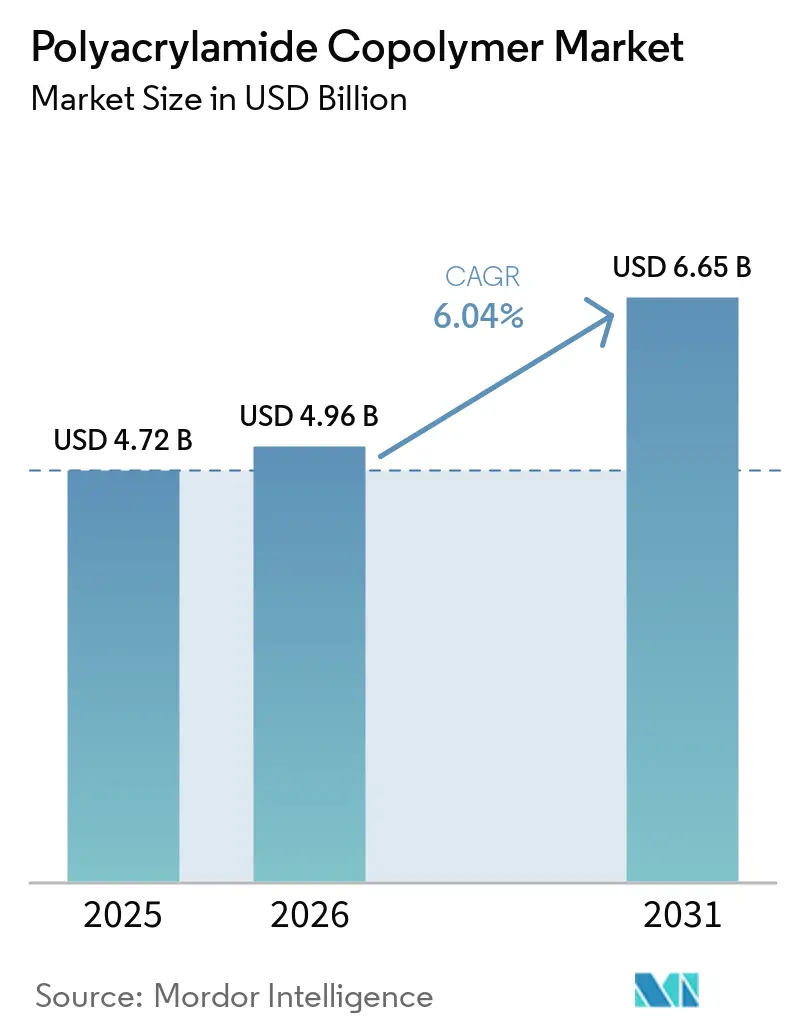
The polyacrylamide copolymer market size was valued at USD 4.72 billion in 2025 and is estimated to grow from USD 4.96 billion in 2026 to USD 6.65 billion by 2031, at a CAGR of 6.04% during the forecast period (2026-2031). The polyacrylamide copolymer market is driven by demand from wastewater treatment, enhanced oil recovery, and mineral tailings separation applications. Stricter discharge regulations prompt utilities to add treatment stages, increasing demand for sludge conditioning and dewatering chemicals. Suppliers are developing grades designed to withstand saline water, elevated temperatures, and complex industrial sludge. China’s production capacity influences pricing for standard anionic grades, while specialized formulations create opportunities for suppliers with technical capabilities. Feedstock costs, residual acrylamide requirements, and bio-based alternatives remain constraints for the polyacrylamide copolymer market.
Key Report Takeaways
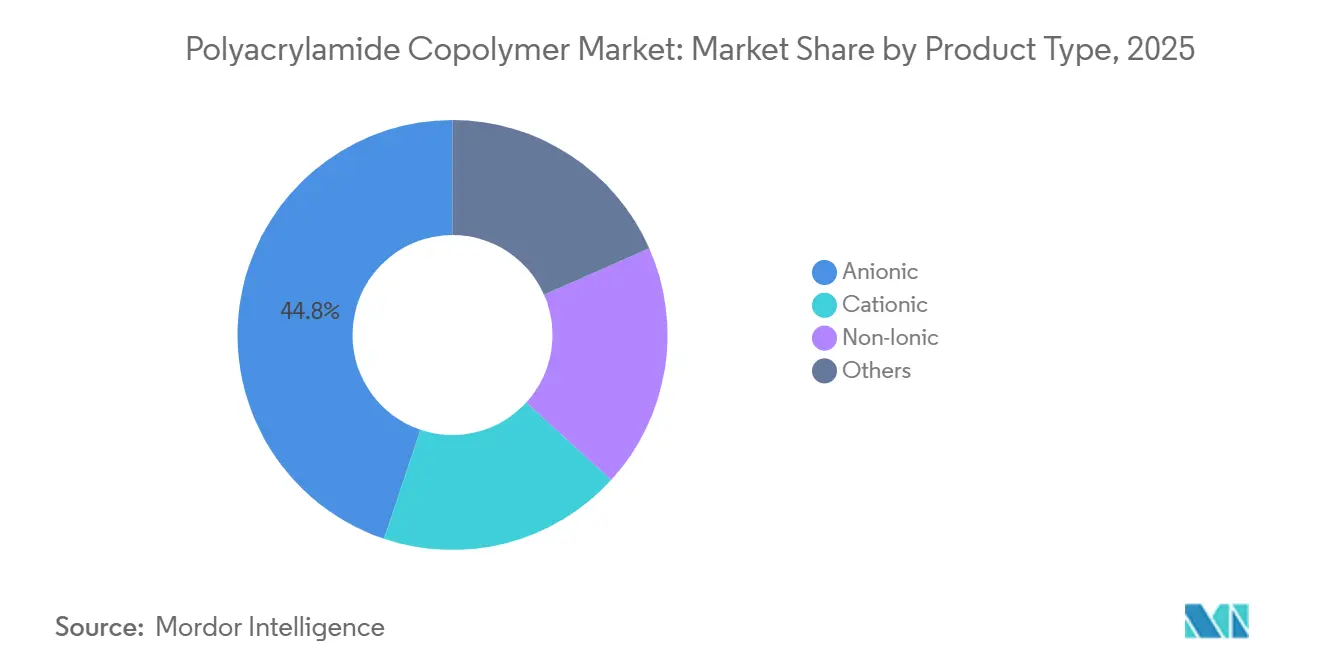
- By product type, anionic polyacrylamide accounted for 44.83% of revenue in 2025, while cationic polyacrylamide is forecast to record the highest CAGR of 6.23% through 2031.
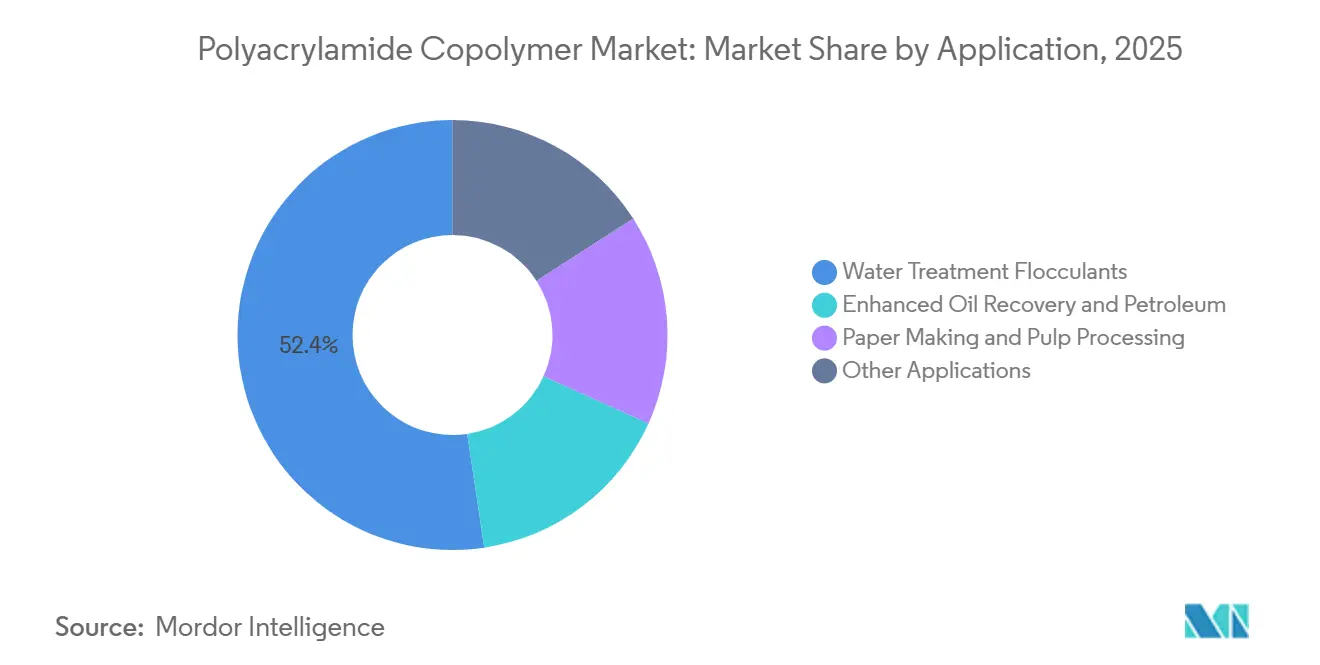
- By application, water treatment flocculants accounted for 52.35% revenue share in 2025, while enhanced oil recovery and petroleum are projected to grow at a CAGR of 6.78% through 2031.
- By geography, Asia-Pacific commanded 45.07% of the polyacrylamide copolymer market share in 2025 and is forecast to expand at the highest CAGR of 6.34% through 2031.
Note: Market size and forecast figures in this report are generated using Mordor Intelligence’s proprietary estimation framework, updated with the latest available data and insights as of January 2026.
Global Polyacrylamide Copolymer Market Trends and Insights
Drivers Impact Analysis*
| Drivers | (~) % Impact on CAGR Forecast | Geographic Relevance | Impact Timeline |
|---|---|---|---|
| Stricter Wastewater Discharge and Reuse Requirements | +1.8% | Global, strongest in the EU, China, and India | Short term (≤ 2 years) |
| Expansion of Municipal and Industrial Sludge Dewatering | +1.4% | Asia-Pacific core, with spillover to Southeast Asia and Latin America | Medium term (2-4 years) |
| Polymer Flooding in Mature and High-Salinity Oilfields | +1.5% | China, the Middle East, and Kazakhstan | Medium term (2-4 years) |
| Critical-Mineral Tailings and Solid-Liquid Separation Demand | +1.1% | Latin America, Asia-Pacific, the Middle East, and Africa | Long term (≥ 4 years) |
| High-Performance Polyacrylamide (PAM) for Unconventional and Offshore Production | +0.9% | North America, China, and the Middle East | Long term (≥ 4 years) |
| Source: Mordor Intelligence | |||
Stricter Wastewater Discharge and Reuse Requirements
The revised European Union Urban Wastewater Treatment Directive entered into force on January 1, 2025, introducing stricter treatment obligations for larger facilities. Plants serving more than 10,000 population equivalents must meet tighter nitrogen and phosphorus standards by 2036. The directive also requires specified large facilities to implement quaternary treatment by 2045, increasing treatment and sludge management requirements. Each additional treatment stage can increase the quantity of solids that utilities must condition and dewater. These requirements drive demand for high-molecular-weight copolymers that improve solid-liquid separation at low dosages. In the United States, drinking water regulations limit acrylamide dosing conditions, supporting demand for certified products in municipal procurement.
Expansion of Municipal and Industrial Sludge Dewatering
Municipal and industrial treatment plants require sludge dewatering to reduce disposal quantities and improve operational efficiency. Cationic grades suit sludge containing negatively charged solids, including sludge from food processing, textile manufacturing, coal washing, and municipal treatment facilities. This application links the polyacrylamide copolymer market to treatment throughput rather than solely to new plant construction. More complex sludge compositions may require higher molecular weights or tailored charge densities to achieve the required cake dryness. Hybrid products that combine conventional polymer backbones with biopolymer components have demonstrated lower dosage requirements in fluid fine tailings applications. These gains can shift purchasing decisions toward grades that reduce total treatment costs rather than those with the lowest unit price.
Polymer Flooding in Mature and High-Salinity Oilfields
Polymer flooding is a chemical-enhanced oil recovery method used in mature fields to slow production declines. A 2025 study of Thailand’s Maesoon oilfield found that polymer flooding can be commercially viable when implemented before water cut increases accelerate. Reservoir conditions strongly influence polyacrylamide copolymer selection, as heat, salinity, and adsorption can reduce polymer performance. Consequently, water-quality control and polymer selection are interdependent decisions for field operators. 2-Acrylamido-2-methylpropane sulfonic acid (ATBS)-based terpolymers and N-vinylpyrrolidone (NVP)-modified copolymers are relevant for reservoirs requiring thermal stability above 100°C. Field-scale work in Kuwait has also demonstrated the use of polymers under high-salinity and high-temperature conditions, supporting the role of specialty grades in the polyacrylamide copolymer market[1]European Association of Geoscientists and Engineers, “Transforming Challenges into Opportunities, Field-Scale Success Case Studies from Polymer Flooding in Harsh Environments of Kuwait,” OnePetro, onepetro.org..
Critical-Mineral Tailings and Solid-Liquid Separation Demand
Lithium, copper, cobalt, and nickel processing generate fine slurries that require settling and water recovery. High-molecular-weight anionic copolymers can concentrate solids and return water to the process circuit. Research on Amazonian bauxite and copper tailings found that anionic copolymers increased settling rates by 31 to 33 times compared with untreated slurry. The research also linked improved water recovery to a reduction of 17,000 m³ in annual freshwater withdrawals per operation. This application favors formulations that maintain performance in high-ionic-strength water and across varying mineral compositions. As battery-metal projects expand, the polyacrylamide copolymer market gains another source of demand distinct from municipal treatment and oilfield applications.
Restraints Impact Analysis*
| Restraints | (~) % Impact on CAGR Forecast | Geographic Relevance | Impact Timeline |
|---|---|---|---|
| Residual Acrylamide Monomer Compliance Costs | -0.7% | EU, North America, and Japan | Short term (≤ 2 years) |
| Petrochemical Feedstock Price Volatility | -0.6% | Global, with greater exposure in Europe | Medium term (2-4 years) |
| Bio-Based and Natural Flocculant Substitution | -0.4% | Western Europe, North America, and pilot markets in Southeast Asia | Long term (≥ 4 years) |
| Source: Mordor Intelligence | |||
Residual Acrylamide Monomer Compliance Costs
The European Union regulates acrylamide under the Registration, Evaluation, Authorization and Restriction of Chemicals (REACH) framework, creating compliance requirements for suppliers. These requirements affect product formulation, testing, certification, and documentation throughout the supply chain. In the United States, drinking water applications operate under dosing conditions that limit residual acrylamide exposure[2]United States Environmental Protection Agency, “National Primary Drinking Water Regulations,” United States Environmental Protection Agency, epa.gov.. Suppliers serving multiple regions may require separate product grades and certification processes to comply with local regulations. These requirements may benefit larger manufacturers with established quality systems and low-monomer production capabilities. They also increase barriers to entry for specialty applications in the polyacrylamide copolymer market.
Petrochemical Feedstock Price Volatility
Acrylonitrile is a key upstream feedstock for acrylamide monomer and, consequently, polyacrylamide copolymer production. Its cost depends on propylene prices, plant operating rates, energy costs, and regional trade conditions. This exposure can affect margins when polymer suppliers operate under fixed-price contracts with municipal utilities. These contracts often extend beyond a single procurement cycle, limiting suppliers’ ability to promptly pass higher input costs on to customers. Producers with captive acrylamide monomer capacity can mitigate part of this risk through greater control over upstream supply. This restraint broadly affects the polyacrylamide copolymer market, as standard grades face direct price competition when feedstock costs rise.
*Our forecasts treat driver/restraint impacts as directional, not additive. The impact forecasts reflect baseline growth, mix effects, and variable interactions.
Segment Analysis
By Product Type: Anionic Grades Lead but Cationic Chemistry Accelerates
Anionic polyacrylamide held 44.83% of the polyacrylamide copolymer market share in 2025. It is used in mining tailings thickening, industrial effluent clarification, and paper retention because its polymer structure bridges charged suspended particles. Research on pyrite-containing tailings found that anionic polyacrylamide (PAM) provided adsorption and flocculation performance and showed that mineralogy affects results. These findings support the demand for grades tailored by molecular weight and charge density. Non-ionic polyacrylamide is used in specialized applications, including soil erosion control, hydraulic fracturing spacers, and selected textile processes. Amphoteric and other modified products include 2-acrylamido-2-methylpropane sulfonic acid (ATBS) and NVP terpolymers for oilfield conditions.
Cationic polyacrylamide is forecast to grow at a CAGR of 6.23% from 2026 to 2031. It is used where sludge requires cationic conditioning before centrifuge or belt press dewatering. Municipal wastewater treatment, food processing, and industrial treatment are key demand centers for these products. Treatment systems handling increasingly complex sludge support demand for cationic products in the polyacrylamide copolymer market. High-ionicity cationic grades generally have higher selling prices than commodity anionic products. As a result, their revenue contribution can increase faster than their market share.



By Application: Water Treatment Remains the Anchor, Enhanced Oil Recovery (EOR) Is the Highest-Velocity Opportunity
Water treatment flocculants accounted for 52.35% of the polyacrylamide copolymer market share by application in 2025. Wastewater clarification uses polymers as recurring operating inputs, linking demand to treatment volumes. The European wastewater directive imposes additional requirements for nutrient removal and advanced treatment at qualifying facilities. These requirements can generate additional solids requiring conditioning and dewatering before disposal or reuse. Papermaking and pulp processing also use structured anionic, cationic, and amphoteric grades to improve retention and drainage. Other applications include agriculture, construction, soil stabilization, semiconductor applications, water treatment, and pharmaceutical wastewater treatment, each with distinct performance requirements.
Enhanced oil recovery (EOR) and petroleum applications are forecast to record a CAGR of 6.78% from 2026 to 2031. This application depends on the economics of mature fields and the availability of polymers that maintain viscosity under reservoir conditions. Experience at the Daqing Oilfield provides an operational reference for polymer-flooding programs at other mature assets. Demand does not move in direct correlation with oil prices, as operators may have limited alternatives for maintaining production from established fields. Offshore sites also use liquid and emulsion formulations when space constraints limit the installation of powder dissolution equipment. A study of space-constrained reservoirs identified operational and economic differences between liquid and powder polymer systems.
Geography Analysis
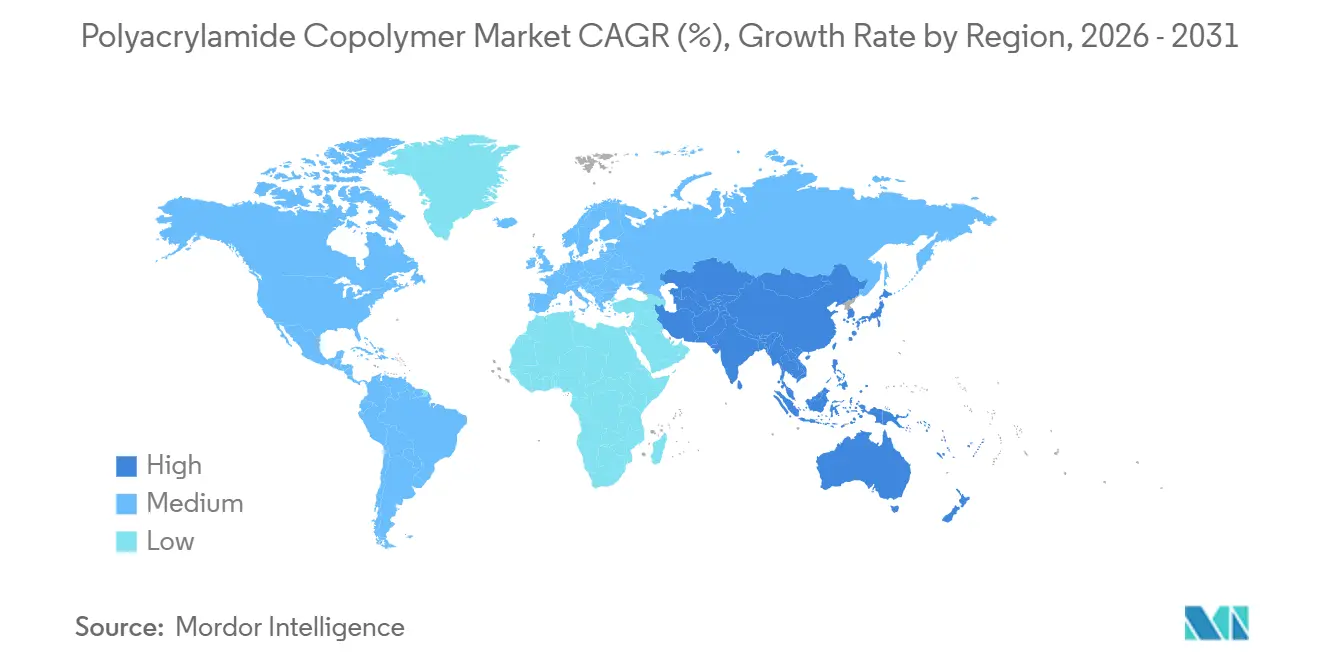
Asia-Pacific held 45.07% of the polyacrylamide copolymer market share in 2025 and is forecast to grow at a CAGR of 6.34% through 2031. The region has municipal water treatment requirements, mining activity, and oilfield demand. China is a production hub for standard polyacrylamide grades and influences pricing across export markets. India’s expansion of treatment infrastructure supports demand for flocculants used in sewage treatment and sludge management. Manufacturing and battery supply chain investments in Indonesia, Malaysia, Thailand, and Vietnam also increase wastewater treatment requirements.
North America is a mature segment of the polyacrylamide copolymer market. Unconventional oil production, produced water management, and municipal utility upgrades support demand. The United States maintains federal drinking water requirements that influence quality standards for acrylamide-containing water treatment products. In Europe, the implementation timeline for the revised Urban Wastewater Treatment Directive influences market demand. Industrial and municipal users in Germany require higher-performance grades to meet effluent standards. Nordic procurement activity also supports the evaluation of bio-hybrid flocculant solutions.
South America, the Middle East, and Africa have distinct demand patterns within the polyacrylamide copolymer market. Chile, Peru, and Brazil use polymer-assisted tailings dewatering in the processing of copper, lithium, and iron ore. In water-scarce mining regions, improved settling efficiency and water recovery support the use of anionic polymers. Demand in the Middle East is linked to enhanced oil recovery applications, particularly in high-temperature, high-salinity reservoirs. North Africa and Sub-Saharan Africa contribute to demand through the development of water treatment infrastructure. South African mining operations also use high-molecular-weight anionic grades for tailings management and related compliance requirements.

Competitive Landscape
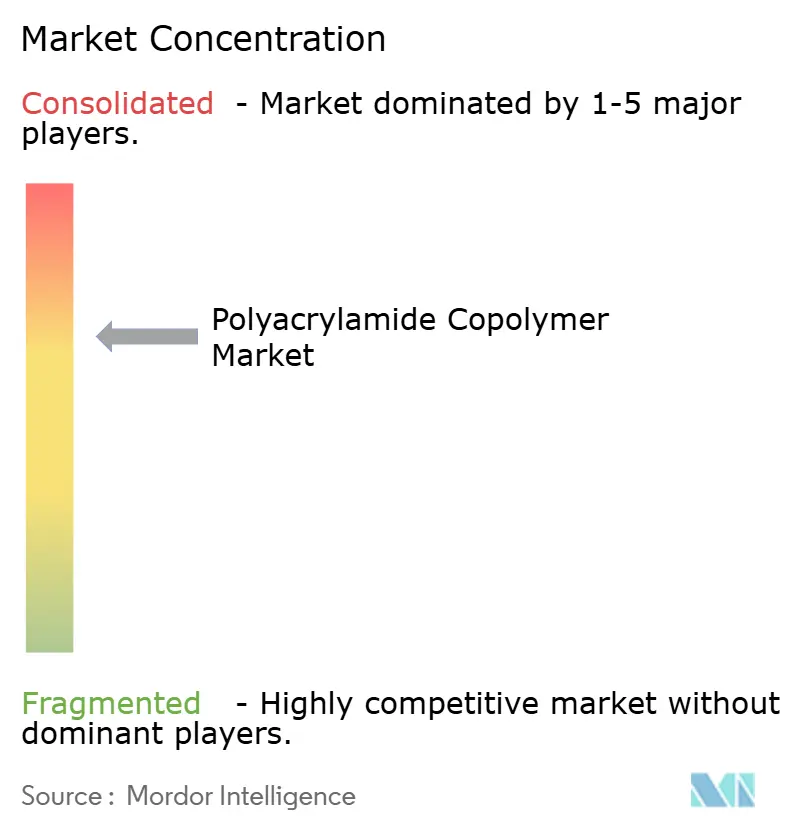
The polyacrylamide copolymer market is moderately consolidated, with the scale of leading suppliers differentiating them from regional producers in China, Finland, Germany, and India. SNF combines upstream integration with manufacturing and application capabilities across water treatment, mining, and oilfield applications. The company expanded its portfolio through the 2025 acquisition of Obsidian Chemical Solutions, building on its earlier acquisitions of PfP Industries and Ace Fluid Solutions. These initiatives expand their reach and support customer service through local operations. This concentration provides large, integrated producers with advantages in supply reliability and technical service.
Kemira is expanding its water treatment business through acquisitions and service capabilities. In February 2026, the company acquired SIDRA Wasserchemie to strengthen its water solutions business in Central Europe. In July 2026, Kemira acquired ANMAC Water Treatment Service to expand its industrial water treatment services in California. These transactions highlight the role of local service relationships alongside polymer manufacturing. Suppliers compete by combining product performance with application support, particularly for customers managing complex wastewater streams and evolving compliance requirements.
Solenis is investing in regional manufacturing to expand its pulp and paper chemicals business. In April 2026, the company broke ground on a 60,000-ton facility in Beihai, Guangxi, with operations expected to begin in the second quarter of 2027. The facility will support Solenis’s access to Western China and Southeast Asia. Commodity producers serve standard anionic grades, while specialty suppliers focus on performance in high-salinity, high-temperature, and difficult-solids conditions. Bio-hybrid developers may target municipal tenders that emphasize biodegradability and lower acrylamide content. The competitive landscape supports suppliers that meet performance, compliance, and supply requirements.
Polyacrylamide Copolymer Industry Leaders
SNF Group
Solenis
Kemira Oyj
BASF
Ashland
- *Disclaimer: Major Players sorted in no particular order

Recent Industry Developments
- August 2026: SNF SA signed a memorandum at the Kazakhstan Enhanced Oil Recovery (EOR) Forum 2026 in Astana to invest up to EUR 100 million (approximately USD 108 million) in a local polymer and equipment manufacturing facility for Kazakhstan's oil and gas sector. The investment aligns with SNF's strategy to co-locate manufacturing capacity with major EOR clients, increase local content, and facilitate technology transfer to regional operators.
- May 2026: SNF Oman LLC commissioned Phase 1 of its new polymer processing plant in the Raysut Industrial Area of Salalah, with an annual production capacity of approximately 6,000 metric tons. Phase 2 targets full-scale polymer manufacturing and will add more than 10,000 metric tons of annual capacity. SNF schedules Phase 2 for completion in Q4 2026.


Global Polyacrylamide Copolymer Market Report Scope
Polyacrylamide copolymer is a water-soluble synthetic polymer produced by chemically combining acrylamide with other monomers, such as acrylic acid. This copolymerization process modifies the polymer’s chemical properties for specific industrial applications.
The polyacrylamide copolymer market is segmented by product type, application, and geography. By product type, the market is segmented into anionic, cationic, non-ionic, and others. By application, the market is segmented into water treatment flocculants, enhanced oil recovery and petroleum, paper making and pulp processing, and other applications. The report also covers market size and forecasts for polyacrylamide copolymer across 15 countries in major regions. The market sizes and forecasts are provided in terms of value (USD).
| Anionic |
| Cationic |
| Non-Ionic |
| Others |
| Water Treatment Flocculants |
| Enhanced Oil Recovery and Petroleum |
| Paper Making and Pulp Processing |
| Other Applications |
| Asia-Pacific | China |
| India | |
| Japan | |
| South Korea | |
| ASEAN Countries | |
| Rest of Asia-Pacific | |
| North America | United States |
| Canada | |
| Mexico | |
| Europe | Germany |
| United Kingdom | |
| France | |
| Italy | |
| NORDIC Countries | |
| Rest of Europe | |
| South America | Brazil |
| Argentina | |
| Rest of South America | |
| Middle East and Africa | Saudi Arabia |
| South Africa | |
| Rest of Middle East and Africa |
| By Product Type | Anionic | |
| Cationic | ||
| Non-Ionic | ||
| Others | ||
| By Application | Water Treatment Flocculants | |
| Enhanced Oil Recovery and Petroleum | ||
| Paper Making and Pulp Processing | ||
| Other Applications | ||
| By Geography | Asia-Pacific | China |
| India | ||
| Japan | ||
| South Korea | ||
| ASEAN Countries | ||
| Rest of Asia-Pacific | ||
| North America | United States | |
| Canada | ||
| Mexico | ||
| Europe | Germany | |
| United Kingdom | ||
| France | ||
| Italy | ||
| NORDIC Countries | ||
| Rest of Europe | ||
| South America | Brazil | |
| Argentina | ||
| Rest of South America | ||
| Middle East and Africa | Saudi Arabia | |
| South Africa | ||
| Rest of Middle East and Africa | ||


Key Questions Answered in the Report
What is current market size of Polyacrylamide Copolymer Market Market?
The polyacrylamide copolymer market size was valued at USD 4.72 billion in 2025 and is estimated to grow from USD 4.96 billion in 2026 to USD 6.65 billion by 2031, at a CAGR of 6.04% during the forecast period (2026-2031).
Which application is forecast to grow the fastest through 2031?
Enhanced oil recovery and petroleum are projected to grow at a CAGR of 6.78% as mature fields adopt polymer flooding.
Which region leads in global demand?
Asia-Pacific held a 45.07% share in 2025 and is forecast to record the highest CAGR of 6.34% through 2031.
Which product type held the largest share in 2025?
Anionic polyacrylamide led with a 44.83% share in 2025, driven by its use in tailings, industrial effluents, and paper applications.
Page last updated on:





