
Styrene Market Size and Share
Market Overview
| Study Period | 2021 - 2031 |
|---|---|
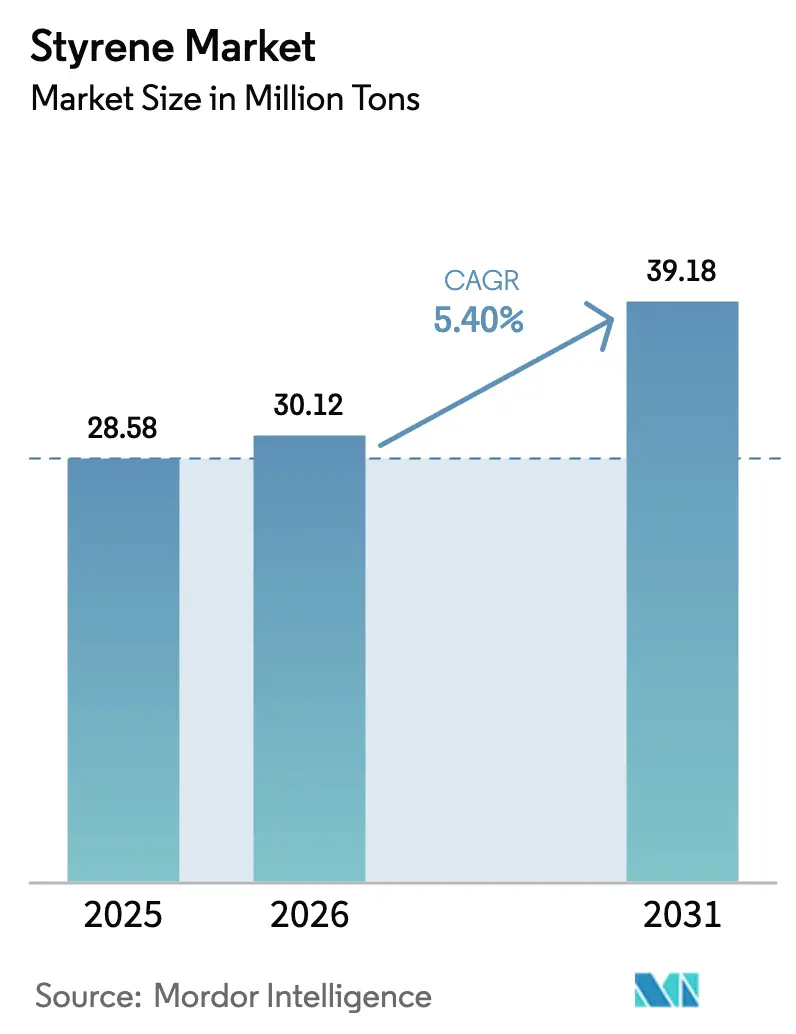
| Market Volume (2026) | 30.12 Million tons |
| Market Volume (2031) | 39.18 Million tons |
| Growth Rate (2026 - 2031) | 5.40 % |
| Fastest Growing Market | Middle East and Africa |
| Largest Market | Asia Pacific |
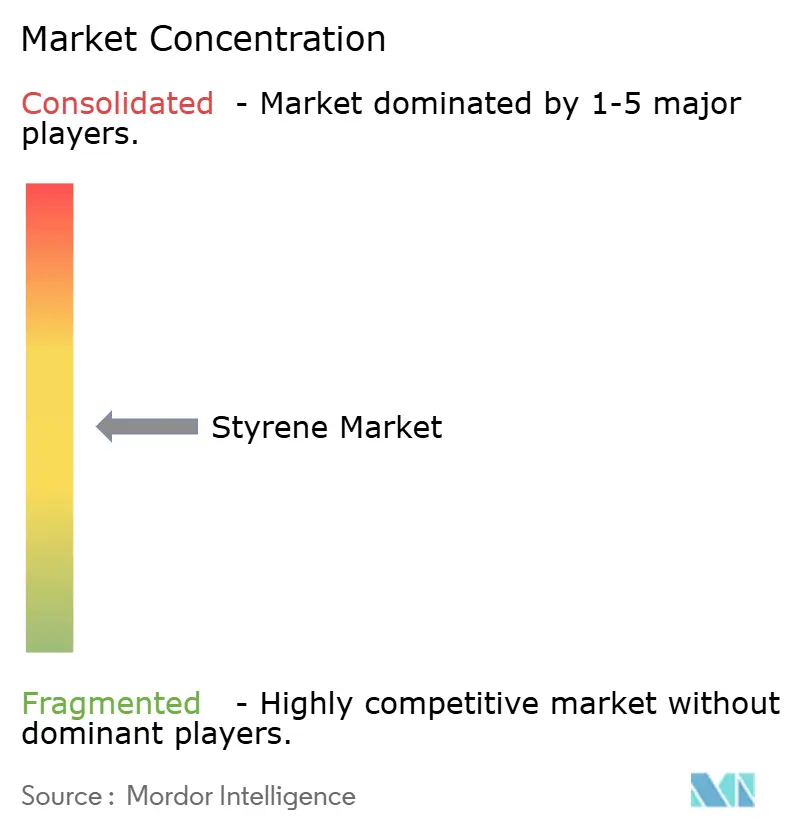
| Market Concentration | Medium |
Major Players *Disclaimer: Major Players sorted in no particular order Image © Mordor Intelligence. Reuse requires attribution under CC BY 4.0. | |
Styrene Market Analysis by Mordor Intelligence
The Styrene Market size is expected to increase from 28.58 million tons in 2025 to 30.12 million tons in 2026 and reach 39.18 million tons by 2031, growing at a CAGR of 5.40% over 2026-2031. Demand momentum persists even as single-use plastic bans, feedstock volatility, and carbon-pricing schemes reshape cost curves. Packaging retains structural importance for rigid clamshells and foam cushioning, while automotive electrification is accelerating acrylonitrile-butadiene-styrene uptake for battery enclosures and interior substrates. Breakthrough chemical-recycling deployments in Europe and North America are beginning to supply food-contact-grade monomer, enabling brand owners to meet recycled-content mandates without sacrificing performance. Asia-Pacific dominates capacity additions, yet margin leadership is migrating toward Western producers that commercialize circular solutions under FDA and EU approvals. Competitive strategies are therefore bifurcating between volume-driven integrated complexes and specialty players that monetize certifications and technical service.
Key Report Takeaways
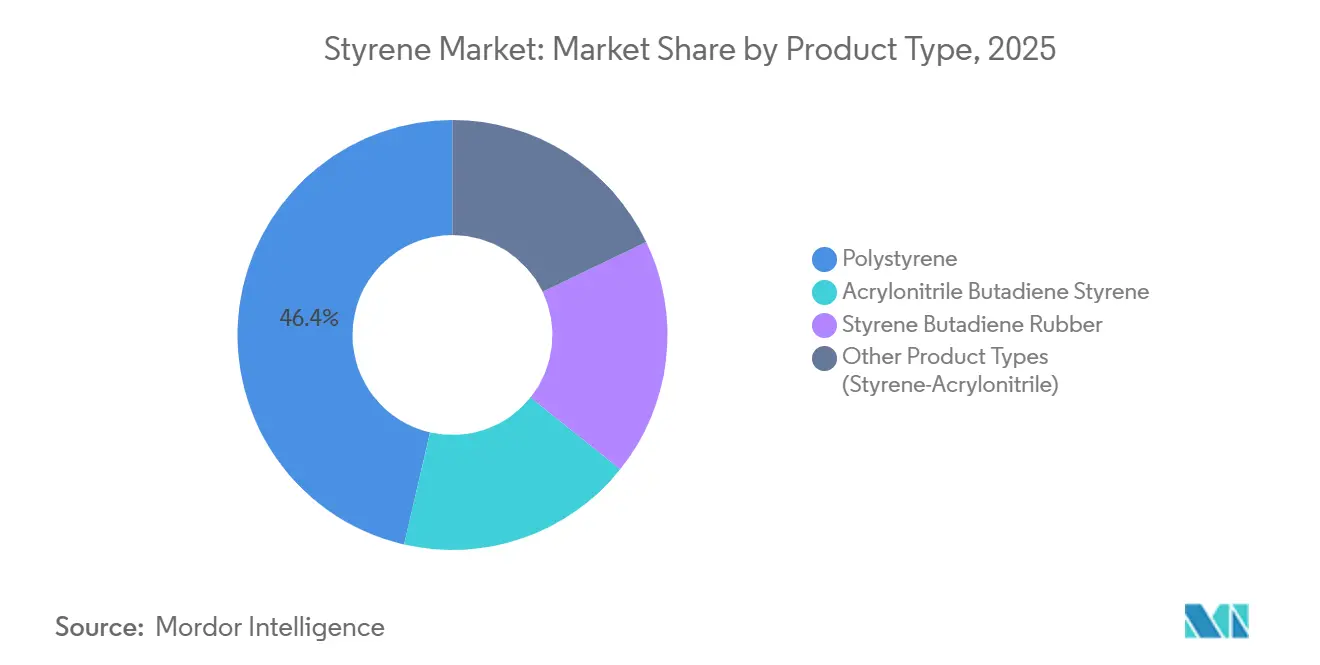
- By product type, polystyrene led with 46.38% of the styrene market share in 2025, and acrylonitrile-butadiene-styrene (ABS) is projected to grow at a 6.18% CAGR through 2031.
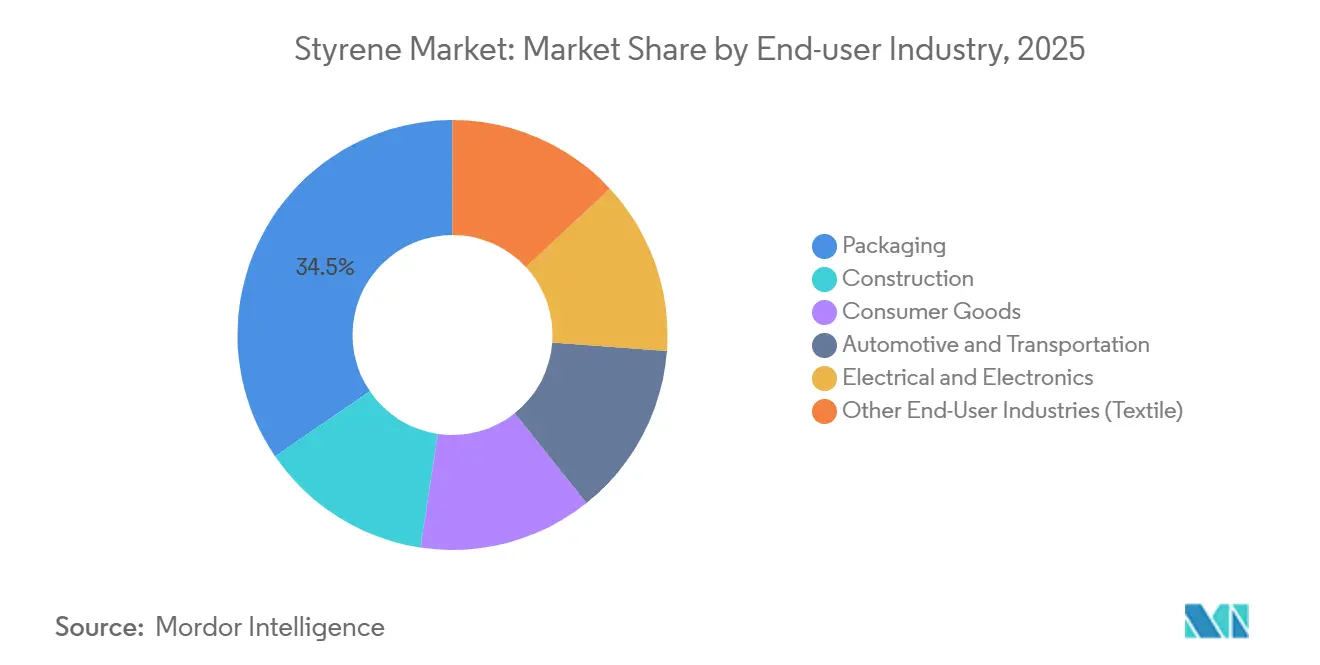
- By end-user industry, packaging absorbed 34.52% of 2025 demand, yet automotive and transportation is advancing at a 6.24% CAGR through 2031.
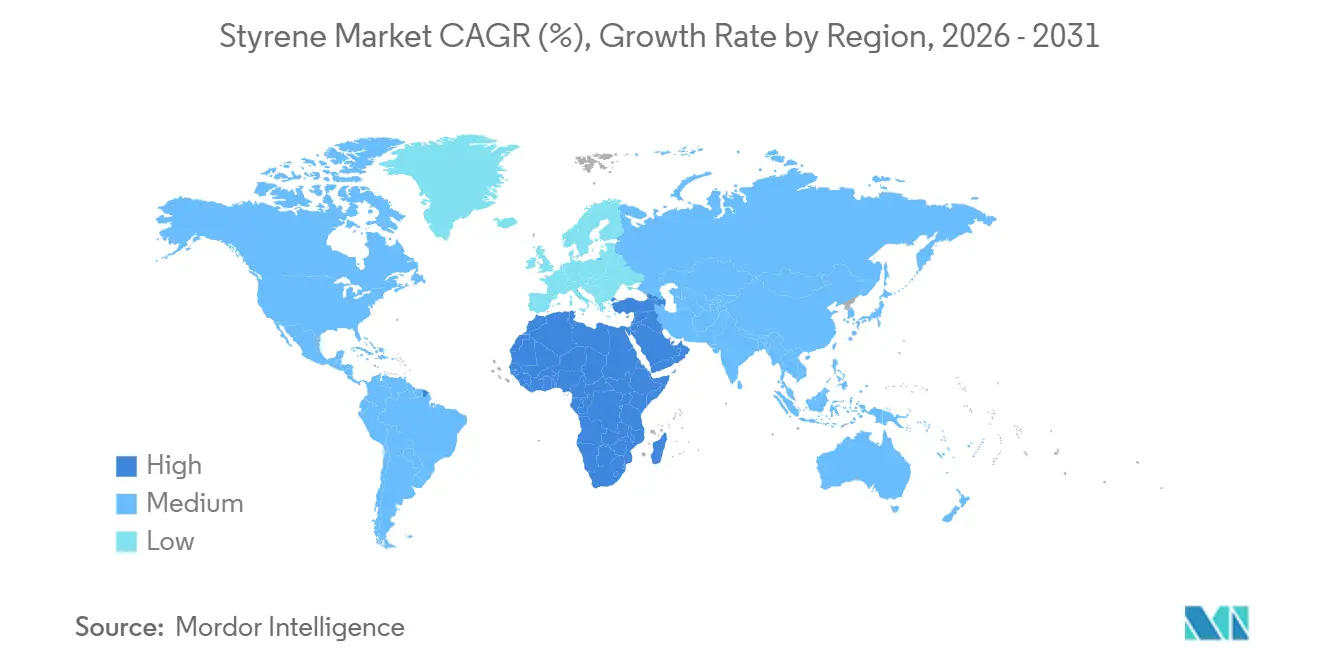
- By geography, Asia-Pacific accounted for 49.27% of 2025 consumption, while the Middle East and Africa is the fastest growing region at a 5.91% CAGR through 2031.
Note: Market size and forecast figures in this report are generated using Mordor Intelligence’s proprietary estimation framework, updated with the latest available data and insights as of January 2026.
Market Trends and Insights
Drivers Impact Analysis of Styrene Market*
| Driver | (~) % Impact on CAGR Forecast | Geographic Relevance | Impact Timeline |
|---|---|---|---|
| Rising demand for lightweight, rigid packaging | +1.2% | Global, with EU and North America leading recycled-content adoption | Medium term (2-4 years) |
| Booming consumer-electronics housing demand | +0.9% | APAC core (China, South Korea, Vietnam), spill-over to North America | Short term (≤ 2 years) |
| Insulation push from net-zero construction codes | +1.1% | EU (EPBD 2024 compliance), North America (building-code updates), China (green-building standards) | Long term (≥ 4 years) |
| Automotive lightweighting for EV range extension | +1.3% | Global, concentrated in China, EU, and North America EV hubs | Medium term (2-4 years) |
| Breakthrough chemical-recycling capacity build-out | +0.8% | EU and North America (food-contact regulatory approval), pilot deployments in Japan | Long term (≥ 4 years) |
| Source: Mordor Intelligence | |||
Rising Demand for Lightweight, Rigid Packaging
Rigid polystyrene clamshells deliver clarity and stiffness that polyethylene and polypropylene alternatives struggle to match at comparable thickness. The EU Packaging and Packaging Waste Regulation 2025/40 sets 35% recycled content by 2030 and 65% by 2040, pushing converters toward mechanically recycled polystyrene for non-food uses and chemically recycled monomer for food-contact items. INEOS Styrolution obtained U.S. FDA Food Contact Notification 2245 for pyrolysis-derived styrene, clearing the way for yogurt cups and bakery trays to meet brand targets without compromising drop-impact resistance [1]U.S. Food and Drug Administration, “Food Contact Notification 2245,” fda.gov . Agilyx’s TruStyrenyx facility completed engineering for a 100 ton-per-day depolymerization line, although final investment hinges on offtake agreements. While pyrolysis achieves more than 90% monomer purity, feedstock collection remains the bottleneck, keeping recyclers' operating rates below nameplate in most regions.
Booming Consumer-Electronics Housing Demand
Global AI-capable PC shipments are projected at 114 million units in 2025, each incorporating 150-200 grams of flame-retardant ABS for internal structures. Hyperscale operators specify UV-stabilized acrylonitrile-styrene-acrylate copolymers for 5G base-station enclosures that must endure 10-year outdoor exposure without chalking. Samsung’s Galaxy S24 family, launched January 2024, continues to rely on virgin ABS for brackets where dimensional tolerances below ±0.05 millimeters are mandatory. Supply of high-heat ABS from LG Chem and CHIMEI is tight, compelling electronics OEMs to dual-source from China despite variability in melt-flow index specifications.
Insulation Push from Net-Zero Construction Codes
The EU Energy Performance of Buildings Directive 2024/1275 requires zero on-site emissions for new buildings by 2026 and mandates life-cycle global-warming-potential disclosure from 2028. Expandable and extruded polystyrene boards achieve lambda values of 0.030-0.038 W/mK, matching polyisocyanurate foam at lower installed cost. BASF lifted Neopor EPS capacity by 50,000 tons per year at Ludwigshafen in 2024 to address Germany’s retrofit wave. Bio-attributed feedstock under the Biomass Balance approach cuts cradle-to-gate CO₂ by up to 50%, helping converters pre-qualify for public-sector tenders that now request ISO 14067 footprints.
Automotive Lightweighting for EV Range Extension
Battery packs add 200-300 kilograms to electric vehicles, and glass-fiber-reinforced ABS battery-tray covers weigh 40% less than stamped steel while meeting tensile strengths of 80-120 MPa. BASF and SABIC compete with higher-cost polyamide and polyphenylene-ether blends, but ABS maintains a unit-cost edge of EUR 2.20-2.50 per kilogram versus EUR 3.50-4.00 per kilogram. Covestro supplies UL 94 V-0 ABS for Chinese EV interiors following 2024 GB 38900 updates. SAE J2807, published in 2024, standardized thermoplastic battery-housing tests, shortening qualification cycles and encouraging metal substitution.
Restraints Impact Analysis of Styrene Market*
| Restraint | (~) % Impact on CAGR Forecast | Geographic Relevance | Impact Timeline |
|---|---|---|---|
| Single-use PS and EPS bans in more than 130 nations | -0.9% | Global, most stringent in EU, Canada, select U.S. states, and coastal developing economies | Short term (≤ 2 years) |
| Feedstock (benzene/ethylene) price volatility | -0.6% | Global, acute in import-dependent regions (Southeast Asia, Middle East) | Short term (≤ 2 years) |
| EU carbon-border tariffs on high-energy polymers | -0.4% | EU imports from non-ETS jurisdictions (China, India, Middle East) | Medium term (2-4 years) |
| Source: Mordor Intelligence | |||
Single-Use PS and EPS Bans in More Than 130 Nations
The EU Packaging and Packaging Waste Regulation bans single-use EPS foodware from January 2029 for dine-in and January 2030 for takeaway, eliminating 180,000 tons of regional demand. New York and California restrictions remove another 35,000-40,000 tons in the United States, while Canada’s nationwide ban came into force in 2024[2]Government of Canada, “Single-Use Plastics Prohibition Regulations,” canada.ca . Quick-service restaurants migrate to molded-fiber pulp or polypropylene, raising costs 10-15% yet reducing marine-litter exposure. Small extruders lacking capital to retool are selling assets to larger converters, accelerating consolidation.
Feedstock (Benzene/Ethylene) Price Volatility
U.S. ethane crackers generate ethylene at USD 250-300 per ton, versus EUR 600-700 from European naphtha crackers, sustaining a 15-20% cash-cost gap. Forward curves show benzene contango into 2027, suggesting tighter aromatics supply as gasoline demand eases, yet margin visibility remains poor for non-integrated players.
*Our forecasts treat driver/restraint impacts as directional, not additive. The impact forecasts reflect baseline growth, mix effects, and variable interactions.
Styrene Market Segment Analysis
By Product Type:
Recycling Unlocks Value Amid Regulatory PressurePolystyrene commanded 46.38% of 2025 volume, though its growth is projected below the overall styrene market CAGR due to food-service bans. The chemical-recycling pivot is critical; Trinseo and Recycling Technologies now convert 30,000 tons per year of post-consumer material into virgin-equivalent monomer that qualifies under EU Regulation 10/2011 and FDA FCN 2245. Acrylonitrile-butadiene-styrene heads the expansion table at a 6.18% CAGR, supported by electric-vehicle battery trays and 5G equipment housings that require UL 94 V-0 compliance. Specialty ABS grades from BASF and SABIC achieve 25-30% part-weight savings versus metal substitutes. Commodity general-purpose polystyrene faces margin compression from 1.45 million tons per year of new Chinese capacity commissioned in 2023-2024.
Recycled monomer validation by INEOS Styrolution in September 2025 demonstrates circular viability, yet collection and sorting costs of USD 150-200 per ton continue to suppress operating margins. Styrene-acrylonitrile copolymers grow in line with overall demand, primarily in transparent housings where clarity is valued. Styrene-butadiene rubber gains traction as Michelin integrates recycled styrene into tire treads, targeting 40% sustainable-material content by 2030.


By End-User Industry:
Automotive Gains, Packaging PlateausPackaging absorbed 34.52% of 2025 output, yet automotive and transportation is expanding at a 6.24% CAGR through 2031, the swiftest among all segments. Glass-fiber-reinforced ABS battery covers weigh 40% less than steel, pushing adoption as OEMs offset battery mass. Covestro supplies ABS meeting GB 38900 fire norms for Chinese EV interiors.
Construction demand rises with EPS and XPS insulation mandated by the EU renovation wave, and BASF’s Neopor expansion positions it to capture this uptick. Electrical and electronics rely on high-heat ABS for AI PCs and 5G infrastructure, while consumer goods and textiles move in line with GDP but face polyolefin substitution. Certification hurdles (ISO 22000 for food-contact recycling and UL 94 for flame retardancy) are creating barriers to entry for smaller converters.
Geography Analysis
APAC Styrene Market
Asia-Pacific controlled 49.27% of 2025 volume and will retain leadership, yet capacity expansions outpace demand growth, turning China into a structural exporter. India’s annual increase rides consumer-goods manufacturing and remains 40% import-dependent, presenting opportunity for Gulf exporters. South Korea and Taiwan confront tight high-heat ABS supply, prompting electronics brands to accept longer lead times from China. Japan pilots Agilyx chemical recycling, signaling a pivot toward circularity.
North America Styrene Market
North America’s growth trails Asia-Pacific as INEOS closed the Sarnia plant and LyondellBasell emphasizes circular projects over new capacity, despite the region’s ethane cost advantage. Mexico advances under USMCA-aligned auto-parts exports.
Europe Styrene Market
Europe lags due to energy costs and stringent bans. Versalis shuttered its Priolo cracker, and converters must secure chemically recycled or bio-attributed feedstock to meet recycled-content mandates. Renovation of Germany’s pre-1979 housing stock under EU directives does lift EPS demand, albeit conditioned on low-carbon footprints.
MEA Styrene Market
The Middle East and Africa delivers the highest regional CAGR at 5.91% as Saudi Arabia extends downstream integration under Vision 2030 and South Africa substitutes imports with local EPS insulation. Carbon-capture pilots seek to neutralize potential EU carbon-border levies post-2030.

Value Chain Analysis
The styrene value chain begins with upstream aromatics and olefins supply. Benzene and ethylene are combined to make ethylbenzene, which is then converted to styrene monomer primarily through catalytic dehydrogenation. Producers run integrated or merchant styrene units, and process economics remain sensitive to energy intensity (steam and vacuum distillation) and the steam-to-hydrocarbon ratio, which keeps catalyst selection and utilities optimization central. By-products such as benzene, toluene, and heavier fractions are typically recovered for internal reuse or external sale.
Downstream, styrene monomer is polymerized or compounded into derivatives including polystyrene (including EPS/XPS grades), ABS, SAN, and SBR. A fragmented processor base then turns these resins into packaging, construction insulation, automotive parts, and electrical and electronics housings. Bulk logistics (tank storage and marine/rail movements) support monomer transport, while pellet logistics move resins cross-regionally, where trade flows help balance structural surpluses and deficits. Coordination and standards alignment draw on bodies such as the Styrene Information and Research Center (SIRC), the International Council of Chemical Associations (ICCA), the Gulf Petrochemicals and Chemicals Association (GPCA), and European styrenics industry groups. For chemically recycled styrene, circular feedstock collection and sorting continues to be a practical bottleneck.
Competitive Landscape
The styrene market is moderately concentrated, with the top five producers holding about 42% share, while downstream conversion remains highly fragmented. Integrated Asian and Gulf complexes leverage co-production of benzene and ethylene to maintain cash-cost leadership. Western producers shift toward circular offerings: INEOS Styrolution’s FDA-approved recycled monomer commands a 20-30% premium. BASF’s Biomass Balance route, certified ISCC PLUS, slices cradle-to-gate CO₂ by up to 50% but carries a 20-30% price premium.
Agilyx and Pyrowave license microwave and catalytic depolymerization, and Michelin’s 2025 partnership validates demand in tire-rubber applications. Trinseo emerged from Chapter 11 in 2024 with USD 225 million new equity, divested polycarbonate to Mitsubishi Chemical, and reviews latex binders to concentrate on engineered styrenics.
Overcapacity pressures in China persist: Hengli, Shenghong, and Wanhua added 1.45 million tons between 2023 and 2024, driving general-purpose polystyrene margins below USD 50 per ton. European producers idle swing lines during price troughs, and consolidation is expected as small extruders face capital barriers for certification and recycling investments.
Styrene Industry Leaders
SABIC
INEOS Styrolution
LG Chem
Trinseo
CHIMEI
- *Disclaimer: Major Players sorted in no particular order
Styrene Market Companies Covered in this Report
- Americas Styrenics LLC (AmSty).
- Asahi Kasei Corporation
- BASF
- Chevron Phillips Chemical Company
- CHIMEI
- Covestro AG
- Dow
- Formosa Chemicals & Fibre Corp.
- Hanwha Group
- INEOS Styrolution
- Kumho Petrochemical
- LG Chem
- LyondellBasell Industries Holdings BV
- PetroChina Co. Ltd
- Reliance Industries Ltd
- SABIC
- SIBUR
- Synthos
- TotalEnergies
- Trinseo
- Versalis SpA
- Wanhua Petrochemical (Yantai) Co., Ltd.
- Westlake Corporation

Market Opportunities and Future Outlook
The key opportunity centers on scaling circular styrene pathways that meet food-contact and recycled-content requirements while keeping monomer quality and polymer performance consistent. Industrial evidence is already visible in Europe, where Indaver operates a depolymerization unit in Antwerp (referenced at 26,000 tonnes per year) supplying recycled styrene monomer into INEOS Styrolution's European chain, and in commercialization steps such as the May 2026 launch of the TruStyrenyx platform by Technip Energies and Agilyx for high-purity recycled styrene monomer (over 99.8% purity). These developments create room for brand-owner compliant packaging and certified inputs for converters, but they also underline near-term pressure points around feedstock sourcing, qualification, and offtake structures.
A second opportunity is building supply-chain resilience as trade flows react to outages and logistics risk. In 2026, shipping challenges around the Strait of Hormuz, with force majeure reported from producers in Saudi Arabia and Kuwait, highlighted the value of diversified sourcing, storage, and regional flexibility for styrene monomer and styrenics. China also showed export responsiveness during tight spot availability, with reported March 2026 styrene exports of 84,470 metric tons, supporting the role of Asia-linked arbitrage and derivative exports in balancing global markets. On the supply side, integrated projects continue to add capacity, including a reported 700,000-ton-per-year styrene facility tied to the Huajin Aramco complex. That increase raises pressure on non-integrated assets and places more weight on cost position, circular certifications, and application development across ABS, insulation, and higher-spec styrenics.
Recent Industry Developments in Styrene Market
- June 2026: INEOS Styrolution announced the decision to permanently close its Channahon, Illinois polystyrene production site. The decision tightens the company’s North American footprint and reflects ongoing network optimization amid challenging economics for commodity polystyrene.
- September 2025: INEOS Styrolution marked its first commercial delivery of recycled styrene monomer supplied by Indaver from Antwerp, Belgium. The milestone advances closed-loop styrenics by demonstrating industrial-scale supply of circular feedstock into the company’s European production chain.
- June 2024: Trinseo launched sustainably advantaged MAGNUM ECO+ ABS and TYRIL CR SAN resins that work as drop-in solutions using post-consumer recycled content. The introductions expand PCR-based styrenics options for automotive, industrial, and consumer applications that need performance continuity alongside footprint reduction.


Styrene Market Report Scope and Research Methodology
Market Definition and Coverage
For this methodology, the styrene market is defined as global demand for styrene-based products that are consumed across key end uses, quantified in physical volume (tons) to reduce distortion from cyclical pricing.
Scope exclusions: We exclude pure price-only inflation effects and non-merchant internal transfers that do not reflect end-market consumption.
Segments Covered in This Report
- By Product Type
- Polystyrene
- Acrylonitrile Butadiene Styrene
- Styrene Butadiene Rubber
- Other Product Types (Styrene-Acrylonitrile)
- By End-user Industry
- Packaging
- Construction
- Consumer Goods
- Automotive and Transportation
- Electrical and Electronics
- Other End-User Industries (Textile)
- By Geography
- Asia-Pacific
- China
- India
- Japan
- South Korea
- ASEAN Countries
- Rest of Asia-Pacific
- North America
- United States
- Canada
- Mexico
- Europe
- Germany
- United Kingdom
- France
- Italy
- NORDIC Countries
- Rest of Europe
- South America
- Brazil
- Argentina
- Rest of South America
- Middle East and Africa
- Saudi Arabia
- South Africa
- Rest of Middle-East and Africa
- Asia-Pacific
Data Sources, Market Sizing, and Validation
Desk Research
Desk work starts by setting a clean fact base for styrene capacity, trade, and downstream conversion patterns, since this is a large commodity chain with visible public signals. Sources that helped here include official trade statistics and customs portals, energy and petrochemical statistical publications such as from the U.S. EIA and OECD series, and technical literature in polymer and chemical engineering journals.
We also reviewed producer annual reports, investor presentations, and plant-level announcements carried by reputed press and association websites. This helped us build a timeline for turnarounds, debottlenecking, and new builds. For cross-checks, we used paid subscriptions focused on company financials and intelligence, news and financials, and an import-or-export shipment-level database to validate trade direction and the reasonableness of implied regional supply gaps. These are illustrative sources, and many other public references were consulted to collect data, validate points, and clarify assumptions.
Primary Interviews and Surveys
Primary work was used to pressure-test the desk findings and then tighten the volume model using real operating and demand-side signals. We spoke with participants across the styrene value chain, including producers, traders and distributors, and downstream converters and large end users, with coverage across APAC, EMEA, and the Americas to reflect how supply and demand differ by region. Inputs from these discussions were used to confirm utilization bands, trade leakages, typical product slate splits, and how quickly demand shifts when pricing and regulations change.
Distribution of primary research fieldwork respondents
| Company type | Respondent position | Region |
|---|---|---|
| Top tier: 28% | CXOs: 20% | APAC: 38% |
| Mid tier: 50% | Functional/Unit leaders: 27% | EMEA: 35% |
| Smaller Players: 22% | Managers: 53% | Americas: 27% |
Market-Sizing & Forecasting
Our sizing starts with a top-down reconstruction where regional styrene supply is inferred from nameplate capacity, typical operating rates, and net trade movements, then mapped to downstream consumption pools. Because derivatives drive most demand, the model is anchored on conversion relationships and mix patterns for major styrene-based products, followed by adjustments for inventory swings and short-term outages.
To keep totals realistic, selective bottom-up approximations were used as checks, such as sampled producer and distributor volume disclosures, channel checks on local market tightness, and implied demand derived from end-use activity. Key inputs tracked closely include operating rate ranges by region, planned and unplanned shutdown cadence, import and export flows, downstream plastics and rubber production indicators, and construction and packaging demand signals that typically pull polystyrene and related products.
For forecasting, scenario analysis was applied so base, conservative, and faster-recovery pathways could be tested against feedstock and macro assumptions shared by industry respondents. Where bottom-up information was patchy in smaller countries, gaps were filled using proxy indicators like trade intensity, downstream capacity presence, and per-capita plastics consumption, and then corrected through interview feedback before finalizing the series.
Data Validation & Update Cycle
Validation is done in layers so the story and the math line up before results are signed off. Model outputs are compared with independent signals such as reported plant operating updates, trade balance direction, and downstream production activity, and then abnormal jumps are reviewed until a clear driver is documented.
A second analyst review is run to challenge key assumptions, and we re-contact sources when utilization, trade, or mix assumptions do not reconcile with observed movements. Reports are refreshed annually, and interim updates are made when material events happen, such as large capacity starts, extended outages, or policy changes affecting plastics demand. Before delivery, a final pass is completed so clients receive the latest updated view of numbers and supporting logic.
Mordor Intelligence's Styrene Market Estimate Compared With Other Published Estimates
Published styrene market numbers can look far apart even when the same end uses are being discussed. This is mainly because studies mix value and volume definitions, and some scopes lean toward derivatives while others focus on the monomer. Timing also matters, since feedstock swings can change implied value quickly, and update cadence can leave older assumptions in the model longer than intended.
Key gaps usually come from how derivatives are bundled, how average selling prices are built over the year, and whether the model relies more on capacity-side signals or demand-side consumption checks. Currency conversion timing and the month chosen for price reference can also shift the stated USD value, especially in a market where benzene and ethylene-linked feedstock movements affect costs quickly.
Benchmark comparison
| Source | Market Size | Gaps in Research Methodology |
|---|---|---|
| Mordor Intelligence | USD 30.12 M (2026) | |
| Global Consultancy A | USD 66.97 B (2024) | Uses a value-based definition and prices a basket of styrene derivatives, so shifts in polymer pricing and assumed product mix can move totals even if physical demand is steady. |
| Industry Publisher B | USD 60.55 B (2024) | Reports revenue in USD and typically relies on blended ASP progression and longer forecast horizons, which can amplify differences during periods of feedstock and margin volatility. |
The table points to a unit mismatch first, and then a scope mismatch, because Mordor Intelligence's model reports global styrene demand in tons and ties it back to operating rates, trade flows, and downstream conversion rather than converting volume into USD using blended polymer prices. Once that is understood, the remaining spread usually comes from which derivative basket is priced, the timing of the price deck, and how quickly assumptions are refreshed after capacity changes.


Key Questions Answered in the Report
What is the projected styrene market size in 2031?
The styrene market size is forecast at 39.18 million tons by 2031.
Which regional market is growing the fastest for styrene between 2026 and 2031?
The Middle East and Africa leads with a 5.91% CAGR, driven by Saudi downstream integration and insulation demand.
Which product segment is expanding most rapidly?
Acrylonitrile-butadiene-styrene is rising at a 6.18% CAGR on electric-vehicle and 5G infrastructure applications.
How are chemical-recycling projects influencing styrene demand?
Commercial depolymerization plants in Europe and North America supply food-contact monomer, supporting demand despite single-use bans.
Page last updated on:


 Your data is secure and never sold or shared.


