
Physiotherapy Equipment Market Size and Share
Market Overview
| Study Period | 2020 - 2031 |
|---|---|
| Market Size (2026) | USD 23.89 Billion |
| Market Size (2031) | USD 33.26 Billion |
| Growth Rate (2026 - 2031) | 6.85 % |
| Fastest Growing Market | Asia-Pacific |
| Largest Market | North America |
| Market Concentration | Medium |
Major Players *Disclaimer: Major Players sorted in no particular order Image © Mordor Intelligence. Reuse requires attribution under CC BY 4.0. | |
Physiotherapy Equipment Market Analysis by Mordor Intelligence
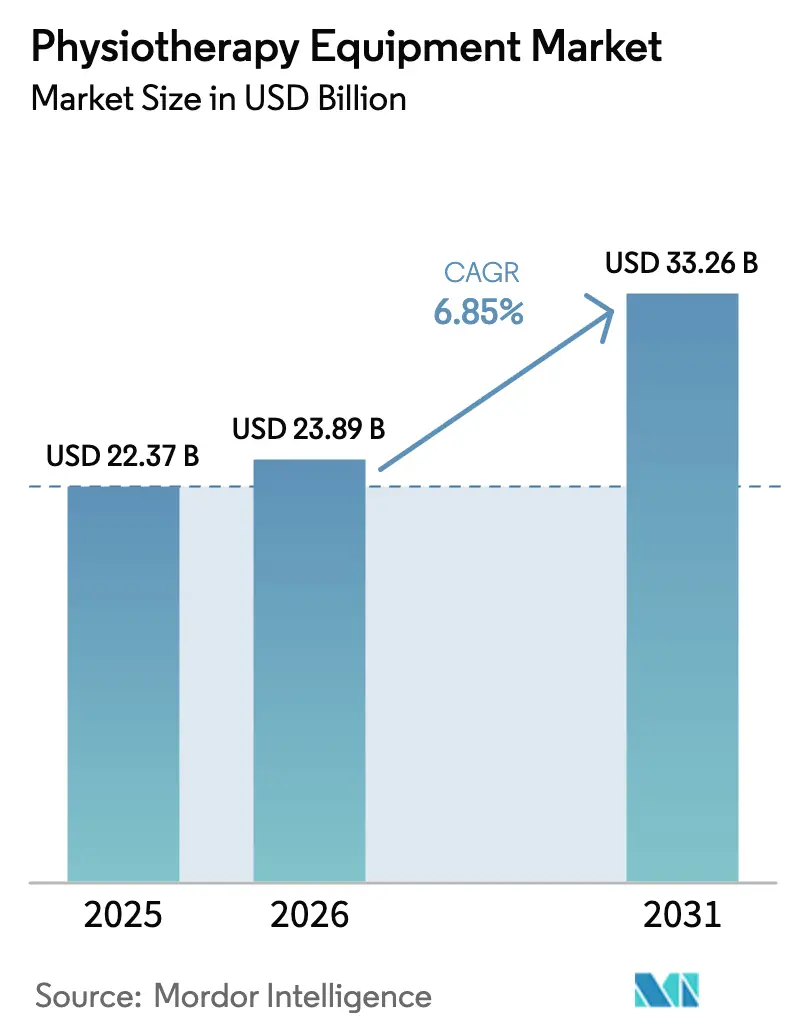
The Physiotherapy Equipment Market size is expected to grow from USD 22.37 billion in 2025 to USD 23.89 billion in 2026 and is forecast to reach USD 33.26 billion by 2031 at 6.85% CAGR over 2026-2031.
The solid outlook stems from health-system budgets pivoting toward prevention and functional recovery, an aging population that is driving rehabilitation demand, and widening insurance coverage for connected devices. The World Health Organization reports that 2.41 billion people require rehabilitation yet fewer than half receive it, highlighting a persistent access gap that fuels the physiotherapy equipment market. A growing preference for home-based care, rising sports participation, and broader reimbursement for AI-enabled tele-rehabilitation are increasing the installed base of portable and connected systems. Competitive pressure is intensifying as low-cost Asian suppliers challenge Western incumbents, while robotics and SaaS platforms are opening new profit pools. Together, these forces underpin robust demand across hospitals, rehabilitation centers, and home-care channels.
Key Report Takeaways
- By equipment type, electrotherapy commanded 36.7% of the physiotherapy equipment market share in 2025, while wearable and assistive rehabilitation devices are forecast to expand at a 7.12% CAGR through 2031.
- By application, musculoskeletal conditions accounted for 51.6% of the physiotherapy equipment market size in 2025, and sports & orthopedic injuries are projected to post a 7.45% CAGR to 2031.
- By end user, hospitals held 46.8% revenue share in 2025; rehabilitation centers are advancing at a 6.98% CAGR through 2031.
- By geography, North America led with 39.4% of revenue in 2025, whereas Asia-Pacific is set to grow at 7.62% through 2031.
Note: Market size and forecast figures in this report are generated using Mordor Intelligence’s proprietary estimation framework, updated with the latest available data and insights as of January 2026.
Market Trends and Insights
Drivers Impact Analysis of Physiotherapy Equipment Market*
| Driver | (~) % Impact on CAGR Forecast | Geographic Relevance | Impact Timeline |
|---|---|---|---|
| Rising geriatric population & chronic disease burden | +1.2% | Global, notably Asia-Pacific and Europe | Long term (≥ 4 years) |
| Rapid adoption of connected & portable physiotherapy devices | +1.1% | North America, Europe, accelerating in Asia-Pacific | Medium term (2-4 years) |
| AI-driven tele-rehabilitation platforms gaining reimbursement | +1.3% | United States, Germany, Netherlands | Short term (≤ 2 years) |
| Exoskeleton & robotics integration in physiotherapy suites | +0.9% | Japan, South Korea, United States | Medium term (2-4 years) |
| Expanding post-surgical & oncology rehabilitation demand | +0.6% | North America, Europe | Medium term (2-4 years) |
| Growing investments in outpatient & sports medicine facilities | +0.4% | North America, Western Europe, urban Asia-Pacific | Short term (≤ 2 years) |
| Source: Mordor Intelligence | |||
Rising Geriatric Population & Chronic Disease Burden
According to the World Health Organization, the proportion of the geriatric population is expected to nearly double from 12% to 22% of the global population[1]. Older demographics experience higher rates of osteoarthritis, stroke, and chronic pain, pushing demand for automated gait trainers, electrotherapy units, and balance systems. WHO’s Rehabilitation 2030 agenda highlights a 40% therapist shortfall in lower-income regions, prompting suppliers to build devices that lower clinician-to-patient ratios [2]. As chronic disease prevalence rises, the physiotherapy equipment market is positioned for sustained volume growth.
Rapid Adoption of Connected & Portable Physiotherapy Devices
Payers are encouraging home-based care to reduce inpatient costs, and portable electrotherapy units priced at USD 300-500 are reshaping purchasing patterns. Medicare removed prior authorization for physician-prescribed DME in 2024, helping Zynex Medical shift the majority of revenue to direct-to-consumer channels. Embedded inertial measurement sensors stream compliance data that insurers use to validate therapy adherence. New FDA cybersecurity guidance obliges suppliers to disclose software bills of materials, raising technical barriers but standardizing data protocols. Collectively, these dynamics are enlarging the connected-device share of the physiotherapy equipment market.
AI-Driven Tele-Rehabilitation Platforms Gaining Reimbursement
Remote Therapeutic Monitoring (RTM) codes launched by CMS in 2024 permit clinicians to bill USD 200-300 per patient per month for asynchronous data review, establishing a USD 1.2 billion reimbursement pool. AI algorithms that analyze smartphone-captured gait parameters now alert therapists to re-injury risks, cutting readmissions significantly among orthopedic cases. Germany’s Digital Health Applications pathway forces suppliers to prove clinical equivalence to in-person therapy, opening doors for SaaS platforms with rigorous evidence bases. Hardware-only manufacturers risk commoditization, while integrated software ecosystems gain recurring margins.
Exoskeleton & Robotics Integration in Physiotherapy Suites
Costs of robotic gait trainers historically limited uptake, but new insurance mechanisms are unlocking demand. A 2024 meta-analysis reported 30% faster time-to-independent walking for stroke patients using robotic assistance. South Korea declared rehabilitation robotics a strategic industry and earmarked USD 400 million in subsidies, incentivizing joint ventures between electronics giants and med-tech specialists. Robotics is progressing from niche to mainstream within the physiotherapy equipment market.
Restraints Impact Analysis of Physiotherapy Equipment Market*
| Restraint | (~) % Impact on CAGR Forecast | Geographic Relevance | Impact Timeline |
|---|---|---|---|
| Shortage of skilled physiotherapists worldwide | -1.0% | Sub-Saharan Africa, South Asia, rural North America | Long term (≥ 4 years) |
| High upfront cost of advanced electro-mechanical systems | -0.8% | India, Southeast Asia, Latin America | Medium term (2-4 years) |
| Unfavorable or patchy reimbursement in developing markets | -0.5% | Sub-Saharan Africa, South Asia, parts of Latin America | Long term (≥ 4 years) |
| Cyber-security & data-compliance risk in connected devices | -0.3% | North America, EU, select Asia-Pacific | Short term (≤ 2 years) |
| Source: Mordor Intelligence | |||
Shortage of Skilled Physiotherapists Worldwide
Low-income nations average only 0.1 therapists per 10,000 people versus 15-20 in Scandinavia, creating a 50-fold disparity. India's mental health professional-to-population ratio is critically low, with only about 0.7 mental health professionals per 100,000 people, well below the recommended three per 100,000. Equipment utilization suffers when staffing is inadequate, limiting the physiotherapy equipment market in high-need regions. Manufacturers are adding automated feedback and multi-patient stations, yet professional bodies caution against diluting individualized care.
Unfavorable or Patchy Reimbursement in Developing Markets
In Latin America and Africa, few public insurers reimburse outpatient physiotherapy, forcing patients to self-pay. Clinics then hesitate to invest in premium hardware, focusing instead on low-cost modalities. This reimbursement patchwork keeps the physiotherapy equipment market under-penetrated outside high-income geographies.
*Our forecasts treat driver/restraint impacts as directional, not additive. The impact forecasts reflect baseline growth, mix effects, and variable interactions.
Physiotherapy Equipment Market Segment Analysis
By Equipment Type:
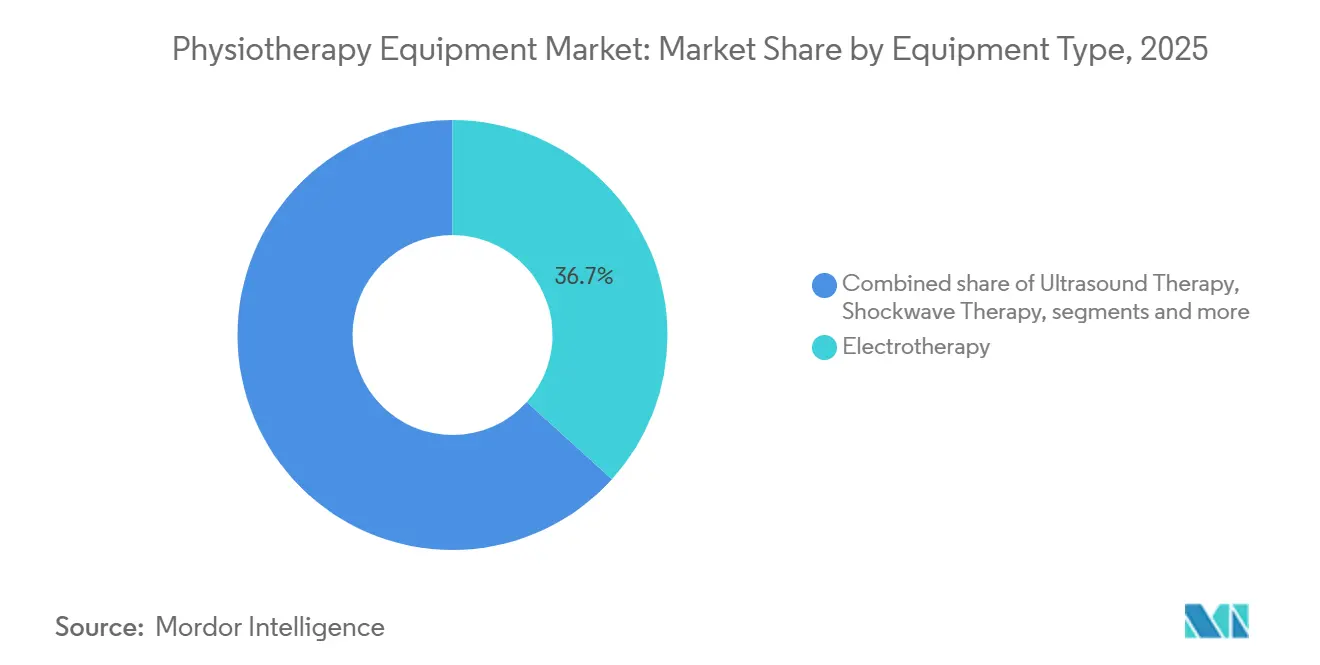
Electrotherapy Dominance Faces Wearable DisruptionElectrotherapy accounted for a 36.7% physiotherapy equipment market share in 2025, buoyed by decades of evidence for pain control and neuromuscular re-education [3]. Ultrasound and laser modalities added close to 20% combined share as sports clinics adopted tissue-healing technologies. Despite entrenched demand, the physiotherapy equipment market size for electrotherapy is moderating, while the wearable sub-segment is accelerating.
Wearable and assistive devices are projected to grow at a 7.12% annual rate through 2031. The costs of inertial sensors have dropped below USD 5, allowing for 6-axis motion tracking in braces and straps that retail at consumer-friendly price points. These devices collect adherence data that feed payer dashboards, a capability traditional clinic-bound systems lack. Multi-exercise stations are losing ground in home settings, whereas hydrotherapy remains confined to hospitals where space and maintenance budgets are available.

By Application:
Musculoskeletal Volume, Sports Injury MomentumMusculoskeletal conditions represented 51.6% of the physiotherapy equipment market size in 2025, reflecting the pervasive burden of low back pain and osteoarthritis. Robotics adoption is highest in neurology, but volume still trails musculoskeletal demand. Cardiopulmonary rehabilitation claims a stable 10-12% slice, sustained by post-COVID-19 programs.
Sports and orthopedic injuries are forecast to deliver the fastest expansion at 7.45% CAGR. Leagues and amateur athletes alike view technology as a performance differentiator, spurring procurement of force-plate platforms and anti-gravity treadmills. Pediatric and women’s health segments remain niche yet present upside as clinical evidence strengthens and reimbursement frameworks evolve.
By End User:
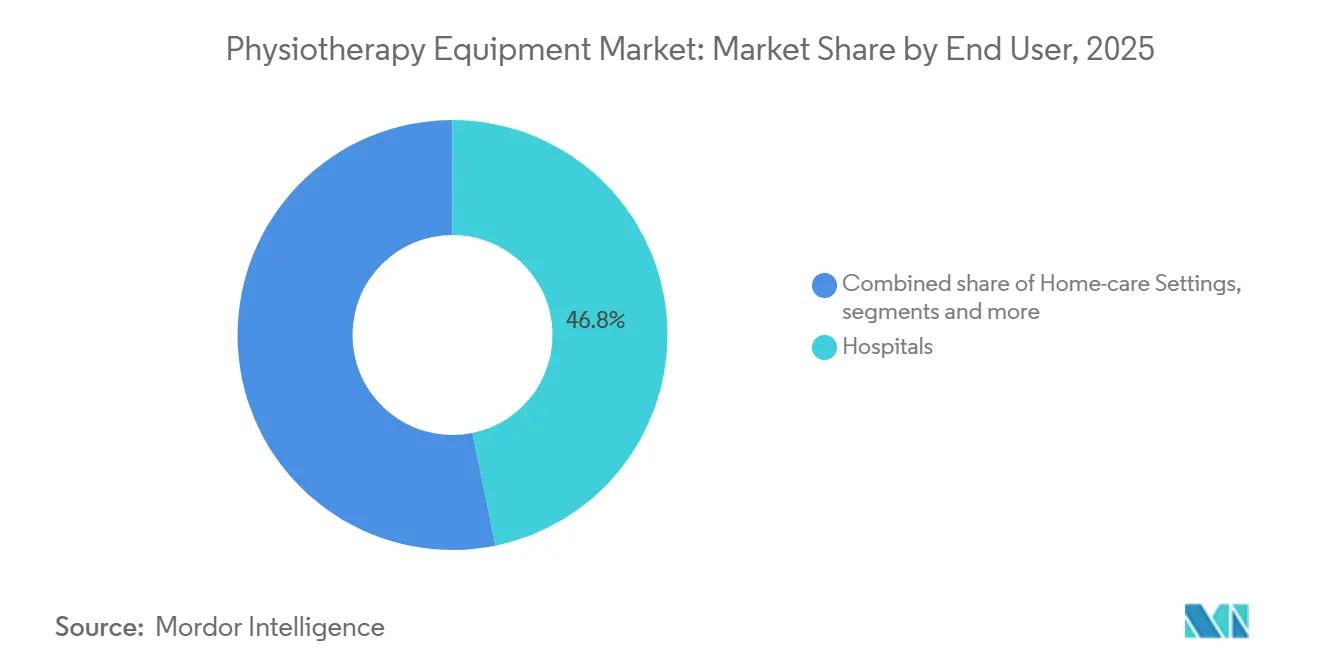
Hospitals Hold, Rehabilitation Centers RiseHospitals contributed 46.8% revenue in 2025, maintaining the largest footprint due to high-acuity caseloads. Procurement committees favor multi-modal systems to maximize usage across departments. The physiotherapy equipment market share of rehabilitation centers is, however, rising rapidly as insurers steer patients toward lower-cost outpatient pathways.
Home-care settings promise the highest margins. Direct-to-consumer channels sidestep group-purchasing discounts, and patients value convenience. Ambulatory surgical centers and sports medicine facilities demand smaller form-factor equipment that supports same-day discharge and fast return-to-play targets, respectively.
Geography Analysis
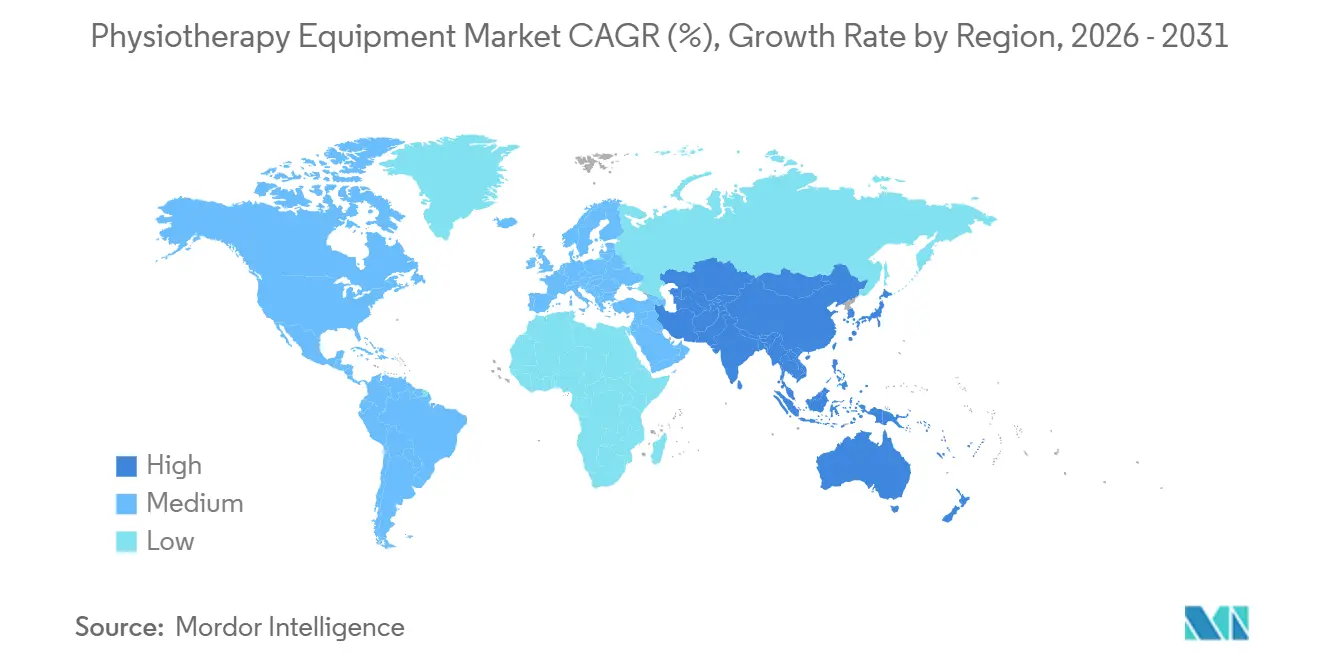
North America Physiotherapy Equipment Market
North America generated 39.4% of 2025 revenue, supported by Medicare coverage of tele-rehabilitation and a vast outpatient clinic network. The physiotherapy equipment market size in the United States benefits from new RTM codes that reward connected devices. Canada’s private clinics charge USD 60-90 per session, prompting investments in wearables to enhance service differentiation.
APAC Physiotherapy Equipment Market
Asia-Pacific is the fastest-growing region at a 7.62% CAGR, propelled by China’s Healthy China 2030 mandate requiring rehabilitation departments in all tertiary hospitals. India’s Ayushman Bharat extended coverage to 500 million citizens, encouraging private providers to expand rehabilitation capacity. Japan’s super-aging society funneled USD 2.1 billion into robotic mobility aids in 2024-2025, elevating physiotherapy equipment market penetration.
EMEA and South America Physiotherapy Equipment Market
Europe contributes roughly one-quarter of global value. Stringent EU MDR rules have raised compliance costs, favoring well-resourced manufacturers. The Middle East and Africa remain nascent, though the United Arab Emirates and Saudi Arabia are investing under Vision 2030. South America, led by Brazil, is advancing steadily at 5-6%, but currency volatility tempers capital spending.
Regulatory Landscape
Physiotherapy equipment is generally regulated as medical devices, and market access is shaped by regulator-specific classification, quality systems, and post-market surveillance requirements. In the United States, FDA oversight covers premarket pathways (including 510(k) where applicable) and manufacturing controls, and the Quality Management System Regulation (QMSR) took effect on February 2, 2026, updating device CGMP expectations and raising the compliance bar for suppliers of connected and software-enabled rehabilitation devices.
In 2026, FDA actions also clarified and lowered regulatory friction for certain physical medicine and stimulation-related device categories via Class II classifications and reclassifications, including non-invasive bone growth stimulators (effective May 18, 2026) and specific transcutaneous electrical nerve stimulator indications (effective April 16, 2026 and May 29, 2026). In Europe, the EU Medical Device Regulation (EU MDR) continues to reward manufacturers with strong clinical evaluation and vigilance capabilities, with EUDAMED UDI and the device registration module use commencing on May 28, 2026 and an updated list of harmonised standards adopted via Implementing Decision (EU) 2026/1231 effective June 17, 2026, which increases documentation and digital traceability obligations across electrotherapy, robotics, and connected modalities.
Competitive Landscape
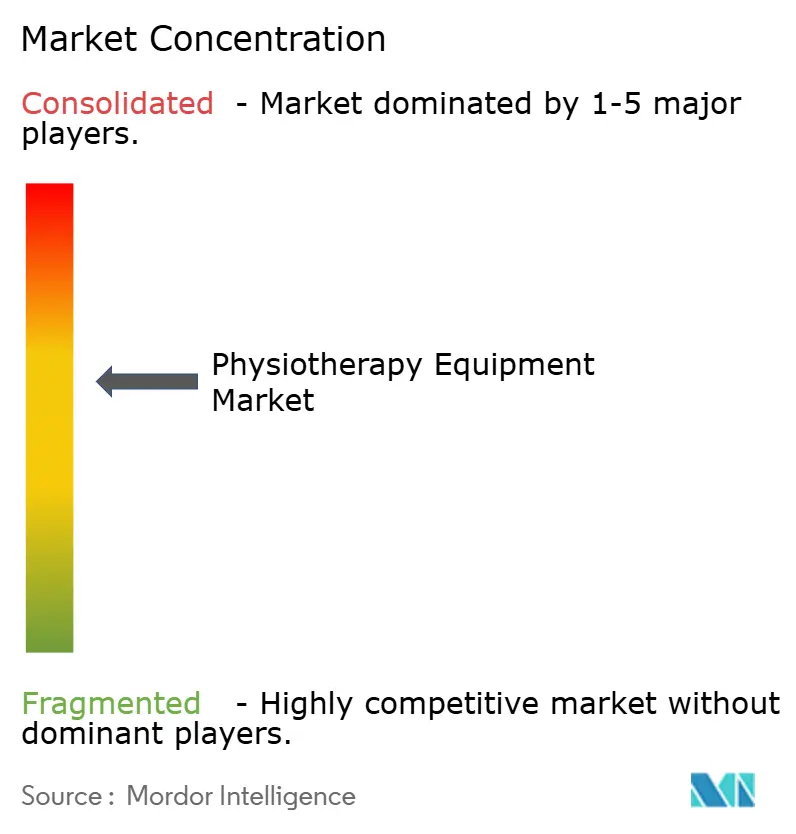
Global supply is moderately fragmented. The top five vendors, Enovis, BTL Industries, Zimmer MedizinSysteme, EMS Physio, and Patterson Medical, collectively contribute a significant share of the physiotherapy equipment market revenue. Enovis integrated DJO Global in 2025, leveraging group-purchasing contracts to cross-sell bracing, cold therapy, and electrotherapy systems. BTL’s subscription model shifts capital outlay to monthly fees, broadening its reach among mid-tier clinics.
Cost-advantaged Chinese suppliers such as Guangzhou Longest capture a significant share in emerging markets by pricing below Western peers, although perceptions of after-sales support cap penetration in regulated regions. High-margin whitespace lies in AI-enabled SaaS platforms from Lifeward and Hocoma, which yield 60-70% gross margins compared with 30-40% for hardware lifts. Robotics firms are moving to rental models aligned with Japan’s reimbursement shift, smoothing adoption curves.
Start-ups focused on tele-rehabilitation analytics are attracting venture funding, but FDA cybersecurity rules complicate entry for smaller players. Overall, the physiotherapy equipment market exhibits healthy rivalry across price bands and technology tiers, fueling consistent innovation.
Physiotherapy Equipment Industry Leaders
-
EMS Physio
-
BTL industries
-
Enovis
-
Zimmer MedizinSysteme GmbH
-
Patterson Medical
- *Disclaimer: Major Players sorted in no particular order
Physiotherapy Equipment Market Companies Covered in this Report
- AlterG
- BTL
- Chinesport
- Dynatronics
- EMS Physio
- Enovis Corporation (DJO Global Inc.)
- Guangzhou Longest Science & Technology Co., Ltd.
- HMS Medical system
- Hocoma
- ITO Co. Ltd.
- Lifeward, Inc.
- Lusio Rehabilitation
- Mectronic Medicale
- Meden-Inmed
- Patterson Medical (Performance Health)
- Restorative Therapies
- ReWalk Robotics
- SEERS Medical
- Zimmer MedizinSysteme (Enraf-Nonius BV)
- Zynex Medical
Market Opportunities and Future Outlook
The main whitespace is concentrated in reimbursement-enabled remote monitoring as rehabilitation volume shifts toward home and outpatient settings. In the United States, CMS Remote Therapeutic Monitoring (RTM) codes introduced in 2024 (USD 200-300 per patient per month for asynchronous review) create a commercialization lane for wearable sensing, portable electrotherapy, and software layers that translate adherence and outcomes data into billable clinical workflows, which is pushing product roadmaps toward closed-loop systems that can capture, analyze, and report objective functional metrics.
Public system adoption of AI-supported musculoskeletal care also provides a practical proof point for virtual-first pathways. In July 2026, Sword Health partnered with Portugal’s National Health Service to integrate AI-supported MSK care into a national framework. On the technology side, clinically oriented combinations of immersive rehabilitation and neuromodulation (for example, VR plus synchronous neurostimulation platforms studied for stroke recovery) point to an opportunity for vendors to bundle hardware with validated protocols and analytics rather than selling stand-alone modalities. Regionally, underpenetrated secondary cities in India remain an expansion corridor for affordable electrotherapy and clinic-ready combo systems as coverage expands under large public initiatives, while in the European Union, EU MDR post-market vigilance and standards updates are driving differentiation toward manufacturers that can sustain evidence generation, software update governance, and lifecycle compliance at scale.
Recent Industry Developments in Physiotherapy Equipment Market
- June 2026: Enovis launched the DonJoy Spinamic Hybrid Scoliosis Brace for adolescent idiopathic scoliosis, using adjustable pressure regulators and hump pads designed to support derotation. The release broadens Enovis participation in deformity management adjacent to rehabilitation and increases cross-selling potential through orthopedic and therapy channels.
- July 2025: Enovis launched the Manafuse bone growth stimulator using low intensity pulsed ultrasound (LIPUS) technology for fracture healing. Adding an ultrasound-based stimulation platform strengthens the company's portfolio in recovery pathways that commonly overlap with physiotherapy and outpatient rehab utilization.
- June 2024: BTL Industries partnered with JANZ Corporation to supply Emsculpt NEO devices to U.S. military and veteran healthcare facilities. The agreement expands access to large institutional accounts and supports standardized deployment of therapy-adjacent devices across government-linked care networks.
Physiotherapy Equipment Market Report Scope and Research Methodology
Market Definition and Coverage
This market covers revenue generated from physiotherapy equipment used to assess, treat, and support physical rehabilitation across clinical and home settings. It includes device-based therapy modalities and rehab systems that are commonly used by therapists to restore function and manage pain.
Scope exclusions: Excludes therapy services, procedure fees, and general fitness or wellness equipment that is not positioned for physiotherapy care.
Segments Covered in This Report
- By Equipment Type
- Electrotherapy
- Ultrasound Therapy
- Laser & Light Therapy
- Shockwave Therapy
- Magnetic & PEMF Therapy
- Heat & Cryotherapy Systems
- Hydrotherapy Systems
- Multi-exercise & Rehabilitation Stations
- Wearable & Assistive Rehabilitation Devices
- By Application
- Musculoskeletal
- Neurology
- Cardiovascular & Pulmonary
- Sports & Orthopedic Injuries
- Pediatrics
- Women’s Health & OB/GYN
- Pain Management & Chronic Care
- By End User
- Hospitals
- Rehabilitation Centers / Specialty Clinics
- Home-care Settings
- Ambulatory Surgical Centers
- Sports Medicine Centers
- By Geography
- North America
- United States
- Canada
- Mexico
- Europe
- Germany
- United Kingdom
- France
- Italy
- Spain
- Rest of Europe
- Asia-Pacific
- China
- Japan
- India
- Australia
- South Korea
- Rest of APAC
- Middle East and Africa
- GCC
- South Africa
- Rest of Middle East and Africa
- South America
- Brazil
- Argentina
- Rest of South America
- North America
Data Sources, Market Sizing, and Validation
Desk Research
Desk work starts with building a clear map of what is sold as physiotherapy equipment and where demand is created, before numbers are modeled. We rely on public sources such as the World Health Organization for rehabilitation and disability context, the World Bank for population and health spend indicators, the US FDA device database and safety communications for product classification signals, and the US Bureau of Labor Statistics for therapy workforce direction.
To make the sizing inputs practical, we also review company annual reports, investor presentations, press releases, and product catalogs to understand pricing ladders and how placement typically differs by care setting. In parallel, we use paid subscriptions for company financials and intelligence, patent databases, and shipment-level trade statistics to cross-check manufacturing and cross-border supply patterns where relevant. These desk sources are illustrative only, and we also reviewed other public materials to collect, validate, and clarify data points.
Primary Interviews and Surveys
Primary work is used to pressure-test desk assumptions that can otherwise drift, especially around what gets purchased, at what price band, and through which care pathways. We spoke with a mix of manufacturers, distributors, physiotherapy clinic owners, hospital procurement teams, and rehabilitation professionals across APAC, EMEA, and the Americas to cover both supply constraints and day-to-day usage realities.
Distribution of primary research fieldwork respondents
| Company type | Respondent position | Region |
|---|---|---|
| Top tier: 38% | CXOs: 18% | APAC: 43% |
| Mid tier: 44% | Functional/Unit leaders: 33% | EMEA: 33% |
| Smaller Players: 18% | Managers: 49% | Americas: 24% |
Market-Sizing & Forecasting
Our core model uses a top-down build where rehabilitation demand is reconstructed from indicators like aging population, chronic pain and musculoskeletal burden, procedure and injury recovery volumes, and the expansion of outpatient and home-care pathways. Those demand signals are then converted into equipment value using adoption rates by care setting, typical replacement cycles, and average selling price bands for key therapy modalities.
After that, selective bottom-up checks are run to keep totals realistic, using sampled supplier revenue exposure, distributor channel feedback, and volume times ASP approximations for high-share categories such as electrotherapy systems and ultrasound therapy equipment. Where data is thin for smaller device classes, we handle gaps using proxy variables like installed base growth, import trends, and a conservative share-of-wallet assumption that was checked through interviews.
For forecasting, scenario analysis is applied around a base case and two sensitivity cases tied to variables that experts repeatedly flagged, including reimbursement direction for rehab, home-based physiotherapy adoption, clinic opening rates, and price movement for multi-exercise and rehabilitation stations. The final forecast is kept reproducible by using a limited set of inputs that can be tracked and updated each year.
Data Validation & Update Cycle
Outputs are checked in a few passes so that large jumps or unusual regional splits are not carried forward without explanation. We compare the model against independent signals such as device registration activity, trade movement, public financial commentary, and changes in rehabilitation infrastructure, and then variances are reviewed before sign-off.
If an input shifts materially, such as a demand shock, a regulatory change affecting device availability, or a sharp pricing move, interview callbacks are triggered to retest the assumption. Reports are refreshed annually, and interim updates are made when events are significant. Before delivery, an analyst performs a fresh review pass so clients receive the most current view available at that time.
Mordor Intelligence's Physiotherapy Equipment Market Size Measured Against Other Published Estimates
Published market sizes for physiotherapy equipment often differ because the product basket, the care settings counted, and the year used for pricing conversion are not consistent across studies. Differences also show up when some sources anchor forecasts on aggressive adoption assumptions, while others use more conservative replacement and utilization patterns.
General fitness and wellness equipment sits outside Mordor Intelligence's scope, which tends to reduce the total versus estimates that blend rehab-grade devices with broader exercise products sold into consumer channels. Another driver is how home-care demand is treated, because some methods assume rapid penetration without validating therapist usage, reimbursement friction, and realistic replacement cycles. Currency timing also matters, since converting using a different average-year exchange rate can shift the headline value even when unit volumes look similar.
Benchmark comparison
| Source | Market Size | Gaps in Research Methodology |
|---|---|---|
| Mordor Intelligence | USD 22.37 B (2025) | |
| Global Consultancy A | USD 22.10 B (2024) | Uses an earlier base year and a different pricing conversion window, and it appears to mix in broader rehabilitation equipment assumptions that can shift category weights. |
| Industry Publisher B | USD 21.32 B (2024) | Relies on a 2024 baseline and a longer forecast horizon, with limited visibility on replacement-cycle logic and the split between clinical and home-care purchasing. |
Overall, the spread is explained less by math and more by what gets counted, how prices are normalized, and how quickly adoption is assumed to move in home and outpatient settings. By tying the model to observable demand signals and then cross-checking with supplier and channel feedback, the estimate stays traceable to a small set of repeatable inputs that can be updated cleanly.
Key Questions Answered in the Report
Estimated market size of the physiotherapy equipment market in 2026?
The physiotherapy equipment market size is estimated at USD 23.89 billion in 2026 and is forecast to grow at a 6.85% CAGR through 2031.
Which equipment segment leads global sales?
Electrotherapy systems led with 36.7% physiotherapy equipment market share in 2025, supported by established reimbursement in North America and Europe.
What is the fastest-growing application area?
Sports and orthopedic injuries are projected to register a 7.45% CAGR through 2031 as professional and amateur athletes increase preventive spending.
Which region will expand most rapidly?
Asia-Pacific is expected to post a 7.62% CAGR thanks to initiatives such as Healthy China 2030 and Japan’s investment in robotics.
How are insurers influencing purchasing trends?
New Remote Therapeutic Monitoring codes allow providers to bill USD 200-300 per patient monthly, incentivizing the shift toward connected and AI-enabled devices.